한국전문물리치료학회지 제 6권 제 4호
KAUTPT Vo l. 6 No. 4 1999.
A Comparison of Two Procedures to Assess Visual Perceptual Skills of Children With Cerebral Palsy
Kim Kyeong-m i. Ph.D .. O.T.
Dept
‘of Rehabilitation Therapy. College of Health Science.
Yonsei University Yu Byong-kyu. M.Ed .. P.T.
Dept. of Physical Therapy ‘ Shin Gu College
국문요약
뇌성마벼의 사 지각 검사를 위한 평가도구의 벼교
김경미
연세대학교 보건과학대학 재활학과
유병규
신구대학 물리치료과
이 연구의 목적 은
Motor-Free Visual Perception Test
(MVPT) 와Mariannene Frostig Developmental Test of Visual Perception
(DTVP)을 사용하여 뇌 성 마비 아동과 정 상아동 의 시 지각 능력의 차이를 알아보고 뇌성마비의 사지마비군과 양하지마비군, 그리고 정상 아동군에서 두 평가도구의 결과에서 제시한 시 지각능력의 차이를 비교하기 위한 것이다.뇌성마비 아동 21 명(사지마비 11 명, 양하지마비 10명)과 정상아동 8명을 대상으로 하였다.
대상의 연령범위는 4세에서 8.5세이었다. 시 지각 능력을 평가하기 위하여 운동기능을 포함 하지 않은 MVPT와 운동기능을 포함한 DTVT를 사용하였다. 평가과정과 방법은 표준화된 지침서에 따라 수행하였다. 자료분석은 SPSS를 사용하여
Wilcoxon signed rank
test와Mann
•Whitney.
Kruskal-Wallis를 하였다. MVPT와 DTVP의 지각지수를 뇌성마비 아동과 정상아동을 비교한 결과 뇌성마비 아동의 지각지수가 정상 아동보다 유의하게 낮았다. 아 동의 교정연령과 MVPT 와 DTVP의 지각연령의 차 (CA-PA) 를 사지마비군, 양하지마비군,그리고 정상군과 비교한 결과 정상군에서는 두 평가도구 간의 차이가 없었으나, 사지마비 군에서는 두 평가도구 사이에 유의한 차이가 있었다. 이 연구의 결과는 뇌성마비 아동의 시 지각능력올 평가하기 위한 도구로 MVPT의 사용을 제시하였다.
핵심단어: 뇌성마비; 시 지각; 시 지각 평가도구.
Introduction have problems of visual perception along
with motor disability. Two arguments sup-
Children with cerebral palsy (CP) often porting this result are first: that cerebral
한국전문물리치료학회지 제 6권 저14호
KAUTPT Vo l. 6 No. 4 1999
pa1sy is often the suspected cause of both motor impairment and visual misperception.
Second: the 1ikelihood of a visual perceptual deficit is increased in any samp1e of children with quadriplegic type motor disability. Many theorists postulate a direct relationship bet- ween the severity of motor development defects and visual perceptual deficits. Sig- nificant deficits in one skill usually produce some impairment of function in the other (Friedrich and Fuller , 1974; Newcomer and Hami1 , 1973 ),
It is equally possible , however , that the observed high incidence of perceptual disor- ders in quadriplegic type CP may be a func- tion of the visual perception itself , test itself.
Colarusso ’ s (1972) review of many standard visual perceptual tests suggests that they require not only perception , but also the ability to reproduce the percept through some motor process , usua l1 y drawing. Commonly used visual perception tests include the Bender Visual-Motor Gestalt Test (Bender , 1938) , the Memory-For- De signs Test (Grahan and Kendall , 1960) , the Be nton Visual Reten- tion Test (B enton , 1963) and the Mariannene Frostig Developmental Test of Visual Per- ception (Frostig , et al , 1966). If perception is measured with such tools , the results may in fact be a reflection of a child ’ s motor deficiencies rather than his perceptual inadequacies.
The purposes of this study were to deter- mine the difference in performance between children with cerebral palsy and normal children in each of two visual perception tests which were the Motor-Free Visual Perception Test (MVPT) as a motor-free test and the Mariannene Frostig Develop-
mental Test of Visual Perception <D TVP) as a motor-involved tes t. A second purpose was to compare the difference in these two tests in two cerebra1 palsy subgroups who were divided into dip1egia and quadriplegia and a group of normal chi1dren.
It was hypothesized that , firs t: the group with CP would obtain significan t1 y 10wer scores than the normal contro1 group in each test and second: that while there wou1d be no significant difference between the two tests results in the normal group , there wou1d be a significant difference in the quadrip1egic CP group.
Methods
Subjects
The CP group consisted of 21 chi1dren:
10 were dip1egic and 11 were quadrip1egic.
Eight norma1 chi1dren were used as the contro1 group. The avai1ability of subjects who met the criteria for this study was 1imited. Onl y subjects with a MVPT percep tual quotients (PQ) greater than 85 were accepted.
Chrono10gical age for al1 groups ranged from 4 to 8.5 years with means of 5.5 for the contro1 group , 6.5 for the dip1egic group , and 6 years for the quadrip1egic group.
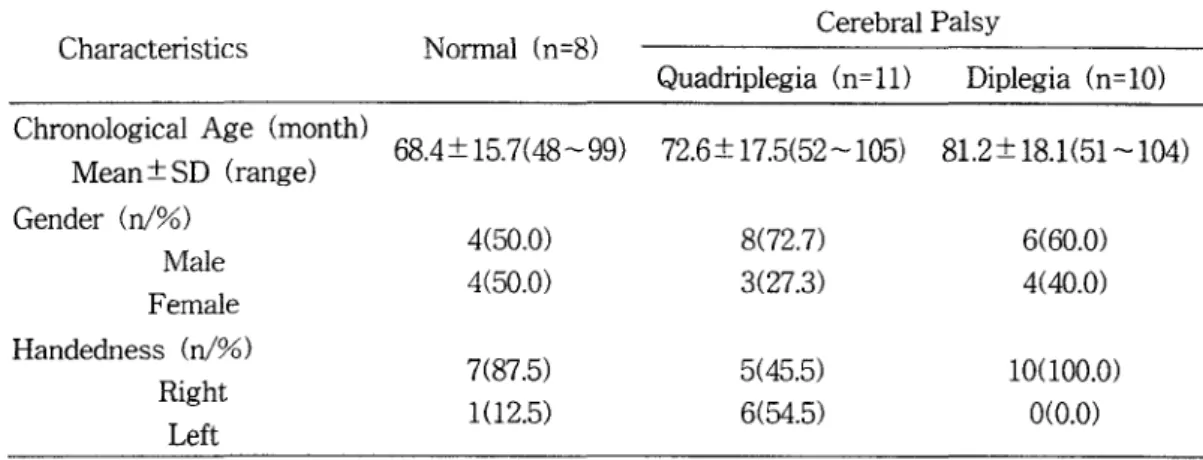
There were slightly more males than girls in the CP group (Table 1). All CP children had a confirmed medical diagnosis of diplegia or quadriplegia and were receiving treatment for cerebral palsy either at one of two reha- bilitation facilities or at a
universiψhospita1 at the time of this study. All the facilities involved were located in central Korea.
- 16 -
한국전문물리치료학회지 저116권 제4호
KAUTPT Vo l. 6 No. 4 1999.
Table 1. Subject characteristics
Cerebral Palsy Characteristics Normal (n=8)
Quadriplegia (n=1 1) Diplegia (n= lO)
Chronological Age (month) 68 .4:t 15.7 (48 - 99) 72.6 :t 17 .5 (52 -105) 8 l. 2 :t 18. 1( 51 -104) Mean :t SD (range)
Gender (n/%)
4(50.0) 8(72.7) 6(60.0)
Male
4(50.0) 3(27.3) 4(40.0)
Female Handedness (n!%)
7(87.5) 5(45.5) 10 (1 00.0)
Right
1( 12.5) 6(54.5) 0 (0 .0)
Left
Instruments
The Motor-Free Visual Perception Test (MVPT) is a test of "visual perception that avoids motor involvement and is suitable for screening , diagnostic assessment and research purposes" (Colarusso and Hammill , 1972). There are 36 multiple-choice designs that evaluate 5 types of visual perception skills: visual discrimination (the ability to discriminate dominant features in different objects) , spatial relationships (the ability to orient one ’ s body in space and to perceive the position of objects in relationto oneself and to other objects) , figure-ground relation- ships (the ability to distinguish an object from its background) , visual closure (the ability to identify an incomplete figure with only fragments are present) , and visual memory (the ability to reca Il dominent features of one stimulus item or to remember the sequence of several items). The MVPT has been standardized on 881 children , ages 4 to 8 in the United States but not yet in Korea. Test-retest reliability ranges from .77 to .91: split-half reliability ranges from .81 to .88.
The Mariannene Frostig Developmental
Test of Visual Perception (DTVP) is designed to identify disturbances of visual perception contributing to disabled or
distur1x최children.
It is useful in diagnostic batteries , as a screening test , and as a guide to suggest areas and methods of treatment for the
야,rceptu려ly
impaired
c비ld.Thi s test consists of five relatively distinct subtests: eye-motor coordination, figure-ground, constancy of shape , position in space and spatial relation ships , each requiring the subject to draw and check items manually in the test bookle t.
The DTVP has been standardized on a large sample of normal nursery and school children , ages 3 to 9 in the United States. This also has yet to standardized in Korea. Test-retest reliability is .98 and split-half reliability ranges from .78 to .89 (Asher , 1988; Breger , 1968; Frostig et al , 1966).
Test Procedure
The MVPT and the DTVP were individ- u a1 1y administered to each subject in the standardized manner described in each test
manu떠 (α,1arusso
and
없mmill,1972; Frostig
et al , 1966). Each subject was seated while
한국전문물리 치료학회 지 제 6권 저14호
KAUTPT Vo l. 6 No. 4 1999.
taking the test , with the test plates lying flat on a table
plaα갱c1i retly in front of the child.
The subject answered the test questions by pointing to one of four altematives in the MVPT booklet and by drawing and checking the answers in the DTVP test bookle t. The raw scores on both tests were converted to perceptual ages (P A) and per- ceptual quotients (PQ). An alysis of the data was done by use of the Wilcoxon signed rank test , the
l'v뻐nn-Whitneyand the Kru skal -Wallis. A p-value of .01 was set for sig- nificance of the results.
Results
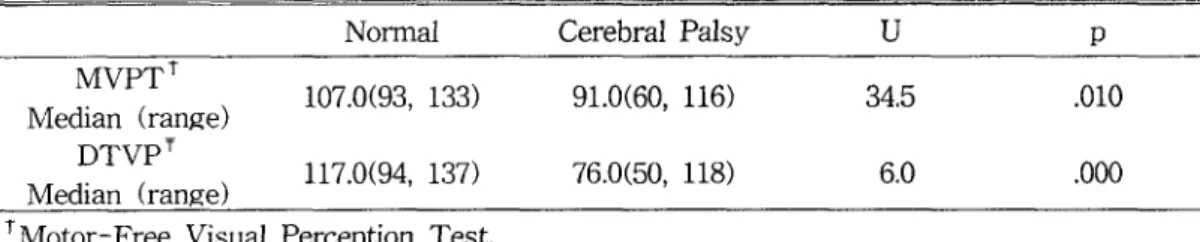
It was hypothesized that the CP group would obtain sigrúficantly lower scores than would the control group. Therefore , the Mann - Whitney test was used to deterrrune if there was sigrúficant a perceptual quotient
difference between the two main groups in each of the two tests. The median , range , U score , and Pr obability for the control and CP group in the MVPT and the DTVP are presented in Table 2. There were sigrúficant differences in perceptual quotients between the control and the CP group in the MVPT and in the DTVP.
In the control group of normal children , the perceptual age (P A) was greater than the chronological age (CA) in
려1but two groups.
Conversely , in the CP group the comparison of perceptual age and chronological age was different according to subgroup and tes t.
These differences were calculatedstaistically with the Kru skal-Wallis. There ere signifi- cant c1i fferences among control , diplegia , and quadriplegia groups in eaches t. But there was no significant difference between the two CP subgroups in each test (Table 3).
Table 2. Difference between perceptual quotient for two groups in both tests
Normal Cerebral Palsy U p
MVPT T
107.0(93 , 133) 9 1. 0(60 , 116) 34.5 .010 Median (range)
DTVP'
117.0(94 , 137) 76.0(50 , 118) 6.0 .000 Median (range)
TMotor-Free Visual Perception Tes t.
TMariannene Frostig Developmental Test of Visual Perception.
Table 3. Chronological age (CA) and perceptual age (PA) differences between the diplegia and the quadriplegia groups across two tests
MVPT T Median (range)
DTVP' Median (range)
Diplegia 9.5( -16 , 24) 18.5( -9 , 43) T Motor-Free Visual Perception Tes t.
Quadriplegia 12.0( -11 , 36) 26.0 (0, 44)
TMarianne Frostig Developmental Test of Visual Perception.
- 18
U
50.0 45.0
p
.72
.48
한국전문물리치료학회지 제 6권 저14호
KAUTPT Vo l. 6 No. 4 1999.
When comparing the norrnal and quadri- plegìa groups there was no significant chrono- logical age minus perceptual age (CA-PA) difference between two groups in the MVPT , but there was in the DTVP (Table 4).
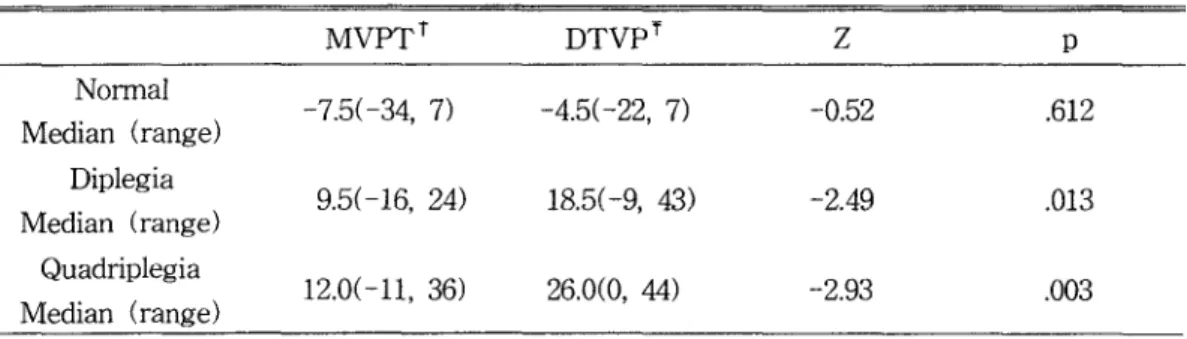
The second hypothesis was that while the normal group would have no difference bet ween two tests , the quadriplegia group would. The Wilcoxon signed rank test was
used to ìdentìfy the MVPT - DTVP difference in each group. The chronological age minus the perceptual age (CA - P A) totals were used for the analysis. The results showed that no significant difference between the two tests in the normal and the diplegic groups , but did show a significant difference between two tests in the
quadripl멍ícgroup (Table 5).
Table 4. Chronological age (CA) and perceptual age (PA) differences between the normal and the quadriplegia groups across two tests
Normal Quadriplegia U p
MVPT T
-7.5(-34 , 7) 12.0( -11 , 36) 16.5 .023 Median (range)
DTVp í
•
4.5( -22 , 7) 26.0 (0, 44) 3.0 .000 Median (range)
TMotor-Free Visual Perception Tes t.
f Marianne Frostig Developmental Test of Visual Perception.
Table 5. The chronological age minus the perceptual age (CA-PA) differences between two tests across three groups
MVPT T DTVp í Z p
Normal
-7.5( -34 , 7) -4.5( -22 , 7) -0.52 .612 Median (range)
Diplegia
9 .5( -16 , 24) 18.5( -9 , 43) -2 .4 9 .013 Median (range)
Quadriplegia
12.0( -11 , 36) 26.0 (0, 44) -2.93 .003 Median (range)
TMotor-Free Visual Perception Tes t.
f Marianne Frostig Developmental Test of Visual Perception.
Discussion and from our own b여ies through the senses
The information is then processed and the
A perception is the manner in which we sensory impressions interpreted and identified
take in infonnation from the environment according to what has
1x꿋n previously learned
한국전문물리치료학회지 제 6권 저'14호
KAUTPT Vo l. 6 No. 4 1999.
and experienced (Frostig and Home , 1964;
Strauss and Leh tinen , 1947). In the developing child , there is a systematic increase in the ability to perceptual analysis and discriminate objects. Al though disturbed visual perception often accompanies cerebral damage , one may not conclude from this that 1) a11 patients with cerebral damage have disordered visual perception , or that 2) the functional inade- quacies exhibited by cerebra11y damaged persons on tasks demanding visual discrimi- nation may automatically be interpreted in terms of a presumed disturbance in visual perceptual functioning (B ortner and Birch , 1962)
Early research indicated that the degree of perceptual impairment in person with CP was related to the type of CP and the se- verity of the motor impainnent (Abercrombie , 1964; Brich , 1964). It is logical to think that the various motor disorders found in the subtypes of CP are caused by different brain lesion , other than
righνIefthemisphere , to perceptual or perceptual-motor functions (Hardy, 1983; Menkes, 1980; 0 ’ Reilly and Walentynowicz , 198 1l. In many studies which purported to assess visual perception used evaluations that required a ski11ed motor responsed (Bo rtner and Birch , 1ffi2; Newcomer and Hammill , 197 1). In the study by Menken and Cermark (1 987) suggested that the Test of Visual-Perceptual Ski11s to be a useful tool in evaluating visual perception in CP as a motor-free tes t.
The results of this study support the first hypothesis that CP w i11 obtain significantly lower scores than normal children in each test. A11 but the CP group fe11 more PQ in the DTVP than in the MVPT , the normal control did no t. The second hypothesis also support that while the normal group would
have no difference between two tests , the quadriplegia group would in this study.
Thi s study indicated that the MVPT may be useful evaluation tool for children with cerebral
맹lsy.However , because of the small number of cerebral palsy subjects used in this study , the results may not be indicative of visual perceptual functioning in a11 cere- bral children.
Conclusion
The MVPT appears to be a valid assess- ment of
띠sualperceptual deficits for children with cerebral palsy and can be used for identifying and screening visual perceptual deficits in quadriplegic type CP children.
The DTVP does no t.
The results were as follows:
1. Children with cerebral palsy showed significantly lower perceptual quotients (P Q) in the MVPT (p<.O l) and the DTVP (p
<.01) when compared with normal children.
2. In normal children no significant the chronological age minus the perceptual age (CA-PA) differences between the MVPT and the DTVP were found.
3. In the diplegic group there was no significant the chronological age minus the perceptual age (CA - PA) differences between the MVPT and the DTVP groups (p> .0 1).
4. In the quadriplegic group there was a significant the chronological age minus the perceptual age (CA - PA) differences between the MVPT and the DTVP groups (p<.0 1).
This study would be strengthened by increasing the number of subjects studied.
Continued research are needed to identify a visual perceptual ability according to the
- 20 -
한국전문물리치료학회지 제 6권 제4호
KAUTPT Vo l. 6 No. 4 1999.
severity of rnotor disability in the children with cerebral palsy. And the other one is to examine visual perceptual developrnent and self-care functioning in the CP group.
References
Abercrombie ML J, Perceptual and Visuornotor Di sorders in Cerebral Palsy. London , William Heinernann , 1964.
Asher IE. An Annotated lndex of Occupa- tional Therapy Evaluation Tools. The American Occupational Therapy Asso- ciation , 1989.
Be nder L. A Visual-Motor Ge stalt Test and its clinical use. Research Monograph , Am erican Orthopsychiatric Association , 1938.
Benton A L. Revised Visual Retention Test:
Manua l. New York , Psychological Cor- poration , 1963.
Birch HG. Brain Darnage in Children: The biological and social aspects. New York , Williams & Wilkins , 1964.
Bortner M , Birch HG. Perceptual and per- ceptual-rnotor dissociation in cerebral palsied children. J Nerv Ment Dis. 1962;
134:103-108.
Breger D. Visual perception: An overview.
Arn J Occup Ther. 1968;22(2):82-85.
Colarusso RP , Hamrnill D D. The Motor-Free Visual Perception Test. San Rafael , C A, Arn erican Th erapy Pu blications , 1972.
Friedrich D , Fuller GB.
Visu머motor perforrn- ance: Additional delineation of the
"perceptual deficit" hypothesis. J Clin Psycho l. 1974;30:30-33.
Frostig M , Horne D. The Frostig Program Development of Visual Perception. Chi- cago , Follet Pub. Co. , 1964
Frostig M , Maslow P , Lefever DW , et a l.
The Mariannene Frostig Developmental Test of Visual Perception (revised).
Consulting Psychologists Press , 1966.
Gr삶lam
F K, Kendall BS. Memory-For Design Test (revised). Perceptual and Motor Skills. 1960; 1l :147-188.
Hardy J c. Cer ebral
P머sy.Englewood Cliffs , N J, Prentice-Hall , 1983.
Menken C , cerrnark S A, Fisher A Evaluating the Visual-Perceptual Skills of children with cerebral pasy. Am J Occup Ther.
1987;41:없6-651.