• 검색 결과가 없습니다.

Recognizable Investigation on Home Visiting Physical Therapy of Physical Therapist in Gwangju and Jeonnam

N/A
N/A
Protected

Academic year: 2021

Share "Recognizable Investigation on Home Visiting Physical Therapy of Physical Therapist in Gwangju and Jeonnam"

Copied!
16
0
0

로드 중.... (전체 텍스트 보기)

전체 글

(1)

| Abstract |

1)

PURPOSE: This study seeks to examine the awareness and need of home visiting physical therapy among physical therapist in Gwangju and Jeonnam province.

METHODS: Survey was conducted during the continuing education on physical therapist held in Gwangju in 2015 with 297 participants. The survey questionnaire consisted of 12 questions on the characteristics of physical therapists, 8 questions regarding the awareness of home visiting physical therapy, and 7 questions on need.

RESULTS: Significant differences were found regarding service period, according to categories of the inconvenience associated with commuting to/from hospitals, long-term treatment for patients, high quality treatment with intensive care, treatment at a time of patients’ choosing. The category

†Corresponding Author : [email protected]

This is an Open Access article distributed under the terms of the Creative Commons Attribution Non-Commercial License (http://creativecommons.org/licenses/by-nc/3.0) which permits unrestricted non-commercial use, distribution, and reproduction in any medium, provided the original work is properly cited.

of hospital fees reduced due to early discharge from the hospital also saw significant differences, depending on respondents’ marital status, dependent family, and service period. Providing treatment without causing discomfort to patients in front of others also saw significant differences according to physical therapist career period. Home visiting physical therapy is easier for family members to take care of patients also saw significant differences according to education and physical therapist career period.

CONCLUSION: Survey indicates that physical therapist province feel the need for home visiting physical therapy in many respects. However, since as many as half of the surveyed physical therapists have only heard of home visiting physical therapy or are have no awareness of the this form of treatment, it appears that there is a need to raise awareness of home visiting physical therapy among physical therapist and introduce appropriate policies.

Key Words: Awareness, Home visiting physical therapy, Physical therapist

Research Article Open Access

Recognizable Investigation on Home Visiting Physical Therapy of Physical Therapist in Gwangju and Jeonnam

Seong-Hun Yu⋅Seung-Rae Kim 1 ⋅Sung-Hyoun Cho 2 ⋅Tae-Hwa Seo 3 ⋅Young-Sung Moon 1 ⋅ Myeong-Hui Kim 4 ⋅Hyun-Jin Kim 5†

Gwangju Trauma Center

1 Gwangju Donggu Public Health Center

2 Department of Physical Therapy, Nambu University

3 Sangmu Healing Rehabilitation Convalescent Hospital

4 Chosun University Dental Hospital

5 Department of Physical Therapy, Hanlyo University Received: May 5, 2016 / Revised: May 20, 2016 / Accepted: June 15, 2016

ⓒ 2016 J Korean Soc Phys Med

(2)

Ⅰ. Introduction

Rapid economic growth, developments in cutting-edge technology, and improvements in medical science have affected health and the lifespan of human beings. As a result, qualitative improvements in life have taken place while inducing an aging society as a new social problem.

As the ratio of aged people increases in the entire population of Korea, there is an increase in elderly patients with chronic diseases which requires more demand for rehabilitation treatment for recovery and maintenance of their body functions (Yoon, 2009). Such cases are frequently lead to long-term hospital treatment, causing several problems in terms of physical, economic, and psychological aspects both for the patients and their family members (An, 2009;

Bae, 2003). In this context, the necessity of home visiting physical therapy has been consistently presented in order to resolve socially-increasing problems of the vulnerable in medical care and as an alternative from of long-term management of diseases and health promotion (Ahn and Yu, 2012; Hwang et al., 2003).

When the system of home visiting physical therapy is settled, bed turnover rate and effective utilization of professional manpower and facilities can be improved by preventing hospital centralization due to long-term hospitalization, providing effective physical therapy services, preventing social problems by effective patient management in home, inhibiting unnecessary hospitalization, and inducing early discharge of long-term patients who do not require hospitalization. Minimizing unnecessary use of hospitals can have several advantages such as reduction in time and medical cost, fast recovery of patients, and satisfaction of desires on treatment of the disabled at home have been sufficiently presented in other researches (Bae, 2003; Hwang et al., 2003). Home visiting physical therapy is also effective on improving quality of life by enhancing motor skills, enhancing the ability of performing activities in daily life, providing increases in movement and balance

ability, and maintaining the active joint working range to contribute to maintaining and enhancing body functions of the old people (Gill et al., 2002; Mangione et al., 2008).

Thus, it may be essential to provide systematic home visiting therapy programs for improving motor skills such as endurance and balance ability (Duncan et al., 2003).

Because home visiting physical therapy has sufficient usefulness in increasing the quality of life of patients and in terms of practicality such as reducing in medical coast, it has the potential to become a useful and effective system for satisfaction and necessity of patients (Kim, 2013; Kwon et al., 2014). However, implementation of the system has difficulties due to institutional incompletion. Local home visiting physical therapy which is now being implemented has increased its roles, and it is required to perform several roles or functions as well as its own tasks. In addition, duplication or ambiguous separation of jobs that can be shown when nurses, nutritionist, care helpers, and social works perform jobs as a team with physical therapists, which sometimes leads to ineffective job performance (Ahn and Yu, 2012). Such ineffectiveness interrupts professional implementation of home visiting physical therapy and causes difficulty in active performance because of the uncertain matter of responsibility. It reduces the quality of treatment as appropriate services cannot be provided for the recipients, negatively affecting overall effectiveness of local integrated health promotion programs. Further research may be needed to consistently study home visiting physical therapy because the roles and demands of physical therapists are expected to increase in future rehabilitation projects in local communities.

The purpose of this study, in this context, was to

investigate the perception and need of home visiting

physical therapy among physical therapists in Gwangju and

Jeollanam-do.

(3)

Ⅱ. Methods

1. Subjects and methods

The subjects of this study were physical therapists, who participated in supplementary education of physical therapy in Gwangju in 12, April, 2015. We explained the purpose of this study to them, and a total of 297 people agreed to participate in the survey of this study. Survey was collected after the supplementary education.

2. Experimental methods

We used a questionnaire including twelve items of general characteristics of physical therapist, eight items of their level of awareness of home visiting physical therapy, and seven items regarding the need for home visiting physical therapy. This survey was made on the basis of the literature; physical therapy processor and doctor’s degree decided appropriate question number and details (Ahn and Yu, 2012; Han et al., Kim and Lee, 2014; Lee et al., 2014). The subjects were asked to fill in the questionnaires without writing their names. The validity and reliability of the survey results showed that high.

3. Data analysis

The SPSS 18.0 program was used to analyze the results of the survey. A frequency analysis was used to analyze the general characteristics of the subjects, level of awareness, and the need of home visiting physical therapy.

An independent t-test was used to identify the need for home visiting physical therapy based on sex, marital status, dependent family, position, and site of the general characteristics of the subjects. ANOVA for each group was performed to verify satisfaction of supplementary education based on age, education, monthly pay, physical therapist career period, working week, service period, and 1 day number of patient care. For the level of statistical significance was set at α=.05.

Ⅲ. Results

1. General characteristics of physical therapist Out of the subjects who participated in the survey, 67.30% were female and the age group of 30∼39 years old occupied the most shares, or 42.40%. Those who graduated from college occupied 56.90% as the largest group, those who were unmarried were 61.60%, and those who had no dependents were 57.60%. The highest percentage of each item was as follows: 43.80% earned monthly paid 1,510,000∼2,000,000 won per month;

38.00% had a physical therapist career period of less than five years; 72.10% were physical therapists; 70.00%

worked 41∼49 hours per week; 76.10% lived in Gwangju;

73.40% had a service period of less than five years; and 24.90% cared for 31∼40 patients per day (Table 1).

characteristics N %

Sex Male 97.00 32.70

Female 200.00 67.30

Age 20∼29 years old 116.00 39.10

30∼39 years old 126.00 42.40 40 years old< 55.00 18.50 Education College graduate 177.00 59.60 University graduate 97.00 32.70 A postgraduate school 23.00 7.70 Marital status Unmarried 183.00 61.60

Married 114.00 38.40

Dependent family

No 171.00 57.60

Yes 126.00 42.40

Monthly pay <1,500,000 48.00 16.20 1,510,000∼2,000,000 130.00 43.80 2,010,000∼2,500,000 57.00 19.20 2,510,000∼3,000,000 42.00 14.10 3,010,000< 20.00 6.70 Physical

therapist career period

<5 years old 113.00 38.00

6∼9 years old 106.00 35.70

10 years old< 78.00 26.30

Table 1. General characteristics of physical therapist

(4)

2. Level of awareness of home visiting physical therapy

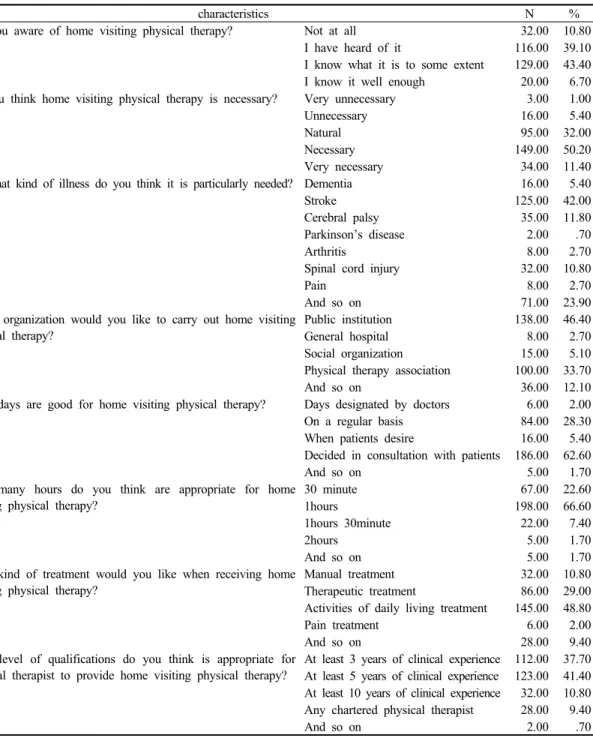
For the question “Are you aware of home visiting physical therapy?", 43.40% of the participants answered

“I know what it is to some extent”. For the question “Do you think home visiting physical therapy is necessary?”, 50.20% said “Necessary”. 42.00% of the participants chose

“Stroke” for the question "For what kind of illness do you think it is particularly needed?”. 46.40% of them chose

“Public institution” for the question “Which organization would you like to carry out home visiting physical therapy?". For the question “What days are good for home visiting physical therapy?”, 62.60% (the highest) answered they “decided in consultation with patients”. When asked

“How many hours do you think are appropriate for home visiting physical therapy?”, 66.60% (the highest) answered

“One hour”. For the question “What kind of treatment would you like when receiving home visiting physical therapy?”, 48.80% (the highest) chose “Activities of daily living treatment”. For the question “What level of qualifications do you think is appropriate for physical

therapist to provide home visiting physical therapy?”, 41.40% (the highest) of them said “At least 5 years of clinical experience” (Table 2).

3. Need for home visiting physical therapy When asked “Do you think home visiting physical therapy helps reduce the inconvenience associated with commuting to/from hospital?”, “Do you think home visiting physical therapy is appropriate for patients who need long-term treatment?”, “Do you think early discharge from hospital can help reduce hospital fees?”, “Do you think that with home visiting physical therapy, intensive care is possible and effective treatment can be provided?”, “Do you think with that home visiting physical therapy can provide treatment without causing discomfort to patients in front of others?”, “Do you think that with home visiting physical therapy, it is easier for family members to take care of patients?”, and “Do you think that home visiting physical therapy can be provided at a time patients choose by way of advance appointment?”, 62.30%, 61.30%, 47.80%, 54.20%, 60.60%, 54.20%, and 54.90% (the highest) of the participants chose the answer “Satisfied”

(Table 3).

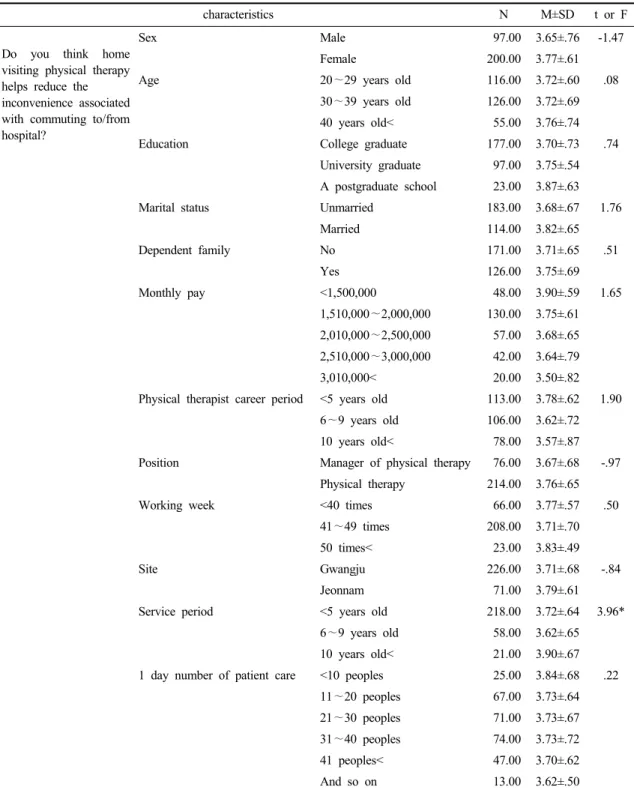
4. Need for home visiting physical therapy in terms of physical therapist characteristics For the question “Do you think early discharge from hospital can help reduce hospital fees?”, there were significant differences according to marital status, dependent family, and service period. For the question “Do you think that with home visiting physical therapy, it is easier for family members to take care of patients?”, significant differences were found according to education and physical therapist career period. For the question “Do you think with that home visiting physical therapy can provide treatment without causing discomfort to patients in front of others?”, there was significant change in physical therapist career period. As for service period, in particular, Position Manager of physical

therapy

76.00 25.60

Physical therapy 214.00 72.10

And so on 7.00 2.40

Working week <40 times 66.00 22.20 41∼49 times 208.00 70.00 50 times< 23.00 7.70

Site Gwangju 226.00 76.10

Jeonnam 71.00 23.90

Service period <5 years old 218.00 73.40 6∼9 years old 58.00 19.50 10 years old< 21.00 7.10 1 day number

of patient care

<10 peoples 25.00 8.40 11∼20 peoples 67.00 22.60 21∼30 peoples 71.00 23.90 31∼40 peoples 74.00 24.90 41 peoples< 47.00 15.80

And so on 13.00 4.40

(5)

significant changes were shown for the questions “Do you think home visiting physical therapy helps reduce the inconvenience associated with commuting to/from hospital?”, “Do you think home visiting physical therapy

is appropriate for patients who need long-term treatment?”,

“Do you think that with home visiting physical therapy, intensive care is possible and effective treatment can be provided?”, and “Do you think that home visiting physical

characteristics N %

Are you aware of home visiting physical therapy? Not at all 32.00 10.80

I have heard of it 116.00 39.10

I know what it is to some extent 129.00 43.40

I know it well enough 20.00 6.70

Do you think home visiting physical therapy is necessary? Very unnecessary 3.00 1.00

Unnecessary 16.00 5.40

Natural 95.00 32.00

Necessary 149.00 50.20

Very necessary 34.00 11.40

For what kind of illness do you think it is particularly needed? Dementia 16.00 5.40

Stroke 125.00 42.00

Cerebral palsy 35.00 11.80

Parkinson’s disease 2.00 .70

Arthritis 8.00 2.70

Spinal cord injury 32.00 10.80

Pain 8.00 2.70

And so on 71.00 23.90

Which organization would you like to carry out home visiting physical therapy?

Public institution 138.00 46.40

General hospital 8.00 2.70

Social organization 15.00 5.10

Physical therapy association 100.00 33.70

And so on 36.00 12.10

What days are good for home visiting physical therapy? Days designated by doctors 6.00 2.00

On a regular basis 84.00 28.30

When patients desire 16.00 5.40

Decided in consultation with patients 186.00 62.60

And so on 5.00 1.70

How many hours do you think are appropriate for home visiting physical therapy?

30 minute 67.00 22.60

1hours 198.00 66.60

1hours 30minute 22.00 7.40

2hours 5.00 1.70

And so on 5.00 1.70

What kind of treatment would you like when receiving home visiting physical therapy?

Manual treatment 32.00 10.80

Therapeutic treatment 86.00 29.00

Activities of daily living treatment 145.00 48.80

Pain treatment 6.00 2.00

And so on 28.00 9.40

What level of qualifications do you think is appropriate for physical therapist to provide home visiting physical therapy?

At least 3 years of clinical experience 112.00 37.70 At least 5 years of clinical experience 123.00 41.40 At least 10 years of clinical experience 32.00 10.80 Any chartered physical therapist 28.00 9.40

And so on 2.00 .70

Table 2. Level of awareness of home visiting physical therapy

(6)

therapy can be provided at a time patients choose by way of advance appointment?” (p<.05), (Table 4).

characteristics N %

Do you think home visiting physical therapy helps reduce the inconvenience associated with commuting to/from hospital?

Very dissatisfied 2.00 .70

Dissatisfied 8.00 2.70

Neutral 80.00 26.90

Satisfied 185.00 62.30

Very satisfied 22.00 7.40 Do you think home visiting physical therapy is appropriate for patients who

need long-term treatment?

Very dissatisfied 1.00 .30 Dissatisfied 15.00 5.10

Neutral 74.00 24.90

Satisfied 182.00 61.30

Very satisfied 25.00 8.40 Do you think early discharge from hospital can help reduce hospital fees? Very dissatisfied 4.00 1.30 Dissatisfied 30.00 10.10

Neutral 101.00 34.00

Satisfied 142.00 47.80

Very satisfied 20.00 6.70 Do you think that with home visiting physical therapy, intensive care is

possible and effective treatment can be provided?

Very dissatisfied 1.00 .30 Dissatisfied 18.00 6.10

Neutral 84.00 28.30

Satisfied 161.00 54.20

Very satisfied 33.00 11.10 Do you think with that home visiting physical therapy can provide treatment

without causing discomfort to patients in front of others?

Very dissatisfied .00 .00 Dissatisfied 12.00 4.00

Neutral 60.00 20.20

Satisfied 180.00 60.60

Very satisfied 45.00 15.20 Do you think that with home visiting physical therapy, it is easier for family

members to take care of patients?

Very dissatisfied .00 .00 Dissatisfied 20.00 6.70

Neutral 80.00 26.90

Satisfied 161.00 54.20

Very satisfied 36.00 12.20 Do you think that home visiting physical therapy can be provided at a time

patients choose by way of advance appointment?

Very dissatisfied .00 .00 Dissatisfied 11.00 3.70

Neutral 89.00 30.00

Satisfied 163.00 54.90

Very satisfied 34.00 11.40

Table 3. Need for home visiting physical therapy

(7)

characteristics N M±SD t or F

Do you think home visiting physical therapy helps reduce the inconvenience associated with commuting to/from hospital?

Sex Male 97.00 3.65±.76 -1.47

Female 200.00 3.77±.61

Age 20∼29 years old 116.00 3.72±.60 .08

30∼39 years old 126.00 3.72±.69 40 years old< 55.00 3.76±.74

Education College graduate 177.00 3.70±.73 .74

University graduate 97.00 3.75±.54 A postgraduate school 23.00 3.87±.63

Marital status Unmarried 183.00 3.68±.67 1.76

Married 114.00 3.82±.65

Dependent family No 171.00 3.71±.65 .51

Yes 126.00 3.75±.69

Monthly pay <1,500,000 48.00 3.90±.59 1.65

1,510,000∼2,000,000 130.00 3.75±.61 2,010,000∼2,500,000 57.00 3.68±.65 2,510,000∼3,000,000 42.00 3.64±.79

3,010,000< 20.00 3.50±.82

Physical therapist career period <5 years old 113.00 3.78±.62 1.90

6∼9 years old 106.00 3.62±.72

10 years old< 78.00 3.57±.87

Position Manager of physical therapy 76.00 3.67±.68 -.97

Physical therapy 214.00 3.76±.65

Working week <40 times 66.00 3.77±.57 .50

41∼49 times 208.00 3.71±.70

50 times< 23.00 3.83±.49

Site Gwangju 226.00 3.71±.68 -.84

Jeonnam 71.00 3.79±.61

Service period <5 years old 218.00 3.72±.64 3.96*

6∼9 years old 58.00 3.62±.65

10 years old< 21.00 3.90±.67 1 day number of patient care <10 peoples 25.00 3.84±.68 .22

11∼20 peoples 67.00 3.73±.64

21∼30 peoples 71.00 3.73±.67

31∼40 peoples 74.00 3.73±.72

41 peoples< 47.00 3.70±.62

And so on 13.00 3.62±.50

Table 4. Need for home visiting physical therapy in terms of physical therapist characteristics.

(8)

Do you think home visiting physical therapy is appropriate for patients who need long-term treatment?

Sex Male 97.00 3.67±.76 -.92

Female 200.00 3.75±.67

Age 20∼29 years old 116.00 3.68±.71 .93

30∼39 years old 126.00 3.71±.70 40 years old< 55.00 3.84±.69

Education College graduate 177.00 3.70±.70 .60

University graduate 97.00 3.73±.71 A postgraduate school 23.00 3.87±.69

Marital status Unmarried 183.00 3.67±.70 -1.79

Married 114.00 3.82±.70

Dependent family No 171.00 3.66±.70 -1.81

Yes 126.00 3.81±.70

Monthly pay <1,500,000 48.00 3.75±.75 .04

1,510,000∼2,000,000 130.00 3.72±.72 2,010,000∼2,500,000 57.00 3.72±.55 2,510,000∼3,000,000 42.00 3.69±.71

3,010,000< 20.00 3.75±.78

Physical therapist career period <5 years old 113.00 3.76±.68 1.24

6∼9 years old 106.00 3.60±.75

10 years old< 78.00 3.67±.69

Position Manager of physical therapy 76.00 3.67±.68 -.78

Physical therapy 214.00 3.74±.69

Working week <40 times 66.00 3.79±.62 .86

41∼49 times 208.00 3.72±.71

50 times< 23.00 3.57±.78

Site Gwangju 226.00 3.73±.70 .27

Jeonnam 71.00 3.70±.70

Service period <5 years old 218.00 3.71±.70 5.87*

6∼9 years old 58.00 3.58±.72

10 years old< 21.00 3.94±.61 1 day number of patient care <10 peoples 25.00 3.80±.81 .24

11∼20 peoples 67.00 3.72±.75

21∼30 peoples 71.00 3.76±.62

31∼40 peoples 74.00 3.73±.68

41 peoples< 47.00 3.64±.70

And so on 13.00 3.69±.75

(9)

Do you think early discharge from hospital can help reduce hospital fees?

Sex Male 97.00 3.54±.87 .75

Female 200.00 3.46±.79

Age 20∼29 years old 116.00 3.43±.82 .79

30∼39 years old 126.00 3.48±.82 40 years old< 55.00 3.60±.83

Education College graduate 177.00 3.46±.78 2.79

University graduate 97.00 3.44±.88 A postgraduate school 23.00 3.87±.76

Marital status Unmarried 183.00 3.40±.81 2.31*

Married 114.00 3.62±.81

Dependent family No 171.00 3.83±.81 -2.59*

Yes 126.00 3.63±.81

Monthly pay <1,500,000 48.00 3.52±.96 .44

1,510,000∼2,000,000 130.00 3.47±.74 2,010,000∼2,500,000 57.00 3.56±.78 2,510,000∼3,000,000 42.00 3.36±.87

3,010,000< 20.00 3.55±.88

Physical therapist career period <5 years old 113.00 3.54±.81 1.72

6∼9 years old 106.00 3.36±.79

10 years old< 78.00 3.29±.96

Position Manager of physical therapy 76.00 3.46±.77 -.41

Physical therapy 214.00 3.50±.83

Working week <40 times 66.00 3.52±.70 .37

41∼49 times 208.00 3.49±.84

50 times< 23.00 3.35±.88

Site Gwangju 226.00 3.48±.83 -.26

Jeonnam 71.00 3.51±.77

Service period <5 years old 218.00 3.43±.82 3.55*

6∼9 years old 58.00 3.39±.80

10 years old< 21.00 3.69±.81 1 day number of patient care <10 peoples 25.00 3.48±.96 .43

11∼20 peoples 67.00 3.60±.78

21∼30 peoples 71.00 3.49±.75

31∼40 peoples 74.00 3.41±.85

41 peoples< 47.00 3.47±.88

And so on 13.00 3.38±.65

(10)

Sex Male 97.00 3.73±.85 .55 Do you think that with

home visiting physical therapy, intensive care is possible and effective treatment can be provided?

Female 200.00 3.68±.71

Age 20∼29 years old 116.00 3.78±.71 2.67

30∼39 years old 126.00 3.58±.80 40 years old< 55.00 3.80±.73

Education College graduate 177.00 3.72±.72 1.36

University graduate 97.00 3.61±.82 A postgraduate school 23.00 3.87±.76

Marital status Unmarried 183.00 3.69±.73 -.08

Married 114.00 3.70±.81

Dependent family No 171.00 3.64±.75 -1.42

Yes 126.00 3.77±.77

Monthly pay <1,500,000 48.00 3.88±.76 1.24

1,510,000∼2,000,000 130.00 3.68±.70 2,010,000∼2,500,000 57.00 3.61±.72 2,510,000∼3,000,000 42.00 3.60±.91

3,010,000< 20.00 3.85±.81

Physical therapist career period <5 years old 113.00 3.75±.73 2.87

6∼9 years old 106.00 3.60±.84

10 years old< 78.00 3.38±.80

Position Manager of physical therapy 76.00 3.68±.73 -.31

Physical therapy 214.00 3.71±.76

Working week <40 times 66.00 3.68±.66 1.59

41∼49 times 208.00 3.73±.77

50 times< 23.00 3.43±.84

Site Gwangju 226.00 3.69±.76 -.27

Jeonnam 71.00 3.72±.76

Service period <5 years old 218.00 3.75±.72 5.77*

6∼9 years old 58.00 3.51±.78

10 years old< 21.00 3.87±.72 1 day number of patient care <10 peoples 25.00 3.68±.90 .63

11∼20 peoples 67.00 3.64±.77

21∼30 peoples 71.00 3.73±.69

31∼40 peoples 74.00 3.74±.82

41 peoples< 47.00 3.74±.67

And so on 13.00 3.38±.65

(11)

Do you think with that home visiting physical therapy can provide treatment without causing discomfort to patients in front of others?

Sex Male 97.00 3.88±.75 .13

Female 200.00 3.87±.68

Age 20∼29 years old 116.00 3.92±.67 1.24

30∼39 years old 126.00 3.79±.73 40 years old< 55.00 3.93±.72

Education College graduate 177.00 3.86±.66 .43

University graduate 97.00 3.86±.76 A postgraduate school 23.00 4.00±.80

Marital status Unmarried 183.00 3.85±.71 -.50

Married 114.00 3.89±.70

Dependent family No 171.00 3.83±.71 -1.08

Yes 126.00 3.92±.70

Monthly pay <1,500,000 48.00 3.98±.75 .56

1,510,000∼2,000,000 130.00 3.88±.67 2,010,000∼2,500,000 57.00 3.77±.70 2,510,000∼3,000,000 42.00 3.86±.71

3,010,000< 20.00 3.85±.81

Physical therapist career period <5 years old 113.00 3.92±.69 5.83*

6∼9 years old 106.00 3.84±.67

10 years old< 78.00 3.38±.80

Position Manager of physical therapy 76.00 3.82±.63 -.97

Physical therapy 214.00 3.91±.72

Working week <40 times 66.00 3.71±.71 2.09

41∼49 times 208.00 3.91±.69

50 times< 23.00 3.91±.73

Site Gwangju 226.00 3.87±.73 -.06

Jeonnam 71.00 3.87±.63

Service period <5 years old 218.00 3.92±.68 2.61

6∼9 years old 58.00 3.75±.71

10 years old< 21.00 3.96±.71 1 day number of patient care <10 peoples 25.00 3.88±.66 .18

11∼20 peoples 67.00 3.88±.78

21∼30 peoples 71.00 3.86±.68

31∼40 peoples 74.00 3.88±.70

41 peoples< 47.00 3.89±.66

And so on 13.00 3.69±.75

(12)

Do you think that with home visiting physical therapy, it is easier for family members to take care of patients?

Sex Male 97.00 3.70±.79 -.25

Female 200.00 3.73±.75

Age 20∼29 years old 116.00 3.75±.71 .34

30∼39 years old 126.00 3.67±.75 40 years old< 55.00 3.75±.91

Education College graduate 177.00 3.65±.78 4.21*

University graduate 97.00 3.74±.75 A postgraduate school 23.00 4.13±.55

Marital status Unmarried 183.00 3.70±.74 -.51

Married 114.00 3.75±.81

Dependent family No 171.00 3.67±.74 -1.33

Yes 126.00 3.79±.79

Monthly pay <1,500,000 48.00 3.85±.82 1.46

1,510,000∼2,000,000 130.00 3.75±.70 2,010,000∼2,500,000 57.00 3.53±.78 2,510,000∼3,000,000 42.00 3.67±.78

3,010,000< 20.00 3.80±.83

Physical therapist career period <5 years old 113.00 3.77±.75 3.44*

6∼9 years old 106.00 3.66±.76

10 years old< 78.00 3.33±.86

Position Manager of physical therapy 76.00 3.63±.76 -1.34

Physical therapy 214.00 3.77±.75

Working week <40 times 66.00 3.71±.71 .51

41∼49 times 208.00 3.74±.78

50 times< 23.00 3.57±.66

Site Gwangju 226.00 3.68±.78 -1.44

Jeonnam 71.00 3.83±.70

Service period <5 years old 218.00 3.77±.72 2.21

6∼9 years old 58.00 3.59±.71

10 years old< 21.00 3.81±.86 1 day number of patient care <10 peoples 25.00 3.68±.74 .22

11∼20 peoples 67.00 3.72±.77

21∼30 peoples 71.00 3.70±.80

31∼40 peoples 74.00 3.77±.82

41 peoples< 47.00 3.72±.64

And so on 13.00 3.54±.66

(13)

Do you think that home visiting physical therapy can be provided at a time patients choose by way of advance appointment?

Sex Male 97.00 3.78±.72 .73

Female 200.00 3.72±.70

Age 20∼29 years old 116.00 3.80±.65 2.17

30∼39 years old 126.00 3.64±.72 40 years old< 55.00 3.84±.76

Education College graduate 177.00 3.71±.69 2.33

University graduate 97.00 3.72±.73 A postgraduate school 23.00 4.04±.64

Marital status Unmarried 183.00 3.72±.70 .77

Married 114.00 3.78±.71

Dependent family No 171.00 3.68±.72 -1.61

Yes 126.00 3.82±.69

Monthly pay <1,500,000 48.00 3.83±.75 .62

1,510,000∼2,000,000 130.00 3.75±.70 2,010,000∼2,500,000 57.00 3.65±.61 2,510,000∼3,000,000 42.00 3.69±.74

3,010,000< 20.00 3.85±.74

Physical therapist career period <5 years old 113.00 3.76±.71 .66

6∼9 years old 106.00 3.74±.69

10 years old< 78.00 3.57±.68

Position Manager of physical therapy 76.00 3.70±.69 -.90

Physical therapy 214.00 3.78±.69

Working week <40 times 66.00 3.79±.64 .26

41∼49 times 208.00 3.72±.73

50 times< 23.00 3.78±.60

Site Gwangju 226.00 3.73±.71 -.65

Jeonnam 71.00 3.79±.67

Service period <5 years old 218.00 3.79±.66 6.72*

6∼9 years old 58.00 3.56±.73

10 years old< 21.00 3.92±.67 1 day number of patient care <10 peoples 25.00 3.68±.74 .73

11∼20 peoples 67.00 3.87±.67

21∼30 peoples 71.00 3.73±.71

31∼40 peoples 74.00 3.74±.74

41 peoples< 47.00 3.64±.64

And so on 13.00 3.62±.76

*p<.05

M±SD : mean±standard deviation

(14)

Ⅳ. Discussion

Home visiting physical therapy can enhance functions needed for daily home life and be effective on improving satisfaction of life and psychological stability (An, 2009;

Jung et al., 2002). The therapy may have positive influence on motor skills and daily life behaviors of patients with stroke, and can solve problems of inconvenience associated with commuting to/from hospital to facilitate consistent treatment after discharge (Hwang et al., 2003; Yang, 1997).

Thus, active participation from both physical therapists and patients is expected when home visiting physical therapy is implemented (Kim, 2011).

In this study, many of the physical therapists in Gwangju and Jeollanam-do knew the significance of home visiting physical therapy to some extent and thought it was necessary. When asked of what diseases required this type of therapy, they chose stroke followed by cerebral palsy and spinal cord injury, a selection that may be caused by the fact that physical therapists mainly see patients with such disorders. In addition, the therapists said that they mostly wanted to conduct physical therapy to activities of daily living treatment when they performed home visiting physical therapy, indicating that they focused on activities of daily living treatment in order to reduce inconvenience in home life after basic exercise and manual therapies were provided in hospitals. Many of the therapists argued that public institutions should be in charge of home visiting physical therapy, indicating that they wanted the government to approach and manage the therapy systematically and professionally. Meanwhile, the therapist thought that the time of visit should be decided after consultation with patients and one hour would be appropriate. As for the level of qualification for the physical therapist providing home visiting physical therapy, most of the therapist chose at least five years of clinical experience with appropriate education. The therapists mostly thought home visiting physical therapy was needed.

Almost half of them said that they knew of home visiting physical therapy to some extent, while the other half had just heard of it or did not know of it at all. The result may be because home visiting physical therapy has not been sufficiently promoted yet and the policies supporting the system are not complete. Systematic management and consistent implementation such as the development of various programs that are effective at improving functions of patients within their homes, increasing satisfaction with life, maintaining psychological stability, training of professional manpower, and development of evaluation methods and self exercise programs may be needed to implement home visiting physical therapy (Nho, 2007).

In addition, it may be necessary to connect the system with local medical institutions and manpower expansion through specialization and classification of manpower on visiting medical services (Lee et al., 1996).

Home visiting physical therapy may greatly contribute to improving quality of life and providing sufficiently higher usefulness as it gains higher satisfaction from all ages, but the beneficiaries of the therapy was small enough that only 7.5% of patients received home visiting physical therapy for a year (Ahn and Yu, 2012). The therapy is necessary both for physical therapist and for patient and is twice as economical as visiting medical institution in terms of cost and convenience, requiring the foundation on which the therapy could be expanded and activated as soon as possible (Kim, 2013).

Home visiting physical therapy is a necessary system to solve problems of inconvenience of physical therapist, patients, and caregivers. It urgently needs to be introduced and can provide patients with chronic disease with high-quality physical therapy service (Lee et al., 2013).

For its implementation without delay, efforts by of physical

therapist, physical therapy association, and the government

are required. Home visiting physical therapy have

therapeutic effects on movement, self management, home

life, and interpersonal relationships by improving activity

(15)

and social participation. Home visiting physical therapy shows usefulness in satisfaction and need, having great potential in medical services in the future. In particular, guidance of daily life as the most important therapeutic approach may enhance capability of daily life, expand opportunities to perform various social participations, and have positive influence on satisfaction and quality of life.

In foreign countries where the system is already implemented well, 450 individuals considered to be elderly, at least 80 years old, showed a decline in falling and improvement in balance ability after home visiting physical therapy (Robertson et al., 2001; Rosie and Taylor, 2007).

Meanwhile, 759 patients who were at least 45 years old showed highly positive reactions in cost reduction and efficiency of treatment when they received home visiting physical therapy (Gitlin et al., 1995; Thomas et al., 2005).

In order to promote functions, thus, not only the existing traditional medical approach but also holistic approach according with realistic and practical demands should be significantly considered. It may be needed to develop services customized for individual patients, and it is urgent to activate home visiting physical therapy as soon as possible.

Ⅴ. Conclusion

The purpose of this study was to investigate thoughts of physical therapists in Gwangju and Jeollanam-do on home visiting physical therapy. The results showed that they felt the therapy was necessary in various domains but almost half of them just heard of it or did not know it, indicating that promotion and policies on home visiting physical therapy is required as soon as possible.

References

Ahn CS, Yu WJ. A study of management and satisfaction for home visiting physical therapy. J Korean Soc Phys Med. 2012;7(3):241-50.

An DH. Effects on improvement of activities of daily living through short-term home visiting physical therapy.

Phys Ther Kor. 2007;14(2):53-60.

Bae SS. A strategy of the home visiting physical therapy.

J Kor Phys Ther. 2003;15(4):180-9.

Duncan P, Studenski S, Richards L, et al. Randomized clinical trial of therapeutic exercise in subacute stroke. Stroke.

2003;34(9):2173-80.

Gill TM, Baker DI, Gottschalk M, et al. A program to prevent functional decline in physically frail, elderly persons who live at home. N Engl J Med. 2002;347(14):

1068-74.

Gitlin LN, Corcoran M, Leinmiller-Eckhardt S. Understanding the family perspective: An ethnographic framework for providing occupational therapy in the home. Am J Occup Ther. 1995;49(8):802-9.

Han DW, Moon TH, Lee EM, et al. Development of the system for home visiting physical therapy. J Kor Phys Ther.

2005;17(1):1-26.

Hwang BY, Lee EJ, Han SD. Effects of home visiting physical therapy on motor function and ADL in the persons with chronic stroke. J Kor Phys Ther. 2003;15(4):

319-30.

Jung HS, Park HS, Park TS, et al. A survey of patient satisfaction with physical therapy service. Phys Ther Kor.

2002;9(1):97-110.

Kim GY. A study on the introduction of home-based physical therapy rehabilitation services. Doctor’s Degree. Eulji University. 2013.

Kim JH, Lee KJ. Study on the awareness and the necessity of home and visiting physical therapy. J Korean Soc Phys Med. 2014;9(4):465-74.

Kim MS. The study of efficient way of home-based physical

(16)

therapy. Master’s Degree. Sahmyook University.

2011.

Kwon CS, Kim SY, Jang HJ. The effects of home visiting physical therapy on the motor function, activity of daily living, and pain for disabled veterans. J Korean Soc Phys Med. 2014;9(2):171-9.

Lee DJ, Lee YS, Jung SM, et al. The necessity and awareness of home visiting physical therapy in Gwang ju, Junnam area. J Korean Soc Integr Med. 2014;2(1):77-89.

Lee HS, Park DM, Kim CS. Home-visiting physical therapy.

J Kor Phys Ther. 1996;8(1):91-8.

Lee MS, Kim MC, Kim GY. A study for home-based physical therapy service introduction through a group of professionals in-depth interview. J Korean Soc Phys Med. 2013;8(3):303-15.

Mangione KK, Lopopolo RB, Neff NP, et al. Interventions used by physical therapists in home care for people after hip fracture. Phys Ther. 2008;88(2):199-210.

Nho HY. A study on the improvement of the elderly medical

insurance system in the aging society: Focused on the increase in medical expense for the aged. Master’s Degree. Konyang University. 2007.

Robertson MC, Devlin N, Gardner MM, et al. Effectiveness and economic evaluation of a nurse delivered home exercise programme to prevent falls. 1: Randomized controlled trial. BMJ. 2001;322(3):697-702.

Rosie J, Taylor D. Sit-to-stand as home exercise for mobility-limited adults over 80 years of age- Grandstand system TM may keep you standing?. Age Ageing. 2007;36(5):555-62.

Thomas KS, Miller P, Doherty M, et al. Cost effectiveness of a two-year home exercise program for the treatment of knee pain. Arthritis Rheum. 2005;53(3):388-94.

Yang YA. A positive study on home-visiting physical therapy system. Master’s Degree. Hanyang University. 1997.

Yoon TH. A study of the inclusion of home-based physical therapy service in the long term care insurance.

Doctor’s Degree. Hanyang University. 2009.

수치

Table 2. Level of awareness of home visiting physical therapy
Table 4. Need for home visiting physical therapy in terms of physical therapist characteristics.

참조

관련 문서

You like finding things out, perhaps by looking things up in books or by working things out.. Physical work: You enjoy

그러므로 어떤 관심사에 대해 탐구하고 문제를 해결한 경험 중에 서 몰입하거나 집중하여 탐구한 것, 끈질기게 파고들어 탐구한 내용, 친구들과 함께

 Depression of the scapulothoracic joint is performed by the lower trapezius, latissimus dorsi, pectoralis minor, and the subclavius... Protractors of

 최대의 노력을 통한 편심성 활성동안 근육의 힘은 근육이 길어지는 속도에 비례한다.  근육의 최대힘과 짧아지는 속도

머리 가속 또는 감속 움직임시 TM joint 손상 탈구 시 연부조직 손상..

Department of Physical Therapy. Hwi-young

O: 손배뼈결절, 큰마름뼈, 굽힘근지지띠의 노쪽 앞면 I: 엄지손가락의 첫마디뼈 바닥 및 노쪽에 있는 종자뼈 지배신경 : 정중신경(C6∙C7)..

• The specialty of Clinical Electrophysiology physical therapy was approved and board certified in 1982 by the American Physical Therapy Association (APTA) House of