Vol. 16, No. 11 pp. 8064-8073, 2015
*Corresponding Author : Ki-jun Kang (Hoseo University) Tel: +82-10-5430-5813 email : [email protected] Received March 23, 2015
Accepted November 6, 2015
Revised (1st October 5, 2015, 2nd November 6, 2015) Published November 30, 2015
In-Plane Inextensional and Extensional Vibration Analysis of Curved Beams Using DQM
Ki-jun Kang
1*1Department of Mechanical Engineering, Hoseo University
미분구적법(DQM)을 이용한 곡선보의 내평면 비신장 및 신장 진동해석
강기준1*
1호서대학교 공과대학 기계공학부
Abstract One of the efficient procedures for the solution of partial differential equations is the method of differential quadrature. This method has been applied to a large number of cases to circumvent the difficulties of the complex algorithms of programming for the computer, as well as excessive use of storage due to conditions of complex geometry and loading. In-plane vibrations of curved beams with inextensibility and extensibility of the arch axis are analyzed by the differential quadrature method (DQM). Fundamental frequencies are calculated for the member with various end conditions and opening angles. The results are compared with exact experimental and numerical results by other methods for cases in which they are available. The DQM gives good accuracy even when only a limited number of grid points is used, and new results according to diverse variation are also suggested.
요 약 편미분방정식 해를 위한 효율적인 방법 중의 하나는 미분구적법이다. 이방법은 복잡한 구조 및 하중에 따른 컴퓨터 용량의 과도한 사용뿐만 아니라, 컴퓨터 프로그래밍의 복합알고리즘 해석상의 어려움 피하기 위해 많은 분야에 적용되어왔 다. 아크축의 비신장 및 신장을 고려한 곡선보의 내평면 진동을, 미분구적법 (DQM)을 이용하여 해석하였다. 다양한 경계조 건과 열림각에 따른 진동수을 계산하였다. DQM의 해석결과는, 비교 가능한 정확한 수학적 해법을 다른 수치해석결과와 비교하였다. DQM은 적은 격자점을 사용하고도 정확한 해석을 보여주었고, 다양한 변화에 따른 새로운 결과를 제시하였다.
Keywords : DQM, Exact Experimental, Extensional Vibration, Inextensional Vibration, In-Plane, New Result, Numerical Solution
1. Introduction
The increasing use of curved beams in buildings, vehicles, ships, and aircraft has results in considerable effort being directed toward developing an accurate method for analyzing the dynamic behavior of such structures. Accurate knowledge of the vibration response of curved beams is of great importance in many engineering applications such as the design of
machines and structures.
The earlier investigators into the in-plane vibration of rings were Hoppe[1] and Love[2]. Love[2] improved on Hoppe's theory by allowing for stretching of the ring. Lamb[3] investigated the statics of incomplete ring with various boundary conditions and the dynamics of an incomplete free-free ring of small curvature. Den Hartog[4] used the Rayleigh-Ritz method for finding the lowest natural frequency of
circular arcs with simply supported or clamped ends, and his work was extended by Volterra and Morell[5]
for the vibrations of arches having center lines in the form of cycloids, catenaries or parabolas. Archer[6]
carried out for a mathematical study of the in-plane inextensional vibrations of an incomplete circular ring of small cross section with the basic equations of motion as given in Love[2] and gave a prescribed time-dependent displacement at the other end for the case of clamped ends. Nelson[7] applied the Rayleigh-Ritz method in conjunction with Lagrangian multipliers to the case of a circular ring segment having simply supported ends. Auciello and De Rosa[8] reviewed the free vibrations of circular arches and briefly illustrated a number of other approaches. Ojalvo[9]
obtained the equations governing three-dimensional linear motions of elastic rings and the results for generalized loadings and viscous damping making use of usual classical beam-theory assumptions. Rodgers and Warner[10] calculated the frequencies of curved elastic rods with simply supported ends.
A rather efficient alternate procedure for the solution of partial differential equations is the method of differential quadrature which was introduced by Bellman and Casti[11]. This simple direct technique can be applied to a large number of cases to circumvent the difficulties of programming complex algorithms for the computer, as well as excessive use of storage. This method is used in the present work to analyze the free in-plane inextensional and extensional vibrations of curved beams with various boundary conditions and opening angles. The results are compared with exact experimental and numerical results by other methods (Rayleigh-Ritz, Galerkin, FEM, or Holzer-type iterative procedure and an initial value integration procedure).
2. Theoretical Method
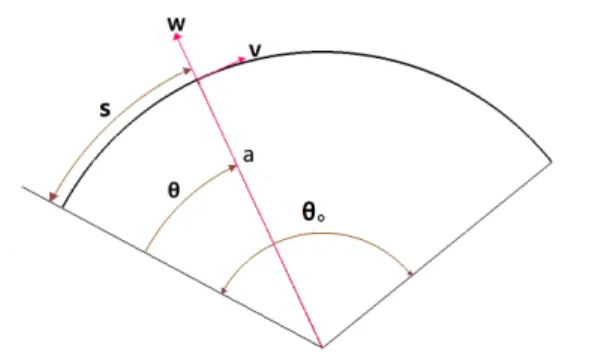
The uniform curved beam considered is shown in Fig. 1. A point on the centroidal axis is defined by the
angle θ, measured from the left support. The tangential and radial displacements of the arch axis are
v and w, respectively. Herea is the radius of the centroidal axis.
Fig. 1. Coordinate system for curved beam
2.1 In-plane inextensional vibrations of curved beams
A mathematical study of the in-plane inextensional vibrations of a curved beam of small cross section is carried out starting with the basic equations of motion as given by Love[2]. Following Love[2], the analysis is simplified by restricting attention to problems where there is no extension of the center line.
In fact, in this case there is a simple kinematic(vector) condition which relates the radial displacementW and the tangential displacement V,
(1)
If rotatory inertia is neglected, the bending moment related to the change in curvature and moment equations take the form, respectively,
(2)
(3)
The equations of motion in the radial direction and in the tangential direction take the form, respectively,
(4)
(5)
Where and M are the internal shear force, normal force, and bending moment, respectively.
If rotatory inertia is neglected, the substitution of equation (1) into equation (2); (2) into (3), and (4) and (3) into (5) leads to the following differential equation governing the in-plane inextensional vibrations, in terms of the displacement v,
(6)Assume that the beam is undergoing free vibration with a frequency and let
(7)
where , is the normal function of V , is the normal function of W, and which leads to a separation of equation (6) into
″
″
(8)in which each prime denotes one differentiation with respect to the dimensionless distance coordinate R defined as
R = θθ
0
(9)
Here, m is the mass per unit length, V is the displacement in the direction of increasingθ, θ0 is the opening angle, ω is the circular frequency of vibration of the system, E is the Young's modulus of elasticity for the material, andI is the area moment of inertia of the cross section.
If the curved beam is clamped at θ = 0 and
θ = θ 0, then the boundary conditions take the form as
(10)
(11)
(12)
at and ,, or
′ ″ ′ ″ (13) If the curved beam is simply supported, then the boundary conditions can be expressed in the following form as
(14)
(15)
(16)
at and ,, or
′ ″′ ′ ″′ (17)
2.2 In-plane extensional vibrations of curved beams
Veletsos et al.[12] used a theory which accurately considered the extensibility of the arch axis and the curved beam effect but neglects the effects of rotatory inertia and shearing deformation. The differential equations for rotational motion and for translatory motion in radial, in tangential directions, and the bending moment of the beam are
(18)
(19)
(20)
(21)
Where A is the area of cross section. The term
. in equation (19) for the extensional
vibration instead of 0 in equation (1) for the inextensional vibration. is related to the slope of the deflection curve. Using the same procedures used in the in-plane inextensional vibrations, the differential equations of the system which considers the extensibility of the arch axis neglecting the effects of rotatory inertia and shearing deformation by Flugge's equations[13] are in terms of the displacements v and w, respectively,
″″
″
'
(22)
″
′
(23)
where S ( = a θ0) is the length of the arch axis, r is the radius of gyration of the cross section (=
), and each prime denotes one differentiation with respect to the dimensionless distance coordinate R.The boundary conditions for clamped and simply supported ends are, respectively.
′ ′ (24)
″ ″ (25)
3. Differential Quadrature Method
The differential quadrature method (DQM) was introduced by Bellman and Casti[11]. By formulating the quadrature rule for a derivative as an analogous extension of quadrature for integrals in their introductory paper, they proposed the differential quadrature method as a new technique for the numerical solution of initial value problems of ordinary and partial differential equations. It was applied for the first time to static analysis of structural components by
Jang et al.[14]. The versatility of the DQM to engineering analysis in general and to structural analysis in particular is becoming increasingly evident by the related publications of recent years. Kang and Han[15] applied the method to the analysis of a curved beam using classical and shear deformable beam theories, and Kang and Kim[16] studied the in-plane buckling analysis of curved beams using DQM.
Recently, Kang and Kim[17], and Kang and Park[18]
studied the vibration and the buckling analysis of asymmetric curved beams using DQM, respectively.
From a mathematical point of view, the application of the differential quadrature method to a partial differential equation can be expressed as follows:
for (26) where L denotes a differential operator, are the discrete points considered in the domain, are the row vectors of the values, are the function values at these points, are the weighting coefficients attached to these function values, and N denotes the number of discrete points in the domain. This equation, thus, can be expressed as the derivatives of a function at a discrete point in terms of the function values at all discrete points in the variable domain.The general form of the function is taken as
for (27)
If the differential operator L represents an n th derivative, then
∑
N
j = 1Wijxk - 1j = (k - 1)( k - 2)⋯ ( k - n)xk - n - 1i
for i, k = 1,2,...,N (28)
This expression represents N sets of N linear algebraic equations, giving a unique solution for the weighting coefficients, W ij, since the coefficient matrix is a Vandermonde matrix which always has an inverse.
4. Numerical Analysis
4.1 In-plane inextensional vibrations of curved beams
The DQM is applied to the determination of the in-plane inextensional vibration of the curved beam.
The differential quadrature approximations of the governing equations and boundary conditions are shown.
Applying the differential quadrature method to equation (8) gives
(29) where , and are the weighting coefficients for the second-, fourth-, and sixth-order derivatives, respectively, along the dimensionless axis.The boundary conditions for clamped ends, given by equation (13), can be expressed in differential quadrature form as follows:
at (30)
at (31)
at (32)
at (33)
at (34)
at (35)
Similarly, the boundary conditions for simply supported ends, given by equation (17), can be expressed in differential quadrature form as follows:
at (36)
at (37)
at (38)
at
(39)
at (40)
at (41)
where A ij and C ij are the weighting coefficients for the first- and third-order derivatives. Here, δ denotes a very small distance measured along the dimensionless axis from the boundary ends. In their work on the application of the DQM to the static analysis of beams and plates, Jang et al.[14] proposed the so-called δ-technique wherein adjacent to the boundary points of the differential quadrature grid points chosen at a small distance. This set of equations together with the appropriate boundary conditions can be solved for the in-plane inextensional vibrations of the curve beam.
4.2 In-plane extensional vibrations of curved beams
Applying the differential quadrature method to equations (22) and (23) gives
(42)
(43)
The boundary conditions for clamped ends, given by equation (24), can be expressed in differential quadrature form as follows:
at (44)
at (45)
at (46)
at (47)
at (48)
at (49)
Similarly, the boundary conditions for simply supported ends, given by equation (25), can be expressed in differential quadrature form as follows:
at (50)
at (51)
at (52)
at (53)
at (54)
at (55)
This set of equations together with the appropriate boundary conditions can be solved for the in-plane extensional vibrations of the curve beam.
5. Numerical Results and Comparisons
Based on the above derivations, the fundamental frequency parameter of the in-plane inextensional and extensional vibrations of the curved beam is calculated by the DQM and is presented together with existing exact and numerical solutions by other methods. All results are computed with thirteen discrete points along the dimensionless axis, and δ is
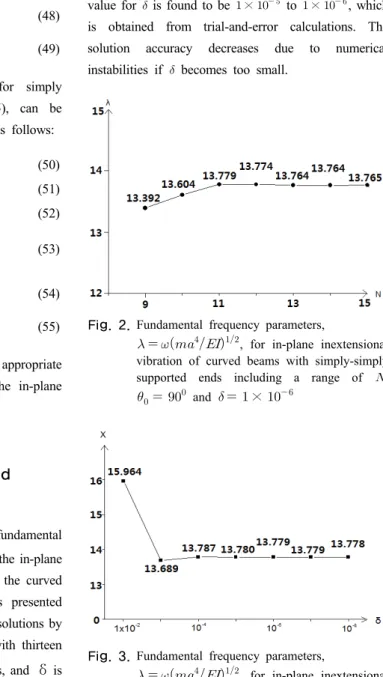
× . Figs. 2 and 3 present the results of convergence studies relative to the number of grid points and the parameter , respectively. Fig. 2 shows that the accuracy of the numerical solution increases with increasing and passes through a maximum. Then, numerical instabilities arise if becomes too large. The optimal value for is found to be 11 to 13. Fig. 3 shows the sensitivity of the numerical solution to the choice of δ. The optimal
value for is found to be × to × , which is obtained from trial-and-error calculations. The solution accuracy decreases due to numerical instabilities if becomes too small.
Fig. 2. Fundamental frequency parameters,
, for in-plane inextensional vibration of curved beams with simply-simply supported ends including a range of ;
and ×
Fig. 3. Fundamental frequency parameters,
, for in-plane inextensional vibration of curved beams with simply-simply supported ends including a range of ;
and
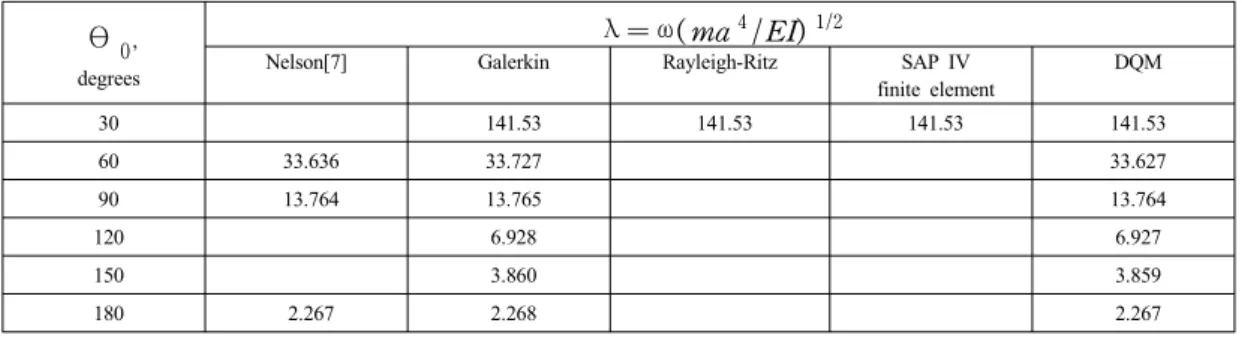
The fundamental frequency parameter of the in-plane inextensional vibrations of the curved beam is calculated by the DQM and is presented together with results from other methods: exact solutions by Archer[6], the Lagrangian multiplier technique by Nelson[7], Galerkin, Rayleigh-Ritz, or finite element
θ0, degrees
λ = ω(ma4/EI)1/2
Archer[6]
(Exact)
Galerkin Rayleigh-Ritz SAP IV
finite element
DQM
30 228.18 222.36 222.36 222.35
60 55.221 53.737
90 23.295 22.624
120 12.225 11.847
150 7.194 6.958
180 4.384 4.539 4.384
Table 2. Fundamental frequency parameters, λ = ω(ma4/EI)1/2, for in-plane inextensional vibration of curved beams with clamped ends
θ0, degrees
λ = ω(ma4/EI)1/2
Nelson[7] Galerkin Rayleigh-Ritz SAP IV
finite element
DQM
30 141.53 141.53 141.53 141.53
60 33.636 33.727 33.627
90 13.764 13.765 13.764
120 6.928 6.927
150 3.860 3.859
180 2.267 2.268 2.267
Table 1. Fundamental frequency parameters, λ = ω(ma4/EI)1/2, for in-plane inextensional vibration of curved beams with simply supported ends
methods. The results are summarized in Tables 1 and 2. Auciello and De Rosa[8] determined the natural frequencies of the beam using the SAP IV or the SAP 90 finite element methods (FEM) using 60 elements.
Table 3 shows that the numerical results by the DQM are in excellent agreement with those by the SAP 90 finite element.
θ0, degrees
λ = ω(ma4/EI)1/2
SAP 90 finite element DQM
30 178.94
60 42.942 42.942
90 17.871
120 9.216 9.210
150 5.299
180 3.258 3.254
Table 3. Fundamental frequency parameters,
λ = ω(ma4/EI)1/2, for in-plane inextensional vibrations of curved beams with clamped-simply supported ends
In Table 4, the first four frequency parameter
of the in-plane extensional vibrations of the curved beam is calculated by the DQM and is presented together with results by Veletsos et al.[12] using a combination of a Holzer-type iterative procedure and an initial value integration procedure for the comparisons. Tables 5, 6, and 7 show the fundamental frequency parameter
of the in-plane extensional vibrations of the beam using the DQM.
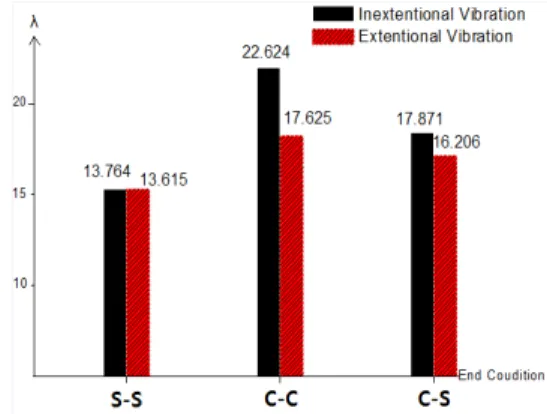
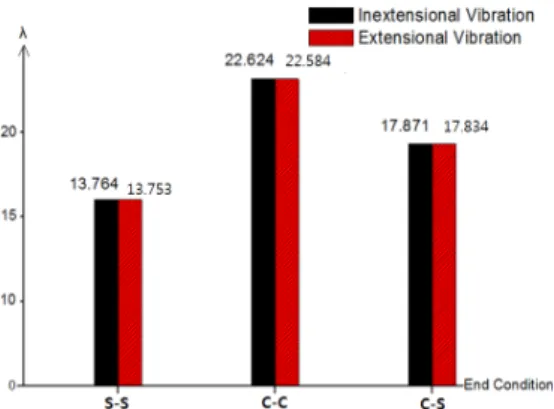
In Figs. 4 ~ 6, the fundamental frequency parameter λ = ω(ma4/EI)1/2 of the in-plane inextensional and extensional vibrations is calculated by the DQM with both ends simply supported (s-s), clamped (c-c), and clamped-simply supported ends (c-s), and compared with each other in the cases of the slenderness ratio is 30, 100, and 300, and the opening angle is 90 degree, respectively.
S/r θ
0
Veletsos et al.[12] DQM
n=1 n=1 n=2 n=3 n=4
11.78 17.28 23.56 47.12 117.8 251.3 377.0
90
18.08 25.25 33.32 33.82 33.94 33.96 33.96
18.08 25.25 33.32 33.82 33.94 33.96 33.96
71.53 83.19 81.49 144.9 151.9 152.2 152.3
89.78 113.8 153.9 171.5 345.6 349.5 349.8
148.6 215.1 226.0 351.4 414.4 652.7 627.0 7.85
15.71
47.12 180 ∘
18.26 21.37 22.27
18.26 21.36 22.27
39.18 66.53 133.6
74.73 133.2 205.8
- 167.5 339.9 Table 4. Fundamental frequency parameters, , for in-plane inextensional vibration of curved
beams with simply supported ends
θ0,
degrees
30 100 300
30 62.231 141.53 141.56
60 26.759 33.612 33.628
90 13.615 13.753 13.764
120 6.8350 6.9196 6.9266
150 3.8069 3.8544 3.8584
180 2.2402 2.2647 2.2668
Table 5. Fundamental frequency parameters, λ = ω(ma4/EI)1/2, for in-plane extensional
vibrations of curved beams with simply supported ends
θ0, degrees
30 100 300
30 93.871 175.75 222.40
60 30.753 53.692 53.743
90 17.625 22.584 22.624
120 11.419 11.817 11.846
150 6.6836 6.9374 6.9571
180 4.2121 4.3706 4.3835
Table 6. Fundamental frequency parameters, λ = ω(ma4/EI)1/2, for in-plane extensional
vibrations of curved beams with clamped ends
θ0, degrees
30 100 300
30 74.052 166.24 178.86
60 27.633 42.831 42.937
90 16.206 17.834 17.869
120 8.8977 9.1893 9.2082
150 5.1423 5.2870 5.2981
180 3.1662 3.2469 3.2533
Table 7. Fundamental frequency parameters, λ = ω(ma4/EI)1/2, for in-plane extensional
vibrations of curved beams with clamped- simply supported ends
From Tables 3 ~ 7, the frequencies of the member with clamped ends are much higher than those of the member with simply supported ends and clamped-simply supported ends, and the frequencies can be increased by decreasing the opening angle for the cases of both inextensional and extensional vibrations. From Figs. 4 ~ 6, the frequency parameters of the in-plane inextensional vibrations are slightly higher than those of extensional vibrations, and the difference is decreased by increasing the slenderness ratio (= S/r). When the slenderness ratio is greater than 300, the difference of fundamental frequency values is less than 0.1 percent. The natural frequencies of the member with clamped ends are more affected by the slenderness ratio than those with any other boundary conditions.
Fig. 4. Comparisons between fundamental frequency parameters,λ = ω(ma4/EI)1/2, for inextensional
and extensional vibrations of the curved beam by DQM with = 30 and
Fig. 5. Comparisons between fundamental frequency
parameters,λ = ω(ma4/EI)1/2, for inextensional and extensional vibrations of the curved beam by DQM with = 100 and
Fig. 6. Comparisons between fundamental frequency
parameters, λ = ω(ma4/EI)1/2, for inextensional and extensional vibrations of the curved beam by DQM with = 300 and
6. Conclusions
The differential quadrature method (DQM) was used to compute the eigenvalues of the equations of motion governing the free in-plane inextensional and extensional vibrations of a curved beam with various boundary conditions and opening angles. The results are analyzed, compared with exact experimental and numerical results by other methods (Rayleigh-Ritz,
Galerkin, FEM, or Holzer-type iterative procedure and an initial value integration procedure), and are also compared with each other for the cases of both inextensional and extensional vibrations. The present method gives the results which agree very well with other solutions for the cases treated while requiring only a limited number of grid points.
The present approach gives the followings:
1) The results by the DQM give the good accuracy compared with the exact experimental and the numerical solutions by others for the cases in which they are available.
2) Only thirteen discrete points are used for the evaluation. It has also been shown that compare to the finite element method using 60 elements, the DQM using 13 points was more accurate for the cases of vibration analysis of the beams.
3) It requires less than 1.0 second to compile the program with IMSL subroutine using a personal computer.
4) Diversity of new results according to the boundary condition and the slenderness ratio is also suggested.
References
[1] R. Hoppe, “The Bending Vibration of a Circular Ring”, Crelle's J. Math., Vol. 73, pp. 158-170, 1871.
DOI: http://dx.doi.org/10.1515/crll.1871.73.158
[2] A. E. H. Love, A Treatise of the Mathematical Theory of Elasticity, 4th Ed. Dover, New York, 1944.
[3] H. Lamb, “On the Flexure and Vibrations of a Curved Bar”, Proceedings of the London Mathematical Society, Vol. 19, pp. 365-376, 1888.
[4] J. P. Den Hartog, “The Lowest Natural Frequency of Circular Arcs”, Philosophical Magazine, Series 7, Vol. 5, pp. 400-408, 1928.
DOI: http://dx.doi.org/10.1080/14786440208564480 [5] E. Volterra and J. D. Morell, “Lowest Natural Frequency
of Elastic Arc for Vibrations outside the Plane of Initial Curvature”, J. Appl. Math., Vol. 28, pp. 624-627, 1961.
DOI: http://dx.doi.org/10.1115/1.3641794
[6] R. R. Archer, “Small Vibration of Thin Incomplete Circular Rings”, Int. J. Mech. Sci., Vol. 1, pp. 45-56, 1960.
DOI: http://dx.doi.org/10.1016/0020-7403(60)90029-1 [7] F. C. Nelson, “In-Plane Vibration of a Simply Supported
Circular Ring Segment” Int. J. Mech. Sci., Vol. 4, pp.
517-527, 1962.
DOI: http://dx.doi.org/10.1016/S0020-7403(62)80013-7 [8] N. M. Auciello and M. A. De Rosa, “Free Vibrations of
Circular Arches”, J. Sound Vibr., Vol. 176, pp. 443-458, 1994.
DOI: http://dx.doi.org/10.1006/jsvi.1994.1388
[9] U. Ojalvo, “Coupled Twisting-Bending Vibrations of Incomplete Elastic Rings”, Int. J. Mech. Sci., Vol. 4, pp.
53-72, 1962.
DOI: http://dx.doi.org/10.1016/0020-7403(62)90006-1 [10] L. C. Rodgers and W. H. Warner, “Dynamic Stability of
Out-of-Plane Motion of Curved Elastic Rods”, J. Appl.
Math., Vol. 24, pp. 36-43, 1973.
DOI: http://dx.doi.org/10.1137/0124005
[11] R. E. Bellman and J. Casti, “Differential Quadrature and Long-Term Integration”, J. Math. Anal. Applic., Vol. 34, pp. 235-238, 1971.
DOI: http://dx.doi.org/10.1016/0022-247X(71)90110-7 [12] A. S. Veletsos, W. J. Austin, C. A. L. Pereira, and S. J.
Wung, "Free In-plane Vibration of Circular Arches", Proceedings ASCE, Journal of the Engineering Mechanics Division, Vol. 98, pp. 311-339, 1972.
[13] W. Flugge, Stresses in Shells, Springer- Verlag, Berlin, 1960.
DOI: http://dx.doi.org/10.1007/978-3-662-29731-5 [14] S. K. Jang, C. W. Bert, and A. G. Striz, "Application of
Differential Quadrature to Static Analysis of Structural Components", Int. J. Numer. Mech. Engng, Vol. 28, pp.
561-577, 1989.
DOI: http://dx.doi.org/10.1002/nme.1620280306 [15] K. Kang and J. Han, "Analysis of a Curved beam Using
Classical and Shear Deformable Beam Theories", Int. J.
KSME., Vol. 12, pp. 244-256, 1998.
[16] K. Kang and Y. Kim, "In-Plane Buckling Analysis of Curved Beams Using DQM", J. KAIS., Vol. 13, pp.
2858-2864, 2012.
DOI: http://dx.doi.org/10.5762/kais.2012.13.7.2858 [17] K. Kang and Y. Kim, "In-Plane Vibration Analysis of
Asymmetric Curved Beams Using DQM", J. KAIS., Vol.
11, pp. 2734-2740, 2010.
DOI: http://dx.doi.org/10.5762/kais.2010.11.8.2734 [18] K. Kang and C. Park, "In-Plane Buckling Analysis of
Asymmetric Curved Beams Using DQM", J. KAIS., Vol.141, pp .4706-4712, 2013.
Ki-Jun Kang[Regular Member]
•Feb. 1984: Chungnam National University, Dept. of Mechanical Engineering (B.S),
•Dec. 1989: San Jose State University, Dept. of Mechanical Engineering (M.S)
•Dec. 1995: University of Oklahoma, Dept. of Mechanical Engineering (Ph.D)
•Mar. 1997~ the present : Dept. of Automotive Engineering, Hoseo University, Professor
<Areas studied>
Structural Analysis, Numerical Analysis, Buckling