KOREAN JOURNAL OF ENGLISH LANGUAGE AND LINGUISTICS
ISSN: 1598-1398 / e-ISSN 2586-7474 http://journal.kasell.or.kr
Perceptions on Generic Exceptions
YoungEun Yoon (Ewha Womans University)
This is an open-access article distributed under the terms of the Creative Commons License, which permits unrestricted non-commercial use, distribution, and reproduction in any medium, provided the original work is properly cited.
ABSTRACT
Yoon, YoungEun. 2021. Perceptions on generic exceptions. Korean Journal of English Language and Linguistics 21, 153-170.
Quite recently, two interesting approaches to generics have been put forth, both of which attempt to account for generics based on the notions of alternative sets of entities and features, and relative generics. They are both argued to have much in common with Leslie’s (2008, 2013) cognition-based approach, but grounded on Cohen’s (1999) analysis of relative generics. However, they differ in that the approach by van Rooij and Schulz (2020) tries to explain various generics with the representativeness of features, i.e., value(f), whereas the other by Tessler and Goodman (2019) resorts to one’s prior expectations. In this context, the primary purpose of this paper is to review these new theories on generics and address some shortcomings of these approaches. In doing so, we will propose that the appropriateness of a generic is judged depending on how people perceive its exceptions with their encyclopedic and contextual knowledge. This position will be supported by experimental results.
Received: Jan. 25, 2021 Revised: March 10, 2021 Accepted: March 15, 2021
YoungEun Yoon
Professor, Dept. of English Language and Literature, Ewha Womans University [email protected]
KEYWORDS
generics, exceptions, absolute/relative generics, alternative sets of entities/features, encyclopedic and contextual knowledge
1. Introduction
Generics have been strenuously investigated over the past few decades, producing three representative approaches, i.e., majority-based, normalcy-based, and cognition-based theories of generics. A majority-based approach (Cohen 1996, 1999, 2004) would argue, for example, that (1) is an appropriate generic since a ‘majority’
of the members of the ‘dog’ kind satisfy the predicate ‘bark’ with minor exceptions such as newborn, sick, and barkless dogs. A normalcy-based theory (Nickel 2006, 2009, 2010a, 2010b, 2013, 2016, 2018) would argue that (1) is satisfied since all ‘normal’ dogs bark except for some abnormal ones.
(1) Dogs bark.
On the other hand, a cognition-based approach (Leslie 2007a, 2007b, 2008, 2013, 2017) argues that a generic expresses the cognitive system’s most primitive and fundamental generalization and does not represent a specific consistent quantification, as illustrated by the following well-known generic sentences. In fact, not many mosquitoes carry the West Nile Virus and not many sharks attack bathers. The cognitive view by Leslie also accounts for generics like (2a, b) with a feature called ‘strikingness.’
(2) a. Mosquitoes carry the West Nile Virus.
b. Sharks attack bathers.
As for generics like (3a, b), only a half of lions, i.e., male lions, have a mane; and only a half of birds, i.e., female birds, lay eggs. A generic like (3c) does not mean that elephants simultaneously live in Africa and Asia
at the same time. For (4a, b), although most books are paperbacks and most primary school teachers are female, these are not proper generics.
(3) a. Lions have a mane.
b. Birds lay eggs.
c. Elephants live in Africa and Asia.
(4) a. Books are paperbacks.
b. Primary school teachers are female.
In order to account for various generics and non-generics like these, the three representative theories have proposed concepts like homogeneity, relative generics, domain narrowing, ways of normality, negative counterinstance, and strikingness, among others.
In this context, quite recently, two interesting theories of generics have been proposed, both of which attempt to account for various forms of generics by resorting to alternative category sets and relative readings. Both theories also argue to have much in common with Leslie’s (2008, 2013) cognition-based approach, but are grounded on Cohen’s (1999) analysis of relative generics, which is a majority-based formal approach. However, the two differ in that one approach by van Rooij and Schulz (2020; henceforth, R&S) resorts to the representativeness of features, i.e., value(f), along with alternative sets of entities and features, whereas the other by Tessler and Goodman (2019; henceforth, T&G) employs the notion of one’s prior expectations.
Given these, the main purpose of this paper is to address some shortcomings of these two new approaches.
Another purpose is to propose that the appropriateness of a generic is judged by how people perceive its exceptions based on their encyclopedic and contextual knowledge, an assertion that will be supported by experimental results.
This paper is organized as follows: in the next section, Cohen’s (1996, 1999, 2004) majority-view, and R&S’s and T&G’s modified views based on alternative category sets will be discussed; a critical review on the two new
analyses will be presented in section 3; experimental results on people’s perceptions on the exceptions of generics will be presented in section 4; and section 5 will conclude our discussion.
2. Previous Approaches
2.1 Cohen’s Majority-based Approach
In this subsection, Cohen’s (1996, 1999, 2004) majority-based approach, which is considered as a quite refined theory, will be discussed, since R&S’s and T&G’s approaches are mainly based on Cohen’s (1999) relative generics. According to Cohen (2004), examples (5a, b) are truth-conditionally equal, but not equal in terms of felicity. He attempts to explain this difference by the ‘homogeneity’ requirement defined as in (6).
(5) a. ?Mammals are placental mammals.
b. Mammals have a placenta.
(6) The generic gen(ψ, φ) presupposes that exactly one of the following holds:
a. for every psychologically salient partition Ω on ψ, and for every ψ' ∊ Ω, P(φ∣ψ') is high, b. for every psychologically salient partition Ω on ψ, and for every ψ' ∊ Ω, P(φ∣ψ') is low.
(7) Truth condition for generics:
gen(ψ, φ) is true iff P(φ∣ψ)>0.5
Cohen argues that both (5a, b) satisfy (7), whereas only (5b) suffices (6a). That is, “gen(ψ, φ) is true iff the conditional probability of φ given ψ is high (specifically, greater than 0.5).” In addition, the “generic gen(ψ, φ) presupposes that its domain, ψ, is homogeneous, in the following sense: for any psychologically salient criterion by which ψ may be partitioned into subsets, the conditional probability of φ ought to be roughly the same given every such subset of ψ” (Cohen 2004: 531).
Cohen also proposes two modes of dividing the domain of a generic into subsets; i.e., ‘tree’/‘featural’ and
‘geometric’/‘multidimensional space’ representations. He argues that the domain in (5b), ψ, is divided into subsets, ψ's, according to the age, size, etc., using a multidimensional representation, which satisfies the homogeneity. The domain in (5a), however, is claimed to be represented as a tree being partitioned into different kinds of mammals, such as placentals, marsupials, and monotremes. The probability of the placental subset is high (i.e., 1), whereas that of the marsupial or monotreme subset is low (i.e., 0). In other words, as for (5b), for example, we have P(having-a-placenta∣small-sized mammals) > 0.5, P(having-a-placenta∣medium-sized mammals > 0.5, and P(having-a-placenta∣large-sized mammals) > 0.5, which verifies the felicity of (5b). On the other hand, for (5a), we have P(placental-mammals∣placentals)=1, P(placental-mammals∣marsupials=0 (i.e., ≯0.5), and P(placental- mammals∣monotremes)=0, which leads to the violation of the homogeneity and the infelicity of (5a).
However, the selection between the tree and the geometric divisions is quite often equivocal. Although (5a) is argued to dissatisfy homogeneity because its syntactic form generates a tree division, the selection between the two representations would be challenging for those who are unacquainted with the partitions among placentals, marsupials, and monotremes. Furthermore, those who are familiar with the partitions would judge both (5a) and (5b) as inappropriate.
Leslie (2007b, 2008) also provides a number of counterexamples for Cohen’s (1996) account, which divides generics into absolute and relative generics, as in (9) and (10). She points out that Cohen’s ‘homogeneity’ condition successfully eliminates false generics, such as “chickens are female,” based on his definition on absolute generics, (9), and homogeneity, (11), while improperly falsifying true generics, such as “lions have manes,” “peacocks have
fabulous blue-green tails,” and “cardinals are red.” That is, an inappropriate absolute generic, “chickens are female,”
is successfully eliminated, since the probability that an arbitrary chicken that is male could be female is 0, whereas an appropriate absolute generic, such as “cardinals are red,” is improperly falsified because the probability that an arbitrary cardinal that is olive colored (female) could be red colored (male) is also 0.
(8) Alt(F): the contextually supplied alternatives to a predicate ‘is F’ (For example, if F is ‘drives to the department,’ then Alt(F) could be ‘takes the bus to the dept.,’ ‘walks to the dept.,’ ‘bikes to the dept.,’ etc.) Alt(K): the contextually supplied alternatives to a kind K (For example, if K is Cat, then Alt(K) could be other midsized mammals, such as racoons, dogs, etc.)
(9) Absolute generics: ‘Ks are F’ is true iff the probability that an arbitrary K that satisfies some predicate in Alt(F) satisfies ‘is F’ is greater than .5
(10) Relative generics: ‘Ks are F’ is true iff the probability that an arbitrary K that satisfies some predicate in Alt(F) satisfies ‘is F’ is greater than the probability that an arbitrary member of Alt(K) that satisfies some predicate in Alt(F) satisfies ‘is F.’
(11) Homogeneity: These conditions, (9) and (10), must hold for all salient partitions of the kind K.
Leslie further argues that if ‘number of legs’ constitutes a salient partition, then both a true generic, such as
“dogs are four-legged,” and a false generic, such as “dogs are three-legged,” are predicted to be false. In other words, the true generic, “dogs are four-legged,” is improperly falsified because the probability that an arbitrary dog that is three-legged is four-legged is 0, while the false generic, “dogs are three-legged,” is properly eliminated in a similar way. On the other hand, if ‘number of legs’ does not compose a salient partition, then the false generic,
“dogs are three-legged,” could be true as a ‘relative’ generic based on Cohen’s view. That is, according to Cohen’s definition (10), the probability that an arbitrary dog that, say, has short fur is three-legged is greater than the probability that, say, a racoon that has short fur is three-legged, since, Leslie argues, three-legged dogs live much easier lives with human support compared to three-legged racoons, wolves, and foxes.
2.2 R&S’s Approach
R&S suggest that sentences like (12a, b, c) are true not because, for example, most Frenchmen eat horsemeat, but because relatively many Frenchmen do. Generics like these including striking ones like (2a, b) motivated Cohen (1999) to propose the ambiguity of generics between absolute and relative readings, as discussed above.
Cohen’s analysis also objectively interprets the probabilities of generics.
(12) a. Frenchmen eat horsemeat.
b. Bulgarians are good weightlifters.
c. Dutchmen are good sailors.
R&S also comment on some problems of Cohen’s analysis including the one discussed by Leslie. They point out, above all else, the ambiguity of his analysis as a problem. They argue that it should be more natural to provide the same logical form for all types of generics. Although various aspects of Cohen’s analysis have been criticized, their theory builds on Cohen’s analysis, particularly on his relative readings. In fact, R&S make use of Cohen’s notions such as probability, contextually supplied alternatives for both F(predicate/feature) and K(kind/group).
They also agree with Leslie’s cognition-based approach and with the idea that generics are based on human categorizations and inductive generalizations.
R&S argue that ‘typicality’ plays an important role in their analysis, similar to recent theories of categorization.
That is, “that a generic of the form ‘Gs are f’ is true if f is a typical feature of Gs, or that typical members of the
category G have feature f” (R&S: 93). They further discuss that a common way to handle category learning concerns ‘associative learning’ based on frequencies and correlations. In classical conditioning research, associations between a cue (C) and an outcome (O) were studied, and Pavlov speculated that the intensity of association between C and O hinges on the number of times C and O are matched. Rescorla (1968) showed in a study with rats, however, that what is more important is the higher frequency of C and O pairings than that of ¬C and O matches, not the simple number of C and O pairs. This difference in frequency is called the ‘contingency’
of the shock (O) on the tone (C) in the study with rats. That is, “the higher the contingency of the shock on the occurrence of the tone, the more the rats anticipated the fear of a shock” (R&S: 94). The contingency or intensity of association between C and O is formally represented as P(O/C)−P(O/¬C), abbreviated as ∆PO
C, where P indicates frequencies.
The notion of contingency could be applied to generics, according to R&S. That is, C corresponds to G(group/kind) and O to f(feature/predicate) in generics, as in ∆PGf. The problem is, however, that as is defined, the absolute values of P(f/G) and P(f/¬G) are not important in the contingency as far as the difference between the two is the same. Yet, the necessary difference between P(f/G) and P(f/¬G) for grasping an association between G and f diminishes with a rise of P(f/¬G). Besides, the higher the value of P(f/G) is, the stronger the association of f with G. The value of P(f/G) should count more than that of P(f/¬G). In order to account for these, they resort to the notion of ‘relative difference,’ which was proposed by Shep (1958), Cheng (1997), and Pearl (2000), among others. They denote the relative difference by ∆*PGf, and define it as the following:
(13) ∆*PGf =1−P(f/¬G)∆PGf = P(f/G)−P(f/¬G) 1−P(f/¬G)
∆*PGf increases if P(f/¬G) increases, with the value of ∆PGf fixed. Therefore, ∆*PGf can be high, although ∆PGf is low. R&S state that as for relatively undistinguished features, ∆*PGf will be high, even though ∆PGf is relatively low.
Given these, R&S define generics based on the notion of ‘representativeness.’ That is, a representative feature for group G is not necessarily one that either most or many members of G have. It is one that ‘distinguishes’ G from its alternative(s). They also argue that in line with Cahill et al. (1995), some striking features could be applied to categories more easily, just like strong emotions cause fast learning and durable memories. Thus, they add the so-called ‘intensity’ of f (i.e., Value(f)) to their definition of the representativeness of f for G as the following:
(14) ▽ PGf = ∆*PGf x Value(f) = P(f/G)−P(f/∪Alt(G))
1−P(f/∪Alt(G)) x Value(f), where ∪Alt(G) = ¬G (and G∉Alt(G))
According to R&S, Value(f)≥1, and normally 1. In other words, when no strikingness of f is involved, the representativeness reduces to relative difference, i.e., ∆*PGf. They further claim the following:
(15) ‘Gs are f’ is true iff (i) ▽ PGf > 0, and (ii) for most h∊Alt(f): ▽ PGf ≫▽ PhG if Alt(f)≠∅ and where ≫ means ‘significantly larger.’
What is argued by (15) is that ‘Gs are f’ is true iff for most alternative features of feature f, the relative difference between G and alternatives of G (i.e., ¬G) is significantly smaller than that for f, given that the relative difference
for f is bigger than 0. For example, according to (14), if the probability of a group G having a feature f is 0.8, the probability of alternatives of G having the feature f is 0.3, and Value(f)=1, then we have 0.8-0.3/1-0.3 (i.e., 0.5/0.7=0.714). On the other hand, (15), which reflects Cohen’s (1996) relativity, argues that as far as the relative difference between G and alternatives of G is bigger for f than for alternatives of f (i.e., h), ‘Gs are f’ is true, although ▽ PGf is low.
In sum, R&S’s approach is based on the causal relations between the features and categories in generics and on the context. They also utilize representativeness/typicality based on relative difference in order to account for such generics that are generalizations on less than a half of the members of the categories. Their approach is argued to be a unified analysis on various generics including striking generics.
2.3 T&G’s Approach
T&G’s approach is based on three concepts, i.e., vagueness, probability, and context. They propose that the meaning of a generic is vague or underspecified. Although their theory has antecedents, especially Cohen’s (1999) theory of relative generics based on alternative sets of kinds (Alt(K)) and features (Alt(F)) as discussed above, it is formulated in unspecified probabilities in contrast to Cohen’s deterministic probabilities. That is, unlike R&S’s theory based on alternatives and objective probabilities similar to Cohen’s relative generics, T&G’s theory makes use of subjective probabilities, i.e., the so-called uncertain thresholds, determined by prior expectations derived from people’s world knowledge. Although both R&S and T&G employ Cohen’s relative generics, alternative sets of features and categories, and probabilities, they differ in this objectivity/subjectivity of probabilities of generics.
Another difference is in that in order to account for various kinds of generics including striking ones in a uniform way, R&S utilize the notion of Value(f) whereas T&G use ‘suitable choices of alternatives.’ That is, T&G propose that the meaning of generics, which is underspecified, is interpreted more precisely in context by listeners using probabilistic world knowledge, i.e., suitable choices of alternatives, as the following shows:
(16) ⟦gen⟧(p, θ): p > θ
The semantics for a generalization in (16) indicates that there is no determined value of the probabilistic threshold (θ) on the prevalence of a generalization, and that it is contextually determined by a listener’s prior knowledge on the property.
As for a generalization, “robins lay eggs,” for example, T&G state that the percentage of robins that lay eggs is the ‘referent prevalence’ and the prevalence of other kinds of animals’ laying eggs is listeners’ prior knowledge/expectations or the ‘prevalence prior,’ based on which the endorsement of the generalization is determined. Given this, the difference in endorsement between “robins lay eggs” and “robins are female” could be accounted for. Providing the prior distributions over the prevalence of ‘laying eggs’ and ‘being female” (T&G, 401), they argue that the difference in endorsement comes from the difference in their priors: many alternative animals have 0% prevalence of laying eggs (i.e., zero egg-layers), whereas the huge majority of animal groups have the same proportion of females (i.e., 50% females). Only “robins lay eggs” is endorsed because the interpretation of listeners is more in line with the referent prevalence than with the prevalence prior in this case.
On the other hand, the interpretation of “robins are female” is not that different from the prevalence prior (i.e., the prevalence of other kinds of animals’ being female) and hence the generic is not endorsed due to its non- informativeness.
In sum, T&G argue that the quantitative gradience in truth judgments on generalizations is systematically determined by interpreters’ prior beliefs about prevalence. In other words, they propose that the underspecified or vague meaning of a generic is not objectively determined by actual facts as argued by Cohen (1999) and Krifka et
al. (1995), but subjectively by listeners’ prior world knowledge in context.
Another difference between R&S and T&G is that the latter presents the results of their experiments on prevalence priors for a property, event, and cause. T&G’s case study 1 on generic language is composed of two experiments. In experiment 1a, 100 subjects were presented with 30 generic sentences (10 true, 10 false, and 10 uncertain a priori truth-value generics) and asked to judge their appropriateness. ‘Gradedness’ was observed in the 30 generics comprising a continuum of endorsement values, which they argue is evidence against a theory that predicts a clear cut categorical judgment between truth and falsity. In experiment 1b, 60 subjects were shown six animal categories related with the generic sentences used in experiment 1a and also eight property labels like lays eggs, and asked to create five animal kinds of their own and to give the percentage of members of the animal categories that have the properties. The derived prior distributions from the experiment had a diversity of shapes.
T&G argue that this diversity was expected because their endorsement model makes different predictions depending on the shape of these distributions. Thus, the endorsements on the 30 generics in experiment 1a could be analyzed to be derived from the prior knowledge in experiment 1b,
Their case study 2 on habitual language (e.g., “Mary smokes”) consists of three experiments, which were carried out using their same computational model and same experimental structure as in their case study 1. In experiment 2a, they created 31 events of actions from five categories of typical human behaviors (i.e., food & drug, work, clothing, entertainment, and hobbies) and asked 40 subjects to answer two questions: one is “How many {men, women} have done action before?” and the other is “For a typical {man, woman} who has done action before, how frequently does he or she do action?” Similar to the results of experiment 1a, the priors derived from experiment 2a cover a range of possible parameter values as predicted. Although, mostly, more popular actions (e.g., “wears socks”) tend to be more frequent actions and vice versa (e.g., “steals cars”), there were some exceptions like “goes to the movies,” which is popular but not done particularly often. On the other hand, experiment 2b elicits human endorsements for generalizations about events, and the results show that the endorsements for the habituals were done by a wide range of frequencies as predicted, and that no difference was found between endorsements of the habituals with male and female names. Experiment 2c was intended to measure the influence of outside causal events on endorsement. 270 subjects were presented with a past frequency sentence (e.g., “smokes cigarettes,” same as experiment 2b); given enabling (e.g., buying a pack of cigarettes), preventative (e.g., quitting smoking), or no additional information; and asked to answer to the question, “in the next time interval, how many times do you think person does action?” The results showed a clear negative effect of preventative information on endorsements for the habituals. T&G argue that generalization language including habituals essentially communicates people’s predictive beliefs, not actual facts.
Their case study 3 also carried out two similar experiments with causal language or causals (e.g., “A causes B”).
The results showed that even in causals, their model of generalizations predict differences in endorsement depending on the priors. In sum, T&G propose that the language of generalization implicitly communicates predictive probabilities. For quantified sentences, people need to learn the context-invariant threshold value, whereas for generics, there exists an uncertain threshold, which is influenced by individuals’ knowledge and context. They argue that it is ironic that the language of generalization including generics should be vague despite the fact that it is such a common communication form and central to learning. According to them, however, underspecification could be efficient, since its uncertainty can be resolved in the moment by context in line with Piantadosi, Tily and Gibson (2012).
3. A Critical Review
Cohen (1999) accounts for various generics by dividing them into absolute and relative generics. On the other
hand, both R&S and T&G provide a unified analysis for generics based on the concept of Cohen’s relativity, although they differ in the ways to explain various generics. That is, to account for a variety of generics that seem to behave differently in terms of the prevalence of the kind/group, R&S employ the intensity of the feature (i.e., Value(f)) while T&G allow listeners’ world knowledge and context to play a role in determining the suitability of a generic. According to T&G, the licensing of a generic does not depend on objective facts but on listener’s subjectively conceptualized knowledge and context.
The common denominator for all the three theories is the utilization of the concept of alternative groups/kinds.
This notion, however, seems quite vague and indeterminate. R&S point out themselves that “it is hard if not impossible to provide general rules for what the alternative sets should be” although formal semantics often employs the notion of alternatives (R&S: 98). In the case of T&G, they claim to be taking advantage of its vagueness, which they argue accounts for the dependency of generics on individuals and contextual factors.
Although both R&S’s and T&G’s analyses are formally quite refined and persuasive theories, similar to Cohen (1999, 2004), the biggest problem for the theories seems to be their crucial reliance on the notion of ‘alternative groups/kinds.’ People’s knowledge on this notion appears to be quite inconsistent and limited, which endangers the validity of the theories. That is, people could come up with quite different sets of alternative groups and features, which could considerably influence R&S’s representativeness of f for G. Furthermore, their knowledge on alternative kinds/groups and features appears to be far more limited than expected, which will be further discussed later with experimental results.
R&S discuss several readings of generics one by one, all of which could be accounted for by the representativeness, as discussed above (R&S: 100-107). First, R&S argue that if the probability of a group with respect to a feature is not high, it should be higher than the probability of the group with respect to alternative features. R&S discuss that if the Value of f and that of Alt(f) are the same, then the generic ‘Gs are f’ is true only if ∆Pf
G > 0, which is Cohen’s relative reading for sentences like “Bulgarians are good weightlifters” and
“Dutchmen are good sailors.” However, this is too weak, because inappropriate generics like “dogs are three- legged” could be true, as discussed in section 2.1. Given this, they argue that if Value is irrelevant and the relevant feature is uncommon, ∆PGf >>∆PGh for most alternative hs. In other words, the generic is true only if for most alternatives of f (i.e., hs or ¬f), the representativeness of f for G should be higher than that of ¬f for G, which could falsify examples like “dogs are three-legged.” In the ‘dog’ example, alternatives of f seem to be relatively more easily obtained than in cases like the following, which are similar to the Bulgarians and Dutchmen examples:
(17) a. Blacks are good athletes.
b. Blacks are good jazz musicians.
Are (17a, b) good generics? If yes, then how? What are the alternatives of the feature ‘being a good athlete’ or
‘being a good jazz musician’? That is, in many cases, it does not seem so obvious what alternative features to f for G could be produced.
Second, R&S argue that a generic is true if f is “very distinctive” for Gs. A generic like “Germans are right- handed” is not true if Germans are compared with other European citizens, for example. They argue that Germans’
being right-handed is not distinctive in any important way. As for (18a, b), they further argue that their analysis correctly explains that (18a) is true whereas (18b) is false. It is because animals other than lions mostly do not have manes, whereas relatively many lions have manes, compared to other animals. Namely, ‘Gs are f’ can be true and ‘Gs are h’ is false, although P(h/G)>P(f/G)< 12.
(18) a. Lions have manes.
b. Lions are male.
According to R&S, f being distinctive for Gs is not a necessary but a sufficient condition, as shown by examples like (19a, b, c). They argue that although being mortal, being four-legged, being a mammal can hardly distinguish humans, dogs, and lions from other alternative kinds, respectively, these generics are good ones. Since the probabilities of f for alternative groups of (19a, b, c) are also high, we could roughly get the following representativeness, as in (20b). That is, Value(f) is 1 in these cases since it is irrelevant, and P(f/G) is 1. They further argue that the features are common among all animals, which makes P(f/¬G)≈1. Hence, roughly we could have the probability in (20b) for examples like (19a, b, c).
(19) a. Humans are mortal.
b. Dogs are four-legged.
c. Lions are mammals.
(20) a. ∆*PGf x Value(f) = P(f/G)−P(f/∪Alt(G))
1−P(f/∪Alt(G)) x Value(f) b. ∆*PGf x 1 = 1−0.951−0.95 x 1 = 0.050.05 =1
However, obtaining the alternative groups in each case seems to be still indecisive and unstable. They include some immortals in the alternative sets of (19a), but just all animals in those of (19b, c). If we include only animals in Alt(G) of (19a), then we have 0 representativeness because P(f/∪Alt(G)) becomes 1. In fact, humans, animals, and plants are all mortal although some rare exceptional trees like Alaska red cedar and sequoias are observed to live more than 3,000 years. What immortal alternatives could we think of for (19a)?
For (19c), they argue that we could be considering only lions if it is given as an answer to the question “What kind of animals are lions?”. In this case, ∪Alt(G)=∅, and as a result, (20a) reduces to P(f/G). Then (19c) is predicted to be true iff P(f/G) >> P(¬f/G). That is, “the generic is true only if there is almost no relevantly salient alternative h that is a more distinctive feature for being a G than f is” (R&S: 100). Yet, various distinctive alternative features could be found for lions, for example, as in (21).
(21) a. Lions are vertebrates.
b. Lions are predatory animals.
c. Lions are carnivores.
What seems to be the case is that people generally do not produce alternative groups and/or features when they deal with generics. Even when they consider alternatives, the range, amount, and knowledge could vary greatly among them, which hugely influences the representativeness of a feature for a kind. As for each of the generics in (22), what alternative groups and features could be generated by people? The answer to this question seems to be quite unclear.
(22) Apples/Plums/Cherries/Tomatoes/Radishes are red.
As for apples, for example, what alternative kinds are evoked? Do we have plums, cherries, tomatoes, and radishes, along with non-red fruits and vegetables like bananas, blueberries, onions, and cabbages? Also, what alternative features could be gathered? Could we roughly have its representativeness as 0.57 like (23a) or 0.88 like (23b), whose difference is quite substantial? Also, what does the difference between 0.57 and 0.88 amount to?
(23) a. P(f/G)−P(f/∪Alt(G))
1−P(f/∪Alt(G)) x Value(f) = 0.7−0.31−0.3 x 1 = 0.57 b. P(f/G)−P(f/∪Alt(G))
1−P(f/∪Alt(G)) x Value(f) = 0.9−0.21−0.2 x 1 = 0.88
Now, what about a flower group called ‘Korean forsythia’ (kaynali in Korean), which is yellow? What alternative groups are derived? There are so many different colored flowers including genetically modified colored ones, most of whose names most people are not familiar with. Kaynali is a very common flower which blossoms in early spring, and Koreans know that “Korean forsythia flowers are yellow” is a good generic. Yet, most of them cannot enumerate more than a few flower groups, cannot identify most of the flowers they encounter, and cannot match the colors and shapes of most flowers with their names.
Also consider the following inappropriate generics. First for (24a), only books have contrasting features like
‘paperbacks’ and ‘hardbacks.’ Thus, according to R&S, Alt(G)=∅, and what counts here is P(f/G) > P(¬f/G). Then, we have its representativeness like, say, 0.8 > 0.2, which should make (24a) a good generic.
(24) a. ?Books are paperbacks.
b. ?Primary school teachers are female.
Now, for (24b), are alternative groups like middle school teachers, high school teachers, and college professors derived or just middle and high school teachers? Should we include college professors, then the gender ratio seems to be revered, i.e., male professors seem to far outstrip females. The 2018 statistics of Korea show the following percentages, based on which we question whether the feature, ‘being female,’ is distinctive enough for primary school teachers or not.
(25) Gender ratio for Korean teachers and professors in 2018
Female Male
Primary 77.17 22.83
Middle 69.71 30.29
High 52.40 47.60
College 25.90 74.10
Supposing that we are aware of the 2018 statistics, we have its representativeness, roughly, 0.55, when the college group is included in the alternatives; and, roughly, 0.41, when it is excluded. Given this, should we falsify (24b)?
Yet, for those who do not have the statistics, its representativeness could be high, but it is still an inappropriate generic. Similar to an inappropriate generic like “Germans are right-handed,” can we argue that primary school teachers’ being female is not distinctive in any important way?
In many cases of generics, it seems that people just lack the detailed knowledge on the alternative groups and features. Laymen simply do not have knowledge on most categories and features except for a small number of common categories and features. On the contrary to the ‘conservativity’ constraint for natural language determiners, which alleviates the burden imposed on the interpretations of quantified sentences, imposing the knowledge of the alternative sets of kind and feature on the interpretation of generics could unnaturally mislead the phenomenon. What we propose instead is that people tend to interpret them without resorting to alternative kinds and features, but mostly based on their conceptualizations on whether each feature well represents a kind without major non-negligible exceptions, which will be discussed in more detail in sections 4 and 5.
On the other hand, T&G’s theory could also be criticized in a similar way, whose basic ideas share the same notions with R&S’s theory except for some aspects, as discussed above. That is, T&G argue for subjective, not objective, probabilities for generics; and use the notion of ‘suitable choices of alternatives’ instead of R&S’s notion
of ‘Value’ to account for the supposed ‘striking’ generics. Yet, T&G also resort to the notion of alternative sets, which we argue causes problems for their theory, in a similar way to R&S. For a generic like “robins are female,”
for example, T&G argue that its hypothetical interpretation is not different from the prevalence prior, and thus it is uninformative, which leads to its inappropriateness. As discussed above, however, “humans are mortal” could also be analyzed in a similar way, but it is considered as a good generic.
To summarize, although R&S and T&G essentially resort to relativity to provide a unified analysis to various generics including striking ones; for example, the probabilities or expected priors of carrying malaria and attacking swimmers to groups like mosquitoes and sharks, respectively, not alone to their alternative groups, simply cannot be easily obtained due to inconsistent and far insufficient knowledge of people on kinds and features. In this context, we will present the results of an experiment in the following section and discuss people’s perceptions on the exceptions of generics, which we propose play a crucial role in deciding the felicity of a generic.
4. The Experiment
R&S and T&G have proposed two quite similar, refined, and formally rigorous theories. As pointed out above, however, human knowledge on categories and features as well as their capabilities of comparing categories and features seems to be quite limited. Hence, people seem to make and understand generalizations mostly based on their available knowledge on individual categories and features without comparing them one another. That is, people could make generalizations about either individual categories or a group of categories comparing them one another, but their generalizations seem to be chiefly based on the representativeness of a specific feature for each category. To find out what people focus on when they judge the validity of a generic, we have categorized generics into four types as in (26).
(26) Four types of generics:
I. Generalizations with minor or no exceptions II. Generalizations with major exceptions III. Generalizations on a small portion of a set
IV. Inappropriate generalizations on most members of a set
Type I generics include a few trivial exceptions (e.g., albino leopards) like in “leopards have spots,” or no exceptions like in “humans are mortal.” Type II generics contain major non-negligible exceptions (e.g., female lions) like in “lions have manes.” Type III generics are generalizations on a small portion of a set like in “mosquitos carry malaria.” It is known that only female mosquitos belonging to anopheles species could carry malaria, and not all of them cause people to be infected with malaria. Type IV generics are inappropriate generalizations although most members of the set have a specific property like in “primary school teachers are female.” Given these, we have performed an experiment designed to test the acceptability of the four types of generic, the results of which will be presented in the following paragraphs.
The experiment designed to examine people’s perceptions on the four types of generic utilized 20 English sentences, which are listed below. Each of the 20 sentences was followed by its Korean counterpart sentence to help avoid misinterpretations. For each of the four types in (26), five examples were allocated, producing a total of 20 examples [5 generics x 4 types = 20 examples]. The 50 subjects, who were all Korean college students, were requested to mark x (very inappropriate, 1 point), △ (a bit inappropriate, 3 points), or ○ (appropriate, 5 points) for each of the 20 examples. They were also requested to provide reasons for their △ and x answers. Tables 1, 2,
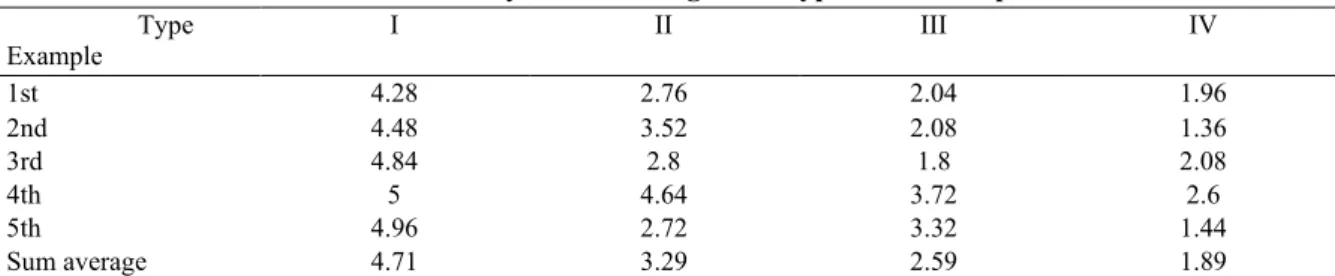
and 3 summarize the experimental results. The average points for each experiment item and the sum average for each type were given in Table 1.
Table 1. Summary of the Averages for Type I~IV Examples Type
Example I II III IV
1st 4.28 2.76 2.04 1.96
2nd 4.48 3.52 2.08 1.36
3rd 4.84 2.8 1.8 2.08
4th 5 4.64 3.72 2.6
5th 4.96 2.72 3.32 1.44
Sum average 4.71 3.29 2.59 1.89
First, all five examples for type I in (27) obtained high average points, above 4 points, and the average for type I was 4.71. This result was expected, since type I generics contain only a few trivial exceptions (#1, #6, #10, and
#18) or no exceptions at all (#14).
(27) Type I
#1. Humans walk on two legs. (인간은 두 다리로 걷는다.)
#6. Humans have two kidneys. (인간은 콩팥을 두 개 가지고 있다.)
#10. Leopards have spots. (표범은 몸에 반점이 있다.)
#14. Humans are mortal. (인간은 언젠가는 죽는다.)
#18. Pigeons have wings. (비둘기는 날개를 가지고 있다.)
Second, type II generics in (28) received lower average values than type I examples, except for example #15, which gained a very high average (4.64). Compared to this, example #20 received much lower average, 2.72, whereas #4 obtained a bit higher 3.52 average values. Type II examples contain non-negligible major exceptions, which was predicted to lead to their lower average points than type I examples.
(28) Type II
#2. Roses are red. (장미꽃은 붉은색이다.)
#4. Peacocks have beautiful blue and green feathers. (공작새는 아름다운 청록색 깃털을 가지고 있다.)
#13. Birds fly. (새는 난다.)
#15. Kangaroos have pouches. (캥거루는 주머니를 가지고 있다.)
#20. Lions have manes. (사자는 갈기를 가지고 있다.)
Third, the average for type III examples in (29) was even lower than that of type II although examples #11 and
#16 received more than 3 average points. Type III examples are generalizations on a small portion of a group.
They were predicted to receive low average points due to the existence of a considerable number of real exceptions.
This prediction was confirmed by their quite low sum average of 2.59. The differences among the examples will be discussed more in detail below with Table 2.
(29) Type III
#5. Pitbulls maul children. (핏불테리어 종 개는 아이들을 공격하여 상처를 입힌다.)
#7. Blacks are good athletes. (흑인은 훌륭한 스포츠선수이다.)
#9. Koreans eat dog meat. (한국인은 개고기를 먹는다.)
#11. Mosquitos carry malaria. (모기는 말라리아를 전파시킨다.)
#16. Sharks attack bathers. (상어는 해수욕객들을 공격한다.)
Fourth, the average for type IV examples in (30) was less than 2 points (i.e., 1.89). These examples are generalizations on most of the members of the groups each. Yet, there exist significant exceptions such as: Koreans living in houses; male primary school teachers; red, green, and brown Korean cars; hardcover books and e-books;
and left-handed Koreans. Hence mostly they are not accepted as appropriate generics.
(30) Type IV
#3. Koreans live in apartments. (한국인은 아파트에 산다.)
#8. Primary school teachers are female. (초등 교사는 여성이다.)
#12. Korean cars are white, gray, or black. (한국 승용차는 흰색, 회색, 또는 검은색이다.)
#17. Books are paperbacks. (책은 종이표지 책이다.)
#19. Koreans are right-handed. (한국인은 오른손잡이다.)
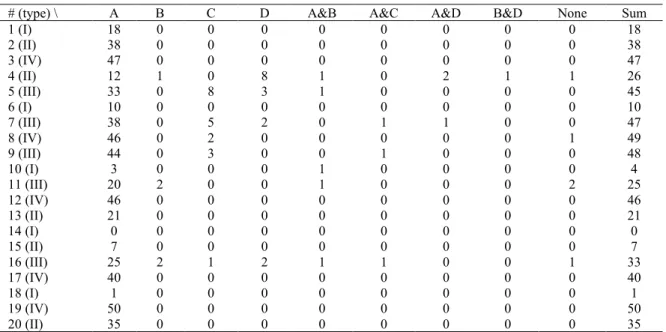
The reasons provided by the participants for the △ and x answers to the 20 examples are encapsulated in Table 2. The reasons were organized into nine different categories: A, B, C, D, A&B, A&C, A&D, B&D, and None.
Explanations for reasons A, B, C, and D are given at the bottom of Table 2. Two reasons for one example, such as A&B, A&C, A&D, or B&D, were given by some participants, each of which was considered as one reason for convenience. A few participants gave no reason for their △ or x answer, which is marked as ‘None.’ The maximum answer sum for each example is 50, since 50 subjects participated.
Table 2. Summary of the Reasons for △ and x Answers to 20 Examples
# (type) \ A B C D A&B A&C A&D B&D None Sum
1 (I) 18 0 0 0 0 0 0 0 0 18
2 (II) 38 0 0 0 0 0 0 0 0 38
3 (IV) 47 0 0 0 0 0 0 0 0 47
4 (II) 12 1 0 8 1 0 2 1 1 26
5 (III) 33 0 8 3 1 0 0 0 0 45
6 (I) 10 0 0 0 0 0 0 0 0 10
7 (III) 38 0 5 2 0 1 1 0 0 47
8 (IV) 46 0 2 0 0 0 0 0 1 49
9 (III) 44 0 3 0 0 1 0 0 0 48
10 (I) 3 0 0 0 1 0 0 0 0 4
11 (III) 20 2 0 0 1 0 0 0 2 25
12 (IV) 46 0 0 0 0 0 0 0 0 46
13 (II) 21 0 0 0 0 0 0 0 0 21
14 (I) 0 0 0 0 0 0 0 0 0 0
15 (II) 7 0 0 0 0 0 0 0 0 7
16 (III) 25 2 1 2 1 1 0 0 1 33
17 (IV) 40 0 0 0 0 0 0 0 0 40
18 (I) 1 0 0 0 0 0 0 0 0 1
19 (IV) 50 0 0 0 0 0 0 0 0 50
20 (II) 35 0 0 0 0 0 0 0 0 35
A: Exceptions exist.
B: I am not sure. / I have no information.
C: It is a prejudice. / It is a misinformed or inappropriate generalization.
D: Others
One noticeable example, #1(I), was judged to be a bit inappropriate by 18 subjects, a quite high number compared to the other four type I examples. They mentioned the existence of exceptions, i.e., disabled people with one or no leg. 10 subjects also remarked the existence of exceptional people with only one kidney for #6(I). For the rest three type I generics, less than 10 subjects each judged them as inappropriate based on the existence of exceptions, i.e., 3 for #10, 0 for #14, and 1 for #18.
For type II examples, 38 subjects commented on the existence of many different colors of roses for #2(II), which led to its rather low average, 2.76. Also, #13 was judged to be inappropriate by 21 subjects with A given as a reason. As for example #15, it gained a very high average, 4.64, which was due to the fact that only 7 subjects were aware of the fact that only female kangaroos have pouches. Compared to this, #20 received much lower average, 2.72, because 35 subjects answered that no female lions have manes. For #4, 12 subjects stated that only female peacocks have blue and green feathers (A), and 8 mentioned that “beautiful” is a rather subjective concept (D). These results show that people’s knowledge state greatly influences their judgment on the felicity of a generic.
That is, especially for kangaroos, most of the subjects associated the pouch as a representative characteristic of kangaroos irrespective of gender.
When it comes to type III examples, example #9 received the lowest average of 1.8 among the five examples.
44 subjects mentioned the existence of Koreans not eating dog meat (A), 3 commented on the prejudice involved in it (C), and one stated both the existence of exceptions and prejudice (A&C). This example shows that the felicity of a generic could change over time. Compared to several decades ago, now it is not that easy to find places selling and people eating dog meat, and a great number of families keep companion dogs. Koreans still do not taboo the dog meat eating culture, but this culture is going through the process of losing people’s acceptance.
Example #5 was judged to be inappropriate by 45 subjects, with A(33), C(8), D(3), and A&B(1) given as reasons, whereas #7 was, by 47 subjects, with A(38), C(5), D(2), A&C(1), and A&D(1), which leads to their low averages (i.e., 2.04 and 2.08, respectively). Also, these two were the only examples for which some subjects (i.e., 8 (C’s) for #5 and 6 (5 C’s + 1 A&C) for #7) compared the given categories with other alternative categories in the sense of R&S and T&G. The subjects mentioned the prejudices involved in the generalizations comparing pitbulls to other breeds of dogs for #5, and blacks to whites and/or Asians for #7.
Examples #5, #11, and #16 are generics often cited by linguists and analyzed to be based on “strikingness.” That is, the strikingness of the characteristics licenses the generics although only small portions of the sets possess the characteristics. Yet, the average for #5 was 2.04, while those for #11 and #16 were 3.72 and 3.32, respectively.
We propose that it is due to the indistinguishability of the members of the set. For #5, 33 subjects stated that not all pitbulls maul children, and how they are trained and what personality they have could determine their aggression. On the other hand, for #11 and #16, 20 and 25 subjects, respectively, answered that exceptions exist, and two subjects for each of them stated that they have no information. Mosquitos and sharks seem to be mostly indistinguishable from the human perspective, compared to the pitbull breed of dogs. People live with dogs as companions. People are aware that dogs behave differently depending on how well they are trained and socialized.
In contrast, it is not well-known for laypeople what species of mosquitos and sharks exist, what diseases they carry, or how they behave differently.
All 5 examples of type IV were judged to be inappropriate by most of the subjects, i.e., 47 for #3, 49 for #8, 46 for #12, 40 for #17, and 50 for #19. Almost all of the reasons given for them were A’s except for two C’s for #8.
These two C’s were about the prejudice towards women. This result shows that conceptualizations are involved in the perceptions on generics. Quantification on most of the members of a category does not guarantee the acceptability of a generalization. Cognitive conceptualizations based on people’s experiences and encyclopedic knowledge are required for generics.
Table 3 totals up the sums of the reasons for △ and x answers to the 20 examples given in Table 2:
Table 3. Summary of the Reasons for △ and x Answers to Four Types of Generic Answer
Type A B C D A&B A&C A&D B&D None Sum
I 32 0 0 0 1 0 0 0 0 33
II 113 1 0 8 1 0 2 1 1 127
III 160 4 17 7 3 3 1 0 3 198
IV 229 0 2 0 0 0 0 0 1 232
First, type I generics received 33 A’s including one A&B answer, which was a quite small number, compared to types II, III, and IV. Types II and III received many A’s, 116 and 167 A’s including A&B’s (1 and 3), A&C’s (0 and 3), and A&D’s (2 and 1), respectively. As predicted, compared to type I generics with no or ignorable trivial exceptions, types II and III generics with non-negligible substantial exceptions obtained far more instances of reason A. Type IV examples, which are not conceptualized generalizations, received 229 A’s and 2 C’s. As for the sum value, whose maximum number is 250 [50 subjects x 5 examples] for one type, the sum of △ and x answers for type I was the lowest (i.e., 33), whereas that for type IV was the highest (i.e., 232). These sum values were not much different from the numbers of answer A’s for all the four types, since most of the reasons for the
△ and x answers were A’s, which shows that the subjects judged the appropriateness of the generalizations based on the existence of exceptions. That is, generalizations on most members of a category with negligible or no exceptions were accepted as appropriate generics.
5. Discussions and Conclusions
As presented above, the experimental results show that the appropriateness of a generic is mainly determined by people’s perceptions on its exceptions. For type I generics, humans who are born with one or no leg and who lose one or two legs after birth are quite rare and unusual. This is the same case for humans’ kidneys (#6), leopards’
spots (#10), human’s mortality (#14), and pigeons’ wings (#18). Hence, the participants mostly accepted these type I examples as appropriate generics with average 4.71. That is, the exceptions to these examples are perceived as being negligible trivial ones by most participants.
Compared to type I, type II examples include notable exceptions: various-colored roses other than red (#2);
female peacocks and lions (#4 & #20); penguins, ostriches, chickens, etc. (#13); and male kangaroos (#15).
Although the average of type II was 3.29, which was quite lower than that of type I (i.e., 4.71) due to the existence of non-negligible real exceptions, the averages of example #4 (3.52) and, especially, of #15 (4.64) were much higher than expected. It is evident that almost all of the participants did not have the information that only female kangaroos have pouches for nurturing joeys. For peacocks, a considerable number of the participants did not know that blue and green feathers are only for male peacocks. Therefore, it has also been confirmed that people’s information state has a significant influence on the acceptance of generics.
As pointed out above, type III generics, which are generalizations on a small portion of a category, received even less average points than type II, as predicted. The pitbull example (#5) received an average of only 2.04. 34 participants (33 A’s + 1 A&B) answered that it is inappropriate due to the existence of exceptions. 8 participants (8 C’s) compared pitbulls with other dog breeds and commented that it is a prejudice to regard all pitbulls as being violent. Also for the black example (#7), whose average was 2.08, 40 subjects (38 A’s + 1 A&C + 1 A&D) gave the reason of exceptions for their △ or x answers. Comparing the black population with the white and Asian population, 5 participants commented on the prejudice involved in the generalization. The Korean example (#9)
obtained an even lower average of 1.8 and 45 subjects (44 A’s + 1 A&C) mentioned the existence of exceptions.
3 subjects also commented on the prejudice involved in the generic.
According to statistics, for example, over ten million Koreans keep pets, most of which are companion dogs.
The media is also overflowing with dog-related programs and advertisements. Hence, it is widely known to the Korean people that dogs behave differently depending on how well they are trained and socialized and that not all pitbulls are aggressive. American sports which are popular worldwide are played by a lot of black athletes compared to white and Asian athletes. Yet, people perceive that, for example, not all American football or basketball players are black, and American baseball games are played by many white and Hispanic athletes.
Several decades ago, it was not difficult in Korea to find restaurants selling dog meat and people eating dog meat.
With the recent explosive increase in companion dogs, however, it became difficult to find restaurants selling dog meat and people eating dog meat in Korea. As a result of all these, the participants came up with non-negligible exceptions for the three generics (#5, #7, and #9) without much difficulty.
Meanwhile, the mosquito (#11) and shark (#16) examples gained much higher averages (i.e., 3.72 and 3.32, respectively) than expected. 21 (20 A’s + 1 A&B) for #11 and 27 participants (25 A’s + 1 A&B + 1 A&C) for #16 reported the existence of exceptions. This difference is proposed to come from the participants’ different knowledge states concerning the two groups of categories. On one hand, most people are aware that dogs including pitbulls have different individual dispositions and levels of training (#5), people including the black population have different individual physical and mental abilities (#7), and people have different eating habits (#9). On the other hand, it is not well-known what species of mosquitos and sharks exist, what diseases they carry, or how they behave. Thus, people do not have much information about various species of mosquitos and of sharks. However, those participants who gave △ or x answer for #11 and #16 mentioned that there exists a specific species of mosquito carrying malaria or a species of aggressive shark attacking people, respectively. Furthermore, two participants each gave reason B (no information) to their △ and x answers for #11 and #16, whereas no B was given for all the other examples except for example #4 with one B. Therefore, differences in knowledge states for different categories are highly likely to have caused these differences.
T&G present Cimpien’s (2010) series of experiments to demonstrate that a generic could be judged as appropriate despite only a small number of members of a category possessing a specific feature. The followings are two of the items used for Cimpien’s experiment 4. According to Cimpien (2010: 1470), about 50% of the participants judged (31b) and (32b) each as true, given the situations (31a) and (32a), respectively. That is, although 70% of lorches, which is an imaginary species, do not have the respective features, half of the subjects judged the generics appropriate.
(31) a. 30% of lorches have dangerous purple feathers. These feathers are as sharp as needles and can easily get lodged in you, causing massive bleeding.
b. Lorches have dangerous purple feathers.
(32) a. 30% of lorches have distinctive purple feathers. No other animals on this island have wide, smooth feathers like these.
b. Lorches have distinctive purple feathers.
For these examples, we propose that the indistinguishability between the lorches having dangerous or distinctive purple feathers and those not having these influenced the participants who judged the generics to be true. As discussed above with our experiment type III examples #11 and #16, which received somewhat higher average points than the other type III examples, malaria-carrying mosquitos and not carrying ones, and bather-attacking sharks and not attacking ones are not easily distinguishable. In a similar vein, for (31), although only 30% of lorches have sharp feathers that could cause massive bleeding, it would be safe to characterize them as a whole as