KOREAN JOURNAL OF ENGLISH LANGUAGE AND LINGUISTICS
ISSN: 1598-1398 / e-ISSN 2586-7474 http://journal.kasell.or.kr
Breaking through Digital Barriers: Exploring EFL Students’
Views of Zoom Breakout Room Experiences* Andrea Rakushin Lee (Konkuk University)
This is an open-access article distributed under the terms of the Creative Commons License, which permits unrestricted non- commercial use, distribution, and reproduction in any medium, provided the original work is properly cited.
ABSTRACT
Lee, Andrea Rakushin. 2021. Breaking through digital barriers: Exploring EFL students’ views of Zoom breakout room experiences. Korean Journal of English Language and Linguistics 21, 510-524.
As a result of the COVID-19 pandemic, many educators had to transition from face to face to online classes. Zoom has become a popular platform for live, online classes in different educational contexts including English language learning. This phenomenological study sought to gain insight into South Korean students’ satisfaction with Zoom breakout rooms in English communication classes. Participants included 25 undergraduate students attending English communication classes at a university in central South Korea. Data collection comprised an open-ended survey, a focus group, and individual interviews. Data analysis centered on examining significant statements and developing themes. The results of this study indicate that most students were satisfied with using Zoom breakout rooms for EFL classes.
Further, students expanded on various benefits of using Zoom breakout rooms and provided recommendations for improvement. This paper concludes with practical implications and suggestions for future research pertaining to the use of Zoom breakout rooms in EFL classes.
Received: June 06, 2021 Revised: June 18, 2021 Accepted: June 25, 2021
Andrea Rakushin Lee Professor, Konkuk University Glocal Campus [email protected]
*This paper was supported by Konkuk University in 2020.
KEYWORDS
Zoom, videoconferencing, EFL, breakout rooms, synchronous learning
1. Introduction
The COVID-19 pandemic has resulted in myriad changes to education systems throughout the world. Many educational institutions quickly made the decision to convert traditional face to face classes to an online format (Hodges et al. 2020). Emergency online learning was deemed necessary to reduce the spread of the novel coronavirus (Murphy, 2020). In March of 2020, under the guidance of the Ministry of Education, universities in South Korea made the decision to implement a fully online learning system. Some universities opted to proceed online for the entire semester and others assessing the situation periodically to determine when to return to traditional classes on campus. Universities released guidelines and rules for the progression of online classes.
Videoconferencing classes became the norm at many universities and educational institutions.
Many instructors have conducted classes using the Zoom videoconferencing program to host synchronous classes during the pandemic (Lederman 2020). Synchronous videoconferencing learning programs including Zoom provide instructors with a platform to conduct classes in real time. Synchronous learning activities allow individuals to interact in real time through videoconferencing, cell phone apps, and instant messenger systems, whereas asynchronous activities allow students to complete activities on their own time. Even before the COVID- 19 pandemic, synchronous learning activities had become more common as many educational institutions sought to increase online learning activities (Delello et al. 2019).
A primary benefit of synchronous learning is that students can obtain course information immediately as well as communicate in real time with their peers and instructors. Additionally, through live interaction, student participation and classroom engagement can improve (Park and Bonk 2007). Synchronous learning activities can benefit English language learners by providing more communication opportunities (Lin 2014) and increasing understanding of the language (Sauro and Smith 2010). Ochonogor et al. (2012) found that through synchronous learning activities, students can improve their English speaking and writing communication. Synchronous learning activities have also been used to pair together non-native English speakers with native English speakers to help improve English proficiency (Kato et al. 2016). Furthermore, these activities can help improve student motivation and confidence and thus increase their communication output (Vurdien 2019). Providing students with authentic learning activities that center on communication development is essential when creating online classes for English language learners. Moreover, developing a Community of Inquiry (CoI) that centers on social presence, teaching presence, and cognitive presence in online classes is critical for supporting a collaborative learning environment (Garrison 2018). In the online learning environment, English language learners need ample opportunities to communicate and collaborate with other peers.
In English communication classes, having classes in real time is often necessary so that students can communicate with peers to improve their English language proficiency. Even prior to the COVID-19 pandemic, online and blended learning courses were gaining popularity, and some studies had previously examined benefits of synchronous learning activities for foreign language learners (Bueno-Alastuey 2011, Lin 2014, Zhao 2009). In the post-pandemic era, Zoom may continue to play a role in course instruction, especially for institutions looking to expand online programs or to provide students with supplementary lessons. Zoom and many other videoconferencing programs include a breakout room feature, where participants can be divided into smaller groups for activities, discussions, or sub-meetings. Through breakout rooms, students can engage in practical communicative activities and assignments with a smaller group of peers (Chandler 2016).
This study aimed to explore South Korean university students’ perceptions of Zoom breakout rooms in English communication courses. Although a plethora of studies have been conducted on videoconferencing programs including Zoom in various educational settings, there is a paucity of research on students’ perceptions of Zoom breakout room learning experiences, especially in the South Korean English language learning context. Gaining
more insight into how Zoom breakout rooms can be used to improve English communication classes is critical since group and partner activities often play a significant role in improving communicative competence in the traditional language classroom. Furthermore, it was important to examine students’ overall satisfaction with Zoom and determine if any responses were made regarding the breakout room experience prior to asking specific questions about it. Research is warranted to further explore the Zoom breakout room experience of English language learners. In addition, practical implications can assist instructors and course designers in developing effective teaching methods and activities for group and partner activities conducted in Zoom breakout rooms. The following questions were used to guide the study:
1. How do South Korean university students describe their satisfaction with using Zoom for English communication classes?
2. What do South Korean university students perceive as the benefits of using Zoom breakout rooms for English communication classes?
3. What recommendations do South Korean university students have for improving Zoom breakout rooms for English communication classes?
2. Literature Review
2.1 Zoom Videoconferencing
Current videoconferencing platforms including Zoom can aid in achieving instructional goals. Zoom has a wide range of features making it appealing to educators including but not limited to a screen share function, a polling system to test students or get input, annotation tools, a chat box, and whiteboard (Zoom 2020). Users can also choose a virtual background picture if they do not want to share their actual location. Zoom provides transcription resources, which can be particularly beneficial for English language learners. Additionally, Zoom has cloud recording options, and users have the option to save files locally.
One unique feature of Zoom is breakout rooms, which allow instructors to divide students into groups to work on assignments or projects (Sutterlin 2018). Students can also contact the instructor if they are having any problems while in the breakout room. Moreover, there is a function in which the instructor can broadcast a short message to all students.
When it is time for the breakout room meeting to end, the instructor can close the breakout room. Then students can immediately return to the main room or wait for a timer that automatically puts them back into the main room after a preset time period. These features make Zoom a popular choice for live classes and meetings. These benefits can aid students by helping them to stay on task and receive further instructions as needed. By participating in group activities, students have opportunities to communicate with classmates and improve their English language proficiency.
Emerging research during the COVID-19 pandemic has shown that there have been both benefits and challenges with using Zoom in the English language teaching context. For instance, Kohnke and Moorhouse (2020) found that group discussions in Zoom tend to take a significant amount of time and are difficult for the instructor to monitor. Furthermore, it can be burdensome for instructors to supervise students’ interaction in larger classes, and students can get tired from looking at the screen for a long period of time (Moorhouse 2020). Researchers have coined the term “Zoom fatigue” to address the “tiredness, anxiety, or worry” that comes from excessive videoconferencing sessions (Wiederhold 2020, p. 437). Instructors should consider implementing break sessions as needed to ensure optimal learning and focus. Zhang (2020) reported challenges in terms of students multitasking
and not focusing, Internet connection problems, and the awkwardness of having to speak to a screen. Although there are many benefits to videoconferencing, it is also critical for instructors to consider the drawbacks when designing online classes and making adaptations.
2.2 Zoom Breakout Rooms
Research specifically focusing on the breakout room experience and student and faculty perceptions of breakout rooms is still limited. However, some studies have highlighted the role of breakout rooms in online courses. For example, in the UAE English language learning context, Mohamed (2020) found that breakout rooms play an important role in English language development among students (n = 43) but highlighted that the instructor’s position is critical in achieving language proficiency goals. Mohamed (2020) also emphasizes that instructors have to take on various responsibilities in assisting students including moving around into different breakout rooms, ensuring students’ comprehension of the activities, giving feedback to students, socializing as well as checking that students are staying on task. In the study, students also reported that breakout rooms were valuable for improving group work activities, interaction, and cooperation. It is also critical that instructors are aware of potential problems based on a lack of awareness with the breakout room functions as well as technical issues that can arise; he adds that educational institutions should ensure that proper training is available to support instructors’
understanding of online platforms and resources. Furthermore, Mohamed (2020) provides eight practical tips to improve the breakout room experience in English language classes, which include:
1) making breakout room groups based on the number of students in class
2) putting students with technical issues into one room so other students can stay on task 3) creating a group leader system
4) activating the share screen button so students can utilize this feature in their groups 5) providing prompt assistance to students who ask for help
6) removing the instructor’s photo when moving so students stay on task and do not focus on the instructor’s presence in the room
7) giving encouragement to students for achieving class goals
8) offering incentives to groups that stay on task or excel in the breakout rooms
Studies outside of the English language teaching context also provide much needed insight into students’ breakout room experiences. For example, Greyling and Ahmad (2020) highlight the importance of providing sufficient structure and monitoring of breakout room activities. Cavinato et al. (2021) indicate that although breakout rooms have many advantages, it can be difficult for students to share answers to questions together, and conversations may progress more slowly in comparison to traditional classroom activities. Another limitation noted is that the instructor can only assist one group at a time, which can be problematic for struggling students or those who are not staying on task. Instructors must ensure that students are adequately prepared for activities once they go into the breakout room since the instructor is limited to posting short Zoom announcements to further clarify or explain assignments.
Resources for improving breakout room instruction and activities are also readily available. For example, the University of Michigan (2020) created an online guide that explains best practices specifically in Zoom breakout rooms. These include giving clear instructions to students on expectations, assigning students specific roles to ensure that participation is fair, checking rooms and providing guidance, assigning the same groups so students can get to know each other, and using active learning activities. The guide also provides specific examples of
active learning assignments that promote engagement and deeper understanding of course materials. This website as well as other invaluable online resources can provide practical tips to both novice and seasoned online educators who may need extra support in the Zoom classroom.
2.3 Community of Inquiry
The CoI framework provides guidance in creating a collaborative learning environment that supports higher- order thinking skills (Garrison 2017). CoI is based on three primary dimensions of online learning, which include cognitive presence, social presence, and teaching presence (Garrison et al. 2000). The CoI framework is rooted in the social constructivist learning theory (Garrison 2017), which centers on collaborative and communicative activities in learning (Vygotsky 1981). According to Garrison et al. (2000) cognitive presence can be defined as
“the extent to which learners are able to construct and confirm meaning through sustained reflection and discourse”
(p. 11). Cognitive presence focuses on the concept of learners developing new knowledge or awareness through reflection and discussion (Serembus and Kemery 2020). Social presence focuses on individual learners’
connections and interactions with peers and classmates (Garrison et al. 2000). Finally, teaching presence is based on the instructor’s role in designing, facilitating, and leading a course through various types of curriculum and activities (Garrison et al. 2000). These three interdependent dimensions play a critical role in establishing a sense of learner belonging in addition to increased student satisfaction. According to Tucker (2020), the CoI framework helps instructors in “understanding the interplay between these presences can help teachers transitioning their courses online create learning experiences that are engaging, student-centered, and leverage the class’ collective intelligence” (p. 11). When designing online courses, instructors should ensure that activities aim to create a sense of community and promote meaningful and engaging lessons and activities.
Community of Inquiry (CoI) can be applied to various online learning platforms and activities (Fiock 2020).
Studies on Zoom videoconferencing classes have also examined the research in light of the CoI framework (Choppin et al. 2020, Delello et al. 2019, Hyer 2019). Technology can help promote interaction in online courses; however, educators, students, and administrators must take on an active role in creating a community of learners (Lawrence-Benedict et al. 2019). Although the CoI framework has been used to examine the interplay and impact of the three dimensions in synchronous Zoom courses, it is critical to further explore the role of CoI in the English language learning setting and especially in breakout rooms where the instructor’s role may be more limited since time has to be divided among groups.
Various online resources as well as research and practical articles provide guidance and specific tips and activities that can be used in online courses to promote effective implementation and maintenance of the three dimensions. For example, Fiock (2020) created a list of online teaching activities that promote each of the three presences in online courses. Practical implications discussed in various articles also provide much needed insight into effective use of the CoI framework in English language classes conducted online (e.g., Assalahi 2020, Smidt et al. 2021). The English language learning context can be even more difficult to create an effective CoI since poor English language proficiency can result in a decreased interest in wanting to learn and interact in online classes (Kang and Im 2013; Salisman et al. 2018). Instructors should review practical and research-based activities that provide guidance into effective CoI strategies that can promote cognitive, teacher, and social presence in online classes to ensure meaningful and effective learning.
3. Method
3.1 Participants and Setting
This phenomenological study was carried out at a private university in central South Korea during the fourth to sixth weeks of the spring semester of 2020. A phenomenological design was chosen to examine the essence of the shared experience (Creswell 2014) of using Zoom breakout rooms in university English communication classes.
Participants (n = 25) were obtained through purposive and convenience sampling and were enrolled in three English communication courses, which include English Communication Skills, Multimedia English, and Intercultural Communication. Participants were assigned pseudonyms to protect their identities. The classes met two times per week for 80 minutes during a 16-week semester. Classes typically included 20 minutes of mini lecturing or explanations about the lesson followed by 45 minutes of structured breakout room activities. Classes generally ended with 15 minutes of review activities in the main Zoom room. This format sometimes changed though depending on the lesson topic or activities. For breakout room activities, the instructor uploaded worksheets to the course management system for each week of class and instructed students to open the activity prior to going to the breakout room. The instructor explained the activity before going to the breakout rooms to try to confirm that the students understood the activities. Additionally, the instructor tried to make breakout room activity directions as specific as possible so that students could go through the activities step by step without any problems.
Occasionally, some clarification was needed though since directions may not have been clear enough.
3.2 Data Collection
Participants completed an open-ended survey through Survey Monkey. The survey questions included:
1. How do you feel about using Zoom for English classes?
2. Do you feel satisfied with using Zoom for English classes? Why or why not?
3. What do you like about using Zoom in English classes?
4. What do you like about using breakout rooms in English classes?
5. What recommendations do you have to improve the breakout room experience in English classes?
6. Is there anything else you would like to share?
Although the present study centers on the breakout room experience, the instructor also wanted to ask questions pertaining to general Zoom satisfaction and experiences to see if the participants mentioned anything specific related to the breakout rooms or discussed general issues that may also impact the breakout room experience.
An online focus group using Zoom was conducted with students who were enrolled in the English Communication Skills (n = 10) class to gain more understanding of the students’ perceptions. The same questions from the interview were used, but the researcher added probing and follow-up questions to obtain more details and to provide clarification when needed. The English Communication Skills class was chosen for the focus group since it only had 10 students, making it easier to speak with each student and have a discussion. The focus group lasted 20 minutes and was conducted at the end of an 80-minute class. Follow up semi-structured interviews were carried out over the phone with these 10 participants to further elaborate on responses given during the focus group.
The average telephone interview was 12 minutes.
Due to the need for social distancing in the COVID-19 period, all data were collected online and over the telephone. Archibald et al. (2019) researched the use of Zoom as a method for qualitative data collection and
generally reported favorable results based on data management capabilities, security, cost, and the relative ease for users. The researcher can also build rapport with participants better than other online methods that do not include visual interactions (Archibald et al., 2019). To improve trustworthiness, data triangulation was used, and member checking was conducted with four of the participants.
3.3 Data Analysis
Data analysis centered on finding “significant statements” that emerged (Creswell 2014, p. 448). Coding was used to look for similarities in students’ responses. After examining the “significant statements,” the researcher searched for
“themes” in the data (Creswell 2014, p. 448). According to Creswell (2014), it can also be beneficial to report individual and group differences even when focusing on similarities in the shared phenomenon. Although the researcher focused heavily on examining similarities in the data, unique findings among participants were also included in the results.
4. Results and Discussion
4.1 Zoom Satisfaction
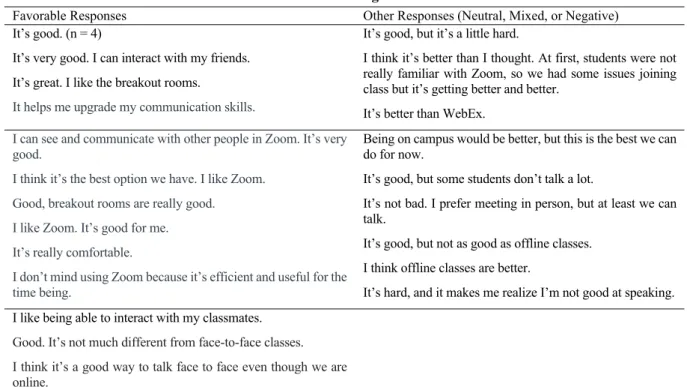
In the survey, students generally reported favorable perceptions of their experiences using Zoom for English communication classes. In terms of satisfaction with Zoom, 16 indicated that they were satisfied, while nine students’ responses were neutral, negative, or included mixed opinions on their satisfaction.
Table 1. Satisfaction with Using Zoom for EFL Classes
Favorable Responses Other Responses (Neutral, Mixed, or Negative)
It’s good. (n = 4)
It’s very good. I can interact with my friends.
It’s great. I like the breakout rooms.
It helps me upgrade my communication skills.
It’s good, but it’s a little hard.
I think it’s better than I thought. At first, students were not really familiar with Zoom, so we had some issues joining class but it’s getting better and better.
It’s better than WebEx.
I can see and communicate with other people in Zoom. It’s very good.
I think it’s the best option we have. I like Zoom.
Good, breakout rooms are really good.
I like Zoom. It’s good for me.
It’s really comfortable.
I don’t mind using Zoom because it’s efficient and useful for the time being.
Being on campus would be better, but this is the best we can do for now.
It’s good, but some students don’t talk a lot.
It’s not bad. I prefer meeting in person, but at least we can talk.
It’s good, but not as good as offline classes.
I think offline classes are better.
It’s hard, and it makes me realize I’m not good at speaking.
I like being able to interact with my classmates.
Good. It’s not much different from face-to-face classes.
I think it’s a good way to talk face to face even though we are online.
The focus group and interviews were only conducted with students in the English Communication Skills class (n = 10). The participants included Sanghyeok (Male), Donghyun (Male), Jihoon (Male), Junghoon (Male), Sungho (Male), Eunae (Female), Jiwoo (Female), Hyejin (Female), Sunjung (Female), and Youngmi (Female).
Results are categorized based on the order of the research questions.
In the focus groups and interviews, all students indicated that they were satisfied with using Zoom, but two students mentioned that they would prefer to be on campus. However, these two students also stated that they are generally satisfied with Zoom. Sanghyeok stated that he would prefer to have classes on campus, but he said, “This is a pandemic, and I can’t be selfish. Zoom seems to be the best that we have right now.” In addition, he made comparisons to WebEx. He said, “Most of my classes are using WebEx. It’s fine for most lecture classes, but we have to communicate in English classes. The breakout room makes that possible. We don’t use breakout rooms in my WebEx classes.” Sungho had a similar response. “I really miss all of my professors and classmates. I hope we can go back to campus soon. Zoom is okay now though. It’s nice to talk with my classmates and professor.” The other eight students said they are satisfied with Zoom, and six discussed how they like being able to interact with their classmates and professor. For example, Youngmi said:
I like that I can improve my English skills while talking to my classmates and professor. Since COVID started, I haven’t met many people. Even though we are online, I feel like I’m having real conversations. I don’t feel as bored at home. It’s much better than just listening to lectures and a professor just calls on a few students.
Jihoon had a similar response. He said, “I’m glad that I can have conversations with other people and practice English. I especially like the breakout rooms since we can spend more time talking in groups.” Four students said that they have been more satisfied with Zoom in comparison to WebEx. Students mentioned that they had technical glitches with WebEx from time to time but had not experienced any major issues with Zoom.
4.2 Benefits of Zoom
In the survey, 13 participants responded that the breakout rooms helped improve their communication or provided more opportunities for communication. Four respondents stated that the breakout room is a good system, one stated that it is not bad, one stated that it is useful, and one stated that it is sufficient. A specific example provided was, “Meeting other people is quite burdensome, but I can also see that I need to improve my English skills.” Other responses include being able to screen share while talking (n = 1) and that the breakout room system is fun (n = 1). Three participants did not answer the question.
In terms of benefits of Zoom breakout rooms in EFL classes, eight students in the focus group stated that they like the breakout room activities because they can engage in practical conversations and complete class assignments with groups or partners. For example, Sunjung said, “Although lecturing is sometimes needed, communication is most important in English classes. We are able to talk to each other and practice English more in the breakout rooms.” A similar response was mentioned by Jiwoo. “Sitting at the computer all day watching lectures or videos gets so tiring. Having real activities and conversation practice is helpful and interactive. I think students want more of this.” Three students stated that they like that they can call the instructor if needed to answer questions or deal with problems. Two students indicated that they like the broadcast feature, so they can get additional instructions or know what time they will go back to the main room. A wide range of benefits of the breakout rooms were discussed, but the importance of communication was a notable response.
4.3 Recommendations for Improving Zoom Breakout Rooms in EFL Classes
In terms of breakout rooms, 16 students stated in the survey that they do not have any recommendations for improving the breakout room. Three recommendations centered on increased participation. For example, one student stated, “I think some students don’t seem to participate passionately and also recommended having a group leader for each class. Of course there are differences in English skills, but I think participation is most important.”
Another student provided several examples and indicated that talking to someone for the first time is awkward, that screen share is inconvenient, more supervision is needed, and that several students do not participate. Three participants did not answer the question.
In the focus group, students were also asked to provide recommendations for the breakout rooms since many communication activities were carried out as small group and partner activities. Five students said that there is variation in terms of student participation. They mentioned that several students actively participate regularly, and others moderately or rarely participate. One of the more outspoken students, Sanghyeok said,
Overall, the breakout room activities are good. However, you (the instructor) have to move around from group to group. When you aren’t in a specific room, some students are lazy or are maybe shy and don’t participate.
It would be nice if Zoom could provide videos of what is happening in each group. If students know they are being monitored, they may be more likely to participate.
Three students mentioned that there should be assigned group leaders for each class. Eunae said,
When we don’t have an assigned leader, normally the same outgoing students or the students who are better at English lead the conversations. This gets kind of tiring for the ones who always lead. Some students are putting in more effort than other students.
Three students stated that peers should be matched with classmates who have a similar level of English. For example, Hyejin said, “Even though our class is small, students have very different levels. One student lived in America for a while. He spoke just like a native speaker. Other students struggled to understand and didn’t talk.”
Other recommendations included repeating instructions several times before going to the breakout room, having strict policies regarding breakout room participation, including more partner activities rather than small group activities, and requiring webcams. Participants provided a wide range of recommendations for improvements;
however, some responses were more prominent including the variation in student participation, the need for assigned group leaders, and putting students into groups with peers who have a similar language level.
4.4 Discussion
The first research question aimed to explore how South Korean university students describe their satisfaction with using Zoom in EFL classes. Among the survey respondents, 16 stated that they had favorable views in terms of satisfaction with using Zoom for EFL classes, while nine had neutral, negative, or mixed opinions. Focus group and interview participants (n = 10) stated that they were satisfied with Zoom; however, two of the students stated that they would prefer to take on campus courses. Nevertheless, even though they prefer face-to-face classes, they still stated that they were generally satisfied with Zoom. Primary reasons for satisfaction include improving communication skills, participating in breakout rooms, having real conversations, feeling comfortable, being the
best option available, interacting with the professor and students, and engaging in group activities. Comments were also made about preferring Zoom in comparison to WebEx, especially because of the breakout room feature on Zoom. Additionally, students mentioned that they had more technical issues with WebEx, which was predominantly used in other university classes.
On the survey, reasons for dissatisfaction, mixed, or neutral opinions about Zoom include initial technical issues while trying to join classes, that it is a little difficult, it is better than WebEx, preferring face-to-face classes but indicated that Zoom was okay or good for now, lack of student speaking, face-to-face classes are better, and it is difficult and made a student aware of speaking deficiencies. In the focus groups and interviews, all of the students indicated satisfaction with Zoom, but two stated that they would prefer to be on campus. Some of these challenges have also been supported by the literature. Zhang (2020) reported a wide range of difficulties including Internet issues, feeling uncomfortable speaking to a screen, and lack of student focus as well as multitasking. Students reported having some Internet problems initially in this study but did not discuss discomfort with talking on Zoom or having problems staying focused on the lesson and activities.
The second research question centered on students’ perceived benefits of Zoom breakout rooms in EFL classes.
On the survey, 13 students stated that the breakout rooms helped improve their communication or gave them more opportunities to communicate. Other specific benefits include that the screen share function is helpful and that the breakout rooms are fun. Among the focus group and interview participants, eight stated that they like the breakout rooms because they can have practical conversations and do class activities with groups or partners. Other benefits discussed include calling the instructor into the room to answer questions or assist with problems and the practicality of the broadcasting system. The results align with Mohamed’s (2020) study which indicates that breakout rooms were beneficial for improving interaction and group work activities.
The third research question aimed to obtain participant recommendations for improving breakout rooms in EFL classes. On the survey, 16 students stated that they did not have recommendations for improving the breakout room. Three participants indicated that increased participation is important since not all students are actively engaged in conversations and activities. Other recommendations include improving the screen share function, having more supervision, and that it can be awkward talking to different people initially. Focus group and interview participants also indicated the need for increased participation, with some students dominating discussions while others rarely speak. In addition, they mentioned the need to have group leaders for each class, matching students who have a similar level of English, having the instructor repeat breakout room directions several times in the main room, having more strict policies for breakout room participation, including more partner activities than small group activities, and requiring webcams.
Cavinato et al. (2020) found that conversations can take more time to develop in Zoom breakout rooms. Students in the present study indicated problems with communication and stated that some students were less inclined to speak. This could be due to various factors including but not limited to distractions, laziness, technical issues, discomfort, and shyness. Developing a strict system for participation in the breakout room could aid in eliminating some of the problems with lack of student speaking and interaction. Group leaders or graduate assistants could assist in this process. Although it would be time consuming and perhaps even burdensome, students could also be responsible for video or audio recording what takes place in their breakout rooms.
Greyling and Ahmad (2020) indicate the importance of having ample structure and monitoring of group activities, which could have helped to reduce some of the problems that emerged. However, with only one instructor, this can be problematic. To overcome this weakness, potentially graduate school assistants could be used to help provide guidance and assistance to groups. In addition, the instructor tried to create very specific instructions to provide more structure in the breakout rooms, but additional directions may have been beneficial.
In addition, instructors need to develop plans for dealing with students who may not be actively participating in the breakout rooms. Students were informed to contact the instructor if classmates were not participating; however, some may have been afraid to appear as snitches and did not contact the instructor. The instructor also realized that some students were not focused on the lesson and were not participating, and some may have likely had legitimate technical issues. A potential solution would be for Zoom to create a system that provides video monitoring of different breakout rooms in the future so that instructors have evidence of student participation.
To overcome potential problems that may develop in the breakout rooms, Mohamed (2020) emphasizes that instructors should be more cognizant of best practices and common problems that occur. Mohamed (2020) discusses the need to focus carefully on the size of breakout rooms, developing a group leader system, putting students with technical issues into the same room, allowing students to screen share, giving quick assistance as needed, removing the instructor’s photo so students do not focus on that and stay on task, giving praise, and providing incentives for staying on task. The instructor in this study used some of these suggestions including the development of a group leader system, which was used for one of each of the two classes each week. Students were assigned specific groups and leaders for one of the classes, but the instructor chose mixed group assignment for the other day so that the students had more opportunities to converse with a wider range of classmates. The instructor also tried to provide feedback and give praise as appropriate. Nevertheless, some problems persisted, and the feedback that emerged can be useful in creating future online courses conducted on Zoom.
A dominant theme that emerged in the surveys, interviews, and focus groups is the importance of communication and interaction in the breakout rooms. Creating a CoI that fosters and supports student learning and improvement in online courses is critical, but this can be even more challenging in breakout rooms where the instructor cannot always be present because time needs to be divided among groups. In addition, the instructor may spend more time giving assistance to certain groups, which may limit interaction time with some students.
Kohnke and Moorhouse (2020) discussed challenges with group discussions on Zoom. It is difficult for instructors to monitor multiple groups. In addition, in larger classes, monitoring student interaction and participation is challenging (Moorhouse 2020). The Zoom instructor has myriad responsibilities and needs to move around to different groups to assist students, check to ensure students are on task and understand the activities, and give feedback (Mohamed 2020). In larger classes or when students are divided into multiple smaller groups, this can be especially problematic since it takes considerable time to move in and out of each group.
Social and teaching presence, including communication with peers and the professor, were considered beneficial aspects of the breakout room system. Research also indicates that social presence is improved through activities that promote active participation (Jorge 2010). Furthermore, increased social presence is also linked to student satisfaction (Richardson et al. 2017). Students highlighted the importance of interaction and activity, but the role of cognitive presence in the online community was not a central focus among participants. In English language courses, communicative activities are critical for improving language awareness. The Zoom breakout room provides a setting for students to be able to engage in practical communicative activities that may not be easily achieved in the main Zoom room, especially if the class has a large number of students. Instructors must also remember that to create a CoI, it is important for all participants to be actively engaged in the learning process (Lawrence-Benedict et al. 2019).
5. Conclusion
The COVID-19 pandemic has vastly changed education, and videoconferencing classes have become the norm in many EFL courses. It is difficult to ascertain how education will change in the post COVID-19 period, but educational technology will still play a significant role as it did in the pre-pandemic period. Online and blended learning will continue to expand in the future, and educators and administrators need to ensure that students are equipped with the resources that they need to succeed in the virtual classroom. The data surrounding EFL students’
perceptions indicates that students are generally satisfied with Zoom. They clearly articulated primary benefits of Zoom breakout rooms and provided practical examples for how to improve the Zoom breakout room experience in EFL classes. Using this data along with other studies on videoconferencing and Zoom integration can help educators and administrators to create more effective online courses.
This study has significant practical implications. Learning more about students’ perceptions of online courses is critical for enhancing course satisfaction. Moreover, some of the recommendations provided by students are not incredibly difficult or time consuming to implement. By exploring the benefits and recommendations discussed, instructors can make more informed decisions about how to proceed with online classes for EFL students. Even minor changes to Zoom classes could lead to greater satisfaction by focusing more on the perceived needs of students. It is also important to remember that Zoom is a platform for learning, and myriad other factors impact learning and student satisfaction. Instructors and administrators should regularly examine student satisfaction as well as academic development. Finally, although this research centers on EFL university students in South Korea, the data can be considered in light of other educational contexts, especially considering the dearth of research on Zoom breakout rooms in various educational settings.
Myriad resources have also been developed to help improve the overall Zoom learning and teaching experience.
For example, bin Rosawi (2020) created a practical and concise guide for Zoom users that can easily translate to the classroom. It also includes specific instructions on how to use the breakout rooms. This information is quite beneficial for instructors, but having a breakout room guide that includes best practices, activity suggestions, and other useful information would also be of value, especially for specific learning contexts including EFL. Yi and Jang (2020) state that the pandemic has given instructors the chance to use their teaching experiences and knowledge to aid in the learning process; furthermore, it has fueled more ingenuity and partnerships among instructors. Having a platform to share experiences on Zoom and specifically in the breakout rooms can improve future online classroom experiences. Universities and other institutions should also provide adequate support on how to effectively use different technologies effectively in the classroom (Hartshorn and McMurry 2020). Training may be provided on the basic functions of certain learning platforms or videoconferencing programs but may not include sufficient information on breakout rooms and other features. In some classes, especially those that focus on practical communicative activities, breakout rooms may play a major role in daily class operations and should be examined more closely. There should also be additional guidance and resources on how to effectively utilize breakout rooms for EFL classes and other courses. Partner and group work are often included in face-to-face EFC classes and being able to convert these types of activities to the online learning environment is critical.
This research has limitations that should be considered. This study was limited to students attending a single university in South Korea. The results should not be generalized across EFL and higher education settings. The study was conducted near the beginning of the spring semester of 2020. Obtaining additional data would have been beneficial toward the end of the semester. Future research should include a larger sample to gain a more holistic understanding of students’ perceptions of Zoom breakout rooms and also aim to explore how breakout rooms are being used in the EFL context. It would also be useful to examine students’ perceptions and experiences
using breakout rooms on other videoconferencing platforms. Furthermore, this study only explored students’
perceptions; thus. it would be advantageous to obtain data from educators and administrators.
References
Assalahi, H. 2020. Learning EFL online during a pandemic: Insights into the quality of emergency online education. International Journal of Learning, Teaching and Education Research 19(11), 203-222.
https://doi.org/10.26803/ijlter.19.11.12
bin Rosawi, K. A. 2020. Zoom user guide. International Journal of TESOL Studies 2(2), 1-12.
https://doi.org/10.46451/ijts.2020.09.14
Bueno-Alastuey, M. 2011. Perceived benefits and drawbacks of synchronous voice computer mediated communication in the foreign language classroom. Computer Assisted Language Learning 24(5), 419–432.
doi: 10.1080/09588221.2011.574639
Cavinato, A. G., R. A. Hunger, L. S. Ott and J. K. Robinson. 2021. Promoting student interaction, engagement, and success in an online environment. Analytical and Bioanalytical Chemistry 413, 1513-1520.
https://doi.org/10.1007/s00216-021-03178-x
Chandler, K. 2016. Using breakout rooms in synchronous online tutorials. Journal of Perspectives in Applied Academic Practice 4(3), 16-23. doi: 10.14297/jpaap.v4i3.216
Creswell, J. W. 2014. Research Design: Qualitative, Quantitative, and Mixed Methods Approaches (4th ed.). Sage Publications.
Delello, J. A., R. R. McWhorter and H. Lawrence. 2019. Fostering a community of inquiry in online discussions.
Academic Exchange Quarterly 23(1), 51-57. http://rapidintellect.com/AEQweb/5933-how-to.pdf Fiock, H. 2020. Designing a community of inquiry in online courses. The International Review of Research in
Open and Distributed Learning 21(1), 135-153. https://doi.org/10.19173/irrodl.v20i5.3985
Garrison, D. R. 2018. Designing a community of inquiry. Community of Inquiry. http://www.
thecommunityofinquiry.org/editorial9
Garrison, D. R. 2017. E-learning in the 21st Century: A Community of Inquiry Framework for Research and Practice. Routledge.
Garrison, D. R., T. Anderson and W. Archer. 2000. Critical inquiry in a text-based environment: Computer conferencing in higher education. The Internet and Higher Education 2(2-3), 87-105. https://doi.
org/10.1016/S1096-7516(00)00016-6
Garrison, D. R., T. Anderson and W. Archer. 2001. Critical thinking, cognitive presence, and computer conferencing in distance education. American Journal of Distance Education 15(1), 7-23. https://doi.
org/10.1080/08923640109527071
Greyling, W. and F. Ahmad. 2020. Zoom-based delivery as an interactively accomplished learning conversation:
A tentative descriptive account. http://researcharchive.wintec.ac.nz/7368/1/2020%20Discursive%
20features%20Zoom%20Covid19.pdf
Hartshorn, K. J. and B. L. McMurry. 2020. The effects of the COVID-19 pandemic on ESL learners and TESOL practitioners in the United States. International Journal of TESOL Studies 2(2), 140-156. https://doi.org/
10.46451/ijts.2020.09.11
Hodges, C., S. Moore, B. Lockee, T. Trust and A. Bond. 2020, March 27. The difference between emergency remote teaching and online learning. EDUCAUSE Review. https://er.educause.edu/articles/2020/3/the-
difference-between-emergency-remote-teaching-and-online-learning
Hyer, A. 2019. Establishing presence in an online course using Zoom video conferencing. 2019 Undergraduate Research and Scholarship Conference. 123. https://scholarworks.boisestate.edu/under_conf_2019/123/
Jorge, I. 2010. Social presence and cognitive presence in an online training program for teachers of Portuguese:
Relation and methodological issues. IODL and ICEM 2010 Join Conference and Media Days, 427-435.
Kang, M. and S. Karau. 2013. Factors of learner instructor interaction which predict perceived outcomes in online learning environment. Journal of Computer Assisted Learning 29(3), 292-301. https://doi.org/10.1111/jcal.
12005
Kato, F., R. Spring and C. Mori. 2016. Mutually beneficial foreign language learning: Creating meaningful interactions through video-synchronous computer-mediated communication. Foreign Language Annals 49(2), 355-366. https://doi.org/10.1111/flan.12195
Kohnke, L. and B. L. Moorhouse. 2020. Facilitating synchronous online language learning through Zoom. RELC Journal, 1-6. https://doi.org/10.1177/0033688220937235
Lawrence-Benedict, H., M. Pfahl and S. J. Smith. 2019. Community of inquiry in online education: Using student evaluative data for assessment and strategic development. Journal of Hospitality, Leisure, Sport & Tourism Education 25, https://doi.org/10.1016/j.jhlste.2019.100208
Lederman, D. 2020, March 25. The shift to remote learning: The human element. InsideHigherEd.
https://www.insidehighered.com/digital-learning/article/2020/03/25/how-shift-remote-learning-might- affect-students-instructors-and
Lin, H. 2014. Computer-mediated communication (CMC) in L2 oral proficiency development: A meta-analysis.
ReCALL, 27(3), 261-287. https://doi.org/10.1017/S095834401400041X
Mohamed, K. 2021. The impact of utilizing breakout rooms in ESL distance learning from students’ perspectives [Unpublished manuscript]. Faculty of Education, British University in Dubai.
Moorhouse, B. L. 2020. Adaptations to face-to-face initial teacher education course ‘forced’ online due to the COVID-19 pandemic. Journal of Education for Teaching 46(4), https://doi.org/10.1080/02607476.2020.
1755205
Murphy, M. P. A. 2020. COVID-19 and emergency elearning: Consequences of the securitization of higher education for post-pandemic pedagogy. Contemporary Security Policy 41(3), 492-505. https://doi.org/10.
1080/13523260.2020.1761749
Ochonogor, C., O. Alakpodia and E. Achugbue. 2012. The impact of text slang (Tms) or chartoom slang on students’ academic performance. International Journal of Internet of Things 1(2), 1-14. doi: 10.5923/j.
ijit.20120102.01
Park, Y. and C. Bonk. 2007. Synchronous learning experiences: Distance and residential learners’ perspectives in a blended graduate course. Journal of Interactive Online Learning 6(3), 245-264. http://www.ncolr.
org/jiol/issues/pdf/6.3.6.pdf
Richardson, J. C., Y. Maeda, J. Lv. and S. Caskurlu. 2017. Social presence in relation to students’ satisfaction and learning in the online environment: A meta-analysis. Computers in Human Behavior 71, 402-417. https://
doi.org/10.1016/j.chb.2017.02.001
Salisman, S., M. Rutherford, M. Tovin and R. Cianelli. 2018. Cultural integration online: The lived experience of English-as-a-second-language RN-BSN nursing students learning in an online environment. Nursing Education Perspective 39(4), 221-224. https://pubmed.ncbi.nlm.nih.gov/29543628/
Sauro, S. and K. Zourou. 2019. What are the digital wilds? Language Learning & Technology 23(1), 1-7.
https://doi.org/10125/44666
Serembus, J. F. and D. C. Kemery. 2020. Creating dynamic learning with Zoom. Nursing Educator 45(6), 291- 293. doi: 10.1097/NNE.0000000000000915
Smidt, E., M. H. Chau, E. Rinehimer and P. Leever. 2021. Exploring engagement of users of global Englishes in a community of inquiry. System 98. https://doi.org/10.1016/j.system.2021.102477
Sutterlin, J. 2018 December. Learning is social with Zoom video conferencing in your classroom.
https://elearnmag.acm.org/featured.cfm?aid=3236697
Tucker, C. R. 2020. Successfully taking offline classes online. Educational Leadership: Special Report.
http://www.ascd.org/publications/educational-leadership/summer20/vol77/num10/Successfully-Taking- Offline-Classes-Online.aspx
University of Michigan. 2020. Improving breakout room discussions in online teaching. https://lsa.umich.
edu/technology-services/news-events/all-news/teaching-tip-of-the-week/improving-breakout-room- discussions-in-online-teaching.html
Wiederhold, B. K. 2020. Connecting through technology during the coronavirus disease 2019 pandemic: Avoiding
“Zoom fatigue.” Cyberpsychology, Behavior, and Social Networking 23(7), 437-428.
Vurdien, R. 2019. Videoconferencing: Developing students’ communicative competence. Journal of Foreign Language Education and Technology 4(2), 269-298. http://jflet.com/jflet/index.php/jflet/article/view/145 Vygotsky, L. S. 1981. The genesis of higher mental functions. Harvard University Press.
Yi, Y. and J. Jang. 2020. Envisioning possibilities amid the COVID-19 pandemic: Implications from English language teaching in South Korea. Current Issues in TESOL: TESOL and the COVID-19 pandemic, 1-5.
doi: 10.1002/tesj.543
Zhang, M. 2020. When at home: A phenomenological study of Zoom class experience. Paper presented at the TFH2020: Technology and the Future of the Home Conference, Missouri University of Science and Technology, Rolla, MO, November 5-6, 2020.
Zhao, Y. 2009. Communication strategy use and negotiation of meaning in text chat and video conferencing [Doctoral dissertation]. Cleveland State University, Cleveland, OH). https://etd.ohiolink.edu/!etd.send_file?
accession=csu1278398160&disposition=inline
Examples in: English
Applicable Languages: English Applicable Level: Tertiary