KOREAN JOURNAL OF ENGLISH LANGUAGE AND LINGUISTICS
ISSN: 1598-1398 / e-ISSN 2586-7474 http://journal.kasell.or.kr
Instruction of Meaning Inference Strategies and Its Relation to Learners’ Proficiency Levels
Chaehee Park (Sun Moon University)
This is an open-access article distributed under the terms of the Creative Commons License, which permits unrestricted non-commercial use, distribution, and reproduction in any medium, provided the original work is properly cited.
ABSTRACT
Park, Chaehee. 2021. Instruction of meaning inference strategies and its relation to learners’ proficiency levels. Korean Journal of English Language and Linguistics 20, 1027-1044.
Lexical inference strategies play an important role in vocabulary learning, but it is still unknown whether the effectiveness of inference strategies is related to learners’ proficiency levels. In this study, it is investigated how an explicit instruction of word-meaning inference strategies contributes to the success of meaning inference. Seventy-five Korean EFL university students participated in the task experiments (36 for the experiment with treatment of inference strategies instruction, 39 for the control with no treatment). Two reading texts materials containing 10 nonwords each were created. The participants’ meaning inference accuracy rate was tested two times (pretest and posttest after treatment). It was found that the experiment group was significantly more advanced than the control group in meaning inference and only the low-level students of the experiment showed a meaningful increase in meaning inference accuracy. The results indicated that the explicit instruction of word-meaning inference strategies was conducive to successful inference of unknown vocabulary, particularly in low- level students. Pedagogical implications regarding the instruction of word-meaning inference strategies in relation to learners’ proficiency levels were discussed.
Received: Sep. 17, 2021 Revised: Oct. 16, 2021 Accepted: Oct. 27, 2021
Chaehee Park Professor, Division of Foreign Languages, Sun Moon University Tel: 041-530-2423 [email protected]
* Partial data were presented at the conference of The Association of English Language and Literature in Korea in June 2021.
KEYWORDS
meaning inference strategies, knowledge sources, vocabulary learning instruction, second language acquisition, inference success
1. Introduction
Word-meaning inference plays an important role in vocabulary learning in second language acquisition (SLA) and its importance has been emphasized, yielding a great deal of research (Cho and Ahn 2016, Fraser 1999, Hamada 2009, Hamada and Koda 2011, Hamada and Park 2013, Hassanzadeh, Tamjid and Ahangari 2019, Hasstrup 1991, Hu and Nassaji 2014, Huckin and Bloch 1993, Nassaji 2003, Park 2020). It involves making informed guesses as to the meaning of a word using all available knowledge sources such as morphological, grammatical, discourse or L1 knowledge, in combination with meaning inference strategies (Hasstrup 1991, Nassaji 2003). In this regard, lexical inference can be considered as a qualified guessing of the meaning of lexical items in context rather than from context (Schmitt 2010). Nassaji (2003) further defines inference strategies as
“conscious cognitive or metacognitive activities that the learner uses to gain control over or understand the problem without any explicit appeal to any knowledge sources as assistance” (p. 655).
A number of studies have been reported on this topic;1) the effectiveness of word-meaning inference strategies (Hamada 2009, Hassanzadeh, Tamjid and Ahangari 2019, Hu and Nassaji 2014, Nassaji 2003, Park 2020), 2) the inferencing behaviors and the factors that may affect strategy use (Hamada 2009, Hu and Nassaji 2014, Nassaji 2003), and 3) the relationship of L1 to L2 inferences focusing on its orthography and morphology (Hamada and Koda 2010, Ke and Koda 2017). Among them, learners’ strategy use to guess unknown words during reading has become the focus of empirical studies in recent years because understanding learners’ inferencing strategies during reading could provide ESL learners with a clearer insight into the instruction of word-meaning inference strategies.
For instance, Nassaji (2003) identified 11 categories of strategy types and knowledge sources and suggested that learners use various strategies and knowledge sources, among which some knowledge sources and strategies are related to more successful inferences.
Even with those various strategies and knowledge sources available for learners to use, a number of studies also suggest that not every student uses thoes strategies and is able to successfully infer the correct meaning of unknown words (Hamada and Koda 2010, Kelly 1990, Nassaji 2003, Pressley et al. 1987). A students’ low meaning inference success rate across all levels indicates that it is not easy to infer unknown word meanings accurately; a success rate was less than half in Hamada and Koda (2010) and 25.6 percent of successful and 18.6 percent of partially successful in Nassaji (2003). However, Park (2020) reported students’ awareness of meaning inference strategies contributes to more successful word-meaning inference. Then, it is assumed that students’ awareness of strategies and knowledge sources is necessary for better word-meaning inferencing, and not all English learners are aware of word-meaning inference strategies which contribute to successful word-meaning inference.
Nassaji (2003) also reported that a success of word-meaning inference is rather dependent on individual learners’
overall linguistic performance in which successful inferences were made by students who monitored and judged the usefulness of the information in a wider context. Similarly, Hamada (2009) found that a success rate of meaning inference and types of strategy learners use were dependent on learners’ reading comprehension ability. Thus, it is also assumed that learners’ proficiency levels can be one of the factors influencing the effectiveness of strategies.
Despite the importance of the students' awareness of the stgrategies in relation to their proficiency levels, there has been limited research investigating the effectiveness of strategy instruction to students who are different in their proficiency levels. That is, the effectiveness of conscious awareness of word-meaning inference strategies with a consideration of learners’ L2 proficiency levels was not fully investigated enough to make conclusive implications regarding its effectiveness in relation to proficiency levels, particularly for Korean EFL learners.
There is still a need for more empirical data providing insight into the effectiveness of word-meaning inference strategies. The primary objective of the current study is to examine the effectiveness of word-meaning inference
strategies in reference to learners’ English proficiency levels. This study aims to answer the following research questions.
1. Does the instruction of meaning inference strategies improve students’ inference of vocabulary meaning?
2. Is the effectiveness of meaning inference strategies related to learners’ proficiency levels?
2. Literature Review
First, research on the relation between phonological knowledge and word-meaning inference demonstrated learners’ phonological decoding process relates to meaning inference success. For instance, students’
morphological knowledge either in L1 or L2 could enhance their L2 word-meaning inference (Hamada and Koda 2010), and only L2 morphological knowledge, not L1 morphological knowledge, indirectly contributed to L2 word-meaning inference (Ke and Koda 2017). Hamada and Koda (2010) reported the relationship between decoding efficiency and meaning inference was stronger in the alphabetic group than in the logographic group, suggesting a similarity between L1 and L2 facilitates phonological decoding process contributing to word-meaning inference. Similarly, Ke and Koda (2017) conducted both tasks for several morphological awareness of L1 and L2, and a task for L2 word-meaning inference to 50 English-speaking learners of L2 Chinese and found that only L2 morphological awareness contributed to L2 word-meaning inference success through L2 linguistic knowledge.
Therefore, it was assumed that L2 word-meaning inferencing would demand language specific-knowledge.
Similarly, Parel (2004) also reported that high school beginning-level ESL learners’ morphological knowledge led to successful meaning-inference.
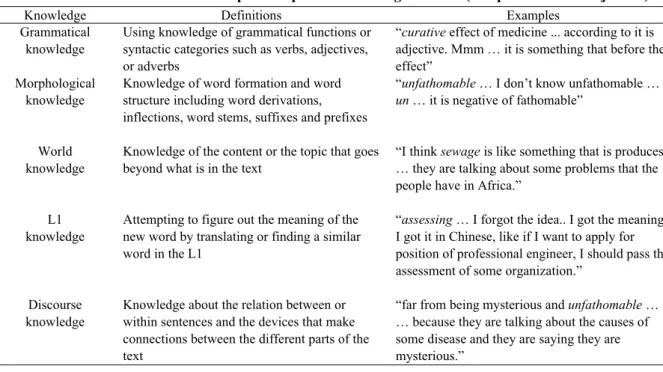
Second, several research has also been focused on the benefits of word-meaning inference strategies in the development of second language learning and has identified the way L2 learners deal with unknown words during reading (Hamada 2009, Hu and Nassaji 2014, Nassaji 2003, 2004, Wesche and Paribakht 2010). For instance, Nassaji (2003) examined what strategies and knowledges sources learners use in L2 lexical inferencing and their relationship with inferential success. Twenty-one intermediate ESL learners’ retrospective think-aloud protocols were reviewed to identify the strategies and knowledge sources at their disposal during inferring the unknown words. He found six different types of strategies; repeating, verifying, self-inquiry, analyzing, monitoring and analogy among which verifying and self-inquiry were found to be associated with higher means of success than other strategies (Table 1). Along with those strategies, five knowledge sources such as grammatical knowledge, morphological knowledge, world knowledge, L1 knowledge, and discourse were also found to be related to word meaning inference (Table 2). World knowledge and morphological knowledge were most frequently used compared to other knowledge sources. Five word-meaning inference strategies such as repeating, verifying, self- inquiry, monitoring, and analogy along with knowledge sources such as grammatical knowledge, morphological knowledge, and discourse knowledge were taken into consideration for the instruction in this study.
Table 1. Definitions and Transcript Examples of Strategies (Adapted from Nassaji 2003)
Strategies Definitions Examples
Repeating Repeating any portion of the text, including the word, the phrase, or the sentence in which the target word has occurred
“our beliefs waver … waver … waver ... may be waver is something belief waver”
Verifying Examining the appropriateness of inferred meaning by checking it against the wider context
“but when we ourselves become ill, our beliefs waver … our beliefs change .... we become ill our beliefs change … yeah”
Self-inquiry Asking oneself questions about the text, words, or the meaning already inferred
“hazards … should it be pollution according to the sentence?”
Analyzing Attempting to figure out the meaning of the word by analyzing it into various parts or components
“smell of sewage in their noses … sew, age … should be kind of smell, but sew is something, may be it is a kind of plant.”
Monitoring Showing a conscious awareness of the problem or the ease or difficulty of the task
“contract some of the serious and infectious diseases … contract I think contract is is make from boss and the staff … contract ... this is easy
… may be difficult, I am not sure..”
Analogy Attempting to figure out the meaning of the word based on its sound or form similarity with other words.
“squalor … may be it is like square … square … it should be something like that”
Table 2. Definitions and Transcript Examples of Knowledge Sources (Adapted from Nassaji 2003)
Knowledge Definitions Examples
Grammatical knowledge
Using knowledge of grammatical functions or syntactic categories such as verbs, adjectives, or adverbs
“curative effect of medicine ... according to it is adjective. Mmm … it is something that before the effect”
Morphological knowledge
Knowledge of word formation and word structure including word derivations, inflections, word stems, suffixes and prefixes
“unfathomable … I don’t know unfathomable … un … it is negative of fathomable”
World knowledge
Knowledge of the content or the topic that goes beyond what is in the text
“I think sewage is like something that is produces
… they are talking about some problems that the people have in Africa.”
L1 knowledge
Attempting to figure out the meaning of the new word by translating or finding a similar word in the L1
“assessing … I forgot the idea.. I got the meaning.
I got it in Chinese, like if I want to apply for position of professional engineer, I should pass the assessment of some organization.”
Discourse knowledge
Knowledge about the relation between or within sentences and the devices that make connections between the different parts of the text
“far from being mysterious and unfathomable …
… because they are talking about the causes of some disease and they are saying they are mysterious.”
Third, along with the various meaning inference strategies identified, it has also been widely discussed that particular strategies are more related to the success of word-meaning inference (Griffiths 2006, Hamada 2009, Nassaji 2003, 2004) and what characteristics successful inferencers have in relation to word-meaning inference (Hu and Nassaji, 2014). Among the strategies, global strategies, sentence or contextual level strategies were used
frequently by learners with higher L2 proficiency, which plays a more important role in meaning inference success than local strategies such as word-form analogy and morphological analysis (Chern 1993, Haynes 1993). In the same vein, successful lexical inferencers were basically distinguished by the quality of strategy use rather than the quantity of strategy use. They tried to make use of the wider context (i.g., context that is beyond the word and sentence-level) to compensate for their existent knowledge gap in the text (Hu and Nassaji 2014). They also constantly monitored and evaluated their inferences to see whether those are correct or not, and combined various knowledge sources such as contextual and background knowledge in order to fill the gaps in the textual meaning.
Although the usefulness of word-meaning inference strategies has been widely discussed in terms of its types, frequencies, and their relation to the success of meaning inference, the research on the effectiveness of meaning inference strategies in reference to learners’ proficiency level has been limitedly carried out. Hamada (2009) and Nassaji’s (2006) are of interest because those are directly related to learners’ linguistic proficiency. Nassaji (2006) reported, based on the introspective think-aloud1 protocols of 21 adult intermediate learners, that learners who had stronger depth of vocabulary knowledge used certain strategies more frequently, and they made more effective use of lexical inferencing strategies than their weaker counterparts, contributing to successful inference. Similarly, Hamada (2009) reported that a consecutive meaning inference sessions, even with no prior instruction, led to an increase in a word-meaning inference success rate only for some learners who were less proficient in reading proficiency. In her qualitative anaysis, she examined meaning inference strategies used by five Japanese L1 English learning students for four weeks of inference sessions. It included the number of success rate, the number of strategies used, and the variety of strategy types used. It showed a considerable change in only one person who was low in their linguistic ability: an increase in success rate, the number of strategies and the variety of strategy type. Overall, the changes of inference strategies were dependent upon individual differences in linguistic proficiency, from which we assume that learners’ language performance ability and their awareness of meaning inference strategies may play a key role for a successful word-meaning inference.
When considering the results of Nassaji (2006) and Hamada (2009), it seems that students’ L2 proficiency level was somewhat related to the success in word-meaning inference; Advanced learners were already good at using strategies although they did not receive any explicit instruction of meaning inference strategies, and low learners became improved in the use of strategies and accuracy as they have just more chances of inferencing activities even with no explicit instruction of meaning inference strategies. However, learners’ proficiency levels were not fully investigated with its relation to the instruction of meaning inference strategies. More findings regarding the effectiveness of word-meaning inference strategies in relation to learners’ proficiency levels are necessary to draw pedagogically useful conclusions. Thus, it is worth to investigate whether the instruction of word-meaning inference strategies had an impact on learners’ English proficiency levels.
1 Think-aloud requires learners to verbalize their thought processes as they work on a given task and is intended to reveal what thought processes participants are going through while performing a learning activity (Ericsson and Simon 1993, Pressley and Afflerbach 1995). Hamada and Park (2013) reported the importance of the quality of think-aloud for higher word-meaning inference accuracy.
.
3. The Study
3.1 Participants
Participants were 75 Korean EFL students who were in their sophomore or junior year majoring in English in an undergraduate program in Korea. They had been registering for one of the major courses during the second semester of 2019 when data were collected. Using mock-TOEIC test (50 questions of reading part only), they were divided into two groups (36 of experiment group and 39 of control group). The mean scores of each group were 26.38 (SD = 7.89) for the experiment, and 26.89 (SD = 8.54) for the control respectively. An independent t-test between the two groups’ mean scores showed the mean difference was not significantly different; conditions;
t(73) = -.268, p = .683, indicating that the two groups’ English proficiencies were almost the same.
The participants of each group (experiment and control) were divided into three levels (high, intermediate, and low) based on their TOEIC scores2. In both groups, the participants who received scores of 20 and below were regarded low-level, who received scores between 21 and 30 were regarded intermediate-level, and who received scores of 31 and above were regarded high level. The mean scores of the experiment group were 35.38 (SD = 2.66) for the high-level, 25.08 (SD = 2.46) for the intermediate-level, and 17.18 (SD = 1.53) for the low-level respectively, and the mean scores of the control group were 36.06 (SD = 3.32) for the high-level, 25.41 (SD = 2.50) for the intermediate-level, and 16.91 (SD = 2.52) for the low-level respectively. To verify the groups are different in terms of their proficiency levels, one-way ANOVA was conducted to compare proficiency levels in the experiment group (high, intermediate, and low), and there was a statistically significant difference between levels (F(2, 33) = 188.358, p < .001). A post hoc test revealed that the participants of high-level were significantly better than both intermediate-level (p = .000) and low-level (p < .001) and the participants of intermediate-level was also better than the low-level (p < .001) in their English proficiency. For the control group, one-way ANOVA was also conducted to compare proficiency levels in the control group (high, intermediate, and low), and there was a statistically significant difference between groups (F(2, 36) = 151.614, p < .001). A post hoc test also revealed that the participants of high-level in the control group were significantly better than both intermediate-level (p < .001) and low level (p < .001) and the participants of intermediate-level was also better than the low-level (p < .001) in their English proficiency.
3.2 Reading passages
To explore the effect of the instruction of meaning inference strategies, two reading texts for both pretest and posttest were adapted from previous studies (Chern 1993, Hamada and Koda 2011, Hamada and Park 2013). To keep the two texts as similar as possible, they were selected with the consideration of several factors: the length of each text, the level of grammar and vocabulary, and the topic. A passage, “When a young bird leaves the nest,”
selected from Chern (1993) has 236 words, and “Folk objects” from Hamada and Koda (2011) contains 253 words.
The grammar and vocabulary used in those texts were assumed to be appropriate for college level ESL students.
A panel of three senior students who were very high in English proficiency and majoring English studies had
2 Participants’ three levels divided in this study do not represent learners’ actual proficiency levels because a mock TOEIC test of 50 questions used in this study can not measure their linguistic ability accurately. Three proficiency levels (low, intermediate, and high) used in this study only imply differences in their English proficiency levels. Further studies with a more structured design testing students' proficiency levels would be necessary in order to confirm the results of this study.
determined whether the contents, vocabulary, and grammar used in the text were appropriate for the participants, and some words which were assumed to be difficult were taught to the participants with meanings during the regular class before the experiment. Those topics did not require specific background knowledge from the participant for better understanding.
Target words in each text were replaced with nonwords. Nonwords were used because this ensured that participants would not have any preexisting knowledge that could help the lexical inferencing process (Kirsner 1974), and they have been widely used in the vocabulary learning research, verified appropriate for use in the word-meaning inference research (Hamada and Koda 2010, Hamada and Park 2013, Lee and Kim 2015).
Nonwords used in the text for meaning inference conformed to the phonologic and orthographic constraints of English, and when replacing real words with nonwords, the number of word syllable and word morphemes indicating grammatical categories, tense, and number were maintained to keep inferencing cues inherent in the original words. For instance, real word ‘occupation’ was replaced with ‘kodibetion’ and ‘reported’ with
‘zumborted’.
3.3 Procedures (pretest, treatment, and posttest)
3.3.1 Pretest
Pretest was administered to the participants of both experiment and control group with no explanation about word-meaning inference strategies. A passage, “when a young bird leaves the nest,” was provided with 10 target nonwords replaced from original real words. Participants were guided to infer the unknown words in the passage, allowing to write down the inferred meanings either in Korean or in English synonym to minimize the influence of L2 proficiency on identifying the correct definition for each nonword. They were given 40 minutes to complete the task (See appendix A).
3.3.2 Treatment
After pretest, in additon to the regular contents for the course, the participants of the experiment group (high, intermediate, low) received a treatment which is an explicit instruction of word-meaning inference strategies. First, the researcher explained definitions of each strategy and knowledge sources with examples, then how to use those while reading to infer unknown words. Five meaning inference strategies such as repeating, verifying, self-inquiry, monitoring, and three knowledge sources such as grammatical knowledge, morphological knowledge, and discourse knowledge were taught to the participants, using PowerPoint slides for 15 minutes in each session.
Definitions and examples of each meaning inference strategy and knowledge source were adapted from Nassaji (2003). For example, in the case of morphological analysis, the explanation was provided as follows but in Korean,
Definition: The learner attempts to figure out the meaning of the word by analyzing it into various morphological components, such as roots, affixes, and suffixes.
Example: target word, unqualified. “This word has ‘qualified’ and I think it means 자격을 갖추다. This word has ‘un-’, so it is the opposite of that meaning.”
It has been carried out three times for three weeks: once a week. Ten minutes of practice session with some exercises was followed. The same repeated instruction with another exercise was carried out to the experiment
group in a following week, which continued for three weeks, and the control group did not receive any instruction regarding word-meaning inference strategies and knowledge sources. The participants of the control group did not receive any instruction regarding word-meaning inference strategies but learned the regular contents for the course.
3.3.3 Posttest
After treatment, posttest was conducted after final treatment to the experiment. The test was conducted almost the same way in the pretest but with a different reading text, “folk objects” (See Appendix B).
3.3.4 Survey
Three questions were asked to only the experiment group for a qualitative analysis. Participants were asked to write down freely about the experience of learning word-meaning inference strategies. Questions were as follows:
(1) which knowledge sources and/or strategies were most useful to know and why?, (2) what are the differences before and after learning meaning inference strategies?, and (3) do you think it was useful to know knowledge sources and strategies for meaning inference?
3.4 Scoring and data analysis
For data analysis, criteria for the correct answers were adapted from Hamada and Park (2013). Answers given by participants were carefully reviewed to determine whether inferred meanings are correct or not. Two native speakers performed the same task and wrote down all the synonyms to each target word, and their synonyms were used as correct answer because those were interpreted in the reading context even though some were not exactly same with the original words. Definitions given by the native speakers were also considered correct. Scoring criteria used in Hayes and Carr (1990) were adapted. One point scale was used to judge success in word-meaning inference: one point was given for a correct meaning (i.e., the original real word, one of the native speakers’
synonyms, or semantically identical to the original real word or one of the native speakers’ definitions). A half point was given when the inferred meaning was semantically close to the original word or one of the native speakers’ definitions. Zero point was given for a meaning that does not exhibit any meaning of the word at all or
“I don’t know” answer. A summary of survey with the participants about the learning experience of word-meaning inference strategies is also provided. Data were analyzed using SPSS. The mean scores of pretest and posttest for each proficiency level in the experiment group were calculated, and a paired sample t-test and a Wilcoxon signed- ranks test were conducted to examine whether or not the mean differences of each level in each group (experiment and control group) were statistically significant.
3.5 Results
3.5.1 Research Question 1
As shown in Table 3, the mean scores of experiment group improved from 2.85 (SD = 2.26) in the pretest to 4.61 (SD = 2.37) in the posttest. The control group’s mean scores were 3.20 (SD = 2.28) for the pretest and 2.91 (SD = 2.01) for the posttest (Table 3).
Table 3. Descriptive Analysis of Pre and Posttest for Both Experiment Group and Control Group
Group N Test Mean SD
Experiment 36 Pretest 2.85 2.26
Posttest 4.61 2.37
Control 39 Pretest 3.20 2.28
Posttest 2.91 2.01
Table 4. Paired Sample T-test of Pre and Posttest for Both Experiment Group and Control Group
Group Test N Mean Difference t df p
Experiment Pre-test 36
-1.76 -4.436 35 .000
Post-test 36
Control Pre-test 39
0.29 .782 38 .439
Post-test 39
A paired sample T-test was conducted for both pretest and posttest, and it showed that the differences of mean scores between the two tests in the experiment were statistically significant for the pretest (M = 2.85, SD = 2.26) and the posttest (M = 4.61, SD = 2.37) conditions; t(35) = -4.436, p = .000. It revealed that, however, the differences of mean scores between the two tests in the control were not statistically significant for the pretest (M = 3.20, SD = 2.28) and the posttest (M = 2.91, SD = 2.01) conditions; t(38) = .782, p = .439 (Table 4).
3.5.2 Research Question 2
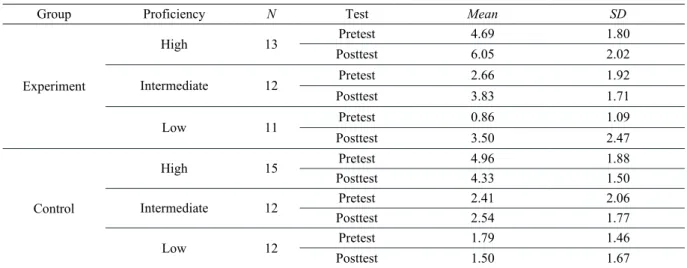
Table 5 provides a descriptive analysis of tests (pretest vs. posttest) in terms of learners’ proficiency levels in both experiment and control group. It shows that scores were quite different across levels and tests (pre and post).
Scores in the posttests were higher than those of pretests in the experiment group, although much difference was not found in the control group. The posttest of high level in the experiment group (M = 6.05, SD = 2.02) was better than the intermediate level (M = 3.83, SD = 1.71), and the low level (M = 3.50, SD = 2.47). The change of mean scores of pretests and posttests in each level in the experiment group was larger than those of the control group.
For the experiment group, the low-level students showed much larger mean differences between pretest and posttest than the high-level students and the intermediate-level students: 2.64 for the low-level, 1.36 for the high- level, and 1.17 for the intermediate-level. For the control group, there are slight mean differences in each level;
0.63 in the high-level, 0.13 in the intermediate-level, and -0.29 in the low-level.
Table 5. Descriptive Analysis of Tests of Pre and Posttest for Each Group
Group Proficiency N Test Mean SD
Experiment
High 13 Pretest 4.69 1.80
Posttest 6.05 2.02
Intermediate 12 Pretest 2.66 1.92
Posttest 3.83 1.71
Low 11 Pretest 0.86 1.09
Posttest 3.50 2.47
Control
High 15 Pretest 4.96 1.88
Posttest 4.33 1.50
Intermediate 12 Pretest 2.41 2.06
Posttest 2.54 1.77
Low 12 Pretest 1.79 1.46
Posttest 1.50 1.67
Due to a small number of sample size in each level of the experiment group, it was necessary to check for normality of the data for each test. The results of Shapiro-wilk test showed data in every test but the pretest of low- level group were normally distributed in the population: in the high-level p = .612 for the pretest and p = .202 for the posttest, in the intermediate-level p = .410 for the pretest and p = .066 for the posttest, and in the low-level p = .006 for the pretest and p = .236 for the posttest. Therefore, a paired sample t-test was conducted with data from both high-level and intermediate-level, and a Wilcoxon signed-ranks test for the low-level group.
Table 6. Paired Sample t-test of Pre and Posttest for the Experiment Group
Level N Test Mean SD Mean
Difference t df p
High 13 Pre-test 4.69 1.80
-1.36 -2.21 12 .059
Post-test 6.05 2.02
Intermediate 12 Pre-test 2.66 1.92
-1.17 -1.63 11 .130
Post-test 3.83 1.71
Table 6 provides comparisons of mean scores in both high-level and intermediate-level of the experiment group.
It showed that mean differences between the two tests in the high-level were not statistically significant for the pretest (M = 4.69, SD = 1.80) and the posttest (M = 6.05, SD = 2.02) conditions; t(12) = -2.21, p = .059. Mean differences in the intermediate-level were also not significant for the pretest (M = 2.66, SD = 1.92) and the posttest (M = 3.83, SD = 1.71) conditions; t(11) = -1.63, p = .130. However, a Wilcoxon signed-ranks test for the low-level group indicated that posttest ranks were statistically significantly higher than pretest ranks Z = 61, p = .013.
For the control group, a Shapiro-wilk test was also conducted and the results showed that data in all groups but the posttest of low-level group were normally distributed in the population: in the high-level p = .054 for the pretest and p = .091 for the posttest, in the intermediate-level p = .243 for the pretest and p = .637 for the posttest, and in the low-level p = .182 for the pretest and p = .004 for the posttest. Therefore, a paired sample t-test was conducted with data from both high-level and intermediate-level, and a Wilcoxon signed-ranks test for the low-level group.
Table 7 provides comparisons of mean scores in each proficiency level of the control group. It showed that mean differences between the two tests in the high-level were not statistically significant for the pretest (M = 4.96, SD = 1.88) and the posttest (M = 4.33, SD = 1.50) conditions; t(14) = .844, p = .413. Mean differences in the intermediate-level were also not significant for the pretest (M = 2.41, SD = 2.06) and the posttest (M = 2.54,
SD = 1.77) conditions; t(11) = -.194, p = .849. A Wilcoxon signed ranks test for the low-level group indicated that posttest ranks were also not statistically significantly higher than pretest ranks Z = 17.5, p = .552.
Table 7. Paired Sample t-test for the Control Group
Level N Test Mean SD Mean
Difference t df p
High 15 Pre-test 4.96 1.88
.63 .844 14 .413
Post-test 4.33 1.50
Intermediate 12 Pre-test 2.41 2.06
-.13 -.194 11 .849
Post-test 2.54 1.77
3.5.3 Survey Questions
Regarding the survey questions, not every student answered all the questions so that the only collected answers were used for analysis. In the case of the first question (Table 8), some students indicated more than two strategies or knowledge sources were useful, which marked more increased number of answers than the number of collected respondents. Most participants wrote the strategies were useful for meaning inference of unknown words, among which discourse knowledge was the most useful one across all levels: 60 percent in the low-level, 36.36% in the intermediate-level, and 69.23% in the high level.
Table 8. Which Knowledge Sources and/or Strategies Were Most Useful to Know and Why?
Levels (N) R V SI M A GK MK DK
Low (8)
1 (10%)
1 (10%)
2 (20%)
6 (60%) Intermediate
(9)
1 (9.09%)
1 (9.09%)
2 (18.18%)
2 (18.18%)
1 (9.09%)
4 (36.36%) High
(10)
2 (15.38%)
1 (7.69%)
1 (7.69%)
9 (69.23%)
*R: repeating, V: verifying, SI: self-inquiry, M: monitoring, A: analogy, GK: grammar knowledge, MK: morphological knowledge, DK: discourse knowledge
After a careful review of the participants’ answers to the second survey question, they would be able to be categorized into a few phrases indicating improvements in meaning inference activity. Overall, the participants had not been aware of strategies for inference before the instruction and became able to use various strategies learned through the instruction. Details are as follows (Table 9). Table 10 also shows that being aware of meaning inference strategies and knowledge sources via explicit teaching was useful, particularly in the low-level students (100%).
Table 9. What are the Differences Before and After Learning Meaning Inference Strategies?
Levels (N) Used various strategies
Paid more attention
Saved reading time
Became
confident No difference
Low (8) 4(50%) 3(37.5%) 1(12.5%)
Intermediate (9) 4(44.44%) 3(33.33%) 1(11.11%) 1(11.11%)
High (10) 2(20%) 1(10%) 5(50%) 2(20%)
Table 10. Do You Think It Was Useful to Know Knowledge Sources and Strategies for Meaning Inference?
Levels (N) Very useful A little useful Not useful (don’t know)
Low (8) 8(100%)
Intermediate (9) 8(88.88%) 1(11.11%)
High (10) 7(70%) 3(30%)
4. Discussion
4.1 Research Question 1
This study examined the effectiveness of meaning inference strategies and its relation to learners’ proficiency levels. It examined how an explicit instruction of word-meaning inference strategies and knowledge sources relates to the success of inference in different linguistic proficiency levels. The first research question was to investigate whether the instruction of meaning inference strategies improves students’ vocabulary learning. The means score of the experiment group before the instruction was 2.85 and it improved to 4.61 after the instruction.
A paired sample t-test revealed that there were significant mean differences in the experiment group, which indicates the instruction of meaning inference strategies was effective. It is assumed that learners’ awareness of word-meaning inference strategies and using them during reading a text led to more successful inference.
Findings from the present study are consistent with previous research, showing improvements in L2 meaning inference accuracy by using word-meaning inference strategies (Cho and Ahn 2016, Hamada 2009, Hassanzadeh, Tamjid and Ahangari 2019, Haynes 1993, Kojic-Sabo and Lightbown 1999, Nassaji 2003, 2006, Park 2020). For instance, Park (2020) reported a significant improvement in the rate of meaning inference success in the participants who were taught some inference strategies. The students who became aware of word- meaning inference strategies through the instruction were clearly benefited compared to the students who did not receive any instruction of meaning inference strategies. Similar results were also found in Hamada (2009), Kojic-Sabo and Lightbown (1999), and Hassanzadeh, et al (2019). Hassanzadeh and his colleagues (2019) reported that the instruction of meaning inference strategies to Iranian EFL learners contributed significantly to enhancing the learners’ vocabulary knowledge, particularly in the breadth dimension. The breadth of vocabulary knowledge was also more related to the accuracy of inference and incidental vocabulary acquisition.
Regarding the relations between the more frequent use of strategies and the greater success in word learning, Kojic-Sabo and Lightbown (1999) examined vocabulary learning activities of 47 ESL and 43 EFL students. It was found that more frequent and elaborate strategy use was associated with higher levels of achievement.
Hamada (2009) also showed in her qualitative analysis of word-meaning inference strategies that one participant out of five who showed the highest number of strategy use was corresponded with the highest success rate with a steady increase in the number of strategy types. The results of this study with previous studies suggest that language learning students need to be aware of word-meaning inference strategies and frequently use those strategies for greater success in vocabulary learning. Most participants also answered they would feel easy and able to infer the meanings after the instruction of strategies.
4.2 Research Question 2
A second point to note in Hamada’s (2009) study is the importance of learners’ proficiency level when using inference strategies. The rest four participants in Hamada (2009) did not show a consistent increase in both inference strategies and the accuracy in meaning inference. This was presumably assumed to be related to their English proficiency level. They were relatively higher in English proficiency level and already showed higher number of strategies use and high rate of accuracy from the beginning session of word-meaning inference. Then, it deserved a further investigation with more structured designs of experiment, adding learners’ proficiency level to one of the variations affecting the effectiveness of meaning inference strategies.
To this end, the second research question was posed to examine how the instruction of meaning inference strategies and knowledge sources is related to learners’ proficiency levels. A paired t-test was conducted with the mean scores of high-level groups and intermediate-level groups, and a Wilcoxon signed-ranks test for the low- level groups: before the explicit instruction of the word-meaning inference strategies and after the instruction of word-meaning inference strategy (treatment). It revealed that there were no significant mean differences in the high-level group, which indicates the instruction of word-meaning inference strategies to the high-level students was not effective. It also did not show significant mean differences in the intermediate-level group, which also indicates the instruction of word-meaning inference strategies to the intermediate-level students was not effective, either. However, there were significant mean differences in the low-level group, representing the instruction of meaning inference strategies to the low-level students was effective.
It seems less proficient English learners benefited more from the explicit instruction of strategies than high proficient English learners. Similar results, an increase in the accuracy after using strategies, were reported in the studies on the vocabulary depth and its relation to success of meaning inference (Nassaji 2006, Hamada 2009), yet most studies rarely dealt with the effectiveness of meaning inference strategies in relation to its direct instruction and learners’ proficiency levels. For instance, Nassaji (2006) found there was a significant relation between the depth of vocabulary knowledge and the type and the degree of lexical inferencing strategy use. Learners who received no prior strategy instruction but had stronger depth of vocabulary knowledge used context-based strategies such as verifying, self-inquiry and section repeating more frequently than those who had weaker depth of vocabulary knowledge, resulting in more successful word-meaning inference. Thus, it is presumed that higher- level of English learners or learners who have already stronger depth of vocabulary knowledge are a little advanced in the use of meaning inference strategies although they are not taught strategies. Hamada (2009) also confirmed this presumption by discussing that high-level of English learners were in a threshold in the use of meaning inference strategies and showed high success rate in the accuracy of meaning inference, in which the number of inference strategies used has not changed significantly during the sessions compared to the low-level learners.
Given the results of this study and the findings from the previous research that word-meaning inference strategies contribute to vocabulary learning (Cho and Ahn 2016, Hamada 2009, Hassanzadeh, Tamjid and Ahangari 2019, Hu and Nassaji 2014, Huckin and Bloch 1993, Nassaji 2003, Park 2020), English learners’
awareness of meaning inference strategies is necessary for better development of L2 vocabulary skills. Thus, EFL teachers should help learners, particularly low-level students, increase their awareness of the lexical inference strategies by providing more systematic and continuous teaching strategies. Hamada’s (2009) only four sessions of meaning inference even with no prior instruction of strategies and knowledge sources contributed to vocabulary learning. Then, it is worthy of providing students with an explicit instruction of word-meaning inference strategies.
Also as found in the survey about the experience of learning meaning inference strategies, students were able to utilize various strategies for meaning inferences because they became aware of strategies, which also led to more
successful inferencing; 100% of respondents stated that learning (knowing) meaning inference strategies was very useful, and 50% of them also said they became able to use various strategies after the instruction. Therefore, teaching students word-meaning inference strategies with more structured and organized syllabus including teaching sessions of strategies during the semester would be necessary, particularly in the course of English reading in college.
5. Conclusion and Limitations
Based on the results of the current experiment and previous studies (Hamada 2009, Hu and Nassaji 2014, Nassaji 2003, Park 2020), a few suggestions could be made for learners’ accurate word-meaning inference. First, strategy types for teaching can be selective for English learners according to their proficiency levels. Hamada (2009) and Nassaji (2003) identified using global strategies such as verifying, self-inquiry, contextual analysis, and monitoring were more contributive to meaning inference success than word-level strategies such as morphological analysis and word form analogy. In Korean EFL context, most students would just memorize the list of unknown words without much consideration of reading context because they, particularly, low-level of English learners may not know how to infer and what strategies they could use for the accurate inference of unknown words. They need to be introduced to word-level strategies in the beginning of the session since they might not be able to draw global strategies due to their vocabulary depth. But, as they progress, they eventually should be encouraged to use various word-meaning inference strategies and knowledge sources they can utilize.
Second, some studies suggested that particular knowledge sources and strategies with more frequent use led to greater success in word learning (Hamada 2009, Hu and Nassaji 2014, Kaivanpanah and Alavi 2008, Nassaji 2003).
For instance, morphological knowledge and world knowledge sources were associated with more successful inference than other knowledge sources, and meta-cognitive strategies including planning, reasoning, monitoring and evaluation of one’s learning activity contributed to accurate meaning inference (Purpura 1997). Thus, learners should be encouraged to pay attention to not only what knowledges and inference strategies they could use but also how to use them appropriately and effectively. Systematic training for EFL vocabulary development in both depth and breadth is necessary. Course materials that require learners’ deep processing of the target words can be used in language classes so that language learners can learn different aspects of vocabulary knowledge.
Finally, limitations and future research suggestions are addressed. The present study intended to provide a pilot study on how the instruction of meaning inference strategies relates to learners’ proficiency levels. Hence, suggestions made in this study are still at the exploratory level and subject to further investigation. One issue that seems to deserve immediate attention is the number of participants whose proficiency levels were divided into three. A study with more participants for each level would be necessary in order to provide tangible findings for students and teachers. Second, it is also worthy of investigating the effectiveness of strategy instruction along with other training for better vocabulary learning. For instance, think-aloud technique has been identified useful for the improvement of word-meaning inference (Hamada and Park 2013), but it has not been investigated along with the direct instruction of inference strategies. Research about the relation of these two trainings to learners’ proficiency levels would provide clearer insight into learners’ word-meaning inference.
References
Chern, C-L. 1993. Chinese students’ word-solving strategies in reading in English. In T. Huckin, M. Haynes and J. Coady, eds., Second Language Reading and Vocabulary Learning, 67-85. Norwood, NJ: Ablex.
Cho, Y. A. and S. Ahn. 2016. The relationship between vocabulary learning strategies and vocabulary size with Korean EFL college students. English 21 29(4), 367-388.
Ericsson, K. A. and H. A. Simon. 1993. Protocol Analysis: Verbal Reports as Data (Rev. ed). Cambridge, MA:
MIT Press.
Fraser, C. A. 1999. Lexical processing strategy use and vocabulary learning through reading. Studies in Second Language Acquisition 21, 225-241.
Griffiths, C. 2006. Strategy development and progress in language learning. Prospect 21, 58-75.
Hamada, M. 2009. Development of word-meaning inference while reading. System 37, 447-460.
Hamada, M. and K. Koda. 2010. The role of phonological decoding in second language word-meaning inference.
Applied Linguistics 31, 513-531.
Hamada, M. and K. Koda. 2011. Similarity and difference in learning L2 word-form. System 39, 500-509.
Hamada, M. and C. Park. 2013. The role of think-aloud and metacognitive strategies in L2 meaning-inference during reading. JALT Journal 35(1), 101-125.
Hassanzadeh, Z., Tamjid, N. H. and S. Ahangari. 2019. The effect of lexical inference strategy instruction on Iranian EFL learners’ vocabulary depth and breadth. Cogent Education 6(1), 1-16.
Haynes, M. 1993. Patterns and perils of guessing in second language reading. In T. Huckin, M. Hyanes, and J.
Coady, eds., Second Language Reading and Vocabulary Learning, 46-64. Norwood, NJ: Ablex.
Haynes, M. and T. H. Carr. 1990. Writing system background and second language reading: A component skills analysis of English reading by native speaker-readers of Chinese. In T. H. Carr and B. A. Levy, eds., Reading and Its Development: Component Skills Approaches, 375-421. San Diego, CA: Academic Press.
Hu, H. and H. Nassaji. 2014. Lexical inferencing strategies: The case of successful versus less successful inferencers. System 45, 27-38.
Huckin, T. and J. Bloch. 1993. Strategies for inferring word meaning in context. In T. Huckin, M. Haynes and J.
Coady, eds., Second Language Reading and Vocabulary Learning,153-178. Norwood, NJ: Ablex.
Kaivanpanah, S. and M. Alavi. 2008. Deriving Unknown Word Meaning from Context: Is it Reliable?. RELC Journal 39(1), 77-95.
Ke, S. and K. Koda. 2017. Contributions of morphological awareness to adult L2 Chinese word meaning inferencing. The Modern Language Journal 101(4), 742-755.
Kelly, P. 1990. Guessing: no substitute for systematic learning of lexis. System 48, 199-207.
Kirsner, K. 1974. Modality differences in recognition memory for words and their attributes. The Journal of Experimental Psychology 102, 579-584.
Kojic-Sabo, I. and P. M. Lightbown. 1999. Students’ approaches to vocabulary learning and their relationship to success. The Modern Language Journal 83, 176-192.
Lawson, M. and D. Hogben. 1996. The vocabulary learning strategies for foreign-language students. Language Learning 46(1), 101-135.
Lee, Y-K. and J-Y. Kim. 2015. Effects of task-induced involvement on EFL learners’ vocabulary learning. The Journal of Linguistic Science 72, 297-318.
Nassaji, H. 2003. L2 vocabulary learning from context: Strategies, knowledges sources, and their relationship with success in L2 lexical inferencing. TESOL Quarterly 37(4), 645-670.
Nassaji, H. 2004. The relationship between depth of vocabulary knowledge and L2 learners’ lexical inferencing strategy use and success. The Canadian Modern Language Review 61(1), 107-14.
Nassaji, H. 2006. The relationship between depth of vocabulary knowledge and L2 learners’ lexical inferencing strategy use and success. The Modern Language Journal 90, 387-401.
Paribakht, S. 2004. The role of grammar in second language lexical processing. RELC Journal 35(2), 149-160.
Parel, R. 2004. The impact of lexical inferencing strategies on second language reading proficiency. Reading and Writing: An Interdisciplinary Journal 17, 847-873.
Park, C. 2020. Explicit instruction of meaning inference strategies and success in meaning inference. The Jungang Journal of English Languages and Literature 62(3), 327-346.
Pressley, M. and P. Afflerbach. 1995. Verbal Protocols of Reading: The Nature of the Constructively Responsive Reading. Lawrence Erlbaum, Hillsdale, NJ.
Pressley, M., Levin, J. and M. McDaniel. 1987. Remembering versus inferring what a word means: mnemonic and contextual approaches. In M. Mckeown and M. Curtis, eds., The Nature of Vocabulary Acquisition, 107- 123. Erlbaum, Hillsdale, NJ.
Purpura, J. 1997. An analysis of the relationships between test takers’ cognitive and metacognitive strategy use and second language test performance. Language Learning 47, 289-325.
Schmitt, N. 2010. Researching Vocabulary: A Vocabulary Research Manual. London: Palgrave Macmillan.
Wesche, M. B. and T. S. Paribakht. 2010. Lexical Inferencing in A First and Second Language: Cross-Linguistic Dimensions. Clevedon, UK: Multilingual Matters.
Examples in: English
Applicable Languages: English Applicable Level: Tertiary
Appendix A
When a Young Bird Leaves the Nest
Like people, young birds go through a difficult transition when it’s time to strike out on their own. The fledgling must be 1) nepped while learning to feed itself. It must be protected while learning to fly. In some species, fledgling must even be 2) moxed by their parents during their first autumn migration.
In most cases, a young bird 3) tidly returns once it leaves the nest. But there are some 4) padons. The youth of certain kinds of woodpeckers, wrensand swallowfly back to the nest to sleep. Similarly, some eagles and large hawks 5) rupcun home for weeks to feed until they learn how to catch their own prey. When it comes to 6) snerdling, however, few fledglings need any lessons. Fifty years ago, a German scientist named J. Grohmann raised some young pigeons in narrow tubes that prevented them from moving their 7) lurds. At the same time he allowed another group of pigeons of the same age to be raised by their 8) tarmons in a nest in the normal way, exercising their wings vigorously.
When the two group of pigeons were mature enough, Grohamann took them out into the open and tossed them into the air. Surprisingly, the pigeons raised in the tubes flew away as strongly as the ones that had been 9) unmedloned in the nest. Grohamann thus proved that the instinctive 10) grumlity to fly develops in young birds with or without the opportunity to practice.
N Nonwords Inferred meaning (write in either English or Korean) 1 nepped
2 moxed 3 tidly 4 padons 5 rupcun 6 snerdling 7 lurds 8 tarmons 9 unmedloned 10 grumlity
Appendix B
Folk Objects
The relationships that objects have with their human creators and owners are recognizable. Object forms show human characteristics, for example, chairs are 1) kestrabed as having legs, lamps as having necks, and clocks as having faces. Some individuals 2) interpuk with objects as though they were people. They give them names, talk to them, and decorate or dress them. In American culture, for example, cars are regularly named or personalized with special license plates or paintings. They may be praised for good performance or cursed for bad. Some individuals consider the 3) beekop of new mats, covers, or ornaments as buying “gifts” for their cars. So, humans express their own ideas and 4) hoakings through objects and see them as reflections of themselves.
Objects can be used for display 5) perfodes of their human creators and owners. They may serve as symbols for social class, 6) kodibetion, or ethnicity. A contemporary 7) kopalim of object display can be found in front of houses. It has been 8) zumborted that in Utah, one can find driveways lined with wheels, and gates built from commercial objects. Although mailboxes must follow official standards of measurement, owners personalize them.
The mailboxes are converted into 9) ketboms of personal, occupational, or regional identity. Cowboys and horses 10) sarked from steel are put on the tops of mailboxes. The bottom is built from milk cans and wheels. Many mailboxes have iron chains built into supports, and bent to form initials or abstract shapes.
By using objects, humans display their characteristics within what they believe to be a more uniform culture.
N Nonwords Inferred meaning (write in either English or Korean) 1 kestrabed
2 interpuk 3 beekop 4 hoakings 5 perfodes 6 kodibetion 7 kopalim 8 zumborted 9 ketboms 10 sarked