KOREAN JOURNAL OF ENGLISH LANGUAGE AND LINGUISTICS
ISSN: 1598-1398 / e-ISSN 2586-7474 http://journal.kasell.or.kr
Grammatical Complexity of EFL Learners’ Casual Conversation at Different Proficiency Levels
Soyeon Yoon (Incheon National University) Shinjae Park (Incheon National University)
This is an open-access article distributed under the terms of the Creative Commons License, which permits unrestricted non- commercial use, distribution, and reproduction in any medium, provided the original work is properly cited.
ABSTRACT
Yoon, Soyeon and Shinjae Park. 2021. Grammatical complexity of EFL learners’
casual conversation at different proficiency levels. Korean Journal of English Language and Linguistics 21, 599-616
Grammatical complexity of written and spoken language of L2 leaners has been extensively studied, but casual conversation of L2 learners remains rarely explored although it is considered one of the most basic forms of speech. This study explores whether proficiency level modulates grammatical complexity in casual conversation.
We examined the conversations performed by 51 Korean EFL learners of two proficiency levels (HIGH and LOW) and 21 native speakers of American English (NS). The syntactic complexity was measured for global scale complexity (e.g., production length, use of subordination) and clause complexity for fine-grained scale complexity (e.g., components within a clause). As a result, in the global scale, HIGH demonstrated complex structures more often than LOW in general, and similarly with or more often than NS. HIGH employed subordination as often as NS do, but demonstrated more complex structures for production length and complex nominals.
NS used more coordination than the non-native speakers. In the fine-grained scale, HIGH produced more dependents in a clause than LOW in general. When compared with NS, HIGH employed more dependents and subordination conjunctions or similar number of clausal complements and prepositions. In short, HIGH used grammatical structures close to written compositions rather than natural conversation. The results suggest that proficient learners can readily use complex structures as often as NS do, but their conversation is not as natural as that of NS.
Received: June 07, 2021 Revised: July 10, 2021 Accepted: July 25, 2021
Soyeon Yoon (1st author) Professor, Dept. of English Language and Literature, Incheon National University
Shinjae Park (corresponding author) Instructor, Dept. of English Language and Literature, Incheon National University
KEYWORDS
syntactic complexity, clause complexity, casual conversation, second language acquisition, proficiency level, learner spoken corpus
1. Introduction
Grammatical complexity1 has been studied as a measure for language users’ proficiency levels for decades (Anderson 1937, Hunt 1965, Biber, Gray and Poonpon 2011, p. 6). A number of studies investigated grammatical complexity on the assumption that more proficient speakers produce more complex expressions, roughly represented by longer unit, clausal subordination, and more complex phrases (Cumming, Kantor, Baba, Erdosy, Eouanzoui and James 2005, Kyle 2016, Lu 2011, Ortega 2003, Wolfe-Quintero, Inagaki and Kim 1998). However, as many scholars have pointed out (Biber et al. 2011, Biber, Gray and Staple 2016, Hwang, Jung and Kim 2020), the studies on grammatical complexity have relied on written data, and even when spoken data were examined, they were mostly monologues where the speakers are given a topic (Biber et al. 2016) or interviews where the speakers answer the interviewers’ prompts (Lintunen and Mäkillä, 2014). On the other hand, EFL (English as a Foreign Language) learners’ casual conversation has rarely been investigated, although ordinary conversation is considered the most basic forms of speech that other forms of talk-in-interaction are derived from (Paltridge 2012, p. 91). Nevertheless, the EFL learners now are getting exposed to the situations where casual conversation is used, like travelling abroad for business, study, or tourism, or encountering incoming foreign population. Therefore, it is essential to understand the characteristics of EFL learners’ casual conversation and apply it to language education.
Since casual conversation involves dynamic interaction between two or more speakers where they have to respond spontaneously and immediately, it may be possible to observe the learners’ most entrenched construction (including lexical items and syntactic structures) (Kemmer and Barlow 2000), which the speakers can readily and easily access. Investigating casual conversation data will lead us to a more complete picture of relations between the proficiency level of EFL learners and the degree of grammatical complexity that they use.
Therefore, this study aims to identify the characteristics of grammatical complexity that might be different according to proficiency in EFL learners’ spontaneous conversation. To this end, we examine the spoken data of casual conversations performed by 51 Korean EFL learners of two proficiency levels (high and low) and 21 native speakers (NS) of English as a control group.
2. Previous Studies
2.1 Grammatical Complexity and L2 Proficiency
According to Biber et al. (2016), grammatical complexity has been considered one of the measures of proficiency of first language development since the 1930’s (Anderson 1937), and expanded to L2 development in
1 We adopt the term grammatical complexity (Biber et al. 2011, Larsen-Freeman 2006) to encompass both syntactic complexity and clause complexity. Various terms have been used to indicate the complexity relevant to syntactic structure:
grammatical complexity, complex syntax (Nippold et al. 2014), syntactic complexity (Ai and Lu 2013, Hwang, Jung and Kim 2020, Lintunen and Mäkillä 2014, Yazdani 2018), and syntactic sophistication (Kyle 2016). Among these, the term syntactic complexity seems to be widely used, but in this study, this term indicates a set of indices that are automatically calculated by Syntactic Complexity Analyzer (Ai and Lu 2013). The measurement includes 14 indices that are adopted from Wolfe-Quintero et al. (1998) and Ortega (2003). The indices are calculated by counting the number of components (clause, phrase, words) in a clause or sentence (i.e., in global scale), but they do not show the internal structure of the clause. In order to examine the component type of a clause (i.e., fine-grained scale), we adopt another measurement called clause complexity (Kyle 2016).
the 1970’s (Cooper 1976), along with grammatical accuracy and fluency (Larsen-Freeman 2006). Traditionally, grammatical complexity has been quantified with regard to length of a unit (e.g., sentence, clause, or T-unit) and clausal subordination, and recently, phrasal complexity (Biber et al. 2011, Biber et al. 2016, Kyle, 2016) has also been added.
Several units have been widely used to quantify grammatical complexity. A sentence has been used for the analysis of written data. However, noticing that the punctuation is not necessarily consistent (Lintunen and Mäkillä 2014, p. 383), Hunt (1965, p. 21) proposed the T-unit (minimal terminable unit), which is defined as in (1).
(1) T-unit: a unit that consists of one main clause and (optional) subordinate clauses and non-clausal units or sentence fragments attached to it
A clause has been defined differently depending on studies: Some studies define it as a unit that consists of a verbal element plus additional clause elements such as an object or an adverbial (Foster, Tonkyn and Wigglesworth 2000, p. 366) whereas the current study define it as in (2), following the definition of Hunt (1965) and some automatic complexity analyzing tools (Kyle 2016, Lu 2013).
(2) Clause: a unit with a subject and a finite verb
If we adopt (2) as the definition of a clause, the sentence in (3) can be analyzed as (4).
(3) Since he got so upset, I didn’t think we would want to wait for Tina to come back, and I wanted to leave as soon as possible. (adopted and modified from Biber et al. (2011, p. 14))
(4) a. one sentence
b. two T-units (Since he got so upset, I didn’t think… / I wanted…)
c. four clauses (Since he got so upset… / I didn’t think… / we would want… / I wanted…)
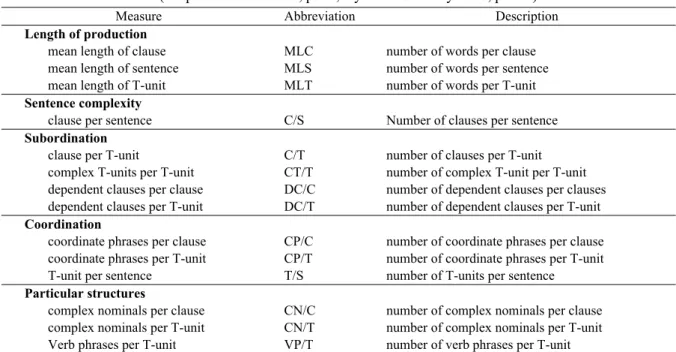
Regarding the grammatical complexity, the present study adopted the indices of syntactic complexity proposed by Lu (2010, 2011), following many studies (Ai and Lu 2013, Kyle 2016, Kyle and Crossley 2017, Wolfe-Quintero et al. 1998) to examine grammatical complexity as a global dimension, meaning that the indices examine the frequency and function at the level of clause and sentence. Table 1 lists the 14 indices of syntactic complexity adopted from Lu (2011), and the indices are categorized so they can represent “a different (yet interrelated) aspect of complexity” (Bulté and Housen 2014, p. 47, parentheses are original). The sets are the mean length of production, the complexity in sentence level, the amount of subordination, the amount of coordination, and the number of complex nominals and verb phrases.
Table 1. Description of Each Syntactic Complexity Index (adopted from Lu 2011, p. 42, Kyle and Crossley 2017, p. 521)
Measure Abbreviation Description
Length of production mean length of clause mean length of sentence mean length of T-unit
MLC MLS MLT
number of words per clause number of words per sentence number of words per T-unit Sentence complexity
clause per sentence C/S Number of clauses per sentence Subordination
clause per T-unit
complex T-units per T-unit dependent clauses per clause dependent clauses per T-unit
C/T CT/T DC/C DC/T
number of clauses per T-unit number of complex T-unit per T-unit number of dependent clauses per clauses number of dependent clauses per T-unit Coordination
coordinate phrases per clause coordinate phrases per T-unit T-unit per sentence
CP/C CP/T T/S
number of coordinate phrases per clause number of coordinate phrases per T-unit number of T-units per sentence Particular structures
complex nominals per clause complex nominals per T-unit Verb phrases per T-unit
CN/C CN/T VP/T
number of complex nominals per clause number of complex nominals per T-unit number of verb phrases per T-unit
Numerous studies have reported a positive correlation between L2 proficiency and syntactic complexity of L2 learners’ written compositions (Ai and Lu 2013, Cumming et al. 2005, Kim 2014, Lu 2011, Wolfe-Quintero et al.
1998), meaning that more proficient learners produce longer sentences/clauses, combine more subordinate/complex clauses, and use more complex phrases. However, the results regarding which syntactic complexity indices that are relevant to writing proficiency were not consistent across studies. According to Kyle (2016), for example, indices for production length (MLC, MLS, MLT) are positively related with proficiency (Cumming et al. 2005, Ortega 2003, Wolfe-Quintero et al. 1998), but coordination (T/S) was negatively related (Monroe 1975). Most indices revealed mixed results of relation: Either positively or negatively related, or the relation was not significant (See Kyle 2016 for more details). Regarding these inconsistent results from the analysis of written data, some studies pointed out that these syntactic complexity indices, which capture clause-level complexity, are not appropriate to measure the proficiency of written data (Biber et al. 2016). Rather, written language, especially academic writing, is characterized by nominal complexity while spoken language, especially conversation, is often expressed with clausal complexity (Biber et al. 2011). Note also that these indices measure complexity by counting the number of a certain structure (e.g., words, clause, phrase) in a given unit (e.g., clause, T-unit, sentence). In other words, the indices are measured in global-scale because they focus mostly on clause or sentence level, and even if some indices deal with phrase-level, they do not let us look at how the clauses or phrases are structured in complex ways. For example, we do not know if a noun subject is modified by a relevant clause or a verb takes a clause as a complement.
Considering that the traditional syntactic complexity indices are not optimal for written language, and that more fine-grained indices are required to observe the internal structure of complex units, Biber et al. (2016) proposed multi-dimensional analysis that looks at what kinds of specific structures are used (e.g., wh-complement clauses, verb+ing-clause, finite relative clauses, etc.). Also, recent studies propose alternative indices such as indices of syntactic sophistication and lexical sophistication (Kyle 2016, Kyle and Crossley 2016, 2017). These indices not only measure which type of structures (e.g., modals, clausal complex, pronoun subject, etc.) occurs in a clause/phrase but also calculate how many times a structure occurs in the targeted data when compared with Corpus
of Contemporary American English, which is a large-sized corpus. These studies claim that a wide range of complexity features must be considered because different types of register (spoken vs. written), and different levels of proficiency may be better predicted with various indices. These recent studies emphasize the importance of examining grammatical complexity in both global and fine-grained scales.
2.2 Spoken Production of L2 Learners
When compared to written language, spoken language, especially conversation, has been rarely studied with regard to L2 proficiency, although conversation is one of the most fundamental genres of speech that EFL learners are supposed to experience directly or indirectly.
Spoken production and written production are psychologically different (e.g., Andringa, deGlopper and Hacquebord 2011, Grabe and Kaplan 1996, Levelt 1989). For written production, planning ahead and revising what was produced are possible while spoken production is a linear process constrained by time. Writing is “product-like”
and the writer has control over the product, which allows the writer to produce longer and more complex structures (Hwang et al. 2020). On the other hand, speech is “process-like”, and the speakers have to keep updating the continuously changing context (Halliday 2002, Ravid and Tolchinsky 2002). These characteristics of speech require more cognitive effort for linguistic encoding and articulation of speech sounds compared to writing (Hwang et al.
2020). In addition, L2 leaners often exhibit poorer working memory spans and lexical access abilities than NS (McDonald 2006). Therefore, L2 learners are expected to experience more difficulty speaking than writing.
Recognizing the difference, some studies examined grammatical complexity of L2 learners’ spoken language.
Some studies associated grammatical complexity with L2 proficiency level. For example, Yazdani (2018) examined not only English writing but also speaking discourse of 45 Iranian speakers across three proficiency levels. Each participant wrote an essay of 200 words and had an interview of the same topic as the writing task.
The result was that the advanced group used more subordination than the elementary group in speaking. On the other hand, Biber et al. (2016) reported that proficiency level was not systematically related with complexity. They looked at TOEFL iBT tests which involve speaking and writing with two kinds of tasks (independent where no external texts were given vs. dependent where external texts were given and the speakers gave responses to them).
The study revealed that speaking was associated with clausal complexity (e.g., finite adverbial clauses, verb+to- clauses, etc.) while writing was associated with phrasal complexity (e.g., NP with PP, of-phrases, etc.). However, it seemed that the choice of a certain structure depended on individual preference, not on the proficiency levels.
There has been studies that examined the influence of genres of speaking to grammatical complexity. Nippold, Frantz-Kaspar, Cramond, Kirk, Hayward-Mayhew and MacKinnon (2014) examined conversation and narrative.
They interviewed 40 adolescents: a conversational task followed by a narrative task consisting of listening and retelling fables. The result showed that the narrative task could elicit expressions of greater complexity (longer C- unit2 and clausal density). In the subsequent study (Nippold, Frantz-Kaspar and Vigeland 2017), the results were similar: The complexity becomes greater in critical-thinking tasks and narrative tasks than in conversation.
Most studies examining grammatical complexity of L2 learners’ speaking investigated the data obtained from either a monologue type task (Biber et al. 2016) or an interview where the learners speak most of the time (Lintunen and Mäkillä 2014, Yazdani 2018). Even the conversation data used in some studies (Nippold et al. 2014, Nippold et al. 2017) were elicited not in natural, but in institutionalized settings, which was closer to an interviewing
2 C-unit is an utterance that contains a main clause; it also may contain one or more subordinate clauses that are attached to it (Nippold et al. 2017, p. 1346). Unlike T-unit, it includes utterances that do not contain a main clause as in the case where it is used as an answer to a question.
environment. In the interviews, the interviewer controls the discourse, and thus, the speaker distribution is asymmetric: The interviewer plans and chooses the topics, decides when the interviewee can start and stop the turn, and the interviewee’s turn is longer than the interviewer. Hwang et al. (2020) examined 14 indices of syntactic complexity by using conversation data of child EFL learners. They talked with a partner about a given topic (e.g., their favorite person). The data was close to conversation in the sense that each speaker’s contribution was not predetermined. However, it was still far from natural setting and casual conversation because they had a preplanning stage, and the topic was given.
However, note that casual conversation is different from institutionalized speech. The number of participants in one conversation may vary, not just limited to one or two like monologues and interviews. Also, casual conversation is characterized as ‘equal distribution of speaker rights’ (Cheng and Warren 1999, p. 8). Since there is no particularly given topic, the interaction in a conversation is unpredictable and more spontaneous. In this dynamic discourse flow, it is expected that L2 learners will undergo more cognitive pressure. They not only have to build a sentence but have to manage the conversation flow: They have to compete or cooperate with their interlocutors by updating ongoing context and by using strategies to control turn-taking. Thus, they have much less time to plan and revise their speech in conversation than in monologues and interviews, and even less than in writing. Therefore, the grammar and vocabulary used in conversation will be quite different from other genres.
Nevertheless, L2 learners’ casual conversation still remains rarely explored.
3. The Study
Casual conversation of L2 learners is worth examining in terms of grammatical complexity. Compared to written language, speakers in casual conversation lack time to plan and revise the structures. Thus, the grammar structures that the learners employ in natural conversation might be the most firmly formulated, ready to be articulated (Levelt 1989), entrenched to be accessed (Kemmer and Barlow 2000), and then automatically represented. Since casual conversation data have hardly been dealt with before in EFL studies, it will be meaningful to grasp the characteristics of complexity that learners can readily encode by observing casual conversation data.
3.1 Research Questions
The current study examines whether L2 proficiency affects grammatical complexity in casual conversation in Korean learners of English. To that end, we consider two kinds of grammatical complexity indices. One is a global dimension, syntactic complexity (Lu 2010, 2011), which is composed of a widely used set of 14 indices in Table 1. Also, this study examines the complexity in fine-grained scale, or clause complexity (Kyle 2016, Kyle and Crossley 2016, 2017), which specifically focuses on the internal structure of a clause, as previous research claimed that clausal complexity is the characteristics of conversation (Biber et al. 2011). The clause complexity indices are briefly introduced in 3.2.
In order to capture the characteristics of different grammatical complexity according to proficiency, this study sets up the following research questions as in (5).
(5) Research Questions
RQ1: Are there any differences in syntactic complexity of conversation among the groups of different L2 proficiency levels and NS?
RQ2: Are there any differences in clause complexity of conversation among the groups of different L2 proficiency levels and NS?
To answer RQ1 and RQ2, the study examines if each of the 14 indices of syntactic complexity and each of the 30 indices of clause complexity is different across proficiency level.
We predict that the index scores for syntactic complexity is higher for more proficient speakers, indicating that they produce longer units, more subordination, coordination, and complex phrases. Likewise, the index scores for clause complexity is higher for more proficient speakers, indicating that they employ more components within a clause. Also, NS will produce more complex structures than the learners both in global and fine-grained scales.
3.2 Method
In order to see if the scores of the syntactic complexity indices in L2 learners’ casual conversation are different depending on the level of proficiency, the current study used a part of INU-MULC (Incheon National University Multi-language Learner Corpus, Park and Yoon 2021) in which not only casual conversation of EFL learners but also writing and monologues are included. The conversation data used in the study were adjusted so the grammatical complexity could be quantified through automatic analyzer.
The current study examines 14 syntactic complexity indices presented in Table 1. These indices let us examine the complexity from various perspectives: production length, number of clauses in a sentence, amount of subordination and coordination, and number of particular phrases (complex NP and VP). As was pointed out in 2.1, these indices do not specifically tell us how the clauses/phrases are structured in complex ways. In other words, we do not know which constituents compose the clause/phrase.
Therefore, we measured the indices of clause complexity (Kyle 2016, Kyle and Crossley 2016, 2017) in fine- grained scale. There are 31 indices in this fine-grained measurement, and they indicate how many times a certain type of dependent occurs per clause. For example, in the sentence The baby is cute, the governing verb is is, and its dependents are baby (nominal subject) and cute (adjective complement). Some examples of the dependent types are presented in Table 2.
Table 2. Clausal Dependent Types of Clause Complexity (adopted from Kyle 2016, p. 55)
Structure Example of Structure
modal auxiliary He [may]modal [be]gov awesome.
agent The man has been [killed]gov by the [police]agent
clausal coordination [Jill runs]gov and [Jack jumps]cc
conjunction He [runs]gov and [jumps]conj
clausal subject [What she said]csubj [is]gov not true
Through these indices, we know which type of dependents comprise a clause. We examined 30 indices out 31, excluding the standard deviation of the dependents per clause.3 (For the full list of the indices, see Kyle 2016, p.
55). Although we examined all 30 indices, we will only discuss the indices that are statistically meaningful as a result. The scores of the syntactic complexity and clause complexity were measured by Tool for the Automatic
3 Note that only the index of ‘standard deviation of the dependents per clause’ calculates the standard deviation while all the other indices count the average number of a particular dependent per clause. To make the measurements consistent, we excluded this index from the analysis.
Analysis of Syntactic Sophistication and Complexity (TAASSC) version 1.3.8 (Kyle 2016).
3.2.1 Unit
Measurement unit is an issue when quantifying complexity indices. As was seen in 2.1, the complexity indices were invented to measure the grammatical knowledge development shown in writing. Therefore, when we apply the indices to speaking, problems arise because many utterances in speaking, especially conversation data, are fragmentary, elliptical, and repetitive (Foster et al. 2000). Also, the unit break may not be as clear as in writing in many cases. Noticing that the units used in writing data may not be ideal as a measurement of spoken utterances, other units such as turn, tone unit, utterance, idea unit, C-unit (Communication unit) and AS-unit (Analysis of Speech unit) have been proposed (see Crookes 1990, Foster et al., 2000).
Since the current study investigates grammatical complexity at the level of the clause, we adopt the widely used units, ‘clause,’ ‘T-unit,’ and ‘sentence.’ The first two are defined in (1) and (2). The sentence unit in writing is quite clear: A sentence ends with a period or a question/exclamation mark. In TAASSC, non-clausal expressions like ‘Okay’ and ‘Yes,’ are also considered as a sentence as long as they end with a sentence-ending punctuation.
In speaking, however, the sentence boundary is not obvious especially when two independent clauses are linked by a coordinating conjunction. To determine the sentence break in speech, this study adopts the concept of U-unit (modified utterance unit, Lintunen and Mäkillä 2014), which is defined in (6).
(6) U-unit: one independent clause or several coordinated independent clauses, with all dependent clauses or fragmental structures attached to it, separated from the surrounding speech by a pause of 1.5 seconds or more, or, especially in occurrences of coordination, a clear change in intonation and a pause of 0.5 seconds or more, containing one semantic unit (Lintunen and Mäkillä 2014, p. 385)
According to the definition, U-unit counts a coordinated clause as one unit, like a sentence. In fact, Lintunen and Mäkillä (2014) compared the sentence in writing with the U-unit in speaking. The transcription used in this study marks a pause longer than 1.0 seconds by number, and the sentence ending punctuations were used when there is a clear falling intonation or rising intonation. Therefore, the U-unit definition was easily applied when we determined where the sentence ends. In addition, we also considered sentence fragments as one sentence if it ends with a long pause or terminative intonation (e.g., Alright. / Mine. / Beautiful weather.).
Foster et al. (2000) presented in detail how to unitize utterances in speaking. Following their proposal, we removed false starts, repetitions, and fillers. When a speaker’s utterance was interrupted by another speaker’s utterance, but continued without a long pause or intonation change, the interrupted utterance was considered as one unit. The example of unitizing the transcription is presented in (7). (7a) is the example before unitizing the transcription. When it was unitized, it looked like (7b).
(7) unitizing the transcription (Corpus name omitted: CF_Academy) a. JULY; People said the test test way
WEN; Mm-hm.
JULY; is good.
b. JULY; /{[People said] [the test way is good.]}/
WEN; /Mm-hm./
* / / sentence, { }T-unit, [ ] clause
In (7a), July’s turn was interrupted by Wen’s response token. Since the interruption was very short and the intonation did not change, the interrupted utterance was considered as one unit. Note that one of the tests was removed in (7b) because it was a repetition. The response token was preserved and counted as a sentence unit, since removing response tokens (e.g., hmm, oh, ah) or minor utterances (e.g., yes, okay, right) may distort the perception of the nature of casual conversation (Foster et al. 2000). In sum, (7b) is analyzed as having two sentences, one T-unit, and two clauses in this study.
3.2.2 Data
The English part of Corpus in Incheon National University Multi-language Learner Corpus (INU-MULC, Park and Yoon 2020) is a learner corpus that collected spoken data of monologue, casual conversation, and writing composition produced by 350 college students (18-24 yrs) in Korea. There are 109 recordings of conversation, in each of which 2-5 speakers talk freely without a given topic for 20-25 minutes (approximately 40 hours in total).
Among the recordings, 34 include one non-native speaker of Korean, and the rest of them include only native speakers of Korean. The conversations were all transcribed in detail using simplified Discourse Transcription (Du Bois 2006). The average number of words in each transcription was 3,112.
Since the conversation is meant to be actively and naturally exchanged, the participants in each conversation were often friends. For this reason, the speakers’ proficiency level in each conversation was not consistent across the recordings. The speakers’ proficiency level was determined by two native speakers of English on the basis of their speaking performances through Common European Framework of Reference for Languages (CEFR) level where A1 is the lowest and C2 is the highest. To make the evaluation consistent and reliable, they were trained until they consistently reached consensus on their decision before the actual evaluation. After the actual evaluation, the third evaluator determined the level when the resulted level of a person was different across the evaluators.
We divided the six levels into two – low level (A1, A2, B1: hereafter, LOW) vs. high level (B2, C1, C2: hereafter, HIGH), but there were no C2 level speakers in the corpus. We excluded 34 recordings that include non-native speakers of Korean because their presence in the conversation might affect the Korean speakers’ English use. We selected conversations so the number of speakers in each level (i.e., LOW and HIGH) could be almost equal. In the end, 17 transcriptions were selected, and the number of words in the transcription was 32,832, in total.
In order to compare the learners’ spoken language with that of native speakers, we looked at Santa Barbara Corpus of Spoken American English (Du Bois et al. 2002-2005). The corpus recorded naturally occurring spoken language in various situations, such as casual conversation, lecture, and debate, and transcribed it with detailed transcription symbols. We selected 5 casual conversations performed by young adult friends, which is a similar setting as the non-native speakers (NNS) conversations. In addition, the average recording time per conversation of NS was 20 minutes, which is also similar to that of NNS conversation.
Since all 22 transcriptions include not only transcription symbols but also false starts, repetitions, and incomplete utterances, we adjusted the 22 transcriptions so their grammatical complexity can be automatically analyzed: All transcription symbols were removed, and all utterances were unitized on the basis of ‘sentence’ as was exemplified in (7). Then, each utterance was compiled according to the speaker attribution and the speaker’s proficiency level. The number of speakers and mean number of words per speaker are presented in Table 3.
Table 3. Corpus Description
LOW HIGH NS Total
Number of speakers 26 25 21 72
Word mean per speaker 511 781 1054 763
(54,966 words in total)
Since there were 72 speakers in total, 72 files were created. All files were processed through TAASSC (Kyle 2016) for automatic analysis of grammatical complexity. The scores for the 14 syntactic complexity indices and the 30 clause complexity indices were generated for each file.
4. Results
In order to see how the complexity is different depending on the proficiency level, we conducted Multivariate Analysis of Variance (MANOVA) tests for the index scores of syntactic complexity and also for those of clause complexity that were obtained through TAASSC. The proficiency level of the speakers was the independent variable (3 levels: LOW, HIGH, and NS), and the index scores were the dependent variable.
Before the MANOVA test, we ran Shapiro-Wilk’s normality test on the index scores and excluded the indices that violated normality. As a result, from the syntactic complexity indices, MLS, DC/T, CT/T, and CN/T were excluded.
From the clause complexity indices, 19 were excluded from the 30. For the remaining indices of syntactic complexity and clause complexity, MANOVA was conducted. When there was a significant difference between the proficiency levels, Tukey HSD post-hoc test was conducted in order to identify which levels were different.
In order to answer RQ1, the results from the syntactic complexity are reported with respect to the complexity category, i.e., production length, sentence complexity, subordination, coordination, and particular structure. For RQ2, the indices that showed significant difference across the proficiency level are reported.
4.1 Syntactic Complexity
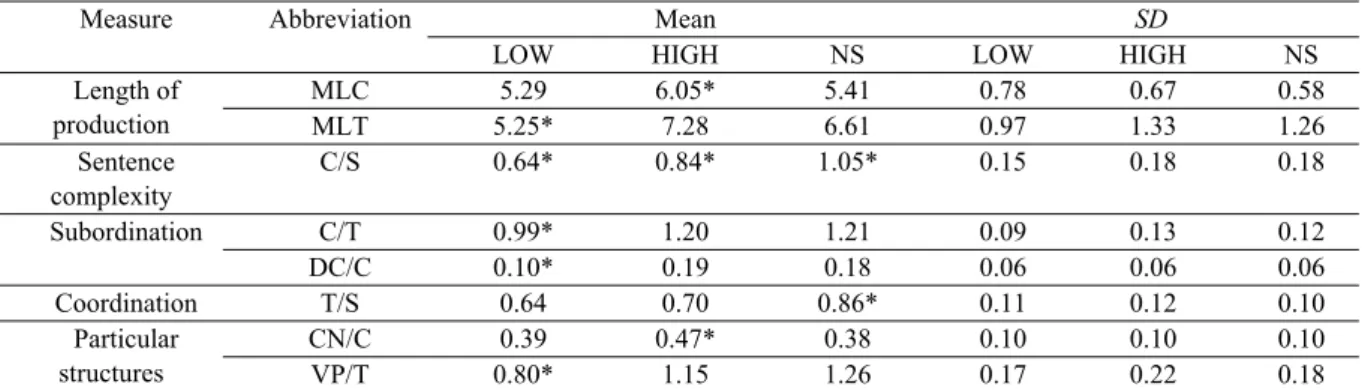
In Table 4, we present the indices that showed significant difference as a result of MANOVA with their mean and standard deviation in each proficiency level. The table also indicates which level resulted in different mean scores as a result of the post-hoc test. For example, in the case of MLC, the asterisk in HIGH (6.05*) means that only HIGH was significantly different from the other groups while LOW and NS did not show significant difference.
Table 4. Descriptive Statistics of the Syntactic Complexity Scores
Measure Abbreviation Mean SD
LOW HIGH NS LOW HIGH NS Length of
production
MLC 5.29 6.05* 5.41 0.78 0.67 0.58
MLT 5.25* 7.28 6.61 0.97 1.33 1.26 Sentence
complexity
C/S 0.64* 0.84* 1.05* 0.15 0.18 0.18
Subordination C/T 0.99* 1.20 1.21 0.09 0.13 0.12 DC/C 0.10* 0.19 0.18 0.06 0.06 0.06 Coordination T/S 0.64 0.70 0.86* 0.11 0.12 0.10
Particular structures
CN/C 0.39 0.47* 0.38 0.10 0.10 0.10
VP/T 0.80* 1.15 1.26 0.17 0.22 0.18 Note: * in Mean indicates that the score was significantly different from the other levels, as a result of Tukey HSD post-hoc test.
4.1.1 Length of production
Length of production was indicated by the number of words per unit (e.g., sentence, clause, and T-unit). As a result of MANOVA, both MLT (F(2, 69) = 19.26, p < .001, η2 = .97) and MLC (F(2, 69) = 8.99, p < .001, η2 = .21) were significantly different across the proficiency level. In general, HIGH produced the longest T-unit and clause, even longer than the NS. Tukey HSD post-hoc test revealed that the length of T-unit was significantly shorter than the other two groups, but the difference between HIGH and NS was not significant. However, HIGH produced significantly longer clauses than LOW and NS.
4.1.2 Sentence complexity
Sentence complexity was indicated by the number of clauses per sentence. MANOVA (F(2, 69) = 33.80, p < .001, η2 = .50) and following post-hoc test revealed that the difference across groups was significant, and it means that regardless of the complexity type (subordination / coordination), NS used the greatest number of clauses in a sentence and LOW used the smallest number of clauses. Note that the scores for LOW and HIGH were smaller than 1 while that of NS was larger than 1. The scores mean that NNS used many response tokens and fragmentary expressions that lack a subject and finite verb rather than a full clause.
4.1.3 Subordination
There was significant difference in both C/T (number of clauses per T-unit) and DC/C (number of dependent clause per clauses) (F(2, 69) = 29.11, p < .001, η2 = .46 / F(2, 69) = 18.04, p < .001, η2 = .34). As the result of Tukey HSD, in both cases, HIGH and NS were not very different whereas only LOW used the least subordination.
Since T-unit is a structure that is composed of one independent clause and optional dependent clauses, when the C/T score is less than 1, it means that a T-unit is composed of less than one clause, which is the case of LOW. If the score is larger than 1, it means that a T-unit involves more than one subordinate clause, which is the case of HIGH and NS. Also, the use of dependent clauses per clause (DC/C) was significantly small for LOW.
Interestingly, both indices indicate that HIGH learners use as much subordination as NS.
4.1.4 Coordination
The indices of coordinate phrases did not show difference across groups (CP/C: F(2, 69) = 1.28, p = .284, η2
= .04; CP/T: F(2, 69) = 2.78, p = .069, η2 = .08). It means that using a coordinate phrase is not relevant to the proficiency level. However, T/S difference was significant (F(2, 69) = 22.89, p < .001, η2 = .40), and the post-hoc test revealed that NS showed significantly higher scores than the NNS groups. It means that NS used more coordinated T-units than the other groups.
4.1.5 Particular structures
Complex nominals per clause (CN/C) and verb phrases per T-unit (VP/T) were significantly different across the levels (CN/C: F(2, 69) = 7.03, p = .002 ., η2 = .17; VP/T: F(2, 69) = 38.03, p < .001, η2 = .52). As a result of the post-hoc test, LOW was different from HIGH and NS for the VP/T, meaning that the use of verb phrases was not different between HIGH and NS. On the other hand, for the CN/C, LOW and NS were similar, and HIGH used
complex nominals more often than the others.
4.2 Clause Complexity
The clause complexity indices count the number of a certain type of dependents per clause. 11 indices were tested for MANOVA, and the relevant dependent types were as follows: the number of any dependents, adjective complements, clausal complements, undefined dependents, direct objects, subordinating conjunctions, nominal subjects, prepositions, adverbial modifiers, and auxiliary verbs. Among these, only six were significantly different across the levels. The significant indices and their F values and effect sizes are summarized in Table 5. In the table, the dependent types observed in a clause are presented with their abbreviation and the examples.
Table 5. Clausal Complexity Indices of Significant Difference (adopted and modified from Kyle 2016, p. 55)
Dependent type (index) Example of the dependents F(2,59) p effect size (η2)
any dependents(A_Deps) The baby is cute. 9.24 .000 .21
clausal complements (Ccomp) I am certain that he did it. 12.98 .000 .27
direct object (Dobj) She gave me a raise. 6.85 .002 .17
subordinating conjunction (Mark) Forces engaged in fighting after insurgents attacked.
12.07 .000 .26
prepositional modifiers (Prep) They went into the store. 6.78 .002 .16 adverbial modifier(Advmod) Accordingly, I ate pizza. 5.85 .004 .02
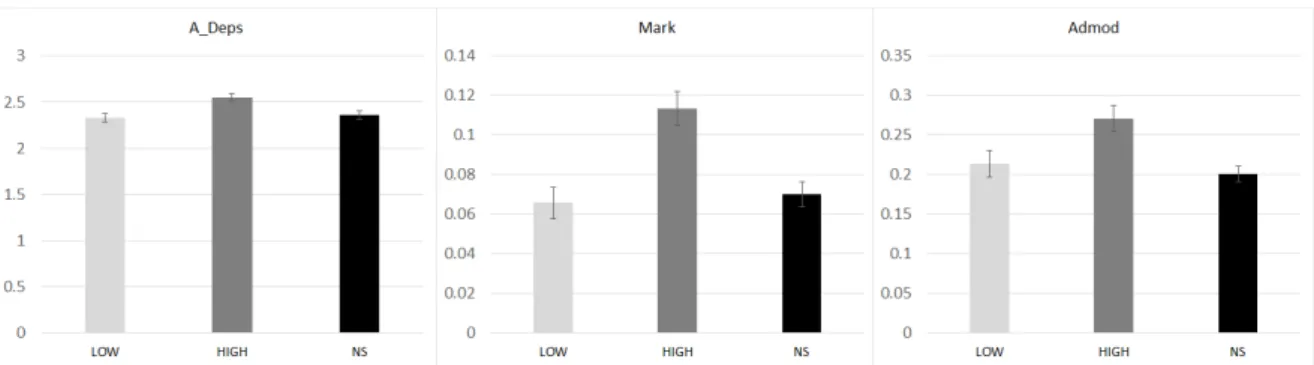
Tukey HSD post-hoc test revealed that the scores of A_Deps, Mark, and Advmod were all greater in HIGH compared to LOW and NS (Figure 1). It means that HIGH use more than 2.5 dependents in a clause while the other groups used them significantly less than HIGH. The HIGH group used subordinating conjunctions (Mark) and adverbial modifier (Advmod) most frequently.
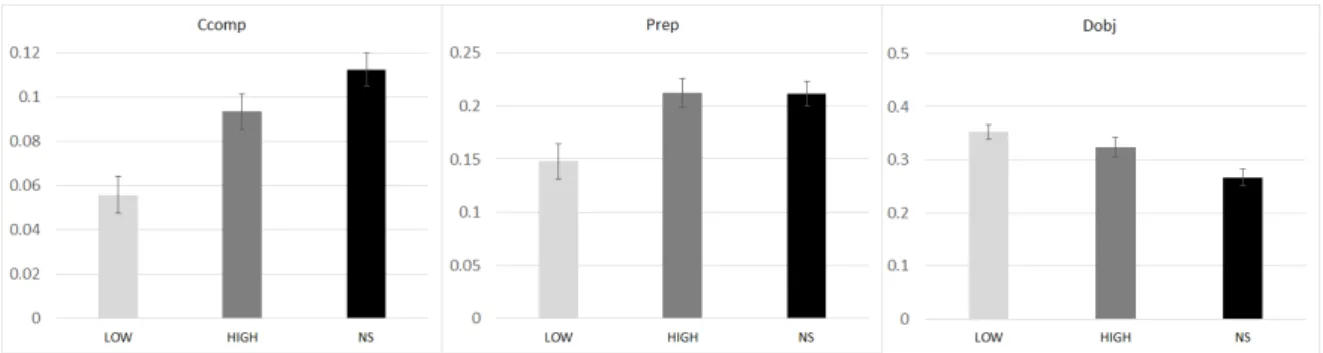
For Ccomp and Prep, HIGH and NS obtained similarly high scores, which was significantly different from LOW (Figure 2, left, middle). The results show that LOW did not use clausal complements and prepositional modifiers as much as the other groups.
Finally, NS used the fewest direct objects (Dobj) whereas High and Low used similarly more direct objects (Figure 2, right). Note that all groups produced less than 0.5 direct object in a clause. It implies that the more than half of the clause appeared with no object (e.g., as in the case of intransitive verb or passive structure) or some other dependents (e.g., with a prepositional modifier, noun or adjective complement).
Figure 1. Clausal Complexity: Low/NS vs. High
Figure 2. Clausal Complexity: LOW vs. HIGH-NS (left, middle) / LOW-HIGH vs. NS (right)
In general, the results showed that High NNS used either larger or similar number of dependents compared to NS.
5. Discussion
In casual conversation, more proficient learners produced complex structures more often than less proficient learners, but similarly with or more often than NS. The results from the syntactic complexity scores can be summarized as follows: The length of units (MLT) produced by HIGH and NS is not different. HIGH employs subordination as much as NS do (i.e., C/T, DC/C, VP/T). However, HIGH demonstrated more complex structures for production length (MLC) and complex nominal (CN/C). Finally, NS use more coordination than the NNS (i.e., T/S, C/S). The fine-grained level analysis results were similar: For the indices of clause complexity, HIGH obtained higher scores than NS (i.e., A_Deps, Mark, Advmod, Dobj) or similar scores (i.e., Ccomp, Prep). Since the utterances in casual conversation are produced in an environment involving time limit and cognitive pressure (Hwang et al. 2020), the structures that they produce may be the ones that are entrenched through frequent experience (Kemmer and Barlow 2000). The high index scores in this study imply that proficient learners can readily use complex structures as much as NS do.
A number of previous studies have shown a positive correlation between L2 proficiency and syntactic complexity in both writing and speaking, (Cumming et al. 2005, Hwang et al. 2020, Kim 2014, Lu 2011, Wolfe- Quintero et al. 1998, Yazdani 2018). Therefore, a similar relation had been expected in casual conversation as well:
More proficient learners would use more complex structures in conversation, and thus, NS would use more complex structures than NNS.
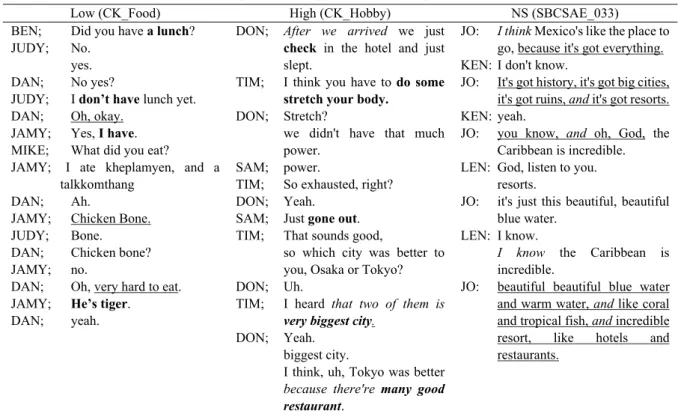
It is true that the LOW group showed significantly low scores in many indices compared to HIGH and NS. For example, they produced short T-unit (MLT) and as the C/S and VP/T scores showed, they did not produce full clause. In the left column of Table 6, the speakers’ utterance did not include a finite verb (e.g., Chicken bone. / Oh, okay, / Oh, very hard to eat). Also, they did not produce subordination. The result demonstrates that the less proficient speakers produce less complex structures.
However, both syntactic and clause complexity showed the results that deviate from the prediction based on the previous studies of writing (Ai and Lu 2013, Lu and Ai 2015) because in this study NS did not show any higher scores than NNS in most indices. This deviation may be explained in two perspectives: the nature of L1 conversation and the characteristics of the NNS conversation.
First, we need to consider the fact that casual conversation is a dynamic interaction of speakers of two or more people about any daily topics. Throughout the discourse, turn-taking occurs dynamically: The speakers have to
rapidly cooperate and compete with one another in order to take or hold their turns, which may lead the speakers to deliver the gist of the idea in their turn rather than to use a full-fledged clause. In addition, in our data, the NS participants were mostly close friends who may share background knowledge. Therefore, fragmentary utterances tended to be preferred instead of lengthy explanation. When we look at the excerpts of NS in Table 6, each unit is short in length (i.e., MLT, MLC in JO’s second turn, It's got history, it's got big cities, it's got ruins, and it's got resorts.). Also, each unit is simple in complexity, lacking subordination (i.e., DC/C, C/T, Mark). For example, throughout the excerpts, there was only one subordinate clause in the first turn of JO (because it's got everything).
Instead, they add T-units by using coordination (i.e., T/S, C/S). In the NS excerpt in Table 6, it seems that NS may try to hold their turn by using and (See JO’s 3rd and 5th turn). Also, if direct objects are clearly known from the context, the speakers may omit the objects (i.e., lack of Dobj, Eu 2018). Instead, NSs may use clausal complements followed by I think, I know, I heard, etc. (See the use of Ccomp in Figure 2).
Table 6. Example of Excerpts from the Corpus in Each Level
Low (CK_Food) High (CK_Hobby) NS (SBCSAE_033)
BEN; Did you have a lunch?
JUDY; No.
yes.
DAN; No yes?
JUDY; I don’t have lunch yet.
DAN; Oh, okay.
JAMY; Yes, I have.
MIKE; What did you eat?
JAMY; I ate kheplamyen, and a talkkomthang
DAN; Ah.
JAMY; Chicken Bone.
JUDY; Bone.
DAN; Chicken bone?
JAMY; no.
DAN; Oh, very hard to eat.
JAMY; He’s tiger.
DAN; yeah.
DON; After we arrived we just check in the hotel and just slept.
TIM; I think you have to do some stretch your body.
DON; Stretch?
we didn't have that much power.
SAM; power.
TIM; So exhausted, right?
DON; Yeah.
SAM; Just gone out.
TIM; That sounds good,
so which city was better to you, Osaka or Tokyo?
DON; Uh.
TIM; I heard that two of them is very biggest city.
DON; Yeah.
biggest city.
I think, uh, Tokyo was better because there're many good restaurant.
JO: I think Mexico's like the place to go, because it's got everything.
KEN: I don't know.
JO: It's got history, it's got big cities, it's got ruins, and it's got resorts.
KEN: yeah.
JO: you know, and oh, God, the Caribbean is incredible.
LEN: God, listen to you.
resorts.
JO: it's just this beautiful, beautiful blue water.
LEN: I know.
I know the Caribbean is incredible.
JO: beautiful beautiful blue water and warm water, and like coral and tropical fish, and incredible resort, like hotels and restaurants.
Also, the content of the NS conversation may result in simple structures. According to Nippold et al. (2017), NNS produce more complex structures when retelling and critical thinking tasks are given than when conversation (in the form of an interview) is given, which implies that intellectually more complex topics lead to more complex structures. Note that the casual conversation data used in this study were small talks involving topics like ‘why they love living in New York,’ ‘how they missed the highway exit,’ ‘what happened in the store,’ etc. Due to the nature of casual conversation (e.g., dynamic interaction and casual topics), the grammatical structure of the NS’s utterance itself may not have been very complex.
Second, the relatively high index scores of HIGH implies that proficient learners’ utterances in casual conversation are closer to writings compared to NS’s utterances in terms of grammatical complexity. The proficient learners produced more complex nominals (CN/C) than NSs, which is recognized as indicative of
writings. Also, they tended to produce longer units (i.e., MLC, MLT). These results are consistent with the results from the previous study that compared NS’s writings and EFL learners’ writings: The differences between the NS group and the more proficient learner group were not significant in most syntactic complexity indices, and proficient learners produced longer units than NS (Mancilla, Polat and Akcay 2017). In other words, the grammatical complexity characteristics in learners’ conversation are consistent with those of writings.4
It seems that these somewhat writing-like characteristics are found in HIGH learners’ conversation because these learners were able to control their turn in a less competitive environment than in the conversation among NSs. All conversations lasted about 20 minutes, but HIGH spoke more than LOW, and NS spoke 1.6 times more than NNS (See Table 3). Even though NS produced the largest number of words, it does not mean that one unit was the longest and the most complex. Rather, they produced short and simple units many times rapidly over the course of dynamic interaction. On the other hand, in the interactions among NNSs, others did not interrupt the speakers that much, especially when the speaker was more proficient than the other interlocutors. Therefore, it seems that the proficient speakers could produce relatively longer and more complex structures without much cognitive pressure of turn-taking management.5 As Table 6 shows, the HIGH used subordinate clauses and clausal complements (e.g., After we arrived, because there're many good restaurant, that two of them is very biggest city.
See the clauses in italic).
Also, the inputs given to the learners may have affected the results. As was pointed out by many researchers, EFL learners receive input mostly from textbooks (Saito 2017, Yang 2010). Even the conversational input that they receive often come from movies and TV shows, which are based on scripts. Usually, these types of input do not represent naturally occurring casual conversation genre. Therefore, the learners’ conversation might resemble written language due to the lack of experience in authentic casual conversation and frequent exposure to written language.
The results should not be expanded to the hasty conclusion that the learners in HIGH are more proficient than NS because L2 proficiency involves not only complexity but also fluency and accuracy. With regard to the fluency, the learners were never fluent compared to the NS, as the number of words per speaker in Table 3 indicates although recording time of each conversation was similar. This addresses the issue of fluency that less proficient learners’ speech contains many pauses and repetitions, and longer planning time, which causes slow speech. Note that the pauses, truncated expressions, and repetitions were removed for the complexity analysis in this study. As for the accuracy, although the structure might be complex for the HIGH, there were many grammatical and lexical errors (e.g., I don’t have lunch yet, instead of I haven’t had lunch yet; He’s tiger, instead of He’s a tiger; two of them is very biggest city, instead of two of them are the biggest cities; See the expressions in bald in Table 6). The proficiency level assessed in the corpus depends on their conversation and monologues, with both fluency and accuracy taken into consideration. Therefore, the results of the study should be interpreted with caution when relating them with the overall proficiency level.
4 Some NS and NNS speakers who teach English conversation in Korea pointed out that the results of this study confirm their ‘impression’ from the teaching experience that proficient students who studied only in Korea produced longer and more complex structures than the students who lived in English-speaking countries for a long time (Lee and Cummings, in personal communication, April 24-27, 2021).
5 There might have been cognitive pressure that the EFL learners experience when encoding and articulating English. This cognitive pressure was represented in low level of fluency (use of fillers, repetitions, false starts, slow speech) and inaccurate grammar and lexical items. However, these aspects are not considered in this study.
6. Conclusion
Although complexity alone does not represent the L2 proficiency, the current study contributes to the issue of L2 learners’ grammatical complexity in that it examined casual conversation of EFL learners. More proficient learners can readily produce the structure of more or similar complexity compared to the NSs in conversation.
However, their conversation was not natural enough to be comparable to that of NSs because the learners’
utterances were closer to writing rather than NS’s casual conversation in terms of complexity, and the fluency and accuracy may not reach the level of NS. The aspects of fluency and accuracy call for further research. As EFL students also encounter situations where casual conversation is involved, examining the learners’ casual conversation will allow us to understand how they acquire the characteristics of conversation genre and how we can help the learners practice the genre in a natural way.
References
Ai, H. and X. Lu. 2013. A corpus-based comparison of syntactic complexity in NNS and NS university students’
writing. In A. Diaz-Negrillo, N. Ballier and P. Thompson, eds., Automatic Treatment and Analysis of Learner Corpus Data, 249-264. Amsterdam/Philadelphia: John Benjamins.
Anderson, J. E. 1937. An evaluation of various indices of linguistic development. Child Development 8, 62-68.
doi:10.2307/1125823.
Andringa, S., K. de Glopper and H. Hacquebord. 2011. Effect of explicit and implicit instruction on free written response task performance. Language Learning 61(3), 868-903.
Biber, D., B. Gray and K. Poonpon 2011. Should we use characteristics of conversation to measure grammatical complexity in L2 writing development? TESOL Quarterly 45(1), 5-35.
Biber, D., B. Gray and S. Staples. 2016. Contrasting the grammatical complexities of conversation and academic writing: Implications for EAP writing development and teaching. Language in Focus 2(1), 1-18.
Bulté, B. and A. Housen. 2014. Conceptualizing and measuring short-term changes in L2 writing complexity.
Journal of Second Language Writing 26, 42-65.
Cheng, W. and M. Warren. 1999. Peer and teacher assessment of the oral and written tasks of a group project.
Assessment & Evaluation in Higher Education 24(3), 301-314.
Cooper, T. C. 1976. Measuring written syntactic patterns of second language learners of German. The Journal of Educational Research 69(5), 176-183.
Cumming, A., R. Kantor, K. Baba, U. Erdosy, K. Eouanzoui and M. James. 2005. Differences in written discourse in independent and integrated prototype tasks for next generation TOEFL. Assessing Writing 10(1), 5-43.
Du Bois, J. 2006. Transcription in Action, retrieved from http://transcription.projects.linguistics.ucsb.edu/
representing.
Du Bois, J. W., W. L. Chafe, C. Meyer, S. A. Thompson and N. Martey. 2000-2005. Santa Barbara corpus of spoken American English, Parts 1-4. Philadelphia: Linguistic Data Consortium.
Eu, J. 2018. On the nature of object omission: Indefiniteness as indeterminacy. English Language and Linguistics 22(3), 523-530.
Foster, P., A. Tonkyn and G. Wigglesworth. 2000. Measuring spoken language: A unit for all reasons. Applied Linguistics 21(3), 354-375.
Grabe, W. and R. B. Kaplan. 1996. Theory and Practice of Writing. London: Longman
Halliday, M. A. K. 2002. On Grammar. London, UK: Continuum.
Hunt, K. W. 1965. Grammatical Structures Written at Three Grade Levels. Champaign, Ill: National Council of Teachers of English.
Hwang, H., H. Jung and H. Kim. 2020. Effects of written versus spoken production modalities on syntactic complexity measures in beginning‐level child EFL learners. The Modern Language Journal 104(1), 267- 283.
Kemmer, S. and M. Barlow. 2000. Introduction: A usage-based conception of language. In M. Barlow and S.
Kemmer, eds., Usage-based models of grammar, i-xxi. Stanford, CA: CSLI Publications.
Kim, J. Y. 2014. Predicting L2 writing proficiency using linguistic complexity measures: A corpus-based study.
English Teaching 69, 27-51.
Kyle, K. 2016. Measuring Syntactic Development in L2 Writing: Fine Grained Indices of Syntactic Complexity and Usage-based Indices of Syntactic Sophistication. Unpublished doctoral dissertation, Georgia State University.
Kyle, K. and S. Crossley. 2017. Assessing syntactic sophistication in L2 writing: A usage-based approach.
Language Testing 34(4), 513-535.
Larsen-Freeman, D. 2006. The emergence of complexity, fluency, and accuracy in the oral and written production of five Chinese learners of English. Applied Linguistics 27(4), 590-619.
Levelt, W. 1989. Speaking: From Intention to Articulation. Cambridge, MA: The MIT Press.
Lintunen, P. and M. Mäkilä. 2014. Measuring syntactic complexity in spoken and written learner language:
Comparing the incomparable? Research in Language 12(4), 377-399.
Lu, X. 2010. Automatic analysis of syntactic complexity in second language writing. International Journal of Corpus Linguistics 15, 474-496.
Lu, X. 2011. A corpus-based evaluation of syntactic complexity measures as indices of college-level ESL writers’
language development. TESOL Quarterly 45, 36–62.
Lu, X. and H. Ai. 2015. Syntactic complexity in college-level English writing: Differences among writers with diverse L1 backgrounds. Journal of Second Language Writing 29, 16-27.
Mancilla, R. L., N. Polat and A. O. Akcay. 2017. An investigation of native and nonnative English speakers’ levels of written syntactic complexity in asynchronous online discussions. Applied Linguistics 38(1), 112-134.
McDonald, J. L. 2006. Beyond the critical period: Processing-based explanations for poor grammaticality judgment performance by late second language learners. Journal of Memory and Language 55(3), 381- 401.
Monroe, J. H. 1975. Measuring and enhancing syntactic fluency in French. The French Review 48(6), 1023-1031.
Nippold, M. A., M. W. Frantz-Kaspar, P. M. Cramond, C. Kirk, C. Hayward-Mayhew and M. MacKinnon. 2014.
Conversational and narrative speaking in adolescents: Examining the use of complex syntax. Journal of Speech, Language, and Hearing Research, 57, 876-886.
Nippold, M. A., M. W. Frantz-Kaspar and L. M. Vigeland, 2017. Spoken language production in young adults:
Examining syntactic complexity. Journal of Speech, Language, and Hearing Research 60(5), 1339-1347.
Ortega, L. 2003. Syntactic complexity measures and their relationship to L2 proficiency: A research synthesis of college‐level L2 writing. Applied Linguistics 24, 492-518.
Paltridge, B. 2012. Discourse analysis: An introduction. Bloomsbury Publishing.
Park, S. and Yoon, S. 2021. Syntactic complexity of EFL learners’ casual conversation, monologue, and writing.
The Journal of Studies in Language 37(1), 75-89.
Ravid, D. and L. Tolchinsky. 2002. Investigating literacy development and language acquisition. Reply to commentaries on ‘Developing linguistic literacy: a comprehensive model’. Journal of Child Language 29(2), 489-494.
Saito, K. 2017. Effects of sound, vocabulary, and grammar learning aptitude on adult second language speech attainment in foreign language classrooms. Language Learning 67, 665–693.
Wolfe-Quintero, K. S. Inagaki and H. Y. Kim. 1998. Second Language Development in Writing: Measures of Fluency, Accuracy, and Complexity (No. 17). University of Hawaii Press, Hawaii.
Yang, H. K. 2010. Linguistic systems of target language as organizational foundations of foreign language teaching. The Education of Korean Language 133, 63–81.
Yazdani, S. 2018. Syntactic complexity in Iranian learners’ English writing and speaking. Journal on English as a Foreign Language 8(1), 75-96.
Examples in: English
Applicable Languages: English Applicable Level: Tertiary