KOREAN JOURNAL OF ENGLISH LANGUAGE AND LINGUISTICS
ISSN: 1598-1398 / e-ISSN 2586-7474 http://journal.kasell.or.kr
The Capitalistic versus Militaristic Debate: Paradigm Uniformity Revisited
Jungyeon Kim (Yonsei University)
This is an open-access article distributed under the terms of the Creative Commons License, which permits unrestricted non- commercial use, distribution, and reproduction in any medium, provided the original work is properly cited.
ABSTRACT
Kim, Jungyeon. 2021. The capitalistic vs. militaristic debate: Paradigm uniformity revisited. Korean Journal of English Language and Linguistics 21, 636-655.
The present study examined the well-known data in which the onset of the third syllable is flapped in capitalistic whereas it is aspirated in militaristic even though both words have the same stress pattern and syllable structure. While a number of studies have considered several different approaches in this discussion including paradigm uniformity effect, foot-based analyses, optimality theoretic (OT) accounts, and analogy, there has been no research that seeks to account for the possibility that the underlying /t/’s of those two words can be realized as both aspirated and flapped by speakers of American English. This study basically follows a prosodic foot-based account to explain this phenomenon and attempts to capture the variant realizations using the audio pronunciation listed in eleven different online dictionaries within the Maximum Entropy (MaxEnt) Model, which is a probabilistic model that assigns each candidate a probability rather than picking a single winner as in standard OT. The frequency data observed from those dictionaries were fed into MaxEnt to see if the learned grammar can successfully predict the observed frequency. The current simulation results show that the frequency found in the actual linguistic data corresponds to that predicted by the training corpus data, which indicates that the learned grammar is able to accurately reproduce the observed frequency. These findings suggest that MaxEnt modeling has a more explanatory power than classical OT analyses in that it can serve to account for grammars involving free variation.
Received: June 17, 2021 Revised: July 14, 2021 Accepted: July 24, 2021
Jungyeon Kim
Postdoctoral Researcher, Yonsei University Tel: 02) 2123-2329 [email protected]
KEYWORDS
paradigm uniformity, American English flapping, optimality theory, Maximum Entropy
1. Introduction
The name of paradigm uniformity has been widely discussed in the phonological literature under the name of analogy (Eddington 2006, Kiparsky 1978), cyclic rules (Chomsky and Halle 1968, Withgott 1982), and output-to- output correspondence (Benua 1995, Burzio 1994, Davis 2003, 2005, Flemming 1995, Kenstowicz 1996, Steriade 1995, 1998, 2000). While the term has also been referred to as paradigm regularity or paradigm coherence, a paradigm represents a group of words that share a morpheme (e.g., bear, bearing, unbearable) or a group of phrases that share a word (e.g., bear, to bear); uniform paradigms are then the observation that morphemes tend to be invariant across the members of a paradigm even in phonologically unexpected contexts. Steriade (2000) states the condition of paradigm uniformity as follows:
(1) Paradigm uniformity (Steriade 2000: 313)
All surface realizations of μ, where μ is the morpheme shared by the members of paradigm x, must have identical values for property P.
A great number of studies have considered various linguistic phenomena with paradigm uniformity effects including affixation as in æ-tensing, cluster simplification, and primary stress placement, hypocoristic names, and flapping, where phonological identity is maximized between morphologically related outputs (Benua 1995, 1997a, b, Borowsky 1986, Burzio 1994, Davis 2003, 2005, Jensen 1987, 2000, Harris and Kaye 1990, Kahn 1980, Kaisse 1985, Kiparsky 1979, Nespor and Vogel 1986, Selkirk 1982, Steriade 2000, Withgott 1982). The main focus of the current research lies on what is called flapping shown in American English, which applies to an intervocalic /t/ when the preceding vowel is stressed. In words like bottom, for example, no aspiration is attested and the /t/ is usually flapped by American speakers. American English flapping has been extensively studied both phonologically (Borowsky 1986, Burzio 1994, Davis 2003, 2005, Gussenhoven 1986, Harris and Kaye 1990, Inouye 1989, Jensen 1987, 2000, Joos 1942, Kahn 1980, Kaisse 1985, Kiparsky 1979, Nespor and Vogel 1986, Selkirk 1982, Withgott 1982) and phonetically (Davis and Summers 1989, de Jong 1998, Fox and Terbeek 1977, Stone and Hamlet 1982, Umeda 1977, Zue and Laferriere 1979). Phonological models have traditionally understood American English flapping as a phonological rule whereby intervocalic /t/ becomes a flap before an unstressed vowel. Kahn (1980) argued that an alveolar stop becomes a flap following a [-consonantal] segment and preceding an unstressed syllable, pointing out that although the following vowel is required to be unstressed, the absence or presence of stress on the preceding vowel is irrelevant in that flapping may occur following a stressed vowel as in útter or an unstressed vowel as in obésity. Several phonological accounts identified the occurrence of a flapped /t/ as the outcome of ambisyllabicity, i.e., alveolars that belong to both syllable-initial and syllable-final are flapped (Gussenhoven 1986, Kahn 1980); yet, others claimed that the ambisyllabic consonants are resyllabified to be the coda of the preceding syllable (Inouye 1989, Selkirk 1982). Selkirk (1982) stated that resyllabified consonants behave as though they were underlyingly syllable-final. Kiparsky (1979), on the other hand, presented a foot-based analysis with no reference to syllable structure in describing the context for the flapping rule; he proposed a foot-sensitive rule where flapping occurs in non-foot-initial position between [- consonantal] and [+syllabic] segments, e.g., potato phə(theyɾow)F (Kiparsky 1979: 438).
Several phonetic studies examined the articulatory or acoustic elements of a flapped /t/. In a comprehensive study of a medial /t/ in American English, Zue and Lafferiere (1979) examined alveolar stops in six different contexts, i.e., (i) prestressed as in retúrn, (ii) nasal-released as in sweeten, (iii) flapped as in ráter, (iv) unstressed as in párity, (v) post-nasal as in tenting, and (vi) post-lateral as in molted (Zue and Lafferiere 1979: 1040). Two of
those environments are relevant here producing a flapped /t/; the first context, which Zue and Lafferiere refer to as flapped environment, describes a context where the /t/ follows a stressed syllable and precedes an unstressed syllable as in words such as ráter and flátter. In this environment, producing a flapped /t/ involves tongue tip to make brief contact with alveolar ridge followed by immediate release and results in various acoustic realizations including turbulence noise due to partial closure (Zue and Lafferiere 1979). They reported that the mean duration of flaps is 26 ms varying from 10 to 40 ms; a high probability was also reported that the underlying segment yielded one phonetic realization, i.e., 99% of /t/’s in the flapped environment were realized as [ɾ] (Zue and Lafferiere 1979: 1048). The second context, which they call unstressed environment, describes an environment where the /t/ falls between two unstressed syllables as in párity and complícity. They reported that in this case more than one surface realization was found, i.e., the /t/ was realized either as a fully released, aspirated [th] (66%) or as a long flap (33%) with an average longer duration than flaps in the flapped environment (26 ms vs. 40 ms).
A number of studies have investigated this variability in the output of the flapping rule where flapping is considered as a gradient phonetic process of lenition rather than as a categorical one (de Jong 1998, Fujimura 1986, Macchi 1985, Stone and Hamlet 1982, Umeda 1977). Stone and Hamlet (1982), for example, examined reiterant productions of various sentences with syllables replaced by the CV /da/ and found that flapping is gradient since there were no apparent categorical differences between the conditions with stops and those with flaps and there was no strong modality in the articulatory posture exhibited. De Jong (1998) tested the plausibility of two flapping models, i.e., a traditional model as a categorical switch from stop to flap production in a specified linguistic environment and a model where flapping arises as a by-product of articulatory changes associated with the implementation of prosodic structure. While the latter model accommodates a great deal of data, as he acknowledges, neither the categorical rule nor the prosodic by-product account can alone explain his findings (de Jong 1998: 309).
While there is contention regarding whether flapping is phonological or phonetic, Withgott (1982) first highlighted and analyzed flapping suppression in specific positions, which has developed into the matter associated with paradigm uniformity effect. The dataset given in Table 1 shows that although the words capitalistic and militaristic have the same stress pattern and syllable structure, flapping and aspiration apply differently; that is, the /t/ is flapped in capi[ɾ]alistic but aspirated in mili[th]aristic. Withgott (1982) noted that despite the near- identical context the /t/ is unflapped in militaristic whereas it is flapped in capitalistic; the possible reason for this could be that while capitalistic is morphologically related to cápi[ɾ]al where the /t/ is already flapped, the base form of militaristic bears stress on the syllable whose onset the /t/ is, i.e., míli[th]àry, as shown in Table 1 below.
Table 1. capitalistic vs. militaristic
Derivative Base Rule
capitalistic [khæ̀.pə.ɾə.lɪ́s.tɪk] capital [khǽ.pə.ɾəl] Flapping
militaristic [mɪ̀.lə.thə.rɪ́s.tɪk] military [mɪ́.lə.thɛ̀.ri] Aspiration
There is an ongoing debate in the literature concerning how to account for the data given in Table 1 where the underlying /t/’s of capitalistic and militaristic surface with the same realization as in their base forms (Ahmed et al. 2020, Davis 2003, 2005, Eddington 2006, Jensen 1987, 2000, Steriade 2000, Withgott 1982). Withgott (1982) argues that capitalistic begins with (capi)tal with refooting giving (capital)(istic), while we have (mili)(tary) and then (mili)ta(ristic), to which a separate adjunction rule applies providing the final representation (mili)(ta(ristic)), where the /t/ of the third syllable is foot-initial and should be aspirated. An alternative approach is Steriade’s (2000) paradigm uniformity effect. She claims that the /t/ in militaristic is aspirated since the /t/ in its base form military
is aspirated; similarly, flapping in capitalistic is dependent upon flapping in capital. Davis (2005) also invokes paradigm uniformity effect for the capitalistic case, but he argues that aspiration in militaristic should be regarded as a regular phonological pattern found in words such as Medi[th]erranean and abra[kh]adabra. In the meantime, several researchers reported variability with respect to the flapping/aspiration of the /t/; that is, the /t/ may be realized as both aspirated and flapped by speakers of American English. For instance, Riehl (2003) stated that her speakers tended to articulate and aspirate stops during the early portions of the recording session and flap later in the session. Kim (2009) also observed free variation within a single speaker’s responses as well as between speakers. While a number of different frameworks have been used in the debate of capitalistic vs. militaristic, there is no clear-cut explanation for this variability issue. In particular, the majority of the models using the framework of the classical optimality theory (OT, Prince and Smolensky 1993) fail to account for variant forms due to the strict hierarchy of different constraint rankings. The current study attempts to capture the variants [th] ~ [ɾ] deploying the audio pronunciation listed in 11 different online dictionaries within the Maximum Entropy model (MaxEnt, Goldwater and Johnson 2003, Hayes and Wilson 2008, Smolensky 1986, Wilson 2006). Since there has been no study, to the best knowledge of the author, where Maxent modeling is employed in the discussion of American English flapping, the contribution of this research is that it finds and provides an additional dataset to help resolve the debate between capitalistic vs. militaristic.
2. Previous Studies
Withgott (1982) was the one who initiated the discussion about the contrast between flapped and aspirated /t/’s in the words capitalistic and militaristic. She stated that both aspiration and flapping are conditioned by stress and syllable structure; that is, /t/ may flap in a word when it is intervocalic and precedes a stressless syllable or when it follows a vowel within a foot, as in I[ɾ]aly, rhe[ɾ]oric and capi[ɾ]alistic, as agreed by many (Kahn 1980, Kiparsky 1979, McCarthy 1982, Selkirk 1978, Stampe 1973). Withgott rejected, however, the cyclic explanation for the rules of aspiration and flapping; she claims that if it is assumed that the aspiration rule (i.e., /t/ is aspirated before a stressed vowel) is cyclic and that flapping is disjunctively ordered with aspiration, then the /t/ in Italy, for example, will not be aspirated where it fails to satisfy the structure description, yet it will be aspirated in Italian and when Italian further derives as in Italianize, it should show an aspirated /t/ (Withgott 1982: 161). Such predicted cyclicity is ruled out by the examples such as sta[th]istic ~ sta[ɾ]istician, where /t/ is aspirated in statistic due to the first rule (i.e., aspiration) but flapped in statistician, as shown in (2) below. Withgott argues, therefore, that all rules associated with aspiration and flapping are noncyclic in that aspiration does not feed flapping and vice versa.
(2) Aspiration and flapping (adapted from Withgott 1982: 161) Italian [ɪthæljən] Italianize [ɪthæljənaɪz]
statistic [stəthɪstɪk] statistician [stæɾɪsthɪʃən]
autocracy[ɔthɑkhrəsi] autocratic [ɔɾəkhrætɪk]
Withgott (1982) proposes instead a foot-based aspiration rule where stops are aspirated when they begin with a stressed syllable of a foot. She considers four different foot structures in which the aspiration rule may apply to derived and nonderived words, as given in (3). The problem with this footing, however, is that the structure of nonderived words having foot-internal [th] in a stressed syllable does not involve a foot-initial [th]; hence, she has
added an intervocalic /t/-aspiration rule where an intervocalic /t/ is aspirated foot-initially or before a prominent vowel. As we will discuss below, Davis (2005) proposes an alternative foot structure that can provide more consistent explanation for both aspiration and flapping.
(3) Foot structures where aspiration applies (adapted from Withgott 1982: 161-165) a. Derived word with [th] in stressed syllable: ‘Italian’
F F
σw σs σw
ɪ thæ ljən
b. Derived word with foot-initial [th]: ‘militaristic’
F
F F
σs σw σw σs σw
mɪ lə thə rɪs tɪk
c. Nonderived word with foot-initial [th]: ‘laboratory’
F F σs σw σs σw
læ brə thɔ ri
d. Nonderived word with foot-internal [th] in stressed syllable: ‘martini’
F F
σw σs σw
mar thi ni
As noted by Withgott (1982), the accentually parallel words militaristic [mɪ̀ləthərɪ́stɪk] and capitalistic [khæ̀pəɾəlɪ́stɪk] show the near-identical contrast between aspirated and flapped stops. Although the third syllable is realized with the stressless nucleus [ə] in both words, its onset is aspirated in militaristic whereas it is flapped in capitalistic. Withgott mentions that the aspirated /t/ in militaristic corresponds to the aspirated /t/ in its base form military [mɪ́ləthɛ̀ri], while the flapped /t/ in capitalistic corresponds to the flapped /t/ in its base capital [khǽpəɾəl]
(Withgott 1982: 158). Steriade (2000) refers to this phenomenon as paradigm uniformity effect where the
underlying /t/’s surface with the same realization as in their base words; namely, the paradigm of {military, militaristic} becomes phonologically less variable once the /t/ is generalized to the stressless third syllable of the derivative word, which can serve to maintain the durational similarity between [thɛ] in military and [thə] in militaristic. Based on previous findings where a flap tends to be shorter than a stop (Zue and Lafferiere 1979, Banner-Inouye 1995), Steriade (2000) proposes a feature called [extra short closure], which is a non-categorical phonetic feature. She claims that a flapped /t/ possesses this non-contrastive feature in that the mean duration of [ɾ] is considerably shorter than [th], i.e., 26 ms vs. 129 ms (Zue and Lafferiere 1979: 1042).
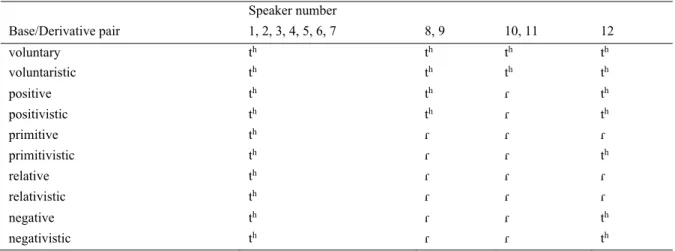
In order to test the hypothesis that the phonetic feature is subject to paradigm uniformity and that it should not be distinct from a phonological feature, she conducted an experiment where 12 speakers of American English were asked to read two lists of words. The first list contained five target words, i.e., voluntary, positive, negative, primitive, and relative. She expected some of the speakers to place secondary stress on the syllable following the /t/ and thereby produce [th] and other speakers not to place stress on that syllable and produce [ɾ]. In her study, those five words were randomized with five other words, i.e., fatal, fetish, totem, notary, and rotary, where all speakers were predicted to flap because of the /t/ following a stressed syllable and preceding an unstressed syllable.
The second list involved all ten of those words derived with the suffix -istic, whose outcome included several nonce forms such as voluntaristic, primitivistic, and rotaristic. Steriade expected aspiration or flapping to occur in the derivative forms according to the effect of paradigm uniformity, i.e., if a base form is produced as a form with [th] due to a following syllable bearing secondary stress, then its derivative form will also be produced as a form with [th] even in the absence of secondary stress on the following syllable; similarly, a speaker who produces [ɾ]
in the base form is predicted to pronounce [ɾ] in its derivative form. When paradigm uniformity is moot, however, in monomorphemic words with the same stress pattern, the /t/ was expected to be generally flapped as in mèri[ɾ]ocrátic, pèri[ɾ]onítis, and hèma[ɾ]ogénesis although she acknowledges an unexpected example like Mèdi[th]erránean, which Davis (2005) later attempts to explain using a foot-based approach.
Table 2. Results of Speaker Production (adapted from Steriade 1996)
Speaker number
Base/Derivative pair 1, 2, 3, 4, 5, 6, 7 8, 9 10, 11 12
voluntary th th th th
voluntaristic th th th th
positive th th ɾ th
positivistic th th ɾ th
primitive th ɾ ɾ ɾ
primitivistic th ɾ ɾ th
relative th ɾ ɾ ɾ
relativistic th ɾ ɾ ɾ
negative th ɾ ɾ th
negativistic th ɾ ɾ th
As summarized in Table 2, the results of Steriade’s study overall support her claims of phonetic paradigm leveling even though there is a small amount of variation in her data. Eleven out of 12 speakers had identical allophones for every pair of base and derivative forms (cf. primitive vs. primitivistic by Speaker 12). Steriade (2000) contends that these results are the consequence of the relative ranking of two constraints, i.e., paradigm uniformity and reduction constraints; first, a constraint assuring paradigm uniformity in the case of categorical stress given in (4a) can be
broken down into a more specific constraint based on the individual phonetic correlates of stress like duration as given in (4b). The constraint shown in (4b) ensures that the duration of a stressed syllable in a base form is maintained in a corresponding derivative form (Steriade 2000: 321). This constraint is outranked by reduction constraint, which states that stressless vowels must be schwa. Since the duration of the vowel is restricted by reduction constraint, paradigm uniformity constraint can be satisfied only by maintaining uniformity in the duration of the /t/; that is, according to Steriade (1996, 2000), [th] in militaristic and [ɾ] in capitalistic are attributed to Paradigm Uniformity (Stress: Duration), where they are partial preservation of the stress carried by the syllables in their base forms as shown in the tableau given in (4c). Reduction constraint outranks paradigm uniformity constraint, which in turn outranks flapping constraint. As shown in the tableau, the third candidate for militaristic violates the highest ranked constraint, and the remaining two candidates differ in flapping of the third syllable; the first candidate is durationally closer to military than the second candidate, and hence it is chosen as an optimal output (Steriade 2000: 326).
(4) Paradigm Uniformity constraints and constraint interaction in capitalistic and militaristic
a. Paradigm Uniformity (Stress) (Steriade 2000: 319)
Let F be a form exhaustively analyzable into the constituents A(F), an affix, and S(F), a stem. If a realization of S(F) occurs as a free word W, then for every syllable σ in S(F), if σ has a correspondent σ´ in W, then σ has the same stress category (stressed or stressless) as σ´.
b. Paradigm Uniformity (Stress: Duration) (Steriade 2000: 321)
If two strings, ⅀ and ⅀´, stand in correspondence and if ⅀ is a stressed syllable, then ⅀ and ⅀´ are durationally equivalent.
c. Constraint interaction in capitalistic and militaristic (adapted from Steriade 2000: 326)
Base: mɪ̀ləthɛ́ri Reduction Paradigm Uniformity Flapping
→ a. mɪ̀ləthərɪ́stɪk * *
b. mɪ̀ləɾərɪ́stɪk **!
c. mɪ̀ləthɛrɪ́stɪk *! *
Base: khǽpəɾəl
→ a. khæ̀pəɾəlɪ́stɪk
b. khæ̀pəthəlɪ́stɪk *! *
Steriade (2000) has become sufficiently influential that there have been a number of discussions on her claims about paradigm uniformity effect in American English flapping (Davis 2003, 2005, Eddington 2006, Riehl 2003);
among those, it is worthwhile mentioning Davis (2005) here since he argues for a different view than Steriade’s (2000) of paradigm uniformity in terms of the distinction between capitalistic and militaristic. Davis asserts that the aspiration of the /t/ in mìlitarístic reflects a general pattern in American English, which does not require a paradigm uniformity effect. He cites the metrically comparable monomorphemic words such as Mèditerránean and Nàvratilóva, which also possess an aspirated /t/ at the beginning of the third syllable. As briefly discussed above, Steriade (2000) stated that the specific example Mediterranean is simply an exception since the aspiration of this word is influenced by the orthographic geminate inducing a sort of illusory secondary stress (Steriade 2000:
334); yet, there are still many other unresolved examples such as Navra[th]ilova, lolla[ph]alooza, and
abra[kh]adabra, which she did not appear to be aware of.1
Davis (2005) considers the foot structure of the words with dactylic sequences that Steriade (2000) viewed as a mere exception (i.e., Mediterranean). There have been different proposals concerning such words since early metrical phonology (Davis 2005, Davis and Cho 2003, Hayes 1981, Jensen 2000, McCarthy 1982, Pater 2000). First, in the foot structure given in (5), the initial dactylic sequence comprises a superfoot, which reflects the analysis of English found in Hayes (1981) and McCarthy (1982), where a superfoot consists of a binary foot followed by an adjoined single syllable. As Davis (2005) points out, the issue with this structure is that there is no clear motivation for the fact that the /t/ would be aspirated at the beginning of the third syllable because it is not in the foot-initial position.
(5) Foot structure of Mediterranean suggested by Hayes (1981) and McCarthy (1982) Fs
F F σs σw σw σs σw
mɛ dɪ thə reɪ nɪən
An alternative foot structure that Davis (2005) argues for is shown in (6), where although this also involves a superfoot, this differs from the structure given in (5) in that the third syllable of the initial dactylic sequence is adjoined as the first syllable of a superfoot and it forms as constituent with what follows. This foot structure was originally proposed by Withgott (1982) and has been adopted by many researchers including Davis (2003, 2005), Davis and Cho (2003), Jensen (2000), and Pater (2000). As Davis (2005) points out, the advantage of this structure is that it can lead to a unified statement about American English aspiration that voiceless stops are aspirated in the foot-initial position, and hence, paradigm uniformity does not appear to have a role in the word militaristic, as shown in (6). The /t/ of the third syllable is aspirated as expected insofar as it is foot-initial, i.e., at the beginning of the superfoot. Therefore, Davis maintains that militaristic does not display a paradigm regularity effect with military involving the non-contrastive phonetic property of closure duration, as argued by Steriade (2000); instead that militaristic displays the same phonological patterning of the similarly shaped monomorphemic words like Mediterranean and Navratilova, as shown in (6) below.
(6) Alternative footing adopted by Withgott (1982), Davis (2003, 2005), and among others Fs
F F σs σw σw σs σw
mɛ dɪ thə reɪ nɪən ‘Mediterranean’
nɑ vrɑ thɪ loʊ vɑ ‘Navratilova’
mɪ lə thə rɪs tɪk ‘militaristic’
1 As an anonymous reviewer pointed out, Mediterranean might be morphologically related to terrain whose bound allomorph would be terran, and Navratilova and lollapalooza could also have a paradigmatic relationship with their allegedly base words, Tilova and palooza. There are still however cases such as abracadabra where paradigm uniformity can hardly be applied.
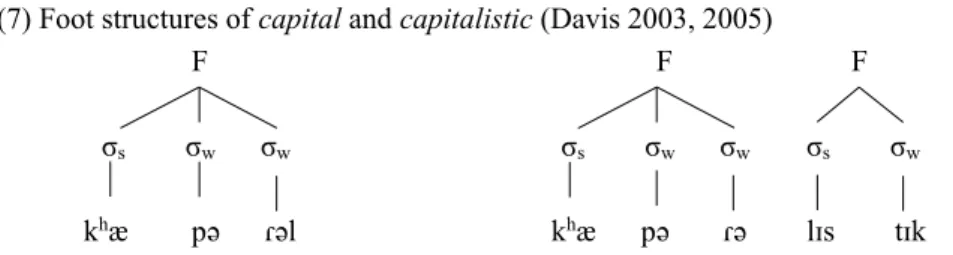
Davis (2005) claims that while the aspirated nature of the /t/ in militaristic does not reflect paradigm uniformity, the flapped /t/ in capitalistic can be accounted for by paradigm uniformity with capital; yet, the difference with Steriade’s (2000) is that the uniformity effect involves uniformity of foot structure with capital instead of the non- contrastive phonetic feature, [extra short closure], proposed by Steriade. This footing should be contrasted with the superfoot type in the case of militaristic because the third syllable of the dactylic sequence is word-final in capital and there is no following foot where it can adjoin. That is, according to Davis (2005), the flapping of the /t/ in capitalistic is a consequence of the uniformity of foot structure with capital, as given in (7).
(7) Foot structures of capital and capitalistic (Davis 2003, 2005)
F F F
σs σw σw σs σw σw σs σw
khæ pə ɾəl khæ pə ɾə lɪs tɪk
However, Kim (2009) argues against the view that the third syllable in Mediterranean forms the beginning of a superfoot with what follows, as suggested in the structure shown in (6). Kim conducted what he called an impressionistic experiment where six English speakers read a list of monomorphemic English words with a dactylic sequence preceding primary stress, including actual words and pseudowords. For the actual monomorphemic words such as Mediterranean and Navratilova, all three speakers who read those items tended to contain an aspirated stop rather than a flap; on the other hand, for the nonce items like Winnetegosis, Luxitalila, and Tamatagouchi, a considerable amount of variability was observed within a single speaker’s responses as well as between speakers, as summarized in Table 3.
Table 3. Results of Speaker Production (adapted from Kim 2009)
Speaker number
Items 1 2 3 4 5 6
Mèditerránean th th th
Nàvratilóva th th th
Wìnnetegósis th th/ɾ th/ɾ
Wàpatonéta th th/ɾ th/ɾ
Lùxitalíla th/ɾ ɾ th/ɾ
dèlitercússion th/ɾ ɾ th/ɾ
pèritapétic th ɾ th/ɾ
Tàmatagóuchi th ɾ th/ɾ
Based on the findings that the onset of the third syllable in the words used in the production task can be realized as both aspirated and flapped by English speakers, Kim (2009) makes a strong argument that the concept of a superfoot is simply illusory. Similarly, Riehl (2003) reported variability in her study where she replicated Steriade’s experiment with the modification that her participants repeated each of the base and derivative forms 12 times rather than just once. She assumed that paradigm uniformity would be supported only if all 12 repetitions of a base and its derivative form are pronounced with a flapped /t/ or only if all of them are produced with an
aspirated /t/. As discussed above, in Steriade’s (2000) study a small amount of variability was encountered within a single speaker’s responses, i.e., primi[ɾ]ive vs. primi[th]ivistic; Riehl takes this inter-speaker variation as a seeming refutation of paradigm uniformity. Riehl mentions that Steriade failed to clarify how variation in pronunciation would fit into paradigm uniformity.
Table 4. Results of Speaker Production (adapted from Riehl 2003: 296)
Speaker number
Base/Derivative pair 1 2 3 4 5 6
positive/positivistic ɾ ɾ
primitive/primitivistic ɾ
relative/relativistic th th th
negative/negativistic ɾ
Note. Empty cells indicate no case of paradigm uniformity.
As summarized in Table 4, results reported in Riehl’s study showed that uniform paradigms including near- uniform ones were observed in seven cases from three speakers; that is, Speakers 1, 3 and 6 produced an aspirated /t/ in the relative/relativistic pair every single time, and Speakers 3 and 6 had near-uniform paradigms pronouncing a flapped /t/ more than 10 out of 12 times in positive/positivistic, primitive/primitivistic, and negative/negativistic pairs. As Eddington (2006) points out, however, Riehl’s data may support paradigm uniformity if statistical tendencies are considered rather than an all-or-nothing interpretation. According to a correlation test conducted by Eddington, the number of times each speaker used a flapped /t/ in a base form was correlated with the number of times a flapped /t/ occurred in a derivative form, i.e., r = 0.748 (large effect size), p < 0.001 (Eddington 2006: 3).
This indicates that the more frequently the /t/ was flapped in the base form, the more often the /t/ was flapped in the derivative form and vice versa. In addition, an important issue that Riehl has brought up is that it may not be easy for paradigm uniformity to account for the variation found in the data. Her findings revealed that speakers had a tendency to articulate a stop (i.e., produce an aspirated /t/) during the early portions of the recording session and a flap during the later portions. She supposes that her speakers were possibly more likely to feel uncomfortable and want to slow down and enunciate carefully in the beginning of the recording period, considering the fact that the flapping rule occurs in informal, fast speech. She also mentions in her study there was a close relationship between speech rate and the tendency for the /t/ to be flapped; speech rate was more likely to accelerate as the repetitions proceeded for the majority of the speakers, and by the second half of the recordings when they probably felt familiar with the wordlist of the task, they were more likely to speak casually and fast.
3. Prosodically-Based Account
As mentioned earlier in the preceding section, Kim (2009) strongly doubts that a superfoot can exist as a prosodic unit and that a foot can be the boundary of aspiration/flapping, based on the findings on variant forms shown in his study. Davis (2010), however, provides substantial evidence for the foot on the basis of the distribution of certain sounds found in American English. He argues for the foot-based distribution of aspirated stops and the occurrence of the phoneme /h/ in American English as well as the distribution of the phoneme /r/ in non-rhotic dialects of English spoken in the Southern United States. He further contends that child acquisition data support the role of the foot in American English.
First, the environments where voiceless stops are aspirated in American English have been discussed above in the previous section: they are aspirated in foot-initial position; elsewhere, they are not aspirated. For example, the intervocalic /t/ is flapped in (sáni[ɾ]y)F while the target stop is aspirated in (Mèdi)F{[th]e(rránean)F}Fs (Davis 2003:
281). The distribution of the phoneme /h/ also closely parallels that of aspirated stops in that /h/ surfaces in the same positions in which aspiration surfaces on voiceless stops. That is, /h/ is realized in foot-initial position and it does not occur elsewhere. For instance, the /h/ is pronounced at the beginning of the foot-initial syllable as in pro([h]íbit)F, whereas the /h/ is not pronounced when it is in a foot-internal position as in (prò[Ø]i)F(bítion)F
(Davis and Cho 2003: 613). Given that aspiration and /h/ can both be represented by the phonological feature [spread glottis], Davis (2010) follows Davis and Cho (2003) in maintaining that [spread glottis] is only realized foot-initially in American English. Similarly, a foot-based distribution also relates to Harris’s (2013) observation of non-rhotic dialects of southern American English where /r/ surfaces predominantly in foot-initial position, e.g., te([r]áin)F vs. (shé[Ø]iff)F (Harris 2013: 365). Additional distribution phenomena in dialectal American English that make important reference to foot structure include Canadian raising (Chambers 1973), devoicing of obstruents in Pennsylvania Dutchified English (Anderson 2011), and the occurrence of dark/light /l/ in various varieties of American English (Sproat and Fujimura 1993).
Crucially, Davis (2010) provides a foot-based analysis of L1 American English acquisition data on lateral gliding and velar fronting presented in Inkelas and Rose (2007), where a child referred to as E is acquiring American English as his first language from the time he was two years of age until he was four. Inkelas and Rose (2007) focus on two processes E displays in his language acquisition. First, with reference to the first process, velar fronting, the velar consonant is fronted with a coronal realization in foot-initial position while it is realized as an appropriate target in other positions, as shown in (8) below. Positional lateral gliding given in (9) also shows foot- based distribution in the child’s language, i.e., the coronal glide [j] occurs when the target lateral is in foot-initial position whereas the labiovelar glide [w] occurs when the target lateral is in other positions. Although Sugahara and Turk (2009) questioned the foot-based account of truncated words in early acquisition suggesting that unstressed initial syllables are less perceptually salient than unstressed final syllables, the acquisition data given in (8) and (9) indicate that children acquiring American English as their first language are already sensitive to the foot before the age of three.
(8) Velar fronting (adapted from Inkelas and Rose 2007: 710-711) a. /k, g/ → [t, d] in foot-initial position
[thʌp] ‘cup’
[doː] ‘go’
[ədín] ‘again’
[hǽwəthʌ̀əkɚ] ‘helicopter’
[ǽwədɛ̀ɾɚ] ‘alligator’
[tʌndʌ́ktə] ‘conductor’
b. /k, g/ → [k, g] elsewhere
[bɪg] ‘big’
[bʊkh] ‘book’
[ɑ́ktəpʊs] ‘octopus’
[mɑ́ŋki] ‘monkey’
[béjgu] ‘bagel’
(9) Positional lateral gliding (adapted from Inkelas and Rose 2007: 712-713) a. /l/ → [j] in foot-initial position
[jæmp] ‘lamp’
[vajəjín] ‘violin’
[hajów] ‘hello’
[mǽdəjàjn] ‘Madeline’
[jiván] ‘Livan’
b. /l/ → [w] elsewhere
[hǽwəthʌ̀əkɚ] ‘helicopter’
[ǽwədɛ̀ɾɚ] ‘alligator’
[nɛ́kwəs] ‘necklace’
[stɛ̀wəjúwnə] ‘Stellaluna’
[fɛw] ‘fell’
While Davis (2003, 2005, 2010) provided strong evidence for the foot, on the basis of the distribution of aspirated/flapped stops in American English, there have been other explanations that are not prosodically-based, including the contrast enhancement approach (Flemming 1995) and cue-based approach (Steriade 2000, Blevins 2003). However, these perspectives fail to distinguish between the two instances of /t/ in the words capitalistic and militaristic because in both words the /t/ occurs in identical segmental environments. Moreover, a resyllabification based analysis of aspiration (Selkirk 1982) has similar difficulties explaining the difference between the two. That is, in capitalistic the onset of the third syllable between two stressless vowels would have to be resyllabified into the preceding coda in order to account for the lack of aspiration; yet, the voiceless stop at the beginning of the third syllable cannot be resyllabified in the identical environment of militaristic. On the other hand, the prosodic foot-based approach can explain the difference in the two words; aspiration occurs in militaristic since the /t/ is foot-initial in that word, while flapping occurs in capitalistic while the /t/ is foot-internal, i.e., (mili){ta(ristic)} vs.
(capita)(listic).
The present study basically follows the foot-based prosodic approach since the difference between capitalistic and militaristic is problematic for any account that does not reference the foot, and this research attempts to provide an explanation for the variant realizations of the two words using the Maximum Entropy (MaxEnt) model (Goldwater and Johnson 2003, Hayes and Wilson 2008, Smolensky 1986, Wilson 2006). Optimality theory (OT, Prince and Smolensky 1993) should be noted in order to introduce the MaxEnt grammar tool. OT has been considered a successful linguistic theory because it may account for how learners acquire the language-specific knowledge required by the theory and it has algorithms for learning constraint rankings (Prince and Tesar 1999, Pulleyblank and Turkel 1996, Tesar and Smolensky 1993). Most existing OT learning algorithms, however, have major issues; because of their single constraint ranking, they fail to model grammars involving free variation, where a single input form has more than one output form. There have been a great variety of attempts to adapt the OT model in order to explain free variation including floating constraint (Nagy and Reynolds 1997), free ranking of constraints within strata (Anttila 1997) and strictness bands (Hayes 2000). One of the most successful models is the probabilistic model proposed by Boersma (1997) and its associated learning algorithm, the Gradual Learning Algorithm (GLA). By stepping away from the discrete domain of standard OT, the GLA can learn from noisy input and accurately reproduce grammar with free variation. As Keller and Asudeh (2002) pointed out, however, the GLA cannot explain cumulativity effects. Although Linear OT (Keller 2000) is designed to explain cumulativity effects, it does not learn from actual linguistic data but only from acceptability judgment data.
MaxEnt is a different OT-inspired model of constraint-based phonology; like the GLA, this model is probabilistic making it resistant to noise and it reproduces the distribution of output forms in a training corpus modeling free variation. MaxEnt is also similar to Linear OT in that it treats constraints as additive and explains cumulativity effects. In practice, this model is a very general statistical model that has been used in a wide range of fields including computational linguistics. MaxEnt models involve logistic regression models (Berkson 1944), exponential models (Gebraeel et al. 2005), Boltzmann networks (Smolensky 1986), Harmonic grammars (Legendre et al. 1990), probabilistic context free grammars (Chomsky 1956), and Hidden Markov Models (Hopcroft and Ullman 1979). MaxEnt was initially motivated by information theory (Jaynes 1957) that is designed to include as much information as is known from the data while making no additional assumptions; namely, it has as high an entropy as possible under the constraint that they match the training data.
MaxEnt assumes a set of choices, e.g., the candidate set GEN of OT. As a probabilistic model, MaxEnt assigns each candidate a probability rather than picking a single winner as in classical OT. Constraints in MaxEnt are not ranked as in OT but given numerical weights, and constraints with higher weights are considered stronger. These weights are employed in the core MaxEnt formula given in (10), which takes as input the set of constraints, constraint weights, candidates and constraint violations and outputs a probability Pr(x) for each candidate x. In order to calculate this probability, the things given in Table 5 should be done in order.
(10) The MaxEnt formula (adapted from Goldwater and Johnson 2003) exp(-∑i wifi (x))
Pr(x) = , where Z = ∑j exp(-∑i wifi (xj)) Z
Table 5. The MaxEnt Calculations for a Given Candidate x (adapted from Goldwater and Johnson 2003, Smolensky 1986, Wilson 2014)
Order Compute this Name of what is computed
How and why it is computed
1 ∑i wifi (x) Harmony Multiply x’s violation counts for each constraint (designated fi(xj)) by the weight of the constraint (wi), and then add up the results across all constraints (∑i). All available evidence (i.e., constraint violations) bearing on a candidate is considered, in proportion to the constraint weights.
2 exp(-∑i wifi (x)) eHarmony Negate the harmony of x, and then compute the function exp() on the results, where exp(x) is a typographic convenience for ex, e ≈ 2.72. In a series of candidates with greater harmony penalties, the probabilities descend not in linear fashion, but instead asymptote to zero (negative exponential curve).
3 ∑j exp(-∑i wifi (xj)) Z, the ‘normalizing constant’
Compute the eHarmony of every candidate derived from the same input as x and sum these values.
4 exp(-∑i wifi (x)) Z
Probability of x Divide the eHarmony of x by Z. The probability of a candidate depends inversely on the probability of the candidates with which it competes.
The current study investigated the pronunciation of the two words under examination, capitalistic and militaristic, using the audio pronunciation listed in eleven different online dictionaries including Oxford English Dictionary, Merriam Webster, American Heritage, the CMU Pronouncing Dictionary, Cambridge Dictionary, Collins English
Dictionary, Longman Dictionary of Contemporary English, Dictionary.com, The Free Dictionary, YouGlish, and Educalingo. The frequency data observed from those dictionaries were fed into the MaxEnt model to see if the learned grammar can successfully predict the observed frequency. Maxent Grammar Tool (Wilson 2006) was employed in this study to compute weights for constraint-based maxent grammars. This is a useful tool for linguists since you can make up a grammar consisting of constraints and train it using the program to match a corpus of data. You can easily feed the program using an input file that contains underlying representations, rival surface representations for each UR, specification of winners, a list of constraints, and the number of violations of each constraint for each candidate. Then, the program computes and writes to an output file a set of maxent weights for a maxent grammar and the predicted probabilities that the grammar assigns to each candidate when using these weights.
Constraints given in (11a-c) are needed to analyze the difference in capitalistic vs. militaristic and their predicted weights are as shown in (11d) following the constraint ranking suggested in Davis (2005). Given that the final two syllables in both militarístic and capitalístic consist of a trochaic foot, if the foot structure of mílitàry were preserved in militaristic, there would be a stress clash, i.e., *mìlitàrístic. This constraint against head clash is expected to have higher weights than a constraint on foot identity, which demands the uniform foot structure between input and output forms. *CLASHHEAD prevents the third syllable of militaristic from surfacing with stress, and it is predicted that militaristic reflects the regular footing constraints for English such as FOOTBINARITY. On the other hand, the foot structure of cápital may be maintained when the final two syllables of capitalístic consist of a trochaic foot. That is, there is no head clash in càpitalístic where the foot identity constraint can be respected.
*CLASHHEAD and IDENT-FOOT are expected to have higher weights than FOOTBINARITY since there is no overriding constraint that would compel the third syllable of capitalistic to be refooted with the syllables that follow in violation of IDENT-FOOT.
(11) Constraints necessary for the analysis of capitalistic vs. militaristic a. *CLASHHEAD (Pater 2000)
No stressed syllable has to be adjacent to the head syllable of the prosodic word.
b. IDENT-FOOT (adapted from Pater 2000 and Davis 2005)
The foot head of an input has to correspond to that of an output.
c. FOOTBINARITY (Prince and Smolensky 1993) A foot has to be minimally bimoraic.
d. Predicted weight: *CLASHHEAD >IDENT-FOOT > FOOTBINARITY
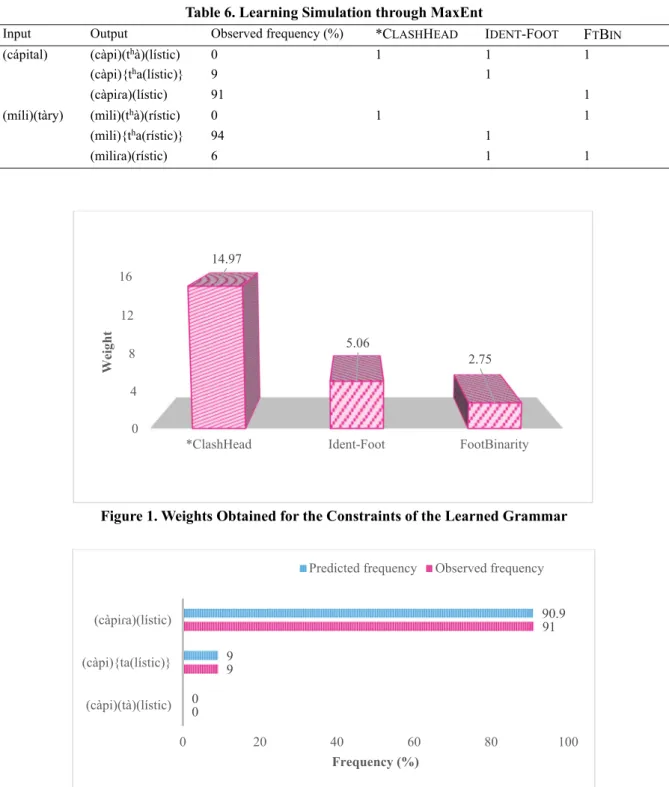
With these constraints, learning simulation was conducted using MaxEnt as given in Table 6 where no constraint is assumed to be in a strict domination hierarchy. As shown in Figure 1, constraint weights obtained by the learned grammar are quite similar to the relative weights predicted for each constraint given in (11d). As expected,
*CLASHHEAD had the highest weights, which means that this constraint is more important in relation to IDENT- FOOT and FOOTBINARITY with relatively lower weights. Moreover, given that MaxEnt is a probabilistic model, the violation of the most powerful constraint in the learned grammar can lessen the probability that an output candidate such as (càpi)(thà)(lístic) or (mìli)(thà)(rístic) could be realized as an actual linguistic form. As displayed in Figures 2 and 3, simulation results of capitalistic and militaristic show that the observed frequency corresponds exactly to the predicted frequency, which suggests that the learned grammar is able to accurately reproduce actual variant forms in a similar way to the training corpus data. That is, it turned out that the learned grammar predicted the pronunciation of the third syllable of the two words with the same frequency as the actual observation. MaxEnt
modeling captured the fact that each variant form had different output frequency since the relevant constraints possessed their own weights. This result indicates that MaxEnt is better in explaining variability issue than standard OT approaches that fail to model grammars involving free variation due to their single constraint ranking.
Table 6. Learning Simulation through MaxEnt
Input Output Observed frequency (%) *CLASHHEAD IDENT-FOOT FTBIN
(cápital) (càpi)(thà)(lístic) 0 1 1 1
(càpi){tha(lístic)} 9 1
(càpiɾa)(lístic) 91 1
(míli)(tàry) (mìli)(thà)(rístic) 0 1 1
(mìli){tha(rístic)} 94 1
(mìliɾa)(rístic) 6 1 1
Figure 1. Weights Obtained for the Constraints of the Learned Grammar
Figure 2. Simulation Results of capitalistic 0
4 8 12 16
*ClashHead Ident-Foot FootBinarity
14.97
5.06
Weight 2.75
0 9
91
0 9
90.9
0 20 40 60 80 100
(càpi)(tà)(lístic) (càpi){ta(lístic)}
(càpiɾa)(lístic)
Frequency (%)
Predicted frequency Observed frequency
Figure 3. Simulation Results of militaristic
4. Conclusion
The present study examined the data where the underlying /t/’s of capitalistic and militaristic surface with the same realization as in their base forms capital and military, which is widely known as the phenomenon of paradigm uniformity. While a great number of studies have considered several different approaches in this discussion including foot-based analyses, OT accounts, paradigm leveling, and analogy, there has been no research that examines a possible output form involving both aspiration and flapping. This study seeks to capture the variant realizations in the third syllables of the two words deploying 11 different online dictionaries within the MaxEnt model. Current simulation results show that the frequency observed in the actual linguistic data corresponds to that predicted by the training corpus data, and this indicates that the learned grammar is able to accurately reproduce the observed frequency. These findings suggest that MaxEnt has a more explanatory power than classical OT accounts since it can serve to explain grammars involving free variation.
Lexical frequency is another issue related to the debate of capitalistic vs. militaristic that the current study did not consider. Patterson and Connine (2001) reported that there was a difference in the probability of occurrence of flaps in a medial position as a function of the lexical frequency of the carrier words used in their study, i.e., its probability was smaller for the lower frequency words compared to that of high frequency words, i.e., 76% vs. 95%
(Patterson and Connine 2001: 264). However, their findings are not line with the frequency information of the two words examined in the current study in that militaristic had the frequency of 4,016 (rank: 31,701) while capitalistic failed to be in the top 60,000 word list, according to the iWeb corpus.2 This corpus analysis could suggest that frequency is not everything since the third syllable of militaristic is unflapped even though capitalistic is less frequently used than militaristic. Future research will focus on this possibility that other variant patterns can be interrelated with lexical frequency by particularly considering Korean loanwords adapted from English.
2 The iWeb corpus (Davies 2018) is one of the BYU corpora, which is the world’s most widely-used corpora. This corpus involves nearly 95,000 websites that include an average of 240 web pages and 145,000 words each, which contains 14 billion words in size. This makes about 25 times as big as Corpus of Contemporary American English (560 million words) and about 140 times as big as the British National Corpus (100 million words).
0
94 6
0
93.9 6
0 20 40 60 80 100
(mìli)(tà)(rístic) (mìli){ta(rístic)}
(mìliɾa)(rístic)
Frequency (%)
Predicted frequency Observed frequency
References
Ahmed, S., S. Andersson and B. Vaux. 2020. English phonology and morphology. In B. Aarts, A. McMahon and L. Hinrichs, eds., The Handbook of English Linguistics, 345-364. New York: John Wiley and Sons Inc.
Anderson, V. 2011. Bidialectalism in Intense Language Variety Contact: An “Unexpected” Development in the Death of Pennsylvania Dutchified English. Doctoral dissertation, Indiana University.
Anttila, A. 1997. Variation in Finnish Phonology and Morphology. Doctoral dissertation, Stanford University.
Banner-Inouye, S. 1995. Trills, Taps and Stops in Contrast and Variation. Doctoral dissertation, UCLA.
Benua, L. 1995. Identity effects in morphological truncation. In J. Beckman, L. Dickey and S. Urbanczyk, eds., University of Massachusetts Occasional Papers 18, 77-136. GLSA, University of Massachusetts, Amherst.
Benua, L. 1997a. Transderivational Identity: Phonological Relations between Words. Doctoral dissertation, University of Massachusetts, Amherst.
Benua, L. 1997b. Affix classes are derived by faithfulness. University of Maryland Working Papers in Linguistics 5, 1-26.
Berkson, J. 1944. Application of the logistic function to bio-assay. Journal of the American Statistical Association 9, 357-365.
Blevins, J. 2003. The independent nature of phonotactic constraints: An alternative to syllable-based approaches.
In C. Féry and R. van de Vijver, eds., The Syllable in Optimality Theory, 375-403. Cambridge: Cambridge University Press.
Boersma, P. 1997. How we learn variation, optionality and probability. In Proceedings of the Institute of Phonetic Sciences of the University of Amsterdam, vol. 21, 43-58.
Borowsky, T. 1986. Topics in the Lexical Phonology of English. Doctoral dissertation, University of Massachusetts, Amherst.
Burzio, L. 1994. Principles of English Stress. Cambridge University Press.
Cambridge Dictionary. 2021. Cambridge University Press. Available online at http://www.dictionary.cambridge.
org
Chambers, J. 1973. Canadian raising. Canadian Journal of Linguistics 18, 113-135.
Chomsky, N. 1956. Three models for the description of language. IEEE Transactions on Information Theory 2(3), 113–124.
Chomsky, N. and M. Halle. 1968. The Sound Pattern of English. New York: Harper and Row.
Collins English Dictionary. 2021. Available online at http://www.collinsdictionary.com.
Davies, M. 2018. The iWeb Corpus. Available online at https://www.english-corpora.org/iWeb/.
Davis, S. 2003. The footing of dactylic sequences in American English. In T. Homma, M. Okazaki, T. Tabata and S. Tanaka, eds., A New Century of Phonology and Phonological Theory, 277-289. Tokyo: Kaitakusha.
Davis, S. 2005. Capitalistic vs. militaristic: The paradigm uniformity effect reconsidered. In L. Downing, T. Hall and R. Raffelsiefen, eds., Paradigms in Phonological Theory, 107-121. Oxford: Oxford University Press.
Davis, S. 2010. Distributional evidence for the foot from the L1 acquisition of American English. Phonological Studies 13, 39-50.
Davis, S. and M. Cho. 2003. The distribution of aspirated stops and /h/ in American English and Korean: An alignment approach with typological implications. Linguistics 41, 607-652.
Davis, S. and W. Summers. 1989. Vowel length and closure duration in word-medial VC sequences. Journal of Phonetics 17, 339-353.
de Jong, K. 1998. Stress-related variation in the articulation of coda alveolar stops: Flapping revisited. Journal of
Phonetics 26, 283-310.
Dictionary.com. 2021. Available online at http://www.dictionary.com
Eddington, D. 2006. Paradigm uniformity and analogy: The capitalistic versus militaristic debate. International Journal of English Studies 6(2), 1-18.
Educalingo. 2021. Available online at http://www.educalingo.com.
Flemming, E. 1995. Auditory Features in Phonology. Doctoral dissertation, UCLA.
Fujimura, O. 1986. Relative invariance of articulatory movements: An iceberg model. In J. Perkell and D. Klatt, eds., Invariance and Variability in Speech Processes, 226-234. Hillsdale, N. J.: Lawrence Earlbaum Assoc.
Fox, R. and D. Terbeek. 1977. Dental flaps, vowel duration and rule ordering in American English. Journal of Phonetics 5, 27-34.
Gebraeel, N., M. Lawley, R. Li and J. Ryan. 2005. Residual-life distributions from component degradation signals:
A Bayesian approach. IIE Trans. 37, 543–557.
Goldwater, S. and M. Johnson. 2003. Learning OT constraint rankings using a maximum entropy model. In J.
Spenader, A. Eriksson and O. Dahl, eds., Proceedings of the Stockholm Workshop on Variation within Optimality Theory, 111-120. Stockholm: Stockholm University.
Hayes, B. 1981. A Metrical Theory and Stress Rules. Doctoral dissertation, MIT.
Hayes, B. 2000. Gradient well-formedness in optimality theory. In J. Dekkers, F. van der Leeuw and J. van de Weijer, eds., Optimality Theory: Phonology, Syntax and Acquisition, 88-120. Oxford: Oxford University Press.
Hayes, B. and C. Wilson. 2008. A maximum entropy model of phonotactics and phonotactic learning. Linguistic Inquiry 39, 379-440.
Gussenhoven, C. 1986. English plosive allophones and ambisyllabicity. Gramma 10, 119-141.
Harris, J. 2013. Wide-domain r-effects in English. Journal of Linguistics 49, 329-365.
Harris, J. and J. Kaye. 1990. A tale of two cities: London glottalling and New York City tapping. The Linguistic Review 7, 251-274.
Hopcroft, J. and J. Ullman. 1979. Introduction to Automata Theory, Languages, and Computation. Addison- Wesley Publishing Company.
Inkelas, S. and I. Rose. 2007. Positional neutralization: A case study from child language. Language 83, 707-736.
Inouye, B. 1989. The flap as a contour segment. UCLA Working Papers 72, 39-81.
Jaynes, E. 1957. Information theory and statistical mechanics. The Physical Review 106(4), 620-630.
Jensen, J. 1987. English stop allophones in Metrical Theory. Proceedings of the 11th International Congress of Phonetic Sciences 2, 153-156.
Jensen, J. 2000. Against ambisyllabicity. Phonology 17, 187-235.
Joos, M. 1942. A phonological dilemma in Canadian English. Language 18, 141-144.
Kahn, D. 1980. Syllable-Based Generalizations in English Phonology. New York: Garland.
Kaisse, E. 1985. Connected Speech: The Interaction of Syntax and Phonology. Orlando: Academic Press.
Keller, F. 2000. Gradience in Grammar: Experimental and Computational Aspects of Degrees of Grammaticality.
Doctoral dissertation, University of Edinburgh.
Keller, F. and A. Asudeh. 2002. Probabilistic learning algorithms and optimality theory. Linguistic Inquiry 33(2), 225-244.
Kenstowicz, M. 1996. Base-identity and uniform exponence: Alternatives to cyclicity. In J. Durand and B. Laks, eds., Current Trends in Phonology: Models and Methods, 363-393. CNRS, Paris X and University of Salford: University of Salford Publications.
Kim, Y. 2009. On ternary feet in American English. Language and Information Society 11, 1-19.
Kiparsky, P. 1978. Analogical change as a problem for linguistic theory. In P. Kiparsky, ed., Explanation in Phonology, 217-236. Dordrecht: Foris.
Kiparsky, P. 1979. Metrical structure assignment is cyclic. Linguistic Inquiry 10, 421-441.
Legendre, G., Y. Miyata and P. Smolensky. 1990. Can connectionism contribute to syntax?: Harmonic Grammar, with an application. In M. Ziolkowski, M. Noske and K. Deaton, eds., Proceedings of the 26th Regional Meeting of the Chicago Linguistic Society, 237-252. Chicago: Chicago Linguistic Society.
Longman Dictionary of Contemporary English. 2021. Harlow, English: Longman. Available online at http://www.ldoceonline.com.
Macchi, M. 1985. Segmental and Suprasegmental Features and Lip and Jaw Articulators. Doctoral dissertation, NYU.
Merriam-Webster Dictionary. 2021. Available online at http://www.merriam-webster.com McCarthy, J. 1982. Prosodic structure and expletive infixation. Language 58, 574-590.
Nagy, N. and B. Reynolds. 1997. Optimality theory and variable word-final deletion in faetar. Language Variation and Change 9, 37-55.
Nespor, M. and I. Vogel. 1986. Prosodic Phonology. Dordrecht: Foris.
OED Online. 2021. Oxford University Press. Available online at http://www.oed.com
Pater, J. 2000. Non-uniformity in English secondary stress: The role of ranked and lexically-specific constraints.
Phonology 17, 237-274.
Patterson, D. and C. Connine. 2001. Variant frequency in flap production. Phonetica 58, 254-275.
Prince, A. and P. Smolensky. 1993. Optimality Theory: Constraint interaction in generative grammar. RuCCS Technical Report. New Brunswick, NJ: Rutgers University.
Prince, A. and B. Tesar. 1999. Learning phonotactic distributions. RuCCS Technical Report. New Brunswick, NJ:
Rutgers University.
Pulleyblank D. and W. Turkel. 1996. Optimality theory and learning algorithms: The representation of recurrent featural asymmetries. In J. Durand and B. Laks, eds., Current Trends in Phonology: Models and Methods, 653-694. University of Salford.
Riehl, K. 2003. American English flapping: Perceptual and acoustic evidence against paradigm uniformity with phonetic features. Working Papers of the Cornell Phonetics Laboratory 15, 271-337.
Selkirk, E. 1978. On prosodic structure and its relation to syntactic structure. In T. Frethein, ed., Nordic Prosody II, 111-140. Trontheim: Tapir.
Selkirk, E. 1982. The Syntax of Words. Cambridge, MA: MIT Press.
Smolensky, P. 1986. Information processing in dynamical systems: Foundations of harmony theory. In J.
McClelland, D. Rumelhart and the PDP Research Group, eds., Parallel Distributed Processing, vol. 2:
Psychological and Biological Models, 390–431. MA: MIT Press.
Sproat, R. and O. Fujimura. 1993. Allophonic variation of English /l/ and its implications for phonetic implementation. Journal of Phonetics 21, 291-311.
Stampe, D. 1973. A Dissertation on Natural Phonology. Doctoral dissertation, University of Chicago.
Steriade, D. 1995. Underspecification and markedness. In J. Goldsmith, ed., The Handbook of Phonological Theory, 114-175. Blackwell Publishing.
Steriade, D. 1996. Paradigm uniformity and the phonetics-phonology boundary. Paper presented at the 5th Conference on Laboratory Phonology, Northwestern University, Evanston, Illinois.
Steriade, D. 1998. Licensing laryngeal features. In M. Gordon, ed., UCLA Papers in Phonology 3, 25-147.