KOREAN JOURNAL OF ENGLISH LANGUAGE AND LINGUISTICS
ISSN: 1598-1398 / e-ISSN 2586-7474 http://journal.kasell.or.kr
Cross-linguistic Differences of Temporal Information Processing Between L1 and L2 in Narrative Text Comprehension: An Eye-Tracking Study
JungEun Choi (Seoul National University) Moongee Jeon (Konkuk University)
This is an open-access article distributed under the terms of the Creative Commons License, which permits unrestricted non- commercial use, distribution, and reproduction in any medium, provided the original work is properly cited.
ABSTRACT
Choi, JungEun and Moongee Jeon. 2021. Cross-linguistic differences of temporal information processing between L1 and L2 in narrative text comprehension: An eye-tracking study. Korean Journal of English Language and Linguistics 21, 617-635.
The present study investigated cross-linguistic differences of temporal information processing between Korean as L1 and English as L2 in narratives. The study was based on the event-indexing model, which is one of the situation models in text comprehension. Recognizing that temporal information processing differs in Korean and English reading depending on the temporal shift markers such as a moment later, an hour later, and a day later, this study sought to explain the cause of the differences. An eye-tracking experimental method was employed for a closer investigation. The examination focused on the temporal shift markers and the subsequent critical event information contained in the target sentence. Measures of eye-dwell time for the respective information included the first pass gaze duration, the regressions into the information, and the second pass gaze duration. The results indicated that a significant difference between L1 and L2 occurred in the processing of the temporal shift markers. While L1 readers read the temporal information gradually slower as the distance of the temporal shift increased, L2 readers read the temporal marker of an hour later the slowest. The results supported that the processing of temporal information differs between L1 and L2, and that L2 proficiency is a crucial variable for L2 successful situation model construction.
Received: June 07, 2021 Revised: July 10, 2021 Accepted: July 25, 2021
Choi, JungEun (1st author) Lecturer, Faculty of Liberal Education, Seoul Nat’l University [email protected]
Moongee Jeon (corresponding author) Professor, Dept. of English Language & Literature, Konkuk University [email protected]
*This work was supported by the Ministry of Education of the Republic of Korea and the National Research Foundation of Korea (NRF-2018S1A5B5A07074313).
KEYWORDS
situation model, temporal information, narratives, eye-tracking, Korean learners of English
1. Introduction
Reading is a crucial ability for an individual learner to perform adequately both in school and society at large (Kendeou, van den Broek, White and Lynch 2007). For successful reading comprehension, many cognitive psychologists have acknowledged that a reader needs to construct a coherent situation model as the text intends to convey (Kintsch 1988, van den Broek and Espin 2012, Zwaan and Radvansky 1998, Zwaan and Rapp 2006).
To this end, many factors are involved from understanding individual sentences to understanding the overall content of the text. The textual information and the reader’s background knowledge interact, and a mental representation or a situation model has been made for the text at the end of the reading (Johnson-Laird 1983, van Dijk and Kintsch 1983). This situation model represents what the reader understands about the text, and how well they construct this model is the key to successful reading.
Since the theorization of the situation model in the first language (L1) text comprehension (Graesser, Singer and Trabasso 1994, Johnson-Laird 1983, Kintsch 1988, van Dijk and Kintsch 1983), many psychologists have tried to identify specific phenomena in which a reader builds situational models while reading. One of them is the event-indexing model, which first focused on the narrative text reading, posited by Zwaan and his colleagues (Zwaan, Langston and Graesser 1995, Zwaan, Magliano and Graesser 1995, Zwaan and Radvansky 1998).
According to the theory, the core of the situation in narratives is the event or action of the character, and this event is connected and integrated into the reader’s cognitive memory during reading. Finally, the reader forms a mental representation for the multidimensional elements of the situation. The model suggests that this mental representation can be identified in five aspects: space, time, protagonist, motivation or intentionality, and causality. Later studies have provided a myriad of empirical evidence for the components of this situation model (e.g., McNerney, Goodwin and Radvansky 2011, O'Brien, Rizzella, Albrecht and Halleran 1998, Petijohn and Radvansky 2016, Radvansky and Copeland 2010, Rinck and Weber 2003, Therriault and Rinck 2007). They have demonstrated readers’ sensitivity to the consistency of information about situational elements when paying attention to events in narratives and their update processes with the change of such information in creating a situation model.
However, despite many of these L1 studies, discussions for the second language (L2) or foreign language readers about the construction of situation models which is fundamental in reading comprehension are relatively scarce. Since the initiation by Zwaan and Brown (1996), although several attempts have been made later (e.g., Morishima 2013, O’Rourke and Bunting 2018, Takaki 2010, 2011, Xianle 2011), the situation model construction for L2 readers has still been under-researched. Meanwhile, Choi (2020) took an interest in the proficiency issue that was yet-inconclusive for L2 readers to reach the level of situation model in text comprehension. Also, she examined the difference between L1 and L2 situation model construction focusing on temporal information in narratives. As a result, her study demonstrated that the L2 threshold seemed considerably high for L2 higher-level reading, and that there was a difference in processing the temporal information between languages. However, she did not provide details about this difference. The present study was, thus, motivated by this research need and attempted to explore L2 readers’ sensitivity for a situational element in narrative texts. The study focused on temporal information that is one of the situational dimensions specified by the event-indexing model. Additionally, it tried to investigate more detailed cross-linguistic differences in the processing of temporal shift in narratives between Korean as L1 and English as L2 within an eye movement tracking experimental approach.
2. Literature Review
2.1 L2 Situation Model Construction
Amid the lack of research for L2 readers, a small number of researchers have attempted to examine L2 situation model construction. As a cornerstone, Zwaan and Brown (1996) looked at the cognitive process of L2 readers understanding the narrative text. Their findings indicated that L2 proficiency plays a crucial role in multi-faceted L2 situation model construction, and that L2 readers should reach a certain level of proficiency.
However, since the study was conducted on lower-level L2 learners, there is a limit to knowing more about the impact of L2 proficiency for the successful L2 situation model construction. Several other studies have contributed to building some more empirical evidence for L2 readers, but they have also been limited in providing clear information about the proficiency issue. For example, Takaki (2010, 2011) replicated the study of Zwaan and Brown (1996) for Japanese L2 learners of English, but did not show the apparent difference between upper- and lower-level L2 readers. Xianle (2011) investigated the influence of time shift on the memory retrieval process of Chinese L2 readers of English by replicating the study of Speer and Zacks (2005). However, the participants were all English majors in college who can be regarded as somewhat higher-level L2 learners, so they showed a similar processing pattern for time shift information to the original L1 study. In addition, as a more recent study, O’Rourke and Bunting (2018) examined mental model ability in L1 and L2 and tried to determine the contribution of language proficiency and working memory. Their findings demonstrated that successful L1 reading is more related to working memory capacity, whereas L2 reading is likely to be involved with L2 reading ability. Still, specific individual differences by L2 proficiency were not so clear in their findings.
Considering this limitation of prior work, Choi (2020) examined the effects of L1 and L2 reading proficiency on narrative text comprehension in a more systematic approach. Under the framework of the event-indexing model, focusing on temporal information and expanding Zwaan’s (1996) work, her findings revealed that only higher-level L2 readers tracked the temporal inconsistencies in narrative texts. Also, the L2 reader proficiency level for the successful situation model construction was much higher than the text difficulty level. Furthermore, she investigated differences between L1 (Korean) and L2 (English) situation model construction and found that the processing of time shift markers in narratives (i.e., a moment later, an hour later, and a day later) differed between languages. In other words, in the example story presented in Table 1, Korean L1 readers read the target sentences that contained a moment later and an hour later significantly faster than that of a day later, and there was no difference in reading time between the first two markers. On the other hand, in L2 reading, they read the sentence of a moment later significantly the fastest among the three as complied with the study of Zwaan (1996).
The fastest reading of such temporal information means that the information is read most naturally in the text, and this indicates that the type of time-shifting information brings a difference in the reader’s cognitive processing.
Table 1. A Sample Narrative Story (Choi 2020)
English (L2) Korean (L1)
Chris was a lawyer in Memphis. He had opened an office there after his move from Seattle. He already had quite a few clients. This morning, Chris had a busy schedule. He had to finish some work before he flew to Boston to meet a client. His plane would leave tonight. Chris started opening the mail. A moment/an hour/a day later, Chris felt a headache. This was a sign that he had been working too hard. Chris decided to work more efficiently, so that he could find more time to relax. He would take up playing racquetball again.
크리스는 멤피스에서 변호사였다. 그는 시애틀에서 이사 온 후 그곳에 사무실을 열었다. 그에게는 이미 고객이 몇 명 있었다. 오늘 아침 크리스는 일정이 많았다. 고객을 만나러 보스턴행 비행기를 타기 전에, 그는 끝내야 할 일이 있었다. 비행기는 오늘 밤 출발한다. 크리스는 메일을 확인하기 시작했다.
잠시 뒤에/한 시간 뒤에/하루 뒤에, 크리스는 두통을
느꼈다. 이것은 그가 일을 너무 많이 했다는
신호였다. 크리스는 일을 좀 더 효율적으로 하리라 생각했고, 그러면 쉴 시간을 좀 더 낼 수 있을 것이다. 그는 라켓볼을 다시 시작하기로 하였다.
One interesting point in her findings, however, was that time information was processed differently when the same learner read the same text in Korean (L1) and English (L2). Thus, given this result, the question remains whether an individual reads the same temporal information in the narrative text and understands it differently across languages. In other words, it is a question of whether readers understand the information in the text differently when reading in Korean and English. According to the situation model theory, situation model construction reflects an individual’s general understanding (Ericsson and Kintsch 1995, Kintsch 1998). It is then considered to have the same mental representation without interlinguistic differences in understanding the main content of the text. However, in Choi’s (2020) work, the readers showed differences between languages in processing time shift markers. Thus, this requires further examination. Since Choi (2020) did not provide more details of such differences between languages, it is necessary to further investigate what psycholinguistic causes or differences are involved according to languages in the reader’s understanding and processing of temporal information in narrative texts.
2.2 Time Shift Processing in Narratives
The present study considered psycholinguistic theories for readers to process time shifts in narratives: the scenario model and the strong iconicity assumption. First, the scenario model examines the time shift effects of narrative text in the context of a scenario (Anderson, Garrod and Sanford 1983). According to this model, a reader constructs situation models based on events in the text, that is, scenarios. Temporal markers at this point provide a criterion for whether the reader should maintain or disable the current scenario model and create a new one (Anderson et al. 1983, Gernsbacher 1990). Accordingly, the temporal information makes a difference in the reader’s cognitive processing depending on whether it is within or outside the scenario boundary. To consider the example text presented in (1), in Anderson et al.’s (1983) study, readers read the underlined target sentence that contains seven hours later longer than that of ten minutes later. This is because the action of the scenario-bound character is out of the time boundary of a scenario (a film screening). Therefore, the scenario model implicates that the time shift information within the normal time boundary for the event is processed fast as it does not burden the information processing in memory, otherwise it slows down.
(1) At the cinema,
Jenny found the film rather boring.
The projectionist had to keep changing reels.
It was supposed to be a silent classic.
Ten minutes/seven hours later, the film was forgotten.
He/she was fast asleep. (Anderson et al. 1983, p. 430)
Next, Zwaan (1996) proposed the strong iconicity assumption, an extended version of the iconicity assumption that deals with temporal information processing in narrative texts (Fleischman 1990, Hopper 1979). In this assumption, he applied Dowty’s (1986) temporal discourse interpretation principle (TDIP) which is a formal model of text interpretation to online discourse comprehension. According to the assumption, since temporal adverbs or adverbials are rarely presented every time in narrative texts, readers follow a set of rules in understanding and processing the sequence of events in the text. In other words, if time information is provided for a sentence, the time of an event is considered to have occurred at that time, but otherwise, the reader understands that the events occurred in the order in which the sentences are presented. For example, since no specific time information is given in sentence (2) below, it is understood that the three actions of the pianist occurred in the order presented in the text. This is the default assumption of readers in narrative temporal information processing. Also, since there is no certain temporal information to be processed in memory, the processing for each event (action) does not slow down.
(2) The pianist finished the piece, sighed, and shook his head. (Zwaan 1996, p. 1197)
On the other hand, when a time adverb or adverbial is given, even if two events (actions) occur close in time, the adverb or adverbial indicates a time shift, which violates the default temporal information processing assumption. Therefore, the load of memory temporarily increases to process the time information. In the case of example (3a) below, even if two events occur in succession, an hour later signals the time shift, so the load for the reader memory would increase relative to that in (3b). Since the temporal information (at that moment) presented in (3b) is consistent with the default assumption that two events occur in close proximity in time, the information processing burden on the memory does not increase (Zwaan 1996).
(3) (a) The professor started analyzing the data. An hour later, her phone rang.
(b) The professor started analyzing the data. At that moment, her phone rang. (Zwaan 1996, p. 1197)
In light of these two theories, the difference in temporal information processing between Korean and English reading found in Choi (2020) can be interpreted as showing different theoretical phenomena in the two languages. In other words, the time shift information processing in Korean is consistent with the scenario model, and English reading is close to the strong iconicity assumption. However, what the difference between languages is due to is still unclear. It is not clear whether the time shift information itself has an influence on the reader’s updating of temporal information by languages, or it is associated with the critical event that follows it.
Therefore, the present study aimed to scrutinize the aspects of differences between the English and Korean languages in processing time shift and to reveal what their mechanisms are. In the previous work, Choi (2020) did not distinguish detailed information contained in the target sentence in the examination. Rather, she measured only reading times for the entire target sentence. Thus, for the purpose of the study, the present study
divided the examination into two pieces of information within the target sentence, the time shift markers and the critical events, and investigated the cross-linguistic differences in temporal information processing respectively with an eye-tracking methodology.
The overarching research question posed by the present study was “In narrative text comprehension, where does the difference in the processing of time shift between languages occur between time shift markers and critical events?” The subordinated research questions were as follows:
1) Does the difference between Korean and English occur in the processing of time shift markers?
2) Does the difference between Korean and English occur in the processing of critical event information?
3. Method
3.1 Participants
Originally, a total of 32 Korean college students participated in this study. They were divided into two groups according to their wish when recruited: a Korean reading group and an English reading group. However, there found some participants who were not suitable for an eye movement tracking study. This was the case when some of the contact lens wearers had high myopia or astigmatism, which made it difficult to collect normal data through the eye tracker. Thus, they were excluded from the study. Another exclusion was made to those in the English reading group who did not reach at least the intermediate level as a result of the English reading proficiency test. After excluding all those, the number of participants finally included in the analysis was a total of 26, 16 in the English group and 10 in the Korean group. All the students were paid for their participation.
The present study targeted college students for homogeneity of the sampled subjects in that they are learners of English who possess an appropriate level of mother tongue reading ability, and who have completed secondary English education courses and possess a certain level of English reading ability set in the national curriculum. They were all Korean students learning English for academic purposes only in Korea, and their prior experience in English-speaking countries was not considered.
3.2 Materials
In order to examine L2 learners’ temporal information processing in narratives, the 18 experimental stories used in Choi’s (2020) study were adopted for both English and Korean reading. They were originally from Zwaan (1996) in the case of English texts, and Choi (2020) modified some of them to be more understandable for Korean L2 readers of English and converted them into Korean for the L1 Korean version. Each story contained a temporal shift in events, and it was systematically varied by using one of the three temporal adverbials: a moment later, an hour later, or a day later. In other words, the stories were all the same, but only the information representing the time shift was varied across the conditions, among which a day later indicated the most inconsistent time shift within the text. With these conditions, three experimental sets and a total of 54 stories were used following a Latin square design where one participant read 6 moments, 6 hours, and 6 days. In addition, 19 filler stories were included in this study, and they did not contain information on the time shift. The order of text presentation was all randomized so that the participants did not recognize the experimental target content. Sample experimental texts for both languages were provided earlier in Table 1.
3.3 Procedure
Unlike Choi’s (2020) study, where participants read both English and Korean versions of the text, this study divided participants into English and Korean reading groups to rule out possible practice effects such as text familiarity in the first place. By doing this, the present study tried to assure the sole effect of language on temporal information processing in narratives. In each group, each student read the narrative texts in each language from a computer screen. The texts in English and Korean were made up of the same content to investigate the cross-linguistic difference in understanding the temporal information.
The English reading group additionally took the English reading ability test, which was a paper-pencil test.
The purpose of conducting the reading test was to select only participants whose English reading proficiency was intermediate or higher. The administration of the English reading test and narrative text reading adopted the counterbalance approach to avoid possible interferences. The detailed data collection procedure is shown in Table 2.
Table 2. Procedure of Data Collection
Phase Korean (L1) reading group English (L2) reading group 1 Narrative text reading Narrative text reading
2 - Reading ability test
In the phase of text reading, an entire passage was presented on one computer screen to enable the participants’ natural reading within the text at their own reading pace, and their eye movements during the reading were tracked and recorded. After reading the text, two comprehension check questions were asked one by one to determine if the participants were focused and read the text for understanding (e.g., Was Chris going to meet his parents?). Only the data of participants whose correct answer rate of these questions exceeded 70%
were included in the analysis. There were two breaks during the reading where they could take a short break on their own.
3.4 Apparatus
Eye movements were recorded using an iView X™ RED 500 eye-tracking system (SensoMotoric Instruments, SMI, Germany) at a sampling rate of 250 Hz with an infrared camera on the system. The participants kept a viewing distance of 70 cm from a 21-inch monitor. The chin and forehead rests were also used to minimize the participant’s head movements. Eye movements of both eyes were tracked by the system, but only the data of the right eye of each participant were included in the analysis. Prior to the actual experiment, calibration and validation of eye fixations were conducted using a five-point fixation procedure, and it was made sure that calibration was sufficiently precise with less than the deviation of 0.5°. The texts were formatted in black, Times New Roman font, size 21 with double spacing. The experiment was controlled using SMI Experiment Center 3.7.
3.5 Data Analysis
The analysis of eye movement data in this study was primarily performed using SMI BeGaze 3.7. Areas of interest (AOIs) were set at the time shift markers and the information for the critical events in the target sentence.
On these AOIs, we analyzed the first pass gaze duration, regressions into AOIs, and the second pass gaze
duration. The first pass gaze duration is the sum of all eye fixation times that occurred within each AOI and represents the total time processing the target information. Regressions into AOIs and the second pass gaze duration refer to the number of times to return to each AOI and the processing time after once leaving the AOIs, respectively. The focus of gaze duration in the analysis was based on the theoretical literature that the gaze duration represents not only the vocabulary frequency but also the information processing in the target area (Rayner 1998).
To test the statistical significance of these measures, a mixed ANOVA was performed with languages (L1, L2) as a between-subjects variable and the text conditions (three types of temporal information: a moment later, an hour later, a day later) as a within-subjects variable. In other words, the independent variables of the study included the language and the temporal condition, and the reading time of the target information such as the first and second gaze duration and the frequency of regression to AOIs were the dependent variables. The statistical analyses were conducted using IBM SPSS Statistics Version 26 for Windows. All statistical analyses were performed based on the significance level set at p = .05.
4. Results and Discussion
4.1 Processing of Temporal Information
The purpose of this study was to examine differences between English (L2) and Korean (L1) in processing time shift in narrative texts by tracking eye movements. Specifically, it was to investigate whether the difference between languages in processing time shift comes from the temporal information itself or the critical event in the target sentence. Temporal information was examined according to the three time conditions: a moment later, an hour later, and a day later. For this, eye-dwell time for the temporal adverbial and the critical event, which were set as AOIs, was examined by time conditions and languages in terms of the first pass gaze duration, the regressions into AOIs, and the second pass gaze duration. For more precise analysis, the average gaze duration was calculated by the number of syllables in each AOI, and those that were placed beyond two standard deviations (SD) of the average gaze duration by conditions within the item were removed to exclude the effect of outliers. This elimination occurred only in L2 reading for about 2.4% (14 cases) in total.
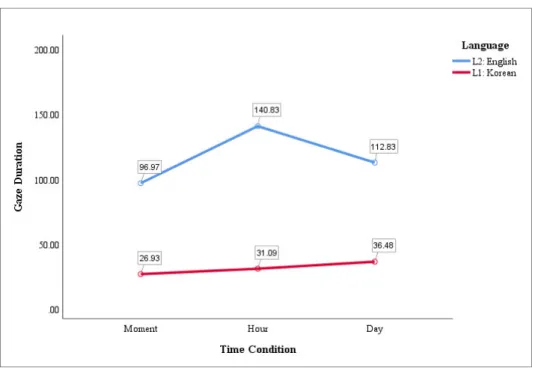
First, this section considers the results of temporal information processing across languages. Table 3 and Figure 1 show the first pass gaze duration in L1 and L2 according to the time conditions.
Table 3. First Pass Gaze Duration for Temporal Information (in Milliseconds per Syllable)
Language N Moment Hour Day
Mean SD Mean SD Mean SD L2 (English) 16 96.97 43.38 140.83 43.87 112.83 47.42
L1 (Korean) 10 26.93 16.71 31.09 7.80 36.48 17.92
Total 26 70.03 49.37 98.62 64.35 83.46 53.85
Figure 1. First Pass Gaze Duration for Time Shift Markers by Languages
In processing the temporal information, the first difference between L1 and L2 was found in the reading rate.
L1 readers read the text obviously faster than L2 readers. Next, the processing of temporal shift markers indicated another difference between languages. While L1 readers read the time shift information increasingly slower from Moment to Day, L2 readers read the hour information the slowest. This may indicate that L1 readers showed a pattern of noticing a difference between the temporal adverbials, probably detecting a violation of temporal shift within the text with the temporal change of a day later. However, in L2 reading, there was not a signal of such successful understanding of the temporal information. A decline between Hour and Day supports this interpretation. Even though reading times with Hour and Day were longer than Moment, the fact that the reading time with Day was shorter than Hour suggests that L2 readers might not have noticed the inconsistency of the temporal shift in the text.
To test if the observed differences between languages were statistically significant, a 2 (language) x 3 (time condition) factorial ANOVA was conducted. The results revealed a significant difference in reading rates between L1 and L2, F(1, 24) = 45.329, p < .05, ηp2 = .654, and thus, it was statistically supported that L2 reading required longer processing time than L1. In addition, there were a statistical main effect of time condition, F(2, 48) = 6.676, p < .05, ηp2 = .218, and a statistical interaction between language and time condition, F(2, 48) = 5.266, p < .05, ηp2 = .180. For the significant main effect of time condition, pairwise comparisons revealed the significant mean difference between Moment and Hour (p < .05). This came from the big difference in processing between Moment and Hour in L2 reading and was confirmed from the follow-up tests conducted for the interaction effect. The planned comparisons showed the significant mean differences between all the three conditions only in L2 reading (ps < .05). That is, L2 readers read an hour later significantly slower than a moment later in the text, and vice versa with a day later. Considering the difference between Moment and Hour only, temporal adverbial processing in L2 seemed to comply with Speer and Zacks (2005), who demonstrated that readers understand the temporal shift in narratives as event boundaries. Plus, it seemed to fit the strong iconicity assumption (Zwaan 1996), but since the direction between Hour and Day was reversed which is not
desired, the interpretation should be reserved. On the other hand, even though the differences between the conditions did not reach the statistical significance in L1 reading, it is worthy to note that reading between the three temporal adverbials was in the desired direction; L1 readers had increasingly longer gaze from Moment to Day although the degrees of difference between the conditions were weak.
Next, regression rates for the temporal conditions were examined to investigate if L1 and L2 readers noticed the inconsistency of time shifts after they read the target area. Table 4 presents the mean regression rates for the time conditions across languages.
Table 4. Regressions into Temporal Information
Language N Moment Hour Day
Mean SD Mean SD Mean SD
L2 (English) 16 2.13 2.16 2.56 2.40 3.69 3.26
L1 (Korean) 10 1.40 1.51 1.40 1.27 2.40 2.37
Total 26 1.85 1.93 2.12 2.09 3.19 2.97
In both languages, the temporal shift with Day received more reading and direct regressions as summarized in Table 4. This suggests that the readers might have recognized something that was not natural to read on with the temporal adverbial of a day later in the text. Thus, they seemed to have returned to the target area to recheck the consistency of information. This observation was also statistically supported with a significant main effect of time condition, F(2, 48) = 9.374, p < .05, ηp2 = .281, as a result of the mixed ANOVA. Planned comparisons between the conditions also showed significant mean differences with Day. That is, the mean differences between Moment and Day, and between Hour and Day were all significant (ps < .05). On the other hand, both the interaction effect and the difference between languages were not found (ps > .05). Therefore, all this indicates that the frequency of rereading the temporal shift markers increased as the temporal transition is inconsistent regardless of language.
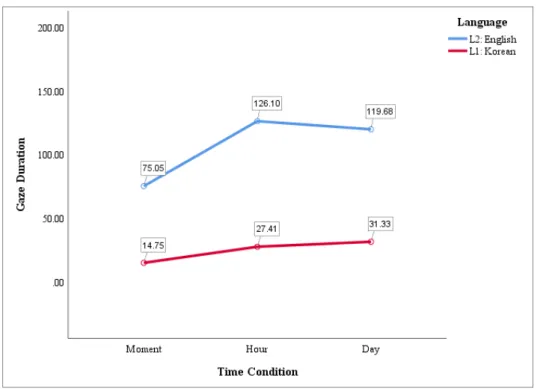
For an extended discussion on how much the readers detected the inconsistency of temporal shift in narratives across languages, the second pass gaze duration was also considered. The second pass gaze duration is the eye- dwell time or reading time when readers returned to the target area once they left it. Table 5 presents the summary of this second-pass reading, and Figure 2 illustrates it for the time conditions across languages.
Table 5. Second Pass Gaze Duration for Temporal Information (in Milliseconds per Syllable)
Language N Moment Hour Day
Mean SD Mean SD Mean SD L2 (English) 16 75.05 63.70 126.10 113.88 119.68 93.61
L1 (Korean) 10 14.75 13.73 27.41 18.75 31.33 26.78 Total 26 51.86 58.29 88.14 101.52 85.70 86.24
Figure 2. Second Pass Gaze Duration by Languages
Compared to the first gaze duration, the second reading of temporal information for the time conditions across languages showed a similar pattern, as indicated in Figure 1 and Figure 2. In L1 reading, the information processing time increased as the time shifts increased even though the gap between them was not remarkable. On the other hand, L2 readers had the shortest mean information processing time with Moment and the longest processing with Hour. It was also similar that the reading time at Day was shorter than Hour. However, one observable difference in the second reading was that in L2, the gap in reading times between Hour and Day was smaller than that in the first reading. This may be related to the more frequent regressions with the inconsistent time shift discussed above. That is, at the first reading, the readers might not have detected the inconsistent temporal shift with the adverbial of a day later. After reading it on, they might have recognized the awkwardness of the text, returned to that information, and checked it again, and at this time, the processing of the information can be considered to have more increased to some extent.
A 2 (language) x 3 (time condition) mixed ANOVA conducted on the second pass gaze duration showed a significant main effect of time, F(2, 48) = 4.158, p < .05, ηp2 = .148, with no statistical interaction effect.
Pairwise comparisons for time found a significant mean difference between Moment and Day (p < .05), and a marginally significant difference between Moment and Hour (p = .076). This implies that the difference in processing the temporal adverbials between Moment and Day became more apparent as the processing time at Day increased in L2 at the second reading. However, the direction in reading between Hour and Day was still reversed, and thus as a whole, it cannot be interpreted that they successfully understood the temporal information.
On the other hand, L1 reading showed an expected direction between the temporal shift markers although the differences between them were not significant. These results may be due to the small number of subjects, and thus a further study is necessary to find statistical effects by the interaction between language and temporal information. Meanwhile, the mixed ANOVA also found a significant difference between languages in reading the temporal information at the second reading, F(1, 24) = 9.853, p < .05, ηp2 = .291. This again indicated that L1
readers read the text much faster than in L2.
Overall, the temporal processing revealed significant differences between L1 and L2 in the reading rate and the pattern of recognizing the inconsistency of temporal shift in text. Reading in L1 was faster than in L2, and processing temporal adverbials in L1 showed a consistent pattern that the longer processing time is likely to be required as the time shift gets longer. However, the differences between chronological distances were not found.
On the other hand, unlike L1 processing of temporal markers, L2 readers read the intermediate condition, an hour later, the slowest. The fact that they read it reliably slower than the close condition, a moment later, can only suggest that temporal processing in L2 is consistent with the strong iconicity assumption. However, the present study was not found to fully support it due to their failure to detect the inconsistency of the far condition, a day later. On the second reading, they seemed to recognize some inconsistency with the far condition, but they were not still found to be successful to fully understand the temporal shift within the text, i.e., to construct a situation model for time shift. Meanwhile, in both L1 and L2, readers were found to recognize the inconsistency of time shift to some extent as evidenced in the greater regression rates with the temporal shift with the far condition, even though it did not lead to reliable results in the second reading of the information.
4.2 Processing of Critical Event
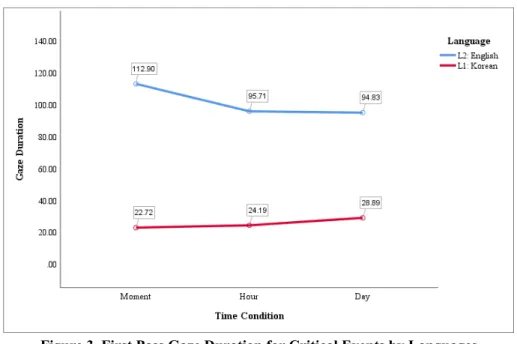
To gain more insight into a cross-linguistic difference in temporal shift, the present study also considered the processing of the critical event that follows the temporal marker in the target sentence. As in the temporal markers, the examination included the participants’ first pass gaze duration, regression rates, and second pass gaze duration for the critical events. Table 6 and Figure 3 present the first pass gaze duration for this information between the time conditions across languages.
Table 6. First Pass Gaze Duration for Critical Event (in Milliseconds per Syllable)
Language N Moment Hour Day
Mean SD Mean SD Mean SD L2 (English) 16 112.90 55.77 95.71 35.94 94.83 48.71 L1 (Korean) 10 22.72 8.20 24.20 9.73 28.89 11.11
Total 26 78.21 62.39 68.20 45.48 69.47 50.38
Figure 3. First Pass Gaze Duration for Critical Events by Languages
As seen in Table 6 and Figure 3, in L1, a consistently increasing pattern in reading the information from Moment to Day was observed, even though the differences between the conditions were as weak as those for temporal markers. This may suggest that the effects of temporal shift occurred in the processing of temporal markers would continue to the following information of critical events. However, in L2, rather an opposite reading pattern was found. L2 readers read the critical events for Moment the slowest, and those for Hour and Day similarly faster. This means that L2 readers might have read the critical events quite slower after quickly reading the temporal adverbial of a moment later. This implies that L2 readers might have felt natural in temporal change with Moment, and later they took the time to integrate the information of the critical event. On the other hand, for the other adverbials, an hour later and a day later, they tended to read the critical events quite faster, although the temporal marker of Hour itself was read the slowest. For these observations, a 2 (language) x 3 (time condition) mixed ANOVA did not find a main effect of time and an interaction effect (ps > .05). Only a significant difference in reading rates between languages was found, F(1, 24) = 39.524, p < .05, ηp2 = .622, which indicated that L2 reading required longer processing time than L1 reading.
The participant students’ recognition for inconsistent time shift was examined in terms of the regressions into the information of the critical events. As Table 7 indicates, in both languages, overall mean regression rates for the time conditions were not remarkable. Compared to those for the temporal information in 4.1, the rates were quite small. This may show that readers tended to reread the temporal information itself if there is a problem with the consistency of the time shift. Nevertheless, it should be noted that the regression rates in L2 increased as the temporal shift takes longer.
Table 7. Regressions into Critical Event
Language N Moment Hour Day
Mean SD Mean SD Mean SD
L2 (English) 16 .00 .000 .50 1.155 .75 1.291
L1 (Korean) 10 .60 .966 .10 .316 .40 .966
Total 26 .23 .652 .35 .936 .62 1.169
A 2 (language) x 3 (time condition) factorial ANOVA for the regressions also did not find a main effect of time condition (p > .05) and a difference between languages (p > .05). However, an interaction effect between time condition and language were close to the significance, F(2, 48) = 3.190, p = .05, ηp2 = .117. For this interaction effect, the planned comparisons found a significant mean difference between L1 and L2 at Moment (p < .05). In addition, in L2, the regression rate of Moment brought significant differences with Hour (p = .059) and Day (p
< .05). All these differences were seen to be due to no regression with the temporal adverbial of a moment later in L2.
Finally, after returning to the critical events, the changes in information processing between the time conditions were examined by languages. The summary and illustration of second pass gaze duration for the critical events are presented in Table 8 and Figure 4.
Table 8. Second Pass Gaze Duration for Critical Event (in Milliseconds per Syllable)
Language N Moment Hour Day
Mean SD Mean SD Mean SD L2 (English) 16 101.53 82.07 99.31 68.91 136.37 93.74 L1 (Korean) 10 28.66 22.65 27.94 16.23 35.13 44.08
Total 26 73.50 74.39 71.86 64.79 97.43 92.17
Figure 4. Second Pass Gaze Duration for Critical Events by Languages
As illustrated in Table 8 and Figure 4, the second reading of the critical events revealed a similar pattern between L1 and L2. Although the reading times slightly declined at Hour in both languages, all the readers read the information of the critical events with Moment faster and those with the inconsistent time shift of Day much slower. Particularly, for L2 reading, this is a quite different result from the slowest reading of the information related to Moment in the first reading. Furthermore, it was found at the second reading of the critical events that L2 readers were likely to detect and process the inconsistency of the time shift in an expected way. From these results, it can be seen that L1 readers were more likely to spend more time reading and processing the information as the longer or inconsistent time shift is encountered in text. On the other hand, L2 readers seemed to recognize the inconsistency of time shift to some extent in the information of critical event presented later in the sentence and when re-reading this information. However, a 2 (language) x 3 (time condition) factorial ANOVA did not support these observations because it did not find a statistical main effect of time and an interaction effect (ps > .05). Instead, a difference in reading rates between L1 and L2 was obtained as consistently as the previous analyses, F(1, 24) = 12.399, p < .05, ηp2 = .341. Probably, the lack of power in the effects may be due to the small number of participants again, and thus a further study should be called for to gain more reliable results and to verify the patterns found in the present study.
To sum, for the processing of the critical events that follow the temporal markers in the target sentence, L1 readers were found to be consistently aware of the inconsistency of time shift between events. Their reading times gradually increased as the temporal shift gets longer, but the differences between the conditions were still weak. On the other hand, even though it was not statistically supported, L2 readers’ sensitivity to the inconsistency of time shift appeared at the second reading of the critical event. This could be viewed that the effect of temporal markers might have been delayed at the later information within the sentence. Besides, one thing to note is that in both languages, the readers tended to read the critical event information faster for the temporal adverbial of an hour later than a moment later. This could suggest that, compared with the processing of temporal information in 4.1, even though it took longer to read the temporal marker itself, the readers might have felt more natural in reading the following information in both languages.
4.3 General Discussion
This study aimed to investigate cross-cultural differences between L1 and L2 in processing temporal shift in narratives from the perspective of situation model. Motivated from the prior work of Choi (2020), which addressed L1 and L2 readers’ situation model construction for temporal shift, the present study tried to reveal specific differences between languages by employing an eye movement tracking approach. For the study, the examination was focused on the processing of temporal shift markers and the critical events that subsequently follow in the target sentences. As a result, the first difference between L1 and L2 was from the reading rates. In all the examinations, L1 readers read the information significantly faster than L2 readers. This faster reading rate is one of the frequently reported differences between L1 and L2 reading (Bialystok 2001, Grabe 2009). Since L2 readers tend to lack L2 linguistic knowledge to instantly process incoming textual information during reading, the reading in L2 is more likely to take more time than in L1 (Segalowitz and Hébert 1990). Additionally, Choi (2020) also has reported that this difference in reading rates between languages is not only found in L2 learners with lower proficiency, but also in highly proficient L2 learners.
Next, the present study found that L2 participant readers were not successful for the temporal situation model construction in narratives at the time of temporal information processing. Rather, quite later in the target sentence, they appeared to recognize the inconsistency of temporal shift in the text when returning to the critical
event and reading it twice, but it was not statistically supported. However, in L1, there was a more consistent reading pattern between the time conditions for both the temporal information and the critical event, despite being the weak power of the effect. For this difference in processing temporal shift between languages, the delayed weak effect of temporal shift in L2 may be related to the participants’ L2 proficiency. That is, the participants did not seem to be proficient enough to demonstrate their success for the situation model construction, although the present study included those who are above the intermediate level of L2 reading proficiency. In this sense, the current finding can support Choi’s (2020) suggestion that the higher-level processing such as situation model building for a text seems to require a much higher level of proficiency than the level of text difficulty.
Another difference in processing temporal shift between languages can be found in the processing of the temporal shift markers of a moment later and an hour later in L2. L2 readers read an hour later significantly slower than a moment later. L1 readers also tended to show a similar pattern in processing the two adverbials, but the difference was not as big as it can reach significance. Considering L2 reading only, thus, the fact that the significant difference occurred between the close and intermediate conditions at the processing of the temporal markers can be viewed to be consistent with the strong iconicity assumption as found for English-speaking L1 readers in Zwaan (1996) and Speer and Zacks (2005). However, L2 readers read the far condition of Day much faster, not detecting its inconsistency of temporal shift, and thus, it should note that it was not fully supported in the present study. Of course, in the second reading of the temporal markers, there was a slight increase in the degree of detection for this inconsistency, but the power of the difference between the close and the intermediate conditions became weaker at the same time. This could probably have some relevance to the proficiency of L2 learners again. Therefore, it is necessary to focus on the proper level of proficiency to obtain more accurate evidence from a follow-up study.
5. Conclusion
The goal of the present study was to investigate differences between L1 (Korean) and L2 (English) in processing temporal information in narrative texts. It was grounded on the event-indexing model, which specifies the multidimensional representations for the situational information in texts. Specifically, this study focused on the processing of time shift in narratives that is denoted by temporal markers such as a moment later, an hour later, and a day later. Recognizing the sentence processing with this temporal shift information differs between L1 and L2, the study attempted to explore what specific area in a sentence makes the difference between languages. It employed an eye movement tracking approach for more close investigation. The examination of the target sentence was divided into the time shift marker and subsequent critical event information, and eye-dwell time for each area was measured in terms of the first pass gaze duration, the regressions into each area, and the second pass gaze duration.
As a result, the current findings demonstrated that a significant difference between L1 and L2 occurred in the processing of the temporal shift information. While L1 readers read the temporal information gradually slower as the distance of the temporal shift increased, L2 readers read the temporal adverbial an hour later the slowest, generating a significant difference from a moment later. This implies that contrary to L1 readers, L2 readers may perceive the temporal change with an hour later significantly in the flow of a story, and this can support the strong iconicity assumption in part. However, as L2 readers were not found to detect the inconsistency of temporal shift in the day condition, the interpretation was not fully supported yet in this study. Another
difference between L1 and L2 was found in the reading rates. Across the target information, L2 readers read them all significantly faster than L1 readers. In addition, the situation model construction also brought a difference between languages. L2 readers were not found to be successful to reach the level of situation model in understanding temporal shift, even though they appeared to recognize the inconsistency to some extent later in the target sentence. On the other hand, L1 readers showed a consistent increasing pattern of reading in the temporal conditions, indicating that they might have perceived a difference depending on the distance of time shift. In this sense, L1 readers might have constructed the situation model for time, but further study should be needed to obtain more reliable results and clarify more detailed psycholinguistic aspects underlying them.
The present study has some significance as the results could show the difference in online processing of situational information in narratives between L1 and L2. First, it has provided detailed information about the cross-linguistic difference in temporal information processing. Inherently, temporal information processing is involved with the processing of temporal markers and subsequent critical events. However, previous studies did not examine language differences in such detail. For this, the present study has closely examined the differences in the processing of temporal information between languages by focusing on the respective information. Next, this study can contribute to the expansion of the psycholinguistic theory established in the first language context to the second or foreign language environment. Most of the relevant research has been conducted so far on native speakers of English to provide empirical evidence. Through this study, thus, an academic contribution can have been made by examining L2 readers’ actual cognitive processing for a situational element in the text and revealed the need to include further aspects of L2 reading processes, especially for the higher-level processing.
This study also has several laminations. First, the participant L2 readers’ proficiency was not highly advanced.
For this reason, they were hardly able to reach the situation model level in understanding the temporal information, and it was sometimes difficult to obtain consistent results. In this study, it was confirmed again that L2 proficiency is a crucial variable for L2 higher level processing such as situation model building. This is because situation model building is not at the level of obtaining information by simply interpreting individual sentences, but it is possible only when the incoming text information is sufficiently updated and integrated into the reader’s memory during reading. Therefore, in future studies, this needs to be considered and to be more proficiency-focused. Another limitation is the small sample size, especially for L1 reading. One interesting result of the present study was that, unlike L2 reading, temporal information processing in L1 was considerably consistent by showing an increasing pattern of reading times between the time conditions. However, the statistical differences between them were not found, and thus it was difficult to achieve more reliable evidence whether L1 temporal information processing was consistent with the scenario model or other one. Therefore, considering this, further study should be required to obtain more accurate information.
References
Anderson, A., S. C. Garrod and A. J. Sanford. 1983. The accessibility of pronominal antecedents as a function of episode shifts in narrative text. Quarterly Journal of Experimental Psychology 35A(3), 427-440.
Bialystok, E. 2001. Bilingualism in Development. New York, NY: Cambridge University Press.
Choi, J. 2020. The influence of L1 and L2 reading proficiency on situation model construction. Manuscript submitted for publication.
Dowty, D. R. 1986. The effects of aspectual class on the temporal structure of discourse: Semantics or pragmatics? Linguistics and Philosophy 9(1), 37-61.
Ericsson, K. A. and W. Kintsch. 1995. Long-term working memory. Psychological Review 102(2), 211-245.
Fleischman, S. 1990. Tense and Narrativity: From Medieval Performance to Modern Fiction. London:
Routledge.
Gernsbacher, M. A. 1990. Language Comprehension as Structure Building. Hillsdale, NJ: Erlbaum.
Grabe, W. 2009. Reading in a Second Language. New York, NY: Cambridge University Press.
Graesser, A. C., M. Singer and T. Trabasso. 1994. Constructing inferences during narrative text comprehension.
Psychological Review 101, 371-395.
Hopper, P. J. 1979. Aspect and foregrounding in discourse. In T. Givón, ed., Syntax and Semantics: Discourse and Syntax, Vol. 12, 213-241. New York: Academic Press.
Johnson-Laird, P. N. 1983. Mental Models: Towards a Cognitive Science of Language, Inference and Consciousness. Cambridge, MA: Cambridge University Press.
Kendeou, P., P. van den Broek, M. J. White and J. Lynch. 2007. Comprehension in preschool and early elementary children: Skill development and strategy interventions. In D. S. McNamara, ed., Reading Comprehension Strategies, 27-45. Mahwah, NJ: Lawrence Erlbaum Associates, Inc.
Kintsch, W. 1988. The role of knowledge in discourse comprehension: A construction-integration model.
Psychological Review 95(2), 163-182.
Kintsch, W. 1998. Comprehension: A Paradigm for Cognition. New York, NY: Cambridge University Press.
Morishima, Y. 2013. Allocation of limited cognitive resources during text comprehension in a second language.
Discourse Processes 50, 577-597.
McNerney, M. W., K. A. Goodwin and G. A. Radvansky. 2011. A novel study: A situation model analysis of reading times. Discourse Processes 48(7), 453-474.
O'Brien, E. J., M. L. Rizzella, J. E. Albrecht and J. G. Halleran. 1998. Updating a situation model: A memory- based text processing view. Journal of Experimental Psychology: Learning, Memory, and Cognition 24(5), 1200-1210.
O’Rourke, P. and M. F. Bunting. 2018. The cognitive underpinnings of mental model construction in L1 and L2.
Quarterly Journal of Experimental Psychology 7(4), 801-807.
Pettijohn, K. A. and G. A. Radvansky. 2016. Narrative event boundaries, reading times, and expectation. Memory
& Cognition 44(7), 1064-1075.
Radvansky, G. A. and D. E. Copeland. 2010. Reading times and the detection of event shift processing. Journal of Experimental Psychology: Learning, Memory and Cognition 36(1), 210-216.
Rayner, K. 1998. Eye movements in reading and information processing: 20 years of research. Psychological Bulletin 124(3), 372-422.
Rinck, M. and U. Weber. 2003. Who when where: An experimental test of the event-indexing model. Memory &
Cognition 31(8), 1284-1292.
Segalowitz, N. S. and M. Hébert. 1990. Phonological recoding in the first and second language reading of skilled bilinguals. Language Learning 40(4), 503-538.
Speer, N. K. and J. M. Zacks. 2005. Temporal changes as event boundaries: Processing and memory consequences of narrative time shifts. Journal of Memory and Language 53(1), 125-140.
Takaki, S. 2010. Investigating EFL learners' mental representations with the verb-clustering test. JLTA Journal 13, 163-175.
Takaki, S. 2011. Effects of situational continuity on reading time of Japanese EFL learners. KATE Journal 25, 53-62.
Therriault, D. J. and M. Rinck. 2007. Multidimensional situation models. In F. Schmalhofer and C. A. Perfetti,
eds., Higher Level Language Processes in the Brain: Inference and Comprehension Processes, 311-327.
Mahwah, NJ: Lawrence Erlbaum Associates.
van den Broek, P. and C. A. Espin. 2012. Connecting cognitive theory and assessment: Measuring individual differences in reading comprehension. School Psychology Review 41(3), 315-325.
van Dijk, T. A. and W. Kintsch. 1983. Strategies of Discourse Comprehension. New York, NY: Academic Press.
Xianle, X. 2011. A Study of the Effects of Narrative Time Shifts on L2 Learners' Reading Comprehension Processes (Unpublished master's thesis). Ningbo University, Zhejiang, China.
Zwaan, R. A. 1996. Processing narrative time shift. Journal of Experimental Psychology: Learning, Memory, and Cognition 22(5), 1196-1207.
Zwaan, R. A. and C. M. Brown. 1996. The influence of language proficiency and comprehension skill on situation-model construction. Discourse Processes 21(3), 289-327.
Zwaan, R. A., M. C. Langston and A. C. Graesser. 1995. The construction of situation models in narrative comprehension: An event-indexing model. Psychological Science 6(5), 292-297.
Zwaan, R. A., J. P. Magliano and A. C. Graesser. 1995. Dimensions of situation model construction in narrative comprehension. Journal of Experimental Psychology: Learning, Memory, and Cognition 21(2), 386-397.
Zwaan, R. A. and G. A. Radvansky. 1998. Situation models in language comprehension and memory.
Psychological Bulletin 123(2), 162-185.
Zwaan, R. A. and D. N. Rapp. 2006. Discourse comprehension. In M. A. Gernsbacher and M. J. Traxler, eds., Handbook of Psycholinguistics, 725-764. San Diego, CA: Elsevier.
Examples in: English
Applicable Languages: English Applicable Level: Tertiary