KOREAN JOURNAL OF ENGLISH LANGUAGE AND LINGUISTICS
ISSN: 1598-1398 / e-ISSN 2586-7474 http://journal.kasell.or.kr
Korean Learners’ English Article Revisions and General Attention Areas in an L2 Writing Task: Use of a Picture-Based Narrative Model Text*
Sujung Park (Hanyang Cyber University)
This is an open-access article distributed under the terms of the Creative Commons License, which permits unrestricted non-commercial use, distribution, and reproduction in any medium, provided the original work is properly cited.
ABSTRACT
Park, Sujung. 2021. Korean learners’ English article revisions and general attention areas in an L2 writing task: Use of a picture-based narrative model text. Korean Journal of English Language and Linguistics 21, 656-677.
Previous research has investigated models as feedback to examine what learners notice and revise when comparing their initial texts against models, reporting that their attention largely lies in the order of lexis, content, and grammar. However, these researchers used learners’ self-reports as the measure for assessing learners’
noticing and its subsequent effects on revisions. Thus, this study looked at their actual text revisions for what they notice and revise from a model, with their written reports as the secondary data. Employing a picture-based narrative task with sixteen Korean adult learners, this study investigated the use of English articles to examine in what circumstances the learners correctly revise articles, leave them uncorrected, or incorrectly revise them as well as what general aspects of language, other than articles, they notice and revise in their initial texts. Results indicated that article-related factors included proficiency, prior article knowledge, language awareness, selective attention, input processing priorities, limited attentional capacity, language learning strategies, first language (L1) interference, and location mismatches between learner phrases and model phrases. As for their attention to other general aspects of language, they noticed and revised lexis, content, and grammar sequentially, while organization, a newly added aspect, produced mixed results depending on what aspects of organization were assessed. This paper concludes with future research directions with an aim of diversifying attention to different aspects of language.
Received: June 25, 2021 Revised: July 16, 2021 Accepted: July 25, 2021
Sujung Park
Professor, Hanyang Cyber Univ.
* This study used a subset of the data used in Park’s study (2017) to analyze, using a different
methodology, the underlying interactions among the learners’
initial texts, a model text, and the revised texts. I appreciate an anonymous reviewer from the earlier study who suggested this further approach for a fuller picture of the use of a model text by L2 learners.
KEYWORDS
L2 model text, feedback, revisions, noticing, picture-based narrative writing, English articles, Korean EFL adult learners
1. Introduction
In second language (L2) writing instruction, feedback and revision are two crucial components for improving learners’ discourse competence and linguistic accuracy. In terms of ways of providing feedback, L2 researchers have explored various approaches such as the provision of linguistic error correction, reformulations, and model texts (e.g., Cánovas Guirao, Roca de Larios and Coyle 2015, Coyle, Cánovas Guirao and Roca de Larios 2018, Coyle and Roca de Larios 2014, García Mayo and Loidi Labandibar 2017, Hanaoka 2007, Kang 2020, Martinez and Roca de Larios 2010, Yang and Zhang 2010). Given that the ultimate purpose of L2 writing instruction is to help students understand how to write genre-specific texts for their target audiences and purposes, one of the most effective types of feedback would be the provision of model texts that embed particular discourse structures in them. These can demonstrate to students what kinds of content and organization a text of a specific genre contains, along with some lexical or grammatical features embedded in the texts (Watson 1982). The provision of model texts can be a very practical strategy from the teacher’s perspective as well, since in a large L2 writing class, one-on-one error correction or reformulations would place too much demand on teacher time and energy (e.g., Ferris 2010, Yang and Zhang 2010).
All of the previous studies using models as a feedback strategy have been conducted in English as a foreign language (EFL) classroom contexts (e.g., Cánovas Guirao et al. 2015, Coyle et al. 2018, Coyle and Roca de Larios 2014, García Mayo and Loidi Labandibar 2017, Hanaoka 2007, Kang 2020, Martinez and Roca de Larios 2010, Yang and Zhang, 2010). Most of these studies primarily examined (a) what aspects of language L2 learners notice when they write their initial texts, (b) what they notice when they compare their written texts against the models, and finally, (c) what effects these previously noted features have on their subsequent revisions. The methodological weakness with these studies, however, is that they used students’ written self-reports as the measure of learners’ noticing as well as examining the effects of that noticing on the subsequent revisions. While self-reports may provide descriptive information on what learners notice, these studies have also witnessed that some of the learners incorporated features from models into their revisions without reporting these features as having been noticed during the earlier model comparison tasks (e.g., Cánovas Guirao et al. 2015, Coyle et al.
2018, Coyle and Roca de Larios 2014, García Mayo and Loidi Labandibar 2017, Hanaoka 2007, Kang 2020, Martinez and Roca de Larios 2010). Thus, rather than using learners’ self-reports as the main data source for noticing, the current study examined the actual textual revisions made by the learners as the primary data for what aspects of language they noticed and revised when they compared their initial texts against a model text. In addition, their written reports concerning their drafting and revision processes were also gathered as supplementary, qualitative data for understanding the surface text-based results. Furthermore, unlike the aforementioned studies, this study additionally targeted one specific grammatical form, English articles, to explore in what circumstances, the articles were correctly revised, left uncorrected, or incorrectly revised in their textual revisions. The findings of the previous studies were that grammar was often reported as the least attended aspect of language during the model comparison and revision tasks. Thus, by looking into a particular grammatical form, this research aims to gain a deeper insight into how a model affects learners’ grammatical revisions such as the English articles; in other words, what kinds of underlying factors may be intertwined with their article revisions. The following literature review will address specific motivations for the current study.
2. Literature Review
The earliest study that explored L2 learners’ noticing and revisions using models as a feedback tool is the study by Hanaoka (2007), who employed multi-stage picture description tasks with Japanese college students.
Using three coding categories (lexis, grammar, and content), the results indicated that during the initial writing task, the learners predominantly attended to lexical problems, and when comparing their written texts against the models, they similarly noted lexis the most, then content, followed by grammar. During the revision task, most of the changes made were also lexical features. To explain the greater attention to lexis over grammar, Hanaoka suggested that L2 learners may find lexical features easier to verbalize through self-reports than grammatical features. To prevent this possibility, the current study examines actual changes made in learners’ texts to more directly measure their attention areas. Hanaoka also found that learners’ higher proficiency and prior knowledge may facilitate their noticing from models and promote more incorporations of the noticed features into subsequent revisions.
While Hanaoka (2007) investigated Japanese adult learners, a later study by Martinez and Roca de Larios (2010) examined Spanish secondary learners using picture description tasks. The findings from the initial writing task were analogous in that the learners were mostly concerned about lexis; however, at the model comparison task, their highest attention switched to content (or ideas and expression), followed by lexis, and then by grammar. That is, during the model comparison task, the learners either noticed such content that the model texts described but that they missed or did not include in their initial texts, or the learners realized that they had different understandings of the given picture from the models. Accordingly, due to these different perceptions of the picture, the learners’ initial texts were very different from the models in terms of content and language. This raises the possibility that the use of a certain picture (or what picture to use) may greatly affect learners’ attention areas at the model comparison task; however, because this study is based on a small number of participants, more research is desirable.
Another study by Coyle and Roca de Larios (2014) compared model texts against the teacher’s error correction, another feedback tool, by employing Spanish primary school child pairs who were given picture description tasks. The distinctive findings were that while the model group was most interested in lexis followed by content (or ideas and expression) both at the comparison and revision tasks, the error correction group showed increased interest in grammar at both tasks, although lexis was still their most attended area. In terms of the parts of grammar the latter group attended to, they primarily noticed verb tense forms, subject-verb agreement, and plural nouns. The group had also received article correction from the teacher, but this was not reported to have been noticed by them. However, these results – the particular parts of grammar they attended to – all came from young learners who had received the feedback from one-on-one error correction. It would fill a gap in the literature to investigate what parts of grammar, as well as articles, would be attended to if adult learners received a model text as feedback.
A follow-on study by Cánovas Guirao et al. (2015) that also used Spanish primary school learner pairs and picture description tasks compared a model group with a no-model group to see if there is a superior role of models. The results were that at the initial writing task, both groups attended to content most, followed by lexis, grammar, and discourse in descending order. During the model comparison task, their greater attention to lexis over grammar was still maintained for the model group, but interestingly, there was no attention reported for content and discourse. However, given that their revised texts revealed some ideational and textual improvements, compared to those of the no-model group, this implies that the former probably did notice and benefit from the model in terms of both aspects (content and discourse) but failed to report on them, heightening
the need to use learners’ actual text revisions as an alternative to measure noticing in future research. On the other hand, the no-model group incorporated more grammar-related features than the model group in their revisions, whereas the model group incorporated more acceptable lexical features than the no-model group. In addition, within the model group, the more proficient pairs noticed and incorporated more features from the model text than the less proficient pairs. Thus, these findings seem to suggest that L2 learners process model texts more for lexis, content, and discourse than for grammar, and L2 proficiency may be a mediating factor for such noticing and incorporations. However, as with the previous study by Coyle and Roca de Larios (2014), these learners were young learners, raising the possibility that a future study employing adult learners may generate a different picture.
While the study by Cánovas Guirao et al. (2015) compared the effects of providing a model text with those of no model text, a study by García Mayo and Loidi Labandibar (2017) using picture description tasks looked into ways to make the best use of models, exploring whether extra guidance at the model comparison task as well as learner proficiency would make any differences in learners’ subsequent noticing from models and revisions. The variable of extra guidance was operationalized as asking Basque-Spanish teenage learners to categorize what they had noticed distinctively into lexis, grammar, and content (or content and expression). The results showed that the learners mainly attended to lexis, followed by content, then grammar at the model comparison task. Also, in terms of effects of proficiency and extra guidance, both factors generally showed some effect for greater noticing and subsequent incorporations. Of these findings, the effect of the proficiency variable further corroborates previous findings (Cánovas Guirao et al. 2015, Hanaoka 2007).
Unlike the previous studies discussed above, a more recent study using picture description tasks by Coyle et al.
(2018) took a process-oriented approach, analyzing Spanish child pairs’ oral dialogues, along with their written texts, to closely examine how they develop their L2 knowledge through the study of model texts. Two conditions were created: one that received extensive teacher instruction on how to analyze models against their own texts and another with no such training period. The findings demonstrated specific, qualitative improvements with the former group such that in their revised texts, they were shown to improve in the use of specific features such as indefinite articles, personal pronouns, progressive adjectives, the third person -s, the progressive -ing, and temporal phrases. The use of temporal phrases was also shown to help make the learners’ revised stories look more like organized narratives containing an opening, a middle, and a closing part. A noteworthy point from these findings is that this extent of detailed observation was not offered in the previous studies because their data analysis mainly took a product-oriented, quantitative approach without seeking deeper connections with related qualitative data. While such qualitative findings added to the existing literature, they can be considered as preliminary results, as the researchers also mentioned. Thus, more research taking both quantitative and qualitative approaches would shed further light on how L2 learners interact with a model.
The studies discussed so far all explored picture description tasks with a main focus on lexis, content, and grammar. To expand this focus, a recent study by Kang (2020) added the aspect of organization (e.g., paragraph indentation, organization of opposing views) by employing an argumentative writing genre with Korean high school students. The results were similar to most of the previously mentioned studies at the model comparison task in that lexis, content, and grammar were sequentially attended to; however, at the same time, organization was the least attended area. Similarly, in the revised texts, only lexis and content significantly improved in the model group. These results concerning organization were somewhat surprising, considering that one of the main pedagogical uses of a model text is to show the macro-level organizational structure of a text of a specific genre.
This study did report that in terms of paragraph indentation, many of the learners noticed and incorporated it into their revisions. However, further inquiry is needed to make better sense of the role of a model text in improving
organization.
To summarize, a review of the existing literature employing models points to a need for additional research to explore adult learners using their actual textual revisions as the main measure of noticing, supplemented by related qualitative data. Also, given that grammar was often reported to be the least benefited area from the use of a model text, it would be worthwhile to focus on one specific grammatical form and look into what aspects of a model text may have an influence on learners’ noticing and revisions of that form, with the possibility that other factors may also intervene in that process. Specifically, the current study chose the English articles, particularly, the first mention and subsequent mention functions. These were chosen because they were often investigated in previous studies that used different feedback tools, such as error correction (Sheen 2007, Shintani and Ellis 2013, Shintani, Ellis and Suzuki 2014). Thus, it would be worthwhile to explore the articles with these functions by employing a different feedback tool, a model text, in this study. To investigate the articles in relation to these functions, a narrative writing genre was implemented in this study, as such functions are known to emerge naturally in narrative texts (Celce-Murcia and Larsen Freeman 1999). The empirical study by Tarone and Parrish (1988) also found that the subsequent mention article usage was most frequently elicited, followed by the first mention article usage, in the oral narrative task compared to other types of tasks. Along with the use of a narrative writing genre, this study also employed a picture to compare the results (in particular to the second research question below) with those of a majority of the previous model-based studies that consistently used pictures in their writing tasks. Therefore, based on these motivations from the previous studies, as well as for practical purposes for a typically large EFL writing class, this study implemented a picture-based narrative model text as a feedback tool to answer the research questions:
1. In what types of circumstances do Korean adult learners of English correctly revise the English articles, leave them uncorrected, or incorrectly revise them in their revision process?
2. Other than the English articles, what general aspects of language (i.e., lexis, grammar, content, and organization) do they attend to and revise in their initial texts?
3. Method
3.1 Participants
The participants of this study were 16 Korean adult learners, a subset of students from a large English writing course at an online university in South Korea. They consisted of 13 female and 3 male students, ranging from 22 to 64 in age (mean: 35.06, SD: 10.02). Their writing proficiency was measured by the instructor of the course (and the researcher of the study) on their first written narrative texts completed, a part of their three-stage writing tasks. In L2 classroom-based research, using an instructor’s perceptive ratings as a measure of learners’
proficiency is a common practice (e.g., Kormos 2011, Leeser 2004). As a result, nine of the participants were evaluated to be of intermediate proficiency with four being advanced, and three being low. The participants’
prior knowledge of the English articles was also assessed based on their initial narrative texts. Eight of the learners had fairly high accuracy levels (70s-90s%); another four, mid accuracy levels (50s-60s%); and the remaining four, low accuracy levels (10s-30s%).
3.2 Tasks, Materials, and Procedure
The tasks in this study were three-stage, picture-based narrative writing tasks: an individual initial writing task, a group-based relay writing task, and an individual revision task. Throughout all three tasks, one picture prompt comprising four different strips was provided (see Appendix A, Heaton 1975). Also, the learners were instructed to start their narratives with “One day,” noting that the incident described in the picture had occurred in the past, as well as being instructed to write with as many details as possible because the readers would have no knowledge of what the picture contained.
Specifically, in the first stage, after the course had taught the students two lessons on how to develop narrative texts – one on a narrative paragraph and the other on a narrative essay – they were given seven days to individually write and submit a narrative paragraph using the given picture as an assignment. They were also asked to write notes about the difficulty that they felt during the writing process. One day after the submissions were completed, in the second stage, they were subdivided into groups of four by the instructor and were given another seven days to take turns participating in online relay writings per picture strip within their assigned groups. This collaborative stage was added for affective purposes to promote their interest and motivation in completing the series of written tasks1. It is possible that in an online learning context whereby students review lessons and complete tasks individually, their interest and motivation towards learning may decrease over time unless engaging pedagogical methods are implemented to maintain those. After the group-based writing stage, the third stage was conducted individually again with the students being given 12 days to revise their initial texts after comparison with the model text provided by the instructor (see Appendix B). The model text was written by the instructor and then checked by a native speaker of English. While rewriting, the learners in this study had access to the model text, as well as to a dictionary, the latter of which they also had access to during the preceding writing stages. These pedagogical decisions were considered ecologically valid since these writing tasks took place in an intact writing class with the purpose of providing them with an opportunity to practice the instructed narrative writing genre. After they completed their revisions, they then filled out a written questionnaire as well as an exit survey (see Appendix C).
3.3 Data Coding and Analysis
To answer the two research questions of the present study, the data included the students’ individual initial and revised texts. To answer the first research question regarding in which circumstances the English articles were correctly revised, left uncorrected, or incorrectly revised, the data were further narrowed down to those sentences in the initial and revised texts that contained the noun phrases whose article usage functioned or was supposed to function as either indefinite first mention or definite subsequent mention usage. Then, among these sentences, the sentences that conveyed the same, similar, or extended meanings between the initial and revised texts were further selected as matched pairs of sentences where the target article usage was assessed as (a) correctly revised, (b) uncorrected, or (c) initially correctly used but later incorrectly revised after the model text was provided. Excluded from this process were the entirely copied sentences in their revised texts, either from the model text or their peers’ texts from the group-based relay writing task. Consequently, to answer the first
1 An anonymous reviewer commented that the element of collaborative writing may undesirably affect the outcome of this study. Upon re-examination of the data used for this study, there was no evidence of the learners’ revisions being influenced by their peers’ writings.
research question, a total of 52 noun phrase pairs were examined. Finally, the learners’ prior article knowledge (or article accuracy of their initial texts) was assessed using Pica’s (1991) TLU (or target-like use) analysis for its possible influence on their article revisions in combination with that of the model text.
To answer the second research question, as to other than the English articles, what general aspects of language they attend to and revise in their initial texts, four coding categories were applied to compare the results with the previous studies: lexis, grammar, content, and organization (e.g., Cánovas Guirao et al. 2015, Coyle et al. 2018, Coyle and Roca de Larios 2014, García Mayo and Loidi Labandibar 2017, Hanaoka 2007, Kang 2020, Martinez and Roca de Larios 2010). The coding for lexis pertained to changes, additions, or deletions of single words (including spelling), phrasal verbs, or expressions made in the revised sentences. Concerning grammar, morphological or syntactic changes, additions, or deletions made in the revised sentences were included. The coding for content then involved changes, additions, or deletions in ideational content, mainly resulting in the units of verb phrases, prepositional phrases, or clauses. Finally, the coding of organization concerned whether the first sentence indentation as well as the rhetorical elements of a narrative paragraph, namely, topic sentences and concluding sentences, were noticed and incorporated into the revised texts. Specifically, the topic sentences had to include a hook or a statement trying to capture the reader’s interest, while the concluding sentences had to contain the moral of a story or a final statement that wrapped up the whole story (Savage and Shafiei 2012). To distinguish the learners’ intentions of revisions between content and organization, their written questionnaire and exit survey responses were cross-checked. In other words, only when the written responses included statements related to the topic or concluding sentences from rhetorical perspectives were their corresponding text revisions coded as those pertaining to organization.
For the data concerning the categories of lexis, grammar, and content, the same sentence pairs used for the first research question were analyzed. As for the category of organization, the parts where the learners’ initial and revised texts began and ended were examined, as the first sentence indentation and rhetorical elements targeted in this study are located around the opening and closing parts of a typical narrative paragraph.
The following is an excerpt from one learner that illustrates all the coding of the first and second research question data, except for the aspect of content2. The bold parts show one error with no correction, one change, and two additions the learner made between her initial (IS) and revised sentences (RSs), whereas the underlined parts in the model sentences (MSs) are those that the learner could refer to in her revision process.
IS: One day, two boys saw a thief stealing things in the Jewellery store.
RSs: One day, two boys had a embarrassing experience. They saw a thief stealing things in the Jewelry store.
MSs: One day, two boys were walking on the street when they had a very embarrassing experience. They were near a jewelry store and there were a lot of watches in the shop window. Suddenly, they saw a man break the window.
Specifically, in terms of the first research question, the failure to correct the incorrect definite article in the second noun phrase (“the Jewellery store” → “the Jewelry store”) was classified as “uncorrected” article usage3. In terms of the data relevant to the second research question, the learner changed the spelling of the word
2 The coding for content will be illustrated in other excerpts presented in the results section.
3 The coding for the other two categories, “correctly revised” and “initially correctly used but incorrectly revised,” will be illustrated in the results section.
(“Jewellery” → “Jewelry”) and added the hook that she missed in her initial sentence (“had a embarrassing experience”). She also added a new subject (“They”) when she revised her initial sentence to two sentences. In other words, the spelling change, the hook addition, and the syntactic addition are, respectively, examples of the coding of lexis, organization, and grammar in this study.
Finally, the coding of the data for both the first and second research questions was recursively checked and verified by the researcher, and in particular to the assessment of article accuracy, a native speaker of English also coded both the initial and revised texts independently, resolving any differences with the researcher via discussion.
The following is the results section for the two research questions, where in particular to the first question, the surface textual circumstances will be presented in the form of excerpts to illustrate how the learners’ initial texts changed to the revised ones. The underlying circumstances or factors for these text-based results will be addressed in the discussion section in combination with the qualitative data from the learners’ difficulty notes and questionnaire and exit survey responses.
4. Results
4.1 Cases of Article Revision (Research Question 1)
Out of 48 initially incorrect article instances, 8 of them (8/48, 16.67%) led to correct revisions, and the commonality with these instances is that the model text contained the same referents expressed in the same or analogous noun phrases the learners used in their initial texts. Within this common element, three sub-cases were further drawn. The first case (1/8, 12.5%) was found when a learner with high prior article knowledge made only one change from her initial sentence, which was her article correction from the first mention function to the subsequent mention function.
(Learner A, initial text article accuracy: high, WP4: intermediate) IS: The other boy caught a thief by the collar at the same time.
RS: The other boy caught the thief by the collar at the same time.
MS: At last, the boys caught up with the thief and jumped on top of him.
However, the correct revisions of articles also occurred when attention was divided between articles and other parts of the text, for both high and low or mid-level article accuracy learners (7/8, 87.5%). In the case of the high article accuracy learners (3/8, 37.5%), for example, one learner, as shown below, initially omitted an indefinite article. However, after receiving the model text, she added the article and revised other parts of the sentence, which was also influenced by the model sentences (e.g., a lexical change from “arrive” to “appear,” a content deletion of “to the boys,” and a content addition of “and he was in acting in a movie”).
4 It refers to writing proficiency.
(Learner B, initial text article accuracy: high, WP: intermediate)
IS: Soon policeman arrived and explained to the boys that the thief was actually an actor.
RS: Soon, a policeman appeared and explained that the thief was an actor, and he was in acting in a movie.
MSs: The surprised man answered, “You’ve made a big mistake. I’m acting in a movie!” ... Then a policeman appeared smiling at them and pointing to some cameras.
In the case with the low or mid-level article accuracy learners (4/8, 50%), the third case, the same phenomenon was observed wherein attention was distributed to multiple aspects of language including articles.
For instance, the learner below, who had low prior article knowledge, changed the noun “children” to another noun, “boys,” while correctly inserting the definite article “the” and correcting the verb “catced” to “caught up.”
As with the earlier excerpt, these revisions were all influenced from the model text, as the revised outcomes were all traceable to the model sentence below.
(Learner C, initial text article accuracy: low, WP: intermediate) IS: At last, children catced a thief.
RS: At last, the boys caught up a thief.
MS: At last, the boys caught up with the thief and jumped on top of him.
Compared to these correct article revision instances comprising 17%, a majority of the initially incorrect article instances (40/48, 83.33%) resulted in no changes. In terms of the specific circumstances for the non-revised instances, five types of cases were identified. The first case, comprising the highest number of the instances (22/40, 55%), indicated whether or not the model text contained the corresponding noun phrases that the learners could refer to did not matter, because for 11 of these instances (50%), there were comparable noun phrases available in the model text, but these did not lead to article revisions. More importantly, except for six instances, all the other instances came from the four learners with low prior article knowledge (16/22, 72.73%).
To illustrate this case, the excerpt used earlier produced by the low article accuracy learner is presented here again. As mentioned already, this learner noticed the noun phrase “the boys” from the model sentence, correctly inserting the definite article into her revisions. However, at the same time, she missed the definite article from another noun phrase, “the thief,” in the model sentence and was not able to correct her indefinite article in her initial, matching noun phrase. Along with this missed article, she additionally missed the preposition “with” after the phrasal verb “caught up” from the same model sentence.
(Learner C, initial text article accuracy: low, WP: intermediate) IS: At last, children catced a thief.
RS: At last, the boys caught up a thief.
MS: At last, the boys caught up with the thief and jumped on top of him.
The second case with no article revisions seemed to be related to the mismatches in the locations between the noun phrases used by the learners in their initial texts and the counterparts presented in the model text (3/40, 7.5%). For instance, the initial sentences below are the very beginning of one learner’s initial text where she was
describing picture strip 1 and used “a jewelry shop,” then “a store,” the latter of which is supposed to be “the store” as the subsequent mention. However, the place the model text presented this subsequent mention counterpart was towards the end of the text where picture strip 4 was being described. Thus, due to the mismatches in the locations between the two noun phrases in the learner and model texts, the learners were not likely to have been able to compare the two, consequently not noting the article difference.
(Learner D, initial text article accuracy: high, WP: intermediate)
ISs: One day, two boys who were walking on the street found that a man was breaking the window of a jewelry shop with a brick. The man was about to break in a store. ← description of picture strip 1 RSs: (Same as ISs)
MS: Nearby the shop was a man who looked quite upset. ← description of picture strip 4
The third case of non-revised articles, while being affected by the location disparity issue just discussed, seemed to also pertain to a particular noun phrase, “two boys,” patterned as “number modifier + noun” (12/40, 30%). First, regarding the location issue, there was a disparity in the locations between “two boys” (intended as the subsequent mention) in some learners’ texts and “the two boys” presented in the model text. To illustrate, the learner below used “two boys,” omitting the definite article “the” in the middle part of her initial text describing picture strips 1 and 2, whereas the counterpart containing the correct article was presented in the very last sentence of the model text describing picture strip 4. However, what is additionally notable here is that for the similar phrase “the boys,” used without the numeral modifier, the learner correctly supplied the definite article in her initial text, as seen below.
(Learner E, initial text article accuracy: high, WP: advanced)
ISs: At the same time, two boys noticed that the man was a thief. In order to catch the thief, the boys ran to him. ← description of picture strips 1 and 2
RSs: At the same time, two boys noticed that the man was a thief. ... In an instant, the boys ran to him in order to catch the thief.
MS: That was the most unforgettable day for the two boys. ← description of picture strip 4
In fact, upon further analysis of her entire initial text, focusing on the use of “two boys” versus “boys,” both of which were intended to be used as subsequent mentions, she used both phrases twice each but only consistently missed the definite articles with the former phrase. Similarly, in her revised text, the phrase without the numeral modifier was used three times, and in all instances, the definite articles were correctly supplied. In contrast, with the phrase with the numeral modifier, the learner used it twice, and both times the definite articles were undersupplied again. A similar contrast was observed with three other students as well, whose prior article knowledge and writing proficiency both ranged from the mid/intermediate to the high/advanced levels. In other words, it seems that when a noun is preceded by a numerical modifier, the modifier seems to be mistaken as including the function of the definite article. Thus, in addition to the textual location mismatches between the two noun phrases in the learner and model texts, this particular linguistic construction seemed to further add to the learners’ difficulty of recognizing the missing articles.
The two remaining types of cases with no article revisions5 came from three learners with high prior article accuracy. In one case, two learners (2/40, 5%) used “jewelry shop” without an indefinite article in both their initial and revised texts. One plausible reason may be the influence of task-internal input, which was also noted in a previous study (Jarvis, 2002). That is, in the current study, the picture used for writing the narratives contained the word “Jewellery” written on the sign of the jewelry shop in all of the four strips, and this linguistic input from the picture may have caused these learners to subconsciously omit the article “a,” despite their high prior article knowledge as well as the presence of the model phrase in the model text. The last case with no article revisions (1/40, 2.5%) seems to be due to a long distance gap within the learner’s initial text between the noun phrase of first mention and that of second mention, which resulted in the incorrect use of the indefinite article in the place of the definite article for second mention. In this case, the model text did not have the model phrase available either.
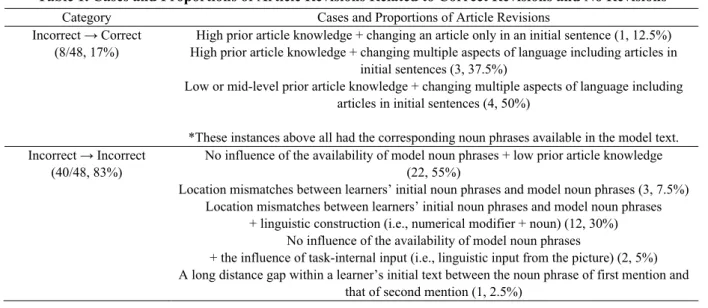
To summarize these findings on the cases and proportions of correct article revisions and no article revisions, Table 1 is presented below.
Table 1. Cases and Proportions of Article Revisions Related to Correct Revisions and No Revisions
Category Cases and Proportions of Article Revisions
Incorrect → Correct (8/48, 17%)
High prior article knowledge + changing an article only in an initial sentence (1, 12.5%) High prior article knowledge + changing multiple aspects of language including articles in
initial sentences (3, 37.5%)
Low or mid-level prior article knowledge + changing multiple aspects of language including articles in initial sentences (4, 50%)
*These instances above all had the corresponding noun phrases available in the model text.
Incorrect → Incorrect (40/48, 83%)
No influence of the availability of model noun phrases + low prior article knowledge (22, 55%)
Location mismatches between learners’ initial noun phrases and model noun phrases (3, 7.5%) Location mismatches between learners’ initial noun phrases and model noun phrases
+ linguistic construction (i.e., numerical modifier + noun) (12, 30%) No influence of the availability of model noun phrases
+ the influence of task-internal input (i.e., linguistic input from the picture) (2, 5%) A long distance gap within a learner’s initial text between the noun phrase of first mention and
that of second mention (1, 2.5%)
Finally, there were also four pairs of article-use instances where learners initially correctly supplied articles but in the revised sentences, the articles were not supplied. These instances were seen from two learners with mid-level prior article knowledge and two learners with high prior knowledge. These learners’ writing proficiency was at the intermediate or advanced level. Below is an excerpt from a learner with high prior article knowledge and advanced writing proficiency who failed to keep the article “a” from the phrase “a heavy brick”
in her revised sentence.
(Learner F, initial text article accuracy: high, WP: advanced)
ISs: One day, two boys who look about 10-years old were passing by shop. The boys heard the sound of a breaking glass and saw a man who was wearing a striped long sleeves shirt and a tam-o’shanter
5 For these minor cases, excerpts will not be presented here, nor will they be further addressed in the discussion section.
breaking the show window of a jewelry shop with one hand holding a heavy brick.
RSs: One day, two boys who look about 10-years old were walking on the street when they had an unforgettable experience. The boys heard the sound of a breaking glass and saw a man break the show window of a jewelry shop with one hand holding heavy brick.
MSs: One day, two boys were walking on the street when they had a very embarrassing experience. They were near a jewelry store and there were a lot of watches in the shop window. Suddenly, they saw a man break the window.
As seen in the excerpt, she made various revisions between her initial and revised sentences. For example, she recognized the hook of the modeled topic sentence (“when they had a very embarrassing experience”) adding her own hook into her revisions (“when they had an unforgettable experience”). Her revisions also included aspects of content and grammar. She deleted her detailed description of the thief’s appearance (“who was wearing a striped long sleeves shirt and a tam-o’shanter”) and changed the verb form “breaking” to “break” after comparison with the model sentences. In other words, while attending to these multiple aspects of language, the learner may have failed to maintain her attention to the last article instance contained in the last noun phrase of her initial sentence. This interpretation, however, appears to be contradictory to the second and third cases of the correct article revisions wherein attending to other aspects of language, the learners still noticed and correctly revised the articles. The possible, underlying explanations (as well as those for the other major cases of article revisions) will be offered later in the discussion section in reference to the learners’ written reflections on their text revisions.
4.2 General Aspects of Revision (Research Question 2)
As presented in Table 2, out of a total of 75 revisions made, the learners attended to and revised aspects of lexis the most (34, 45.33%), then content (29, 38.67%), followed by grammar (12, 16%)6. In terms of lexis, the learners attended more to nouns, verbs/phrasal verbs, adverbs, and expressions (28, 83.35%) than to adjectives, numbers, prepositions, and spellings (6, 17.65%). More specifically, the eight noun-related revisions all occurred from changing the learners’ original words to different words, mainly by adopting the synonyms from the model text (5/8) (e.g., “cop” vs. “policeman”) or due to different interpretations of an item depicted in the picture from the model text (2/8) (e.g., “jewelry” vs. “watches”). Similarly, all eight verb-related revisions were also derived from changes such as substituting the original verbs with synonyms (e.g., “arrive” vs. “appear”), with phrasal verbs (e.g., “catch” vs. “catch up”), or by trying different verbs in collocations (e.g., “shoot a movie” vs. “take7 a movie”), with four of these revised verbs taken from the model text. With respect to the adverbs and expressions, a good number of the revisions in each category accounted for time-related adverbs (4/6, 66.67%) (e.g., “finally”) and time-related expressions (3/6, 50%) (e.g., “all of sudden”). Unlike the nouns and verbs, these revisions concerning temporal words and expressions, except for one, were all newly added ones (6/7, 85.71%), influenced by the model text.
6 Note that in this count, articles were excluded; however, with the inclusion of the eight correctly revised articles, the relevant ranking of the grammar category would be still the same. This also means that the cases of the initially correctly supplied articles not being supplied in the revised sentences would not be included, because as briefly mentioned in the results section and as will be discussed later, this case was judged as the learners not being capable of attending to the articles due to their limited attentional resources.
7 This incorrect verb is not taken from the model text.
Table 2. Revision Aspects and Proportions of Lexis, Grammar, and Content Category Revision Aspects and Proportions of Lexis, Grammar, and Content
Lexis (34/75, 45.33%)
Noun changes (8, 23.53%) Verb/phrasal verb changes (8, 23.53%) Adverb additions and deletion (6, 17.65%) Expression changes and additions (6, 17.65%)
Adjective change and deletion (2, 5.88%) Number addition and deletion (2, 5.88%)
Preposition change (1, 2.94%) Spelling change (1, 2.94%)
Grammar (12/75, 16%)
Subject-verb agreement changes (4, 33.33%) Subject additions and deletion (3, 25%)
Verb form changes (3, 25%) Verb tense change (1, 8.33%) Noun number change (1, 8.33%)
Content (29/75, 38.67%)
Changing inaccurate picture interpretations to accurate ones, changing or deleting plausible descriptions reflecting the model text’s picture interpretations, or newly adding the model text’s
picture interpretations (9, 31.03%)
Adding more background information and situations or changing parts of the texts to more detailed descriptions of situations (6, 20.69%)
Changing the surface descriptions of what appears in the picture to subjective descriptions of characters’ possible inner thoughts and feelings, changing subjective descriptions in meaning, or
deleting subjective descriptions (5, 17.24%)
Adding or changing the descriptions of characters’ actions for more detailed storytelling (4, 13.79%)
Deleting overly detailed descriptions of characters’ appearance (3, 10.35%) Adding direct speech by characters, or changing parts of the texts to their direct speech
(2, 6.90%)
In terms of grammar, the learners attended to and revised aspects of subject-verb agreement (e.g., “was walking” vs. “were walking”), verb form (e.g., “pointed” vs. “pointing”), verb tense (e.g., “looks” vs. “looked”), noun number (“streets” vs. “street”), and sentence subjects as they inserted new subjects when they divided their sentences into two, or deleted the existing subjects when they combined two sentences into one. Most of these revisions (9/12, 75%) accounted for changes, and over half of them (7/12, 58.33%) comprised changes on subject-verb agreement, verb form, and noun number, which were all directly influenced by the sentences in the model text. What is notable here is that these sentences very closely resembled the learners’ initial sentences, as exemplified in the following excerpt by learner G, in which errors of subject-verb agreement (“was” → “were”) and noun number (“streets” → “street”) were noticed and revised.
IS: One day, two little boys was walking on the streets...
RS: One day, two little boys were walking on the street ...
MS: One day, two boys were walking on the street ...
For content, as seen in Table 2, the learners attended to and made revisions in the six different categories, which were either directly or indirectly influenced by the model text. Specifically, these involved picture interpretations, backgrounds and situations, subjective descriptions of characters’ inner thoughts and feelings, characters’ actions, characters’ appearance, and characters’ direct speech. These descriptive details, however, can be further combined according to their commonalities. In other words, the learners were mostly concerned
about the detailedness of the story narration, either trying to be more detailed or deleting too-detailed descriptions from comparison to the model text (13/29, 44.83%). The next area of their attention concerned picture interpretations, either changing their incorrect interpretations to accurate ones or incorporating the model text’s interpretations of what the picture shows, despite their original interpretations being plausible as well (9/29, 31.03%). The last area attended to and revised concerned the subjective descriptions the model text used, such as describing characters’ possible inner thoughts and feelings and integrating their direct speech as well (7/29, 24.14%).
Finally, for organization, 9 out of 16 learners (56.25%) indented the first sentences of their initial texts, and except for one learner, this was maintained in their revised texts as well. Out of the 7 learners who missed indentation in their initial texts, 5 of them (71.43%) noticed and incorporated it into their revised texts. However, as for the rhetorical elements of a narrative paragraph, only 4 out of 16 learners (25%) produced topic sentences and concluding sentences both in their initial and revised paragraphs. Similarly, among the remaining 12 learners who missed these elements in their initial paragraphs, for topic sentences, only 4 learners (33.33%) incorporated them into their revisions. In terms of concluding sentences, only 4 learners (33.33%) made corresponding revisions. In short, the results for organization indicate that the first sentence indentation seemed to be easier for the learners to notice and incorporate from the model narrative paragraph than its two rhetorical elements, topic and concluding sentences.
5. Discussion
The first research question investigated when a picture-based narrative model is provided as a feedback tool, in which types of circumstances L2 Korean learners correctly revise English articles, leave them uncorrected, or incorrectly revise them. The results indicated that only 17% of the initially incorrect article instances were corrected, and these instances all had model noun phrases that the learners could refer to in the model text.
However, as also revealed in the first trend of cases in which there were no correct revisions and wherein the noun phrases that the learners could refer to were available in the model text but did not lead to article corrections, there seems to be more factors in play than the presence of the model noun phrases in the model text.
One combined factor seems to be learners’ overall proficiency levels as well as prior article knowledge. Previous studies found that higher proficiency or prior knowledge can promote greater noticing and subsequent revisions from a model text (Cánovas Guirao et al. 2015, García Mayo and Loidi Labandibar 2017, Hanaoka 2007).
Indeed, the learners from the first and second cases (e.g., learners A and B) who correctly revised their article errors in this study had at least intermediate writing proficiency, and their prior article knowledge was assessed as high. Thus, these findings, in conjunction with previous findings, indicate that a model text would be best utilized by learners of higher proficiency and prior knowledge (of a targeted form).
In addition to these factors, the difficulty notes, questionnaire responses, and exit survey responses gathered in this study further revealed other facilitating factors, such as language learning strategies and language awareness.
For example, learner A from the results section stated, “Once I printed out my text and read it over and over again, I was gradually able to notice and revise a number of errors. I realized that when revising an English text, re-reading with time might be a good language learning method.” This statement shows that to successfully complete the revision task, she devised her own learning strategy: using the technique of printing out a text and reading it several times over an extended period of time. This supports the general findings of L2 strategy-related research that learners’ active use of strategies can have positive effects on their language learning process
(O’Malley and Chamot 1990, Oxford 1990). Learner B, on the other hand, explicitly commented that “I was certain about using ‘a’ before ‘thief’ for the first mention usage, but for the ensuing sentences, I was not sure if I could use ‘the’ continuously, and not having solved the problem, I ended up using ‘the.’” She later reported that based on the model text, she revised “a, an, the.” Thus, in her case, having identified a “hole” in her article knowledge from writing her initial text (Swain 1995), she must then have focused on how articles were used in the model text, which led her to refocus on the use of “the” and notice the missed “a,” as shown in the excerpt earlier. This shows that depending on individual learners’ language awareness, a model text can be an effective form of corrective feedback.
The findings with the third case of learners (those who did not have prior high article knowledge but correctly revised their articles) can also be explained by similar reasoning. As it turned out from their written responses, their correct article revisions seemed to be the result of their selective attention to some particular aspects of the model text. Learner C from the excerpt in the results section, stated “I had a difficulty with the use of pronouns. I wondered if I had to use ‘they’ consistently to refer to ‘two boys,’ but after reading the model text, I learned that I could alternate between them (using pronouns vs. repeating nouns).” Thus, as seen in her excerpt earlier, since the model sentence used “the boys,” which contained the noun “boys,” this must have caught her attention, solving her problem and consequently leading to the correct insertion of the missed article.
On the other hand, the second portion of the study findings revealed that a majority of the incorrect article instances (83%) were left unresolved. As just seen, while the learners whose prior article knowledge was not high could also make correct article revisions, the most dominant case of failure to address needed article revisions still seemed to be derived from learners’ low prior article knowledge. Schmidt (2001) argued that for L2 learners to learn a certain form, their attention to that relevant input is essential. Accordingly then, some of the learners’ initial low article accuracy rates found in this study likely indicate that their extent of noticing that form had been minimal. However, the model text provided in this study did not implement a special pedagogical technique, for example, input or text enhancement (Sharwood Smith, 1993), to draw their attention to articles, thus not helping them to notice the mismatches between their article uses and those from the model text.
Furthermore, as argued by VanPatten (2004), when processing input, L2 learners tend to process content words first before any other categories of words. This explicates learner C’s excerpt wherein while focusing on
“the boys,” as discussed earlier, she missed “the thief,” or to be more precise, the definite article “the” as well as the preposition “with” from the same model sentence. Given that the content word “thief” was the same between her initial sentence and the model sentence, her noticing may have stopped there, meaning she was not paying particular attention to the article, a function word; instead, she attended to another content word of the sentence,
“caught up,” while missing “with” again, another function word. Similar occurrences to these were also observed in previous studies (Coyle et al. 2018, Hanaoka 2007). They described this phenomenon as limited “scope of noticing” from a model text, which is a plausible interpretation. However, it can also be more fundamentally understood as L2 learners’ input processing priorities towards meaning over grammar (i.e., in this study, the input being the model text), unless they selectively attend to some particular aspects of language as shown in the case of the same learner’s noticing of “the boys” above.
The other factors found for the article revision failures included the location mismatches between some learners’ initial noun phrases and the model noun phrases. This is interpreted to be due to the use of the visual aid (picture prompt) only without giving some descriptive guidance of a storyline, which otherwise may have helped the learners to generate closer storylines to the model text. Furthermore, influenced by this location factor, another source of difficulty with article noticing and revisions was found to be a pre-modified context as in “two boys,” where the numerical modifier precedes the noun “boys.” This is in line with the findings of previous
cross-linguistic studies that when a modifier precedes a noun versus when an English article directly precedes the noun, more article omissions occur with the former case with L2 learners whose L1s do not have the article system (Jarvis 2002, Lee 1999, Trenkic 2004, 2007). Trenkic (2007) further reported that this tendency persisted even at higher proficiency levels. This was also confirmed in this study, as those who consistently omitted the articles in that linguistic context all ranged from the intermediate/mid to the advanced/high levels both in their writing proficiency and prior article knowledge. Of additional note here is that the structure “the two boys” was presented only once in the model text. Thus, in future research, if this kind of structure is employed in a model text, and the purpose is to draw learner attention to articles, more instances would be better for learners to notice them.
Finally, the cases of initially correctly used articles not being included in the revised sentences may be explained by Skehan’s (1998) limited capacity hypothesis that given L2 learners’ limited information processing resources, attention to some aspects of performance will reduce the attention needed for other aspects of performance. Thus, as in learner F’s excerpt from the results section, her attending to and revising multiple aspects of language, including organization, content, and verb-form-related grammar, was likely to have led her to fail to maintain her attention to the last article used in the last noun phrase of her initial sentence. The evidence that this missed article was unintentional can be further supported from her very thoroughly written reflections, where she stated all the revisions described above except for the missed article.
The second research question investigated, other than the English articles, what general aspects of a narrative text L2 Korean learners attend to and revise when a picture-based model text is provided as feedback. The findings that the learners’ attention and revision focused on lexis, content, and grammar in descending order are largely in line with those of the model-comparison stages implemented in previous studies (Cánovas Guirao et al.
2015, Coyle and Roca de Larios 2014, García Mayo and Loidi Labandibar 2017, Hanaoka 2007). These findings thus suggest one possible implication for future research. That is, given that this study employed the learners’
textual revisions as the primary data source, compared to self-reports used by previous studies, the use of self-reports may be a reliable data collection method if the inquiry is on the relevant order of learner attention to the categories of lexis, content, and grammar in future model-based L2 writing studies. However, at the same time, since this study used a subset of the data restricted to the sentences containing the target article functions, this implication cannot be overstated.
Unlike most of previous studies, the findings of the present study also showed what sub-aspects of those categories, along with organization, were further attended to and revised. In terms of lexis, the study found that many of the noun- and verb-related revisions accounted for insignificant differences in word choices made between the learners’ texts and the model text. Previous studies have emphasized the provision of alternative lexis and content as one of the advantages of using models (Cánovas Guirao et al. 2015, Coyle et al. 2018, Coyle and Roca de Larios 2014, García Mayo and Loidi Labandibar 2017, Hanaoka 2007, Martinez and Roca de Larios 2010). However, the downside of this is that while incorporating the alternative words used by a model text, learners’ attention is likely to be taken away from other aspects of language such as grammar, which was often reported as the least noticed aspect from a model text. The previous study by Coyle et al. (2018) pointed to a potential role of extensive instruction on raising learners’ attention to form-related features from a model text.
An additional suggestion from this study is that from the initial writing task, if learners are preemptively equipped with a list of nouns and verbs that will be used in the model text, their attention at the model comparison task may be distributed more to other less attended aspects of language.
In terms of the adverb- and expression-related revisions, many of them were caused by new additions of temporal phrases from the model text that the learners had not used in their initial texts. This may indicate that