KOREAN JOURNAL OF ENGLISH LANGUAGE AND LINGUISTICS
ISSN: 1598-1398 / e-ISSN 2586-7474 http://journal.kasell.or.kr
An In-Depth Analysis of Errors in L2 Writing: The Effects of Task Complexity and Task Closure
Jiyong Lee (Konkuk University)
This is an open-access article distributed under the terms of the Creative Commons License, which permits unrestricted non-commercial use, distribution, and reproduction in any medium, provided the original work is properly cited.
ABSTRACT
Lee, Jiyong. 2020. An in-depth analysis of errors in L2 writing: The effects of task complexity and task closure. Korean Journal of English Language and Linguistics 21, 247-260.
Although accuracy is among the common dimensions of L2 performance that is investigated in the majority of task-based research, a limited range of measures—usually the number of error-free units or number of total errors per unit—are used to measure this feature. The present study attempted to conduct an in-depth analysis of the specific types of errors that are more susceptible to task closure and increases in task complexity. The written performance of 45 Korean learners of English was examined, and errors were divided into six major categories.
It was found that increasing task complexity led to significantly greater numbers of noun ending errors and article errors. A significant interaction between task complexity and task closure was also found on the number of lexical errors. Findings are interpreted in terms of Skehan’s (1996, 1998) Trade-Off Hypothesis, the nature of the tasks, and participants’ L2 proficiency level.
Received: Jan. 25, 2021 Revised: March 15, 2021 Accepted: March 25, 2021
Jiyoung Lee
Postdoctoral researcher, Dept. of English Education, Konkuk Univ.
[email protected] KEYWORDS
task complexity, task closure, L2 writing, errors, error-analysis
1. Introduction
Task-based research has continuously made significant advances ever since Long (1985) first introduced the concept of ‘task’ as a viable unit of analysis in learner needs identification, syllabus design, and student assessment.
In recent years, many attempts have been made to ensure that increases in task complexity actually led to the expected increases in cognitive load, which in turn resulted in the significant changes in L2 performance (Lee 2019, Révész, Michel and Gilabert 2015, Sasayama 2016). In addition, several researchers have voiced their concerns about the validity of the outcome measures, wondering if the commonly investigated dimensions of L2 performance, complexity, accuracy, lexis, and fluency (CALF), actually measure what they are supposed to be measuring (Norris and Ortega 2009, Sasayama, Malicka and Norris 2015).
Among the four CALF measures, accuracy is claimed to be the most straightforward and internally consistent construct (Housen and Kuiken 2009, Pallotti 2009). However, most task-based studies incorporated a limited range of measures to assess the accuracy of learners’ written performance. As such, it is vital that more measures are used to look into the specific types of errors that are more susceptible to the effects of task complexity and/or other task-related variables. This paper attempts to fulfill this need, while examining the combined effects of task complexity and open vs. closed tasks.
According to Long (1989), an open task has a wide set of acceptable answers, while a closed task has one or one of a finite set of correct answers. Drawing on findings from L2 interactional research, Long (1989) and Loschky and Bley-Vroman (1993) claimed that closed tasks would be more conducive to L2 learning, because learners are forced to come up with a solution, whereas they are more likely to treat the topic lightly or drop it altogether when the topic is too challenging for them or when a major communication breakdown occurs in open tasks. It is speculated that closed tasks would lead to greater negotiation for meaning, provision and incorporation of feedback, and recycling of language, which are claimed to facilitate L2 learning. This aspect is a relatively less investigated topic of task condition, and one of the aims of this paper is to contribute to the literature on task closure effects.
2. Literature Review
2.1 Task Complexity and Task Closure Effects
Skehan’s (1996, 1998) Limited Attentional Capacity Model (LACM) and Robinson’s (2001, 2005, 2011) Cognition Hypothesis (CH), two prominent frameworks in task-based research that generated over 250 empirical studies, make different predictions about how increasing task complexity leads to changes in linguistic performance. As the name suggests, the LACM assumes that people’s capacity for attention is limited, whereas the CH assumes multiple pools of attentional resources. As such, the LACM predicts that there is a trade-off between linguistic complexity and accuracy when task complexity is increased (hence earning its name as the Trade-Off Hypothesis), while the CH predicts that increasing task complexity facilitates L2 learning because it leads to greater linguistic complexity and accuracy.
In the attempts to test these two hypotheses, an abundance of studies has manipulated numerous task-related variables that were assumed to increase the cognitive load of the task, and investigated their effects on learners’
performance in terms of CALF measures. Focusing on the resource-directing and resource-dispersing dimensions of Robinson’s (2011) Triadic Componential Framework (TCF), Johnson (2017) conducted a research synthesis and meta-analysis of task-based research on L2 writing. It was found that the most common ways to manipulate task complexity along resource-directing dimensions were +/- Here and Now and +/- few elements. +/- Planning time and +/- task familiarity were among the most popular ways to manipulate task complexity along resource-
dispersing dimensions.
Recent years have witnessed a rise in task-based writing studies that investigated the mediating role that task conditions play in the effectiveness of increasing task complexity. This study focuses on the effects of task closure, to which little attention has been paid in task-based research, despite having been introduced in the TCF as +/- one-way solution1. To fill the gap in the literature, Montero (2018) and Lee (2020) have put efforts to come up with consistent and replicable way to manipulate task closure when investigating its effects in combination with those of task complexity.
In Montero’s (2018) study, 62 beginner learners of Spanish carried out an oral description task, whose task complexity was determined by the number of geometric shapes before them. Half of the participants, who were assigned to the closed condition, described a number of simple shapes (e.g., a star and square) whose arrangement was predetermined by the researcher. The other half of the students who were assigned to the open condition described a different set of oddly formed shapes whose arrangement needed to be determined by themselves. It was assumed that those in the open condition would settle on an easier answer, since they were allowed the freedom to arrange the shapes in whichever way they wanted. While findings regarding task complexity effects were in line with the CH in that the complex task version led to greater syntactic complexity, lexical diversity, and accuracy, those in the closed condition did not outperform those in the open condition. In fact, the linguistic diversity of descriptions produced by those in the open condition was found to be significantly greater, providing counter- evidence to Long (1989) and Bley-Vroman’s (1993) claims.
Similar findings were obtained in Lee’s (2020) study regarding task closure effects. Using two tasks to maximize generalizability of findings, the written production of 83 Korean learners of English, half of whom carried out closed tasks and the other half whom carried out open tasks, was examined in terms of syntactic complexity, lexical diversity, and accuracy. The open and closed tasks both involved choosing the best location (hotel or venue) for a certain event, but the closed versions included additional requirements that participants needed to consider when making a choice. While it was found that increasing task complexity led to significantly greater lexical diversity but lower accuracy, thus lending support for the LACM, open tasks were found to elicit significantly greater lexical diversity than closed tasks. It was speculated that in order to make their arguments persuasive, those who performed the open tasks needed to provide more details in their writing than those who carried out the closed tasks. On the other hand, those who carried out closed tasks only needed to discuss whether the requirements were met or not, leading to less diverse vocabulary in their writing.
The aforementioned previous studies did not find significant task closure effects on accuracy in either learners’
spoken or written production. It should be noted that the measures of accuracy that were employed included gender marking of nouns, gender agreement of nouns and articles, gender agreement of nouns and adjectives, and gender agreement of nouns, articles, and adjectives in Montero’s (2018) study, and proportions of target-like use of articles and error-free T-units in Lee’s (2020) study. In other words, the accuracy measures that were used in these studies were of a considerably limited scope. Therefore, the present study sought to investigate the combined effects of task complexity and task closure by performing an in-depth analysis of L2 errors by examining numerous types of errors that have been overlooked in task-based literature.
2.2 Error Analyses in Task-based Written Performance
Learners’ accuracy in their output has been one of the major outcome measures of most task-based research, usually in combination with syntactic complexity and lexical diversity. According to Johnson’s (2017) research synthesis and meta-analysis of task-based studies of L2 writing, 25 measures of accuracy were identified in the 16
1 It should be mentioned that the TCF does not provide any clear definition of this variable, nor does it make any clear predictions about how +/- open solution affects L2 performance.
studies included in his analysis. The most frequently reported measures were some measure of the number of errors per T-unit and/or a metric of error-free units, the units being either the T-unit or the clause. Other measures include a metric that indicate the degree of severity of the error (Kuiken and Vedder 2008, Kuiken, Mos and Vedder 2005) and target-like use of articles (Ishikawa, 2007). With the exception of Kuiken and Vedder’s (2007) study that included a broader range of errors, the majority of task-based studies included a restricted number of measures of a limited range—either by looking at the total number of errors without identifying the specific types of errors, or the total number of error-free units. However, as mentioned by Kuiken and Vedder (2007), finding error-free units in the performance of beginner and (low) intermediate learners is not easy. Furthermore, although the numbers of errors per T-unit may be an indicator of the overall accuracy of written performance, it says little about the nature of the errors about “how serious are they and do they concern morphosyntax, vocabulary use, spelling or style?”
(p. 266).
In Kuiken and Vedder’s (2007) study, attempts were made to include more specific measures of accuracy in order to find out which type of errors were responsible for the established significant effect of task complexity on accuracy on another related study of their own. Accuracy was measured by dividing the numbers of errors regarding grammar, lexicon, orthography, appropriateness, and others by the number of T-units. Eighty-four Dutch learners of Italian and 75 Dutch learners of French, both divided into low and high proficiency groups, completed two writing tasks that required them to write a letter regarding the choice of a holiday destination. Task complexity was manipulated in terms of +/- few elements. Results showed that the majority of errors observed concerned grammar and lexicon. More strikingly, for both Italian and French learners, a significant effect of task complexity was found on lexical errors, in that the two groups performed better in the complex than in the non-complex condition. In addition, task complexity effects were also found on appropriateness, orthography and other errors for the learners of French. In other words, these learners made significantly more appropriateness and other errors, but fewer orthography errors in the complex task.
With the same objectives as Kuiken and Vedder (2007), the present study attempted to investigate the specific types of errors that would be responsible for any significant effects of task complexity and closure on learners’
writing, if any. As such, it was deemed necessary to use a more refined categorization of errors for the analyses.
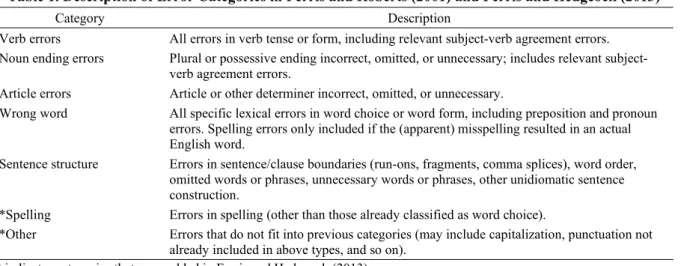
To this end, the study adopted the categorization method of Ferris and Roberts (2001) and Ferris and Hedgcock (2014), whose categories are shown in Table 1.
Table 1. Description of Error Categories in Ferris and Roberts (2001) and Ferris and Hedgcock (2013)
Category Description
Verb errors All errors in verb tense or form, including relevant subject-verb agreement errors.
Noun ending errors Plural or possessive ending incorrect, omitted, or unnecessary; includes relevant subject- verb agreement errors.
Article errors Article or other determiner incorrect, omitted, or unnecessary.
Wrong word All specific lexical errors in word choice or word form, including preposition and pronoun errors. Spelling errors only included if the (apparent) misspelling resulted in an actual English word.
Sentence structure Errors in sentence/clause boundaries (run-ons, fragments, comma splices), word order, omitted words or phrases, unnecessary words or phrases, other unidiomatic sentence construction.
*Spelling Errors in spelling (other than those already classified as word choice).
*Other Errors that do not fit into previous categories (may include capitalization, punctuation not already included in above types, and so on).
* indicates categories that were added in Ferris and Hedgcock (2013).
In order to contribute to the relatively small body of research regarding the effects of task complexity and task closure on specific types of errors in learners’ written performance, the study addressed the following research questions:
RQ1. Does increasing task complexity in terms of the number of elements lead to changes in the number and types of errors in L2 writing?
RQ1. Does task closure lead to changes in the number and types of errors in L2 writing?
3. Methodology
3.1 Participants
Forty-five Korean learners of English (21 males, 24 females) enrolled at a Korean university participated in the study. With the exception of six participants, all were English Education majors. Their mean age was 22.16 (SD = 1.86) at the time of study. In order to measure their overall English proficiency, participants took Brown’s (1980) cloze test. Based on their average scores on the test, 18.29 (SD = 3.35) out of a maximum of 50 points, it was speculated that their English proficiency ranged from lower-intermediate to intermediate level. Participants were randomly assigned to either a Closed group (N = 23) that carried out tasks that had a predetermined answer (i.e., closed tasks), or an Open group (N = 22) that carried out tasks that did not have a predetermined answer (i.e., open tasks).
3.2 Writing Task
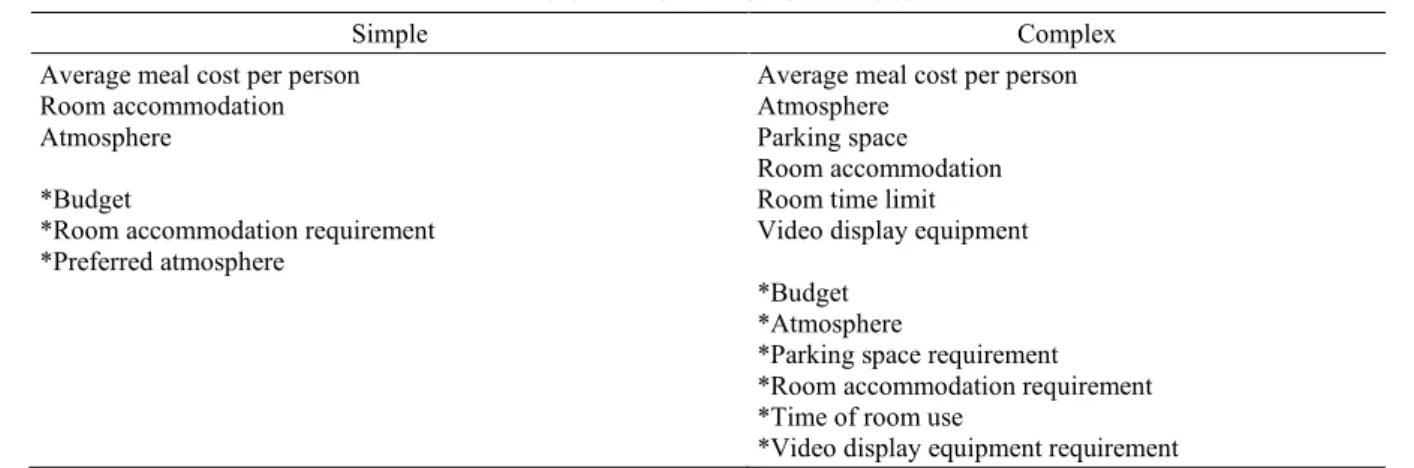
Participants carried out a writing task that required them to choose the best venue for a birthday party and write a letter to the party hosts about their decision and the reasons behind their choice. Task complexity was manipulated in terms of the number of elements. Participants had to choose a venue from three restaurants in the simple version, and from four restaurants in the complex version. Table 2 provides information about the elements that were included in the simple and complex task versions. Task closure was another variable that was manipulated, which was determined by whether the task had a predetermined solution (closed) or not (open). Efforts were put into creating a closed and open task that basically included the same information. However, in order to ‘close’ the task, additional requirements were added that had to be followed by the participants. These requirements involved specific needs and preferences of the imaginary party hosts. If participants in the Closed group took these requirements into consideration, there would be only one venue most suitable for the party. To sum up, the writing task employed in the study had four versions: 1) simple closed, 2) complex closed, 3) simple open, 4) complex closed.
Table 2. Information on Venues
Simple Complex
Average meal cost per person Room accommodation Atmosphere
*Budget
*Room accommodation requirement
*Preferred atmosphere
Average meal cost per person Atmosphere
Parking space Room accommodation Room time limit Video display equipment
*Budget
*Atmosphere
*Parking space requirement
*Room accommodation requirement
*Time of room use
*Video display equipment requirement
* indicates the needs and preferences of the imaginary party hosts in the closed tasks.
3.3 Procedure
Participants met with the researcher for one session. They first completed a language background questionnaire and then took Brown’s (1980) cloze test. After being assigned to either the Closed or Open group, they were given up to 30 minutes to carry out the simple and complex versions of the writing task, whose order was pseudo- randomized. After completing each task version, participants were required to complete a self-rating questionnaire that asked questions about the overall difficulty of the task, the amount of mental effort required, and the level of stress they felt during task performance. The following tests were also administered in random order to measure various individual differences: a modified version of an Operation Span task (Engle, Cantor and Carullo 1992, Malone 2018) to assess working memory capacity, and the LLAMA D and F (Meara, 2005) to measure implicit and explicit language aptitude, respectively.
3.4 Data Analysis
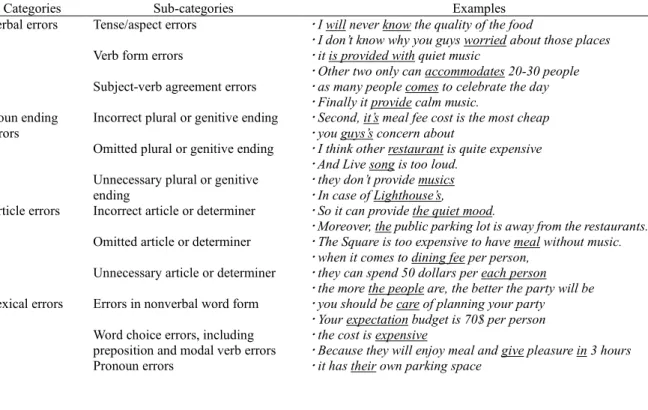
An in-depth error analysis was conducted on participants’ writing. Before the analysis was conducted, the researcher made a list of the types of errors that could be made by L2 learners, which was later regrouped into six major categories. Table 3 provides a list of the categories, subcategories, and examples of each category found in participants’ writing. Based on this list, one rater examined and categorized all of the errors found in participants’
writing. A second rater examined 25 percent of the data, also referring to the list that was created by the researcher.
Then the two raters convened to discuss any discrepancies between their evaluations, which were later reconciled.
After an agreement was made, all numbers of errors were divided by the numbers of T-units (Hunt 1964) in text in order to make comparisons between participants and between tasks. These final numbers for each category served as the dependent variable, and task complexity (within-subjects) and task closure (between-subjects) served as the independent variables with two levels each. A series of repeated-measures ANOVA were conducted, with the significance level set at p = .05.
Table 3. Error categories and subcategories
Categories Sub-categories Examples
Verbal errors Tense/aspect errors I will never know the quality of the food
I don’t know why you guys worried about those places Verb form errors it is provided with quiet music
Other two only can accommodates 20-30 people Subject-verb agreement errors as many people comes to celebrate the day
Finally it provide calm music.
Noun ending
errors Incorrect plural or genitive ending Second, it’s meal fee cost is the most cheap
you guys’s concern about
Omitted plural or genitive ending I think other restaurant is quite expensive
And Live song is too loud.
Unnecessary plural or genitive
ending they don’t provide musics
In case of Lighthouse’s,
Article errors Incorrect article or determiner So it can provide the quiet mood.
Moreover, the public parking lot is away from the restaurants.
Omitted article or determiner The Square is too expensive to have meal without music.
when it comes to dining fee per person, Unnecessary article or determiner they can spend 50 dollars per each person
the more the people are, the better the party will be Lexical errors Errors in nonverbal word form you should be care of planning your party
Your expectation budget is 70$ per person Word choice errors, including
preposition and modal verb errors the cost is expensive
Because they will enjoy meal and give pleasure in 3 hours Pronoun errors it has their own parking space
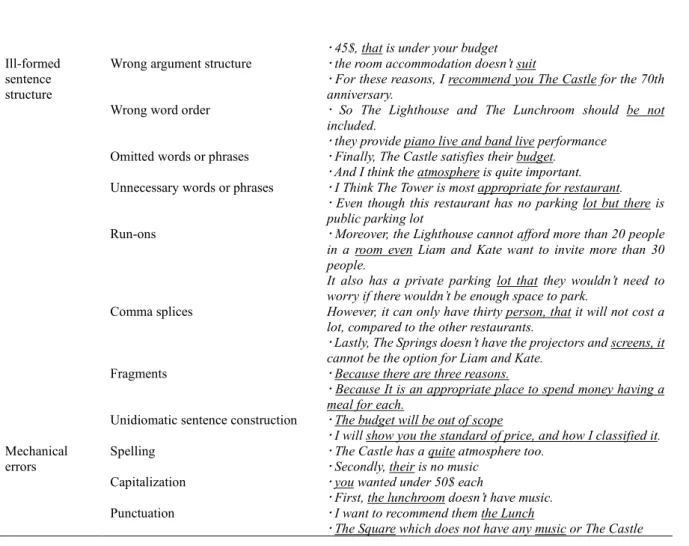
45$, that is under your budget Ill-formed
sentence structure
Wrong argument structure the room accommodation doesn’t suit
For these reasons, I recommend you The Castle for the 70th anniversary.
Wrong word order So The Lighthouse and The Lunchroom should be not included.
they provide piano live and band live performance Omitted words or phrases Finally, The Castle satisfies their budget.
And I think the atmosphere is quite important.
Unnecessary words or phrases I Think The Tower is most appropriate for restaurant.
Even though this restaurant has no parking lot but there is public parking lot
Run-ons Moreover, the Lighthouse cannot afford more than 20 people in a room even Liam and Kate want to invite more than 30 people.
It also has a private parking lot that they wouldn’t need to worry if there wouldn’t be enough space to park.
Comma splices However, it can only have thirty person, that it will not cost a lot, compared to the other restaurants.
Lastly, The Springs doesn’t have the projectors and screens, it cannot be the option for Liam and Kate.
Fragments Because there are three reasons.
Because It is an appropriate place to spend money having a meal for each.
Unidiomatic sentence construction The budget will be out of scope
I will show you the standard of price, and how I classified it.
Mechanical
errors Spelling The Castle has a quite atmosphere too.
Secondly, their is no music Capitalization you wanted under 50$ each
First, the lunchroom doesn’t have music.
Punctuation I want to recommend them the Lunch
The Square which does not have any music or The Castle
4. Results
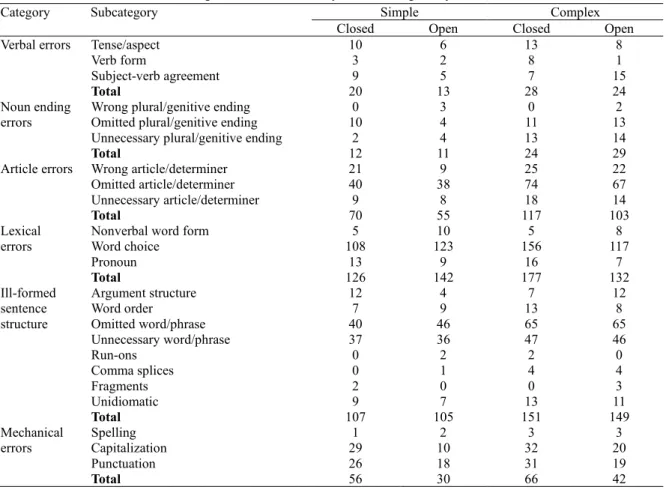
Descriptive statistics for the six major error categories are presented in Table 4, and raw frequencies of the errors in each subcategory are displayed in Table 5. Based on Table 4, it appears that when averaging across groups, the complex task elicited higher ratios of errors regarding noun ending and article use. On the other hand, participants seemed to make fewer lexical errors when they performed the complex task. There didn’t seem to be much difference between the Closed and Open groups, with the exception of lexical errors and sentence structure errors.
Table 4. Means and Standard Deviations of Errors by Task Complexity and Task Closure
Simple Complex
Category Closed Open Closed Open
Verbal errors .08 (.09) .05 (.11) .10 (.14) .11 (.11)
Noun ending errors .04 (.09) .04 (.10) .09 (.14) .12 (.14)
Article errors .31 (.23) .31 (.22) .43 (.24) .40 (.24)
Lexical errors .60 (.46) .83 (.52) .65 (.29) .51 (.40)
Ill-formed sentence structure .46 (.30) .72 (.72) .55 (.35) .58 (.29)
Mechanical errors .22 (.22) .17 (.20) .24 (.21) .16 (.18)
The numbers indicate the number of errors divided by the number of T-units.
Table 5. Raw frequencies of Errors by Task Complexity and Task Closure
Category Subcategory Simple Complex
Closed Open Closed Open
Verbal errors Tense/aspect 10 6 13 8
Verb form 3 2 8 1
Subject-verb agreement 9 5 7 15
Total 20 13 28 24
Noun ending
errors Wrong plural/genitive ending 0 3 0 2
Omitted plural/genitive ending 10 4 11 13
Unnecessary plural/genitive ending 2 4 13 14
Total 12 11 24 29
Article errors Wrong article/determiner 21 9 25 22
Omitted article/determiner 40 38 74 67
Unnecessary article/determiner 9 8 18 14
Total 70 55 117 103
Lexical
errors Nonverbal word form 5 10 5 8
Word choice 108 123 156 117
Pronoun 13 9 16 7
Total 126 142 177 132
Ill-formed sentence structure
Argument structure 12 4 7 12
Word order 7 9 13 8
Omitted word/phrase 40 46 65 65
Unnecessary word/phrase 37 36 47 46
Run-ons 0 2 2 0
Comma splices 0 1 4 4
Fragments 2 0 0 3
Unidiomatic 9 7 13 11
Total 107 105 151 149
Mechanical
errors Spelling 1 2 3 3
Capitalization 29 10 32 20
Punctuation 26 18 31 19
Total 56 30 66 42
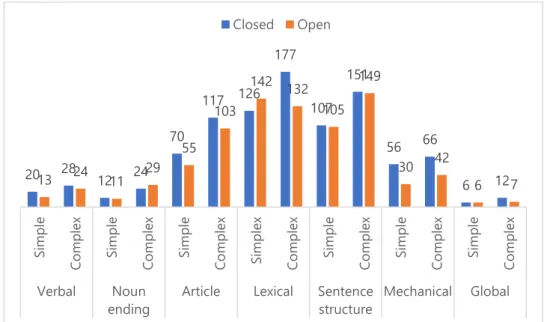
Figure 1 displays the total numbers of errors that were found (not divided by the number of T-units). Because these numbers indicate the sheer volume of errors that were produced by the participants, it was highly likely that participants would make more errors in all categories if their texts were longer. In other words, if they needed to write more because of the added elements in the complex task, they were bound to make more errors. This pattern could be observed in nearly all error categories. The exception would be in the case of lexical errors that were produced by the Open group, who actually made fewer lexical errors (a decrease from 142 to 132) when carrying out the complex task version.
Figure 1. Frequencies of Errors by Task Complexity and Task Closure
Figures 2 and 3 show the proportions of each error category to the total number of errors made by each group when performing the simple vs. complex task versions. The distribution of error patterns did not seem to change for the Closed group. On the other hand, the Open group appeared to show considerable differences in the proportions of lexical and article errors between the simple and complex versions. That is, while the proportions of lexical errors decreased from 39 to 27 percent, those of article errors increased from 15 to 21 percent.
Figure 2. Percentages of Error Types by Closed Group 20 28
12 24 70
117 126 177
107 151
56 66
6 12 13 24
11 29 55
103
142 132 105
149
30 42
6 7
Simple Complex Simple Complex Simple Complex Simplex Complex Simple Complex Simple Complex Simple Complex
Verbal Noun ending
Article Lexical Sentence structure
Mechanical Global Closed Open
Figure 3. Percentages of Error Types by Open Group
Results of a series of repeated-measures ANOVA showed that significant main effects of task complexity were found on errors regarding noun ending, articles, and word choice, F(1, 43) = 9.382, p = .004, ηp2 = .179; F(1, 43)
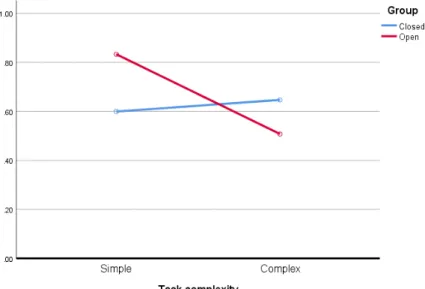
= 5.796, p = .020, ηp2 = .119; and F(1, 43) = 4.374, p = .042, ηp2 = .092, respectively. More importantly, a significant interaction between task complexity and task closure was found on lexical errors, F(1, 43) = 7.872, p = .008, ηp2
= .155. Pairwise comparisons revealed that only participants in the Open group were affected by task complexity, such that they produced significantly fewer lexical errors when carrying out the complex task version (p = .01) (see Figure 4). This is the only finding that is in line with the CH, which predicts a positive relationship between task complexity and learners’ accuracy in their output. On the other hand, the other significant findings run counter to the CH, as it was found that increasing task complexity led to significantly more noun ending and article errors.
Figure 4. Ratio of Errors in Word Choice
Although significant findings regarding task complexity effects were obtained, verbal errors, sentence structure errors, and mechanical errors were not found to be affected by task complexity, F(1, 43) = 3.126, p = .084, ηp2
= .068; F(1, 43) = .102, p = .751, ηp2 = .002; and F(1, 43) = .046, p = .832, ηp2 = .001, respectively. Moreover,
statistical analyses revealed that the main effects of task closure did not elicit significant changes in any of the error categories: F(1, 43) = .279, p = .600, ηp2 = .006 for verbal errors; F(1, 43) = .233, p = .632, ηp2 = .005 for noun ending errors; F(1, 43) = .101, p = .752, ηp2 = .002 for article errors; F(1, 43) = .192, p = .663, ηp2 = .004 for lexical errors; F(1, 43) = 2.036, p = .161, ηp2 = .045 for sentence structure errors; and F(1, 43) = 1.583, p = .215, ηp2 = .036 for mechanical errors. Finally, with the exception of lexical errors, the interaction between task complexity and task closure did not have a significant impact on the other error categories: F(1, 43) = .349, p
= .558, ηp2 = .008 for verbal errors; F(1, 43) = .315, p = .578, ηp2 = .007 for noun ending errors; F(1, 43) = .116, p
= .735, ηp2 = .003 for article errors; F(1, 43) = 1.846, p = .181, ηp2 = .041 for sentence structure errors; and F(1, 43) = .238, p = .628, ηp2 = .005 for mechanical errors.
5. Discussion
With the aim to examine which types of errors are responsible for the effects of task complexity and task closure on learners’ accuracy, if any, the present study compared the written performance of 45 Korean learners of English, who either carried out an open or closed task with two levels of task complexity. Participants’ errors were divided into six categories: 1) verbal errors, 2) noun ending errors, 3) article errors, 4) lexical errors, 5) sentence structure errors, and 6) mechanical errors. Significant findings for task complexity and its interaction with task complexity were obtained.
5.1 Task Complexity Effects on Learners’ Errors
Contrary to the predictions of the CH, participants made significantly more errors regarding noun endings in the complex task. Looking more closely at the raw frequencies of errors produced, it was evident that among the three subcategories of noun ending errors (wrong/omitted/unnecessary plural or genitive endings), the number of unnecessary plural or genitive endings increased drastically in the complex condition. That is, when carrying out the complex task version, participants showed a tendency to add the plural -s or genitive endings to nouns when unwarranted, such as in they don’t provide musics, and In the case of Lighthouse’s.
On a similar note, participants also made significantly more errors in article use in the complex condition.
Upon closer inspection of the data, it was found that participants made more errors across all three subcategories of article errors. In other words, they either used the wrong article/determiner, left out an article/determiner when it was needed, or added an unnecessary article/determiner when carrying out the complex version. Examples of each subcategory are shown in the following: So it can provide the quiet mood (incorrect, as it should have been a quiet mood), The Square is too expensive to have meal without music (omitted; it should have been a meal), and they can spend 50 dollars per each person (unnecessary, as only per person is correct).
Although such findings provide counter-evidence to the CH, they are in line with the predictions of the LACM.
According to this framework, learners can only attend to one aspect of performance, either accuracy or complexity, due to having a single source of attentional resources. Findings of the study also corroborate with those of Lee’s (2020) study, which also revealed that participants’ target-like use of articles significantly decreased with increases in task complexity.
While significant differences between the simple and complex task versions were found for noun ending errors and article errors, the complex task version did not elicit significantly more errors in verbs or sentence structures.
Such significant findings, or lack thereof, can be accounted for by the nature of the tasks. Task complexity was manipulated in terms of the number of elements, and participants had no choice but to include more information in their explanations in order to complete the writing task. In other words, they had to mention the names of more restaurants and discuss a greater number of amenities of the restaurants in the complex condition. For those in the
Closed group, they also had to go over the party hosts’ preferences as well, which doubled in number in the complex condition. As such, participants needed to use more nouns in their writing, therefore inevitably leading to more errors in noun endings and articles in the complex condition if their level of proficiency was not advanced enough for them to avoid making such errors.
One could raise the question as to why the same patterns were not observed for verbal errors, sentence structure errors, and mechanical errors, especially since the data seemed to point toward slight increases in tense/aspect errors, omitted words/phrases, and unnecessary words or phrases, e.g., I don’t know why you guys worried about those places (it should have been worry), And I think the atmosphere is quite important (the atmosphere at the party is correct) and Even though this restaurant has no parking lot but there is public parking lot (should be corrected to Even though this restaurant has no parking lot, there is a public parking lot). However, these increases were not sufficient enough for the differences between the simple and complex condition to be significant. The lack of significant findings can be attributed to the nature of the task and participants’ level of L2 proficiency. The writing task employed in the study required participants to choose the best venue for a certain event. Although not intended by the researcher, this kind of writing task made it difficult for participants to use a variety of tenses/aspects, such as the past and future tenses or the perfect and progressive aspects. In fact, a heavy reliance on the simple present tense could be observed in participants’ writing. On a similar note, there was no need for participants to use various complementation patterns in their writing either. It is also important to note that although the participants were not advanced learners, they were proficient enough to avoid producing fragments, comma splices, and punctuation errors in their writing. In addition, the majority of the capitalization errors that were observed were related to the restaurant names. As a result, significant findings were not obtained regarding these categories of errors.
5.2 Task Closure Effects on Learners’ Errors
Unlike task closure effects, the main effects of task closure were not found to be significant on any outcome measure. However, the combined effects of task complexity and task closure significantly impacted the number of lexical errors per T-unit, such that those in the Open group showed a significant decrease in such errors between the simple and complex conditions. Closer inspection of the data revealed that while the Closed group showed a slight increase in the raw frequencies of errors in word choice and pronouns in the complex condition, the Open group showed an overall decrease in the numbers of all three lexical error subcategories—errors in nonverbal word form, word choice, and pronouns. This is an interesting finding, which is similar to the results of Kuiken and Vedder’s (2007) study, which found that both learners of French and Italian exhibited significantly fewer lexical errors in the complex condition. While Kuiken and Vedder do not provide a possible explanation for their results, the inherent difference between the Closed and Open groups of the present study is highly likely to account for the significant decrease of lexical errors in the case of the Open group.
When the task is cognitively challenging and limited attentional resources (as exhibited by the significant task complexity effects on errors in noun endings and articles) make it difficult for learners to pay attention to accuracy aspects, it would have been easier for participants in the Open group to resort to words that they were more familiar with, since they could write their opinions freely. On the other hand, those in the Closed group were forced to use more words that they may not have been able to use with ease because they needed to cover all of the ways in which a certain restaurant satisfied the party hosts’ needs and preferences, and how the other venues failed to do so. As a result, because their attention was directed toward the contents of their writing in the complex condition, at the expense of accuracy, the Closed group displayed more lexical errors (although not to a significant extent), while the Open group made fewer errors regarding word choice.
6. Conclusion
This paper is an attempt to fill the gap in the literature on the effects of task complexity and task closure on specific types of errors in L2 writing. Instead of using a limited range of accuracy measures, errors were divided into six major categories, and significant findings were obtained regarding the effects of task complexity and its interaction with task closure. Nonetheless, limitations should be noted for further research. In order to increase the generalizability of findings, a greater number of participants should complete at least two tasks of different nature.
Furthermore, the few studies that investigated task closure effects along with task complexity effects manipulated task complexity in terms of the number of elements. It would be interesting to see if significant interaction effects could be found when task complexity is operationalized differently. Moreover, the writing tasks that are usually employed in such research have a strong tendency to elicit a limited range of verb tenses/aspects and complementation patterns. In order to get a better window on the effects of task-related variables, it is vital that researchers pool their ideas so that more diverse writing tasks manipulating task complexity and task closure consistently can be created.
References
Brown, J. D. 1980. Relative merits of four methods for scoring cloze tests. The Modern Language Journal 64(3), 311–317.
Engle, R. W., J. Cantor and J. J. Carullo. 1992. Individual differences in working memory and comprehension: A test of four hypotheses. Journal of Experimental Psychology Learning, Memory, and Cognition 18(5), 972- 992.
Ferris, D. and B. Roberts. 2001. Error feedback in L2 writing classes: How explicit does it need to be? Journal of Second Language Writing 10(3), 161-184.
Ferris, D. R. and J. Hedgcock. 2013. Teaching L2 Composition: Purpose, Process, and Practice. London, UK:
Routledge.
Housen, A. and F. Kuiken. 2009. Complexity, accuracy, and fluency in second language acquisition. Applied linguistics 30(4), 461-473.
Hunt, K. 1964. Differences in Grammatical Structures Written at Three Grade Levels (Cooperative Research Project No. 1998). Florida State University.
Ishikawa, T. 2007. The effect of manipulating task complexity along the (+Here-and-Now) dimension on L2 written narrative discourse. In M. d. P. G. Mayo, ed., Investigating Tasks in Formal Language Learning, 136-156. Tonawanda, NY: Multilingual Matters.
Johnson, M. D. 2017. Cognitive task complexity and L2 written syntactic complexity, accuracy, lexical complexity, and fluency: A research synthesis and meta-analysis. Journal of Second Language Writing 37, 13-38.
Kuiken, F., M. Mos and I. Vedder. 2005. Cognitive task complexity and second language writing performance. Eurosla Yearbook 5(1), 195-222.
Kuiken, F. and I. Vedder. 2008. Cognitive task complexity and written output in Italian and French as a foreign language. Journal of second language writing 17(1), 48-60.
Lee, J. 2019. Task complexity, cognitive load, and L1 speech. Applied linguistics 40(3), 506-539.
Lee, J. 2020. Task closure and task complexity effects on L2 written performance. Journal of Second Language Writing 50.
Loschky, L. and R. Bley-Vroman. 1993. Grammar and task-based methodology. In G. Crookes and S. Gass, eds., Tasks and Language Learning, 123-167. Clevedon, Avon: Multilingual Matters.
Long, M. H. 1985. A role for instruction in second language acquisition: task-based language teaching. In K.
Hyltenstam and M. Pienemann, eds., Modelling and Assessing Second Language Acquisition, ???-???.
Multilingual Matters Ltd.
Long, M. H. 1989. Task, group, and task-group interactions. University of Hawai'i Working Papers in ESL 8(2), 1-26. (Reprinted in S. Anivan, ed., Language Teaching Methodology for the Nineties, 31-50, 1990, Singapore: SEAMEO.)
Malone, J. 2018. Incidental vocabulary learning in SLA: Effects of frequency, aural enhancement, and working memory. Studies in Second Language Acquisition 40(3), 651-675.
Meara, P. 2005. LLAMA language aptitude tests: The manual. Lognostics.
Montero, F. 2018. Effects of task complexity and task closure on the speech of L2 learners of Spanish. Ms.
University of Maryland, MD, USA.
Norris, J. M. and L. Ortega. 2009. Towards an organic approach to investigating CAF in instructed SLA: The case of complexity. Applied linguistics 30(4), 555-578.
Pallotti, G. 2009. CAF: Defining, refining and differentiating constructs. Applied linguistics 30(4), 590-601.
Révész, A., M. Michel and R. Gilabert. 2015. Measuring cognitive task demands using dual task methodology, subjective self-ratings, and expert judgments: A validation study. Studies in Second Language Acquisition 28(4), 1-35.
Robinson, P. 2001. Task complexity, cognitive resources, and syllabus design: A triadic framework for examining task influences on SLA. In P. Robinson, ed., Cognition and Second Language Instruction, 287-318. New York, NY: Cambridge University Press.
Robinson, P. 2005. Cognitive complexity and task sequencing: Studies in a componential framework for second language task design. International Review of Applied Linguistics in Language Teaching 43(1), 1-32.
Robinson, P. 2011. Second language task complexity, the cognition hypothesis, language learning, and performance. In P. Robinson, ed., Second Language Task Complexity: Researching the Cognition Hypothesis of Language Learning and Performance, 3-37. Philadelphia, PA: John Benjamins Publishing Company.
Sasayama, S. 2016. Is a ‘complex’ task really complex? Validating the assumption of cognitive task complexity.
The Modern Language Journal 100(1), 231-254.
Sasayama, S., A. Malicka and J. Norris. 2015. Primary challenges in cognitive task complexity research: Results of a comprehensive research synthesis. In 6th Biennial international Conference on Task-Based Language Teaching (TBLT), Leuven, Belgium.
Skehan, P. 1996. A framework for the implementation of task-based instruction. Applied Linguistics 17(1), 38-62.
Skehan, P. 1998. A Cognitive Approach to Language Learning. Oxford University Press.
Examples in: English
Applicable Languages: English Applicable Level: Tertiary