766 Copyright © 2013 The Korean Society of Cardiology Korean Circulation Journal
Introduction
Atrial fibrillation is a common arrhythmia in the general popula- tion, and a major risk factor for stroke.
1)2) It has been reported that atrial fibrillation is associated with a five-fold increased risk of st- roke.
2) Atrial fibrillation can cause coronary embolism; however, this is a very rare condition.
3) Therefore, simultaneously presented ce- rebral and coronary embolism due to atrial fibrillation has been sc- arcely reported. Herein, we describe a patient with paroxysmal at- rial fibrillation who suffered acute ischemic stroke and concurrent
Case Report
http://dx.doi.org/10.4070/kcj.2013.43.11.766
Print ISSN 1738-5520 • On-line ISSN 1738-5555
Simultaneously Presented Acute Ischemic Stroke and Non-ST Elevation Myocardial Infarction in a Patient with Paroxysmal Atrial Fibrillation
Hack-Lyoung Kim, MD, Jae-Bin Seo, MD, Woo-Young Chung, MD, Joo-Hee Zo, MD, Myung-A Kim, MD, and Sang-Hyun Kim, MD
Cardiovascular Center, Seoul National University Boramae Medical Center, Seoul, Korea
Although atrial fibrillation is the most frequent cause of embolic stroke, coronary embolism from atrial fibrillation is a very rare cause of acute myocardial infarction. Therefore, simultaneously presented acute ischemic stroke and acute myocardial infarction due to atrial fi- brillation in the same patient has not been documented. The present report describes the case of a 58-year-old man with paroxysmal atrial fibrillation who initially presented with a large cerebral infarction due to embolic occlusion of the left middle cerebral artery. Four hours after the diagnosis of cerebral embolism, he was subsequently diagnosed with acute myocardial infarction due to concurrent coronary embolism. He underwent successful coronary revascularization with a drug-eluting stent. The possibility of combined coronary embolism as a rare etiology should be kept in mind when a patient with acute embolic stroke presents, especially when there is evidence of acute myocardial infarction. (Korean Circ J 2013;43:766-769)
KEY WORDS: Atrial fibrillation; Cerebral infarct; Embolism; Myocardial infarction; Percutaneous transluminal coronary angioplasty.
Received: March 12, 2013 Revision Received: May 30, 2013 Accepted: June 14, 2013
Correspondence: Sang-Hyun Kim, MD, Department of Internal Medicine, Seoul National University College of Medicine, Seoul National University Boramae Medical Center, 20 Boramae-ro 5-gil, Dongjak-gu, Seoul 156-707, Korea
Tel: 82-2-870-3864, Fax: 82-2-870-3866 E-mail: [email protected]
• The authors have no financial conflicts of interest.
This is an Open Access article distributed under the terms of the Creative Commons Attribution Non-Commercial License (http://creativecommons.
org/licenses/by-nc/3.0) which permits unrestricted non-commercial use, distribution, and reproduction in any medium, provided the original work is properly cited.
acute myocardial infarction.
Case
A 58-year-old man was admitted to our emergency department
because of altered mental state. He had lived alone and his neigh-
bor discovered him lying in his room unconscious. Therefore, the
precise time of the event was unclear. He had no previous history
of medical illness. His initial blood pressure was 114/57 mm Hg, he-
art rate 110 per minute, respiratory rate 24 breaths per minute and
body temperature was 35.8°C. On neurologic examination, he sh-
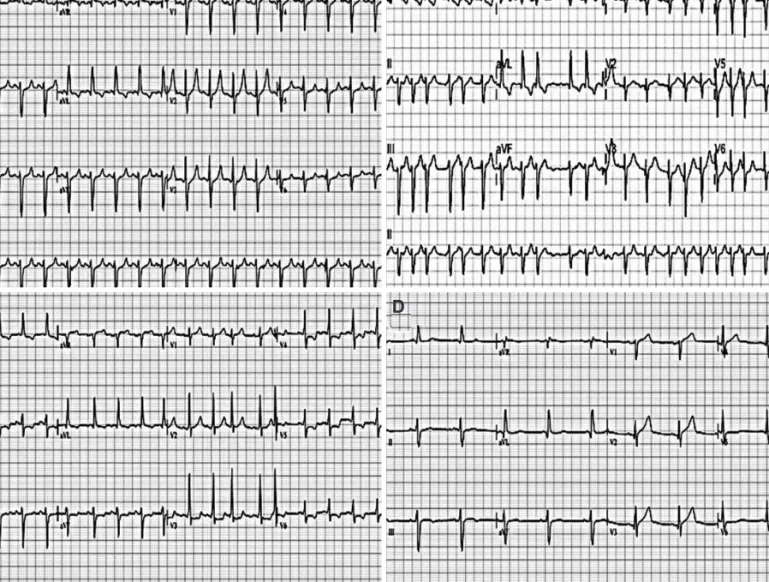
owed global aphasia and right sided weakness. His initial electro-
cardiogram showed sinus tachycardia (Fig. 1A). However, serial el-
ectrocardiograms demonstrated paroxysmal atrial fibrillation with
intermittent rapid ventricular response (Fig. 1B). His initial creatine
kinase-MB (CK-MB) was mildly elevated at 14.6 ng/mL (upper nor-
mal limit: 3.6 ng/mL) and troponin I was within the normal range at
0.11 ng/mL (upper normal limit: 0.5 ng/mL). Brain magnetic reson-
ance imaging and angiography showed a large infarction in the
left basal ganglia area due to total occlusion of the left middle cere-
bral artery (Fig. 2). Three-hundred mg of aspirin was loaded. Be-
cause of lack of information about the stroke onset time and the
possibility of hemorrhagic conversion, thrombolysis and anticoag-