https://doi.org/10.5468/ogs.2017.60.5.485 pISSN 2287-8572 · eISSN 2287-8580
Introduction
There are more than 100 drugs that have been implicated in causing acute pancreatitis [1]. Estrogen is a rare cause of drug-induced acute pancreatitis and only about 40 cases of acute pancreatitis have been reported due to use of estrogen worldwide [1].
Estrogen-containing oral contraceptive is considered a safe method of birth control. Estrogen is also commonly used for postmenopausal hormone replacement therapy (HRT) and en- dometrial development in preparation for embryo transfer (ET).
Although estrogen is used safely in most of the cases, it is one of the causative agents of drug-induced acute pancreatitis. Al- though more than 40 cases of pancreatitis due to HRT or oral contraceptive use have been reported worldwide, there has been no case report of estrogen-induced acute pancreatitis in Korea. In this report, we describe a case of estrogen-induced acute pancreatitis that occurred when estrogen was used for the preparation of ET.
Case report
A 40-year-old woman presented to the emergency depart-
ment with severe epigastric pain and nausea. She had been trying to get pregnant with assisted reproductive technology for 2 years due to unexplained infertility. Previously, she re- ceived 2 cycles of intrauterine insemination and 6 cycles of in vitro fertilization-embryo transfer (IVF-ET), which all failed. She underwent cryo-thawed ET a week ago, and she had been on estradiol valerate (Progynova
®; Bayer-Shering Pharma, Berlin, Germany) 2 mg per os every 8 hours for 24 days, vaginal pro- gesterone 90 mg (Crinone
®gel 8%; Merck Serono SA, Gene- va, Switzerland) every 12 hours for 10 days, and enoxaparin sodium (Clexane
®; Sanofi-Aventis, Paris, France) 40 mg sub-
Estrogen-induced acute pancreatitis: A case report and literature review
Dajeong Seo
1, Hyojin Suh
1, Jun Kyu Lee
2, Dong Kee Jang
2, Ha Yan Kwon
1, Chae Hyeong Lee
1, Sang Ho Yoon
1, Ju-Won Roh
1, Hyun Soo Park
11Department of Obstetrics and Gynecology, 2Division of Gastroenterology & Hepatology, Department of Internal Medicine, Dongguk University Ilsan Hospital, Goyang, Korea
Estrogens are commonly used in gynecologic area, such as oral contraception, hormone replacement therapy, and in vitro fertilization-embryo transfer. Although estrogen is a common cause of acute drug-induced pancreatitis, there has been paucity of report in Korea. Clinical course of estrogen-induced acute pancreatitis is usually mild to moderate, but fetal case can occur. In addition, there can be a latency from the first administration to the symptom. Therefore, physicians should consider the possibility of the disease when a woman taking estrogen or previous history of taking estrogen presents with acute abdominal pain. Here, we report a case of estrogen-induced acute pancreatitis that occurred during the preparation for embryo transfer.
Keywords: Acute pancreatitis; Drug-induced acute pancreatitis; Estrogen
Articles published in Obstet Gynecol Sci are open-access, distributed under the terms of the Creative Commons Attribution Non-Commercial License (http://creativecommons.
org/licenses/by-nc/3.0/) which permits unrestricted non-commercial use, distribution, and reproduction in any medium, provided the original work is properly cited.
Copyright © 2017 Korean Society of Obstetrics and Gynecology Received: 2017.3.23. Revised: 2017.7.6. Accepted: 2017.7.13.
Corresponding author: Hyun Soo Park
Department of Obstetrics and Gynecology, Dongguk University Ilsan Hospital, 27 Dongguk-ro, Ilsandong-gu, Goyang-si, Gyeonggi-do 10326, Korea
Tel: +82-31-961-7367 Fax: +82-31-961-7155 E-mail: [email protected]
http://orcid.org/0000-0002-7873-3234
cutaneous injection once a day for 7 days before presenting.
She had taken estrogens in previous IVF-ET cycles, but denied any severe abdominal pain like this time. She had 3-year his- tory of diabetes mellitus, which was under control with insulin injection. Hemoglobin A1c concentration was 6.8% and the serum cholesterol levels were within normal range on blood test which was performed 1 month before the symptom. She denied smoking and drinking and she did not have familial hypercholesterolemia.
On physical examination, her blood pressure was 145/87 mmHg, pulse rate was 65/min and body temperature was 37.5
oC. Abdominal examination revealed that the abdomen was distended with whole abdomen tenderness and bowel sound was hypoactive. Her weight and height were 77.25 kg/156.2 cm, and body mass index was 29.91 kg/m
2.
Blood tests revealed elevated levels of amylase (416 U/L), lipase (790 U/L), white blood cell count (12.24×10
3/uL), lac- tate dehydrogenase (442 IU/L), total cholesterol (723 mg/dL), triglycerides (4,051 mg/dL) and C-reactive protein (5.54 ng/mL).
Serum blood urea nitrogen, creatinine, alkaline phosphatase, alanine aminotransferase, and bilirubin level were within reference range.
An abdominal computed tomographic (CT) scan was per- formed showing mild swelling of pancreas head with peri- pancreatic infiltration, the presence of peripancreatic fluid and fluid in the upper mesentery which was categorized into grade D of Balthazar CT grade (Fig. 1A).
The patient was managed with supportive therapy includ- ing intravenous hydration, antibiotics, and analgesics. As her abdominal pain still remained and fever sustained at fourth hospital day, follow-up abdominal CT scan was performed
and the result revealed increased peripancreatic fluid collec- tion (Fig. 1B). We changed antibiotics from third generation cephalosporin to ertapenem and clinical condition improved.
She was discharged on the 10
thhospital day. Follow-up CT scan performed 2 months after discharge showed much de- creased peripancreatic fluid collection (Fig. 1C). Fortunately, she became pregnant naturally after the treatment of pan- creatitis and has been maintaining her pregnancy for about 36 weeks without complication.
Discussion
Acute pancreatitis has been described in subjects using oral contraceptives, IVF-patients without using estrogen, and there is a report of increase risk of acute pancreatitis in postmeno- pausal women using hormone therapy [2-4]. Here we report a case of estrogen-induced acute pancreatitis in which estrogen was administered for the cryo-thaw ET.
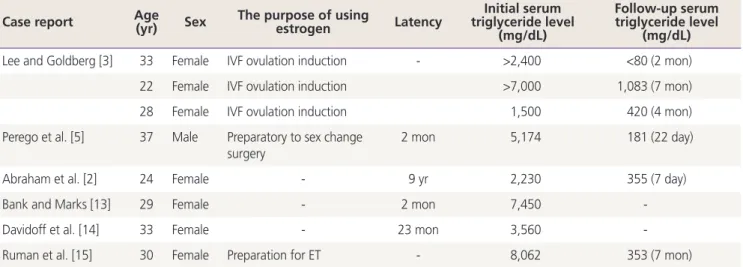
The unique feature of this case is that the symptom did not develop until the last cycle of estrogen administration. There is a report describing the latency between initiating the drug and the onset of acute pancreatitis [1]. In this article which analyzed case reports, estrogens were classified as a category in which a consistent latency has been reported in more than 75% of cases. The latency of estrogen ranged from 2 months to 2 years (Table 1). In addition, there was a recent case report of hypertriglyceridemic pancreatitis caused by oral contraceptive agent. In this case, the patient had been taking the oral pill for 9 years without any adverse effect [2]. Based on the above evidence, it is possible that estrogen-induced
Fig. 1. (A) Mild swelling of pancreas head (arrow) with peripancreatic infiltration, the presence of peripancreatic fluid (arrow head) and fluid in the upper mesentery (admission day). (B) Increased of peripancreatic fluid collection (arrow head) (4th hospital day). (C) Decreased peripancre- atic fluid collection (2 months after discharge).A B C
pancreatitis can develop in women who had taken estrogen without any problem.
Although the exact mechanism of estrogen-induced acute pancreatitis is still unclear, estrogen-induced acute pancre- atitis is thought to be caused by hypertriglyceridemia. Most of the reported cases show elevated serum triglyceride level of up to 1,000 mg (Table 1). Hypertriglyceridemic pancre- atitis is reported to be responsible for 1.3–3.8% of patients with acute pancreatitis [5]. Hyperlipidemia is divided into primary hyperlipidemia and secondary hyperlipidemia. Es- trogen-induced hyperlipidemia is secondary hyperlipidemia.
Other causes of secondary hyperlipidemia include diabetes, alcohol, and pregnancy. The triglycerides transported by chylomicron and very low density lipoprotein are hydrolyzed by the high concentration of lipase in the capillaries of the pancreas and form a large amount of toxic free fatty acids, which causes lipotoxicity during acute pancreatitis. [6,7] The risk factors for estrogen-induced acute pancreatitis include genetic abnormality of lipid metabolism, insulin resistance, obesity, alcohol use, and pregnancy. Infants, elderly, and women patients with advanced acquired immune deficiency syndrome, and patients with inflammatory bowel disease are also considered as high risk groups that are susceptible to drug-induced pancreatitis [7,8]. Although the patient did not have a history of hypercholesterolemia, she was 40 years old which can be identified as a risk factor for the drug- induced acute pancreatitis.
As most of the estrogen-induced pancreatitis are case- reports, it is hard to assess the magnitude of the risk. The
fact that pancreatitis can be caused in woman who had no problem taking the oral contraceptives for long time before the development of disease [2] also adds to the difficulty in assessing the risk. Although the amount of estrogen used in case-reports in the 1970’s was relatively high (0.1 mg of ethinyl estradiol), lower dose of estrogen was associated with acute pancreatitis recently [2]. There is a prospective cohort study addressing the risk of acute pancreatitis in postmenopausal women with HRT. In the report, adjusted risk ratio was 1.92 (1.38–2.66), and the risk increases as the duration of hormone use increases [4]. However, locally ad- ministered therapy did not increase the risk of acute pancre- atitis, which can be expected from the fact that transdermal hormone therapy does not change plasma lipoproteins very much [4,9]. Overall, systemic estrogen administration seems to increase the risk of acute pancreatitis. However, we do not know the magnitude of the risk increase when one or risk factors are present.
In this case, the patient was taking estrogen for ET, and the blood test confirmed a high concentration of triglycer- ide as in other previously reported estrogen-induced acute pancreatitis cases. Although the patient had diabetes which could be the cause of secondary hyperlipidemia, her diabe- tes was under control with insulin. Gallstone or structural abnormality which are major causes of pancreatitis were not visualized in CT scan and no history of alcohol abuse was found. In addition, her symptom improved after stopping taking estrogens. All the evidence above supports the diag- nosis of estrogen-induced acute pancreatitis.
Table 1. Summary of estrogen-induced acute pancreatitis cases with IVF, and with latency Case report Age
(yr) Sex The purpose of using
estrogen Latency Initial serum triglyceride level
(mg/dL)
Follow-up serum triglyceride level
(mg/dL)
Lee and Goldberg [3] 33 Female IVF ovulation induction - >2,400 <80 (2 mon)
22 Female IVF ovulation induction >7,000 1,083 (7 mon)
28 Female IVF ovulation induction 1,500 420 (4 mon)
Perego et al. [5] 37 Male Preparatory to sex change
surgery 2 mon 5,174 181 (22 day)
Abraham et al. [2] 24 Female - 9 yr 2,230 355 (7 day)
Bank and Marks [13] 29 Female - 2 mon 7,450 -
Davidoff et al. [14] 33 Female - 23 mon 3,560 -
Ruman et al. [15] 30 Female Preparation for ET - 8,062 353 (7 mon)
IVF, in vitro fertilization; ET, embryo transfer.