ADAMTS13 Gene Mutations in Children with Hemolytic Uremic Syndrome
Hyoung Soo Choi,
1,2Hae Il Cheong,
3Nam Keun Kim,
4Doyeun Oh,
4,5and Hye Won Park
11Department of Pediatrics and 2Health Promotion Center, Seoul National University Bundang Hospital, Seongnam;
3Department of Pediatrics, Seoul National University Children’s Hospital, Seoul;
4Institute for Clinical Research and 5Department of Internal Medicine, School of Medicine, CHA University, Seongnam, Korea.
Received: June 23, 2009 Revised: November 18, 2009 Accepted: November 26, 2009
Co-corresponding authors: Dr. Doyeun Oh, Department of Internal Medicine, School of Medicine, CHA University, 351 Yatap-dong, Bundang-gu, Seongnam 463-712, Korea.
Tel: 82-31-780-5217, Fax: 82-31-780-5208 E-mail: [email protected] and
Dr. Hye Won Park,
Department of Pediatrics, Seoul National University Bundang Hospital,
166 Gumi-ro, Bundang-gu, Seongnam 463-707, Korea.
Tel: 82-31-787-7289, Fax: 82-31-787-4054 E-mail: [email protected]
∙ The authors have no financial conflicts of interest.
© Copyright:
Yonsei University College of Medicine 2011 This is an Open Access article distributed under the terms of the Creative Commons Attribution Non- Commercial License (http://creativecommons.org/
licenses/by-nc/3.0) which permits unrestricted non- commercial use, distribution, and reproduction in any medium, provided the original work is properly cited.
We investigated ADAMTS13 activity as well as the ADAMTS13 gene mutation in children with hemolytic uremic syndrome (HUS). Eighteen patients, including 6 di- arrhea-negative (D-HUS) and 12 diarrhea-associated HUS (D+HUS) patients, were evaluated. The extent of von Willebrand factor (VWF) degradation was assayed by multimer analysis, and all exons of the ADAMTS13 gene were PCR-amplified us- ing Taq DNA polymerase. The median and range for plasma activity of AD- AMTS13 in 6 D-HUS and 12 D+HUS patients were 71.8% (22.8-94.1%) and 84.9% (37.9-119.9%), respectively, which were not statistically significantly differ- ent from the control group (86.4%, 34.2-112.3%) (p>0.05). Five ADAMTS13 gene mutations, including 2 novel mutations [1584+2T>A, 3941C>T (S1314L)] and 3 polymorphisms (Q448E, P475S, S903L), were found in 2 D-HUS and one D+HUS patients, which were not associated with deficiency of ADAMTS13 activity. Wheth- er these mutations without reduced ADAMTS13 activity are innocent bystanders or predisposing factors in HUS remains unanswered.
Key Words: ADAMTS13, mutation, hemolytic uremic syndrome, children
Hemolytic uremic syndrome (HUS) and thrombotic thrombocytopenic purpura (TTP) are classified as thrombotic microangiopathy (TMA), which is character- ized by occlusive microvascular thrombosis and by following thrombocytopenia, microangiopathic hemolytic anemia, and organ ischemia.1,2 Acute renal failure is prominent in HUS while neurological impairment and variable degrees of renal abnormalities are found in TTP.1,2 The clinical distinction between HUS and TTP is sometimes unclear because neurologic symptoms can be found in HUS and sig- nificant renal insufficiency can develop in TTP.1,2
Deficiency in the von Willebrand factor (VWF)-cleaving protease, also known as ADAMTS13 (a disintegrin and metalloprotease, with thrombospondin 1-like do- mains motif 13), is causatively related in 70-80% of TTP,3,4 either by compound heterozygous or homozygous mutations in the ADAMTS13 gene in congenital TTP5,6 or circulating inhibitory antibodies in the acquired form.4
However, the focus of research in HUS has been on the mechanisms of injury to
the remaining protease activity in the mixture of patient’s plasma and normal pooled plasma at different dilution. Detec- tion of inhibitory activity was carried out by using a screening test, by 1 : 1 mixing pools of normal plasma and patient plas- ma with reduced ADAMTS13 activity (less than 44%) and by incubating for 30 minutes at 37°C. Thereafter, the mixture was diluted to 1 : 10 in Tris/urea, pH 8.0, and processed fur- ther to test ADAMTS13 activity remaining.11
Human genomic DNA was isolated from whole blood.
All exons of the ADAMTS13 gene, including the intron-ex- on boundaries, were PCR-amplified with the primers used by Kokame, et al.6 and Taq DNA polymerase. Products were sequenced in both directions by using a 3700 DNA Analyzer (Applied Biosystems, Foster City, CA, USA).
Statistics were performed using SAS software (version 8.2) and Chi-square test. p value less than 0.05 was consid- ered statistically significant.
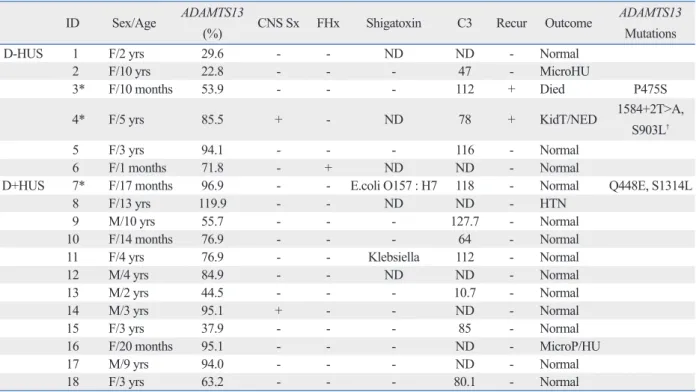
In 18 patients tested, 6 were D-HUS, and 12 D+HUS (Table 1). The median and range for plasma activity of AD- AMTS13 in 6 D-HUS and 12 D+HUS patients were 71.8%
(22.8-94.1%) and 84.9% (37.9-119.9%), respectively, which were not statistically significantly different from the control group (86.4%, 34.2-112.3%) (p>0.05). No inhibitory activi- ty was detected in patients with ADAMTS13 activity less than 44%.
Five ADAMTS13 gene mutations consisting of 2 novel mutations [1584+2T>A, 3941C>T (S1314L)] and 3 poly- morphisms [Q448E, P475S, 2710C>T (S903L)] were found in 3 HUS (2 D-HUS and one D+HUS) patients (Fig. 1). All parents of these 3 HUS patients with ADAMTS13 gene mu- tations are clinically unaffected. Two novel mutations, 1584 +2T>A, and S1314L, were excluded as common polymor- phisms by screening 100 Koreans.
More than 60 mutations of the ADAMTS13 gene have been found in patients with congenital TTP (The Human Gene Mutation Database at the Institute of Medical Genet- ics in Cadiff, http://www.hgmd.ac.uk/ac/index.php). How- ever, analysis of ADAMTS13 gene mutations has generally been restricted to patients already carrying a clear diagnosis of congenital TTP, potentially presenting an ascertainment bias against the identification of mild mutations.12
While severe deficiency of ADAMTS13 (<10%) estab- lishes a diagnosis of TTP unequivocally,13 not all patients diagnosed with TTP have severe protease deficiency. In ad- dition, ADAMTS13 deficiency alone may not be sufficient to initiate an episode of clinical TTP.14 Patients in clinical remission can still demonstrate ultralarge VWF multimers the renal endothelium rather than the regulation of VWF.2
In diarrhea-associated HUS (D+HUS), the bacterial agent Shigatoxin from Escherichia coli and Shigella dysenteriae induces the thrombotic state via direct toxic effects, result- ing more in renal injury and clinical HUS.7 In diarrhea-neg- ative (D-HUS) or atypical HUS, more than 50% of patients have genetic abnormalities in complement regulatory genes, including complement factor H (CFH), factor I (CFI), membrane cofactor protein (MCP), and factor B (CFB) and C3.8,9 Acquired cases of D-HUS associated with CFH dysfunction due to anti-CFH autoantibodies have also been identified.8
Considering the overlapping clinical manifestation of HUS and TTP, we hypothesized that ADAMTS13 would be an important factor in HUS, and therefore, investigated ADAMTS13 activity as well as ADAMTS13 gene mutation in children with HUS.
The samples of 18 patients with HUS were sent to CHA Bundang Medical Center to test for ADAMTS13 activity and ADAMTS13 gene mutation from April 2004 to August 2005. The diagnosis was based on the presence or absence of diarrhea, renal dysfunction, microangiopathic hemolytic anemia and thrombocytopenia. Eighteen normal controls were recruited from those who visited the Department of Pediatrics of CHA Bundang Medical Center in the same period. In cases of decreased ADAMTS13 activity (less than 44%), the presence of autoantibody in the patient’s serum and the ADAMTS13 activity of the parents were tested. The plasma samples were collected from patients and controls with the informed consent, according to the guidelines of the Declaration of Helsinki. The study protocol was ap- proved by the institutional review board of the CHA Bun- dang Medical Center.
The assay of ADAMTS13 activity was performed as de- scribed previously by Furlan, et al.3 Briefly, diluted citrated plasma was activated by barium chloride. This activated plasma was added to protease-free VWF (Green Cross, Yon- gin, Korea). The reaction was stopped by addition of EDTA.
The extent of VWF degradation was assayed by multimer analysis using SDS-electrophoresis in 1.4% agarose gels.
Following electrophoresis, the proteins were eletrotransferred to nitrocellulose, and VWF was visualized with horseradish peroxidase-conjugated goat anti-rabbit IgG against human VWF (A0082, Dako, Glostrup, Denmark). The activity was calibrated as previously described10 with 1 : 20 to 1 : 960 dilution of normal human plasma pool.
Inhibition of the ADAMTS13 was assayed by measuring
leukemia, pregnancy, the postoperative state, the neonatal period, and with advancing age16 other than congenital TTP.
As for HUS, ADAMTS13 activity is normal or only slightly decreased in typical colitis-associated D+HUS, and severe- ly deficient in a few D-HUS.17
In this study, ADAMTS13 activities were not decreased in 18 HUS patients, which is consistent with previous re- ports.18 Although the ADAMTS13 activities were normal, we found mutations and polymorphisms of ADAMTS13 gene in 2 D-HUS and one D+HUS patients. We cannot ex- plain the genotype-phenotype dissociation in our 3 HUS patients with ADAMTS13 gene mutations. Heterozygous mutation, distal location, or interaction with polymorphisms might be possible explanations.
One D-HUS (patient 3) patient had heterozygous P475S in the plasma and absence of ADAMTS13 activity in vitro.3
This heterogeneity suggests the presence of genetic modi- fying factors or environmental triggers other than AD- AMTS13 in TTP.1
Complement factor H mutation, known as a causative factor in D-HUS, and Shigatoxin, inducing the thrombotic state in D+HUS, were reported to be risk factors in TTP.9,15 In addition to the overlapping clinical features between TTP and HUS, these findings suggest possible role of AD- AMTS13 in HUS.
Decreased ADAMTS13 activity, usually mild to moderate (10 to 40% of normal plasma), has been reported in a wide variety of conditions, including liver cirrhosis, chronic ure- mia, idiopathic thrombocytopenic purpura, disseminated intravascular coagulation, systemic lupus erythematosus, Table 1. Patients Characteristics
ID Sex/Age ADAMTS13
(%) CNS Sx FHx Shigatoxin C3 Recur Outcome ADAMTS13
Mutations
D-HUS 1 F/2 yrs 29.6 - - ND ND - Normal
2 F/10 yrs 22.8 - - - 47 - MicroHU
3* F/10 months 53.9 - - - 112 + Died P475S
4* F/5 yrs 85.5 + - ND 78 + KidT/NED 1584+2T>A,
S903L†
5 F/3 yrs 94.1 - - - 116 - Normal
6 F/1 months 71.8 - + ND ND - Normal
D+HUS 7* F/17 months 96.9 - - E.coli O157 : H7 118 - Normal Q448E, S1314L
8 F/13 yrs 119.9 - - ND ND - HTN
9 M/10 yrs 55.7 - - - 127.7 - Normal
10 F/14 months 76.9 - - - 64 - Normal
11 F/4 yrs 76.9 - - Klebsiella 112 - Normal
12 M/4 yrs 84.9 - - ND ND - Normal
13 M/2 yrs 44.5 - - - 10.7 - Normal
14 M/3 yrs 95.1 + - - ND - Normal
15 F/3 yrs 37.9 - - - 85 - Normal
16 F/20 months 95.1 - - - ND - MicroP/HU
17 M/9 yrs 94.0 - - - ND - Normal
18 F/3 yrs 63.2 - - - 80.1 - Normal
C3 normal range 77-195 mg/dL.
FHx, family history; ND, not done; MicroHU, microscopic hematuria; KidT, kidney transplantation; HTN, hypertension; MicroP/HU, microscopic proteinuria and microscopic hematuria.
*Patients with ADAMTS13 gene mutations and/or polymorphisms.
†Homozygote.
Fig. 1. ADAMTS13 gene structure and mutation sites in 3 HUS patients. *Three polymorphisms are indicated by italics. HUS, hemolytic uremic syndrome; S, sig- nal peptide; P, propeptide; MP, metalloprotease domain; D, disintegrin-like domain; T, TSP1 motif; Cys, cysteine-rich domain; Sp, spacer domain; C, CUB domain.
1584+2T>A S1314L
*Q448E *P475S *S903L
S P MP D T Cy Sp T T T T T T T C C
HUS in Korean population. Whether these mutations with- out reduced ADAMTS13 activity are innocent bystanders or predisposing factors in HUS remains unanswered. In TTP, relapse is common among patients with ADAMTS13 defi- ciency, but rarely occurs in patients without ADAMTS13 de- ficiency.25 In 6 D-HUS patients in this study, only the pa- tient 3 and 4 underwent recurrent attack of HUS, suggest- ing the possibility that ADAMTS13 gene mutations may act as a disease modifying or predisposing factor through an unexplained mechanism.
In the future, expression tests are needed to identify the consequences of each ADAMTS13 gene mutations and poly- morphisms found in our HUS patients. Abnormalities in complement system and other genetic or environmental factors, involving TMA, should be investigated. In addition, VWF assay and mutation analysis would be a next assign- ment in our patients. Long-term follow-up of these HUS pa- tients with ADAMTS13 gene mutations might also provide an invaluable clue.
ACKNOWLEDGEMENTS
This study was supported by a grant (A080588) from the Korean Healthcare Technology R&D Project, Ministry of Health, Welfare and Family Affairs, Republic of Korea. The authors thank Dr. Saewon Choi for his assistance in the preparation of this manuscript. We also thank all the physi- cians from the participating centers for providing clinical and biological data and plasma samples. The list of partici- pating centers are as follows; Asan Medical Center, Cheon- gju St. Mary’s Hospital, Chonnam National University Hos- pital, Eulji General Hospital, Hallym University Sacred Heart Hospital, Inha University Hospital, Inje University Pusan Paik Hospital, Inje University Sanggye Paik Hospital, Kangdong Sacred Heart Hospital, Pusan National Universi- ty Hospital, Bundang Medical Center, CHA University Hos- pital, Seoul National University Hospital, Yonsei University Severance Hospital, and Yonsei University Wonju College of Medical Hospital.
REFERENCES
1. Tsai HM. The molecular biology of thrombotic microangiopathy.
Kidney Int 2006;70:16-23.
2. Desch K, Motto D. Is there a shared pathophysiology for throm- botic thrombocytopenic purpura and hemolytic-uremic syndrome?
polymorphism and moderate activity (53.9%) of ADAMTS13 protease. P475S, a well known polymorphism located in the cysteine-rich domain,6,19 was recombinantly analyzed and was found to be associated with a decline in the proteo- lytic activity of ADAMTS13 (5-10% of wild type) despite normal secretion.20 In Japan, the allele frequency of P475S is about 5%, suggesting that approximately 10% of popula- tion are heterozygotes and may possess significantly re- duced ADAMTS13 activity.19
The other D-HUS (patient 4) patient had a novel splicing mutation 1584+2T>A in intron 13 (cysteine-rich domain).
Also, this patient showed a homozygous S903L mutation in exon 21 (Tsp1-5 domain). Liu, et al.21 reported a highly sus- pected congenital TTP patient with significantly reduced ADAMTS13 activity and compound heterozygote mutation of S903L and R1095W in the ADAMTS13 gene. Later, S903L was identified as a common polymorphism in Japa- nese with an allele frequency of 5.5% (7/64).22 Polymor- phisms influence the phenotypic expression of complex dis- ease.17 Dependent on the sequence context, the same polymorphisms might be either positive or negative modifi- ers of gene expression.20 It is unclear whether polymor- phism S903L is a positive modifier of ADAMTS13 expres- sion in the context of 1584+2T>A splicing. The interaction between this splicing mutation and S903L polymorphism might explain normal ADAMTS13 activity in this patient.
One D+HUS (patient 7) patient had a novel heterozygous mutation of S1314L on exon 28 CUB2 domain and also het- erozygous Q448E. It seems that the location S1314L muta- tion is too distal to have a detrimental effect on the AD- AMTS13 function. However, the cooperative activity between the middle carboxyl-terminal TSP1 repeats and the distal carboxyl-terminal CUB domains is crucial for recogni- tion and cleavage of VWF under flow,23 and more than 10%
of ADAMTS13 gene mutations associated with congenital TTP are located in the CUB domains.24 As for Q448E, it is a positive modifier of ADAMTS13 secretion in the context of P618A and A732V, and a negative modifier enhancing the detrimental effect of the missense mutation in the context of R1336W.20 Expression tests would be necessary to elucidate the interaction between S1314L and Q448E.
Limitation of this study is the lack of information on complement system except serum C3 levels. In D-HUS, 4 patients tested C3 levels had normal values. One D+HUS patient had low C3 level with unknown significance.
To our best knowledge, this is the first report about AD- AMTS13 gene mutations and polymorphisms in childhood
15. Motto DG, Chauhan AK, Zhu G, Homeister J, Lamb CB, Desch KC, et al. Shigatoxin triggers thrombotic thrombocytopenic pur- pura in genetically susceptible ADAMTS13-deficient mice. J Clin Invest 2005;115:2752-61.
16. Mannucci PM, Canciani MT, Forza I, Lussana F, Lattuada A, Rossi E. Changes in health and disease of the metalloprotease that cleaves von Willebrand factor. Blood 2001;98:2730-5.
17. Loof AH, van Vliet HH, Kappers-Klunne MC. Low activity of von Willebrand factor-cleaving protease is not restricted to pa- tients suffering from thrombotic thrombocytopenic purpura. Br J Haematol 2001;112:1087-8.
18. Vesely SK, George JN, Lämmle B, Studt JD, Alberio L, El-Ha- rake MA, et al. ADAMTS13 activity in thrombotic thrombocyto- penic purpura-hemolytic uremic syndrome: relation to presenting features and clinical outcomes in a prospective cohort of 142 pa- tients. Blood 2003;102:60-8.
19. Kokame K, Miyata T. Genetic defects leading to hereditary throm- botic thrombocytopenic purpura. Semin Hematol 2004;41:34-40.
20. Plaimauer B, Fuhrmann J, Mohr G, Wernhart W, Bruno K, Ferrari S, et al. Modulation of ADAMTS13 secretion and specific activity by a combination of common amino acid polymorphisms and a missense mutation. Blood 2006;107:118-25.
21. Liu F, Jin J, Dong NZ, Wang YG, Ruan CG. [Identification of two novel mutations in ADAMTS13 gene in a patient with hereditary thrombotic thrombocytopenic purpura]. Zhonghua Xue Ye Xue Za Zhi 2005;26:521-4.
22. Shibagaki Y, Matsumoto M, Kokame K, Ohba S, Miyata T, Fu- jimura Y, et al. Novel compound heterozygote mutations (H234Q/
R1206X) of the ADAMTS13 gene in an adult patient with Upshaw- Schulman syndrome showing predominant episodes of repeated acute renal failure. Nephrol Dial Transplant 2006;21:1289-92.
23. Zhang P, Pan W, Rux AH, Sachais BS, Zheng XL. The coopera- tive activity between the carboxyl-terminal TSP1 repeats and the CUB domains of ADAMTS13 is crucial for recognition of von Willebrand factor under flow. Blood 2007;110:1887-94.
24. Dong JF. Structural and functional correlation of ADAMTS13.
Curr Opin Hematol 2007;14:270-6.
25. George JN, Terrell DR, Swisher KK, Vesely SK. Lessons learned from the Oklahoma thrombotic thrombocytopenic purpura-hemo- lytic uremic syndrome registry. J Clin Apher 2008;23:129-37.
J Am Soc Nephrol 2007;18:2457-60.
3. Furlan M, Robles R, Galbusera M, Remuzzi G, Kyrle PA, Brenner B, et al. von Willebrand factor-cleaving protease in thrombotic thrombocytopenic purpura and the hemolytic-uremic syndrome.
N Engl J Med 1998;339:1578-84.
4. Tsai HM, Lian EC. Antibodies to von Willebrand factor-cleaving protease in acute thrombotic thrombocytopenic purpura. N Engl J Med 1998;339:1585-94.
5. Levy GG, Nichols WC, Lian EC, Foroud T, McClintick JN, Mc- Gee BM, et al. Mutations in a member of the ADAMTS gene family cause thrombotic thrombocytopenic purpura. Nature 2001;
413:488-94.
6. Kokame K, Matsumoto M, Soejima K, Yagi H, Ishizashi H, Funa- to M, et al. Mutations and common polymorphisms in AD- AMTS13 gene responsible for von Willebrand factor-cleaving protease activity. Proc Natl Acad Sci U S A 2002;99:11902-7.
7. Tarr PI, Gordon CA, Chandler WL. Shiga-toxin-producing Esche- richia coli and haemolytic uraemic syndrome. Lancet 2005;365:
1073-86.
8. Loirat C, Noris M, Fremeaux-Bacchi V. Complement and the atypical hemolytic uremic syndrome in children. Pediatr Nephrol 2008;23:1957-72.
9. Caprioli J, Noris M, Brioschi S, Pianetti G, Castelletti F, Bettina- glio P, et al. Genetics of HUS: the impact of MCP, CFH, and IF mutations on clinical presentation, response to treatment, and out- come. Blood 2006;108:1267-79.
10. Furlan M, Robles R, Morselli B, Sandoz P, Lämmle B. Recovery and half-life of von Willebrand factor-cleaving protease after plas- ma therapy in patients with thrombotic thrombocytopenic purpura.
Thromb Haemost 1999;81:8-13.
11. Schneppenheim R, Budde U, Oyen F, Angerhaus D, Aumann V, Drewke E, et al. von Willebrand factor cleaving protease and AD- AMTS13 mutations in childhood TTP. Blood 2003;101:1845-50.
12. Levy GG, Motto DG, Ginsburg D. ADAMTS13 turns 3. Blood 2005;106:11-7.
13. Mannucci PM, Peyvandi F. TTP and ADAMTS13: When Is Test- ing Appropriate? Hematology Am Soc Hematol Educ Program 2007:121-6.
14. George JN, Vesely SK. ADAMTS13 and TTP: the clot thickens.
Blood 2004;103:3997-8.