Mutation spectrum of NIPBL gene
in Korean patients with
Cornelia de Lange Syndrome
Ji-Young Wang
Department of Medical Science
The Graduate School Yonsei University
Mutation spectrum of NIPBL gene
in Korean patients with
Cornelia de Lange Syndrome
Directed by Professor Jin-Sung Lee
The Master’s Thesis
submitted to the Department of Medical Science
the Graduate School of Yonsei University
in partial fulfillment of the requirements for the degree of
Master of Medical Science
Ji-Young Wang
This certifies that the Master’s Thesis
of Jiyoung Wang is approved.
___________________________
Thesis Supervisor : Jin-Sung Lee
_____________________________
Thesis Committee Member #1 : Hoguen Kim
______________________________
Thesis Committee Member #2 : Jong-Rak Choi
The Graduate School
Yonsei University
ACKNOWLEDGEMENTS
석사 학위를 무사히 마칠 수 있도록 도움을 주셨던 분들께
이 지면을 통해 감사의 말씀을 드립니다.
먼저 부족한 저를 이끌어 많은 배움의 기회와 이 논문이 완
성되기까지 세심한 가르침을 주신 이진성 교수님께 깊은 감
사의 말씀을 드립니다.
또한 논문 작성에 조언과 자문해주신 김호근 교수님과 최
종락 교수님께 깊은 감사를 드립니다.
2년 동안 실험실에서 많은 가르침과 도움을 주신 이철호
선배님과 이민정 선배님께 감사의 마음을 전합니다. 그리고
학위 과정 중에 이것저것 신경 써주시느라 고생 하신
구교
연 선생님과 짧은 기간이 이었지만 항상 옆에서 힘이 되어주
셨던 양정윤 선생님께 감사 드립니다.
학위 과정을 마치기 전이지만 저를 믿고 받아주신 DNA
Link 이종은 박사님, 장혜윤 팀장님, DNA Link 식구들, 특히
바쁘신 시간 쪼개서 신경 써주신 정왕림 팀장님께 감사 드립
니다.
석사 과정 동안 자주 만나지는 못했지만 멀리서도 응원해
주고 힘이 되었던 대학교 동기 지이, 경화, 승윤, 태현, 갑수,
영진, 규호와 고등학교 동창 은정이 주연이 미현이에게 고마
운 마음을 전합니다.
힘들 때 늘 웃고 행복하게 만들어 주었던 해은 언니, 엉뚱해
서 귀엽고 발랄한 수민이, 가끔씩 연락하지만 서로의 안부를
챙겨주는 경준 오빠, 민희 오빠에게도 고마움을 전합니다.
TABLE OF CONTENTS
ABSTRACT --- 1
I.
INTRODUCTION --- 3II.
MATERIAL AND METHOD --- 81. SUBJECTS AND DNA EXTRACTION --- 8
2. NIPBL AND SMC1A GENE MUTATION ANALYSIS --- 8
3. ARRAY-CGH --- 9
III.
RESULTS --- 101. SEQUENCE ANALYSIS --- 10
2. ARRAY-CGH ON PATIENTS WITHOUT NIPBL AND SMC1A GENE MUTATIONS --- 10
IV.
DISCUSSION --- 17V.
CONCLUSION --- 19REFERENCE --- 20
LIST OF FIGURES
Figure1. Genetic map of NIPBL gene --- 4
Figure2. Genetic map of SMC1A and SMC3 gene --- 5
Figure3. Schematic organization of SMC proteins --- 5
Figure4. Five novel mutations and eleven polymorphisms in NIPBL
gene identified from the 13 unrelated CdLS patients in this study
--- 11
Figure5. A heterozygous mutation identified in SMC1A in a female
patient and her mother --- 12
Figure6. One novel mutation and four polymorphisms in SMC1A
identified from the 8 unrelated CdLS patients who did not have
mutations in NIPBL --- 13
LIST OF TABLES
Table1. Summary of reported mutations of NIPBL, SMC1A and SMC3
gene in Cornelia de Lange Syndrome --- 6
Table2. Summary of reported mutations of SMC1A and SMC3 gene in
Cornelia de Lange Syndrome --- 7
Table3. Summary of mutations in NIPBL and SMC1A genes identified
in 13 patients with CdLS --- 14
Table4. Polymorphisms in NIPBL and SMC1A genes identified in 13
patients with CdLS --- 15
- 1 -
ABSTRACT
Mutation spectrum of NIPBL gene in Korean patients with Cornelia de Lange Syndrome
Ji-Young Wang
Department of Medical Science The Graduate School, Yonsei University
(Directed by Professor Jin-Sung Lee)
Cornelia de Lange Syndrome (CdLS, also called Brachmann de Lange Syndrome; OMIM 122470) is characterized by multiple malformations, severe growth, mental retardation, and distinctive facial features. Patients with CdLS show clinically variable phenotypes that range from mild to severe. The prevalence of CdLS is estimated to be about 1 in 10,000 ~ 30,000. Although CdLS is inherited as an autosomal dominant or X-linked manner, most cases appear to be sporadic. Currently, heterozygous mutations in the cohesin regulator NIPBL, or the cohesin structural components SMC1A (formerly
SMC1L1) and SMC3 have been identified as a cause of CdLS. NIPBL gene mutation has
- 2 -
mutations in the SMC1A gene. In this study, the mutation spectrum of NIPBL and SMC1A genes in 13 Korean patients with CdLS was investigated. Five patients (38%) showed mutations in NIPBL and one patient (9%) carried a mutation in SMC1A from the 13 unrelated Korean patients with CdLS. There were 5 novel heterozygous mutations including c.2108C>A (p.Pro703Gln), c.6425G>T (p.Arg2142Ile), c.6530T>C (p.Leu2177Ser), c.6679-6682delGTCA, c.7549delG identified in NIPBL and 1 novel heterozygous mutation, c.2327T>C (p.Val776Ala), in SMC1A. The rest of the 7 CdLS patients who showed negative results in mutation analysis for the NIPBL and SMC1A genes were screened by 4X180K array-based comparative genomic hybridization (array-CGH) to detect common chromosomal rearrangements that may suggest novel candidate CdLS genes. Only two patients showed DNA copy number alterations, including a deletion on chromosome 5q12.1 and a duplication on chromosome 16p11.2. The results of this study suggest the genetic heterogeneity of CdLS. Further analysis will be needed to identify novel candidate gene(s) responsible for CdLS.
Key Words : Cornelia de Lange Syndrome, NIPBL, SMC1A, array-based comparative genomic hybridization, genetic heterogeneity
- 3 -
Mutation spectrum of NIPBL gene in Korean patients with Cornelia de Lange Syndrome
Ji-Young Wang
Department of Medical Science The Graduate School, Yonsei University
(Directed by Professor Jin-Sung Lee)
I.
INTRODUCTIONCornelia de Lange Syndrome (CdLS, also called Brachmann de Lange syndrome; OMIM 122470) is a rare, genetically heterogeneous disorder which is characterized by facial dysmorphisms, upper-extremity malformations, hirsutism, cardiac defects, growth and cognitive retardation, gastrointestinal abnormalities and hearing problems.1-2 Patients with CdLS show clinically variable phenotypes that range from mild to severe.1-2
The prevalence of CdLS is difficult to estimate since individuals with milder phenotypes are unlikely to recognize their condition.3 However, it is estimated to be around one in 10,000 to 30,0004, and more than 99% of cases appear to be sporadic. This syndrome is inherited as an autosomal dominant or X-linked manner. There are recorded cases of unaffected parents who have affected children with CdLS. These cases are hypothesized to be the result of germline mosaicism, the recurrence risk of which is estimated to be 0.5% ~ 1.5%.1
- 4 -
Nipped B-Like (NIPBL) is a major gene currently known as a disease gene for CdLS.5 The NIPBL gene, which is the human homolog of the Drosophila Nipped-B gene, is located on chromosome 5p13 and is made up of 2,804 amino acids (Fig 1). The function of the NIPBL gene product, called delangin, is involved in sister chromatid cohesion, in regulating long-range enhancer-promoter interactions, and in repairing of damaged DNA at G2 phase.
6
Figure 1. Genetic map of NIPBL gene. The NIPBL gene is located on chromosome 5p13 and is consisted of 47 exons.
Other disease genes causing CdLS are structural maintenance of chromosomes 1A (SMC1A) and structural maintenance of chromosomes 3 (SMC3) genes, both of which encode core components of the cohesin complex.7 SMC1A gene, located on chromosome Xp11.22-p11.21 that escapes X inactivation in humans8, contains 25 exons and is comprised of 123 amino acids. SMC3 gene is located on chromosome 10q25 (Fig 2). The SMC1A and SMC3 subunits are rod-shaped molecules with globular ATPase domains at one end and dimerization domains at the other end, having intervening sequence forming antiparallel coiled-coil structure (Fig 3).9 The two ATPase head domains interact with the non-SMC subunit (Rad21, Stromalins), creating a triangular structure that could trap sister chromatids.9 The cohesion complex, which is consisted of SMC1A and SMC3, is involved in chromosome cohesion during the cell cycle and functions in DNA repair (similar to NIPBL6), and contributes to gene regulation in postmitotic cell (recently discovered).10
- 5 -
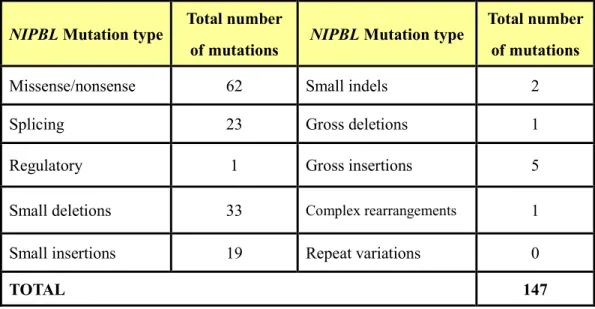
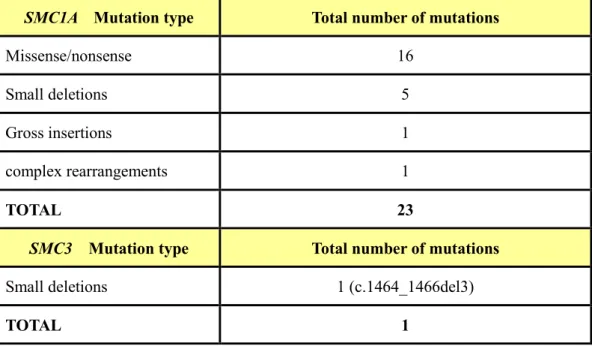
Over 100 causative NIPBL gene mutations have been reported. They include missense/nonsense (~42%), deletion/insertion (~40%), and splice-site mutations (~16%) (Table 1). The mutations types of the SMC1A gene consists missense/nonsense (~70%) and frameshift (~30%) mutations. One individual was found to have an in-frame 3 bp deletion (c.1464_1466del3) in the SMC3 gene (Table 2). Mutations in NIPBL take up to 20 ~50% of clinically diagnosed CdLS cases.11 SMC1A gene mutations contribute to 5% of CdLS cases and result in consistently milder phenotypes than patients with NIPBL gene mutations.12 Approximately 65% of CdLS patients with clinical diagnosis carry mutations in one of cohesin-associated genes (NIPBL, SMC1A or SMC3).13
Figure 2. Genetic map of SMC1A (A) and SMC3 (B) gene. (A) SMC1A gene is located on chromosome Xp11.22-p11.21 and contains 25 exons. (B) SMC3 gene is located on chromosome 10q25.
Recently, chromosomal anomalies with translocation (t(14;21)(q32;q11), t(X;8) (p11.2;q24.3), and t(3;17)(q26.3;q23.1)),14 and a duplication (0.6-Mb de novo 9p duplication)15 were found in CdLS patients. These results suggest genetic heterogeneity of CdLS. Therefore, our study is designed to observe genetic heterogeneity of Korean patients with CdLS by mutation screening of NIPBL and SMC1A genes. Patients with no detectable mutation of NIPBL and SMC1A genes by sequencing were further investigated
- 6 -
Figure 3. Schematic organization of SMC proteins. They contain five distinct domains: N-terminal (or P-loop NTPase), a hinge motif flanked by two coiled coil regions and a C-terminal (or P-loop NTPase).
Table 1. Summary of reported mutations of NIPBL, SMC1A and SMC3 gene in Cornelia de Lange Syndrome (Human Gene Mutation Database 2009)
NIPBL Mutation type
Total number
of mutations NIPBL Mutation type
Total number of mutations
Missense/nonsense 62 Small indels 2
Splicing 23 Gross deletions 1
Regulatory 1 Gross insertions 5
Small deletions 33 Complex rearrangements 1
Small insertions 19 Repeat variations 0
TOTAL 147
using whole genome array-based comparative genomic hybridization (array-CGH) in order to detect chromosome imbalances. Array-CGH uses two genomes, a test and a reference, which are differentially labeled with a fluorescent dye and competitively hybridized to a microarray.16 The resulting ratio of the fluorescence intensities on each array element is proportional to the copy number of the corresponding DNA sequence in the test and reference genomes.16
- 7 -
Table 2. Summary of reported mutations of SMC1A and SMC3 gene in Cornelia de Lange Syndrome (Human Gene Mutation Database 2009)
Array-CGH allows the mapping of genomic copy number alterations at the submicroscopic level, thereby directly linking disease phenotypes to gene dosage alterations.16 Just as the t(5;13)(p13.1; q12.1) translocation paved the way for determining the NIPBL gene5, other chromosomal alterations such as submicroscopic imbalances in different genomic regions could help the recognition and screening of novel candidate CdLS genes.
SMC1A Mutation type Total number of mutations
Missense/nonsense 16
Small deletions 5
Gross insertions 1
complex rearrangements 1
TOTAL 23
SMC3 Mutation type Total number of mutations
Small deletions 1 (c.1464_1466del3)
- 8 -
II.
MATERIAL AND METHOD1. Subjects and DNA extraction.
A total of 13 patients with CdLS phenotype were recruited from Yonsei University Hospital. Informed consent was obtained from the parents of the 13 patients in advance, before collecting blood samples. Genomic DNA was extracted from peripheral blood lymphocytes using Gentra Puregene Blood Kit (Qiagen, Valencia, CA, USA) in accordance to the manufacturer’s protocol.
2. NIPBL and SMC1A gene mutation analysis.
The entire NIPBL gene except the first non-coding exon was screened for mutations in all tested patients, and those who did not have mutation in NIPBL were further analyzed for mutations in SMC1A. The NIPBL gene (exon 2 ~ 47) and SMC1A gene (exon 1 ~ 25) was amplified by PCR using TAKARA PCR Thermal Cycler DICE TP600 (TAKARA, Shiga, JAPAN). The RefSeqs, NM_133433 and NM_006306, obtained from University of California Santa Cruz (UCSC) Genome Browser (http://genome.ucsc.edu/ cgi-bin/hgGateway) were used as the reference sequence of NIPBL and SMC1A, respectively. PCR primers of NIPBL and SMC1A gene were designed using Primer3 software (http://frodo.wi.mit.edu/primer3/, Steve Rozen and Helen J. Skaletsky (2000)) to amplify all exons and exon/intron boundaries. The coding regions of the NIPBL and SMC1A gene were amplified in a 30 reaction volume containing 100ng of genomic DNA, 10X SP-Taq reaction buffer, 0.75 unit SP-Taq polymerase(COSMO Genetech. Co.,LTD, Seoul, Korea), 10pmol of each primer pair, and 0.17mM of each dNTP. Cycling condition for NIPBL gene was as follows: a first denaturation 5min, 35 cycles at 94℃ for 30s, at 60℃ for 30s, and at 72℃ for 1min, with a last extension step at 72℃ for 7min. Cycling condition for
SMC1A gene was as follows: a first denaturation 5min, 35 cycles at 94℃ for 30s, at 60℃
for 30s, and at 72℃ for 30s, with a last extension step at 72℃ for 7min. Each fragment amplified by PCR was sequenced using BigDye® Terminator v3.1 Cycle Sequencing Kit (Applied Biosystems, Foster City, CA, USA) on ABI PRISM 3100 Genetic Analyzer
- 9 -
(Applied Biosystems, Foster City, CA, USA). Sequence analysis was performed using ABI Sequence Scanner Software version 1.0 (Applied Biosystems, Foster City, CA, USA).
3. Array-CGH
Whole genome array-CGH was performed in patients who did not show any mutations within NIPBL and SMC1A gene in order to screen for genomic alterations. Agilent SurePrint G3 human CGH microarray was used with the resolution of 4x180K (Agilent Technologies Santa Clara, CA) containing approximately 180,000 oligonucleotides per 1 array, covering the genome with an average distance of 17kb. Array-CGH was performed by a commercial company, DNA Link, Inc.
- 10 -
III.
RESULTS1. Sequence analysis
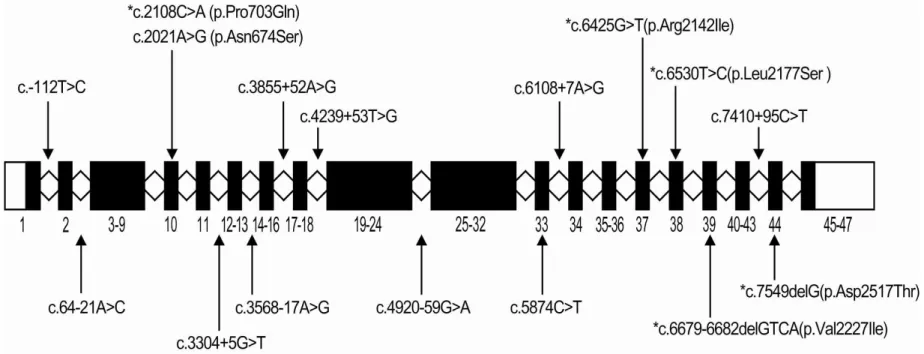
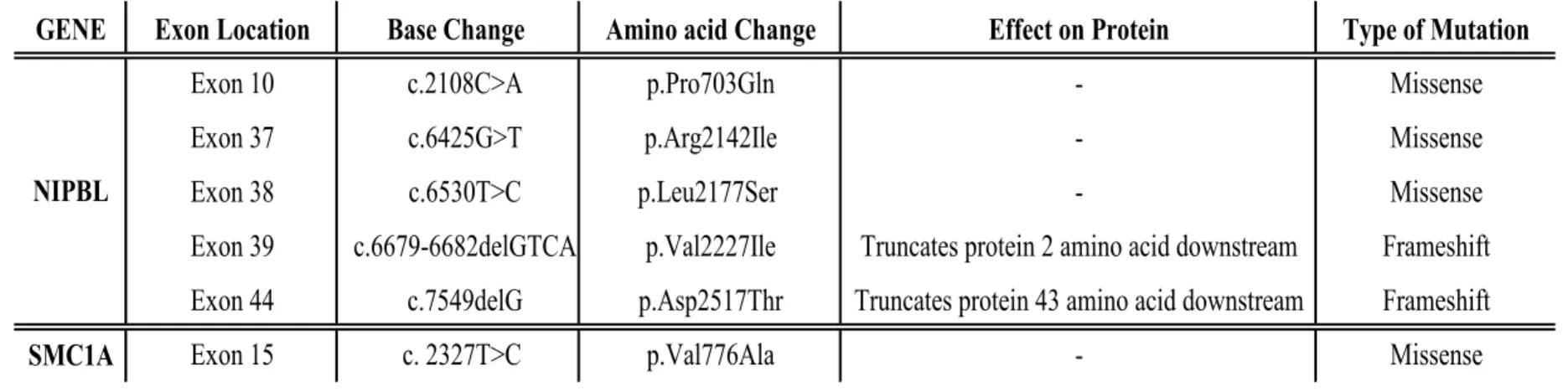
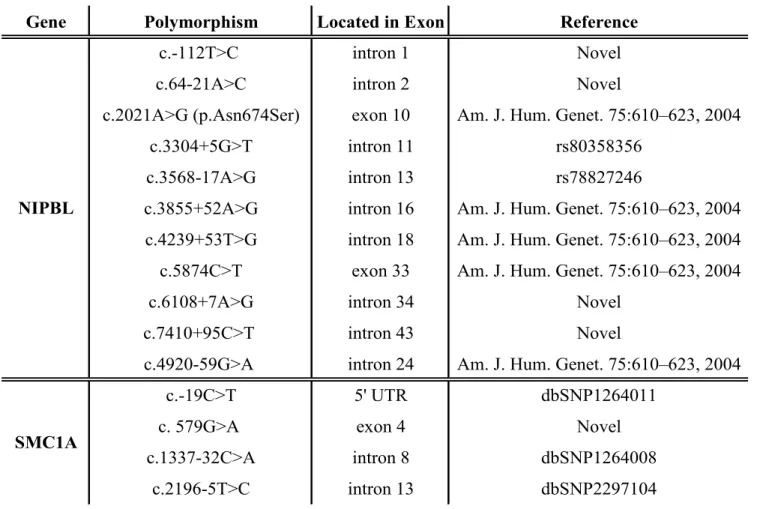
The following five novel mutations within the NIPBL gene were identified in 13 patients: two frame shift mutations by deletion (c.6679-6682delGTCA, c.7549delG) and three missense mutations (c.2108C>A (p.Pro703Gln), c.6425G>T (p.Arg2142Ile), c.6530T>C (p.Leu2177Ser)). Two frameshift mutations, c.6679-6682delGTCA and c.7549delG in exon 39 and exon 44, cause premature termination codon at 2nd amino acid downstream in c.6679-6682delGTCA and 43rd amino acid downstream in c.7549delG. In addition, a number of single nucleotide polymorphisms were found in NIPBL. They are seven previously reported CdLS-related SNPs (c.2021A>G (p.Asn674Ser), c.3304+5G>T, c.3568-17A>G, c.3855+52A>G, c.4239+53T>G, c.5874C>T, c.4920-59G>A), two in dbSNP (c.3304+5G>T (rs80358356), c.3568-17A>G (rs78827246)), and four novel intronic SNPs (c.-112T>C, c.64-21A>C, c.6108+7A>G, c.7410+95C>T) (Fig 4).
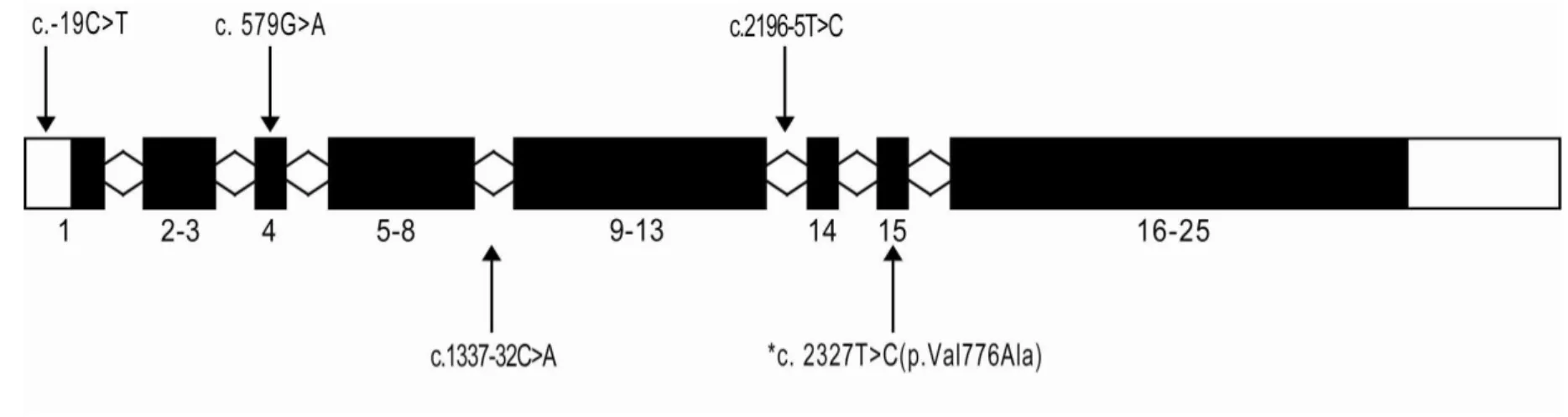
Mutation analysis SMC1A in 8 patients without NIPBL gene mutation was performed, and one novel mutation, c.2327T>C (p.Val776Ala), was identified in a female patient. The fact that this mutation was not detected in her parents suggests this is a de novo mutation (Fig 5). Additionally, one novel silent mutation (c.579G>A) and three previously reported polymorphisms (c.-19C>T (dbSNP1264011), c.1337-32C>A (dbSNP1264008), c.2196-5T>C (dbSNP2297104)) were observed (Fig 6).
2. Array-CGH on patients without NIPBL and SMC1A mutations
Array-CGH was performed in 7 patients without mutations in either NIPBL or SMC1A. Two of these patients showed DNA copy number alterations including a deletion on chromosome 5q12.1 and a duplication on chromosome 16p11.2 of 37 Kb. The known genes mapping within the deleted and duplicated area are NDUFAF2 and ITGAX, ITGAD, respectively (Fig 7).
- 11 -
Figure 4. Five novel mutations and eleven polymorphisms in NIPBL gene identified from the 13 unrelated CdLS patients in this study. The star(*) indicates mutation, and the rest are polymorphisms. Labeled blocks represent exons.
- 12 -
Figure 5. A heterozygous mutation (c.2327T>C (p.Val776Ala)) identified in SMC1A in a female patient (a) and her mother (b). The fact that this mutation was not detected in her parents indicates a de novo event.
- 13 -
Figure 6. One novel mutation and four polymorphisms in SMC1A identified from the 8 unrelated CdLS patients who did not have mutations in NIPBL. The star(*) indicates mutation and the rest are polymorphisms. Labeled blocks represent exons.
- 14 -
Table 3. Summary of mutations in NIPBL and SMC1A genes identified in patients with CdLS
GENE
Exon Location
Base Change
Amino acid Change
Effect on Protein
Type of Mutation
Exon 10
c.2108C>A
p.Pro703Gln
-
Missense
Exon 37
c.6425G>T
p.Arg2142Ile
-
Missense
Exon 38
c.6530T>C
p.Leu2177Ser
-
Missense
Exon 39
c.6679-6682delGTCA
p.Val2227Ile
Truncates protein 2 amino acid downstream
Frameshift
Exon 44
c.7549delG
p.Asp2517Thr
Truncates protein 43 amino acid downstream
Frameshift
SMC1A
Exon 15
c. 2327T>C
p.Val776Ala
-
Missense
- 15 -
Table 4. Polymorphisms in NIPBL and SMC1A genes identified in 13 patients with CdLS
Gene Polymorphism Located in Exon Reference
c.-112T>C intron 1 Novel
c.64-21A>C intron 2 Novel
c.2021A>G (p.Asn674Ser) exon 10 Am. J. Hum. Genet. 75:610–623, 2004
c.3304+5G>T intron 11 rs80358356
c.3568-17A>G intron 13 rs78827246
c.3855+52A>G intron 16 Am. J. Hum. Genet. 75:610–623, 2004 c.4239+53T>G intron 18 Am. J. Hum. Genet. 75:610–623, 2004
c.5874C>T exon 33 Am. J. Hum. Genet. 75:610–623, 2004
c.6108+7A>G intron 34 Novel
c.7410+95C>T intron 43 Novel
c.4920-59G>A intron 24 Am. J. Hum. Genet. 75:610–623, 2004
c.-19C>T 5' UTR dbSNP1264011
c. 579G>A exon 4 Novel
c.1337-32C>A intron 8 dbSNP1264008
c.2196-5T>C intron 13 dbSNP2297104
NIPBL
- 16 -
Figure7. Array-CGH profile of chromosomes 5 and 16. Deleted and duplicated regions are indicated by dotted circles. The regions indicated by solid circles correspond to known copy number variants. Chromosome deletion region 5q12.1 and duplication region 16p11.2 contain NDUFAF2 and ITGAX, ITGAD, respectively.
- 17 -
IV.
DISCUSSIONTwo genes responsible for CdLS are NIPBL, a regulator of the cohesin complex, that was discovered in a patient with t(5;13)(p13.1;q12.1) translocation,5 and SMC1A, a core component of the cohesin complex.7 The mutation detection rates in NIPBL and SMC1A genes were 38% and 9%, respectively, similar to the rate previously reported in a study on Caucasian patients.17 A total of six different mutations were identified which are two frameshift mutations, three missense mutations in NIPBL, and one missense mutation in
SMC1A gene.
According to a study by Gillis’s (2004), there is no mutation in exons 4–6, 8, 11–14, 16, 19, 23–25, 30–34, 36, 37, 41, and 47.14 Also Mutations identified in NIPBL gene show predominance in exon 10.14 Mutations identified in this study were located in exon 10, 37, 38, 39, and 40. Both frameshift mutations discovered in NIPBL are expected to cause prematurely truncated protein products, likely resulting in haploinsufficiency of NIPBL gene, which is a key mechanism in CdLS. Four missense mutations detected in NIPBL and SMC1A can cause the disease by changing a protein residue.
SMC1A is located in the X chromosome, and is reported to escape X inactivation in
human.8 In a female patient with a heterozygous mutation, normal and mutant alleles did not show any significant difference in the production of SMC1A mRNA. Therefore, a carrier female with a mutation in SMC1A gene may show symptoms of CdLS by the dominant negative effect.18 Most of the reported SMC1A mutations are not located in the amino terminal NTPase domain from amino acid 4–148, the hinge domain from amino acid 515–629, or the carboxy terminal NTPase domain from amino acid 1,117–1,220. This indicates that chromosome cohesion may not play a major role in the pathogenesis of CdLS.18 In our study, a heterozygous mutation identified in a female patient is c.2327T>C (p.Val776Ala) in exon 15, which that is not an ATPase domain or a hinge domain.
Also we found two carriers of DNA copy number alterations, which include a deletion on chromosome region 5q12.1 and a duplication on chromosome region 16p11.2 both of
- 18 -
length 37 kb. The deleted area contains the gene NDUFAF2 that encodes mitochondrial complex 1 assembly factor.19 Mutations in this gene cause progressive encephalopathy.20 The duplicated area contains genes ITGAX and ITGAD which encode integrin alpha-X protein and integrin alpha-D protein, respectively.21 These proteins are composed of integrin receptors involved in inflammatory response, monocyte adhesion, chemotaxis, and phagocytosis.22 The results of array-CGH have no immediately apparent relationship to CdLS.
In order to explain the correlation between causative gene mutations and all patient phenotypes, further work is needed to find additional candidate genes. We are currently working to discover new causative genes associated with CdLS by whole exome sequencing.
- 19 -
V.
CONCLUSIONWe identified six novel mutations in 13 unrelated Korean patients clinically diagnosed with CdLS. Those mutations will promote understanding of genetic background in Korean patients with CdLS for the future and will used be to construct a Korean CdLS mutation database. Approximately 46% of Korean patients with CdLS in this study have these mutations, which is similar to the rate of another study (Juan Pie journals: NIPBL:47%, SMC1A:10%), strongly suggests the genetic heterogeneity of this syndrome.
- 20 -
REFERENCE
1. Jackson L, Kline AD, Barr MA, Koch S. de Lange syndrome: a clinical review of 310 individuals. Am J Med Genet. Nov 15 1993;47(7):940-6
2. Ireland M, Donnai D, Burn J. Brachmann-de Lange syndrome. Delineation of the clinical phenotype. Am J Med Genet. Nov 15 1993;47(7):959-64.
3. Dorsett D, Krantz ID. On the molecular etiology of Cornelia de Lange syndrome. Ann N Y Acad Sci. Jan 2009;1151:22-37.
4. Opitz JM. The Brachmann-de Lange syndrome. Am J Med Genet. Sep 1985;22(1):89-102.
5. Krantz ID, McCallum J, DeScipio C, et al. Cornelia de Lange syndrome is caused by mutations in NIPBL, the human homolog of Drosophila melanogaster Nipped-B. Nat Genet. Jun 2004;36(6):631-5.
6. Dorsett D. Adherin: key to the cohesin ring and cornelia de Lange syndrome. Curr Biol. Oct 5 2004;14(19):R834-6.
7. Musio A, Selicorni A, Focarelli ML, et al. X-linked Cornelia de Lange syndrome owing to SMC1L1 mutations. Nat Genet. May 2006;38(5):528-30.
8. Brown CJ, Miller AP, Carrel L, Rupert JL, Davies KE, Willard HF. The DXS423E gene in Xp11.21 escapes X chromosome inactivation. Hum Mol Genet. Feb 1995;4(2):251-5.
9. Liu J, Krantz ID. Cohesin and human disease. Annu Rev Genomics Hum Genet. 2008;9:303-20.
10. Wendt KS, Yoshida K, Itoh T, et al. Cohesin mediates transcriptional insulation by CCCTC-binding factor. Nature. Feb 14 2008;451(7180):796-801.
11. Borck G, Redon R, Sanlaville D, et al. NIPBL mutations and genetic heterogeneity in Cornelia de Lange syndrome. J Med Genet. Dec 2004;41(12):e128.
12. Revenkova E, Focarelli ML, Susani L, et al. Cornelia de Lange syndrome mutations in SMC1A or SMC3 affect binding to DNA. Hum Mol Genet. Feb 1 2009;18(3):418-27.
- 21 -
13. Liu J, Krantz ID. Cornelia de Lange syndrome, cohesin, and beyond. Clin Genet. Oct 2009;76(4):303-14.
14. Gillis LA, McCallum J, Kaur M, et al. NIPBL mutational analysis in 120 individuals with Cornelia de Lange syndrome and evaluation of genotype-phenotype correlations. Am J Hum Genet. Oct 2004;75(4):610-23.
15. Schoumans J, Wincent J, Barbaro M, et al. Comprehensive mutational analysis of a cohort of Swedish Cornelia de Lange syndrome patients. Eur J Hum Genet. Feb 2007;15(2):143-9.
16. Lucito R, Healy J, Alexander J, et al. Representational oligonucleotide microarray analysis: a high-resolution method to detect genome copy number variation. Genome Res. Oct 2003;13(10):2291-305.
17. Pie J, Gil-Rodriguez MC, Ciero M, et al. Mutations and variants in the cohesion factor genes NIPBL, SMC1A, and SMC3 in a cohort of 30 unrelated patients with Cornelia de Lange syndrome. Am J Med Genet A. Apr 2010;152A(4):924-9.
18. Liu J, Feldman R, Zhang Z, et al. SMC1A expression and mechanism of pathogenicity in probands with X-Linked Cornelia de Lange syndrome. Hum Mutat. Nov 2009;30(11):1535-42.
19. Janssen RJ, Distelmaier F, Smeets R, et al. Contiguous gene deletion of ELOVL7, ERCC8 and NDUFAF2 in a patient with a fatal multisystem disorder. Hum Mol Genet. Sep 15 2009;18(18):3365-74.
20. Barghuti F, Elian K, Gomori JM, et al. The unique neuroradiology of complex I deficiency due to NDUFA12L defect. Mol Genet Metab. May 2008;94(1):78-82.
21. Wong DA, Davis EM, LeBeau M, Springer TA. Cloning and chromosomal localization of a novel gene-encoding a human beta 2-integrin alpha subunit. Gene. Jun 1 1996;171(2):291-4.
22. Grayson MH, Van der Vieren M, Sterbinsky SA, et al. alphadbeta2 integrin is expressed on human eosinophils and functions as an alternative ligand for vascular cell adhesion molecule 1 (VCAM-1). J Exp Med. Dec 7 1998;188(11):2187-91.
- 22 -
ABSTRACT (IN KOREAN)
한국인 Cornelia de Lange 증후군 환자의 NIPBL 유전자 돌연변이 분석 <지도교수: 이진성> 연세대학교 대학원 의과학과 왕지영 목적: Cornelia de Lange 증후군은 성장지연, 정신지체의 이상소견과 특징적인 얼굴모습을 동반한 선천성 다발성 기형 증후군이다. 현재까지 약 50%의 환자 에서 NIPBL, SMC1A 유전자 변이와 연관된 것으로 알려져 있어 질환의 유전 적 배경으로 유전적 이질성(genetic heterogeneity) 현상을 추정할 수 있다. 따라 서 한국인 Cornelia de Lange 증후군 환자들을 대상으로 원인 유전자들의 돌연 변이 분석을 시행하고, genome 상의 결손과 중복 분석을 통해 새로운 후보 유 전자를 검색하고자 한다. 대상 및 방법: 연세대학교 신촌 세브란스 병원 임상유전학과에서 Cornelia de Lange 증후군으로 진단되어 추적중인 13명의 한국인 환자를 대상으로 유전자 검사를 시행하였다. 돌연변이 분석은 직접염기서열 분석으로 시행하였고, genome 상의 결손이나 중복은 array-based comparative genomic hybridization
- 23 - (array-CGH) 방법으로 확인하였다.
결과: 13명의 환자 중 5명의 환자에서 NIPBL 유전자 돌연변이가 발견되었으 며, 1명의 환자에서 SMC1A 유전자 돌연변이가 발견되어 총 6명의 환자에서 유전자 돌연변이가 보고되었다. NIPBL 유전자에서 발견된 돌연변이는 c.2108C>A (p.Pro703Gln), c.6425G>T (p.Arg2142Ile), c.6530T>C (p.Leu2177Ser), c.6679-6682delGTCA, c.7549delG이며, SMC1A 유전자에서 발견된 돌연변이는 c.2327T>C (p.Val776Ala)로 현재까지 보고되지 않은 돌연변이이다. 이들 유전자 에서 돌연변이가 발견되지 않은 환자 7명을 대상으로 실시한 array-CGH 결과 2명의 환자에서 비정상적인 염색체의 양상이 발견되었다. 결론: 본 연구에서 새롭게 발견된 돌연변이는 향후 한국인 Cornelia de Lange 증후군의 유전적 진단에 있어 유용한 자료가 될 것으로 사료되지만 array-CGH 결과 발견된 비정상적인 부의의 유전자 조사 결과 이 증후군과 특이한 상관 관계는 없는 것으로 생각된다. 따라서 이 증후군의 유전적 이질성을 이해하여 새로운 후보 유전자를 발굴하기 위한 연구가 필요하다. ________________________________________________________________________ 핵심 되는 말: Cornelia de Lange 증후군, NIPBL, SMC1A, array-based comparative genomic hybridization, 유전적 이질성