INTRODUCTION
In 1962, Bartter and colleagues (1) described a set of new syndrome characterized by hypokalemia, metabolic alkalosis, hyperreninism, hyperaldosteronism with low or normal blood pressure, decreased pressor responsiveness to infused angio- tensin II, and hyperplasia of the juxtaglomerular complex.
Since this original report, hundreds of Bartter and related syn- drome, inherited (autosomal recessive) renal tubular disorders associated with hypokalemic metabolic alkalosis, have been described. These Bartter-like syndromes can be divided into at least three different clinical phenotypes (2, 3): (a) classic Bart- ter syndrome; (b) Gitelman syndrome; and (c) antenatal (neo- natal) Bartter syndrome.
In contrast to classic Bartter syndrome and Gitelman syn- drome, the antenatal Bartter syndrome has both the features of renal tubular hypokalemic alkalosis and profound systemic manifestations. Antenatal Bartter syndrome is characterized by polyhydramnios and premature delivery due to intrauterine polyuria. After birth, severe water and salt wasting, hypokal- emic metabolic alkalosis, severe hypercalciuria with associated
nephrocalcinosis and osteopenia, and marked growth retarda- tion occur. Systemic manifestations, such as fever, vomiting, and occasional diarrhea, are probably caused by marked stim- ulation of renal and systemic prostaglandin E2production.
Recent studies have identified mutations in four genes as being causative, and have demonstrated genetic heterogeneity in Bartter-like syndrome (4-8): the mutation with loss-of- function in (a) the gene encoding the bumetanide-sensitive Na-K-2Cl cotransporter (NKCC2); or (b) the gene encoding an ATP-sensitive inwardly rectifying potassium channel (renal outer medullary K+channel; ROMK) of the medullary thick ascending limb (mTAL) of Henle’s loop in antenatal Bartter syndrome; (c) the gene encoding a renal chloride channel (ClC- Kb) of the mTAL of Henle’s loop in classic Bartter syndrome;
and (d) the gene encoding the thiazide-sensitive Na-Cl cotrans- porter (NCCT) of the renal distal convoluted tubule in Gitel- man syndrome.
In this study, we report the identification of two heterozy- gous mutations of ROMK from antenatal Bartter syndrome presenting with hyponatremia and hyperkalemia, leading to hypokalemia, mild metabolic alkalosis, hypercalciuria and
65 J Korean Med Sci 2003; 18: 65-8
ISSN 1011-8934
Copyright � The Korean Academy of Medical Sciences
Heterozygous Mutations of The Gene for Kir 1.1 ( ROMK ) in Antenatal Bartter Syndrome Presenting with Transient Hyperkalemia, Evolving to a Benign Course
Bartter-like syndrome encompasses a set of inherited renal tubular disorders asso- ciated with hypokalemic metabolic alkalosis, renal salt wasting, hyperreninemic hyperaldosteronism, and normal blood pressure. Antenatal Bartter syndrome, a subtype of Bartter-like syndrome, is characterized by polyhydramnios, premature delivery, life-threatening episodes of fever and dehydration during the early weeks of life, growth retardation, hypercalciuria, and early-onset nephrocalcinosis. Muta- tions in the bumetanide-sensitive Na-K-2Cl cotransporter (NKCC2) and ATP-sen- sitive inwardly rectifying potassium channel (ROMK) of the thick ascending limb of Henle’s loop have been identified in the antenatal Bartter syndrome. We report the identification of two heterozygous mutations of the gene for Kir 1.1 (ROMK) from an antenatal Bartter syndrome patient who presented at birth with mild salt wast- ing and a biochemical findings that mimicked primary peudohypoaldosteronism type 1, such as hyperkalemia and hyponatremia, and evolved to a relatively benign course. We have identified amino acid exchanges Arg338Stop and Met357Thr in the gene exon 5 for ROMK by PCR and direct sequencing. Both mutations alter the C-terminus of the ROMK protein, and can affect channel function.
Key Words : Bartter’s Disease; Potassium Channel; ROMK Protein; Mutation; Pseudohypoaldosteronism
Jong Tae Cho, Lisa Marie Guay-Woodford*
Department of Internal Medicine, Dankook University, College of Medicine, Cheonan, Korea;
Departments of Medicine and Pediatrics*, University of Alabama at Birmingham, Birmingham, Alabama, U.S.A.
Address for correspondence Jong Tae Cho, M.D.
Department of Internal Medicine, Dankook University, College of Medicine, 16-5 Anseo-dong, Cheonan 330-715, Korea
Tel : +82.41-550-3925, Fax : +82.41-556-3256 E-mail : [email protected]
Received : 4 September 2002 Accepted : 31 October 2002
66 J.T. Cho, L.M. Guay-Woodford
nephrocalcinosis, and evolving to normalization of biochemical abnormalities except nephrocalcinosis.
MATERIALS AND METHODS
Medical history and laboratory studies of the patient with antenatal Bartter syndrome were reviewed. These studies were approved by the local ethics committees, and the informed consent was obtained from the parents.
Using standard methods, genomic DNA was isolated from 3 mL of EDTA-treated peripheral whole blood of the patient, her parents, and a healthy control. Polymerase chain reaction (PCR) was performed in a 50 Lvolume containing 150 ng of genomic DNA, 1.5 mM MgCl2, 10 mM Tris (pH 8.6), 50 mM KCl, 0.2 mM dNTP, 30 pmol of each primer, and 2.0 U of Taq polymerase (Amersham Pharmacia Biotech Inc., Piscataway, NJ, U.S.A.). Based on the sequence of ROMK-1, sets of primer pairs were used to amplify the coding sequence for exon 5 as described previously (6). After the initial denat- uration step at 94℃for 5 min, PCR was conducted for 30 cycles with denaturation at 94℃for 45 sec, annealing at 55
℃for 45 sec, and extension at 72℃for 45 sec. The reaction was completed with a final elongation step at 72℃for 10 min. Amplified DNA segments were reamplified with the same primer pair and were subjected to direct DNA sequence analysis using an ABI 373A automated DNA sequencer (Applied Biosystems, Foster, CA, U.S.A.). DNA sequences were confirmed by sequencing both strands from the patient, her parents, and a healthy control.
RESULTS Clinical summary
The female patient was born in the 30th gestational week by cesarean section due to preterm labor and polyhydramnios (birth-weight: 1,450 g). Initially, the patient was hyperkalemic (8.3 mmol/L) and hyponatremic (129 mmol/L), as well as azotemic (BUN 23 mg/dL, creatinine 1.6 mg/dL). After fluid, sodium, and alkali supplementation were initiated, the azo- temia, sodium and potassium of the patient were normalized.
At two months after birth, she was detected to be hyperkale- mic (6.1 mmol/L) and hyponatremic (130 mmol/L). There were no other significant problems until she presented for her routine two-year-old check. At the visit, she was noted to be mild hypokalemic (3.2 mmol/L), metabolic alkalosis (serum bicarbonate 27.5 mmol/L), high renin (22 ng/mL per hour) and aldosterone levels (520 pg/mL), hypercalciuria (9 mg/kg/
day), and bilateral nephrocalcinosis. She had no sibling, and there was no family history of abortion or stillbirth. There was no known consanguinity in the family. She was recommended to begin indomethacin treatment. At her next visit for routine three-year-old check, she had a normal serum potassium (3.7 mmol/L), bicarbonate (26 mmol/L), and urine calcium to cre- atinine ratio (0.1).
Mutational analysis results
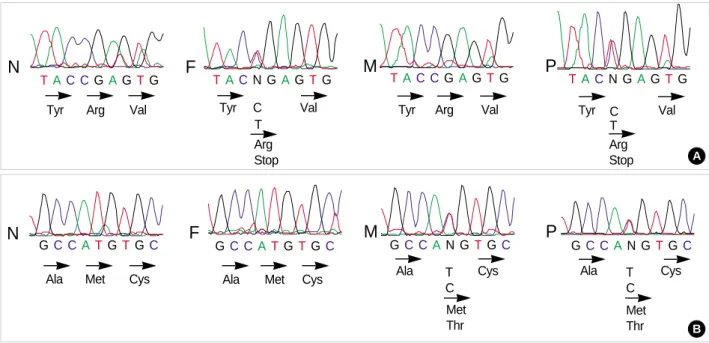
Two heterozygous mutations, nonsense and missense, were identified in the patient. The first mutation (C1573T) resulted
Fig. 1.Identification of mutant alleles for Kir 1.1 gene by genomic sequencing. (A) Corresponding DNA sequence (sense strand) show- ing the Arg338Stop mutation; (B) Corresponding DNA sequence (sense strand) showing the Met357Thr mutation. N, Healthy control; F, father; M, mother; P, patient
N TA C CGA GTG
Tyr Arg Val
TA CN GA GTG TAC CGAGTG TACN GAGTG
GC CA N GTGC GC CAN GTGC
GC CATGTGC GC CA TGTGC
N F M P
P F M
Val Tyr C
T
Arg Val
Tyr Tyr Val
Arg Stop T C
Ala Cys
Met Thr Met
Thr
Ala T
C Ala Met Cys Cys
Ala Met Cys
Arg
Stop A
B T
C
in a stop codon, which was substituted at Arg338 (codon num- ber in ROMK1), thereby deleting the terminal 53 residues of the carboxyl tail. The second mutation (T1631C) caused an exchange of Met357 for Thr (Fig. 1). The Arg338Stop and Met357Thr mutations located in the C-terminal intracellular part were transmitted from the father and mother of the pa- tient, respectively, thereby giving rise to a compound heterozy- gote mutation in the patient.
DISCUSSION
The patient showed typical manifestations of antenatal Bart- ter syndrome characterized by polyhydramnios, premature delivery, hypercalciuria, and early-onset nephrocalcinosis. How- ever, she presented at birth with mild salt wasting, hyperkal- emia, and hyponatremia, suggesting ROMK gene mutation.
Furthermore, her phenotype has evolved from significant peri- natal problems to a relatively benign course at present.
ROMK is expressed in the TAL of Henle’s loop where it recycles reabsorbed potassium back to the tubular lumen (K+ recycling), and in the distal nephron where it contribute to net renal potassium secretion (K+secretion). The contribution of the mutation with the loss of ROMK function to the ante- natal Bartter syndrome can be explained by the impairment of K+recycling, resulting in K+levels in the lumen that are too low to ensure an adequate function of the Na-K-2Cl co- transporter, producing salt wasting and hypokalemic alkalo- sis. It has been proposed that the mutation with the loss of ROMK function would be expected to result in impaired K+ secretion in the distal nephron, and explain the clinical picture in some cases of antenatal Bartter syndrome who presented at birth with mild salt wasting and a biochemical findings that mimicked primary peudohypoaldosteronism type 1, such as hyponatremia, hyperkalemia and metabolic acidosis (3, 5).
Furthermore, one might expect to be able to distinguish Bart- ter syndrome patients with NKCC2 mutations and unimpaired distal K+secretion from those with mutations in ROMK, by higher potassium levels (5). However, further study will be required to determine whether the clinical features of the patients with mutations in these two genes can be distinguished clinically.
In human kidney, differential splicing produces five distinct transcripts of ROMK. Exon 5 is common to all of these iso- forms and encodes the majority of the channel protein (9). All mutations that have been reported so far are located in exon 5 of the ROMK gene (5, 6). ROMK proteins are the tetramers of four subunits that each have two transmembrane spanning domains (M1 and M2), a pore-forming domain, and intracel- lular amino and carboxyl termini. The mutations comprise substitutions of the single bases that either lead to single amino acid substitutions or introduce a premature stop codon, and deletions or insertions causing a frameshift. The mutations affect amino acid residues of the transmembrane domains, the
pore-forming domain, the putative ATP-binding domain, as well as the amino and carboxyl termini of ROMK channel pro- tein (5, 6).
Mutational analysis of ROMK gene in this patient with antenatal Bartter syndrome showing interesting clinical mani- festations revealed two mutations Arg338Stop and Met357 Thr located in the carboxyl terminus, which were transmit- ted from the patient’s father and mother, respectively, there- by giving rise to a compound heterozygote mutation in the patient. Arg 338Stop and Met357Thr had been previously reported by International Collaborative Study Group for Bartter-like syndromes (6) and Simon et al. (5), respectively.
The carboxyl terminus was reported to have a major role in specifying the pore properties of inwardly rectifying potassium channels (10). The nonsense mutation, Arg338Stop, deletes the terminal 53 residues of the carboxyl tail that could alter phosphorylation at the tyrosine kinase site at Tyr337, and cause loss of function in the channel protein (6). The function of the missense mutation, Met357Thr, was suggested to be normal (11). It can help explaining why the patient has been a relatively benign course. However, the functional analysis of the missense mutation, Met357Thr, was done in vitro, and the effect due to regulation by ATP and pH was not complete- ly eliminated. Furthermore, her significant perinatal problems strongly suggest that the function of Met357Thr can be abnor- mal in vivo, and regulated by some factors in vitro. Therefore, the more extensive functional analyses of these mutant proteins will be necessary to prove their causative role and to explain interesting clinical course in the patient.
REFERENCES
1. Bartter FC, Pronove P, Gill JP, MacCredile RC. Hyperplasia of the juxtaglomerular complex with hyperaldosteronism and hypokalemic alkalosis. Am J Med 1962; 33: 811-28.
2. Guay-Woodford LM. Bartter syndrome: unraveling the pathophysi- ologic enigma. Am J Med 1998; 105: 151-61.
3. Rodriguez-Soriano J. Bartter and related syndromes: the puzzle is almost solved. Pediatr Nephrol 1998; 12: 315-27.
4. Simon DB, Karet FE, Hamdan JH, DiPietro A, Sanjad SA, Lifton RP.
Bartter syndrome, hypokalemic alkalosis with hypercalciuria, is caused by mutations in the Na-K-2Cl cotransporter NKCC2. Nat Genet 1996;
13: 183-8.
5. Simon DB, Karet FE, Rodriguez-Soriano J, Hamdan JH, DiPietro A, Trachtman H, Sanjad SA, Lifton RP. Genetic heterogeneity of Bart- ter’s syndrome revealed by mutations in the K+channel, ROMK. Nat Genet 1996; 14: 152-6.
6. International Collaborative Study Group for Bartter-like syndromes.
Mutations in the gene encoding the inwardly-rectifying renal potas- sium channel, ROMK, cause the antenatal variant of Bartter syndrome:
evidence for genetic heterogeneity. Hum Mol Gen 1997; 6: 17-26.
7. Simon DB, Bindra RS, Mansfield TA, Nelson-Williams C, Men- donca E, Stone R, Schurman S, Nayir A, Alpay H, Bakkaloglu A,
ROMK Mutations in Antenatal Bartter Syndrome 67
Rodriguez-Soriano J, Morales JM, Sanjad SA, Taylor CM, Pilz D, Brem A, Trachtman H, Griswold W, Richard GA, John E, Lifton RP. Mutations in the chloride channel gene, CLCNKB, cause Bart- ter’s syndrome type III. Nat Genet 1997; 17: 171-8.
8. Simon DB, Nelson-Williams C, Bia MJ, Ellison D, Karet FE, Moli- na AM, Vaara I, Iwata F, Cushner HM, Koolen M, Gainza FJ, Gitelman HJ, Lifton RP. Gitelman’s variant of Bartter’s syndrome, inherited hypokalemic alkalosis, is caused by mutations in the thi- azide-sensitive Na-Cl cotransporter. Nat Genet 1996; 12: 24-30.
9. Shuck ME, Bock JH, Benjamin CW, Tsai TD, Lee KS, Slightom
JL, Bienkowski MJ. Cloning and characterization of multiple forms of the human kidney ROMK potassium channel. J Biol Chem 1994;
269: 24261-70.
10. Taglialatela M, Wible BA, Caporaso R, Brown AM. Specification of pore properties by the carboxyl terminus of inwardly rectifying K+channels. Science 1994; 264: 844-7.
11. Schwalbe RA, Bianchi L, Accili EA, Brown AM. Functional con- sequences of ROMK mutants linked to antenatal Bartter’s syndrome and implications for treatment. Hum Mol Genet 1998; 7: 975-80.
68 J.T. Cho, L.M. Guay-Woodford