INTRODUCTION
Wiskott-Aldrich syndrome (WAS) is an X-linked prima- ry immunodeficiency characterized by a clinical triad of im- munodeficiency, thrombocytopenia, and eczema (1, 2). WAS is caused by mutations in the gene encoding Wiskott-Aldrich syndrome protein (WASP) that affect all hematopoietic stem cells including lymphocytes, monocytes, neutrophils and pl- atelets (3). Various WASP gene mutations have been reported in patients with WAS and X-linked thrombocytopenia, a clinically mild allelic variant (4-9).
The treatment of WAS depends on the severity of the im- munodeficiency. In severe cases of WAS, the immunodeficien- cy limits the life expectancy of the patient, and immune re- constitution is the treatment of choice. Imai et al. (10) demon- strated correlations between the clinical phenotype, the extent of the mutation, and the presence or absence of WASP and also recommended hematopoietic stem cell transplantation (HSCT) especially for the patients with WASP-negative WAS.
Recently, there have been reports of successful treatment of
WAS by unrelated HSCT with cord blood (CB) as well as bone marrow transplant when a matched sibling donor was unavailable (11-16). Although phenotypic corrections for immunologic and hematologic parameters have been report- ed, genotypic corrections for WAS with cord blood stem cell transplantation (CBSCT) have not been demonstrated.
In this report, we demonstrate 2 cases of WAS which were phenotypically and genotypically corrected with unrelated CBSCT.
CASE REPORT
Patient 1 (UPN 1) is a male who was diagnosed with WAS at the age of 5 months. He presented with incidentally detect- ed thrombocytopenia (23,000/μL) with skin eczema and se- vere, recurrent otitis media and diarrhea on admission. The second male patient (UPN 2) presented with neonatal throm- bocytopenia at birth and received intermittent intravenous immunoglobulin (IVIG). Thereafter he experienced skin ec-
751
Young-Ho Lee1, Yeon-Jung Lim1, Su-Ah Shin1, Chang-Hwa Song2, Eun-Kyeong Jo2, Jin-A Jung3, and Ha-Baik Lee1
Department of Pediatrics and Hematopoietic Stem Cell Transplantation Center1, Hanyang University College of Medicine, Seoul; Department of Microbiology2, Chungnam University College of Medicine, Daejeon; Department of Pediatrics3, Dong-A University College of Medicine, Busan, Korea
Address for correspondence Yeon-Jung Lim, M.D.
Department of Pediatrics and Hematopoietic Stem Cell Transplantation Center, Hanyang University College of Medicine, 17 Haengdang-dong, Seongdong-gu, Seoul 133-791, Korea Tel : +82.2-2290-9789, Fax : +82.2-2297-2380 E-mail : [email protected] This work was supported by the research fund of Hanyang University (HY-2006-000-0000-3455).
J Korean Med Sci 2009; 24: 751-4 ISSN 1011-8934
DOI: 10.3346/jkms.2009.24.4.751
Copyright � The Korean Academy of Medical Sciences
Phenotypic and Genotypic Correction of WASP Gene Mutation in Wiskott-Aldrich Syndrome by Unrelated Cord Blood Stem Cell Transplantation
We present two cases of Wiskott-Aldrich syndrome (WAS), in which nonsense mu- tations in the WASP gene were corrected phenotypically as well as genotypically by unrelated cord blood stem cell transplantation (CBSCT). Two male patients were diagnosed with WAS at the age of 5-month and 3-month and each received unre- lated CBSCT at 16-month and 20-month of age, respectively. The infused cord blo- od (CB) units had 4/6 and 5/6 HLA matches and the infusion doses of total nuclea- ted cells (TNC) and CD34+ cells were 6.24×10⁷/kg and 5.08×10⁷/kg for TNC and 1.33×10⁵/kg and 4.8×10⁵/kg for CD34+ cells, for UPN1 and UPN2, respectively.
Complete donor cell chimerism was documented by variable number tandem re- peat (VNTR) with neutrophil engraftment on days 31 and 13 and platelets on days 58 and 50, respectively. Immunologic reconstitution demonstrated that CBSCT re- sulted in consistent and stable T-, B-, and NK-cell development. Flow cytometric analysis for immunologic markers and sequence analysis of the WASP gene mu- tation revealed a normal pattern after CBSCT. These cases demonstrate that CBs can be an important source of stem cells for the phenotypical and genotypical cor- rection of genetic diseases such as WAS.
Key Words : Wiskott-Aldrich Syndrome; WASP; Unrelated Cord Blood Stem Cell Transplantation
Received : 13 August 2007 Accepted : 27 April 2008
zema and recurrent infections such as cellulitis and pneumo- nia, until he visited our hospital at 3 months old. Flow cyto- metric analysis of peripheral blood mononuclear cells (PBMC) for these 2 patients revealed a defect in WASP, leading to the diagnosis of WAS. Subsequently, the nonsense mutations, Arg211stop and Arg13stop, were confirmed by genomic ana- lysis (17). Before transplantation, these patients were treated with monthly infusions of IVIG as well as supportive treat- ment but there was no clinical improvement.
CBSCT was performed in a laminar air flow room with con- ventional supportive therapy. The pre-transplantation con- ditioning regimen for the 2 patients was 1 mg/kg of busul- fan intravenously every 6 hr on days -9 through -6. This was followed by 50 mg/kg of intravenous cyclophosphamide on days -5 through -3 and 30 mg/kg of intravenous antithymo- cyte globulin (ATG) on days -3 through -1. Prophylaxis for acute graft versus host disease (GVHD) included continuous infusion of cyclosporine A beginning on day -1, targeting
whole blood levels to be 200 to 400 ng/mL, and 1 mg/kg/dose of methylprednisone every 12 hr on days 5 through 19, and then a taper.
The degree of human leukocyte antigen (HLA) match con- firmed by high resolution DNA typing between the infused CB and the patients was 4/6 for UPN 1 and 5/6 for UPN 2.
Infused cell doses of TNC and CD34+ cells for UPN1 and UPN2 were 6.24×10⁷/kg and 5.08×10⁷/kg for TNC, res- pectively, and 1.33×10⁵/kg and 4.8×10⁵/kg for CD34+
cells, respectively.
T-, NK-, and B-cell enumeration and quantitative immu- noglobulin studies (for immunoglobulin [Ig]G, A, M, D, and E) were performed. Cytofluorographic analyses of lym- phocyte subpopulations were performed with murine mon- oclonal antibodies conjugated to either fluorescein (FITC) or phycoerythrin (PE) and then analyzed by flow cytometry (FACScan; Becton Dickinson, San Jose, CA, U.S.A.).
Heparinized venous blood samples from patients and fam- ily members were fractionated on a Ficoll-Hypaque gradient to isolate PBMCs. For mutational analysis, genomic DNA was extracted from the peripheral lymphocytes, and 12 WASP gene exons were amplified by polymerase chain reaction (PCR) followed by direct sequencing according to the protocol of Sasahara et al. (18).
Hematopoietic reconstitution following CBSCT was un- eventful, with an absolute neutrophil count (ANC) of more than 500/μL on days 31 and 13 and a platelet count of more than 20,000/μL on days 58 and 50, for UPN 1 and UPN 2, respectively. Molecular chimerism studies using the VNTR method showed a complete donor cell type for these patients (data not shown). Acute GVHD did not occur, even after the infusion of HLA 1 or 2 antigen mismatched CB. UPN 1 expe- rienced 1 episode of sepsis with B. cepacia during the pre-en- graftment period without any complications. UPN 2 expe-
752 Y.-H. Lee, Y.-J. Lim, S.-A. Shin, et al.
WAS, Wiskott-Aldrich Syndrome; HLA, human leukocyte antigen; TNC, total nucleated cells; ANC, absolute neutrophil count.
UPN 1 UPN 2
Age at transplantation (month) 16 20
Degree of HLA mismatch 2 1
Preparative regimen Bu, Cy, ATG Bu, Cy, ATG Infused cell dose
TNC (107/kg) 6.24 5.08
CD34+ cell (105/kg) 1.33 4.8
Time to engraftment (day)
ANC (>500/μL) 31 13
Platelet (>20,000/μL) 58 50
Follow-up duration (month) 60 55
Table 1. Cord blood stem cell transplantation data in children with WAS
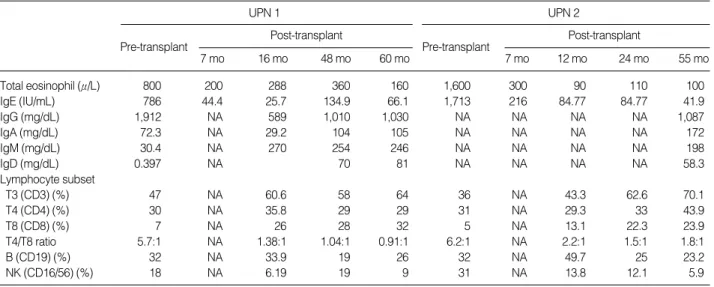
WAS, Wiskott-Aldrich Syndrome; NA, not available; mo, months.
UPN 1
Post-transplant
Pre-transplant Pre-transplant
Post-transplant
7 mo 16 mo 48 mo 60 mo 7 mo 12 mo 24 mo 55 mo
UPN 2
Total eosinophil (μ/L) 800 200 288 360 160 1,600 300 90 110 100
IgE (IU/mL) 786 44.4 25.7 134.9 66.1 1,713 216 84.77 84.77 41.9
IgG (mg/dL) 1,912 NA 589 1,010 1,030 NA NA NA NA 1,087
IgA (mg/dL) 72.3 NA 29.2 104 105 NA NA NA NA 172
IgM (mg/dL) 30.4 NA 270 254 246 NA NA NA NA 198
IgD (mg/dL) 0.397 NA 70 81 NA NA NA NA 58.3
Lymphocyte subset
T3 (CD3) (%) 47 NA 60.6 58 64 36 NA 43.3 62.6 70.1
T4 (CD4) (%) 30 NA 35.8 29 29 31 NA 29.3 33 43.9
T8 (CD8) (%) 7 NA 26 28 32 5 NA 13.1 22.3 23.9
T4/T8 ratio 5.7:1 NA 1.38:1 1.04:1 0.91:1 6.2:1 NA 2.2:1 1.5:1 1.8:1
B (CD19) (%) 32 NA 33.9 19 26 32 NA 49.7 25 23.2
NK (CD16/56) (%) 18 NA 6.19 19 9 31 NA 13.8 12.1 5.9
Table 2. Immunological laboratory data of pre-/post-transplantation in children with WAS
rienced fever and respiratory distress with hypoxemia due to pulmonary edema as well as skin rashes on the trunk in the pre-engraftment period (from days 8 to days 10), which mim- ics engraftment syndrome. He recovered with oxygen supply via endotracheal tube and fluid restriction as well as methyl- prednisone therapy. Both patients were clinically well with- out eczematous skin and recurrent infections at 60 months (UPN 1) and 55 months (UPN 2) post CBSCT. Clinical data regarding CBSCT are shown in Table 1. The elevated total eosinophil counts and serum IgE levels have been normalized since 7 months post-transplantation in both children (Table 2). Other immunologic parameters including IgG, IgA, IgM, IgD and lymphocyte subsets are summarized at Table 2.
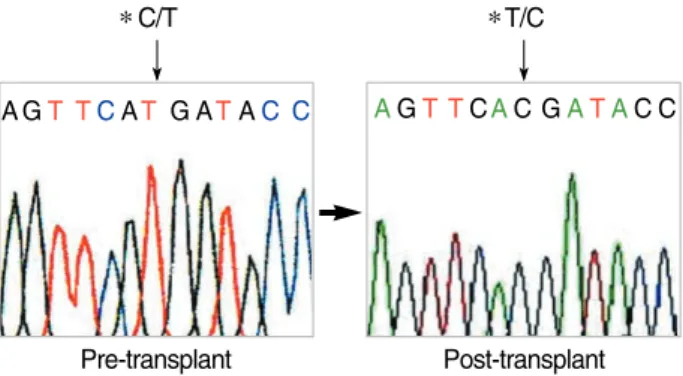
To determine whether the genotype was corrected by CB- SCT, we analyzed the WASP gene sequence before and after CBSCT in UPN 1. UPN 1 had a single base substitution (C665T) in exon 7 that results in an amino acid change in codon 211 (Arg211stop) before CBSCT. Following CBSCT, UPN1 had a normal sequence at the mutation site in exon 7 of the WASP gene (Fig. 1).
DISCUSSION
The gene responsible for WAS (WASP) consists of 12 exons with 1,823 bp. WASP encodes a 502 amino acid protein that is expressed selectively in hematopoietic stem cell-derived lineages (4). To date, approximately 100 mutations in the WASP gene have been described. These mutations consist of frameshift mutations, missense mutations, or splice-site mutations, which all give rise to aberrant transcription (4-9).
A correlation between clinical phenotype and genotype was reported independently by several investigators (7, 9). Imai et al. (10) observed that patients with missense mutations were WASP-positive, but patients with nonsense mutations, large deletions, small deletions, and small insertions were WASP-negative. Patients with splice anomalies were either WASP-positive or WASP-negative. Lack of WASP expression
was associated with susceptibility to bacterial, viral, fungal, and Pneumocystis jiroveci infections and with severe eczema, in- testinal hemorrhage, death from intracranial bleeding, and malignancies. They also revealed that the rates for overall sur- vival and event-free survival were significantly lower in WASP- negative patients. Conclusively, they recommended HSCT to improve prognosis, especially for WASP-negative patients.
Recently, HSCT has been the principal modality for cor- rection of immune deficiencies such as WAS. Since CB has been successfully transplanted to reconstitute patients with WAS, as first reported in 1994 (11-16), CB appears to be an alternative donor source compared with matched unrelated bone marrow with successful engraftment associated with no to mild acute GVHD and without development of chronic GVHD. In this study, we identified 2 WAS patients who had nonsense mutations in WASP and we successfully treated them by unrelated CBSCT with engraftment with no asso- ciated GVHD.
In CBSCT, the immunologic reconstitution resulted in con- sistent and stable T-cell, B-cell, and natural killer-cell devel- opment. The kinetics of recovery of phenotypic expression and function of the T cells occurred between 60 and 100 days and that of natural killer cells at approximately 180 days (19).
The immunologic parameters, especially CD8 of our patients also demonstrated normal values after CBSCT.
Furthermore, following CBSCT, we found that UPN1 had a normal sequence at the mutation site in the exon 7 of WASP gene. While CBSCT has been successfully performed for phe- notypic correction including clinical features and immuno- logical parameters in WAS, our study emphasizes the eviden- ce of genetic correction as well as phenotypic correction by CBSCT in WAS. To our knowledge, this is the first report documenting a genetic correction by CBSCT in WAS.
Collectively, our data demonstrate that CBs could be an important source of stem cells for the phenotypic as well as genotypic correction of genetic diseases such as WAS.
REFERENCES
1. Ochs HD, Rosen FS. The Wiskott-Aldrich syndrome. In: Ochs HD, Edvard Smith CI, Puck JM, eds, Primary Immunodeficiency Disea- ses. New York, NY: Oxford University Press 1999; 292-305.
2. Sullivan KE, Mullen CA, Blaese RM, Winkelstein JA. A multiinsti- tutional survey of Wiskott-Aldrich syndrome. J Pediatr 1994; 125:
876-85.
3. Snapper SB, Rosen FS. The Wiskott-Aldrich syndrome Protein (WA- SP): roles in signaling and cytoskeletal organization. Annu Rev Immu- nol 1999; 17: 905-29.
4. Derry JM, Ochs HD, Francke U. Isolation of a novel gene mutated in Wiskott-Aldrich syndrome. Cell 1994; 78: 635-44.
5. Greer WL, Shehabeldin A, Schulman J, Junker A, Siminovitch KA.
Identification of WASP mutations, mutation hotspots and genotype- phenotype disparities in 24 patients with the Wiskott-Aldrich syndro-
Genotypic Correction of WAS by Cord Blood Transplantation 753
Fig. 1. Sequence analysis showing genetic correction of the WASP gene in UPN 1. DNA sequences are shown that encompass a sin- gle point mutation (C to T) or a correction in exon 7 of the WASP gene. The asterisk denotes a C to T transversion or the T to C cor- rection.
C/T
A G T TCAT G ATA C C AG T TCAC G ATAC C
Pre-transplant Post-transplant
* *T/C
me. Hum Genet 1996; 98: 685-90.
6. Kwan SP, Hagemann TL, Blaese RM, Knutsen A, Rosen FS. Scan- ning of Wiskott-Aldrich syndrome (WAS) gene: identification of 18 novel alterations including a possible mutation hotspot at Arg86 re- sulting in thrombocytopenia, a mild WAS phenotype. Hum Mol Genet 1995; 4: 1995-8.
7. Wengler GS, Notarangelo LD, Berardelli S, Pollonni G, Mella P, Fas- th A, Ugazio AG, Parolini O. High prevalence of nonsense, frame shift, and splice-site mutations in 16 patients with full-blown Wiskott- Aldrich syndrome. Blood 1995; 86: 3648-54.
8. Zhu Q, Zhang M, Blaese RM, Derry JM, Junker A, Francke U, Chen SH, Ochs HD. The Wiskott-Aldrich syndrome and X-linked congen- ital thrombocytopenia are caused by mutations of the same gene. Bl- ood 1995; 86: 3797-804.
9. Zhu Q, Watanabe C, Liu T, Hollenbaugh D, Blaese RM, Kanner SB, Aruffo A, Ochs HD. Wiskott-Aldrich syndrome/X-linked thrombocy- topenia: WASP gene mutations, protein expression, and phenotype.
Blood 1997; 90: 2680-9.
10. Imai K, Morio T, Zhu Y, Jin Y, Itoh S, Kajiwara M, Yata J, Mizuta- ni S, Ochs HD, Nonoyama S. Clinical course of patients with WASP gene mutations. Blood 2004; 103: 456-64.
11. Kernan NA, Schroeder ML, Ciavarella D, Preti RA, Rubinstein P, O’Reilly RJ. Umbilical cord blood infusion in a patient for correc- tion of Wiskott-Aldrich syndrome. Blood Cells 1994; 20: 245-8.
12. Filipovich AH, Stone JV, Tomany SC, Ireland M, Kollman C, Pelz CJ, Casper JT, Cowan MJ, Edwards JR, Fasth A, Gale RP, Junker A, Kamani NR, Loechelt BJ, Pietryga DW, Ringde@n O, Vowels M, Hegland J, Williams AV, Klein JP, Sobocinski KA, Rowlings PA, Horowitz MM. Impact of donor type on outcome of bone marrow transplantation for Wiskott-Aldrich syndrome: collaborative study of International Bone Marrow Transplant Registry and the Nation-
al Marrow Donor Program. Blood 2001; 97: 1598-603.
13. Yamaguchi K, Ariga T, Yamada M, Nelson DL, Kobayashi R, Koba- yashi C, Noguchi Y, Ito Y, Katamura K, Nagatoshi N, Kondo S, Ka- toh H, Sakiyama Y. Mixed chimera status of 12 patients with Wiskott- Aldrich syndrome (WAS) after hematopoietic stem cell transplanta- tion: evaluation by flow cytometric analysis of intracellular WAS pro- tein expression. Blood 2002; 100: 1208-14.
14. Knutsen AP, Steffen M, Wassmer K, Wall DA. Umbilical cord blood transplantation in Wiskott-Aldrich syndrome. J Pediatr 2003; 142:
519-23.
15. Slatter MA, Bhattacharya A, Flood TJ, Abinun M, Cant AJ, Gennery AR. Use of two unrelated umbilical cord stem cell units in stem cell transplantation for Wiskott-Aldrich syndrome. Pediatr Blood Can- cer 2006; 47: 332-4.
16. Kobayashi R, Ariga T, Nonoyama S, Kanegane H, Tsuchiya S, Morio T, Yabe H, Nagatoshi Y, Kawa K, Tabuchi K, Tsuchida M, Miyawa- ki T, Kato S. Outcome in patients with Wiskott-Aldrich syndrome fol- lowing stem cell transplantation: an analysis of 57 patients in Japan.
Br J Haematol 2006; 135: 362-6.
17. Jo EK, Futatani T, Kanegane H, Kubota T, Lee YH, Jung JA, Song CH, Park JK, Nonoyama S, Miyawaki T. Mutational analysis of the WASP Gene in 2 Korean families with Wiskott-Aldrich syndrome. Int J Hematol 2003; 78: 40-4.
18. Sasahara Y, Kawai S, Kumaki S, Ohashi Y, Minegishi M, Tsuchiya S. Novel mutations, no detectable mRNA and familial genetic anal- ysis of the Wiskott-Aldrich syndrome protein gene in six Japanese patients with Wiskott-Aldrich syndrome. Eur J Pediatr 2000; 159:
23-30.
19. Knutsen AP, Wall DA. Kinetics of T-cell development of umbilical cord blood transplantation in severe T-cell immunodeficiency disor- ders. J Allergy Clin Immunol 1999; 103: 823-32.
754 Y.-H. Lee, Y.-J. Lim, S.-A. Shin, et al.