232 Ann Dermatol
Received February 8, 2010, Revised May 19, 2010, Accepted for publication June 14, 2010
Corresponding author: Min-Geol Lee, M.D., Department of Derma- tology and Cutaneous Biology Research Institute, Yonsei University College of Medicine, 134 Sinchon-dong, Seodaemun-gu, Seoul 120-752, Korea. Tel: 82-2-2228-2080, Fax: 82-2-393-9157, E-mail:
Ann Dermatol Vol. 23, No. 2, 2011 DOI: 10.5021/ad.2011.23.2.232
CASE REPORT
LEOPARD Syndrome with PTPN11 Gene Mutation Showing Six Cardinal Symptoms of LEOPARD
Jihyun Kim, M.D., Mi Ri Kim, M.D., Hee Jung Kim, M.D., Kyung-A Lee, M.D.1, Min-Geol Lee, M.D.
Department of Dermatology and Cutaneous Biology Research Institute, 1Department of Laboratory Medicine, Yonsei University College of Medicine, Seoul, Korea
LEOPARD multiple congenital anomaly syndrome inherited in an autosomal dominant manner. LEOPARD is an acronym for Lentigines, Eletrocardiographic conduction defects, Ocular hypertelorism, Pulmonary valve stenosis, Abnor- malities of the genitalia, Retardation of growth, and Deafness. Clinical diagnosis is primarily based on multiple lentigines, typical facial features, and the presence of hypertrophic cardiomyopathy and/or café-au-lait macules.
We report a typical case of LEOPARD syndrome with PTPN11 gene mutation associated with lentigines, electro- cardiograph abnormality, ocular hypertelorism, pulmonary valve stenosis, growth retardation, and sensorineural hearing loss. (Ann Dermatol 23(2) 232∼235, 2011)
-Keywords-
LEOPARD syndrome, Multiple lentigines, PTPN11 gene
INTRODUCTION
LEOPARD syndrome (LS) is a multiple congenital anomaly syndrome inherited in an autosomal dominant manner. It has high penetrance and markedly variable phenotypic expression. Diagnostic clues to LS include multiple lenti- gines, café-au-lait macules, hypertrophic cardiomyopathy, and deafness. To date, about 200 LS patients have been reported globally. It has recently been reported that LS is related to PTPN11 gene mutation1, which is located on chromosome 12q24.1. Herein, we report a case of typical
LS associated with PTPN11 gene mutation.
CASE REPORT
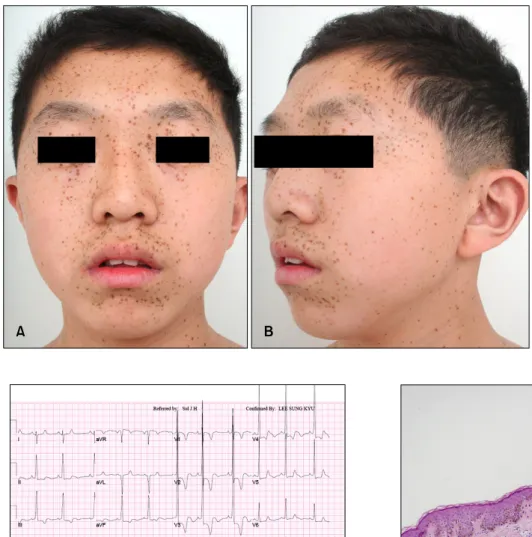
A 16 year-old male visited our clinic with multiple dark macules of varying size over his whole body from the age of 2 years associated with pigmented macules on the face, trunk, and upper extremities (Fig. 1). He had been diagnosed as hypertrophic cardiomyopathy (HCMP) at the age of 1 and for which he has been managed with a beta blocker. In addition, he developed severe bilateral neu- ronal deafness and underwent a cochlear implant in his right ear at the age of 5. His development suffers delay: he sat at 1 year, walked at 2 years, and experienced speech delay. His height and weight were below the 25th per- centile. However, no other family members are similarly affected.
Physical examination revealed ocular hypertelorism (inter- pupillary distance 5.6 cm, >97th percentile), mandibular prognathism, and posteriorly rotated ears. His genitalia was normal on physical examination. Twelve-lead electro- cardiograph (EKG) (Fig. 2) showed right-axis deviation, ST-segment abnormalities, and T-wave inversion. Echocar- diogram (Fig. 3) showed hypertrophic obstructive car- diomyopathy with thickened interventricular septum and systolic anterior motion of the mitral valve leaflets.
However, there were no abnormalities on chromosomal study. Skin biopsies were performed on the face and trunk. Histopathologically, the lesion from the trunk showed a slight elongation of the rete ridges and increase in melanocyte concentration in the basal layer (Fig. 4).
The pathologic diagnosis was consistent with lentigo simplex. Based upon the clinical, pathologic, and echo- cardiographic findings, a diagnosis of LS was made. After obtaining the patient’s consent, mutation analysis of PTPN11 was performed. Genomic DNA for germ-line
LEOPARD Syndrome with PTPN11 Gene Mutation
Vol. 23, No. 2, 2011 233 Fig. 1. (A) Numerous brownish macules on the face with ocular hypertelorism. (B) Low set, post- eriorly rotated ears and mandibular prognathism.
Fig. 2. Twelve-lead EKG shows right-axis deviation, ST-segment abnormalities and T-wave inversion.
Fig. 3. Echocardiographic analysis showed hypertrophic obstruc- tive cardiomyopathy with thickened interventricular septum and systolic anterior motion of the mitral valve leaflets.
Fig. 4. Histopathologic findings of pigmented macules revealed slight elongation of the rete ridges with increased melanocytes in the basal layer (H&E stain, ×100).
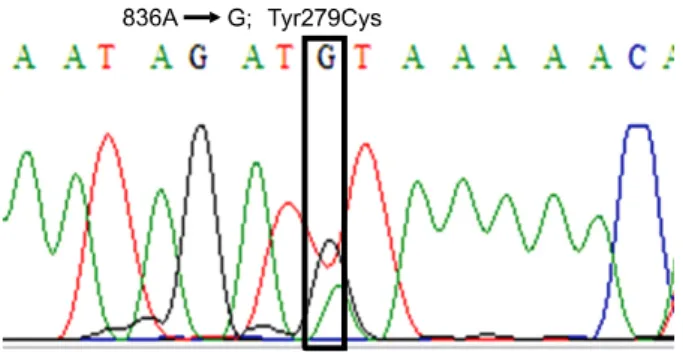
mutation analyses was prepared from peripheral blood leukocytes. We performed polymerase chain reaction amplification of all 15 exons and introns of PTPN11, and sequenced all of exon and intron junctions bilaterally. We found missense mutation (836A3G; Tyr279Cys) in exon 7 (Fig. 5).
We treated the lentigines on face with a triple combi- nation cream of 0.05% tretinoin, 4.0% hydroquinone, and 0.01% fluocinolone acetonide (Tri-LumaⓇ, Hill Derma- ceutical, Inc., Stanford, CA, USA) and the affected lesions showed slight improvement after 2 months of therapy.
J Kim, et al
234 Ann Dermatol
Fig. 5. Mutation analysis of PTPN11 gene revealed a missense mutation 836A→G in exon 7.
DISCUSSION
The LS is coined by Gorlin et al.2 in 1969 based on an acronym of multiple lentigines, EKG conduction abnor- malities, ocular hypertelorism, pulmonary stenosis, abnor- mal genitalia, growth retardation, and sensorineural deafness. This condition is also known as multiple len- tigines syndrome, cardio-cutaneous syndrome, Moynahan syndrome, lentiginosis profusa, and progressive car- diomyopathic lentiginosis. About 200 patients have been reported in the English literature, but only seven cases of LS have been reported in the Korean dermatologic literature3-9.
The most plausible explanation for the pathogenesis of LS is neural crest cell abnormality associated with PTPN11 gene mutation, which codes for non-receptor protein tyrosine phosphatase, SHP21,10, which plays important roles in cell proliferation, differentiation, migration and adhesion. To the best of our knowledge, only 11 different missense PTPN11 mutations in exon 7, 12 and 13 have been reported. Recently, missense mutations in the RAF1 gene have been found in two out of six PTPN11-negative LS patients11. However, all of 7 reported LS cases in the Korean dermatologic literature did not include mutation analysis of the PTPN11 gene. In our patient, mutation analysis of the PTPN11 gene revealed a missense mutation (836A→G; Tyr279Cys) in exon 7, which is one of two frequent mutations that constitute more than 60%
of cases. We did not, however, investigate for RAF1 gene mutation.
The presence of lentigines remains an aesthetic problem, since malignant transformation of the lentigines has not been reported. Kontoes et al.12 reported successful use of intense pulsed light for the treatment of lentigines in a patient with LS. Lee et al.9 reported that alexandrite laser treatment was effective for the treatment of lentigines in a 11-year-old patient with LS. Our patient was treated by triple combination cream containing 0.05% tretinoin,
4.0% hydroquinone, and 0.01% fluocinolone acetonide (Tri-LumaⓇ) for 6 weeks and slight improvement was noted.
In general, the long-term prognosis of LS patients varies with the type of cardiac anomalies. Among patients with PTPN11 mutation, an association between exon 7 and exon 12 mutations with HCMP has been established13. Our patient experienced cyanosis and dyspnea after delivery secondary to HCMP with pulmonary valve stenosis for which he is undergoes periodic cardiology assessment. In addition, Seishima et al.14 suggested that PTPN11 mutation have specific tumorigenic effect re- cently. Due to the rarity of malignant cases associated with LS, the association is inconclusive. However, acute lymphoblastic leukemia15, acute myeloid leukemia16, and multiple granular cell tumor17 associated with LS with mutation in PTPN11 gene have been reported. Although predisposition of malignancy in LS remains debatable, LS patients with PTPN11 mutations should be closely monitored for malignancy, particularly during their childhood. Identification of PTPN11 gene mutation in LS would be a good marker to estimate prognosis. Our patient receives regular dermatological review to monitor for the development of malignancy.
REFERENCES
1. Sarkozy A, Conti E, Digilio MC, Marino B, Morini E, Pacileo G, et al. Clinical and molecular analysis of 30 patients with multiple lentigines LEOPARD syndrome. J Med Genet 2004;
41:e68.
2. Gorlin RJ, Anderson RC, Blaw M. Multiple lentigenes syndrome. Am J Dis Child 1969;117:652-662.
3. Paik SA, Kook HI. A case of multiple lentigines syndrome.
Korean J Dermatol 1978;16:131-136.
4. Park JH, Lee CY, Kim DH, Kim KH. A case of multiple lentigines syndrome. Korean J Dermatol 1985;23:100-104.
5. Shin DY, Koo DW, Roh JY. A case of multiple lentigines syndrome. Ann Dermatol 1997;9:219-223.
6. Kim SJ, Seo PS, Yoon NH, Park SD. A case of multiple lentigines sydrome with a family history of multiple lentigines. Korean J Dermatol 2004;42:1581-1584.
7. Lee ES, Ko SH, Chi JS, Hur M, Park HM. A case of leopard syndrome associated with pure gonadal dysgenesis. Korean J Obstet Gynecol 2002;45:1273-1276.
8. Lee SG, Lee SY, Im SH, Yoo KD, Baek SH, Kim CM, et al. A case of LEOPARD syndrome with cor triatriatum. Korean J Med 2003;65:99-103.
9. Lee HJ, Chung HJ, Cho YH, Chung KY. A case of LEOPARD syndrome. Korean J Dermatol 2005;43:949-952.
10. Digilio MC, Conti E, Sarkozy A, Mingarelli R, Dottorini T, Marino B, et al. Grouping of multiple-lentigines/LEOPARD and Noonan syndromes on the PTPN11 gene. Am J Hum Genet 2002;71:389-394.
LEOPARD Syndrome with PTPN11 Gene Mutation
Vol. 23, No. 2, 2011 235 11. Pandit B, Sarkozy A, Pennacchio LA, Carta C, Oishi K,
Martinelli S, et al. Gain-of-function RAF1 mutations cause Noonan and LEOPARD syndromes with hypertrophic car- diomyopathy. Nat Genet 2007;39:1007-1012.
12. Kontoes PP, Vlachos SP, Marayiannis KV. Intense pulsed light for the treatment of lentigines in LEOPARD syndrome.
Br J Plast Surg 2003;56:607-610.
13. Sarkozy A, Conti E, Seripa D, Digilio MC, Grifone N, Tandoi C, et al. Correlation between PTPN11 gene mutations and congenital heart defects in Noonan and LEOPARD syndromes. J Med Genet 2003;40:704-708.
14. Seishima M, Mizutani Y, Shibuya Y, Arakawa C, Yoshida R, Ogata T. Malignant melanoma in a woman with LEOPARD syndrome: identification of a germline PTPN11 mutation
and a somatic BRAF mutation. Br J Dermatol 2007;157:
1297-1299.
15. Laux D, Kratz C, Sauerbrey A. Common acute lymphoblastic leukemia in a girl with genetically confirmed LEOPARD syndrome. J Pediatr Hematol Oncol 2008;30:602-604.
16. Uçar C, Calýskan U, Martini S, Heinritz W. Acute myelo- monocytic leukemia in a boy with LEOPARD syndrome (PTPN11 gene mutation positive). J Pediatr Hematol Oncol 2006;28:123-125.
17. Schrader KA, Nelson TN, De Luca A, Huntsman DG, McGillivray BC. Multiple granular cell tumors are an asso- ciated feature of LEOPARD syndrome caused by mutation in PTPN11. Clin Genet 2009;75:185-189.