Research Trends of the Korean Urban Geography: 1960~2012
Jae-Heon Choi* ‧ Young-Woo Nam**
한국 도시지리학 연구동향: 1960~2012년
최재헌*·남영우**
Abstract : The development of Korean urban geography can be divided into several stages including initial stage, transition stage, and maturation stage. If this trend persists, it can be expected that it would turn into the matured stage. This paper intended to recall the research trends from 1960 to 2012, focusing on 686 papers and 177 books published during the last 62 years, and investigated by research areas, study regions, methodologies, and journals in relation to urban geography. Although increasing number of urban geographers has made mutual relationship more complex and diverse, no signs of school formation have yet been seen in Korean urban geography. Large portions of papers have concerned about Seoul Metropolitan Region for their study regions. There have been diversified trends of oversea studies away from the US cities to other cities in various countries. Also, quantitative studies have been increasing their weight since the 2000s. Moreover, articles on the Journal of the Korean Urban Geographical Society have been far surpassed in its number.
Key Words : Korea, urban geography, Korean Urban Geographical Society, Korean Geographical Society, urban studies
요약 : 한국도시지리학의 태동기 → 성립기 → 전환기 → 절정기로 구분될 수 있으며, 이러한 추세가 지속된
다면 향후 성숙기의 단계로 접어들 것으로 전망된다. 본 연구는 한국도시지리학의 연구동향을 회고하기 위해 1960~2012년의 62년간 출간된 논문 686편과 단행본 177권을 연구영역별·연구지역별·분석방법별 및 학회지 별로 고찰한 것이다. 도시지리학자의 수적 증가에 따라 학자들 간에 상호관계가 더 복잡하고 다양하게 나타나 고 있으나 학파의 징후는 아직 보이지 않고 있다. 도시연구지역은 여전히 수도권을 대상으로 한 논문이 많고, 해외의 경우는 미국도시로부터 벗어나 다양화되어가고 있음이 밝혀졌다. 도시연구방법은 계량화가 더 많아지 는 경향이 있고, 2000년 이후부터는 한국도시지리학회에 게재된 논문이 국내 학회지 중 가장 많았다.
주요어 : 한국 도시지리학, 한국도시지리학회지, 대한지리학회, 도시연구
* Professor, Department of Geography, College of Science, Konkuk University, [email protected]
** Professor, Department of Geography Education, Korea University, [email protected]
1. Introduction
It was since the late 1960s that urban geography courses have differentiated from settlement geography
in university curriculum of Korea. However, there
were few research activities in the field of urban geog-
raphy except for a handful of scholars from 1945 when
Korean Geographical Society was founded, to 1963
when the first geographical journal was published
Jae-Heon Choi·Young-Woo Nam
(Park, 1983). Research activities in the field of urban geography have produced feasible outcomes since the late 1960s when geography related departments were installed in the universities and Korean Urban Geo- graphical Society was established in the late 1990s. Es- pecially, urban geography among the field of system- atic geography showed remarkable research activities compared to other systematic geography in geographi- cal development (Nam, 1996). It was such geographers as Lee Jiho, Hong Kyunghee, Lee Hansun, and Lee Yongtaek who made cornerstones for development of Korean urban geography. Afterwards, geographers such as Park Young-Han, Lee Ki-Suk, Kim Inn, Kang Dae-Hyon, Sung Junyong, and Choi Ki-Yeop have contributed to make sound roots of Korean urban ge- ography.
In the 1960s, Korea had experienced rapid economic development with remarkable urbanization and ur- ban growth. Thus, the study of urban geography in the 1970s, along with South Korea’s rapid economic growth, focused upon urbanization and urban growth.
The Korean urban geography in the 1970s was in a pe- riod of transition as western theories of both urban sys- tem and urban structure were introduced and verified.
Since the 1980s, the number of urban geographers and their research performances have been drastically increased. In particular, from 1988 to 1989 and from 2000 to 2001, the number of publications in urban geography have almost reached amount of the level of advanced countries.
Heated research on urban geography was revived in the late 1990s after a sightly cool-down period in the early 1990s due to the establishment of the Korean Ur- ban Geographical Society in 1997 and publishing first journal from 1998. During this period of the 1990s, research subjects on urban structures and the urban economy were flourished and the topic of urban trans- port was considerably being noticed. However, despite the growing base of urban geography throughout the
1990s, there was an imbalance between qualitative and quantitative growth of urban research (Nam and Lee, 2002). Nevertheless, inauguration of the Korean Ur- ban Geographical Society was appropriate enough to resolve the imbalanced growth between the quantity and quality of urban geography, playing an decisive role in the development of Korean urban geography.
Previously, research trends of Korean urban geogra- phy were statistically analyzed by Nam (1996, 2002).
Referring to the results of these previous studies, this paper intended to additionally analyze the research trends from 2002 to 2012 by adding 10 years of works.
As a result, this study retrospectively investigated re- search trends of Korean urban geography over a half- century from 1960 to 2012.
1)First, this study mainly adopted analytical frame- work from previous studies (Nam, 1996; Nam & Lee, 2002) for consistency with reference of P. Schöller (1973) who summarized the world trends of urban geography by linguistic areas. Secondly, this study mainly analyzed relevant papers on six journals listed on the Korea Research Foundation unlike the previous studies that included university journals and proceed- ings.
2. Research Trends by Thematic Subjects and Scholars
1) Thematic Subjects
It is necessary to classify the research into thematic categories for the reflection of the last 52 years of Ko- rean urban geography. Thus, it classifies the research subjects into seven thematic categories according to the previous studies (Nam and Lee, 2002), including
① urban population and urban function, ② urban
structure, urban system and CBD, ③ urbanization,
urban field, and new towns, ④ urban location and urban form, ⑤ urban policy, ⑥ city in general, urban history and urban transportation, ⑦ urban economy, urban redevelopment and urban culture. Such themat- ic classification framework is applied from the previous studies of Kang Dae-Hyun (1976) and Park Young- Han (1983) as well as Jones (1973) of UK and Kiuchi and Masai (1973) of Japan.
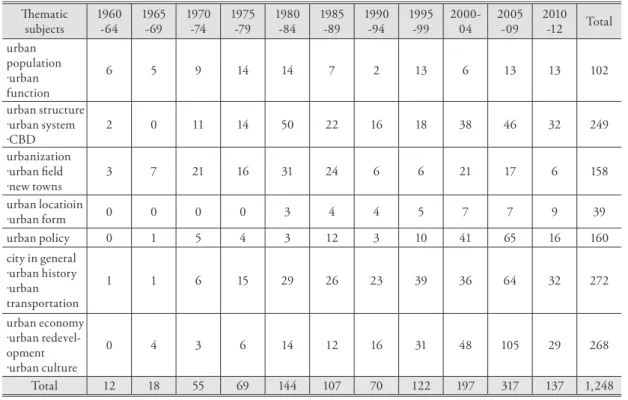
2)As shown in Table 1, the early period of urban geog- raphy revealed few issues that are debatable. Research topics were limited upon urban population, urban function and urbanization. However, at the turn of the 1970s, research topics became diverse. The degree of diversification was heightened in the 1980s.
Until the 1990s, major urban studies in Korea have contained those subjects of urban structure, urbaniza- tion, urban system, and urban economy respectively in firm position. Particularly, studies on urbaniza- tion with rapid urban growth have been increased
along with those of urban system. Yet, this trend was changed to a certain extent at the turn of the 2000s.
Although studies on urban structure and urban system continuously grew, remarkable increases have been noticed on the subjects such as urban policy, urban economy, urban social geography and urban culture respectively. As a whole, an excellent field of urban structure and urban system has kept its dominant po- tion. However, from the late 2000s, urban history and urban transport studies have been rapidly increased with the approaches from historical and transporta- tion geography (Figure. 1).
On the other hand, urban geography books were being published about two to four books per year from the 1960s to the 2000s. However, since the mid- 2000s, book publications have grown remarkably at the peak year with almost 29 books being published.
Published books reached its peak both in 2008 and in 2011, more than 10 copies at least, in particular.
Table 1. Research trend by thematic subjects (1960-2012) Thematic
subjects 1960 -64 1965
-69 1970 -74 1975
-79 1980 -84 1985
-89 1990 -94 1995
-99 2000-
04 2005
-09 2010 -12 Total urban
population
·urban function
6 5 9 14 14 7 2 13 6 13 13 102
urban structure
·urban system
·CBD 2 0 11 14 50 22 16 18 38 46 32 249
urbanization
·urban field
·new towns 3 7 21 16 31 24 6 6 21 17 6 158
urban locatioin
·urban form 0 0 0 0 3 4 4 5 7 7 9 39
urban policy 0 1 5 4 3 12 3 10 41 65 16 160
city in general
·urban history
·urban transportation
1 1 6 15 29 26 23 39 36 64 32 272
urban economy
·urban redevel- opment
·urban culture
0 4 3 6 14 12 16 31 48 105 29 268
Total 12 18 55 69 144 107 70 122 197 317 137 1,248
Jae-Heon Choi·Young-Woo Nam
For instance, books published in the 2000s included
“World Cities”, “Global Cities in the Era of Globaliza- tion”, “City and Land in the Era of Globalization”,
“Urban Geography and Urbanology”, “Changing
Urban Structure of Seoul”, “Urban Spatial Structure”,
“Urban History Seen by a Geographer”, etc.
3). More- over, some translated books for geography readers were noteworthy to be published including “Discourse of Figure 1. Research trends of urban geography in Korea by thematic subjects (%)
Figure 2. Number of published books in Korean urban geography
Urban Planning in Tokyo”, “Urban Order,” as well as
“Urban Geography”, “City and Creative class”, “Ex- ploring Urban Communities”, “Urban Social Geog- raphy”.
4)Nevertheless, urban geography textbooks at the introductory level have been diminished as authors have retired without satisfactory replacement for the introductory urban geography books.
2) Research Trends by Scholars
Many researchers in Korean geography have been produced whereas urban geography took roots in South Korea in the last 50 years. Especially, since the 1970s, both scholars who studied in domestic uni- versities and scholars who studied abroad have given considerable impacts upon the development of urban geography and urban studies in Korea. As the number of scholars who studied abroad have increased in the 2000s, the research fields and approaches have been more diversified afterwards.
Under these circumstances, it would be more in- teresting to analyze the mutual relationships between scholars in urban geography. Similarly, W. Bunge (1961) had examined cross-citations for papers
5)on three academic journals in the United States, identi- fying presence of the four academic schools such as Washington, Iowa, Wisconsin, and Middle school in US geography. Also it pointed out that distinctiveness of study subjects, study areas, study approaches has been notified between the school of American geogra- phers.
In order to identify the school formation in Korean urban geography, this paper applied multidimensional scaling analysis into OD matrix which was created by cross-citations by authors on papers published in six journals related to urban geography. In the previous studies, two academic groups were identified. How- ever, it was not the result of school formation, but was just originated from difference between research sub-
jects.
In this study, geographers registered for the mem- ber of the Korean Geographical Society and full-time faculty members were included in the OD matrix for analysis. Multidimensional scaling analysis (MDS) which is a technique to restore multidimensional space potential in the OD matrix structure can reveal mutual closeness among urban geographers. Figure 3 shows two dimensions of MDS calculated from 48×48 interaction OD matrix during 2002~2012.
Figure 3 shows fairly dispersed pattern unlike ag- gregated patterns from previous studies during 1960- 2002. The previous studies showed concentrated pattern in 2 and 3 grids separated by 1 dimension and 2 dimension, while the result of analysis from 2002 to 2012 revealed evenly scattered pattern in four grids.
This result shows more complex and diversified mutual closeness between urban geographers in accordance with the increasing number of urban scholars.
Specifically, two groups are formed in a weak state.
For instance, Jeon Kyung-Sook, Choi Jae-Heon,
Ryu Yeon-Taek, Sohn Jungyul, and some others have
formed one group while Park Bae-Gyoon, Ryu Ju-
Hyun, Kwon Sangcheol and some others have formed
another group in a weak state. Additionally, there are
independent scholars who don’t belong to any other
group such as Kim Kamyoung, Kang Youngok, Ahn
Young-Jin, Lee Sang-Il, Kwon Yongwoo and more. In
other words, there are no consistent pattern of urban
studies in the Korean geography, which, furthermore,
implies no such formation of academic schools as has
been found in the previous studies.
Jae-Heon Choi·Young-Woo Nam
3. Research Trends by Studying Region
It would be interesting to analyze which cities are se- lected the most for studying regions for Korean urban geographers. It is because such an attempt indicates the cities that urban geographers are most interested in. Most of the papers for analysis, accounting for the total of 1,865 papers (617 papers for previous studies, 1248 papers for current study), are in regard to either a particular city or a group of cities for their study area.
In previous studies, research on Seoul Metropoli- tan Area accounted for 56.4% with the largest por- tion, whereas the current analysis during 2001~2010 showed 167 cases for Seoul Metropolitan Area, ac-
counting for 55.9% of the total. Then, Youngnam Region took the next largest portion, accounting for 23.1% out of total papers. Thus, the studies of both SMR and Yongnam Region consisted the majority of the national urban studies. These phenomena have earnestly been noticed since the 1970s, which can be explained by both concentration of geography related departments and their graduates into two regions, and the nature of highly urbanized areas for these two regions. Nevertheless, studies about Chungcheong-do was just accounted for 10.9%, while those of Honam Region was far less accounted for 9.6%. It is notewor- thy that studies about cities of North Korea emerged during 2001~2010 unlike previous studies (Figure 4).
The research papers dealing with foreign cities in-
cluded 52 papers in the previous studies. However,
Figure 3. Closeness between geographers from cross-citations
the number of papers about foreign cities increased to 124 papers during 2001~2010. In the 1960s, only do- mestic cities were mainly concerned, but in the 1970s, overseas cities began to be concerned intermittently in urban geography. This trend lasted until the 1990s as shown in Figure 5. Then, studies of overseas cities have risen dramatically to 23.5% in the 2000s. It would be explained by the increasing number of Korean scholars who graduated from oversea countries from the 1970s to the 2000s as well as by increasing concerns about oversea cities due to globalization. It is important that increasing interests in overseas cities by Korean geographers can be attributed to the diversification of studying areas as well as internationalization of Ko- rean urban geography in the globalized world. Figure 5 showed such details of oversea studies in the Korean urban geography.
There were big differences before and after the 2000s by countries. The studies of the US cities were the most common like the previous studies, but its proportion showed a significant reduction from 47.4%
to 8.3% of all. It gave a glimpse that Korean urban ge- ographers diversified their regional interests away from the US to other various countries. Moreover, the next large portion went to Chinese cities which accounted for 3.6%, outpacing those of Japanese cities which were taken 2.4%. A study comparing domestic cities with overseas cities accounted for 1.7% of the total.
These changes in South Korea would be an evidence that urban geographers turned their eyes abroad and started to pay attention to the global research (Figure 6).
Figure 4. Research trends by studying areas
Jae-Heon Choi·Young-Woo Nam
Figure 5. Research trend by research areas
Figure 6. Research trends by countries
4. Research Trends by Method- ologies and Academic Journals
1) Research Trends by Methodologies
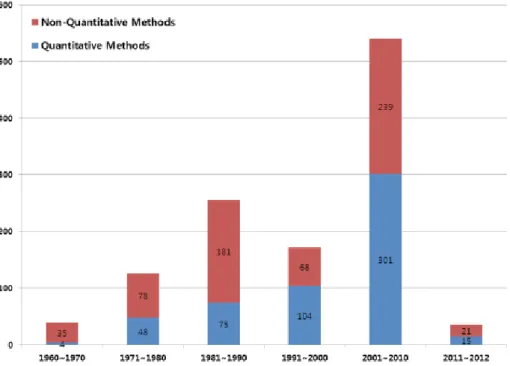
The quantitative revolution that was at its peak around the year 1960 affected the geography in South Korea ten years later. Urban geography, both in the United States and South Korea, played a leading role in the introduction of quantitative analysis. As shown in Figure 7, the introduction of quantitative methods has been in earnest since the 1970s. According to pre- vious research, those papers using quantitative meth- ods amounted to 38.9% of the whole published papers in the field of urban geography. However, since 2000, the proportion of papers of quantitative methods have increased to 55.7% of all.
So to speak, although quantification of urban geog- raphy has begun since the 1970s, the proportion has
quite reversely increased in the 1990s. Especially, surge in quantitative techniques in urban studies attrib- uted to applying GIS and spatial statistics into urban analysis from the 2000s. However, it is argued that the misuse and abuse of quantitative techniques should be avoided even if the development of computers and the new programs can improve the research quality of urban geography (Nam, 2002).
Recently, such concerns of misuse or abuse are becoming a reality in application of spatial statistics with GIS into urban geographical studies. There has been a tendency that researchers prefer to use program packages from adjacent fields without knowing the al- gorithms, even if conventional analytic techniques can be used for geographical analysis. If statistical tech- niques are applied without understanding the quanti- tative algorithm, there are more chances of errors and mistakes leading to fallible spatial analysis. Further- more, geographical research works are inherently to identify the geographic locality. Therefore, it is impor-
Figure 7. Research trends by methodologies
Jae-Heon Choi·Young-Woo Nam
tant to avoid just exhibition of various techniques of methodology without concerning any geographical discourse.
2) Research Trends by Academic Journals
Up to now, there are six geography-related journals listed on the Korea Research Foundation, including Journal of the Korean Geographical Society, Journal of the Korean Urban Geographical Society, Journal of the Economic Geographical Society of Korea, Journal of the Korean Association of Regional Geographers, Journal of Cultural and Historical Geography, and Geographical Journal of Korea. Unlike the previous studies, this one only examined the six journals to identify the ones that are published on urban geogra- phy research. The reason is that geographers are reluc- tant to submit their papers on university journals or proceedings which are not counted for their academic performance and have ceased their publications.
Urban geography-related papers began to show full-
fledged growth from the mid-1980s (Nam and Lee, 2002). A surge in urban geography research has shown since the late 1990s because the Journal of the Korean Urban Geographical Society launched in 1998, pro- ducing lots of urban geography-related papers. Korean Urban Geographical Society has empowered in the 2000s as Korean university vigorously introduced the faculty evaluation system which has been more emphasized upon papers on the listed journals on the Korea Research Foundation in the evaluation and pro- motion.
Since the 2000s, the number of urban geography- related articles on each Journal was published in the following order: Journal of the Korean Urban Geo- graphical Society (24.2%), followed by Geographic Journal of Korea (21.6%), Journal of the Korean Geo- graphical Society (20.6%), Journal of the Korean As- sociation of Regional Geographers (16.4%), Journal of the Economic Geographical Society of Korea (10.0%), and Journal of Cultural and Historical Geography (7.2%). Compilation of the total during the past half-
Figure 8. Urban geography related articles by journals
century revealed the highest number of 179 articles on the Journal of the Korean Geographical Society, but its share has been decreased as professional societies were founded in the 1990s (Figure 8). Also, urban-related papers are evenly published on several academic journals because of existence of common academic interests and personal preference on journals for paper submission
6).
5. Conclusion
This study examined 686 papers and 177 books in relation to urban geography from 1960 to 2012 in order to recall the research trends in terms of research areas, study regions, methodologies, and journals. The results can be summarized as follows.
First, Korean urban geography was established after the liberation in 1945. When the Korean Geographical Society was founded in the 1960s, it was recognized as a part of settlement geography. The Korean urban ge- ography passed through the initial stage in the 1970s, and then entered the transition stage in the 1980s with a growing foundation of geography. The 1990s was a continuing unabated maturation stage. Then, Korean urban geography was brought to its peak in the 2000s and turning into the matured stage if this trend persists. Therefore, the development of Korean urban geography can be phased into initial stage, transition stage, maturation stage, and matured stage.
Second, looking at the research trends by thematic area, both urban structure and urban system have taken dominant position while urban transport sector and urban history have showed rapid increase since the late 2000s. Although published books took only 2-4 volumes per year from the 1960s to the 2000s, the number reached its peak exceptionally in 2008 and 2011.
Third. after applying multi-dimensional scaling method into 48×48 OD matrix made by registered full time faculty members of Korean Geographical Society, mutual closeness between urban geographers was iden- tified. The result showed evenly scattered pattern over dimensions during 2002-2012 unlike previous studies, implying complex and diversified mutual closeness between the urban geographers in accordance with the increasing number of scholars. There were still no clear sign of school formation in Korean urban geography.
Fourth, research trends by study area showed that Seoul Metropolitan Area (55.9%) and Youngnam Region (23.1%) have taken dominant portions in the Korean urban geography respectively. It is because these two regions have most of the geography-related departments and graduates as well as highly urbanized areas that need to be studied. Overseas studies have di- versified away from the dominance of the US cities to other cities in various countries in spite of continuing US dominance.
Fifth, in terms of research methodologies, quantita- tive methods have played dominant role in the urban geography research since the 1970s. The number of quantitative papers have increased their portions from 38.9% before the year of 2000 to 55.7% after 2000.
This is partly related to the introduction of spatial sta- tistics with GIS methods and fast development of com- puter related analytical techniques since the 1990s.
Urban geography-related articles were published
mostly in the Journal of the Korean Urban Geographi-
cal Society, then followed by Geographical Journal of
Korea, Journal of the Korean Geographical Society
and others in order, which suggests common base of
research interests and scholars personal preference for
paper submission.
Jae-Heon Choi·Young-Woo Nam
Acknowledgement
Authors would like to express special thanks to Mr. YOON Hyun Wi, Department of Geography, Konkuk University, for data collection and analysis
Footnotes
1) This paper only analyzed published materials before June, 2012 when it is written.
2) This report was collection of papers presented in IGC urban commission held in Canada in 1972.
3) These books refer to Nam YW, Lee HY, Choi, JH (2000), Kim I (2005), Nam Y W (2006), Son SH & Nam Y W (2006), Nam YW, Coi, JH, Son SH (2009), Kim I, Park SJ et. al (2011), Nam YW (2007; 2011).
4) These translated books refer to Jang JH (2006), Lee HW, Lee BG (2001), Yoo HJ (2011), Lee WH (2008), Shin JY et.al (2011), Park KH, Ryu YT, Jeong HJ, Lee YG (2012).
5) 60 geographers were considered who published their paper in Annals of the Association of American Geographers, Economic Geography, and Geographical Review during 1958-1960.
6) Authors didn’t mention individual name of Korean urban geographers due to the limit of pages.
References