Korean J Pain 2012 October; Vol. 25, No. 4: 272-274 pISSN 2005-9159 eISSN 2093-0569
http://dx.doi.org/10.3344/kjp.2012.25.4.272
| Brief Report |
Mirror Therapy for Phantom Limb Pain
Department of Anesthesiology and Pain Medicine, School of Medicine, Keimyung University, Daegu, Korea
Sae Young Kim, MD, and Yun Young Kim, MD
Phantom limb pain is a painful sensation that is perceived in a body part that no longer exists. To control this pain, many methods have been used such as medication, physical treatment, nerve block, neuromodulation, surgical treatment and mirror therapy. However, until now, there effects have been uncertain. We report the successful reduction of phantom limb pain using mirror therapy when other treatments initially failed to control the pain. (Korean J Pain 2012; 25: 272-274)
Key Words:
amputation, mirror neurons, phantom limb pain.
Received June 28, 2012. Revised July 9, 2012. Accepted July 10, 2012.
Correspondence to: Sae Young Kim, MD
Department of Anesthesiology and Pain Medicine, School of Medicine, Keimyung University, 194 Dongsan-dong, Jung-gu, Daegu 700-712, Korea Tel: +82-53-250-7587, Fax: +82-53-250-7240, E-mail: [email protected]
This is an open-access article distributed under the terms of the Creative Commons Attribution Non-Commercial License (http://
creativecommons.org/licenses/by-nc/3.0/), which permits unrestricted non-commercial use, distribution, and reproduction in any medium, provided the original work is properly cited.
Copyright ⓒ The Korean Pain Society, 2012
Phantom limb pain is a painful sensation that is per- ceived within a body part that no longer exists [1]. This pain was first introduced by Ambrose Pare, a French army surgeon in the mid-16th century. Numerous research studies on phantom limb pain have been done since then due to in part the enormous number of patients who lost body parts during the First and Second World Wars.
However, its components of pathological physiology and etiology have not yet been clearly elucidated.
More than 50-85% of phantom limb pain develops af- ter amputation. It can develop immediately after an ampu- tation procedure. Half of all patients suffer the pain within 24 hours after the amputation. About 75% of the patients experience the pain within a few days after amputation [2-4]. The frequncey of the pain or its severity can be re- lieved over time; however, cases of no change and even increases in pain have also been reported [5].
The treatment for phantom limb pain includes medi-
cation, physical treatment, nerve block, neuromodulation, and surgical treatment. Nevertheless, any effects of these methods have not yet been proven. Herein, we report a case with the successful reduction of phantom limb pain using the mirror therapy when other treatments initially failed to control the pain.
CASE REPORT
A 30-year-old male patient received an above-elbow amputation about eight months prior to seeing us for an open fracture on the left radius and ulna due to trauma.
He ended up transferring from one department to another department since his condition did not improve at all during treatment due to constant and severe pain after the am- putation surgery. We could not find any specific findings in this medical history. He kept complaining about cramp- ing pain on his removed arm and electric-like pain occur-
SY Kim and YY Kim / Mirror Therapy for Phantom Limb Pain 273
www.epain.org
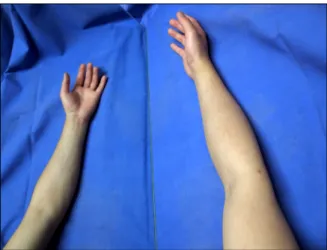
Fig. 1. Mirror image. The patient is watching the reflected image of his intact right arm.
ring once every few minutes. He also said that he felt the entire shape of his removed arm, and it was medially rotated. Every day, he was prescribed gabapentine (2,400 mg), oxycodon (200 mg), and amitriptyline (25 mg), with other medications to control the pain. However, the degree of his pain relief was somewhat insignificant and the visual analog scale (VAS) was 8-10 out of 10. Other treatment methods, such as stellate ganglion block, thoracic sym- pathetic ganglion block, brachial plexus block, cervical transforaminal epidural block, and a subcutaneous infusion of ketamine, were also done. However, they gave the pa- tient only short-term improvement. Lastly, spinal cord stimulation (SCS) was done for the patient, but the treat- ment effect was very insignificant.
Finally, we performed mirror therapy for the patient.
He had to visit the hospital four times a week and went through a 15-minute treatment period. We had the patient feel the movement of his removed arm and hand just like his normal arm and hand moving through a mirror (Fig. 1).
After a week passed, the patient said that he could feel his medially rotated arm was back to normal, and his VAS level decreased to 7 out of 10. One month later, he said that the previous cramping pain was almost gone and the phantom hand and arm returned to normal. At that time, his VAS level was 5 out of 10. After, three month from the initial therapy, he is doing a mirror therapy three to four times a week at home. However, the electric like pain re- mains and the VAS usually is maintained at 4 out of 10.
He is under follow-up at our outpatient department with oxycodon decreased to 100 mg a day.
DISCUSSION
No treatment for phantom limb pain has yet been clearly proven in terms of its effect. Drug therapy includes narcotic drugs, anti-epileptic medications, topical anes- thesia, and analgesics. An infusion of ketamine, a N- Methyl-D-aspartic acid receptor antagonist, was also in- troduced for phantom limb pain treatment [6]. Meanwhile, non-drug therapy includes sympathetic ganglion block, transforaminal epidural block, peripheral nerve block, transcutaneous electrical nerve stimulation (TENS), direct cortical or spinal cord stimulation, and mirror therapy, etc.
One of the most effective treatments is mirror therapy.
Mirror therapy was unveiled by Ramachandran and Rogers-Ramachandran in 1996. Under this therapy, a pa- tient is allowed to feel the imaginary movement of the re- moved body part behaving as normal body movement through a mirror [7]. The mirror image of the normal body part helps reorganize and integrate the mismatch between proprioception and visual feedback of the removed body.
Thus, enhancing the treatment effect for phantom limb pain. The clinical effect of mirror therapy is much more significant than any other treatments [4,8].
Rizzolatti used a mirror neuron to explain the funda- mentals of a mirror therapy [9]. At first, a mirror neuron was found in the monkey premotor cortex, and later, Rossi discovered that humans also have similar mirror neurons systems [10]. A mirror neuron fires both when a person acts and when a person observes the same action per- formed by another. Then, the neuron mirrors the behavior of the other, as though the observer were itself acting. A mirror neuron provides observers with internally recog- nized experiences, making them understand other’s be- haviors, intentions, and emotional status [9,10]. Therefore, while mimicking the behavior of the other, observers can experience not only the sensation, but also the similar emotion of the other. In this sense, a patient with phantom limb pain can feel the same sense or emotion of his/her normal body part by observing the mirror image. By doing so, it is expected to decrease pain by resolving conflict be- tween motor intention, proprioception and visual system.
Not all observing activities are accompanied by these sensory experiences of a mirror neuron. A person without phantom limb pain and no amputations cannot feel these sensory experiences since the signs from a non-mirror neuron block the mirror neuron, while a patient with an
274 Korean J Pain Vol. 25, No. 4, 2012
www.epain.org amputation does not have this non-mirror neuron system
operating [11]. The visual observation can help feeling em- pathy, which explains how the mirror therapy works for a patient.
The effect of the mirror therapy varies depending on the pain. It is reported that the therapy is more effective on deep somatic pain (e.g., pressure sense and proprio- ceptive pain) than on superficial pain (e.g., warmth sense and nociceptive pain). This is because deep tissues are re- sponsible for integrating sensorimotor nerves as well as creating movements compared to superficial tissues [12].
Recently, mirror therapy has used for not only patients with phantom limb pain, but also for patients with complex regional pain syndrome and strokes [13,14]. Many studies indicate that mirror therapy is only effective for upper limb treatment, but it has potential as alternative treatment for pain that is difficult to control.
In this study, mirror therapy resulted in dramatic pain relief for a patient with chronic phantom limb pain when other treatments such as medications, physical therapies, nerve blocks, nerve transformations did not work. Mirror therapy is expected to be widely used for the treatment of phantom limb pain since it is easy to use at both home and in outpatient departments.
REFERENCES
1. Weinstein SM. Phantom limb pain and related disorders.
Neurol Clin 1998; 16: 919-36.
2. Carlen PL, Wall PD, Nadvorna H, Steinbach T. Phantom limbs and related phenomena in recent traumatic amputations.
Neurology 1978; 28: 211-7.
3. Hayes C, Armstrong-Brown A, Burstal R. Perioperative intra- venous ketamine infusion for the prevention of persistent post-amputation pain: a randomized, controlled trial. Anaesth
Intensive Care 2004; 32: 330-8.
4. Weeks SR, Anderson-Barnes VC, Tsao JW. Phantom limb pain: theories and therapies. Neurologist 2010; 16: 277-86.
5. Nikolajsen L, Ilkjaer S, Krøner K, Christensen JH, Jensen TS.
The influence of preamputation pain on postamputation stump and phantom pain. Pain 1997; 72: 393-405.
6. Cheong YK, Lee C, Son Y, Song YK, Kim TY, Lee SW. The trial of continuous intravenous infusion of ketamine in patients with phantom limb pain: a case report. Korean J Pain 2006;
19: 233-6.
7. Ramachandran VS, Rogers-Ramachandran D. Synaesthesia in phantom limbs induced with mirrors. Proc Biol Sci 1996;
263: 377-86.
8. McCabe CS, Haigh RC, Halligan PW, Blake DR. Simulating sensory-motor incongruence in healthy volunteers: impli- cations for a cortical model of pain. Rheumatology (Oxford) 2005; 44: 509-16.
9. Rizzolatti G, Fogassi L, Gallese V. Mirrors of the mind. Sci Am 2006; 295: 54-61.
10. Rossi S, Tecchio F, Pasqualetti P, Ulivelli M, Pizzella V, Romani GL, et al. Somatosensory processing during move- ment observation in humans. Clin Neurophysiol 2002; 113:
16-24.
11. Ramachandran VS, Rogers-Ramachandran D. Sensations referred to a patient's phantom arm from another subjects intact arm: perceptual correlates of mirror neurons. Med Hypotheses 2008; 70: 1233-4.
12. Sumitani M, Miyauchi S, McCabe CS, Shibata M, Maeda L, Saitoh Y, et al. Mirror visual feedback alleviates deafferen- tation pain, depending on qualitative aspects of the pain: a preliminary report. Rheumatology (Oxford) 2008; 47: 1038- 43.
13. Rothgangel AS, Braun SM, Beurskens AJ, Seitz RJ, Wade DT.
The clinical aspects of mirror therapy in rehabilitation: a systematic review of the literature. Int J Rehabil Res 2011;
34: 1-13.
14. Ezendam D, Bongers RM, Jannink MJ. Systematic review of the effectiveness of mirror therapy in upper extremity function.
Disabil Rehabil 2009; 31: 2135-49.