INTRODUCTION
Mycobacterium lentiflavum is one of the slow-growing nontuberculous mycobacteria (NTM), whose colony is characterized by smallness, smoothness, and scotochromo- gen. The biochemical characteristics are similar to Myco- bacterium avium and closely related to Mycobacterium simiae and Mycobacterium genavense[1].
M. lentiflavum may be isolated from clinical specimens as a simple contaminant or may even be the causative organism of disease, both in immunocompetent and im- munosuppressed patients[2-4]. Haase and his colleagues reported M. lentiflavum as an etiological agent of cervi-
cal lymphadenitis in children[5]. The prevalence of the cases in which M. lentiflavum isolation may be clinically significant is approximately 10%[4].
The isolation of NTM always raises the question of its clinical significance because NTM can be found in nature.
Especially in countries where tuberculosis is still an issue of public health, NTM, as the name means, is easily over- looked as a contaminant in contrast to M. tuberculosis. However, NTMs are no longer simple contaminants, thus the accurate identification of a NTM species presages var- ious other necessary purposes such as diagnosis, treatment planning and patient prognostication.
Several molecular typing methods were used for species identification of NTM strains, including PCR-restriction fragment length polymorphism (PCR-RFLP) and the sequencing of some genes. In Korea, due to the simplici- ty and relatively cheap expenses, many laboratories pre- fer PCR-RFLP to sequencing, and the rpoB is the com- mon gene for identification of NTM species[6, 7]. Unfor- 124
대한진단검사의학회지 제27권 제2호 2007 Korean J Lab Med 2007;27:124-7
�증례
∙
임상미생물학�124
결핵으로 인한 폐 실질 파괴 환자의 객담에서 분리한 Mycobacterium lentiflavum 1예
Isolation of Mycobacterium lentiflavum from a Patient with a Lung Destroyed by Tuberculosis
Sue Shin, M.D.
1,3, Jong-Hyun Yoon, M.D.
1,3, Sang Hoon Song, M.D.
2,3, and Eui Chong Kim, M.D.
2,3신 수
1,3∙윤종현
1,3∙송상훈
2,3∙김의종
2,3보라매병원 진단검사의학과1, 서울대학병원 진단검사의학과2, 서울대학교 의과대학 검사의학교실3
124 124
접 수: 2007년 1월 11일 접수번호:KJLM2009 수정본접수: 2007년 2월 5일
게재승인일: 2007년 2월 5일 교 신저 자: 김 의 종
우 110-744 서울시 종로구 연건동 28 서울대학교병원 진단검사의학과 전화: 02-2072-3500, Fax: 02-747-0359
E-mail : [email protected]
Departments of Laboratory Medicine, Boramae Hospital1; Seoul National University Hospital2; Seoul National University College of Medicine3, Seoul, Korea
Mycobacterium lentiflavum has recently been described as an emerging human pathogen without regard to the immune status of the host. We herein report on M. lentiflavum isolated from a respiratory specimen of a patient. Although the organism described in this case seems to be a colonizer of a lung destroyed by tuberculosis, the current methods for species identification of nontuberculous mycobac- teria have to be re-evaluated so as not to underestimate these organisms. (Korean J Lab Med 2007;27:
124-7)
Key Words :Mycobacterium lentiflavum, 16S rRNA gene, Clinical specimen
Isolation of Mycobacterium lentiflavum from a Patient with a Lung Destroyed by Tuberculosis 125
tunately, the rpoB PCR-RFLP is insufficient in the accu- rate identification of some NTM species, especially for those species that are either newlydefined or infrequently isolated from clinical specimens.
Here we report on a M. lentiflavum from a respiratory specimen, which exhibited the phenotypic property of sco- tochromogen, as identified by sequencing analysis of 16S rRNA, the fragment including the hypervariable region (E. coli nt 180-420)[8, 9] or the hsp65 gene[10]. The clinical significance, though, is still unknown as this is the first report of M. lentiflavum from clinical specimens in Korea.
CASE REPORT
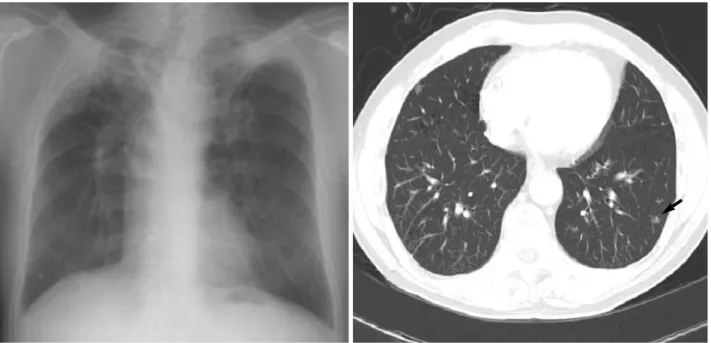
During a physician’s follow-up in 2002, it was discov- ered that a 69-yr-old man, with symptoms of hemopty- sis and a previous history of tuberculosis, had developed a new radiological lesion of the chest (Fig. 1). The man had had a history of pulmonary tuberculosis and had been taking medication for one year at another hospital about 18 yr ago. He had tested positive serologically for hepatitis B virus surface antigen and negative for HIV. His chest CT showed a newly discovered nodule in the left lower field of the lung previously damaged by tuberculosis. Bron-
choscopic findings were free of malignancy, and culture of his bronchial washing specimen had no growth of myco- bacteria. After the bronchoscopic examination, NTM were cultured from three successive sputums with a degree of 10 to 20 colony growth during a 14-month period.
The colonies were identified as M. lentiflavum by the sequencing of either 16S rRNA or hsp65 with 100% simi- larity of studied fragment. However, in the case of rpoB, the organism could not be designated as any specific spe- cies due to the lack of reference sequences. The drug sen- sitivity results performed by the Korean Institute of Tu- berculosis revealed resistance to isoniazid, rifampin, strep- tomycin, ethambutol, kanamycin, capreomycin, para-amino sulfuric acid, ofloxacin, and pyrazinamide; and suscepti- bility to only prothionamide and cyclocerine. Thereafter, for three years, the patient displayed no changes in symp- toms and in X-ray findings, and the patient received no treatment except for symptomatic therapy. None of the sputum cultures tested positive for AFB.
DISCUSSION
The present case represents the first isolation of M.
lentiflavum from a respiratory specimen in Korea, although its clinical significance is still unknown. It could only be
Fig. 1.(A) Simple chest PA done on May 13th, 2002: Lung destroyed due to tuberculosis with volume loss of both upper lung field. No definite change since May, 1998. (B) Routine chest CT done on April 25th, 2002: A new nodular lesion on left lower lung field (arrow) com- pared with October 30th, 2000.
126 신 수∙윤종현∙송상훈 외1인
a colonizer in the damaged lung, although, with the new radiological lesion, we could find no evidence of neoplasm or reactivation of tuberculosis. The same NTM species isolated during a 14-month interval is thought to be an true NTM pulmonary disease by the definition of the British Thoracic Society[11].
M. lentiflavum was thought to only cause lymphadeni- tis, but recently a few cases concerning pulmonary dis- eases has been reported in immunocompetent and immu- nocompromised patients as well[2-4, 13, 14].
The significance of this case is that an accurate iden- tification of M. lentiflavum cannot be made by the rpoB gene, which is generally used as the molecular method for the identification of NTM species in Korea[7-12]. We previously compared, with single strand sequencing easily available in clinical laboratories[15], the usefulness of sev- eral genes (16S rRNA, hsp65, and rpoB) in identifying NTM to the species level. With rpoB, there were no com- parable reference sequences of M. lentiflavum in BLAST (http://www.ncbi.nlm.nih.gov/BLAST). With PCR-RFLP of another segment of rpoB, a method that is widely used for the species identification of NTM in Korea[7], M.
lentiflavum was misidentified as M. szulgai, which is also a scotochromogen. It is not surprising that the misidentifi- cation occurred, because the methods of PCR-RFLP have inherent drawbacks, such as the problem of fragments shorter than 50 bp and a lack of standardization, in the identification of organisms. On the other hand, the avail- ability of PCR and DNA restriction techniques in any laboratory is an undeniable advantage. The problems of identification, as shown in most clinical laboratories, are ignoring the fortuitous organism or giving wrong name with one of the more well known species frequently iso- lated. These may lead to significant biases in epidemiolo- gical and drug susceptibility studies. M. lentiflavum is gen- erally resistant to antituberculous drugs (isoniazid, rifampin, ethambutol and streptomycin).
We emphasize the importance of accurate identification of NTM isolates in Korea so as not to underestimate the presence of the pathogen known as M. lentiflavum.
요 약
비결핵항산균 중Mycobacterium lentiflavum은 최근 국외에 서 숙주의 면역상태와 관계없이 질환을 일으키는 신생 병원균으
로 증례 보고되고 있다. 저자들은 호흡기 검체에서 분리된 M.
lentiflavum을 1예를 경험하였다. 비록 본 증례에서는 과거의 결 핵력으로 인해 파괴된 폐실질의 정착균일 가능성도 배제할 수는 없지만, 임상 검체에서 이렇게 드물게 분리되는 비결핵항산균을 정확히 동정하기 위해서는 현재의 일반적인 검사실 동정법에 대 한 재평가가 필요하다.
REFERENCES
1. Springer B, Wu WK, Bodmer T, Haase G, Pfyffer GE, Kroppenstedt RM, et al. Isolation and characterization of a unique group of slow- ly growing mycobacteria: description of Mycobacterium lentiflavum sp. nov. J Clin Microbiol 1996:34:1100-7.
2. Safdar A and Han XY. Mycobacterium lentiflavum, a recently identi- fied slow-growing mycobacterial species: clinical significance in immunosuppressed cancer patients and summary of reported cases of infection. Eur J Clin Microbiol Infect Dis 2005;24:554-8.
3. Molteni C, Gazzola L, Cesari M, Lombardi A, Salerno F, Tortoli E, et al. Mycobacterium lentiflavum infection in immunocompetent pa- tient. Emerg Infect Dis 2005;11:119-22.
4. Tortoli E, Mattei R, Russo C, Scarparo C. Mycobacterium lentiflavum, an emerging pathogen? J Infect 2005;52:185-7.
5. Haase G, Kentrup H, Skopnik H, Springer B, Bottger EC. Mycobac- terium lentiflavum: an etiologic agent of cervical lymphadenitis. Clin Infect Dis 1997;25:1245-6.
6. Kim BJ, Lee KH, Park BN, Kim SJ, Bae GH, Kim SJ, et al. Differenti- ation of mycobacterial species by PCR-restriction analysis of DNA (342 base pairs) of the RNA polymerase gene (rpoB). J Clin Microbi- ol 2001;39:2102-9.
7. Lee H, Park HJ, Cho SN, Bai GH, Kim SJ. Species identification of mycobacteria by PCR-restriction fragment length polymorphism of the rpoB gene. J Clin Microbiol 2000;38:2966-71.
8. Turenne CY, Tschetter L, Wolfe J, Kabani A. Necessity of quality- controlled 16S rRNA gene sequence databases: identifying nontu- berculous Mycobacterium species. J Clin Microbiol 2001;39:3637-48.
9. Harmsen D, Rothganger J, Frosch M, Albert J. RIDOM: Ribosomal Differentiation of Medical Micro-organisms Database. Nucleic Acids Res 2002;30:416-7.
10. Telenti A, Marchesi F, Balz M, Bally F, Bottger EC, Bodmer T. Rapid identification of mycobacteria to the species level by polymerase chain reaction and restriction enzyme analysis. J Clin Microbiol 1993;
31:175-8.
11. British Thoracic Society. Management of opportunist mycobacterial infections: Joint Tuberculosis Committee Guidelines 1999. Thorax 2000;55:210-8.
Isolation of Mycobacterium lentiflavum from a Patient with a Lung Destroyed by Tuberculosis 127
12. Kim BJ, Lee SH, Lyu MA, Kim SJ, Bai GH, Chae GT, et al. Identifi- cation of mycobacterial species by comparative sequence analysis of the RNA polymerase gene (rpoB). J Clin Microbiol 1999;37:1714-20.
13. Piersimoni C, Goteri G, Nista D, Mariottini A, Mazzarelli G, Borni- gia S. Mycobacterium lentiflavum as an emerging causative agent of cervical lymphadenitis. J Clin Microbiol 2004;42:3894-7.
14. Tortoli E, Bartoloni A, Erba ML, Levre E, Lombardi N, Mantella A, et al. Human infections due to Mycobacterium lentiflavum. J Clin Mic-
robiol 2002;40:728-9.
15. Shin S, Kim EC, Yoon JH. Identification of nontuberculous mycobac- teria by sequence analysis of the 16S ribosomal RNA, the heat-shock protein 65 and the RNA polymerase -subunit genes. Korean J Lab Med 2006;26:153-60. (신수, 김의종, 윤종현. 16S Ribosomal RNA, Heat- shock protein 65 및 RNA polymerage -subunit 유전자염기서열분 석을 통한 비결핵 마이코박테리아의동정. 대한진단검사의학회지 2006;
26:153-60.)