1
INTERACTIVE FEATURE EXTRACTION FOR IMAGE REGISTRATION
Jun-chul Kim
*, Young-ran Lee
*, Sung-woong Shin
**, Kyung-ok Kim
***
Image/System Group, Satrec Initiative Co.
461-26 Jeonmin-dong, Yuseong-gu, Daejeon 305-811, Korea, [email protected], [email protected]
**
Spatial Information Research Team, Telematics Research Division,
ETRI (Electronics and Telecommunications Research Institute), [email protected], [email protected]
ABSTRACT:This paper introduces an Interactive Feature Extraction (IFE) approach for the registration of satellite imagery by matching extracted point and line features. IFE method contains both point extraction by cross-correlation matching of singular points and line extraction by Hough transform. The purpose of this study is to minimize user’s intervention in feature extraction and easily apply the extracted features for image registration. Experiments with these imagery dataset proved the feasibility and the efficiency of the suggested method.
KEY WORDS: Feature Extraction, Image Matching, Image Registration
1.INTRODUCTION
Recently, there has been much research effort put into the field of feature extraction. Feature extraction is a technology that is used for the analysis and interpretation of data obtained by satellite and aerial photo imagery for a wide variety of tasks and applications. Moreover the feature extraction is basic step for image registration.
Especially, automated feature extraction tools and approach have been used on the image registration, triangulation and various parts. Automated feature extraction identifies relevant features and their outlines by post-processing digital imagery to enhance and isolate feature information. Post-processing techniques include mathematically strengthening feature to background contrast, eliminating image noise and pattern recognition.
However, automated feature extraction results cannot be expected to service as a final product. That should be reviewed and validated. Therefore, this paper introduces an interactive feature extraction method so that it can be easily applied to image registration.
2.
BACKGROND
Generally, many significant decisions are based on analysing information in images. Analysing processes usually involve image matching. Image matching is a well-developed mathematical discipline concerned with models and methods for decision process. Thus, the definition of image matching is that given pictorial description of region of a scene, determine which region in another image is similar. In this study, IFE method uses the cross correlation for point feature matching, and uses Hough transform for line feature extraction. Hough transform is an algorithm which generates straight line segments without intermediate chain code. The basic principle is to switch the roles of parameters and spatial variables.
3.
DATA PREPARATION
Datasets in this study are KOMPSAP-1, IKONOS imagery. Test areas are Nonsan and Daejeon in Korea.
Detail information is shown in Table 1.
Table 1. Test-bed Dataset
ID Type Desc. Date
eoc_a KOMPSAT-1
EOC, Nonsan, 6.6m res. 2000.5.1eoc_b KOMPSAT-1
EOC, Nonsan, 6.6m res. 2000.4.8pan_a IKONOS
PAN, Daejeon(N), 1m res. 2001.11.19pan_b IKONOS
PAN, Daejeon(S), 1m res. 2001.11.194.
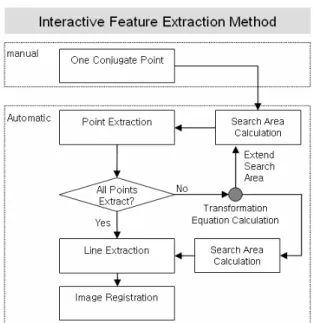
INTERACTIVE FEATURE EXTRACTION The procedure of IFE is described in a Figure 1. In the first step, at least one point is extracted as a conjugate point in each image by user. And the search area is calculated around a given conjugate point (Figure 2).
Then singular points are extracted in searching area of master image A. In the next step, the matching points are extracted in the search area of image B by cross- correlation method.
After above procedure is done, the searching area is extended gradually. Then same procedures are repeated in extended search area. Extracted points are used as the initial value of the next procedure, the transformation equation is completed by extracted points
After the points extracted, lines extraction is followed.
At the first, edges are detected by sobel mask ,then the
lines are extracted by Hough transform in master Image
A. Then, matched lines are extracted in slave Image B
using line-to-line matching method. In this case, potential
area is calculated easily by transformation equation
completed by point extraction step.
2
Figure 1. Image Registration with Interactive Feature
Extraction
Figure 2. Search Area
4.1Point Extraction
The proposed point extraction procedure is shown in Figure 3. Firstly, the point pattern (corner, pick, sink, cross etc) by interest point criteria is searched. Secondly the singular points are extracted and cross correlation matching is operated.
Figure 3. IFE: Flowchart of Point Extraction
4.1.1Singular Points Extraction
The automatic extraction algorithm of singular points is based on the moving window method. First of all, the point pattern (corner, pick, sink, cross etc) by interest point criteria (Figure 4) is searched. Secondly points with high standard deviation of center-pixel are extracted and neighbourhood-pixels at the last are extracted. An example of extracted cross-type singular point is shown in Figure 5.
Figure 4. Interest Point Criteria (Ex: corner type)
(KOMPSAT-1, Daejeon, Korea) Figure 5. Extracted Singular Point
4.1.2Cross Correlation Matching
Cross correlation is a standard method of estimating the degree to which two series are correlated. Consider two series x(i) and y(i) where i=0,1,2...N-1. The cross correlation r at delay d is defined as
(1)
where mx and my are the means of the corresponding seriesIf the above is computed for all delays d=0,1,2,...N-1 then it results in a cross correlation series of twice the length as the original series.
(a) pan_a
3
(b) pan_b
(c) eoc_a
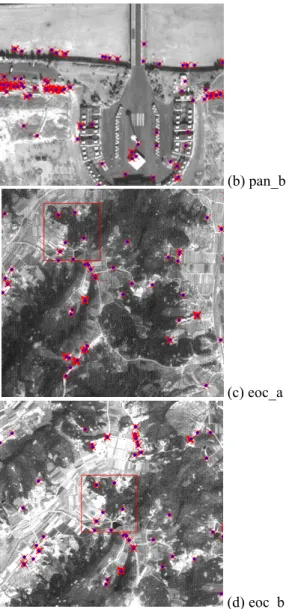
(d) eoc_b Figure 6. Matched Points Result
As the result of matching, Figure 6(a) shows the extracted singular points of master image (IKONOS:
pan_a). Figure 6(b) shows matched points by cross- correlation matching in slave image (IKONOS:pan_b). In case of KOMPSAT image (eoc_a and eoc_b), the matching results are shown in Figure 6(c), (d).
4.2
Line Extraction
The proposed line extraction procedure is as follows.
In the first, the edge detection(sobel mask) is operated and non-linear segments are removed. In the next line features by Hough transform are extracted.
Figure 8. Edge Detection Result
Figure 7. IFE: Flowchart of Line Extraction
4.2.1
Edge Detection & Non-linear Segment Removal The sobel edge detector provides good performance and is relatively insensitive to noise. Better noise characteristics can be achieved by using larger neighbourhoods at the expense of computational effort.
The detected edges in IKONOS scene (pan_a) are shown in Figure 8.
Non-linear segment removal is the post-processing to remove lines which have the short length through line- fitting algorithm after thinning.
4.2.2
Hough Transform
The normal parameterized version of the Hough transform, states that if a line whose normal makes an angle θ with the x axis, and has distance ρ from the origin is considered(Figure. 9), the equation of the line corresponding to any point (xn, yn) on this line is given by the formula
ρ = xn cosθ + yn sinθ (3) In the image analysis context, the coordinates of the points of the edge segments (xn, yn) in the image are known and therefore serve as constants in the parametric line equation, while ρ and θ are the unknown variables we seek.
Figure 9: Hough transform representation of a line
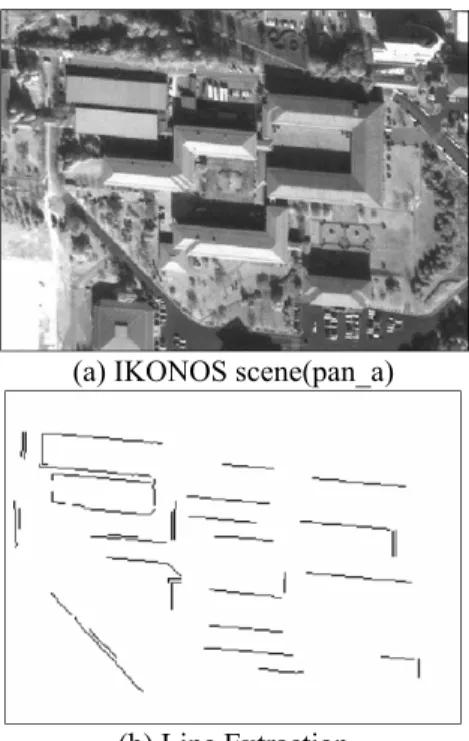
The extracted line features by Hough transform are
shown in Figure 10.
4
(a) IKONOS scene(pan_a)
(b) Line Extraction
Figure 10. Line Extraction by Hough Transform
4.2.3Line-to-Line Matching
For each corresponding pair of L1 and L2, four similarity types are checked (Figure 11).
- dx similarity check: dx =abs(p2.x-p1.x) - dy similarity check: dy =abs(p2.y-p1.y) - slope similarity check: slope = dy/dx
- length similarity check: length=sqrt[(p2.x- p1.x)
2+(p2.y-p1.y)
2]
Figure 11. Line-to-Line Matching
5.
DISCUSSION AND CONCLUSION This paper describes a method to extract point and line features interactively. As the result, the matching accuracy is shown in Table 2. Points are exactly matched about 92.13% in KOMPSAT image; points about 87.10%
are matched in IKONOS image. However, the matching accuracy of lines is less than that of points. It caused by uncompleted line matching criteria (rotation variant) and dynamic shapes of lines. More experiments are studied in current.
The RMS error of image co-registration is related to the accuracy of extracted points and line features. The co- registration accuracy of matched feature is shown in Table 3 and 4. The total number of extracted points is 1500 in KOMPSAT (Table 3) and 1000 in IKONOS (Table 4). The RMS is about 0.1069 in KOMPSAT, and about 0.2127 in IKONOS. Experiments show the feasibility and the efficiency of the suggested method.
Although there are some ambiguous match points and lines in the images, lots of extracted points and lines are help to increase reliability and total accuracy of image matching.
In conclusion, this study is showed the possibility of IFE toward a automatic feature extraction. Further examination and testing are necessary to state a more complete conclusion as to the specific properties of our implementation.
Table 2. Matching Accuracy
Imagery Points Lines
KOMPSAT 92% 60%
IKONOS 87% 70%
Table 3. RMS(unit: pixels) of Matched Point Extraction by IFE (KOMPSAT-1: matched eoc_a and eoc_b, Total RMS = 0.1069) ID x1 y1 x2 y2 Residual x Residual y RMS
1 1325 1201 1532 820 -0.18517 0.27382 0.330558 2 1342 1185 1551 805 -0.16604 0.46316 0.492031 3 1357 1471 1555 1091 0.23702 0.01442 0.237466 4 1358 1470 1556 1090 0.11792 -0.03332 0.122545 5 1362 1301 1568 922 0.41137 0.62919 0.751742
… … … … … … … …
150 1497 1487 1704 1113 0.40904 0.46332 0.618057
Table 4. RMS(unit: pixels) of Matched Point Extraction by IFE (IKONOS-1: matched pan_a and pan_b, Total RMS = 0.2127) ID x1 y1 x2 y2 Residual x Residual y RMS
1 2623 2459 1321 1549 -0.28687 -0.05201 0.291543 2 2624 2447 1322 1547 0.37495 -0.45561 0.590058 3 2625 2469 1321 1550 -0.28958 -0.45505 0.539379 4 2629 1867 1334 1469 0.38128 -0.18411 0.423406 5 2630 1868 1334 1469 0.30067 -0.34495 0.457591
… … … … … … … …
100 3330 1714 1407 1466 -0.04708 -0.48956 0.491821
6.
REFERENCES
Habib, A., and Kelley D., 2001, Automatic relative orientation of large scale imagery over urban areas using modified iterated Hough transform, International Journal of Photogrammetry and Remote Sensing, 56(2001):29–41.
Dietrich W.R., Joachim H., 1998, Applied Pattern Recognition- 2nd Edition, Vieweg.
Medinoi G. and Nevatia R., 1985, Segment based stereo matching, Comput. Vision Image Processing, vol. 31, pp. 2-18.
Grimson W. E. L., 1985, Computational experiments with a feature-based stereo algorithm, IEEE Trans. Pattern Anal. Mach.
Intell., vol PAMI-7, pp. 17-34.
Kitchen L. and Rosenfeld A., 1982, Gray level corner detection, Pattern Recognition Letters, vol. 1, 95 – 102.
Sharghi S. D., 1999, Geometric feature-based matching in stereo images, IEEE, http://www.eleceng.adelaide.edu.au /ieee/idc99/papers