Laver Farm Feature Extraction From Landsat ETM+ Using Independent Component Analysis
J. G. Han, Y. K. Yeon, K. H. Chi, J. H. Hwang
Geoinformation Center, Korea Institue of Geoscience & Mineral Resources 30 Gajeong-dong, Yuseong-gu, Daejeon 30-350, Korea
Abstract: In multi-dimensional image, ICA-based feature extraction algorithm, which is proposed in this paper, is for the purpose of detecting target feature about pixel assumed as a linear mixed spectrum sphere, which is consisted of each dif- ferent type of material object (target feature and background feature) in spectrum sphere of reflectance of each pixel. Land- sat ETM+ satellite image is consisted of multi-dimensional data structure and, there is target feature, which is purposed to extract and various background image is mixed. In this paper, in order to eliminate background features (tidal flat, seawater and etc) around target feature (laver farm) effectively, pixel spectrum sphere of target feature is projected onto the orthogo- nal spectrum sphere of background feature. The rest amount of spectrum sphere of target feature in the pixel can be presumed to remove spectrum sphere of background feature. In order to make sure the excellence of feature extraction method based on ICA, which is proposed in this paper, laver farm feature extrac- tion from Landsat ETM+ satellite image is applied. Also, In the side of feature extraction accuracy and the noise level, which is still remaining not to remove after feature extraction, we have conducted a comparing test with traditionally most popular method, maximum-likelihood. As a consequence, the proposed method from this paper can effectively eliminate background features around mixed spectrum sphere to extract target feature.
So, we found that it had excellent detection efficiency.
Keywords: ICA, Feature extraction, Laver farm, Landsat ETM+.
1. Introduction
The image, which is obtained to take a picture for the surface of earth from Landsat ETM+ satellite is con- sisted of multi-dimensional data structure of multiplex spectrum sphere. A lot of data for the surface of earth are recorded such as an image of multi-dimensional data structure
In order to extract target feature from multiplex spec- trum satellite image, there is an image processing method to change the peculiarity of data with the reflec- tion of a certain axis for image data. At this time, the number of axis of reflected are needed to match the number of original data level so that the data level after reflection can be the same with the data before reflection or small to have the effect of compress.
There are methods to decide the axis to get the result as a meaningful outcome value when multi-dimensional data are reflected[1, 2]. ICA (Independent Component Analysis) method, which is expanded method of PCA (Principal Component Analysis) is a statistical technique represented as a multi-dimensional vector of independ- ence component with combination of linear.
ICA can eliminate not only mutual relations of data but also higher level of mutual relations. In a conse- quence, it is the method to transform to independent be- tween dimensions [3]. ICA is primarily applied to ana- lyze data and extract feature. In this regards, we can use BSS (Blind Source Separation) method for original data and tracking down to find original data with mixed data without knowing the data to be mixed processing [4].
In this paper, ICA method is applied to extract wished feature data from multi-dimensional data struc- ture. In this regard, Lee et al [6, 7], Hyvarinen [5] devel- ops ICA-based feature extraction method based on the result of previous research works.
An experiment about laver farm feature extraction from Landsat ETM+ satellite image has been conducted to verify the validity of the result about actual applica- tion. In chapter 2, the materials and methods used in this paper are described and, in chapter 3, test result will be reviewed together with them. And, finally, the conclu- sion will be described in chapter 4.
2. Materials and Methods
This paper is described for algorithm of object detec- tion, which can be classified as object and background from each pixels of multi spectral image consisted more than 2 object peculiarities.
Multi spectrum image, which is used in this paper, is obtained from Landsat TM sensor with the following spectrum sphere: 450 ㎚~520 ㎚(band 1), 520 ㎚~
600 ㎚(band 2), 630 ㎚~690 ㎚(band 3), 760 ㎚~
900 ㎚(band 4), 1550 ㎚~1750 ㎚(band 5), 1040 ㎚~
1250 ㎚(band 6), 2080 ㎚~2350 ㎚(band 7).
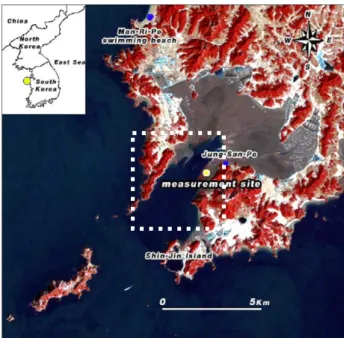
In here, band 6, which is spectrum sphere of thermal infrared rays, is excluded in this paper. Fig. 1 shows you the satellite image of Landsat ETM+ used for experiment
and, as a place of laver farm; its location is Jungsanpo Taeahn-gun, Chungnam province. Fig. 2 shows you im- age data of each different spectrum band photographed from LANDSAT ETM+ Satellite Image around sea area of Jungsanpo Taean-gun, Chungname province when ebb and flow is ebb tide on Feb 16, 2003.
Fig. 1 Experiment data (Landsat ETM+) and research area
Signal energy is controlled by reflected sunbeams ra- diant energy rather than discharged sunbeams by ob- served substance in spectrum sphere. Fig. 3 shows you the curved line of spectral reflectance, which is drawn with Landsat ETM+ spectrum sphere to measure spectral reflectance for laver farm and around substances.
In algorithm for object detection of partial pixel based on mixed models of linear spectrum, reflected spectrum sphere of each pixel is presumed as linear mixed spec- trum sphere from each different kinds of substance in the surface of pixel. If pixel spectrum sphere is controlled by object spectrum sphere, this pixel is the sign as an object pixel. If the contribution extent of object spectrum sphere can neglect in pixel spectrum sphere, that pixel can be classified as a background. As a consequence, what pixel spectrum sphere is disassembled as an or- ganization spectrum sphere is needed to decide what kinds of substances are occupied extensively as a target or background.
ICA is a technique to isolate mutual independent sig- nals statistically from linear mixed signals and, it is ap- plied to not only signal field but also image field vigor- ously. ICA method seeks for direction to reach inde- pendence elements in data.
There are lots of performance algorithms to exist for ICA such as Entropy minimized method, common data minimized method, Gaussian measure most suitable
Fig. 2 Band image of different spectrum of LANDSAT ETM+
Satellite Image
method and, maximum likelihood method. Lee[6, 7] is applied as a mixed model of independent element ana- lyzer by maximum likelihood method. The weakness of this method is not extended easily to find a partial space.
That weakness is not applied for fields like image coding.
However, in an image segmentation and field of image classification, image is described as much smaller di- mension than the numbers of pixels.
Fig. 4 is a sequence chart of data processing to ex- tract target feature based on ICA method, which is indi- cated in this paper.
At first, in a data preparation stage as a first step, in- put feature with N unit from Landsat ETM+ Satellite Image data and creation of input data collection with N+1 dimension from output class. And, they go through the process of formalizing for each input features. In a second performing stage of ICA, ICA is performed to new data collections, which have been made in the data preparation step. And, the result is saved as an extra weight matrix W in dimension of (N+1) x (N+1).
Fig. 3 Curved line of spectral reflection of Landsat ETM+
bands
Fig. 4 The sequence chart for data processing of feature extraction
In a third step, absolute average of each independent line vector, which has N+1 of extra weight matrix W, is searched. And, among the extra weight line elements, elements value, which has an extra weight value less then absolute average, is made as zero. Fourth step is the stage of extracting for candidate feature. After all extra weight value line vectors are reflected in an original pe- culiar space, candidate feature of new N+1 unit is ex- tracted to multiply original input data by new extra weight matrix of (N+1) x N dimension. Extracted candi- date features have been mixed with target and back- ground features. Last stage is the step of deleting back- ground feature from extracted candidate features. Candi- date feature set F is made in this stage and, if extra weight value, which is coped with each candidate fea- tures, is zero, it is considered as background features and, it is removed. As a consequence, only final target fea-
tures, which are removed background features from can- didate features will be extracted.
3. Test result and Consideration
In this chapter, in order to extract laver farm feature from Landsat ETM+ multi spectrum image data, image of 200x161 size is applied and, it is formalized to keep gaucian distribution peculiarity of N (m, σ2). Also, in order to delete noise effectively from original data, test has been conducted to find how features are extracted with keeping the average as regularly (m=0) and chang- ing (σ2: 0~1) the dispersion.
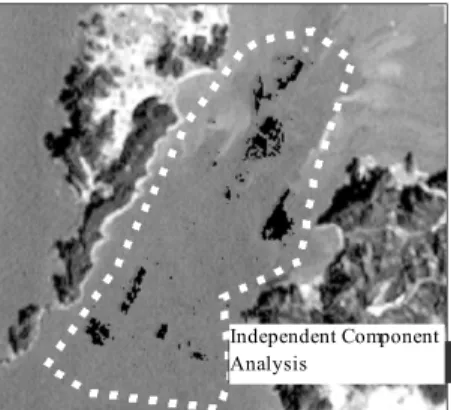
Fig. 5 Laver farm feature through ICA-based feature extraction method (Black color in white dotted line)
Fig. 6 Laver farm feature extracted by maximum likeli- hood distribution method (Black color in white dotted line).
Fig. 5 shows you laver farm feature extracted to apply feature extraction method based on ICA, which is pro- posed in this paper. Indicated section with black color in white dotted line is shown for laver farm feature.
Fig. 6 shows you laver farm feature extracted through distribution method of maximum likelihood, which is the most popular used. The test has been conducted by the side of noise, which is not eliminated after feature ex- traction and accuracy of extracted feature.
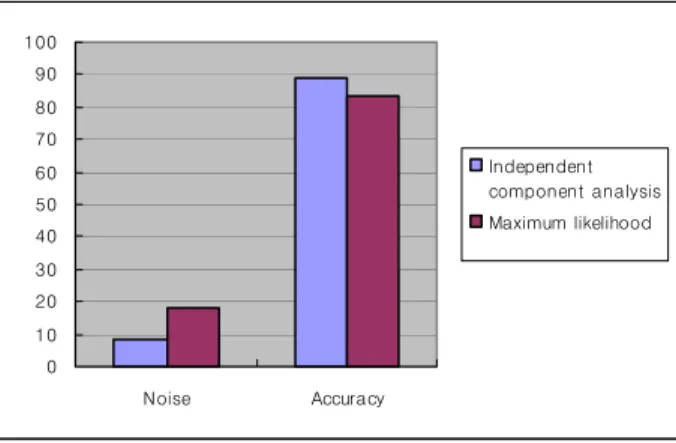
Noise, which is not eliminated after feature extraction, from ICA-based feature extraction method is shown 10%
lower than maximum likelihood method and, also, in the
Landsat ETM+ Satellite Image
Data preparation
ICA performance
Adjustment of small extra weight
Extraction of candidate feature
Elimination of background feature
Extraction of target feature
Independent Component Analysis
Maximum likelihood
side of accuracy, ICA-based feature extraction method is shown 6% higher than maximum likelihood method.
Test result of Fig. 5 and 6 are shown well in image and, it displays the superiority of ICA-based feature extrac- tion method.
0 10 20 30 40 50 60 70 80 90 100
Noise Accuracy
Independent component analysis Maximum likelihood
Fig. 7 Accuracy comparison for feature extraction and noise, which is not eliminated from extracted feature after test.
4. Conclusion
ICA-based feature extraction algorithm, which is proposed in this paper, is purposed to detect target fea- ture about pixel supposed as a linear mixed spectrum sphere, which is consisted of each different substance types (target feature and background feature) that has different reflection spectrum sphere of each pixels.
On Landsat ETM+ Satellite Image, which is consisted of multi dimensional data structure, ICA-based feature extraction method is indicated to eliminate background features (tidal flat, seawater and etc), which is located around target feature (laver farm) effectively and, in or- der to confirm the superiority of proposed method, laver farm feature can be successfully extracted on Landsat ETM+ satellite image.
In the side of noise level, which is not eliminated after feature extraction and accuracy, comparing test with maximum likelihood method, which is the most popular method traditionally, has been conducted.
As a consequence, the proposed method in this paper shows you superior detection performance in extraction of target feature to extract as background feature is eliminated effectively in mixed spectrum sphere around target feature.
References
[1] P.J. Huber, Projection Pursuit, The Annals of Statis- tics, vol. 13, no. 2, pp. 435-475, 1985.
[2] A. Hyvarinen, New Approximations of Differential Entropy for Independent Component Analysis and Projection Pursuit, In Advances in Neural Informa-
tion Processing Systems 10 (NIPS '97), pp. 273-279, 2003/02/18 22:55:40, 1998
[3] A. Hyvarinen, J. Karhunen, and E. Oja, Independent ComponentAnalysis, John Wiley & Sons, 2001.
[4] A.J. Bell and T.J. Sejnowski, An Information- Maximization Approach to Blind Separation and De- convolution, Neural Computation, vol. 7, pp. 1129- 1159, 1995.
[5] A. Hyv¨arinen. Fast and robust fixed-point algo- rithms for independent component analysis. IEEE Transactions on Neural Networks, 10(3):626-634, 1999.
[6] T.-W. Lee, M. Girolami, and T.J. Sejnowski. Inde- pendent component analysis using an extended in- fomax algorithm for mixed sub-gaussian and super- gaussian sources. Neural Computation, 11(2):417- 441, 1999.
[7] T.-W. Lee, M.S. Lewicki, and T.J. Sejnowski. Unsu- pervised classification with non-Gaussian mixture models using ICA. In M.S. Kearns, S.A. Solla, and D.A. Cohn, editors, Advances in Neural Information Processing Systems 11, Cambridge, MA, 1999. NIPS, MIT Press.