Copyright © 2012 Korean Neurological Association 305
Print ISSN 1738-6586 / On-line ISSN 2005-5013 http://dx.doi.org/10.3988/jcn.2012.8.4.305 CASE REPORT
J Clin Neurol 2012;8:305-307
Introduction
Lambert-Eaton myasthenic syndrome (LEMS) is a neuro- muscular junction disorder characterized by fluctuating pro- ximal limb muscle weakness, decreased deep-tendon reflexes, and various autonomic symptoms, and is most frequently as- sociated with small-cell lung cancer (SCLC).1 The etiology of LEMS is the reduced exocytosis of acetylcholine from nerve endings by antibodies against voltage-gated calcium chan- nels (VGCC-abs), increases in the titers of which are observ- ed in more than 90% of patients with LEMS.1 It has been re- ported that titer of muscle anti-acetylcholine-receptor-bind- ing antibodies (AChR-abs), which are more specific for myas- thenia gravis (MG), is also increased in a small percentage of patients with LEMS (7%), although there are no detailed data
or clinical information to corroborate this finding.1 Herein we present a case of LEMS with SCLC with increased AChR-abs titer (0.587 nmol/L), which had decreased to 0.001 nmol/L 5 years later during complete remission from LEMS.
Case Report
A 57-year-old male was admitted to the hospital due to dry mouth and eyes and progressive proximal limb weakness wi- thout diurnal fluctuation of 2 months duration. He also com- plained of mild transient positional dizziness, dysarthria, and dysphagia. He had smoked one pack of cigarettes a day for 30 years. His family history was unremarkable. A neurologic ex- amination showed mild dysarthria, proximal muscle weak- ness, and absent deep tendon reflexes. His cranial nerve, cere- bellar, and sensory functions were all normal. A repetitive nerve stimulation test (RNST) was performed on the right ab- ductor digiti quinti (ADQ), flexor carpi ulnaris (FCU), orbi- cularis oculi, nasalis, and trapezius muscles following Oh’s method2 using the Toennies two-channel NeuroScreen sys-
A Case of Lambert-Eaton Myasthenic Syndrome with Small-Cell Lung Cancer and Transient Increase in Anti-Acetylcholine-Receptor-Binding Antibody Titer
Jung Hwan Lee,a,b Ha Young Shin,a Seung Min Kim,a Il Nam Sunwooa
aDepartment of Neurology, Yonsei University College of Medicine, Seoul, Korea
bDepartment of Neurology, National Health Insurance Corporation Ilsan Hospital, Goyang, Korea
Received December 13, 2010 Revised March 9, 2011 Accepted March 9, 2011 Correspondence Il Nam Sunwoo, MD Department of Neurology, Yonsei University College of Medicine, 50 Yonsei-ro, Seodaemun-gu, Seoul 120-752, Korea Tel +82-2-2228-1602 Fax +82-2-393-0705
E-mail [email protected]
BackgroundzzLambert-Eaton myasthenic syndrome (LEMS) is a presynaptic neuromuscular junction disorder that is most frequently associated with small-cell lung cancer (SCLC). The ti- ters of antibodies against voltage-gated calcium channels are frequently increased in LEMS, but only rarely is titer of anti-acetylcholine-receptor-binding antibodies (AChR-abs) increased.
Case ReportzzA 57-year-old male was admitted to our hospital due to dry mouth and eyes and progressive proximal limb weakness of 2 months duration. The results of a repetitive nerve stimu- lation test disclosed all criteria for the electrophysiological LEMS pattern, and the patient’s AChR- abs titer was 0.587 nmol/L. At a follow-up performed 5 years after successful treatment of SCLC and LEMS, his AChR-abs titer had decreased to 0.001 nmol/L.
ConclusionszzWe suggest that this was a case of transient pseudopositivity of AChR-abs in
SCLC with LEMS. J Clin Neurol 2012;8:305-307
Key Wordszz Lambert-Eaton myasthenic syndrome, small-cell lung carcinoma, myasthenia gravis
Open Access
cc This is an Open Access article distributed under the terms of the Cre- ative Commons Attribution Non-Commercial License (http://creative- commons.org/licenses/by-nc/3.0) which permits unrestricted non-com- mercial use, distribution, and reproduction in any medium, provided the ori- ginal work is properly cited.
Lambert-Eaton Myasthenic Syndrome
306 J Clin Neurol 2012;8:305-307
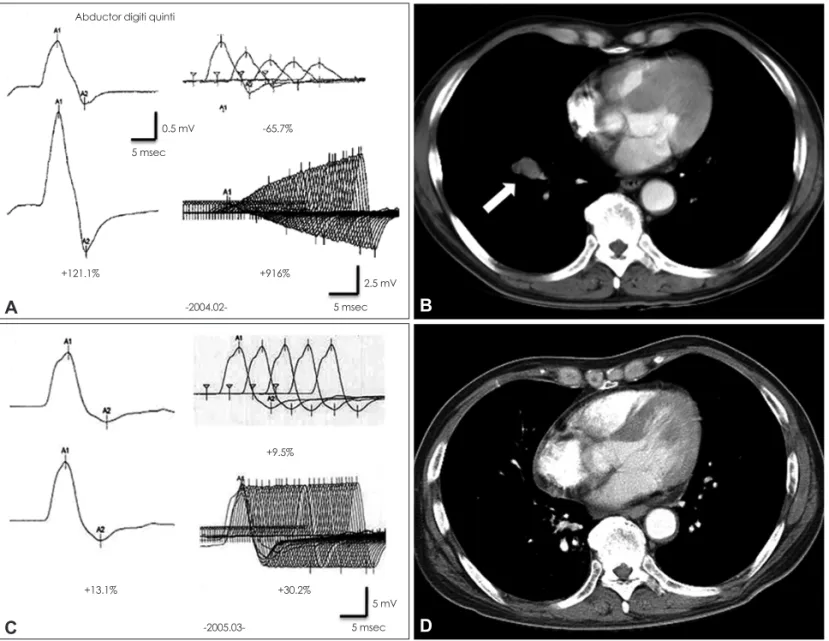
tem (Jaeger-Toennies, Höchberg, Germany). Postexercise fa- cilitation (PEF) of compound muscle action potentials (CM- AP) immediately after maximal voluntary contraction for 30 seconds and increment responses for 1 second at 50-Hz high- frequency stimulation were also recorded for the ADQ and FCU. The RNST results fulfilled all of the criteria for electro- physiological LEMS patterns: low-amplitude CMAP at rest, a decrement on low-frequency (3 Hz) stimulation, PEF of more than 100%, and an approximately 900% increment on high- frequency (50 Hz) stimulation (Fig. 1A).
Following an injection of acetylcholinesterase inhibitor (in- tramuscular injection of 1.5 mg of neostigmine methylsulfate into the deltoid muscle), arm elevation endurance improved from 30 seconds to 2 minutes, and this improvement lasted for up to 30 minutes postinjection; such an observation is an ad-
ditional indicator of LEMS. The titer of AChR-abs was 0.587 nmol/L (normal: <0.2 nmol/L). Chest computed tomography (CT) revealed a 1.6-cm mass in the anterior segment of the right lower lobe and enlarged lymph nodes in the subcarina and lower paratracheal areas (Fig. 1B). SCLC was confirmed by a transbronchial lung biopsy. The patient was successfully treated with radiation (5.4 Gy for the primary tumor and re- gional lymph node area) and chemotherapy (irinotecan and cisplatin for the first cycle, followed by etoposide and cispla- tin for the fifth cycle) for LEMS and SCLC, as confirmed by a follow-up electrophysiological examination (Fig. 1C) and chest CT (Fig. 1D) performed 13 months after the first evalu- ation. The patient was not treated for MG, but the titer of AChR-abs had decreased to 0.001 nmol/L at a follow-up per- formed 5 years after successful treatment.
Fig. 1. Repetitive nerve stimulation test (RNST; A and C) and serial chest computed tomography (CT; B and D) and results before (A and B) and after (C and D) cancer treatment. The initial RNST (A) revealed electrophysiological patterns typical of Lambert-Eaton myasthenic syn- drome: low compound muscle action potentials (1133.7 V; upper-left panel), postexercise facilitation (+121.1%; lower-left panel), a decre- ment (-65.7%) on low-frequency repetitive stimulation (3 Hz; upper-right panel), and an increment (+916%) on high-frequency repetitive stimulation (50 Hz; lower right panel) for the abductor digiti quinti. The initial chest CT (B) revealed a mass of approximately 1.6 cm in the anterior segment of the right lower lobe (white arrow). On follow-up studies at 13 months after treatment, the RNST responses had normal- ized (C) and the lung mass had completely disappeared on chest CT (D).
B
Abductor digiti quinti
0.5 mV
2.5 mV -65.7%
5 msec
5 msec
+121.1% +916%
-2004.02-
A
D
5 mV +9.5%
5 msec +30.2%
+13.1%
-2005.03-
C
Lee JH et al.
www.thejcn.com 307
Discussion
It was clear that our patient had SCLC with LEMS as a para- neoplastic syndrome. Proximal limb muscle weakness, abs- ence of deep tendon reflexes, dry mouth, and transient positio- nal dizziness are clinical characteristics of LEMS. The diag- nosis was supported by classic LEMS patterns on the RNST;
the titers of VGCC-abs were not evaluated due to the cost of performing this test in Korea. The disappearance of the LEMS patterns on the RNST could be considered evidence of com- plete remission of SCLC.3
One unanswered question in this case is the clinical signific- ance of the transiently increased titer of AChR-abs at the first evaluation. It is unclear whether or not this patient had MG.
Clinical symptoms of dysarthria and dysphagia with definite improvement of muscle power after the injection of neostig- mine are indicative of MG, but such characteristics are also often found in patients with LEMS.1 There have been several reports of electrophysiological LEMS patterns seen in other- wise typical seropositive MG.4-8 One of these studies found increased titers of VGCC-abs and transiently increased titer of AChR-abs, but the reported case did not have a malignant dis- ease.8 To our knowledge, there has been only one reported case of lung cancer with LEMS and MG, but the clinical informa- tion is not sufficient to enable speculation as to the exact re- lationship between LEMS and AChR-abs.9 Moreover, al- though our patient was not treated with an immunosuppres- sant such as prednisolone or azathioprine, his symptoms and signs disappeared and he became seronegative for AChR-abs until after the cancer treatment.
Finally, we hypothesize that the transient ‘nonpathologic epiphenomenon’ of raised AChR-abs titer in SCLC with LE- MS is more appropriate than true MG with spontaneous re- mission in this case. In addition to VGCC-abs, patients with LEMS with SCLC are seropositive for several autoantibodies to multiple organs; however, the clinical significance of this fi-
nding is unclear in most cases. Moreover, false-positive re- sponses of AChR-abs have been reported in motor neuron di- sease with lung cancer, thymoma without MG, autoimmune hepatitis, graft-versus-host disease, and healthy relatives of patients with MG.10 The seronegative conversion of AChR-abs without treatment for MG supports our assumption. Further stu- dies are needed to clarify the meaning of the seropositivity for AChR-abs in LEMS with SCLC.
Conflicts of Interest
The authors have no financial conflicts of interest.
REFERENCES
1. Harper CM Jr, Lennon VA. Lambert-Eaton syndrome. In: Kaminski HJ. Myasthenia Gravis and Related Disorders. 2nd ed. New York: Hu- mana Press, 2009;209-225.
2. Oh SJ. Principles of Clinical Electromyography, Case Studies. Balti- more: Williams & Wilkins, 1998;21-22.
3. Lee SA, Sunwoo IN, Ro JK, Park KD. A case of remitted Lambert-Ea- ton myasthenic syndrome with small cell lung carcinoma following chemotherapy and radiotherapy. J Korean Neurol Assoc 1992;10:401- 4. Katz JS, Wolfe GI, Bryan WW, Tintner R, Barohn RJ. Acetylcholine 406.
receptor antibodies in the Lambert-Eaton myasthenic syndrome. Neu- rology 1998;50:470-475.
5. Newsom-Davis J, Leys K, Vincent A, Ferguson I, Modi G, Mills K.
Immunological evidence for the co-existence of the Lambert-Eaton myasthenic syndrome and myasthenia gravis in two patients. J Neurol Neurosurg Psychiatry 1991;54:452-453.
6. Taphoorn MJ, Van Duijn H, Wolters EC. A neuromuscular transmis- sion disorder: combined myasthenia gravis and Lambert Eaton syn- drome in one patient. J Neurol Neurosurg Psychiatry 1988;51:880-882.
7. Tabbaa MA, Leshner RT, Campbell WW. Malignant thymoma with dysautonomia and disordered neuromuscular transmission. Arch Neu- rol 1986;43:955-957.
8. Oh SJ, Sher E. MG and LEMS overlap syndrome: case report with electrophysiological and immunological evidence. Clin Neurophysiol 2005;116:1167-1171.
9. Fettel M, Shin H, Penn A, Lovelace R, Rowland L. Combined Eaton- Lambert syndrome and myasthenia gravis. Neurology 1978;28:398.
10. Kaminski HJ, Santillan C, Wolfe GI. Autoantibody testing in neuro- muscular disorders, part II: neuromuscular junction, hyperexcitability, and muscle disorders. J Clin Neuromuscul Dis 2000;2:96-105.