DOI: https://doi.org/10.7473/EC.2020.55.3.176
Properties of Silica-SBR Compounds Using Cellulose Dispersant Applicable to Tire Tread Rubber
Jung Soo Kim and Dong Hyun Kim
†Human Convergence Technology R&D department, Korea Institute of Industrial Technology (KITECH), Republic of Korea (Received June 20, 2020, Revised June 29, 2020, Accepted July 5, 2020)
Abstract: Silica-styrene butadiene rubber (Silica-SBR) compounds have been used in the preparation of tire treads. The silica dispersibility of silica-SBR compounds is related to the processability, mechanical properties, and wear resistance of tires. Recently, in order to improve the silica dispersibility of the silica-SBR compounds, the wet masterbatch (WMB) pro- cess was introduced, which is a method of mixing rubber in the water phase. We aimed to improve the silica dispersibility of the silica-SBR compounds by preparing a silica dispersant applicable to the WMB process. For this purpose, cellulose, 2-hydroxyethyl cellulose, and cellulose acetate were employed as a silica dispersant. The silica dispersibility of the com- pounds was measured by a moving die rheometer. Improvement in the processability of silica-SBR compounds was eval- uated by the Mooney viscometer. The wear resistance of silica-SBR compounds using a cellulose dispersant was improved by up to 29%.
Keywords: Cellulose, Silica, SBR, Dispersant, Wet masterbatch
Introduction
Automotive tires are composed of ten or more layers, such as treads, sidewalls, composites, belt layers, and carcasses.
Among them, the tread is the outermost layer of the tire, which is the most important layer because it contacts the ground directly. The tread is made of rubber that is resistant to breakage and impact, to protect the conductor and belt lay- ers inside the tire, and wear-resistant rubber to increase tire life.
It is difficult to simultaneously improve the rolling resis- tance, wear resistance, and wetting property of the tire tread.
Among these three properties, improvement of one physical property causes deterioration of another. Moreover, con- trolling these properties is very important for the manufac- turing tire tread. The wear of the tire describes the phen- omenon whereby the surface of the tread rubber contacting the ground is worn out because of the frictional force gen- erated between the tread and the road surface. The wear of the tire considerably affects the life and braking performance of the tire. In addition, in terms of cost reduction, the tire tread should have excellent wear resistance.
1Owing to their good dispersion characteristics, carbon black fillers can facilitate the preparation of good-quality rubber compounds. However, the hysteresis of the rubber compounds increases, which is disadvantageous in terms of the fuel economy of the tire.
2In recent years, rubber com- pounds containing silica fillers have become increasingly popular because of reduced rolling resistance in tires and a significant improvement in the frictional force on wet and snow-covered roads. In particular, the silica content of ultra- high-performance tires and winter tires sold recently may exceed 100 phr. However, there are many difficulties asso- ciated with the preparation of compounded rubber using sil- ica that exhibits satisfactory performance.
3,4Since silanol groups are present on the surface of the silica, hydrogen bonds can form between the hydroxyl groups on the silica surface; thus, the silica dispersibility of the rubber compounds decreases, causing aggregation of the silica par- ticles. The phenomenon of silica aggregation adversely affects the properties of the rubber compound.
5Recently, many studies have been developed to improve the dispers- ibility of composites in various materials fields, and the wet masterbatch (WMB) process was developed to improve the silica dispersibility of rubber compounds.
6WMB rubber compounds are prepared by obtaining a solid rubber com-
†
Corresponding author E-mail: [email protected]
persants are commercially available as additives for com- pounds in the DMB process, commercial silica dispersants suitable for the WMB process have not yet been explor- ed.
8-10Recently, the development of silica dispersants appli- cable to WMB process has gained considerable attention.
Some researchers have prepared dispersants using anionic polymers such as poly (acrylic acid), styrene-acrylic acid copolymers, and vinyl naphthalene-acrylic acid copolymers to enhance filler dispersion in WMB.
11,12Currently, researchers are focusing on the development of eco-friendly tire materials as a measure to reduce global warming; thus, rubber additives such as silica dispersants must be developed using eco-friendly materials.
13,14An example of relevant and eco-friendly material is cellulose, which is naturally available and has the chemical composi- tion similar to that of starch. Previous studies have shown that the addition of cellulose to rubber compounds in the DMB process improved the environmental friendliness, bio- degradability and processability, mechanical properties, and dynamic mechanical performance of the tire.
15,16Since cel- lulose is composed of carbon chains and hydroxyl groups, it exhibits both hydrophilic and hydrophobic functionalities.
Because of these characteristics, research has been conducted using cellulose as a dispersant in various fields.
17-19However, the use of cellulose as a silica dispersant for tire manufac- turing using the WMB process has not yet been investigated.
In this study, cellulose variants having large numbers of hydroxyl groups were investigated for their use as silica dis- persants in the WMB process with the aim of preventing aggregation and improving the silica dispersibility. In the WMB process, rubber compounds were prepared using var- ious cellulosic materials as silica dispersants. In order to assess the silica dispersibility, the processability, mechanical
2
aqueous solution was used as a coagulant. Modified silica NK153 (MIRAESI, South Korea) was used as a reinforcing agent for the compound, whose surface was hydrophobically modified with 10% w/w bis [3-(triethoxysilyl) propyl] tet- rasulfide (TESPT). Various compounding processing addi- tives such as zinc oxide (ZnO), stearic acid (S/A), and N- (1,3-dimethyl-butyl)-N'-phenyl-p-phenylenediamine (6PPD, Sigma Aldrich, United States) were used. In the final com- pounding step, sulfur (SAMCHUN, South Korea) was used as a crosslinking agent. N-cyclohexyl-2-benzothiazole sul- fonamide (CBS, Tokyo Chemical Industry, Japan) and diphe- nyl guanidine (DPG, Sigma Aldrich, United States) were used as crosslinking accelerators.
2. Preparation of the silica-SBR compounds
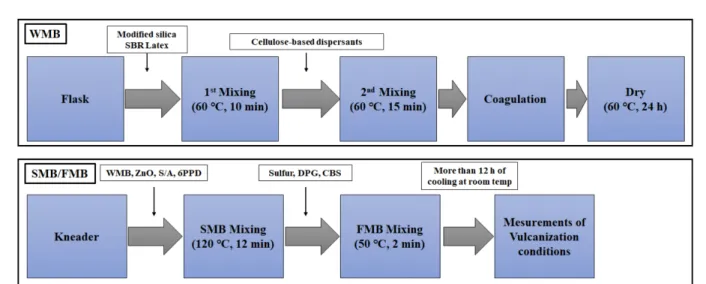
The silica–SBR compounds were prepared using three pro- cesses: WMB, silica master match (SMB), and final master batch (FMB). In the WMB process, the emulsion styrene butadiene rubber (ESBR) was added to silica sludge. After stirring, the cellulose-based dispersants were added, as solu- tions dissolved in water, and the coagulant was added while stirring to aggregate the ESBR and load the silica. In the SMB process, ZnO, S/A, and 6PPD were added as the pri- mary mixing agents. The FMB process is a secondary mixing process that prepares the silica–SBR compounds before vul- canization by adding sulfur for vulcanization as well as DPG and CBS as vulcanization accelerators.
Figure 1 illustrates the WMB, SMB and FMB processes
for the preparation of silica–SBR compounds. TESPT-mod-
ified silica (2% w/w) was added to distilled water and stirred
at 60°C to prepare a silica slurry. After mix ing it with the
ESBR, also heated to 60°C, the mixture was stirred for 10
min. A solution prepared by dissolving the cellulose-based dispersants in distilled water was then added to the silica and ESBR slurry. After 15 min the mixed slurry was coagulated with CaCl
2, washed once, and dried at 60°C for 24 h.
The SMB was produced using dried WMB compounds.
The dried WMB compounds were mixed with ZnO, S/A, and 6PPD for 12 min at 120°C. The FMB was prepared using the SMB compounds, CBS, DPG, and sulfur. They were mixed for 2 min at 50°C using a two-roll mill for the prepa- ration of the final silica–SBR compounds. The detailed for- mulations of silica-SBR compounds are shown in Table 1.
The cure characteristics and silica dispersibility of four sil- ica–SBR compounds made according to Table 2 were mea- sured by MDR. The MDR results confirmed that silica dispersibility was improved when cellulose was added for all three types of cellulose-based dispersants. Next, silica–SBR compounds were prepared with cellulose applied at 2, 4, and 6 phr levels, and the content of cellulose was confirmed.
The torque and cure time of the silica–SBR compounds in the FMB stage were measured with a moving die rheometer (MDR, MDR2020, MYUNGJI TECH) at 160 ± 1°C for 30
min. The optimum cure time was determined using an MDR based on ISO 6502. This test measures the minimum torque value (T
min), maximum torque value (T
max), scorch time (t
10), and optimum cure time (t
90).
3. Mooney viscosity
The Mooney viscosity (MV, MV2020, MYUNGJI TECH) of the silica–SBR compounds in the FMB stage provides a measure of the processability of the unvulcanized rubber. In ML(1+4), the “M” means Mooney, the “L” means plate size, the “1” means 1 min preheating and the “4” corresponds to Figure 1. WMB, SMB and FMB process for the preparation of a silica–SBR composite.
Table 1. Formulation of WMB, SMB, and FMB for the Silica–SBR Compounds (phr)
NAME WN WC2 WHC2 WCA2 WC4 WC6
WMB
E-SBR/Silica 100/100
TESPT 10
Cellulose - 2 - - 4 6
2-hydroxyethyl cellulose - - 2 - - -
Cellulose acetate - - - 2 - -
SMB ZnO/(S/A)/6PPD 3/(2)/1
FMB Sulfur/CBS/DPG 1.5/1.5/1.5
Table 2. Cure Characteristics Data of the Silica–Rubber Compounds by Cellulose-Based Dispersants
Unit WN WC2 WHC2 WCA2
t
10min:ss 03:15 03:44 03:54 03:45
t
90min:ss 15:51 15:33 15:16 14:41
T
minN-m 0.561 0.545 0.583 0.554
T
maxN-m 2.011 1.885 1.874 1.799
T
max-T
minN-m 1.450 1.340 1.291 1.245
using a DIN wear tester (AT-2020-D, MYUNGJI TECH) in accordance with the ASTM D 5963 standard.
Results and Discussion
1. Expected mechanism for the silica dispersing effect of cellulose
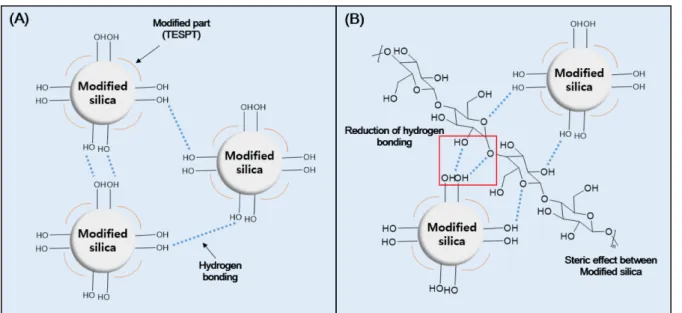
Figure 2 illustrates the dispersing mechanism of cellulose in the WMB process. In the case of modified silica, the TESPT-modified portion is hydrophobic, but the unmodified portion has hydroxyl groups. Silica aggregation occurs due to hydrogen bonding between the hydroxyl groups, which reduces the silica dispersibility of the silica–SBR com- pounds. Cellulose adheres to hydroxyl groups present on the
10
ter processability of the silica–SBR compound. Our results show that the t
10increased for both samples with cellulose- based dispersants. Specifically, for WHC, the t
10value increased by 40 s when compared to that of the correspond- ing material without a dispersant (WN). The t
90parameter represents the cure time when rubber vulcanization is 90%
Figure 2. Illustration of expected filler network in the WMB process: (A) where a residual silanol group in the modified silica forms a hydrogen bond and (B) where a cellulose dispersant interacts with silanol group in the modified silica.
Table 3. Cure Characteristics Data of the Silica–Rubber Compounds according to Cellulose Content
Unit WN WC2 WC4 WC6
t
10min:ss 03:15 03:44 03:37 03:41 t
90min:ss 15:51 15:33 14:49 14:46
T
minN-m 0.561 0.545 0.534 0.525
T
maxN-m 2.011 1.885 1.967 1.865
T
max-T
minN-m 1.450 1.340 1.433 1.340
complete, and is called the optimum vulcanization time. In this study, the t
90values decreased for all three silica–SBR compounds prepared with cellulose-based dispersants. The T
minindicates the minimum torque of silica–SBR compounds and tends to decrease as the silica dispersibility improves. It has been shown that dispersants other than cellulose increased T
minwhen compared to rubber materials prepared without dispersants, which has an adverse effect on silica dis- persibility. The T
maxrepresents the maximum torque of the silica–SBR compound and tends to increase as the cross- linking density increases. In the case of cellulose-based dis- persants, it was found that the T
maxdecreased, which resulted in a decrease in the crosslinking density of the rubber. Hydro- gen bonding between the CBS cure accelerator and cellulose may have led to a loss of CBS activity. The T
max-T
minrep- resents the crosslinking density of the rubber compound, which is similar to the above-mentioned trend, and shows that the crosslinking density decreased when the cellulose- based dispersants were used. MDR results showed the lowest T
minand the highest crosslinking density for silica-rubber compounds prepared with cellulose (WC) among the three types cellulose-based dispersants used. Therefore, we chose to examine cellulose as a dispersant for the remainder of this study.
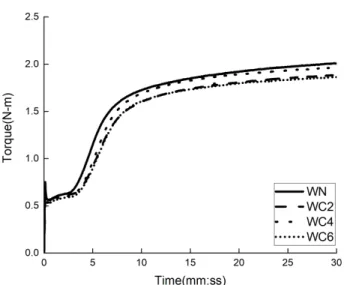
The cure characteristics of compounds according to cel- lulose content are shown in Figure 4 and listed in Table 3.
As the cellulose content increases, the t
90decreases. In the case of WC06, the t
90was reduced by 1 min or more when compared with WN, which is due to the improved silica dis- persibility. The T
min, values measured, decreased with
increasing cellulose content, with WC06 being reduced by up to 7% when compared with WN. This shows that cellulose interferes with the aggregation of silica through hydrogen bonding with the silica. T
maxand T
max-T
minvalues of the WC series using cellulose dispersants decreased compared to those of WN, which was due to the lower activity of CBS caused by a higher degree of hydrogen bonding between CBS and cellulose.
3. MV measurements
Figure 5 and Table 4 provide comparisons of the MV val- ues for the silica–SBR compounds in the FMB stage.
ML(1+4) is the MV index, indicating the processability for the rubber material. A low MV value implies high process- Figure 3. Cure characteristics of compounds by cellulose-based
dispersants. Figure 4. Cure characteristics of compounds according to
cellulose content.
Figure 5. Mooney Viscosity Properties of compounds.
min