• 검색 결과가 없습니다.

Three­dimensional soft tissue analysis for the evaluation of facial asymmetry in normal occlusion individuals

N/A
N/A
Protected

Academic year: 2022

Share "Three­dimensional soft tissue analysis for the evaluation of facial asymmetry in normal occlusion individuals"

Copied!
8
0
0

로드 중.... (전체 텍스트 보기)

전체 글

(1)

Three­dimensional soft tissue analysis for the evaluation of facial asymmetry in normal occlusion individuals

Objective: To identify the right and left difference of the facial soft tissue landmarks three­dimensionally from the subjects of normal occlusion individuals.

Methods: Cone­beam computed tomography (CT) scans were obtained in 48 normal occlusion adults (24 men, 24 women), and reconstructed into 3­dimensional (3D) models by using a 3D image software. 3D position of 27 soft tissue landmarks, 9 midline and 9 pairs of bilateral landmarks, were identified in 3D coordination system, and their right and left differences were calculated and analyzed. Results: The right and left difference values derived from the study ranged from 0.6 to 4.6 mm indicating a high variability according to the landmarks. In general, the values showed a tendency to increase according to the lower and lateral positioning of the landmarks in the face. Overall differences were determined not only by transverse differences but also by sagittal and vertical differences, indicating that 3D evaluation would be essential in the facial soft tissue analysis. Conclusions: Means and standard deviations of the right and left difference of facial soft tissue landmarks derived from this study can be used as the diagnostic standard values for the evaluation of facial asymmetry.

[Korean J Orthod 2012;42(2):56-63]

Key words: Three­dimensional, Soft tissue, Facial asymmetry, Cone­beam CT Hyeon-Shik Hwang

a

Donghui Yuan

b

Kweon-Heui Jeong

c

Gi-Soo Uhm

c

Jin-Hyoung Cho

d

Sook-Ja Yoon

e

a

Department of Orthodontics, 2nd Stage of Brain Korea 21, School of Dentistry, Dental Science Research Institute, Chonnam National University, Gwangju, Korea

b

Department of Orthodontics, School of Dentistry, Chonnam National University, Gwangju, Korea; Department of Stomatology, Bethune International Peace Hospital, Shijiazhuang, PR China

c

School of Dentistry, Chonnam National University, Gwangju, Korea

d

Department of Orthodontics, School of Dentistry, Chonnam National University, Gwangju, Korea

e

Department of Oral and Maxillofacial Radiology, School of Dentistry, Chonnam National University, Gwangju, Korea

Received January 18, 2012; Revised February 26, 2012; Accepted February 27, 2012.

Corresponding author: Hyeon­Shik Hwang.

Professor and Chairman, Department of Orthodontics, School of Dentistry, Chonnam National University, Yong bong­dong 300, Buk­gu, Gwangju 500­757, Korea.

Tel +82­62­530­5841 e­mail [email protected]

This study was financially supported by Chonnam National University, 2007.

pISSN 2234-7518 • eISSN 2005-372X http://dx.doi.org/10.4041/kjod.2012.42.2.56

© 2012 The Korean Association of Orthodontists.

The authors report no commercial, proprietary, or financial interest in the products or companies described in this article.

This is an Open Access article distributed under the terms of the Creative Commons Attribution Non­Commercial License (http://creativecommons.org/licenses/by­nc/3.0) which permits unrestricted non­commercial use, distribution, and reproduction in any medium, provided the original work is properly cited.
(2)

INTRODUCTION

The aim of orthodontic and surgical treatment of pa­

tients who have craniofacial anomalies is to achieve not only an ideal occlusion, but also, more significantly, a harmonious facial appearance.

1

One important aspect of this appearance is facial asymmetry, which is determined by both hard and soft tissue. Although the soft tissue morphology is known to reflect the underlying hard tissue structure, the hard tissue structure may not be fully expressed on the soft tissue images. The soft tissue may compensate for this asymmetry, or be more asymmetric.

2,3

Moreover, a patient and his or her family evaluate the success of the orthodontic treatment or orthognathic surgery mainly by visual cutaneous changes. Since the external appearance of asymmetry is of great importance for patients and essential for treatment planning, the soft tissue features of facial asymmetry, as well as hard tissue characteristics,

4­6

need to be evaluated.

Because differences between the dimensions of the right and left half of any human face, as well as between paired structures are common findings in healthy individuals,

7­12

the aim of surgically creating a perfectly symmetrical face is not realistic. Considering that minor asymmetry exists in normal occlusion individuals and does not cause a problem both aesthetically and functionally, it is neces­

sary to determine the range of “normal asymmetry” for an evaluation of facial asymmetry using a quantitative analysis.

The purpose of the present study was to obtain the right and left difference values of the facial soft tissue land marks from the normal occlusion individuals, and further to determine the range of “normal asymmetry”

in a 3­dimensional (3D) coordinate system, so resultant data can be used as a standard in the evaluation of facial asymmetry.

MATERIALS AND METHODS

The sample was selected from university students. A cli ni cal examination was carried out, and those subjects who were judged to have a Class I molar and canine relationships with no or minimal crowding and well­

balanced faces were selected. All subjects had no previous orthodontic treatment. Any subject who presented ap­

parent facial asymmetry was excluded from the samples.

Thus, lateral and frontal cephalograms were not obtained for the purpose of sample selection. Forty eight students, 24 men (mean age 26.2 years) and 24 women (mean age 25.3 years), were enrolled into the present study. Informed consent from all subjects was obtained.

The com puted tomography (CT) scans were obtained using a cone­beam CT scan ner (Alphard Vega; Asahi Roentgen Co., Kyoto, Japan) under the following condi­

tions: 80 kV, 5 mA, voxel size 0.39 × 0.39 × 0.39 mm,

field of view 200 × 179 mm. The subject was scanned in the seated position with a relaxed facial expression.

After the scanning was completed, digital imaging and communication in medicine (DICOM) images were created, and then input onto a personal computer. The axial images were reconstructed into a 3D model by using V­works program (V­works 4.0 Professional; CyberMed, Seoul, Korea).

After opening the volume rendering image as the skin mode in the V­works, the landmarks were defined using the program’s Create V-surgery Project function. First, the landmarks for the construction of the reference planes were identified in order to evaluate the position of the landmarks with a 3D coordinate system. In this study, hard tissue landmarks were used for the construction of the reference planes. The horizontal reference plane was constructed on both sides of the Porion (Po) and right side of the Orbitale (Or). The sagittal reference plane was defined as being perpendicular to the horizontal plane passing Nasion (N) and Opisthion (Op). The coro nal plane was at a right angle to the horizontal and midsa­

gittal plane passing through N.

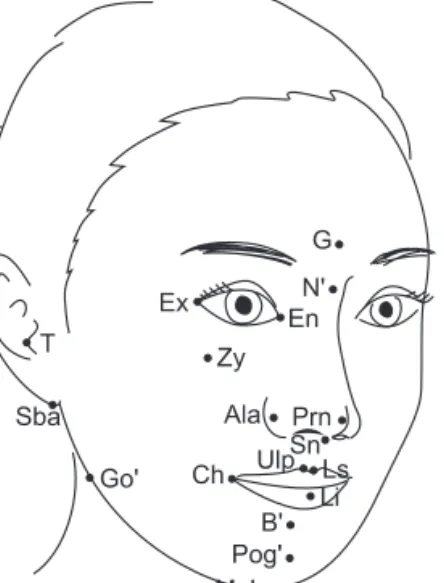
After defining the reference planes using the hard tissue landmarks, 27 soft tissue landmarks, 9 midline and 9 pairs of bilateral landmarks, were located as described in Table 1. The landmarks were located on the 3D surface model, and multi­planar reconstruction (MPR) views were used to identify the landmark when necessary. All data were saved as the form of a vsp file and the files were imported into the related program (V­surgery, CyberMed) (Table 1, Figure 1).

Using the programs, the position of 27 landmarks was obtained in the form of a 3D coordinate system (x, y, z) which was determined as the distances from the reference planes. A positive coordinate value indicates the posterior, superior, and left side of the face, and a negative value indicates the opposite. Using the 3D coordinate values of each point, the right and left differences were calculated for each coordinate. While the difference in the x coordinate direction was designated as the transverse difference (dx), the differences in the y and z coordinates were expressed as the sagittal (dy) and vertical differences (dz) respectively. Each difference was calculated as follows:

dx = |xl - (­xr)|

dy = |yl - yr|

dz = |zl - zr|

where (xl, yl, zl) and (xr, yr, zr) were 3D coordinates of the landmarks of the left and right face. For the midline landmarks, absolute value of the x coordinate was directly assigned to dx.

In order to assess the measurement errors, the images

(3)

from 10 subjects (5 men and 5 women) were selected randomly, and the landmarks were identified twice at an interval of two weeks by an operator. The method errors (MEs) of the double registration of all landmarks in dx, dy, dz were calculated using the Dahlberg’s formula as follows:

ME = ∑ d 2

2

/ n

where d is the difference between the two measurements and n is the number of the subjects. The errors ranged from 0.2 to 0.9 mm.

In order to determine the right and left difference of a pair of landmarks three­dimensionally, the following equation was used according to the study of Ras et al.:

12

3D difference = ( dx )

2

+ ( dy )

2

+ ( dz )

2

As there is no difference in the y and z values between the left and the right sides for the midline landmarks, dx was assigned directly to the 3D difference. Means and standard deviations were calculated for the male and female separately and together. The Shapiro­Wilks test for normality showed that all variables were normally distributed. The independent­samples t­test was used to examine gender differences at the significance level of 0.05.

On the other hand, horizontal, sagittal, and vertical differences were calculated using a pair of each coordinate to evaluate which direction of difference contributed to the degree of 3D difference for bilateral landmarks.

For the examination of gender differences of the 3D coordinate system, Hotelling’s T

2

test was used. All stati­

stical analyses were carried out by the SPSS software Table 1. Description of three-dimensional landmarks used in this study

Landmark Abbreviation Definition

Reference landmarks

Nasion N Most posterior point on curvature between frontal bone and nasal bone in midsagittal plane

Porion Po Highest point on roof of external auditory meatus Orbitale Or Lowest point on infraorbital margin of each orbit

Opisthion Op Most posterior point on posterior margin of foramen magnum Midline landmarks

Glabella G Most prominent midpoint between eyebrows

Soft tissue nasion N' Most posterior midpoint on curvature of nasal root

Pronasale Prn Most prominent midpoint of nasal tip

Subnasale Sn Point at which columella merges with upper lip in midsagittal plane Labrale superius Ls Midpoint of upper vermilion line

Labrale inferius Li Most prominent point of lower lip Soft tissue B point B' Deepest midpoint of mentolabial sulcus Soft tissue pogonion Pog' Most prominent midpoint of chin

Soft tissue menton Me' Lowest median landmark on lower border of chin Bilateral landmarks

Endocanthion En Inner commisure of palpebral fissure

Exocanthion Ex Outer commisure of palpebral fissure

Zygion Zy Most prominent point on the cheek area

Nasal alare Ala Most lateral point of alar contour Upper lip point Ulp Highest point of upper vermilion

Cheilion Ch Lateral extent of labial commisure

Tragion T Tip of tragus

Subaurale Sba Lowest point of earlobe

Soft tissue gonion Go' Most lateral point on the mandibular angle close to bony gonion

(4)

program (version 16.0; SPSS Inc., Chicago, IL, USA).

RESULTS

The means and standard deviations of the right and left differences of the landmarks are presented in Table 2. In the comparison between males and females, all landmarks showed no significant sex differences. Thus, combined data was used in subsequent analyses. The mean difference values derived from normal occlusion individuals used in the study ranged from 0.6 to 4.6 mm, indicating a high variability according to the landmarks.

The midline landmarks showed generally smaller values compared to bilateral landmarks. The values ranged from 0.6 to 1.5 mm. In particular, G, N , Prn, and Sn showed small values ranging from 0.6 to 0.7 mm, indicating that those landmarks can also be used as the references in the evaluation of facial asymmetry. The landmarks in the lower region of the face such as B , Pog , and Me , showed greater values than those in the upper region of the face, indicating an increase of asymmetry according to lower Figure 1. Graphic representation of the landmarks used

in this study.

Table 2. Means and standard deviations of the right and left differences for each landmark in male, female, and combined groups and examination of gender differences

Male (n = 24) Female (n = 24) Total

Sex difference

Mean SD Mean SD Mean SD

Midline landmarks

G 0.50 0.19 0.62 0.33 0.56 0.26 NS

N’ 0.61 0.26 0.65 0.34 0.63 0.30 NS

Prn 0.58 0.21 0.77 0.25 0.68 0.23 NS

Sn 0.61 0.41 0.73 0.39 0.67 0.40 NS

Ls 0.87 0.48 0.85 0.56 0.86 0.52 NS

Li 0.93 0.46 1.00 0.41 0.97 0.44 NS

B’ 1.32 0.62 1.28 0.78 1.30 0.70 NS

Pog’ 1.45 0.66 1.53 0.82 1.49 0.74 NS

Me’ 1.41 0.65 1.56 0.79 1.50 0.72 NS

Bilateral landmarks

En 1.46 0.40 1.58 0.52 1.52 0.46 NS

Ex 1.70 0.39 2.02 0.48 1.86 0.44 NS

Zy 3.37 1.00 3.19 1.36 3.28 1.18 NS

Ala 1.77 0.78 1.94 0.71 1.86 0.75 NS

Ulp 1.57 0.61 1.50 0.82 1.54 0.72 NS

Ch 2.12 0.96 2.28 0.73 2.16 0.85 NS

T 3.11 0.84 2.76 1.34 2.94 1.09 NS

Sba 3.39 1.09 2.78 0.82 3.09 0.96 NS

Go’ 4.46 1.34 4.78 0.90 4.63 1.12 NS

See the Table 1 for the description of each landmark. SD, Standard deviation; NS, not significant.

(5)

positioning of the landmarks.

The bilateral landmarks presented greater values than the midline landmarks, and a higher variability according to the landmarks. The values ranged from 1.5 to 4.6 mm. En and Ulp showed smallest values, approximately 1.5 mm, whereas Zy and Go presented greatest values, 3.3 and 4.6 mm respectively. Similar to the midline landmarks, the bilateral landmarks also showed a tendency of increased values according to lower positioning of the landmarks in the face. In addition, the values showed a tendency to increase according to lateral positioning of the landmarks.

As an example, compared to Ulp and Ala which showed 1.5 and 1.9 mm respectively, Cheilion presented a greater value, 2.2 mm, and Sba and Go showed significantly greater values, 3.1 and 4.6 mm respectively. The more the landmarks were distant from the midsagittal plane, the greater their values were (Table 2).

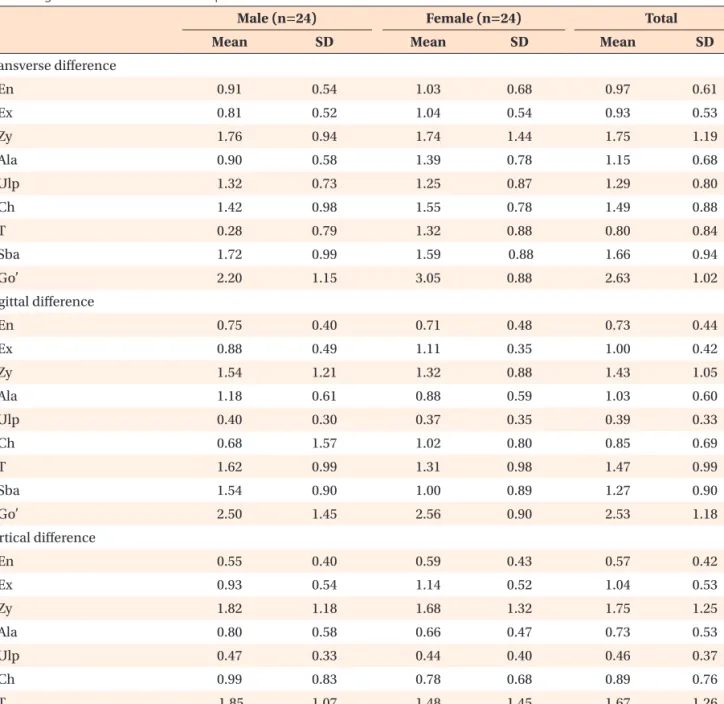
In order to evaluate which direction of difference con ­ tributed to the degree of overall difference for the bila­

teral landmarks, the means and standard deviations were computed for each coordinate direction. While Table 3 shows the values of each sex, combined values were used

Table 3. Right and left differences depicted for each coordinate direction in the bilateral landmarks

Male (n=24) Female (n=24) Total

Mean SD Mean SD Mean SD

Transverse difference

En 0.91 0.54 1.03 0.68 0.97 0.61

Ex 0.81 0.52 1.04 0.54 0.93 0.53

Zy 1.76 0.94 1.74 1.44 1.75 1.19

Ala 0.90 0.58 1.39 0.78 1.15 0.68

Ulp 1.32 0.73 1.25 0.87 1.29 0.80

Ch 1.42 0.98 1.55 0.78 1.49 0.88

T 0.28 0.79 1.32 0.88 0.80 0.84

Sba 1.72 0.99 1.59 0.88 1.66 0.94

Go’ 2.20 1.15 3.05 0.88 2.63 1.02

Sagittal difference

En 0.75 0.40 0.71 0.48 0.73 0.44

Ex 0.88 0.49 1.11 0.35 1.00 0.42

Zy 1.54 1.21 1.32 0.88 1.43 1.05

Ala 1.18 0.61 0.88 0.59 1.03 0.60

Ulp 0.40 0.30 0.37 0.35 0.39 0.33

Ch 0.68 1.57 1.02 0.80 0.85 0.69

T 1.62 0.99 1.31 0.98 1.47 0.99

Sba 1.54 0.90 1.00 0.89 1.27 0.90

Go’ 2.50 1.45 2.56 0.90 2.53 1.18

Vertical difference

En 0.55 0.40 0.59 0.43 0.57 0.42

Ex 0.93 0.54 1.14 0.52 1.04 0.53

Zy 1.82 1.18 1.68 1.32 1.75 1.25

Ala 0.80 0.58 0.66 0.47 0.73 0.53

Ulp 0.47 0.33 0.44 0.40 0.46 0.37

Ch 0.99 0.83 0.78 0.68 0.89 0.76

T 1.85 1.07 1.48 1.45 1.67 1.26

Sba 1.92 1.42 1.61 0.92 1.77 1.17

Go’ 2.39 1.36 2.29 1.17 2.34 1.27

See the Table 1 for the description of each landmark. SD, Standard deviation.

(6)

in the evaluation of the values according to landmarks because Hotelling’s T

2

test did not show any significant differences between male and female subjects. Fig 2 shows graphic presentation of transverse, sagittal, and vertical direction of right and left differences for each landmark.

The differences were present not only in transverse direc­

tion but also in sagittal and vertical directions. A land­

mark, Tragion, presented greater values in sagittal and vertical directions than in transverse directions. These results indicate that overall differences are determined not only by transverse differences but also by sagittal and vertical differences, indicating that 3D evaluation would be essential in the facial soft tissue analysis (Table 3, Figure 2).

DISCUSSION

Selection of reference plane is of the utmost importance in the evaluation of asymmetry of an object. The results can be different depending on the position of the reference plane. Ras et al.

12­14

used a vertical plane perpendicular to and bisecting the line connecting the right and left Exocanthi as the reference plane in the evaluation of fa­

cial asymmetry using stereophotogrammetry. Ferrario et al.

15

selected the vertical line passing through the Na­

sion and perpendicular to the plane connecting the two Exocanthi in the evaluation of asymmetry using a 3D electromagnetic digitizer. Baik et al.

16,17

constructed a plane passing through soft tissue Nasion and the midpoint of both Tragus points as the sagittal reference plane in their 3D facial soft tissue analysis using a laser scanner.

All these studies, however, used soft tissue landmarks for the construction of reference planes. Considering that the reproducibility of soft tissue landmarks is low,

18

the reliability of the reference plane constructed with soft tissue landmark might be questionable. For the pre­

sent study, the hard tissue landmarks were used in the construction of the reference plane. Hard tissue landmarks could be identified easily with the help of the MPR view.

A more important advantage of the construction of the reference plane with the hard tissue landmarks is that the hard and soft tissue can be evaluated simultaneously, in other words, with the same coordinate system as the same reference planes are used. This will enable us to understand the hard and soft tissue interrelationship more accurately. Moreover, use of the same reference planes for both hard and soft tissue evaluation will simplify the procedure of analysis in clinical practice and further contribute to a wider use of 3D image analysis in everyday practice.

The mean values of the right and left differences of the facial soft tissue landmarks derived from normal occlu­

sion individuals ranged from 0.6 to 4.6 mm, indicating a high variability according to the landmarks. Although some landmarks presented small values, the landmarks used in the study generally showed greater values than expected, indicating that the range of “normal asym­

metry” of soft tissue might be wider than in hard tissue.

Katsumata et al.

4

developed the standard values for hard tissue analysis using the same 3D coordinate system as the present study. Comparison of the data of the present study with their studies revealed that the right and left differences of the soft tissue are greater than in hard tissue. This difference might be due to a variation of soft tissue thickness and should be expected results to some extent in the subjects of normal occlusion individuals.

However, it is interesting to note that the findings derived from the subjects of facial asymmetry individuals are quite different from the present study. Kim et al.

3

reported that the degree of asymmetry is less in soft tissue than in hard tissue for most measurements except lip­line can ting in the comparison between soft and hard tissue measurements in the subjects of facial asymmetry indi­

viduals. They explained that skeletal aberration is not fully reflected in soft tissue because it is compensated or masked by muscle and/or skin tissue.

2,3

It is likely that the right and left differences of the soft tissue are greater than in hard tissue in normal occlusion individuals while vice versa in facial asymmetry patients.

While most of the landmarks presented great values of the right and left difference, the midline landmarks showed relatively small values. The values ranged 0.6 to 1.5 mm. In particular, G, N , Prn, and Sn showed very small values ranging from 0.6 to 0.7 mm, indicating that those landmarks also can be used as the references in the evaluation of facial asymmetry. On the other hand, the landmarks in the lower region of the face, B , Pog and Me , showed great values indicating that the degree of Figure 2. The right and left differences for each coor-

dinate direction in the bilateral landmarks. The differences

were present not only in transverse directions but also in

sagittal and vertical directions.

(7)

asym metry increases according to lower positioning of the landmarks. This finding is identical with the results of previous studies.

8,10,11,15,19

Farkas

11

reported that the lowest mean frequency of asymmetries was found in the orbital region (less than 2%), followed by the nose (7%) and mouth (about 12%) in the normal population.

Similar findings were present in facial asymmetry pa­

tients. Severt and Proffit

19

revealed that the asymmetry af fected the upper face in only 5%, the midface in 36%, and the chin in 41% in a retrospective survey of a large number of patients evaluated in the Dentofacial Clinic at the University of North Carolina. This tendency seems to be partly due to the fact that the mandible is a mobile structure compared to the maxilla which is connected to the adjacent structures more strongly with the sutures.

In addition, the right and left difference values showed a tendency to increase according to lateral positioning of the landmarks. As an example, the Subaurale and soft tissue Gonion showed over two times greater values than Upper lip point and Alare in the present study. Pre vious studies dealing with the same issue reported the same results with the present study.

8,10,11,15

Ferrario et al.

15

re­

vealed that Tragion, Gonion, and Zygion were the most asymmetric landmarks whereas the least asymmetric was endocanthion in their 3D study with an electromagnetic digitizer. Considering an increase of asymmetry accor­

ding to lateral positioning of the landmarks, bila teral landmarks should be used with caution in the con­

struction of the reference planes while some au thors

12­17

used bilateral landmarks in the construction of reference planes for their 3D facial soft tissue studies. This will be truer when the landmarks are more distant from the midsagittal structures.

While the data in the study can be used in the iden ti­

fication of individual “asymmetric” subjects, a way of de ci ding the threshold value can be an issue. Farkas

11

and Ferrario et al.

15

used the mean plus 2 standard devia­

tions as the maximum normal asymmetry to supply a threshold value for the identification of asymmetry. On the other hand, Katsumata and her colleagues

4,5

defined a point as asymmetric when the right and left difference was larger than the mean plus one standard deviation, and further defined it as marked asymmetry when the point demonstrated a value greater than twice the mean plus one standard deviation. It is likely that a decision of threshold value is rather subjective according to inve­

stigators or clinicians, particularly in the subject of asym­

metry.

On the other hand, the present data obtained from nor­

mal occlusion individuals can be used in evaluation in post­treatment results and explanation to a patient and his or her family as well as in diagnosis of asymmetry before treatment. The fact that the range of “normal asym metry” of soft tissue is wider than in the hard tissue

indicates that soft tissue symmetry cannot be guaranteed after orthognathic surgery even with perfect correction of hard tissue. This limitation in soft tissue correction should be taken into consideration in formulating a surgical treat ment plan. In addition, it should be informed to the patients that some degree of asymmetry after surgery is natural, not the results of malpractice. Considering that some patients complaint of remaining soft tissue asymmetry after surgery the results of the present study can be a basis of explanation to the patients and can be a further help in improving the interrelationship between the operators and patients.

CONCLUSION

1. In the present study, 27 soft tissue landmarks were identified in 3D coordinate system, and their right and left differences were determined.

2. The right and left difference values showed a tendency to increase according to the lower and lateral positio­

ning of the landmarks in the face.

3. Overall differences were determined not only by transverse differences but also by sagittal and vertical differences, indicating that 3D evaluation would be essential in the facial soft tissue analysis.

REFERENCES

1. Proffit WR, Fields HW Jr, Sarver DM. Contemporary orthodontics. 4th ed. St Louis: Mosby; 2007. p. 5.

2. Bittner C, Pancherz H. Facial morphology and maloc­

clusions. Am J Orthod Dentofacial Orthop 1990;

97:308­15.

3. Kim WS, Lee KH, Hwang HS. Comparison of asym­

metric degree between maxillofacial hard and soft tissue in facial asymmetric subjects using three­di­

men sional computed tomography. Korean J Orthod 2005;35:163­73.

4. Katsumata A, Fujishita M, Maeda M, Ariji Y, Ariji E, Langlais RP. 3D­CT evaluation of facial asymmetry.

Oral Surg Oral Med Oral Pathol Oral Radiol Endod 2005;99:212­20.

5. Maeda M, Katsumata A, Ariji Y, Muramatsu A, Yoshi­

da K, Goto S, et al. 3D­CT evaluation of facial asym­

metry in patients with maxillofacial deformities.

Oral Surg Oral Med Oral Pathol Oral Radiol Endod 2006;102:382­90.

6. Hwang HS, Hwang CH, Lee KH, Kang BC. Maxil­

lofacial 3­dimensional image analysis for the diagnosis of facial asymmetry. Am J Orthod Dentofacial Orthop 2006;130:779­85.

7. Alavi DG, BeGole EA, Schneider BJ. Facial and dental arch asymmetries in Class II subdivision malocclusion.

Am J Orthod Dentofacial Orthop 1988;93:38­46.

(8)

8. Peck S, Peck L, Kataja M. Skeletal asymmetry in esthe­

tically pleasing faces. Angle Orthod 1991;61:43­8.

9. Ferrario VF, Sforza C, Miani A Jr, Serrao G. Dental arch asymmetry in young healthy human subjects evalu ated by Euclidean distance matrix analysis. Arch Oral Biol 1993;38:189­94.

10. Ferrario VF, Sforza C, Miani A, Tartaglia G. Cranio­

facial morphometry by photographic evaluations. Am J Orthod Dentofacial Orthop 1993;103:327­37.

11. Farkas LG. Anthropometry of the head and face. 2nd ed. New York: Raven Press; 1994. p. 103­11.

12. Ras F, Habets LL, van Ginkel FC, Prahl­Andersen B.

Method for quantifying facial asymmetry in three dimen sions using stereophotogrammetry. Angle Orthod 1995;65:233­9.

13. Ras F, Habets LL, van Ginkel FC, Prahl­Andersen B.

Three­dimensional evaluation of facial asymmetry in cleft lip and palate. Cleft Palate Craniofac J 1994;31:

116­21.

14. Ras F, Habets LL, van Ginkel FC, Prahl­Andersen B.

Longitudinal study on three­dimensional changes of facial asymmetry in children between 4 to 12 years

of age with unilateral cleft lip and palate. Cleft Palate Craniofac J 1995;32:463­8.

15. Ferrario VF, Sforza C, Ciusa V, Dellavia C, Tartaglia GM. The effect of sex and age on facial asymmetry in healthy subjects: a cross­sectional study from adole­

scence to mid­adulthood. J Oral Maxillofac Surg 2001;

59:382­8.

16. Baik HS, Lee HJ, Lee KJ. A proposal for soft tis sue landmarks for craniofacial analysis using 3­dimen­

sional laser scan imaging. World J Orthod 2006;7:7­

17. Baik HS, Jeon JM, Lee HJ. Facial soft­tissue analysis 14.

of Korean adults with normal occlusion using a 3­dimensional laser scanner. Am J Orthod Dentofacial Orthop 2007;131:759­66.

18. Gwilliam JR, Cunningham SJ, Hutton T. Repro­

ducibility of soft tissue landmarks on three­dimen­

sional facial scans. Eur J Orthod 2006;28:408­15.

19. Severt TR, Proffit WR. The prevalence of facial asym­

metry in the dentofacial deformities population at the

University of North Carolina. Int J Adult Orthodon

Orthognath Surg 1997;12:171­6.

수치

Table 2. Means and standard deviations of the right and left differences for each landmark in male, female, and  combined groups and examination of gender differences
Table 3. Right and left differences depicted for each coordinate direction in the bilateral landmarks

참조

관련 문서

Red point: primary image, green point: secondary image, purple point: landmarks that have not changed... Using superimposition method(Pog: 1.0mm left movement, 0.6mm

Heritability of the Cephalometric Facial Hard and Soft Tissue Parameters in Korean Adult Twins and Their Siblings Using.. Principal

To compare the amount of asymmetry between healthy adults and patients who underwent ZMC reduction, distance from landmarks on the right and left soft tissues to midsagit- tal

15 used a left and right asymmetry index for their symmetric and asymmetric groups in order to create a diagrammatic chart (i.e., a skeletogram); according to their study, the

Considerable difference in soft tissue thickness was ob- served at the stomion site among each skeletal type, with the lowest value in Class II, greatest in Class III, and an

This study calculated the changes of the skeletal and soft tissue landmarks in order to act as a guide in planning and performing the surgery and as a reference in

The location of midfacial landmarks according to the method of establishing the midsagittal reference plane in three-dimensional computed tomography analysis of facial asymmetry..

Conclusion: In a three-dimensional facial analysis, the vertical and horizontal deviations of the landmarks from the horizontal and midsagittal reference planes could vary depending