Safety and Feasibility of Laparoscopic Surgery for Small Bowel Obstruction
Sung Min Kim, M.D.
1, Jun Ho Park, Ph.D.
2, Byung Chun Kim, Ph.D.
3, Byung Mo Kang, M.D.
4, Jong Wan Kim, M.D.
1, Jeong Yeon Kim, Ph.D.
11
Department of Surgery, Dongtan Sacred Heart Hospital, Hallym University College of Medicine, Hwaseong,
2Department of Surgery, Kangdong Sacred Heart Hospital, Hallym University College of Medicine, Seoul,
3Department of Surgery, Kangnam Sacred Heart Hospital, Hallym University College of Medicine, Seoul,
4Department of Surgery, Chuncheon Sacred Heart Hospital, Hallym University College of Medicine, Chuncheon, Korea
Purpose:
Laparoscopic adhesiolysis is increasingly used to treat patients with small bowel obstruction (SBO), however, its safety of laparoscopic surgery(LS) with bowel resection in SBO is unclear. The purpose of the present study was to compare the perioperative outcomes of LS with those of open surgery (OS) for SBO and to evaluate the risk factors of 30-day postoperative morbidity and recurrence.Methods:
We retrospectively reviewed medical records of patients who had been diagnosed with SBO and underwent surgery at four Hallym-University-affiliated hospitals between January 2013 and December 2016. The rates of 30-day postoperative complications and recurrence were compared between groups using univariate and multivariate analysis. Propensity score matching was performed to compare the outcome.Results:
A total of 117 patients with SBO were included in the present study, of which 86 underwent OS and 31 underwent LS. Time to water intake, time to soft diet, and postoperative hospital stay were significantly shorter in the LS group (p=0.002, 0.003, and 0.027, respectively). The complication (p=0.249) and recurrence rate (p=0.679) were similar between the two group. Propensity score matching analysis demonstrated that laparoscopic surgery showed quicker recovery and similar complication and recurrence rate. In multivariate analysis, LS was not associated with either complications (p=0.806) or recurrence (p=0.956).Conclusion:
LS is associated with several perioperative advantages for the treatment of SBO without affecting the risk of 30-day postoperative complications or recurrence. Therefore LS can be a safe and feasible option for treating SBO.Keywords:
Small bowel obstruction, Laparoscopic surgery, ComplicationReceived March 22, 2018 Revised April 19, 2018 Accepted April 30, 2018
Corresponding author Jeong Yeon Kim
Department of Surgery, Dongtan Sacred Heart Hospital, Hallym University College of Medicine, 40, Sukwoo-dong, Hwaseong 18450, Korea
Tel: +82-31-8086-2430 Fax: +82-31-8086-2709 E-mail: [email protected] ORCID:
http://orcid.org/0000-0003-4345-5884
This is an Open Access article distributed under the terms of the Creative Commons Attribution Non-Commercial License (http://
creativecommons.org/licenses/by-nc/4.0/) which permits unrestricted non-commercial use, distribution, and reproduction in any medium, provided the original work is properly cited.
Copyright © 2018 The Journal of Minimally Invasive Surgery. All rights reserved.
Journal of Minimally Invasive Surgery
J Minim Invasive Surg 2018;21(2):75-81
INTRODUCTION
Small bowel obstruction (SBO) is one of the most common conditions requiring emergency surgical admission. Postopera- tive intra-abdominal adhesion occurs in 60%~80% of patients
with SBO.
1-4Conventional laparotomy with adhesiolysis or
resection of nonviable small intestine is the standard surgical
approach for SBO if conservative treatment fails, or complica-
tions such as bowel necrosis are suspected. However, a poten-
tial problem with laparotomy for SBO is that open surgery (OS)
causes even more adhesions.
Recently, laparoscopic surgery (LS) has been considered as an alternative treatment for SBO, because it is associated with fewer postoperative adhesions than open surgery.
5-8However, there is considerable controversy regarding the potential ad- verse effect of laparoscopic surgery in SBO because of the difficulty in manipulating the distended bowel and the nar- row working space, which may increase the risk of iatrogenic bowel perforation.
3,4Bastug et al. first reported successful laparoscopic adhe- siolysis in 1991.
9Since then, with the recent technical ad- vances and increased experience in LS, many previous studies have shown the safety, feasibility, and potential superiority of a laparoscopic approach for the treatment of SBO.
10-17More- over, some studies have reported long-term outcomes, such as the frequency and management of recurrence after LS.
18-20Despite many studies have been reported on safety of lapa- roscopic adhesiolysis in SBO, prospective randomized trials comparing LS and OS in the treatment of SBO have not been published. Accordingly, the proper surgical approach depends on the condition of the patient and the surgeon ’s discretion.
The purpose of the present study is to compare the rates of 30-day postoperative complications and recurrence rates of LS with those of OS for SBO and to evaluate the risk factors for SBO complications and recurrence. And propensity score matching analysis was performed to compare the outcome between the two groups.
MATERIALS AND METHODS
A retrospective review was performed of patients diagnosed with SBO who underwent surgery at four Hallym-University- affiliated hospitals (Kangnam Sacred Heart Hospital, Kang- dong Sacred Heart Hospital, Chuncheon Sacred Heart Hos- pital, and Dongtan Sacred Heart Hospital) between January 2013 and December 2016. The patients were divided into two groups according to whether they underwent LS or OS. The type of surgery was selected according to the surgeon’s discre- tion and the patients ’ clinical status.
The diagnosis of SBO was determined based on medical history and physical examinations combined with imaging studies, including plain erect/supine abdominal X-ray and ab- dominal computed tomography. We excluded patients with in- complete data and those aged <18 years or >80 years. We also excluded patients with non-adhesion-related causes of bowel obstruction, such as a solid tumor, disseminated malignancy, and internal hernia.
Patient characteristics and perioperative variables were compared between the LS and OS groups. The patients ’ char- acteristics included age, sex, American Society of Anesthesi-
ologists score (ASA), body mass index (BMI), previous surger- ies, duration from symptom onset to surgery, white blood cell count, neutrophil proportion, and serum C-reactive protein concentration. Previous surgeries were divided into major and minor operations according to the site and type of operation.
21Open cholecystectomy, colorectal surgery due to malignancy or diverticulitis, total abdominal hysterectomy, small bowel resection anastomosis due to trauma or stab wound, total or subtotal gastrectomy, and Whipple ’s operation were regarded as major operations, while appendectomy, cesarean section, laparoscopic adnexal surgery, laparoscopic cholecystectomy, and laparoscopic primary repair due to gastric or duodenal ulcer perforation were regarded as minor operations.
Surgical variables included operation time, surgical approach (LS versus OS), procedure type, and reason for conversion to OS. Procedure type was divided into three groups according to the aggressiveness of the method: bowel resection, adhe- siolysis, and band ligation. If more than one procedure was performed, we used the more aggressive procedure. Receiving an additional incision larger than that necessary for specimen retrieval was defined as conversion to OS. Patients who un- derwent LS for bowel resection via an incision less than 5 cm were included in the LS group.
Postoperative outcomes included the time to flatus, time to water intake, time to soft diet intake, and the length of the postoperative hospital stay. Postoperative complications were defined as any condition that prolonged hospitalization or required an additional procedure. Ileus, bowel perforation, pneumonia, wound dehiscence, intra-abdominal abscess, and septic shock were considered complications. The study was approved by the Institutional Review Board of Dongtan Sa- cred Heart Hospital (IRB number, 2017-141).
The primary outcome of this study was the rate of postop- erative complications. The secondary outcomes were indica- tors of postoperative recovery, including time to flatus, time to soft diet, and the length of the postoperative hospital stay, and risk factors for postoperative complications and recurrence.
Continuous variables, presented as means and standard de- viations, were compared using Student ’s t test or the Mann- Whitney U test. Categorical variables, presented as numbers and percentages of patients, were analyzed using the χ
2test or Fisher’s exact test. To remove the effect of selection bias on the outcomes, we matched two groups with propensity score calculated by age, sex, operation type and operation history using binary logistic regression.
Multivariate logistic regression analysis was used to identify
independent predictors of postoperative complications and
bowel resection. Confounding factors evaluated in the multi-
variate analysis included factors previously reported to be as-
sociated with postoperative complications and bowel resection.
Of the confounding factors, continuous variables, including age, BMI, white blood cell count, neutrophil proportion, and serum CRP concentration, were categorized using their mean values. The time from symptom onset to surgery was catego- rized into three periods: ≤1, 1~7, and >7 days. p values <0.05 were considered statistically significant.
RESULTS
A total of 117 patients with SBO underwent surgery: OS in 86 and LS in 31. The patient demographic characteristics are summarized in Table 1. Patients in the LS group were younger than those in the OS group (46.1 vs. 60.9 years, p<0.001).
There were no significant differences between the two groups in terms of sex, ASA, BMI, surgical history, symptom to op- eration time, white blood cell count, or neutrophil proportion.
Propensity score matching yielded 23 pairs of matched LS and OS patients. With propensity score matching, the two patient groups were well-matched in other characteristics including BMI, previous operation type, symptom to operation time, white blood cell count and neutrophil ratio (Table 1).
Table 2 presents the perioperative outcomes. In the OS group, bowel resection was performed most frequently, fol- lowed by adhesiolysis and bandlysis. In the LS group, adhe- siolysis was performed most frequently, followed by bandlysis
and bowel resection. There was no significant difference in operation time between the two groups (115.3 vs. 112.4 min- utes, p=0.844). Time to water intake, time to soft diet, and postoperative hospital stay were significantly shorter in the LS group ( p=0.002, 0.003, and 0.027, respectively). The postop- erative complication rate was similar between the two groups (33.7% vs. 22.6%, p=0.249). Postoperative ileus occurred in 22 (25.6%) patients in the OS group and 6 patients (19.4%) in the LS group. Bowel perforation was observed in one patient (3.2%) in the LS group. Conversion to OS was required in four pa- tients because of severe adhesions in three patients and bowel perforation in one patient. The mean follow-up periods were 18.2 and 14.0 months in the OS and LS groups, respectively.
Recurrence (8% vs. 3.2%, p=0.679) and re-operation (3.4% vs.
6.5%, p=0.604) rates were similar between the groups.
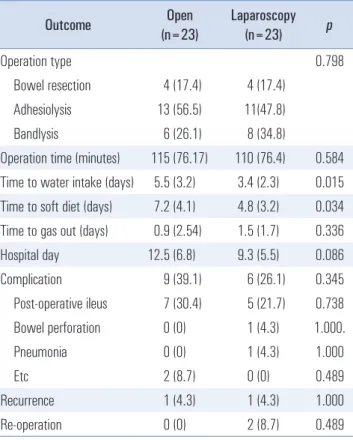
With propensity score matching, the time to water intake (5.5 vs. 3.4 days, p=0.015), time to soft diet intake (7.2 vs. 4.8 days, p=0.034) were significantly shorter in the LS group than in the OS group, and the length of hospital stay tended to be shorter in LS than in OS ( p=0.086) (Table 3). The matching analysis also did not show a difference in the postoperative compli- cation rate, recurrence and reoperation between the groups ( p=0.345, p=1.000, and p=0.489, respectively).
Univariate analysis revealed male sex ( p=0.028), bowel re- section ( p=0.005), and previous major surgeries (p<0.001) as Table 1. Patient demographic characteristics
Variables Unmatched PS-Matched
Open (n=86) Laparoscopy (n=31) p Open (n=23) Laparoscopy (n=23) p
Age (years) 60.9 (18.7) 46.1 (18.3) <0.001 50.9 (19.1) 50.3 (18.5) 0.969
Male 45 (52.3%) 13 (41.9%) 0.321 9 (39.1%) 9 (39.1%) 1.000
ASA score 0.211 0.665
1 and 2 65 (75.6) 27 (87.1) 21 (91.3) 19 (82.6)
3 and 4 21 (24.4) 4 (12.9) 2 (8.7) 4 (17.4)
Body mass index (kg/m
2) 21.7 (4.4) 22.6 (2.5) 0.395 24.1 (3.8) 23.0 (3.7) 0.315
Operation history 0.550 0.797
None 24 (27.9%) 9 (29.0%) 7 (27.3%) 8 (28.1%)
Minor 34 (39.5%) 15 (48.4%) 10 (39.8%) 13 (46.9%)
Major 28 (32.6%) 7 (22.6%) 6 (31.8%) 2 (25.0%)
Symptom to operation time (days) 4.0 (4.5) 4.9 (7.0) 0.511 3.7 (4.1) 6.2 (7.7) 0.163 White blood cell count (×10
3/μL) 12.2 (14.5) 9.9 (3.7) 0.383 9.9 (5.1) 9.58 (4.2) 0.839
Neutrophil ratio (%) 77.4 (16.0) 75.8 (14.4) 0.625 74 (16.9) 72 (15.2) 0.634
CRP (mg/L) 66.4 (95.3) 16.3 (32.7) <0.001 62.3 (78.5) 19.7 (37.2) 0.033
Data presented are numbers of patients (percentage) or means (standard deviations). CRP = c-reactive protein; ASA score = American Society of Anes-
thesiologists score.
risk factors for postoperative complications (Table 4). In the multivariate analysis, male sex (p=0.016) and previous major surgeries (p=0.011) remained significant risk factors for post- operative complications. LS was not associated with compli- cations in either the univariate or multivariate analysis.
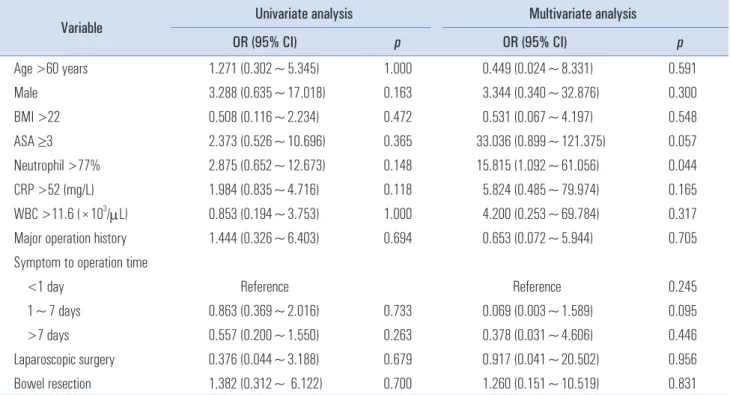
A neutrophil proportion >77% was independently associated with SBO recurrence in the multivariate analysis ( p=0.044) (Table 5). LS was not a risk factor for SBO recurrence in either the univariate or multivariate analysis.
DISCUSSION
The present study revealed several advantages of LS for the treatment of SBO, including a shorter time to flatus, shorter time to soft diet intake, and shorter postoperative hospital stay, without an increase in the risk of complications, com- pared with OS. In a sensitivity analysis, patients in the LS group showed a quicker recovery compared with those in the OS group. Independent factors associated with postoperative complications were male sex ( p=0.01) and prior major surger- ies ( p=0.011). Moreover, a neutrophil proportion >77% was an
independent risk factor for recurrence ( p=0.044).
Postoperative intra-abdominal adhesions account for 60%~80% of SBO cases.1-4 The initial treatment of SBO is conservative management, including decompression of the distended bowel using a Levin tube, hydration, and antibiotics.
If conservative treatment fails, or if signs of strangulation or peritonitis are suspected, conventional laparotomy is the stan- dard surgical treatment for SBO. However, laparotomy treat- ment of SBO has been associated with substantial morbidities including wound infections, increased postoperative pain, prolonged ileus, and reduced postoperative pulmonary func- tion.2 In addition, the estimated rate of obstruction recurrence is 12%~17%.
1,22,23Since the first report of Bastug et al. for successful laparo- scopic adhesiolysis in 1991,
9technological developments and increased experience with LS have led to a number of studies reporting advantages of LS, including a shorter postopera- tive hospital stay, fewer complications, and less postoperative pain.
10-17Kim et al. reported significant reductions in return of bowel function (4.3 vs. 6.6 days, p=0.02), and hospital stay (8.1 vs. 15.2 days, p=0.04).
17Moreover, in a systematic review comparing laparoscopic adhesiolysis with open adhesiolysis for SBO treatment, LS resulted in reduced risks of morbid- ity, mortality, and surgical site infection.
24The present study Table 2. Perioperative outcome
Outcome Open
(n=86) Laparoscopy
(n=31) p
Operation type 0.005
Bowel resection 43 (50%) 5 (16.1%) Adhesiolysis 25 (29.1%) 15 (48.4%) Bandlysis 18 (20.9%) 11 (35.5%) Operation time (minutes) 115.3 (69.1) 112.4 (68.9) 0.844
Open conversion 4 N/A
Time to water intake (days) 5.72 (3.6) 3.52 (2.7) 0.002 Time to soft diet (days) 7.22 (4.0) 4.77 (3.5) 0.003 Time to gas out (days) 1.38 (2.5) 2.10 (2.3) 0.167 Hospital day 18.9 (23.0) 12.5 (8.5) 0.027
Complication 29 (33.7) 7 (22.6) 0.249
Post-operative ileus 22(25.6) 6 (19.4) 0.486 Bowel perforation 0 (0) 1 (3.2) 0.265
Pneumonia 3 (3.4) 1 (3.2) 1.000
Etc 4 (4.5) 0 (0) 0.572
Recurrence 7 (8.0) 1 (3.2) 0.679
Re-operation 3 (3.4) 2 (6.5) 0.604
Data presented are numbers of patients (percentage) or means (standard deviations).
Table 3. Periopertive outcomes of propenisity score matched analysis
Outcome Open
(n=23) Laparoscopy
(n=23) p
Operation type 0.798
Bowel resection 4 (17.4) 4 (17.4) Adhesiolysis 13 (56.5) 11(47.8)
Bandlysis 6 (26.1) 8 (34.8)
Operation time (minutes) 115 (76.17) 110 (76.4) 0.584 Time to water intake (days) 5.5 (3.2) 3.4 (2.3) 0.015 Time to soft diet (days) 7.2 (4.1) 4.8 (3.2) 0.034 Time to gas out (days) 0.9 (2.54) 1.5 (1.7) 0.336 Hospital day 12.5 (6.8) 9.3 (5.5) 0.086
Complication 9 (39.1) 6 (26.1) 0.345
Post-operative ileus 7 (30.4) 5 (21.7) 0.738 Bowel perforation 0 (0) 1 (4.3) 1.000.
Pneumonia 0 (0) 1 (4.3) 1.000
Etc 2 (8.7) 0 (0) 0.489
Recurrence 1 (4.3) 1 (4.3) 1.000
Re-operation 0 (0) 2 (8.7) 0.489
Table 4. Risk factor for complication.
Variable Univariate analysis Multivariate analysis
OR (95% CI) p OR (95% CI) p
Age >60 years 1.125 (0.525~2.414) 0.762 1.055 (0.353~3.154) 0.923
Male 2.383 (1.091~5.208) 0.028 3.543 (1.261~9.951) 0.016
BMI >22 0.771 (0.360~1.651) 0.503 1.579 (0.593~4.200) 0.360
ASA ≥3 1.624 (0.659~4.002) 0.290 1.342 (0.405~4.444) 0.630
Neutrophil >77% 0.964 (0.442~2.103) 0.927 2.008 (0.650~6.199) 0.266
CRP >52 (mg/L) 1.032 (0.420~2.538) 0.945 1.522 (0.508~4.588) 0.453
WBC >11.6 (×10
3/μL) 1.839 (0.828~4.082) 1.132 2.085 (0.670~6.493) 0.205
Major operation history 4.650 (2.001~10.808) <0.001 3.781 (1.350~10.590) 0.011 Symptom to operation time
<1 day Reference 0.766
1~7 days 0.946 (0.396~2.262) 0.820 0.651 (0.206~2.064) 0.466
>7 days 0.657 (0.229~1.888) 0.436 0.786 (0.201~3.070) 0.729
Laparoscopic surgery 0.446 (0.173~1.149) 0.090 0.843 (0.216~3.290) 0.806
Bowel resection 3.059 (1.392~6.722) 0.005 1.660 (0.586~4.701) 0.340
OR = odds ratio; CI = confidence interval; BMI = body mass index; ASA score = American Society of Anesthesiologists score; CRP = c-reactive pro- tein; WBC = white blood cell.
Table 5. Risk factor for recurrence
Variable Univariate analysis Multivariate analysis
OR (95% CI) p OR (95% CI) p
Age >60 years 1.271 (0.302~5.345) 1.000 0.449 (0.024~8.331) 0.591
Male 3.288 (0.635~17.018) 0.163 3.344 (0.340~32.876) 0.300
BMI >22 0.508 (0.116~2.234) 0.472 0.531 (0.067~4.197) 0.548
ASA ≥3 2.373 (0.526~10.696) 0.365 33.036 (0.899~121.375) 0.057
Neutrophil >77% 2.875 (0.652~12.673) 0.148 15.815 (1.092~61.056) 0.044
CRP >52 (mg/L) 1.984 (0.835~4.716) 0.118 5.824 (0.485~79.974) 0.165
WBC >11.6 (×10
3/μL) 0.853 (0.194~3.753) 1.000 4.200 (0.253~69.784) 0.317
Major operation history 1.444 (0.326~6.403) 0.694 0.653 (0.072~5.944) 0.705
Symptom to operation time
<1 day Reference Reference 0.245
1~7 days 0.863 (0.369~2.016) 0.733 0.069 (0.003~1.589) 0.095
>7 days 0.557 (0.200~1.550) 0.263 0.378 (0.031~4.606) 0.446
Laparoscopic surgery 0.376 (0.044~3.188) 0.679 0.917 (0.041~20.502) 0.956
Bowel resection 1.382 (0.312~ 6.122) 0.700 1.260 (0.151~10.519) 0.831
OR = odds ratio; CI = confidence interval; BMI = body mass index; ASA score = American Society of Anesthesiologists score; CRP = c-reactive pro-
tein; WBC = white blood cell; op = operation.
also showed a quicker recovery of bowel function and shorter postoperative hospital stay in the LS group than in the OS group.
However, bowel resection was performed more frequently in the OS group than in the LS group, which may have re- sulted in the faster recovery and shorter hospital stay in the LS group. Thus, we performed a matching the two group us- ing propensity score calculated by age, gender and operation type. Results of the propensity score matched analysis also showed that LS was associated with a shorter time to water intake and time to soft diet. The length of hospital stay tended to be shorter in LS than in OS (p=0.086). These results are in agreement with those of previous studies.
Although many studies have compared postoperative com- plications between LS and OS, the conclusions differ. Oka- moto et al. demonstrated a lower rate of postoperative compli- cations after LS than after laparotomy (7% vs. 56%, p<0.05).
16On the other hand, Hackenberg et al. reported similar overall complication rates between LS and OS (16% vs. 24%, p=0.40).
25In the present study, the overall complication and postopera- tive ileus rates were similar between the two groups (p=0.249 and 0.486, respectively). Possible explanations are that the definitions of complications and disease entities included as complications differ among studies. Several studies have re- ported risk factors for complications. Byrne et al. showed that age, male sex, smoking, and prior abdominal surgery were associated with overall complications. In addition, LS reduced the risk of complications by 60% ( p=0.002).
13Suter et al. sug- gested accidental bowel perforation (p=0.008) and the need for conversion to OS (p=0.009) to be independent risk factors for postoperative complications.
26In the present study, previous major surgeries and male sex were associated with postopera- tive complications. Potential issues in major surgeries are that complicated surgical procedures can result in extensive dis- section, longer operation times, and more aggressive surgical trauma in tissues, which can increase the risk of complica- tions.
Recent studies have reported rates of conversion to OS of 26%~51.9%, much higher than the 12.9% conversion rate re- ported in the present study.
6,13-15,26,27The reason for our low rate of conversion might be that laparoscopic-assisted procedures were not regarded as OS in this study. For such procedures, bowel resection with anastomosis was performed by mini- laparotomy using a less than 5 cm incision in the LS group.
One of the main concerns of LS for SBO is iatrogenic bowel perforation. The incidence of iatrogenic bowel perforation has been reported to range from 3.2% to 13.56%.
3,6,16,18,26,28Bai- ley et al. reported a higher reoperation rate due to iatrogenic bowel perforation in patients treated laparoscopically ( p<0.05).
29However, a systematic review showed that LS for SBO did not
increase the risk of bowel injury compared with OS (95% CI 0.24~2.46; p=0.65).
30Although there was only one case (3.2%) of bowel perforation in the LS group, the incidence of bowel perforation in the present study was lower than those of pre- vious studies. In LS, we insert the first trocar using Hasson ’s technique and then introduce the other trocars under direct camera visual guidance. Suter et al. recommended manipula- tion of the small bowel using atraumatic forceps, including fenestrated forceps or large intestinal Glasson graspers, and performance of bandlysis or adhesiolysis using scissors or a bipolar coagulator, rather than a monopolar coagulator.
26A potential problem with performing LS for patients with SBO is the higher recurrence rate compared with that of OS.
It is likely that occult pathologic lesions at other sites are over- looked because of the limited abdominal cavity and distended (small) bowel. However, several studies reported no difference in recurrence rate between LS and OS.
15,19The recurrence rate in the present study was also similar between the LS and OS groups (3.2% vs. 8.0%, p=0.679). Duron et al. in 2006 reported that adhesions or matted adhesions and surgical complications were independent risk factors for surgical recurrence.
20Re- cently, Yao et al. showed more than three prior surgeries to be a risk factor for overall recurrence ( p=0.041).
19There are several limitations to our study. First, this study was performed retrospectively, which means that selection bias may have existed. Thus, younger patients with severe adhe- sions were more likely to be selected for LS. To address these biases, we performed a matching analysis using propensity scores based on age, gender, and operation type. Second, the median follow-up period in the present study was relatively short compared with those of previous studies, ranging from 41 to 47 months.
18-20To clarify that LS is appropriate for the treatment of SBO, a randomized control study with a long- term follow-up period is needed. Despite these limitations, we believed that the present study showed the safety and feasibil- ity of LS for the treatment of SBO without increases in the complication or recurrence rates.
CONCLUSION
The present study revealed that LS is associated with several perioperative advantages for the treatment of SBO. Moreover, LS did not increase the risk of postoperative complications or recurrence. Therefore, LS can be performed safely in patients with SBO.
REFERENCES
1) Ellis H, Moran BJ, Thompson JN, et al. Adhesion-related hospital readmissions after abdominal and pelvic surgery: a retrospective
cohort study. Lancet 1999;353:1476-1480.
2) Miller G, Boman J, Shrier I, Gordon PH. Natural history of patients with adhesive small bowel obstruction. Br J Surg 2000;87:1240-1247.
3) Tierris I, Mavrantonis C, Stratoulias C, Panousis G, Mpetsou A, Kalochristianakis N. Laparoscopy for acute small bowel obstruc- tion: indication or contraindication? Surg Endosc 2011;25:531- 535.
4) O’Connor DB, Winter DC. The role of laparoscopy in the man- agement of acute small-bowel obstruction: a review of over 2,000 cases. Surg Endosc 2012;26:12-17.
5) Garrard CL, Clements RH, Nanney L, Davidson JM, Richards WO. Adhesion formation is reduced after laparoscopic surgery.
Surg Endosc 1999;13:10-13.
6) Wullstein C, Gross E. Laparoscopic compared with conventional treatment of acute adhesive small bowel obstruction. Br J Surg 2003;90:1147-1151.
7) Ellis H. The clinical significance of adhesions: focus on intestinal obstruction. Eur J Surg Suppl 1997:5-9.
8) van der Zee DC, Bax NM. Management of adhesive bowel ob- struction in children is changed by laparoscopy. Surg Endosc 1999;13:925-927.
9) Bastug DF, Trammell SW, Boland JP, Mantz EP, Tiley EH, 3rd.
Laparoscopic adhesiolysis for small bowel obstruction. Surg Lapa- rosc Endosc 1991;1:259-262.
10) Catena F, Di Saverio S, Kelly MD, et al. Bologna Guidelines for Diagnosis and Management of Adhesive Small Bowel Obstruction (ASBO): 2010 Evidence-Based Guidelines of the World Society of Emergency Surgery. World J Emerg Surg 2011;6:5.
11) Kelly KN, Iannuzzi JC, Rickles AS, Garimella V, Monson JR, Fleming FJ. Laparotomy for small-bowel obstruction: first choice or last resort for adhesiolysis? A laparoscopic approach for small- bowel obstruction reduces 30-day complications. Surg Endosc 2014;28:65-73.
12) Mancini GJ, Petroski GF, Lin WC, Sporn E, Miedema BW, Thaler K. Nationwide impact of laparoscopic lysis of adhesions in the management of intestinal obstruction in the US. J Am Coll Surg 2008;207:520-526.
13) Byrne J, Saleh F, Ambrosini L, Quereshy F, Jackson TD, Okrainec A. Laparoscopic versus open surgical management of adhesive small bowel obstruction: a comparison of outcomes. Surg Endosc 2015;29:2525-2532.
14) Khaikin M, Schneidereit N, Cera S, et al. Laparoscopic vs. open surgery for acute adhesive small-bowel obstruction: patients’ out- come and cost-effectiveness. Surg Endosc 2007;21:742-746.
15) Otani K, Ishihara S, Nozawa H, et al. A retrospective study of laparoscopic surgery for small bowel obstruction. Ann Med Surg (Lond) 2017;16:34-39.
16) Okamoto H, Wakana H, Kawashima K, Fukasawa T, Fujii H.
Clinical outcomes of laparoscopic adhesiolysis for mechanical
small bowel obstruction. Asian J Endosc Surg 2012;5:53-58.
17) Kim SH, Kim BS, Kim YH, Choi SI. The Feasibility of Laparo- scopic Surgery in the Management of Small Bowel Obstruction. J Korean Soc Endosc Laparosc Surg 2011;14:84-90.
18) Wang Q, Hu ZQ, Wang WJ, Zhang J, Wang Y, Ruan CP. Laparo- scopic management of recurrent adhesive small-bowel obstruc- tion: Long-term follow-up. Surg Today 2009;39:493-499.
19) Yao S, Tanaka E, Matsui Y, et al. Does laparoscopic adhesioly- sis decrease the risk of recurrent symptoms in small bowel ob- struction? A propensity score-matched analysis. Surg Endosc 2017;31:5348-5355.
20) Duron JJ, Silva NJ, du Montcel ST, et al. Adhesive postoperative small bowel obstruction: incidence and risk factors of recurrence after surgical treatment: a multicenter prospective study. Ann Surg 2006;244:750-757.
21) Barmparas G, Branco BC, Schnuriger B, Lam L, Inaba K, Deme- triades D. The incidence and risk factors of post-laparotomy ad- hesive small bowel obstruction. J Gastrointest Surg 2010;14:1619- 1628.
22) Beck DE, Opelka FG, Bailey HR, Rauh SM, Pashos CL. Incidence of small-bowel obstruction and adhesiolysis after open colorectal and general surgery. Dis Colon Rectum 1999;42:241-248.
23) Cox MR, Gunn IF, Eastman MC, Hunt RF, Heinz AW. The op- erative aetiology and types of adhesions causing small bowel ob- struction. Aust N Z J Surg 1993;63:848-852.
24) Sajid MS, Khawaja AH, Sains P, Singh KK, Baig MK. A systemat- ic review comparing laparoscopic vs open adhesiolysis in patients with adhesional small bowel obstruction. Am J Surg 2016;212:138- 150.
25) Hackenberg T, Mentula P, Leppaniemi A, Sallinen V. Laparo- scopic versus Open Surgery for Acute Adhesive Small-Bowel Obstruction: A Propensity Score-Matched Analysis. Scand J Surg 2017;106:28-33.
26) Suter M, Zermatten P, Halkic N, Martinet O, Bettschart V. Lapa- roscopic management of mechanical small bowel obstruction: are there predictors of success or failure? Surg Endosc 2000;14:478- 483.
27) Grafen FC, Neuhaus V, Schob O, Turina M. Management of acute small bowel obstruction from intestinal adhesions: indications for laparoscopic surgery in a community teaching hospital. Langen- becks Arch Surg 2010;395:57-63.
28) Levard H, Boudet MJ, Msika S, et al. Laparoscopic treatment of acute small bowel obstruction: a multicentre retrospective study.
ANZ J Surg 2001;71:641-646.
29) Bailey IS, Rhodes M, O’Rourke N, Nathanson L, Fielding G.
Laparoscopic management of acute small bowel obstruction. Br J Surg 1998;85:84-87.
30) Wiggins T, Markar SR, Harris A. Laparoscopic adhesiolysis for acute small bowel obstruction: systematic review and pooled analysis. Surg Endosc 2015;29:3432-3442.