본 연구는 2020년도 농촌진흥청 국립축산과학원 전문연구원 지원사업에 의해 이루어진 것임.
*Corresponding Author : Ki-Taeg Nam(Hankyong National Univ.) email: [email protected]
Received February 8, 2021 Revised March 16, 2021 Accepted May 7, 2021 Published May 31, 2021
Cysteamine hydrochloride (CSH)의 첨가 급여가 육용계의
생산성과 소화율에 미치는 영향
서강민1, 천주란1, 김기현1, 남기택2*
1농촌진흥청 국립축산과학원, 2국립한경대학교 동물생명환경과학과
The Effects of Dietary Supplementation of Cysteamine
Hydrochloride (CSH) on Growth Performance and Digestibility
Characteristic in Broiler Chicks
Kangmin Seo1, Ju Lan Chun1, Ki Hyun Kim1, Ki-Taeg Nam2*
1National Institute of Animal Science, Rural Development Administration
2Department of Animal Life and Environment Science, Hankyong National University
요 약 본 연구는 Cysteamine hydrochloride (CSH)의 사료 내 첨가 급여가 육용계의 생산성 및 소화율에 미치는 영향을 조사하기 위해 수행되었다. 1 일령의 Ross broiler 수컷 180 수를 공시하여 3 개의 실험그룹에 각각 3 반복으로 반복 당 20 수씩 배치하였다. 실험설계는 Control (Basal diets), CSH-1 (Basal diets+250 mg CSH/kg feed), CSH-2 (Basal diets+500 mg CSH/kg feed)으로 디자인하였다. 육성 초기 동안의 일당 사료섭취량, 체중, 일당 증체 량, 사료요구율, 육성률은 모든 실험그룹들 사이에서 차이가 나타나지 않았다. 육성 후기와 전체 실험기간 동안의 결과를 종합적으로 평가한 경우, CSH-1과 CSH-2 그룹은 Control 그룹과 비교하여 사료요구율이 유의하게 개선되는 것으로 나타났다(p<0.05). 한편, CSH의 사료 내 첨가는 육용계에 있어서 도체율과 정육률(가슴근육, 다리근육)에는 영향을 미치 지 않는 것으로 나타났다. 유기물의 소화율은 CSH-2 그룹이 대조구에 비하여 높은 경향으로 나타났으나, 통계적인 유의 차는 인정되지 않았다(p<0.1). 본 연구의 결과는 사료 내 250-500 mg/kg의 CSH 첨가 급여는 육용계의 사료요구율 및 유기물소화율을 개선시킬 수 있음을 시사한다.
Abstract This study investigated the effect of dietary supplementation with cysteamine hydrochloride (CSH) on the growth performance and nutrient digestibility of broilers. A total of 180 one-day-old male Ross broilers were allotted to one of the three treatment groups with three replications (20 birds per replication). The experimental groups were as follows: control group (basal diet), CSH-1 group (basal diet + 250 mg CSH/kg feed), and CSH-2 group (basal diet + 500 mg CSH/kg feed). During the grower period, feed intake, body weight, average daily gain, feed conversion ratio (FCR), and livability did not show any variation among the treatment groups. On the other hand, a comprehensive evaluation of the finisher period and the entire experiment period found that FCR was significantly improved in CSH-1 and CSH-2 groups as compared to the control group (p<0.05). The dietary supplementation of CSH did not affect the carcass and meat percent (breast and leg muscle). Although there was no significant difference, the digestibility of organic matter tended to be higher in the CSH-2 group than in the control group (p<0.1).
This study suggests that a dietary supplement with 250-500 mg/kg CSH can be effective in improving FCR and the digestibility of organic matter in broilers.
Keywords : Cysteamine hydrochloride, Broiler, Growth performance, Digestibility, Carcass traits
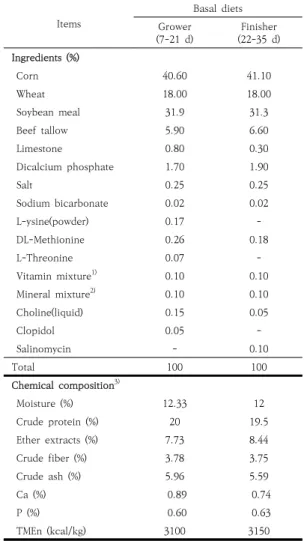
Table 1. Composition of experimental diets Items
Basal diets Grower
(7-21 d) Finisher (22-35 d)
Ingredients (%) ㅤ ㅤ
Corn 40.60 41.10
Wheat 18.00 18.00
Soybean meal 31.9 31.3
Beef tallow 5.90 6.60
Limestone 0.80 0.30
Dicalcium phosphate 1.70 1.90
Salt 0.25 0.25
Sodium bicarbonate 0.02 0.02
L-ysine(powder) 0.17 -ㅤ
DL-Methionine 0.26 0.18
L-Threonine 0.07 -
Vitamin mixture1) 0.10 0.10
Mineral mixture2) 0.10 0.10
Choline(liquid) 0.15 0.05
Clopidol 0.05 -
Salinomycin -ㅤ 0.10
Total 100 100
Chemical composition3)
Moisture (%) 12.33 12
Crude protein (%) 20 19.5
Ether extracts (%) 7.73 8.44
Crude fiber (%) 3.78 3.75
Crude ash (%) 5.96 5.59
Ca (%) 0.89 0.74
P (%) 0.60 0.63
TMEn (kcal/kg) 3100 3150
1)Provided per kilogram of diet: Vit. A (12,500 IU), Vit. D3 (5,000 IU), Vit. E (70 mg), Vit. K3 (4 mg), Vit. B1 (Thiamine, 4 mg), Vit. B2 (Riboflavin, 8 mg), Vit. B6 (Pyfidoxine, 3.6 mg), Vit. B12 (0.3 mg), Pantotenic acid (19.6 mg), Nicotinic acid (70 mg); Folic acid (1.9 mg), Biotin (0.2 mg), Antioxidants (25,000 mg). 2)Provided per kilogram of diet: FeSO4·H2O (2,666.67 mg), MnSO4·H2O (3,225.81 mg), ZnSO4·H2O (2,285.71mg), CuSO4·H2O (1,176.47 mg), CoSO4·H2O (6.06 mg), Ca (IO3)2 (15.87 mg), Na2SeO3 (6.98 mg). 3)Values are calculated value and dry matter basis.
1. 서론
과거, 축산업계의 무분별한 항생제의 사용은 전 세계 적으로 식품 안전과 공중보건에 대한 사회적 우려를 확 대시켰으며, 우리나라에서도 2012년 이후 가축 사료 내 성장촉진용 항생제 사용이 전면 금지되었다. 따라서 항 생제 사용 금지에 따른 가축의 생산성 저하를 예방하기 위하여 대체제 개발에 대한 연구가 꾸준히 증가해 오고 있으며[1], 대체물질로서 생균제, 유기산제, 효소제, 식물 추출물 등이 잠재적 대안으로 주목받고 있다[2-5]. 최근 에는 생리활성 물질 중 하나인 Cysteamine hydrochloride (CSH)가 아시아 국가를 중심으로 주목 받고 있다[6].
CSH는 대부분의 동물 조직에서 합성되며 내분비 및 대사 상태를 조절하는 것으로 알려져 있다[7]. 이들의 주 요 생리적 작용은 시상하부에서 분비되는 Somatostatin (Somatotropin release-inhibiting factor)의 분비를 억제한다고 알려져 있다[8]. Somatostatin는 척추동물 의 췌장, 위, 십이지장, 공장 등의 소화기관에까지 광범 위하게 작용하며[9-11], 성장호르몬[12, 13], 소화 효소 [14, 15], 그리고, 일부 Immunoglobulins과 Cytokines 등의 합성[16, 17]을 음성적으로 조절하는 것으로 보고된 바 있다. 이와 같은 이유에서 Somatostatin의 분비를 억제하는 CSH의 생리적 기능 을 가축의 생산에 활용하기 위한 연구들이 활발히 이뤄 지고 있다. 실제로, 어류[18, 19], 비육돈[20, 21], 착유 우[22], 산란계[23] 등의 다양한 가축을 대상으로 한 과 거의 연구들은 CSH 공급에 의한 생산성 향상 효과를 보 여주고 있다.
그러나, 이러한 광범위한 연구에도 불구하고, 육용계 를 대상으로한 연구는 매우 제한적이다. 몇몇 육용계를 대상으로 한 일부 연구에서 CSH의 공급이 사료이용 효 율의 향상 및 성장 촉진[7, 24], 항병성 및 면역력 향상 [25, 26], 그리고 항염증[27]등의 효과를 보고하고 있으 나, 연구자에 따라 상이한 결과를 제시하고 있으며, 육용 계에서 효과적인 CSH의 첨가농도 결정을 위한 추가적인 연구가 필요한 실정이다.
따라서 본 연구에서는 효율적인 육용계 생산을 위한 CSH의 급여효과를 검증하고, 현재까지 육용계를 대상으 로 검토되지 않았던 CSH의 첨가수준을 평가하기 위하여 실시되었다.
2. 재료 및 방법
2.1 실험동물 및 실험 디자인실험동물은 1 일령의 Ross broiler 수컷 200 수를 공 시하여 사육환경에 적응하도록 6 일간 예비사육 하였다.
평균체중(169.16 g/bird)에 근접한 180 수를 선발하여 open sided-floor pen (1.5 m2/pen)에 20 수/pen로 임의배치 하였다. 실험그룹은 Control (Basal diets),
CSH-1 (Basal diets+250 mg CSH/kg feed), CSH-2 (Basal diets+500 mg CSH/kg feed)의 3 개 그룹으로 나누고, 각 실험 그룹 당 3 반복으로 반복 당 20수(60 bird/group)로 설계하였다.
2.2 실험사료 및 사양관리
사료에 첨가된 CSH는 상용제품(Walcom Biochemical Co., Ltd, shanghai, China)을 사용하였다. 기초사료는 옥수수와 대두박을 기초로 배합되었으며, Table 1에 나 타낸 바와 같이 육성 초기(Grower period; 7-21 일령;
CP 20.0%, TMEn 3,100 kcal/kg)와 육성 후기 (Finisher period; 22-35 일령; CP 19.5%, ME 3,150 kcal/kg)으로 구분하여 급여하였다. 사양관리는 실험기 간 동안 사료와 물은 자유 채식하였고, Heating lamp를 이용하여 입추 시 온도 33℃에서 매주 3℃씩 낮추어 최 종 21℃로 유지하였다. 점등 관리는 24 hr lighting program을 적용하였다. 모든 동물실험은 국립 한경대 학교 동물관리 및 사용위원회 지침에 따라 수행되었다.
2.3 분석항목 및 분석방법 2.3.1 생산성적
사료섭취량과 체중은 매주 측정하였고, 폐사율은 매일 기록하였다. 사료요구율(Feed conversion ratio, FCR) 은 증가 체중 및 사료섭취량을 고려하여 계산하였으며, 생산효율 계수(Production efficiency factor, PEF)는 실험 종료 시점을 기준으로 아래의 계산식 (1)과 같이 산 출하였다[29].
×
×
× (1)
2.3.2 도체성적
도체율(Carcass percent) 및 정육률(Meat percent) 을 평가하기 위하여 실험 개시 35일 후, 각 실험그룹별 평균체중에 근접한 개체를 그룹 당 10마리씩 선발하였 다. 각 선발된 개체를 경추 탈골법으로 안락사 후 비가식 부위를 제거한 도체의 무게를 생체중량으로 나누어 도체 율을 산출하였으며, 정육률은 도체중량 대비 가슴과 다리 부위의 무게가 차지하는 비율(%)로 나타내었다.
2.3.3 영양소 소화율
영양소 소화율은 전분채취법을 활용한 외관상 전장소
화율로 평가하였다. 소화율 평가를 위하여 실험그룹 당 4 마리씩을 선발하여 대사 케이지에서 3 일간 사료섭취량 과 분변량을 기록하고, 전 분을 채집하여 분석에 사용하 였다. 채집된 분변은 건조(70°C, 72 hr) 후 분쇄하여 Cunniff (1995)[30]의 방법에 따라 조단백질(Crude protein), 조지방(Crude fat), 조섬유(Crude fiber), 조 회분(Crude ash)을 분석하였다. 가용무질소물 (Nitrogen Free Extract, NFE)의 경우, 수분, 조단백질, 조지방, 조회분, 조섬유 함량의 합을 100에서 제하여 계 산하였다. 각 영양소의 소화율은 다음과 같은 계산식(2) 을 통하여 산출하였다.
×
(2) 2.4 통계분석
통계분석은 SPSS (Statistical Package for the Social Science, version 17.0)의 일원배치 분산분석 (one-way ANOVA)을 통해 분석하였으며, p value 0.05이하일 때 통계적 유의성을 인정하였다. 실험그룹간 의 유의성은 Tukey tests를 이용하여 사후검정을 실시 하였다.
3. 결과
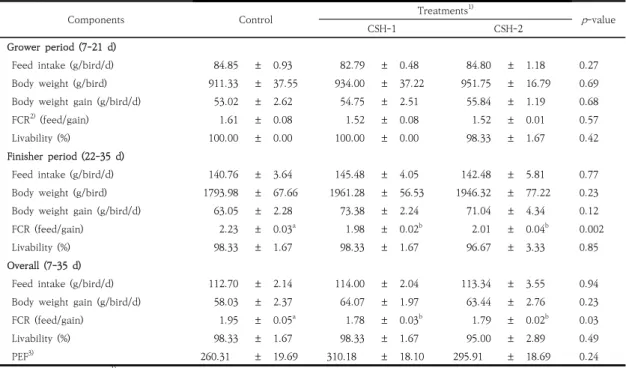
3.1 생산성적CSH가 육용계의 생산성에 미치는 효과를 검토하기 위하여 Table 1에 나타낸 바와 같이 육성 초기(Grower period; 7-21 일령; CP 20.0%, TMEn 3,100 kcal/kg) 와 육성 후기(Finisher period; 22-35 일령; CP 19.5%, ME 3,150 kcal/kg)로 구분하여 CSH를 각각 250 mg/kg feed (CSH-1 group), 500 mg/kg feed (CSH-2 group) 수준으로 공급하고 생산성을 평가하였 다(Table. 2). 육성 초기 동안, 사료섭취량, 체중, 일당증 체량, FCR, 육성률은 모든 실험그룹 사이에서 유의한 차 이는 나타나지 않았다(p>0.05). 육성 후기의 경우, 사료 섭취량과 육성률은 실험 그룹들 사이에서 차이는 나타나 지 않았으며, 일당증체량은 CSH 첨가그룹(CSH-1, CSH-2)이 Control 그룹과 비교하여 다소 높은 경향으 로 나타나(p>0.05), 결과적으로 사료요구율은 Control
Table 3. Effects of dietary supplementation of cysteamine hydrochloride on carcass characteristics in broiler chicken
Components Control Treatments1)
p-value
CSH-1 CSH-2
Carcass percent (%) 68.88± 1.02 67.06± 1.22 67.83± 1.45 0.51
Meat percent (%)
Breast muscle 21.77± 0.75 24.11± 1.35 24.12± 1.52 0.26
Tight muscle 8.06± 0.27 8.18± 0.36 8.27± 0.46 0.90
1)Control: basal diet no other additives; CSH-1: basal diet supplemented with 0.025% CSH; CSH-2: basal diet supplemented with 0.05%
CSH. The results were expressed as mean ± SEM.
Table 2. Effects of dietary supplementation of cysteamine hydrochloride on growth performance in broiler chicken
Components Control Treatments1)
p-value
CSH-1 CSH-2
Grower period (7-21 d)
Feed intake (g/bird/d) 84.85 ± 0.93 82.79 ± 0.48 84.80 ± 1.18 0.27
Body weight (g/bird) 911.33 ± 37.55 934.00 ± 37.22 951.75 ± 16.79 0.69
Body weight gain (g/bird/d) 53.02 ± 2.62 54.75 ± 2.51 55.84 ± 1.19 0.68
FCR2) (feed/gain) 1.61 ± 0.08 1.52 ± 0.08 1.52 ± 0.01 0.57
Livability (%) 100.00 ± 0.00 100.00 ± 0.00 98.33 ± 1.67 0.42
Finisher period (22-35 d)
Feed intake (g/bird/d) 140.76 ± 3.64 145.48 ± 4.05 142.48 ± 5.81 0.77
Body weight (g/bird) 1793.98 ± 67.66 1961.28 ± 56.53 1946.32 ± 77.22 0.23 Body weight gain (g/bird/d) 63.05 ± 2.28 73.38 ± 2.24 71.04 ± 4.34 0.12
FCR (feed/gain) 2.23 ± 0.03a 1.98 ± 0.02b 2.01 ± 0.04b 0.002
Livability (%) 98.33 ± 1.67 98.33 ± 1.67 96.67 ± 3.33 0.85
Overall (7-35 d)
Feed intake (g/bird/d) 112.70 ± 2.14 114.00 ± 2.04 113.34 ± 3.55 0.94
Body weight gain (g/bird/d) 58.03 ± 2.37 64.07 ± 1.97 63.44 ± 2.76 0.23
FCR (feed/gain) 1.95 ± 0.05a 1.78 ± 0.03b 1.79 ± 0.02b 0.03
Livability (%) 98.33 ± 1.67 98.33 ± 1.67 95.00 ± 2.89 0.49
PEF3) 260.31 ± 19.69 310.18 ± 18.10 295.91 ± 18.69 0.24
Data are Mean ± SE. 1)Control: basal diet no other additives; CSH-1: basal diet supplemented with 0.025% CSH; CSH-2: basal diet supplemented with 0.05% CSH. FCR, feed conversion rate; PEF, production efficiency factor
a-bDifferent superscript letters denoted significant differences among each experimental group.
그룹과 비교하여 CSH 첨가 그룹(CSH-1, CSH-2)이 유 의하게 개선되는 것으로 나타났다(p<0.05). 전체 실험기 간 동안의 사료섭취량, 체중, 일당증체량, 생산효율 계수 는 CSH 첨가에 의한 효과는 인정되지 않았으나, 사료요 구율의 경우 CSH 첨가에 의하여 유의하게 개선되었다 (p<0.05).
3.2 도체율 및 정육률
육용계의 사료 내 CSH의 첨가가 도체율 및 가식부위 의 생산량에 미치는 영향은 Table 3에 나타내었다. 실험 종료 후 생시 체중 대비 비가식부위가 제거된 도체의 중
량비를 나타낸 도체율(Carcass percent, %)은 모든 실 험 그룹에서 약 67-68% 수준이었으며, CSH의 첨가에 의한 차이는 나타나지 않았다. 또한, 도체중량(Carcass weight)에서 가슴과 다리근육의 중량이 차지하는 비율 을 나타낸 정육률(Meat percent, %)의 경우, 가슴육은 Control 그룹이 21.8%이었으며, CSH-1과 CSH-2 그룹 은 24.1로 Control 그룹보다 다소 높게 나타났지만, 통 계적 유의성은 인정되지 않았다. 다리육의 정육률 또한 Control 그룹과 CSH-1, CSH-2 그룹에서 각각 8.06, 8.18, 8.27로 CSH첨가 그룹이 다소 높은 수치를 나타내 었으나, 통계적 유의성은 관찰되지 않았다(p>0.05).
Table 4. Effects of dietary supplementation of cysteamine hydrochloride on digestibility in broiler chicken
Components Control Treatments1)
p-value
CSH-1 CSH-2
Organic matter 71.38 ± 0.23 71.67 ± 0.73 73.28 ± 0.50 0.09
Crude protein 57.49 ± 1.35 57.67 ± 1.38 58.69 ± 0.95 0.77
Crude fat 70.89 ± 1.02 69.85 ± 0.76 69.62 ± 1.25 0.67
Nitrogen Free Extract 76.07 ± 1.71 77.04 ± 1.21 79.01 ± 0.95 0.35
1)Control: basal diet no other additives; CSH-1: basal diet supplemented with 250 mg/kg feed CSH; CSH-2: basal diet supplemented with mg/kg feed CSH. The results were expressed as mean ± SEM.
3.3 소화율
Table 4에는 CSH의 공급이 육용계의 소화율에 미치 는 영향을 나타내었다. CSH의 첨가급여는 단백질, 지방, 가용무질소물의 소화율에는 유의한 영향을 미치지 않은 반면, 유기물 소화율은 CSH첨가에 의해 증가하는 경향 을 보여주었다(p<0.1). 특히, 사료 kg 당 500 mg의 CSH를 급여한 CSH-2 그룹의 경우, 통계적인 유의성은 인정되지 않았지만 조단백질과 가용무질소물의 소화율이 Control 그룹 대비 각각 1.2와 2.9% 높은 수준으로 나 타났으며, 유기물 소화율의 경우에는 Control 그룹 대비 1.9% 개선되는 경향을 나타내었다(p=0.09).
4. 고찰
본 연구는 육용계를 대상으로 CSH의 첨가가 생산성 및 소화율에 미치는 영향을 평가하고, 사료 내 적정 첨가 수준을 결정하기 위하여 수행되었다. CSH의 첨가농도는 육용계를 대상으로 한 과거의 연구에서 검토되지 않았던 농도(40-200, 1200-1800 mg/kg)[7, 24-26, 28]를 기 준으로 사료 내 250과 500 mg/kg으로 설정하였다.
본 연구에서는 CSH를 육용계에게 공급한 경우 육성 후기(22-35 일령)에서 FCR의 뚜렷한 개선효과를 보여 주었다. 전체 실험기간 동안의 결과를 종합적으로 평가한 경우에도 FCR의 개선효과가 관찰되었다. 이와 같은 결 과는 과거 잉어[18], 돼지[20, 21], 젖소[22], 산란계[23]
와 같은 경제동물을 대상으로 한 연구에서 CSH의 보충 이 가축의 생산성 향상에 기여할 수 있다고 보고한 연구 들과 일치하였다. 게다가 일부 육용계를 대상으로 CSH 의 효과를 조사한 Nunes 등(2012)[7]과 Yang 등 (2006)[24]의 연구는 CSH의 공급이 육성 후기(21-42d) 동안에 FCR이 개선되었다고 보고한 바 있다. 하지만, Yang 등(2006)[24]는 60, 90 mg/kg feed 수준의 CSH 공급은 FCR에 영향을 미치지 않은 반면, 120 mg/kg
feed 수준에서는 FCR를 개선시킨다고 보고하였다. 이와 같은 결과는 60-80 mg/kg feed 수준의 CSH의 공급이 FCR을 개선했다고 보고한 Nunes 등(2012)[7]의 연구와 상반된 결과이다. 게다가 Yang 등(2006)[24]은 150 mg/kg feed 수준의 CSH의 공급은 FCR에 부정적으로 작용한다고 보고하였다.
CSH의 주목할 만한 생체 내 작용은 Somatoststin의 분비를 감소시키는 것이다[8]. Somatoststin는 내인성 성장호르몬 분비의 강력한 억제제로써 CSH에 의한 이들 의 생리학적 작용은 성장촉진에 기여할 수 있다고 알려 져 있다[31, 32]. 하지만, 이와 같은 CSH의 잠재적인 효 과에도 불구하고 본 연구의 결과에서는 일당증체량 및 생산효율 계수의 변화는 나타나지 않았으며, 도체율 및 정육률의 경우에서도 CSH의 공급에 의한 변화는 관찰되 지 않았다. 이와 같은 결과는 Nunes 등(2012)[7]의 연구 에서 CSH의 공급이 육용계의 일당증체량과 가식부위의 비율의 변화에는 영향을 미치지 않는다고 보고한 결과와 일치하였다. 반면, Yang 등(2006)[24]의 연구결과는 60-90 mg/kg feed 수준의 CSH의 공급은 일당증체량 을 크게 증가시킨다고 보고한 바가 있어, 연구자들 사이 에서 상이한 결과가 보고되고 있다. 본 연구의 결과는 이 러한 논쟁에 있어서 사료 내 CSH 500mg/kg 이하 수준 의 첨가 급여는 일당증체량에 영향을 미치지 않는다는 주장을 지지한다.
Somatostatin는 위에서의 가스트린 및 염산, 췌장 소 화효소인 pancreatic 분비를 억제하며, 이와 더불어 장 의 연동운동 및 소화관으로의 혈액 공급을 저해하는 것 으로 알려져 있다[14, 15]. 한편, CSH의 공급은 Somatostatin의 분비를 억제하여 영양소의 소화와 흡수 를 촉진할 수 있는 것으로 알려져 있다. 육용계[24]와 거 위[32]를 대상으로 한 연구에서 각각 60-90 mg/kg feed와 100 mg/kg BW의 수준으로 CSH를 공급한 결 과 췌장과 소장에서 소화효소(Protease, Amylase, Lipase)의 분비 및 활성 증가에 효과적이라는 것을 보여
주었으며, 이러한 효과는 소화율을 증가시킴으로써 가축 의 생산성 향상에 기여할 수 있다고 제안한 바 있다. 본 연구에서는 CSH를 사료 내 500 mg/kg 수준으로 첨가 급여한 그룹(CSH-2)에서 유기물의 소화율이 Control 그룹과 비교하여 다소 증가하는 경향으로 관찰되었다 (p=0.09). 따라서, 본 연구에서 소화효소의 분비를 직접 적으로 측정하진 않았지만, CSH 급여에 의해 Somatostatin의 분비가 억제되므로써 소화효소의 활성 이 촉진된 결과로 사료된다. 또한, 이와 같은 결과는 Yang 등(2006)[24]과 Ai 등(2002)[33]의 주장을 뒷받침 하는 근거로 제시될 수 있다.
5. 결론
이상의 결과를 종합해 볼 때, 육용계 사료 내 250-500 mg/kg feed 수준의 CSH 공급은 체중과 도체 율에서 뚜렷한 효과는 나타나지 않았다. 하지만, 육성 후 기(생후 22일령 이후) 동안 사료이용 효율을 크게 개선할 수 있는 것으로 나타났으며, 이와 같은 결과는 소화율 향 상에 의한 영향이 일부 반영된 것으로 판단된다. 하지만, 생체 내 CSH의 Somatostatin 억제 작용을 고려했을 때 성장호르몬의 분비 촉진에 의한 영향도 배제할 수 없다 고 생각된다. 결론적으로 본 연구는 사료 내 CSH의 첨가 급여가 육용계의 사료이용 효율을 개선함으로써 생산성 향상에 기여할 수 있다는 것을 입증하였다. 또한, 250-500 mg/kg feed 수준의 CSH의 공급에 의한 안전 성을 확인하였다. 따라서 이와 같은 CSH의 효과는 향후 양계산업에서 생산비의 절감을 위한 전략으로 사용될 수 있을 것으로 기대된다.
References
[1] T. B. Stanton, “A call for antibiotic alternatives research”, Trends in microbiology, Vol.21, No.3, pp.111-113, Mar. 2013.
DOI: https://doi.org/10.1016/j.tim.2012.11.002 [2] J. S. Yoo, Y. J. Chen, I. H. Kim, “Effects of dietary
complex probiotics on growth performance nutrient digestibility and blood characteristics in growing pigs”, Journal of the Korea Academia-Industrial cooperation Society, Vol.8, No.5, pp.1266-1272, Oct.
2007.
[3] K. H. Kim, I. H. Song, J. L. Chun, J. H. Jeon, K. M.
Seo, K. T. Nam, “Effects of dietary supplementation of condensed molasses soluble (CMS) on Growth Performance and Meat Quality in growing-finishing pigs”, Journal of the Korea Academia-Industrial cooperation Society, Vol.21, No.11, pp.427-434, Nov. 2020.
DOI: https://doi.org/10.5762/KAIS.2020.21.11.427 [4] K. H. Kim, J. Y. Jeong, I. H. Song, S. D. Lee, S. Y. Ji,
Y. K. Lee, K. T. Nam, “Effects of dietary supplementation of enzyme complex on growth performance, carcass characteristics and meat storability in broiler chickens”, Journal of the Korea Academia-Industrial cooperation Society, Vol.19, No.12, pp.740-748, Dec. 2018.
DOI: https://doi.org/10.5762/KAIS.2018.19.12.740 [5] J. H. Cho, Y. J. Chen, B. J. Min, H. J. Kim, J. S. Yoo,
T. G. Ko, Y. Hyun, I. H. Kim, “Effects of dietary herbal plant mixture (Koppuulv®) on growth performance, blood immunological parameters, fecal VFA and NH3-N concentrations in growing pigs”, Journal of Animal Science and Technology, Vol.48, No.3, pp.375-282, Jun. 2006.
DOI: https://doi.org/10.5187/JAST.2006.48.3.375 [6] M. C. Barnett, R. S. Hegarty, “Cysteamine: a human
health dietary additive with potential to improve livestock growth rate and efficiency”, Animal Production Science, Vol.56, No.8, pp.1330-1338, Jun. 2016.
DOI: http://dx.doi.org/10.1071/AN15339
[7] J. O. Nunes, A. G. Bertechini, J. Á. G. D. Brito, L.
Makiyama, F. R. Mesquita, C. M. Nishio, “Evaluation of cysteamine associated with different energy patterns in diets for broiler chickens”, Revista Brasileira de Zootecnia, Vol.41, No.8, pp.1956-1960, Jun. 2012.
DOI: https://doi.org/10.1590/S1516-35982012000800022 [8] M. R. Brown, L. A. Fisher, P. E. Sawchenko, L. W.
Swanson, W. W. Vale, “Biological effects of cysteamine: relationship to somatostatin depletion”, Regulatory peptides, Vol.5, No.2, pp.163-179, Jan. 1983.
DOI: https://doi.org/10.1016/0167-0115(83)90124-6 [9] S. Reichlin, “Somatostatin”, new england Journal of
Medicine, Vol.309, No.24, pp.1495-1501, Jan. 1983.
DOI: https://doi.org/10.1056/NEJM198312153092406 [10] C. H. S. McIntosh, “Gastrointestinal somatostatin:
distribution, secretion and physiological significance”, Life sciences, Vol.37, No.22, pp.2043-2058, Dec.
1985.
DOI: https://doi.org/10.1016/0024-3205(85)90576-4 [11] Y. Miyamoto, M. Miyamoto, “Immunohistochemical
localizations of secretin, cholecystokinin, and somatostatin in the rat small intestine after acute cisplatin treatment”, Experimental and molecular pathology, Vol.77, No.3, pp.238-245, Dec. 2004.
DOI: https://doi.org/10.1016/j.yexmp.2004.05.007 [12] W. J. Millard, In animal growth regulation: Central
regulation of growth hormone secretion, p.400, Springer, 1989, pp.237-255.
[13] J. M. M. Rondeel, I. M. D. Jackson, “Molecular biology of the regulation of hypothalamic hormones”, Journal of endocrinological investigation, Vol.16, No.3, pp.219-246, Mar. 1993.
DOI: http://dx.doi.org/10.1007/BF03344952
[14] J. Morisset, “Negative control of human pancreatic secretion: Physiological mechanisms and factor”, Pancreas, Vol.37, No.1, pp.1-12, Jul. 2008.
DOI: https://doi.org/10.1097/MPA.0b013e318161b99a [15] J. Morisset, “One of the rare multifunctional inhibitors of mammalian species”, Pancreas, Vol.46, No.1, pp.8-18, Jan. 2017.
DOI: https://doi.org/10.1097/mpa.0000000000000716 [16] M. C. Aguila, W. L. Dees, W. E. Haensly, S. M.
McCann, “Evidence that somatostatin is localized and synthesized in lymphoid organs”, Proceedings of the National Academy of Sciences, Vol.88, No.24, pp.11485-11489, Dec. 1991.
DOI: https://doi.org/10.1073/pnas.88.24.11485 [17] P. M. Van Hagen, “Somatostatin receptor expression
in clinical immunology”, Metabolism, Vol.45, No.1 pp.86-87, Aug. 1996.
DOI: https://doi.org/10.1016/S0026-0495(96)90092-X [18] D. Xiao, H. R. Lin, “Cysteamine a somatostatin
inhibiting agent–induced growth hormone secretion and growth acceleration in juvenile grass carp (Ctenopharyngodon idellus)”, General and Comparative Endocrinology,Vol.134, No.4, pp.285-295, Dec. 2003.
DOI: https://doi.org/10.1016/S0016-6480(03)00268-5 [19] W. W. Wardani, A. Alimuddin, M. Zairin Jr, M.
Setiawati, S. Nuryati, M. A. Suprayudi, “Evaluation of cysteamine supplementation in red tilapia (Oreochromis sp.) diet: Serum insulin and somatostatin, IGF-1 and GLUT4 genes expression, growth performance, and robustness against stress”, Aquaculture, Vol.528, No.15, 735514, Nov. 2020.
DOI: https://doi.org/10.1016/j.aquaculture.2020.735514 [20] C. B. Yang, A. K. Li, Y. L. Yin, R. L. Huang, T. J. Li,
L. L. Li, M. Z. Fan, “Effects of dietary supplementation of cysteamine on growth performance, carcass quality, serum hormones and gastric ulcer in finishing pigs”, Journal of the Science of Food and Agriculture, Vol.85, No.11, pp.1947-1952, May. 2005.
DOI: https://doi.org/10.1002/jsfa.2123
[21] P. Zhou, L. Zhang, J. Li, Y. Luo, B. Zhang, S. Xing, Y.
Zhu, H. Sun, F. Gao, G. Zhou, “Effects of dietary crude protein levels and cysteamine supplementation on protein synthetic and degradative signaling in skeletal muscle of finishing pigs”, PLoS One, Vol.10, No.9, e0139393, Sept. 2015.
DOI: https://doi.org/10.1371/journal.pone.0139393 [22] C. Wang, C. J. Dong, Z. Q. Wang, F. Yang, H. L. Mao,
Z. Wu, Q. Zhou, H. F. Wang, “Effect of cysteamine hydrochloride supplementation on the milk performance of dairy cow”, Livestock Science, Vol.17, pp.94-99, Aug. 2015.
DOI: https://doi.org/10.1016/j.livsci.2015.05.005 [23] Y. Hu, Y. Ni, L. Ren, J. Dai, R. Zhao, “Leptin is
involved in the effects of cysteamine on egg laying of hens, characteristics of eggs, and posthatch growth of broiler offspring”, Poultry Science, Vol.87, No.9, pp.1810-1817, Sep. 2008.
DOI: https://doi.org/10.3382/ps.2008-00040 [24] C. M. Yang, A. G. Chen, Q. H. Hong, J. X. Liu, J. S.
Liu, “Effects of cysteamine on growth performance, digestive enzyme activities, and metabolic hormones in broilers”, Poultry science, Vol.85, No.11, pp.1912-1916, Nov. 2006.
DOI: https://doi.org/10.1093/ps/85.11.1912
[25] Q. Yang, G. Lian, X. Gong, “Enhancement of mucosal immune responses in chickens by oral administration of cysteamine”, Poultry science, Vol.86, No.7, pp.1323-1328, Jul. 2007.
DOI: https://doi.org/10.1093/ps/86.7.1323
[26] N. Liu, L. Lin, J. Wang, F. Zhang, J. P. Wang, “Dietary cysteamine hydrochloride protects against oxidation, inflammation, and mucosal barrier disruption of broiler chickens challenged with Clostridium perfringens”, Journal of animal science, Vol.96, No.10, pp.4339-2347, Oct. 2018a.
DOI: https://doi.org/10.1093/jas/sky292
[27] N. Liu, J. Q. Wang, Z. Y.. Liu, Y. K. Chen, J. P. Wang,
“Effect of cysteamine hydrochloride supplementation on the growth performance, enterotoxic status, and glutathione turnover of broilers fed aflatoxin B1 contaminated diets”, Poultry science, Vol.97, No.10, pp.3594-3600, Oct. 2018b.
DOI: https://doi.org/10.3382/ps/pey206
[28] M. T. Zavy, T. O. Lindsey, “Effect of cysteamine administration on growth and efficiency of food utilisation in chicks”, British poultry science, Vol.29, No.2, pp.409-417, Nov. 1988.
DOI: https://doi.org/10.1080/00071668808417066 [29] Aviagen, Ross broiler management manual, p.147,
Online Publishers: www.aviagen.com 2018, p.131-132.
[30] P. Cunniff, AOAC international. Official methods of analysis of AOAC International. 16th ed. p.448, AOAC International, 1995, pp.382–382
[31] G. S. Spencer, “New approach to regulation of growth using immunization against somatostatin: discussion paper”, Journal of the Royal Society of Medicine, Vol.77, No.6, pp.496-500, Jun. 1984.
[32] T. R. Hall, S. Harvey, C. G. Scanes, “Control of growth hormone secretion in the vertebrates: a comparative survey”, Comparative Biochemistry and Physiology Part A: Physiology, Vol.84, No.2, pp.231-253, 1986.
DOI: https://doi.org/10.1016/0300-9629(86)90608-0 [33] X. J. Ai, Z. K. Han, “Effect of cysteamine on the
pancreatic secretion and lipase activity of geese”, Acta Universitatis Agriculturalis Boreali-occidentalis, Vol.30, No.4, pp.105-108, Jan. 2002.
서 강 민(Kangmin Seo) [정회원]
• 2013년 2월 : 국립한경대학교 동 물·낙농생명과학전공 (농학석사)
• 2019년 3월 : 일본 북해도대학교 공생기반학전공 (농학박사)
• 2019년 5월 ~ 2020년 1월 : 일본 북해도대학교 박사후연구원
• 2020년 2월 ~ 현재 : 국립축산과 학원 동물복지연구팀 전문연구원
<관심분야>
가축영양생리, 동물세포생리학
천 주 란(Ju Lan Chun) [정회원]
• 2012년 5월 : 일로노이 주립대학 교 줄기세포치료 전공 (박사)
• 2014년 10월 ~ 2018년 7월 : 충 남대학교 산학협력단 계약교수
• 2019년 1월 ~ 2020년 6월 : 농촌 진흥청 국립축산과학원 박사후 연
• 2020년 7월 ~ 현재 : 농촌진흥청 국립축산과학원 농업연구원 구사
<관심분야>
동물복지연구, 동물대체실험
김 기 현(Ki Hyun Kim) [정회원]
• 2013년 3월 : 일본 교토대학교 동 물영양학 전공 (농학박사)
• 2013년 4월 ~ 2017년 2월 : 농촌 진흥청 국립축산과학원 박사후 연 구원
• 2017년 2월 ∼ 현재 : 농촌진흥청 국립축산과학원 농업연구사
<관심분야>
동물영양학, 사료
남 기 택(Ki-Taeg Nam) [정회원]
• 1992년 3월 : 일본 동북대학교 가 축생리학 (농학박사)
• 1998년 3월 ∼ 현재 : 국립한경대 학교 동물생명환경과학부 교수
<관심분야>
가축영양생리, 사료영양