* Associate Professor and Director, Peace Education Center at Hanshin University (한신대학교 평화교육센터장, 부교수, jwlee@hs.
ac.kr)
The Geopolitics of Humanitarian Assistance to North Korea under International Sanctions
Jong-Woon Lee*
대북 제재와 인도적 원조의 지정학
이종운*
Abstract : International aid to North Korea remains far below the humanitarian needs of vulnerable people.
This paper examines the trajectory of international humanitarian assistance to North Korea over the last two decades with the focus on its decline in the context of the country’s nuclear standoff and corresponding stringent sanctions. In so doing, the paper addresses major problems associated with North Korea’s reception of foreign aid and operational constraints placed on humanitarian activities in the country. It shows that humanitarian assistance to North Korea has been largely shaped by geopolitical dynamics. A survey of UN reports and statistics also suggests a shifting trend in recent international aid to North Korea. The decline of aid and multiple operational obstacles faced by humanitarian organizations, for instance, have led to a fall in agricultural support and a proportional rise in health and related services. While UN Security Council reso- lutions include an exemption provision, humanitarian assistance to North Korea has been constrained by stringent sanctions, which have led to adverse consequences for the civilian population. In this regard, the paper suggests some policy directions for international aid to North Korea amidst negotiations over denucle- arization, while stressing an urgent need to address the negative impact of sanctions on vulnerable groups in the country.
Key Words : North Korea, Aid, Sanctions, Humanitarian Assistance, United Nations, Aid Effectiveness
요약 : 북한의 핵·미사일 개발과 이에 대응한 국제사회의 강도 높은 경제제재가 실행되면서 대북 인도적 지원은
2010년대 매우 낮은 수준에 머물고 있다. 본고는 대북지원의 향후 방향을 모색하기 위해 국제사회가 그동안 진행해 온 인도적 원조의 추이와 성과, 문제점을 살펴보고, 대북지원 개선방안을 제시하고자 한다. 북핵문제가 악화되면서 원조를 정치적으로 도구화하는 경향이 심화되었다. 또한 모금실적 부진으로 국제기구와 단체들의 지원활동이 구호 형 사업으로 명맥을 겨우 유지하면서 원조의 질적 수준과 개발협력 효과성이 매우 낮은 실정이다. 대북지원의 현격한 감소 원인으로 경제제재 자체 효과와 함께 원조 장기화에 따른 공여국과 단체들의 피로감 증대, 북한당국의 외부 지 원활동에 대한 과도한 제약 등이 작용하고 있다. 본 연구는 국제기구 보고서와 유엔통계 분석을 통해 2010년대 국제 사회의 대북지원 동향에서 드러나는 특징의 하나로 농업분야 지원의 비중은 낮아지고 보건·의료 분야가 확대된 것 을 밝혔다. 인도주의적 원조는 빈곤 완화와 취약계층을 보호하기 위한 국제사회의 보편적 가치 실현이 강조된다. UN
http://dx.doi.org/10.23841/egsk.2019.22.4.405
1. Introduction
Along with an unprecedented three inter-Korean summits in 2018, Kim Jong Un’s Singapore meet- ing with US President Donald Trump on the 12th of June gave way to great expectation of the diplo- matic resolution of North Korea’s nuclear standoff and the subsequent peace process on the peninsula.
However, the second US-North Korea summit held in Hanoi in February 2019 ended without a deal and stringent international sanctions against North Korea are still in place. Indeed, there is a vast gap be- tween the demands of Pyongyang and Washington.
At the Hanoi summit, North Korea requested the lifting of multilateral sanctions added in the latest five UN Security Council (UNSC) resolutions after the country’s fourth nuclear test in January 2016 in return for the dismantling of its Yongbyon nuclear facilities. Pyongyang’s intention appeared to be the removal of a complete ban on its main exports of minerals, seafood and textiles as well as restriction on the overseas employment of North Korean work- ers and foreign investment. On the other hand, the United States treated North Korea’s proposed closure of the Yongbyon complex as an insufficient step to- wards “final, fully verified denuclearization” and de- manded additional measures, such as the dismantle- ment of other suspected nuclear facility sites (Panda and Narang 2019).
Once again, an unprecedented diplomatic event took place on the 30th of June 2019 as Kim Jong Un met with President Trump and South Korean President Moon Jae-In at Panmunjom in the De- militarized Zone. However, disagreement over denuclearization methods and procedures could not be resolved at the US-North Korea working-level meetings held in Stockholm, Sweden the following October. Such difficulty in reaching a breakthrough in negotiations suggests that trust building and asso- ciated mutual concessions between North Korea and the United Sates are key prerequisites for the former’s nuclear disarmament and the latter’s sanctions relief.
As the US-North Korea negotiations run into a stalemate, South Korean plans to resume humani- tarian aid to North Korea are also unable to move on to the implementation stage. In September 2017, the Moon Jae-In government announced pledges of USD 8 million for humanitarian activities car- ried out by the World Food Programme (WFP) and United Nations Children’s Fund (UNICEF). How- ever, amidst escalating geopolitical tension associ- ated with North Korea’s rapid pace of nuclear weap- ons development and a US campaign of “maximum pressure,” the South Korean government’s plan was left unrealized. South Korea’s provision of humani- tarian aid to the North was seen as inappropriate by its major allies, the US and the Japanese govern- ments, before a denuclearization agreement.
In June 2019, the South Korean government again 안보리 대북제재 결의안에서도 경제제재가 일반주민들에 대한 부정적 영향 초래 및 원조단체의 구호활동을 제한할 의도가 없음을 명확히 하고 있다. 따라서 고강도의 경제제재로 인해 실질적으로 크게 제약 받고 있는 대북 인도지원 활동에 대한 확대조치가 진행되어야 하며, 나아가 국제개발협력의 플랫폼이 되고 있는 지속가능개발목표(SDGs)와 연계된 원조 실행이 필요하다.
주요어 : 북한, 원조, 경제제재, 인도적 지원, 국제기구, 원조효과성
announced its intention to provide 50,000 tons of rice as food aid to North Korea through the WFP.
However, the North Korean government refused to accept nutritional aid from South Korea. Similarly, North Korea has not responded to aid proposals from several South Korean NGOs. This is indicative of the fact that the priorities of the North Korean regime lie in sanctions relief, as argued in a Rodong Sinmun editorial in October 2018 entitled “sanctions and dialogue can never go together.”
1)The regime’s rejection of aid from South Korea also reveals the ambivalent attitude of Pyongyang, which claims harsh sanctions to be the cause of the recurrent humanitarian crises that vulnerable people in the county are subject to.
According to available UN data, international hu- manitarian assistance to North Korea has amounted to more than USD 2.26 billion since 2000,
2)the provision of which has been the subject of some con- troversy. The core of the criticism arises from North Korea’s contrary behaviour in which even while it appeals for humanitarian assistance it has increased its nuclear weapons capability, which has led to seri- ous tensions with the donor community. As such, critics hold that any measure which compromises the effectiveness of the historically highest level of strin- gent sanctions and subsequent pressure on the North Korean regime is not appropriate before it takes veri- fiable steps towards denuclearization.
However, humanitarian aid to North Korea tends to emphasize the international community’s “univer- sal value” of poverty alleviation and the protection of the poor. A recent Joint Rapid Food Security Assess- ment conducted by the WFP and the UN Food and Agriculture Organization (FAO) in May 2019 found that despite North Korean improvements in agricul- tural production in the 2010s, total food production
was only 4.9 million metric tons in 2018, 12 percent- age points below the 2017 near-average level (FAO and WFP 2019, p.22). Additionally, it is estimated that about 11 million North Koreans - 44 per cent of the population - face food shortages in 2019 (DPRK HCT 2019, p.5). Therefore, despite the drastic tight- ening of international sanctions, the UNSC resolu- tion contains exemption clauses for humanitarian assistance to North Korea which repeatedly confirm that “…and this resolution are not intended to have adverse humanitarian consequences for the civilian population of the DPRK or to affect negatively or restrict those activities, including economic activities and cooperation, food aid and humanitarian assis- tance, that are not prohibited by resolutions.”
3)As is well known, marketization in North Korea has improved the livelihood of the population and an emergent entrepreneurial class known as the donju plays an important role in this development.
However, North Korea’s socioeconomic transfor- mation coincides with societal polarization and regional disparity. As such, a large number of people who are unable to receive government rations and social security, and those left out of the economic benefits of marketization still suffer from deprivation and chronic food insecurity. There is thus a need to prevent increasingly stringent sanctions from func- tioning as a mechanism to add to the suffering of vulnerable people. This is a practical reason for the expansion of humanitarian assistance to North Ko- rea under enhanced sanctions.
International aid to North Korea over the last two
decades has shifted in scale and characteristics in line
with the country’s domestic situation and external
relations as well as approaches taken by the interna-
tional community. This paper examines the geopoli-
tics of humanitarian assistance to North Korea with
a focus on the impact of sanctions on humanitarian activities. The trends in international aid to North Korea can be divided into two periods: from 1995 to the early 2000s, when it was expanded in response to the country’s economic crisis, and the following period, which experienced a minimal level of aid, up to date. In addition to the tightening of bilateral sanctions, the implementation of multilateral sanc- tions through the UNSC resolution, especially since the mid-2010s, has placed considerable operational constraints on the aid delivery of UN agencies and international NGOs. This examination confirms the argument that humanitarian aid to North Korea has become increasingly politicized. The paper also sug- gests some policy implications for future assistance to North Korea.
2. The Trajectory of International Aid to North Korea under Sanctions
1) Humanitarian Crisis in North Korea and Contribution of International Aid
In August 1995, the North Korean government of- ficially requested emergency relief from the interna- tional community via its representative to the United Nations. Large-scale international assistance ensued in an effort to alleviate a humanitarian crisis caused by the economic collapse and resulting famine of the mid-1990s. Against the backdrop of the donor com- munity’s active response to North Korean starva- tion, there was the effect of the resolution of the first North Korean nuclear standoff and subsequent im- provement of its external relations through the con- clusion of the Geneva Agreed Framework between
the United States and North Korea in October 1994.
In return for North Korea’s restoration of the Non- Proliferation Treaty (NPT), the United States agreed to provide heavy fuel oil and the construction of two light-water reactors (Manyin and Nikitin 2014, p.1).
Humanitarian operations to address serious food shortages and a dysfunctional public health system were mainly based on the UN Consolidated Inter- Agency Appeal for the DPRK and this UN initia- tive continued for a decade up to 2004. The United States participated in such humanitarian efforts by delivering food, medicine and medical supplies to North Korea. Between 1995 and 2001, US food sup- port recorded 1.8 million tons, equivalent to USD 591 million (Smith 2002, p.4). The Japanese gov- ernment also made pledges of 500,000 tons of rice in 1995. The South Korean government delivered 150,000 tons of domestic rice (valued at about KRW 185 billion) in 1995 and 115,000 tons of chemical fertilizer (valued at KRW 34 billion) in 1999, while providing USD 40.72 million to WFP, UNDP and UNICEF between 1996 and 1998 (South Korean Ministry of Unification 2017). However, South Ko- rea’s aid flow to its poor northern neighbour in the late 1990s was relatively small as the incumbent Kim Yong Sam government took a conservative stance towards the Kim Jong Il regime, adopting “Military First Politics” amidst the economic crisis.
The first inter-Korean Summit held in Pyongyang
in June 2000 created an atmosphere geared towards
rapid improvement in North Korea’s foreign rela-
tions and paved the way for increasing economic
assistance from South Korea and the international
community. Indeed, North Korea’s relations with
the United States had seen progress with the Clinton
administration’s alleviation of economic sanctions
and a cross-visit between Vice Marshal Jo Myong
Rok and Secretary of State Madeleine Albright in 2000. European and other Western countries that had normalized diplomatic relations with Pyong- yang in the early 2000s, such as Canada and Aus- tralia, also expanded their scale of bilateral aid and donations to international agencies. As shown in Figure 1, humanitarian assistance to North Korea in 2000 amounted to a total of USD 224.2 million.
It appears to have peaked at USD 377.6 million in 2001 and USD 360.8 million in 2002. North Korea received contributions from 36 donor countries in the form of bilateral or multilateral aid during the early 2000s.
4)However, with the resurgence of the North Ko- rean nuclear issue, it became difficult to promote relatively large-scale development projects. The incoming Bush administration criticized Clinton’s approach to North Korea as appeasement and US- North Korean relations quickly came to a standstill (Lee 2016, p.129). In particular, marked geopolitical tensions arose following a visit by James Kelly, As-
sistant Secretary of State for East Asian and Pacific Affairs, to Pyongyang in October 2002. The follow- ing month, in accusing the North Korean regime of developing an illicit highly enriched uranium pro- gramme, Washington refused the shipment of heavy fuel oil and halted light-water reactor construction carried out by the Korean Peninsula Energy Devel- opment Organization (KEDO). In response to the suspension of foreign energy assistance, Pyongyang declared the rescission of the 1994 Geneva Agree- ment in December 2002 as well as its withdrawal from the NPT in January 2003. Such renewed tension over North Korea’s nuclear issue led to the multilateral Six-Party Talks from August 2003. The United States did not halt the provision of food aid to North Korea as Washington stipulated that humani- tarian assistance should in principle be separated from the political situation. In reality, however, US aid to North Korea has been used in concert with the security agenda and for political purposes (Manyin and Nikitin 2014, p.13). As a result of deteriorating Figure 1. Humanitarian Funding to North Korea, 2000-2019
Unit: USD millions
Note: Data reported as of October 2019.
Source: UNOCHA Financial Tracking Service (https://fts.unocha.org/)
relations from late 2002, for example, US food aid to North Korea plummeted from 350,000 tons in 2001 to 207,000 tons in 2002 and to just 40,200 tons in 2003 (Manyin and Nikitin 2014, p.2).
As part of Japan’s new bilateral sanctions, the halt of its economic exchange also adversely affected in- ternational humanitarian support for North Korea.
In the early 2000s, it was expected that the warming of relations between North Korea and Japan fol- lowing Pyongyang’s increasingly pragmatic foreign policy and improved inter-Korean dialogue would lead to diplomatic normalization between the two countries. However, conversely, Japan-North Korea relations rapidly worsened following Kim Jong Il’s summit with Japanese Prime Minister Junichiro Koizumi in Pyongyang in September 2002. Kim’s admission of North Korea’s kidnapping of Japanese citizens in the past was accompanied by the hawkish position of Japanese political figures and outraged public opinion. Consequently, the Japanese govern- ment initiated bilateral sanctions against North Korea through the suspension of humanitarian as- sistance, including the complete halt of food aid via the WFP, and provision of medical support in 2005.
Moreover, following North Korea’s first nuclear test in 2006, Japan further enacted tight sanctions, in- cluding the banning of trade and investment.
During this period, North Korea failed to effec- tively utilize foreign aid due to the regime’s initial concern regarding the potential political impact of outside assistance on the country (Lim 2008, p.14;
Choi et al. 2008, p.111). For example, the regime re- fused foreign aid workers’ access to security-sensitive areas. Moreover, excessive restrictions on field visits and monitoring arrangements led to the suspension of activities from such resident NGOs as Medecins sans Frontieres (MSF) and Oxfam (Smith 2002,
pp.11-12). It is also noteworthy that the UN Con- solidated Inter-Agency Appeal ended abruptly from 2005 as the North Korean government expressed its refusal of UN joint assistance in August 2004.
Subsequently, the UN Office for the Coordination of Humanitarian Affairs (OCHA) closed its Pyong- yang office (Choi et al. 2008, p.30). The North Ko- rean authorities complained about the simple food- based relief support as the reason for its rejection.
However, it has been argued that it was unreasonable that North Korea unilaterally rejected the UN’s in- tegrated humanitarian aid system without sufficient policy discussions with UN agencies and interna- tional NGOs (Lee 2012, p.44).
2) The Tightening of Sanctions and Decline of Aid to North Korea
In the first half of the decade, despite deterioration of the regime’s relations with the US and Japan, the scale of international aid to North Korea remained relatively large, UN data recording USD 182.9 mil- lion in 2003 and USD 301.8 million in 2004.
5)The multilateral Six-Party Talks began in August 2003.
At the time, most major donors, including the South Korean government, placed emphasis on the human- itarian grounds of continuing the provision of aid to North Korea rather than ceasing assistance to place economic pressure on the country. This approach has parallels in the engagement policies pursued by the Kim Dae-Jung and Roh Mu-Hyun governments, which stressed underlying outside economic assis- tance working as an incentive for the regime to take positive action to resolve the diplomatic stalemate and the country’ economic hardship (Jeong 2013, pp.165-170).
However, a sharp decline of international aid to
North Korea in the mid-2000s took place over the course of the regime’s boycott of the Six-Party Talks in late 2005 and subsequent demonstration of its nuclear and missile capability. As the North Ko- rean regime formally declared nuclear possession in February 2005 and conducted its first underground nuclear test on the 9th of October 2006, worldwide concern over the authoritarian state’s nuclear arsenal led donor countries and organizations to stop or reduce the bulk of their aid. Consequently, humani- tarian assistance to the country sharply dropped to USD 46 million in 2005 and fell to a low of USD 40 million in 2006.
Over several rounds of the Six-Party Talks throughout the late 2000s, humanitarian assistance to North Korea appeared to fluctuate depending on the alternate progress and setback of denucleariza- tion negotiation. On the 19th of September, 2005, the fourth Round of the Six-Party Talks held in Beijing issued a joint statement which opened up the denuclearization process of North Korea. However, such great expectations soured just one day after this joint statement as the US Treasury accused Banco Delta Asia (BDA) in Macao of facilitating North Korean money laundering, which led to the freeze of 52 North Korean bank accounts worth USD 25 mil- lion (Jeong 2013, pp.184-185). After North Korea’s first nuclear test, US-North Korea negations began again from late November 2006 with an agenda that included the relief of the US Treasury’s ban on North Korean BDA accounts.
As shown in Figure 1, the February 13 Agreement at the Six-Party Talks and temporary progress in US-North Korea relations in 2017 resulted in the ex- pansion of international assistance to over USD 100 million the same year. In exchange for North Korea’s move to abandon its Yongbyon nuclear facility, the
Bush administration agreed to remove the country from its State Sponsors of Terrorism list and to re- sume energy and humanitarian assistance, including the provision of heavy fuel oil and food aid (Manyin and Nikitin 2014, p.6).
However, confrontation between North Korea and the United States over methods and procedures for verifying denuclearization intensified in 2008.
Indeed, the emergence of the conservative Lee Myung Bak government in South Korea combined with North Korea’s provocative actions against the South led to renewed geopolitical tension on the peninsula. Subsequently, the humanitarian assis- tance of South Korean NGOs declined markedly as they underwent government restrictions on the transfer of aid commodities to the North (Lee 2012, p.48; Chi et al. 2017, p.294). After the sinking of the South Korean Navy corvette Cheonan in the Yellow Sea in 2010, the so-called May 24th Measures were forcefully enacted to ban inter-Korean economic exchange. Given the problem of North Korea’s con- tinued development of nuclear weapons and missiles, international assistance to the country remains at the minimal level of humanitarian activities. Fol- lowing the regime’s second nuclear test in May 2009, the volume of international aid reached a mere USD 24.5 million in 2010, the lowest since its initiation in 1995. Nonetheless, the following two years saw a temporary rise in humanitarian assistance as North Korea faced increased likelihood of malnutrition due to recurrent natural disasters.
As is well known, Kim Jong Un’s rise to power
coincided with the acceleration of the country’s
nuclear weapons programme. After conducting its
third nuclear test in February 2013, the regime ad-
opted the dual policy of simultaneous development
of the economy and nuclear weapons at the Plenary
Meeting of the KWP Central Committee on the 31st March of 2013.
6)There is also evidence that the Kim Jong Un regime has implemented more market- friendly policy measures for improving industrial and agricultural production. The Socialist Enterprise Responsibility Management System introduced in 2014 has created a favourable environment for further marketisation, but the regime’s drive toward growing capability of nuclear weapons has led to a tail off in aid delivery. Thus, around ten donors have
annually provided funds to North Korea throughout the 2010s, meaning that total annual assistance has remained below USD 50 million.
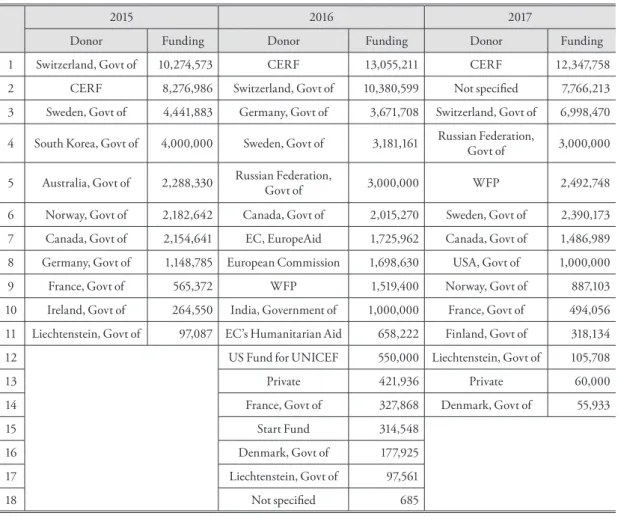
Such a level of funding is far below the target set by the Humanitarian Country Team (HCT) in North Korea. In 2016, for instance, it amounted to 26.7 percent of the USD 142 million of funding required by the humanitarian agencies. This is far less than the 2004 target achievement of 72.6 per- cent. In the case of 2017, the total annual funding of
Table 1. Humanitarian Funding Sources
(Unit: USD)2015 2016 2017
Donor Funding Donor Funding Donor Funding
1 Switzerland, Govt of 10,274,573 CERF 13,055,211 CERF 12,347,758
2 CERF 8,276,986 Switzerland, Govt of 10,380,599 Not specified 7,766,213 3 Sweden, Govt of 4,441,883 Germany, Govt of 3,671,708 Switzerland, Govt of 6,998,470 4 South Korea, Govt of 4,000,000 Sweden, Govt of 3,181,161 Russian Federation, Govt of 3,000,000 5 Australia, Govt of 2,288,330 Russian Federation,
Govt of 3,000,000 WFP 2,492,748
6 Norway, Govt of 2,182,642 Canada, Govt of 2,015,270 Sweden, Govt of 2,390,173 7 Canada, Govt of 2,154,641 EC, EuropeAid 1,725,962 Canada, Govt of 1,486,989 8 Germany, Govt of 1,148,785 European Commission 1,698,630 USA, Govt of 1,000,000
9 France, Govt of 565,372 WFP 1,519,400 Norway, Govt of 887,103
10 Ireland, Govt of 264,550 India, Government of 1,000,000 France, Govt of 494,056 11 Liechtenstein, Govt of 97,087 EC’s Humanitarian Aid 658,222 Finland, Govt of 318,134
12 US Fund for UNICEF 550,000 Liechtenstein, Govt of 105,708
13 Private 421,936 Private 60,000
14 France, Govt of 327,868 Denmark, Govt of 55,933
15 Start Fund 314,548
16 Denmark, Govt of 177,925
17 Liechtenstein, Govt of 97,561
18 Not specified 685
No te: The provision of Start Fund in 2016 is related to the humanitarian activities of Save the Children, Concern Worldwide and German Agro Action. Liechtenstein’s donations were used for WPF’s nutritional aid to North Korea from 2011.
Source: UNOCHA Financial Tracking Service.
USD 35.4 million represented only 31.2 percent of the lowered target of USD 113.5 million. Even lower performance was recorded in 2018, in which USD 27.2 million, or 24.4 percent of the required target, were raised.
7)As shown in Table 1, around ten countries, includ- ing several European nations, Canada, Australia, India, Russia and South Korea provided funds for North Korea during the period 2015-2017. Although direct aid was suspended after the May 24 measures in 2010, the South Korean government occasion- ally donated funds to the WHO, UNICEF, and International Vaccine Institute in support of infant and maternal health promotion and vaccine proj- ects. For instance, in 2015, South Korea allocated USD 400,000 to UNICEF. In 2018, only seven countries (Sweden, Switzerland, Russia, Canada, Norway, France and Liechtenstein) participated in humanitarian aid to North Korea. While showing little interest in aid activities for North Korea during the 2000s, Russia made an initial donation of USD 5 million to the WFP’s nutritional aid project in 2012, and went on to donate USD 3 million in 2013, 2016 and 2017 respectively.
Five American NGOs which had engaged in the distribution of the Bush administration’s food aid from 2008 were expelled from North Korea in March of the following year (Taylor and Manyin 2011, p.5).
8)Nevertheless, in 2011, the US govern- ment provided USD 900,000 worth of relief to North Korea through Samaritan’s Purse for recov- ery work from flood damage in Hwanghae and Gangwon provinces. In addition to USD 550,000 in support from the US Fund for UNICEF, 2016 saw small-scale humanitarian donations from US NGOs. After five years of suspension at the gov- ernment level, humanitarian aid to North Korea
was approved in January 2017 by President Barack Obama just before he stood down. The US govern- ment’s donation of USD 1 million was delivered to UNICEF for relief activities in flood damaged areas in North Hamgyong Province.
9)However, amidst the tightening of international sanctions against the regime’s nuclear and ballistic missile tests, the death of Otto Warmbier, a university student who had been detained in North Korea, led to a travel ban on American citizens in September 2017 and exacer- bated conditions for humanitarian aid.
In the same year, the Trump administration force-
fully carried out the so-called maximum pressure
campaign against North Korea, including the impo-
sition of secondary boycott sanctions which applied
to foreign corporations, financial institutions, trans-
port companies and entrepreneurs with suspicious
transactions with the sanctioned country.
10)Dozens
of foreign companies and individuals, mainly Chi-
nese nationals, dealing with North Korea were in-
cluded in the US Treasury Department’s sanctions
list. By predicting a situation in which financial in-
stitutions, merchants and transport companies could
be associated with unintended risk of sanctions viola-
tion in terms of business activities with North Ko-
rea, the US government attempted to interrupt the
dealings of foreign companies and individuals with
the country. This new sanction measure meant that
suppliers and banks became wary of even dealing
indirectly with humanitarian organizations operat-
ing in North Korea. While UNSC resolutions clearly
stated sanctions exemption for humanitarian activi-
ties, the absence of a banking channel for funding
transfers and breakdown in supply chains of goods in
practice have undermined the ability of aid agencies
to continue their operations in North Korea (DPRK
HCT 2018, p.8; DPRK HCT 2019, p.9).
3. Challenges to Humanitarian Operations in North Korea
The channel for humanitarian assistance to North Korea is largely divided into UN agencies, bilat- eral government organizations and international NGOs. A survey of UNOCHA data suggests that approximately USD 1.5 billion, or about 68 percent of total funding to North Korea, have been delivered through UN entities since 2000. Thus, UN agen- cies play a major role in funding deployment, project implementation and monitoring of humanitarian aid to North Korea. Six resident UN agencies are currently operating in North Korea: United Nations Development Programme (UNDP), United Nations Children’s Fund (UNICEF), World Health Orga- nization (WHO), World Food Program (WFP), United Nations Food and Agriculture Organization (FAO) and United Nations Fund for Population Activities (UNFPA). These agencies have formed a cooperative system for multilateral aid distribution and administration through the UN Country Team (UNCT) under the leadership of the UN Resident Coordinator in Pyongyang.
11)As we have seen, the OCHA, a leading UN body that provides emergency relief to countries and regions in urgent need, withdrew its resident office from Pyongyang in 2005 as the UN Consolidated Inter-Agency Appeal for the country ceased that year. Nevertheless, the OCHA has continued sup- port by allocating the Central Emergency Response Fund (CERF) to humanitarian organizations in North Korea. As humanitarian projects in the coun- try have been largely underfunded in recent years, the CERF grant has emerged as a major funding source. The CERF delivered USD 13.1 million in
2016 (30.4 percent of total international aid to North Korea), USD 12.35 million (31.3%) in 2017 and USD 10 million (30.5%) in 2018.
12It is also noteworthy that the operations of the UNDP, which established its office in Pyongyang in 1979, have been scaled down markedly following its two and half years’ suspension between 2007 and 2009. The UNDP halted its country programme in March 2007 amid allegations by the US govern- ment regarding the agency’s payment and financial transactions and its use of equipment relative to North Korea’s illicit activities (see UNDP External Independent Investigative Review Panel 2008). The UNDP resumed its support from 2010 after the reso- lution of these charges, but most previously planned development-oriented projects for agricultural reha- bilitation and the energy and transport sectors were terminated. As such, the implementation of UNDP aid appears to be small scale, for instance, with the annual allocation of USD 4.6 million in 2017 for the operational sites of only 11 counties.
13)At present, five international NGOs, the Interna- tional Federation of the Red Cross and Red Crescent Societies (IFRC), the International Committee of the Red Cross (ICRC) and several European gov- ernmental aid agencies maintain resident status in North Korea (DPRK HCT 2019, p.18). Although several NGOs have pulled out of the country due to the North Korean government’s excessive restric- tions on field access and monitoring, the number of international NGOs involved in North Korean relief activities increased in the first half of the 2000s.
In addition to European NGOs, dozens of non- resident NGOs from South Korea, the Unites States and other donor countries participated in food aid and health and medical services (see Smith 2002;
Taylor and Manyin 2011). However, the regime’s
continued development of its nuclear programme and increased worsening of its foreign relations led to reluctance among major donors to provide funds to international NGOs in the country. Along with declining donations, the stringency of bilateral and multilateral sanctions also placed constraints on the humanitarian activities of NGOs in North Korea.
For example, the activities of South Korean NGOs, which accounted for a large share of non-governmen- tal humanitarian projects in North Korea during the previous decade, effectively ceased following the en- actment of the South Korean government’s measures in 2010.
The five international NGOs currently present in Pyongyang are all from Europe. Based on an agreement between the European Commission and the North Korean government, these NGOs have maintained their resident offices and operated humanitarian projects as part of European Union Project Support (EUPS) units from the mid-2000s.
They are Premiere Urgence Internationale (France), Concern Worldwide (Ireland), Deutsche Welthung- erhilfe (German Agro Action), Triangle Generation Humanitaire (France) and Handicap International (Belgium) (DPRK HCT 2019, p.31). Aid activi- ties carried out by these international NGOs are financed by the European Commission, European governments, other NGOs and private donors. How- ever, Save the Children, which had actively engaged in food security and the health sector since the early 2000s and worked as EUPS Unit 2, shut down its assistance to North Korea in November 2017 in the wake of enhanced economic sanctions. Similarly, Fida International, a Finnish NGO which had worked in North Korea for the last two decades, an- nounced the end of its humanitarian operations from June 2019 with the issue of the statement, “Financial
services related to North Korean projects impos- sible.”
14)In collaboration with the DPRK Red Cross, the International Red Cross supports disaster relief activities, flood damage reparation, medical care, water supply and sanitation projects and disaster mitigation projects. Total aid from the International Red Cross and its country members since 2000 has amounted to more than USD 240 million. In 2019, three national Red Cross societies from Norway, Sweden and Germany reported the donation of USD 950,205, USD 862,999 and USD 145,180 respec- tively.
15)Caritas Internationalis, a confederation of 165 na- tional Catholic relief and social development service organizations, has also provided humanitarian aid to North Korea, particularly in the field of public health, since the late 1990s. For example, Caritas Germany worked with the North Korean Ministry of Health between 2010 and 2011 to provide the vac- cination of about 3.7 million children against hepa- titis B. Additionally, Caritas Germany’s support for North Korea’s anti-Japanese encephalitis vaccination campaign extended to about 3.1 million children between July 2013 and January 2014 (Shin 2014, pp.24-25). Furthermore, in 2017, Caritas Germany began new projects to support the construction of nursing homes in Hamhung and Kowon in South Hamkyong Province, along with the renovation of a disease management centre in Hamhung City.
16)Given the stringency of bilateral and multilat-
eral sanctions against North Korea, during the last
decade, humanitarian action has been limited to
basic projects. According to UNOCHA data, ap-
proximately 65 percent of USD 2.23 billion, the total
amount of funding to North Korea from 2000 to
2018, has been used for nutritional aid and agricul-
tural recovery. The remainder has mostly been used for health and medical services, including the supply of medicines and medical equipment, the expansion of health care facilities and the management of com- municable diseases. Funding for the health services sector amounted to USD 428 million, which repre- sents about 19.2 percent of the total aid. Additional- ly, although relatively low in funding volume, inter- national agencies implemented the WASH (Water, Sanitation and Hygiene) project to improve the qual- ity of drinking water, sanitation management and hygiene services (DPRK HCT 2019, p.8). However, humanitarian aid in the education sector is found to be very low. UNICEF and UNESCO have provided textbooks and school supplies to children in several regions, but the education programme amounts to only USD 3.61 million, accounting for 0.16 percent of total international aid. The last recorded aid to the North Korean education programme was USD 16,610 in 2008.
17)A survey of humanitarian funding flows shows a change in the sectional distribution of international aid to North Korea during the last decade. The bulk of the decline in aid to the country and the opera- tional obstacles faced by humanitarian organizations have led to a fall in the share of food security and agricultural support and a proportional rise in health and WASH related services. As noted, during the 2010s, agricultural recovery projects led by UNDP and other humanitarian organizations curtailed sig- nificantly from the original plan. On the other hand, while allocation to the health sector decreased over the same period, the amount by which it fell was rela- tively small, and it still represented about 23 percent of the total aid in 2018. The WASH sector also ac- counted for about 7.6 percent of assistance to North Korea during the same year.
18)Although there has been some improvement in North Korea’s food production over the last decade, an estimated 11 million North Koreans remain un- dernourished. Indeed, about nine million people still have limited access to quality health services (DPRK HCT 2019, pp.5-7). Thus, WHO and UNICEF continue to assist vulnerable populations. These UN agencies primarily implement health service projects for disinfection and vaccination campaigns, the provision of medical equipment, and training programmes for health professionals. Grants from the Global Fund to Fight AIDS, Tuberculosis (TB) and Malaria have been used to treat TB patients and to reduce malaria since June 2010 (Shin 2014, p.24).
In addition, the Global Alliance for Vaccines and Immunisation (GAVI) has provided a total grant of USD 66 million since 2001 for strengthening North Korean’s immunization systems.
19)However, while the Global Fund was scheduled
to deliver USD 44 million to North Korea for the
period 2018-21, it halted its support on the 30th of
June 2018 (Pack and Kim 2019). Such a decision
was certainly controversial and has had a deleterious
effect on humanitarian efforts to combat TB and
other infectious diseases in North Korea, a country
regarded as having one of the largest TB burdens in
the world (DPRK HCT 2019, p.7).
20)Along with the
aforementioned shortage of funds, recent challenges
to the day-to-day operation of aid agencies in North
Korea include procurement difficulties, the delay
of deliveries by suppliers and transport companies,
and the reluctance of financial institutions to handle
humanitarian funds to North Korea (DPRK HCT
2018, p.8).
4. Diminishing Aid Effectiveness and the UN Strategic Framework
Despite more than two decades of international assistance to North Korea, the effectiveness of aid has diminished due to funding constraints and the subsequent scaling down of assistance to the country.
As the regime’s humanitarian appeals continue, the phenomenon known as donor fatigue has deepened in the donor community. Despite the fact that for- eign aid has helped to save a lot of vulnerable North Koreans, the regime also appears to be discontent with the delivery of relief-oriented aid. In addition, the North Korean government’s restriction to on-site access and monitoring by international organiza- tions serves as a major hindrance to external aid.
UN agencies and international NGOs working in the country have kept to the principle of “no access- no assistance”, which implies that humanitarian aid only takes place in areas in which monitoring of aid distribution is possible. On the contrary, the North Korean authorities have responded to the situation with a “no aid-no access” stance (UNCT in DPRK 2011, p.34). The issue thus remains a source of dis- pute between North Korea and international donors as the monitoring of aid distribution cannot be suf- ficiently robust. Moreover, with the declining level of funding, progress made through humanitarian or- ganizations’ field visits is likely to be lost when their operations are halted (DPRK HCT 2019, p.20).
Nevertheless, in an effort to improve aid effective- ness through both humanitarian and development work, the UN Country Team (UNCT) has collabo- rated with the North Korean authorities to set up the Strategic Framework for Cooperation, which out- lines an overall strategy for the government’s priori-
ties and UN programmes designed to address them.
The UN Strategic Framework for the period 2011- 15 demonstrates four thematic priority areas agreed between the UNCT and the North Korean govern- ment: social development, partnerships for knowl- edge and development management, nutrition, and climate change and the environment (UNCT in DPRK 2011, p.37).
21)In line with pursuit of the Millennium Develop- ment Goals (MDGs), the social development area centres on the activities of UN agencies to help North Koreans gain better access to health and edu- cation services, and ensure institutional capacity to improve the supply of safe drinking water and sanita- tion/hygiene. Aimed at promoting knowledge and development management partnerships, the Strate- gic Framework sets up programmes to enhance hu- man resources in government institutions, improve capacity in trade and financial management, and facilitate the efficient use of energy resources. Ongo- ing food and nutrition insecurity has also led to em- phasis on increasing food production and sustainable agriculture. Furthermore, these UN programmes demonstrate the need to improve the country’s ca- pacity in environmental protection, natural disaster management and climate change mitigation (UN 2011, pp. 5-10).
However, as we have seen, the UN Strategic Framework faces particular challenges related to the deterioration of the North Korean nuclear issue and the ensuing sharp decline in the donor community’s goodwill to assist the country, which has led to the extension of the coverage period for one more year (UNCT in DPRK 2015, p.4). The Strategic Frame- work for the period 2017-21 is now in progress.
Similar to the previous one, the new UN strategic
framework highlights four thematic areas: food and
nutrition security, social development, resilience and sustainability in response to disasters and climate change, and data and development management (UN 2017, p.11). As indicated by the thematic pri- orities set out in the strategic framework during the mid-2010s, assistance is largely limited to addressing short-term basic humanitarian needs. The outcome of this UN strategic framework so far is even more disappointing as humanitarian programmes and activities have been scaled down and the beneficiary regions and groups of people have further shrunk in the late 2010s.
Nevertheless, a positive indication for the donor community is the fact that UN agencies and inter- national NGOs have experienced continuous im- provements in field visits and monitoring conditions (UNCT in DPRK 2011, p.36; DPRK HCT 2018, p.16; DPRK HCT 2019, p.20). Indeed, the UN Stra- tegic Framework for the period 2017-21 highlights collaboration with the North Korean government to ensure county-level implementation of several spe- cific tasks outlined in the Sustainable Development Goals (SDGs). Such a partnership could encourage policy dialogue between donor agencies and govern- ment organizations at both central and local level.
A recent UN report documents that as of 2018, humanitarian organizations in North Korea are able to conduct field monitoring in all 11 provinces of the country, making 1,855 site visits that year (DPRK HCT 2019, p.20). For security reasons, the regime has not hitherto allowed foreign aid workers access to the mountainous region of Jagang Province in the country’s interior where many military-related factories are located. As such, while full access to project sites and unscheduled field visits are yet to be realized, Pyongyang’s recent permission for foreign aid workers to undertake field monitoring in Jagang
Province demonstrates a more cooperative attitude towards much needed external assistance (DPRK HCT 2019, p.20).
5. Concluding Remarks
As we have seen, while unprecedented summitry events have taken place since the beginning of 2018, the North Korean regime’s nuclear standoff is still in force and stringent international sanctions against the country are maintained. The impasse in US- North Korea negotiations has led to continued geo- political tension in the region. Moreover, although several international organizations, including the Global Fund to Fight AIDS, Tuberculosis and Ma- laria in October 2019, have announced the resump- tion of assistance to North Korea, as shown in Figure 1, a vast funding gap remains, the volume of this year’s aid as of October reaching a mere USD 36.6 million. Along with multiple operational obstacles faced by aid agencies, there is also evidence to suggest the adverse consequences of international sanctions for civilian populations, especially vulnerable groups (DPRK HCT 2019, pp.9-10). As such, the question arises as to how long and to what extent ongoing sanctions under the so-called maximum pressure against North Korea should be continued.
Given the paradoxical situation in which the tight-
ening of international sanctions has had a greater
economic impact on ordinary people than on politi-
cal authorities, bureaucrats and wealthy merchants,
there is urgent need for the expansion of humanitar-
ian aid targeting vulnerable people even before a US-
North Korea deal is reached. The scope of broader
multilateral UN sanctions notwithstanding, devel-
opment projects can be implemented in humanitari- an areas in line with the international goal of poverty reduction. In addition, there must be greater support from the donor community for the realization of such global objectives as the SDGs and the Paris Agreement on climate change, which could serve as a platform for creating a more favourable environment for North Korea’s socio-economic transformation.
However, as we have seen, most projects in the UN Strategic Framework have been wound down. There- fore, increased financial and technical assistance from the donor community for priority areas agreed between UN organizations and the North Korean government is an important method for ensuring closer cooperation.
As multilateral UN sanctions are still in force, the South Korean government faces difficulty in the expansion of its economic assistance to North Korea before the settlement of US-North Korea nuclear negotiations. An efficient measure for the South Ko- rean government would therefore be the relaxation of sanctions regulations on financial transactions and transportation of humanitarian goods necessary for the resumption of its NGOs’ support for North Korea. In addition to the increase in funding, a con- crete effort by the international community is also needed to alleviate operational constraints imposed on humanitarian organizations in North Korea, which will lead to greater aid effectiveness. On the other hand, the lift of the regime’s restrictions on field visits and monitoring by aid agencies could be one proactive way for North Korea to alleviate lin- gering suspicions regarding fair distribution of aid and the regime’s misuse of humanitarian supplies for political purposes. Such efforts to improve the trans- parency of the distribution system could contribute to a reversal in the decline of humanitarian assistance
with more donors participating in development proj- ects in the country.
Notes
1) Rodong Sinmun, 2nd October 2018, “Sanctions and Dialogue Can Never Go Together.”
2) Aggregate from 2000 to October 2019 drawn from the database of the UN Office for the Coordination of Humanitarian Affairs (UNOCHA) Financial Tracking Service (http://fts.unocha.org).
3) Article 25 of UN Security Council resolution 2397, passed on the 22nd December 2017.
Available at https://www.un.org/undpa/en/speeches-state- ments/22122017/resolution2397%282017%29
4) United Nations Office for the Coordination of Humanitarian Af- fairs (UNOCHA) Financial Tracking Service.
5) UNOCHA, Financial Tracking Service.
6) Rodong Sinmun, 2nd April 2013, “Report given by Respected Comrade Kim Jong Un at the March 2013 Plenum of the KWP Central Committee.”
7) UNOCHA, Financial Tracking Service.
8) US NGOs working in North Korea in the 2000s included Chris- tian Friends of Korea, the American Friends Service Committee, Mercy Corps International, Samaritan’s Purse, World Vision, and the Eugene Bell Foundation.
9) Voice of America, 26th January 2017, “US Humanitarian Aid Goes to North Korea Despite Nuclear Tensions.”
https://www.voakorea.com/a/united-states-humanitarian-aid- goes-to-north-korea/3692955.html
10) A detailed data of the US government’s sanctions against North Korea is found in the following website of the US Treasury.
https://www.treasury.gov/resource-center/sanctions/Programs/
pages/nkorea.aspx
11) United Nations in DPR Korea website (https://dprkorea.un.org/
en)
12) UNOCHA, Financial Tracking Service [Accessed October 9, 2019].
13) https://www.kp.undp.org/content/dprk/en/home/about-us.
html
14) Yonhap News, 13th June, 2019. “Finnish NGO decides to quit operations in N. Korea amid sanctions.” https://en.yna.co.kr/
view/AEN20190613008800325 [Accessed October 22, 2019].
15) UNOCHA, Financial Tracking Service.
16) Yonhap News, 26th September, 2017. “Caritas building
nursing homes in N. Korea: RFA.” https://en.yna.co.kr/view/
AEN20170926002500315 [Accessed October 13, 2019].
17) UNOCHA, Financial Tracking Service.
18) UNOCHA, Financial Tracking Service.
19) ‘Gavi support for DPRK factsheet’ [Available at https://www.
gavi.org/country/dpr-korea/].
20) See Pack and Kim (2019) for details on the controversial issue of the Global Fund’s halt of its grants.
21) See United Nations (2011), “Strategic Framework for Coopera- tion between the United Nations and the Government of the Democratic People’s Republic of Korea 2011-2015.”
References
Chi, S-H., Chung, S-Y., Kim, M. and Lee, S-C., 2017, “A
Relational Approach to Political Geography of Bor- der Dynamics: Case study of North Korea-China Border Region Dandong, China,” Journal of the Economic Geographical Society of Korea 20(3), pp.287-306 (in Korean).
Choi, C-H., Kim, Y-Y. and Choi, S-Y., 2008, Aid Structure of UN Agencies and Activities for North Korea, Seoul:
Korea Institute for National Unification (in Ko- rean).
DPRK Humanitarian Country Team, 2018, 2018 DPR Ko- rea Needs and Priorities, Pyongyang: the Humani- tarian Country Team, Available at https://dprkorea.
un.org/sites/default/files/2019-07/unct_kp_NP 2018.pdf.
DPRK Humanitarian Country Team, 2019, 2019 DPR Ko- rea Needs and Priorities, Pyongyang: the Humani- tarian Country Team, Available at https://dprkorea.
un.org/sites/default/files/2019-07/DPRK_NP_
2019_Final.pdf.
FAO and WFP, 2019, FAO/WFP Joint Rapid Food Security Assessment - Democratic People’s Republic of Korea, Bangkok. Licence: CC BY-NC-SA 3.0 IGO.
Jeong, S-H., 2013, Jeong Se-Hyun’s Unification Talks: Thirty Years of Experience in Inter-Korean Relations - Theory and Reality, Paju: Seohae Books (in Korean).
Lee, J-M., 2012, “Processes and Major Changes in Aid to North Korea: Size of Aid, North Korean Recipi- ent Organizations and Discourse on Aid to North Korea,” KDI Review of the North Korean Economy, February 2012, pp.39-56 (in Korean).
Lee, S-O., 2016, “North Korea’s Special Economic Zones Strategy in the Kim Jong-Un era: Territorialization, Decentralization, and Chinese-Style Reform and Opening?,” Journal of the Economic Geographical Society of Korea 19(1), pp.122-142 (in Korean).