Copyright © 2017 The Korean Society for Bone and Mineral Research
This is an Open Access article distributed under the terms of the Creative Commons Attribution Non-Commercial Li- cense (http://creativecommons.org/licenses/by-nc/4.0/) which permits unrestricted non-commercial use, distribu- tion, and reproduction in any medium, provided the original work is properly cited.
Serum Vitamin D Level Related to Coffee
Consumption in Korean Young Adults Using the 5th Korea National Health and Nutrition Examination Survey
Hee-Sook Lim1, Hae-Hyeog Lee2, Dong-Won Byun3, Bora Lee4, Temuulee Enkhbold5, Tae-Hee Kim2
1Department of Food and Nutrition, Yoensung University, Anyang;
2Department of Obstetrics and Gynecology, Soonchunhyang University College of Medicine, Bucheon;
3Division of Endocrinology and Metabolism, Department of Internal Medicine, Soonchunhyang University College of Medicine, Seoul;
4Department of Biostatistics, Graduate School of Chung-Ang University, Seoul, Korea;
5Department of Obstetrics and Gynecology, Etemo Clinic, Ulaanbaatar, Mongolia
Background: Even young adults are highly interested in their osteological health, yet their calcium intake does not match the level of such interest. Increase in bone loss is known to be associated with higher intake of caffeine and coffee consumption among the young Korean is rising steadily. This study was conducted to reveal the relationship between coffee consumption and serum vitamin D level in Korean young adults. Meth- ods: This study analyzed potential difference in lifestyle and concentration of vitamin D in blood in relation to coffee intake frequency of 2,523 subjects on the basis of data from the 5th Korea National Health and Nutrition Examination Survey. Results: According to the analysis, groups of males, with high income, frequent social activity followed by al- cohol consumption and smoking, and high rate of dining out showed a high frequency of coffee consumption. Vitamin D concentration among the groups was 16.2±5.3 mL and 80.3% of them were considered to be vitamin D-deficient. All the groups appeared to have deficiencies compared to males who did not consume caffeine at all. Conclu- sions: The practice of having an adequate amount of coffee is needed, and more efforts should be done to improve vitamin D intake among young adults.
Key Words: Caffeine, Coffee, Nutrition surveys, Vitamin D, Young adult
INTRODUCTION
Import of coffee - one of the iconic favorite foods and pillars of the food service industry – rises rapidly each year in Korea.[1,2] According to an analysis of coffee consumption around the world, Northern Europeans drink three cups a day on average whereas Koreans drink 1.8 cups. It is also reported that coffee ranks the 24th among daily foods in terms of their contribution to energy intake and Kore- ans drink coffee more often than they eat rice and cabbage kimchi which repre- sent staple diet for Koreans.[1] One of the causes underlying such trend is the ex- tensive penetration of franchise coffee shops that have become cultural icons as Corresponding author
Tae-Hee Kim
Department of Obstetrics and Gynecology, Soonchunhyang University Bucheon Hospital, 170 Jomaru-ro, Bucheon 14584, Korea Tel: +82-32-621-5380
Fax: +82-2-6008-6874 E-mail: [email protected] Received: October 22, 2017 Revised: November 24, 2017 Accepted: November 26, 2017
No potential conflict of interest relevant to this article was reported.
Original Article
pISSN 2287-6375 eISSN 2287-7029
they are extremely popular among college students and young office workers. Such preference for coffee can be understood as a lifestyle, yet, concerns associated with cof- fee such as intake of excessive calorie, imbalance in nutri- tional intake, decrease in bone density due to intake of caffeine contained in coffee, and increase in bone loss can- not be shrugged off.[3-6] Hence, this study was conducted to identify the impact of coffee intake on bone health and present proper recommendations for coffee intake by com- paratively analyzing lifestyles and vitamin D concentration in connection with the frequency of coffee intake among young adults in Korea.
METHODS
1. SubjectFor analysis, this study used the database of the 5th Ko- rea National Health and Nutrition Examination Survey (KNHANES V) 2010-2012, database. KNHANES is a country- wide survey conducted by the Korea Centers for Disease Control and Prevention (KCDC) under the Ministry of Health and Welfare. For statistical data representing whole coun- try, stratified sampling used. All the research has been ap- proved and designated by the government and executed the research subjects. Also, this study has been approved for using data from KCDC. Twenty to 39 years old, who par- ticipated in KNHANES providing data of their health medi- cal examination, dietary lifestyle, physical examination and health, and their food in the years 2010, 2011, and 2012, were chosen as sample. First, among all respondents, a to- tal of 25,534, from 2010 to 2012, subjects under 20 and over 40 years old (20,331) were excluded. Next, respon- dents who answered as non-descripted, none, and not ap- plicable (2,680) were not considered either. As a result, a total 2,523 individuals were included in the final analysis.
Based on the statistical report that average coffee con- sumption is 1.8 cups, the research subjects were catego- rized into 4 groups, according to the frequency of coffee consumption as Coffee A (less than 1 time/week), Coffee B (2-6 times/week), Coffee C (1 time/day), and Coffee D (more than 2 times a day). The questionnaire was from food intake frequency survey included in the KNHANES V.
2. Variables measurements
Variables used in research analysis focused on under-
standing lifestyle and serum vitamin D concentration. Vari- ables used in the analysis were classified into different cat- egories in reference to preceding studies – six socio-demo- graphics factors (age, sex, body mass index [BMI], house- hold income, education level, and marital status), four life- style factors (drinking status, smoking status, regular phys- ical exercise, and eating-out frequency), and serum vita- min D level.
3. Statistical analysis
SPSS 18.0 programs (SPSS Inc., Chicago, IL, USA) was used for the statistical analysis and, to identify differences among the four groups in relation to coffee intake, means and stan- dard deviations were analyzed by one-way analysis of vari- ance (ANOVA) and frequency was analyzed by χ2 test. When significant difference appeared among the groups, turkey’s multi-range test was conducted as post-hoc test. Statistical significance was determined at P<0.05.
RESULTS
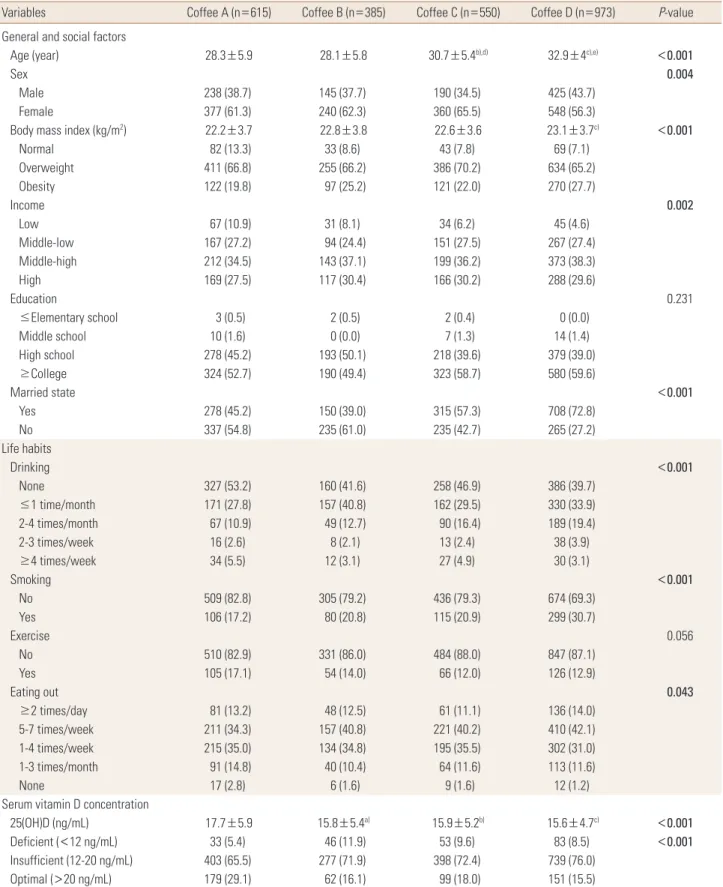
When the frequency of coffee intake by 2,523 young Ko- rean adults was examined, it was found that 550 adults drank one cup a day (21.8%) and 973 drank no fewer than two cups (38.6%). The average age of the total subjects was 30.6±5 years. The average age of coffee C and coffee D was significantly higher than coffee A and coffee B who drank comparatively less coffee and the ratio of male was significantly highest in coffee D among the four groups.
BMI was significantly higher in D than in coffee A and, in terms of the distribution of obesity, the ratio of obese sub- jects was significantly high at 27.7% in D. Most young Ko- rean adults in their 20 to 30s were found to have received tertiary education. Higher frequency of coffee consump- tion was found in subjects with higher educational level, however, there was no significant difference between the 4 groups. When the frequency of coffee consumption ac- cording to marital status was examined, coffee D, the peo- ple with higher coffee consumption tended to be more in married people, which was statistically significant. The anal- ysis of lifestyle factors shows a similar distribution of coffee intake frequency for subjects with 2 or more times alcohol consumption. However, coffee A members who only drank coffee had a significantly higher rate of non-drinking. Smok- ing was also a factor of lower coffee consumption frequen-
Table 1. Comparison of variables according to coffee consumption
Variables Coffee A (n=615) Coffee B (n=385) Coffee C (n=550) Coffee D (n=973) P-value
General and social factors
Age (year) 28.3±5.9 28.1±5.8 30.7±5.4b),d) 32.9±4c),e) <0.001
Sex 0.004
Male 238 (38.7) 145 (37.7) 190 (34.5) 425 (43.7)
Female 377 (61.3) 240 (62.3) 360 (65.5) 548 (56.3)
Body mass index (kg/m2) 22.2±3.7 22.8±3.8 22.6±3.6 23.1±3.7c) <0.001
Normal 82 (13.3) 33 (8.6) 43 (7.8) 69 (7.1)
Overweight 411 (66.8) 255 (66.2) 386 (70.2) 634 (65.2)
Obesity 122 (19.8) 97 (25.2) 121 (22.0) 270 (27.7)
Income 0.002
Low 67 (10.9) 31 (8.1) 34 (6.2) 45 (4.6)
Middle-low 167 (27.2) 94 (24.4) 151 (27.5) 267 (27.4)
Middle-high 212 (34.5) 143 (37.1) 199 (36.2) 373 (38.3)
High 169 (27.5) 117 (30.4) 166 (30.2) 288 (29.6)
Education 0.231
≤Elementary school 3 (0.5) 2 (0.5) 2 (0.4) 0 (0.0)
Middle school 10 (1.6) 0 (0.0) 7 (1.3) 14 (1.4)
High school 278 (45.2) 193 (50.1) 218 (39.6) 379 (39.0)
≥College 324 (52.7) 190 (49.4) 323 (58.7) 580 (59.6)
Married state <0.001
Yes 278 (45.2) 150 (39.0) 315 (57.3) 708 (72.8)
No 337 (54.8) 235 (61.0) 235 (42.7) 265 (27.2)
Life habits
Drinking <0.001
None 327 (53.2) 160 (41.6) 258 (46.9) 386 (39.7)
≤1 time/month 171 (27.8) 157 (40.8) 162 (29.5) 330 (33.9)
2-4 times/month 67 (10.9) 49 (12.7) 90 (16.4) 189 (19.4)
2-3 times/week 16 (2.6) 8 (2.1) 13 (2.4) 38 (3.9)
≥4 times/week 34 (5.5) 12 (3.1) 27 (4.9) 30 (3.1)
Smoking <0.001
No 509 (82.8) 305 (79.2) 436 (79.3) 674 (69.3)
Yes 106 (17.2) 80 (20.8) 115 (20.9) 299 (30.7)
Exercise 0.056
No 510 (82.9) 331 (86.0) 484 (88.0) 847 (87.1)
Yes 105 (17.1) 54 (14.0) 66 (12.0) 126 (12.9)
Eating out 0.043
≥2 times/day 81 (13.2) 48 (12.5) 61 (11.1) 136 (14.0)
5-7 times/week 211 (34.3) 157 (40.8) 221 (40.2) 410 (42.1)
1-4 times/week 215 (35.0) 134 (34.8) 195 (35.5) 302 (31.0)
1-3 times/month 91 (14.8) 40 (10.4) 64 (11.6) 113 (11.6)
None 17 (2.8) 6 (1.6) 9 (1.6) 12 (1.2)
Serum vitamin D concentration
25(OH)D (ng/mL) 17.7±5.9 15.8±5.4a) 15.9±5.2b) 15.6±4.7c) <0.001
Deficient (<12 ng/mL) 33 (5.4) 46 (11.9) 53 (9.6) 83 (8.5) <0.001
Insufficient (12-20 ng/mL) 403 (65.5) 277 (71.9) 398 (72.4) 739 (76.0)
Optimal (>20 ng/mL) 179 (29.1) 62 (16.1) 99 (18.0) 151 (15.5)
Data represented as mean±standard deviation or number (%).
Post-hoc comparisons: a)Coffee A and Coffee B are significantly difference in all subjects. b)Coffee A and Coffee C. c)Coffee A and Coffee D. d)Coffee B and Coffee C. e)Coffee C and Coffee D.
25(OH)D, 25-hydroxy-vitamin D.
cy among non-smokers. In terms of regular exercise, there was no difference of coffee consumption frequency. The frequency of coffee D was significantly high among a group of higher frequency of dining out.
Potential difference in vitamin D concentration in blood was analyzed in connection with the frequency of coffee intake. Average concentration of vitamin D in the entire subjects was 16.2±5.3 ng/mL, with coffee D showing the lowest vitamin D concentration and coffee B, coffee C, and coffee D showing significantly lower vitamin D concentra- tion than in coffee A who drank little coffee. Coffee B showed the highest vitamin D deficiency ratio but the combined ratio of vitamin D insufficiency and deficiency was found to be 70.7% in coffee A, 83.8% in coffee B, 82% in coffee C, and 84.5% in coffee D. In terms of gender, vitamin D con- centration was found to be very low in heavy female cof- fee drinkers (Table 1, Fig. 1).
DISCUSSION
To Koreans, coffee now means a popular icon rather than being just one of the favorite foods. Caffeine contained in coffee has various physiological and pharmacological im- pacts on human body and some studies report caffeine has positive influence on human health.[7-9] However, it is reported in Korea that frequent intake of coffee is one of the factors aggravating dietary issues of college students and concerns about bone loss among young adults have been studied.[10,11] This study analyzed potential differ- Fig. 1. Comparison of vitamin D level by coffee consumption and sex.
50 40 30 20 10 0
Vitamin D (ng/mL)
A B C D
Deficiency criteria Median MaleFemale
ence in lifestyle and vitamin D concentration, targeting young adults in their 20 to 30s who constitute a new cof- fee consumer group. In results, age and the ratios of drink- ers and smokers as well as the degree of obesity were high in the group who drank coffee most frequently, which shows a similar trend to other studies.[4,11] And the big- gest significant difference appeared in coffee D who drank more than two cups of coffee a day. Furthermore, it was found a new in this study that the concentration of vitamin D in blood of those in their 20 to 30s was significantly low in coffee D drinking coffee frequently and among women.
Moreover, it is noticeable that among all young adults, the rate of vitamin D deficiency is 80.3%. The study investigat- ed vitamin D concentration following the frequency of cof- fee consumption, however it is limited since type of coffee, the use of vitamin D supplements, and other factors affect- ing meals were not considered.
In conclusion, according to the study, among young Ko- rean male adults, high income, frequent social activity fol- lowed by alcohol consumption and smoking, and high rate of dining out showed a high frequency of coffee consump- tion. Also, women with higher coffee consumption fre- quency had the lowest vitamin D concentration. However, except for men with no coffee consumption, all the groups appeared to be vitamin D deficient regardless of coffee consumption frequency. Further studies are required to determine whether coffee intake itself is associated with vitamin D level, and coffee consumption needs to be man- aged to maintain serum vitamin D level related to bone health in young adults.
ACKNOWLEDGMENT
This research was supported by High Value-added Food Technology development program, Ministry of agriculture, Food and Rural Affairs, Republic of Korea (115044-03-2- HD030).
REFERENCES
1. Kim YW, Song WG, Lee YJ. A study on the consumption behaviour of coffee product according to monthly income in franchised coffee shop’s consumer. J Korean Soc Food Cult 2014;29:519-27.
2. Je Y, Jeong S, Park T. Coffee consumption patterns in Kore-
an adults: the Korean National Health and Nutrition Ex- amination Survey (2001-2011). Asia Pac J Clin Nutr 2014;
23:691-702.
3. Cano-Marquina A, Tarín JJ, Cano A. The impact of coffee on health. Maturitas 2013;75:7-21.
4. Suliga E, Koziel D, Cieśla E, et al. Coffee consumption and the occurrence and intensity of metabolic syndrome: a cross-sectional study. Int J Food Sci Nutr 2017;68:507-13.
5. Lee DR, Lee J, Rota M, et al. Coffee consumption and risk of fractures: a systematic review and dose-response meta- analysis. Bone 2014;63:20-8.
6. Choi EJ, Kim KH, Koh YJ, et al. Coffee consumption and bone mineral density in Korean premenopausal women. Kore- an J Fam Med 2014;35:11-8.
7. Ludwig IA, Clifford MN, Lean ME, et al. Coffee: biochemis-
try and potential impact on health. Food Funct 2014;5:
1695-717.
8. Gonzalez de Mejia E, Ramirez-Mares MV. Impact of caffeine and coffee on our health. Trends Endocrinol Metab 2014;
25:489-92.
9. Hanhineva K, Törrönen R, Bondia-Pons I, et al. Impact of dietary polyphenols on carbohydrate metabolism. Int J Mol Sci 2010;11:1365-402.
10. Yeon JY, Bae YJ, Kim MH, et al. Evaluation of nutrient in- take and bone status of female college students accord- ing to the calorie consumption from coffee containing beverage. Korean J Food Nutr 2009;22:430-42.
11. Choi MK, Kim MH. The association between coffee con- sumption and bone status in young adult males accord- ing to calcium intake level. Clin Nutr Res 2016;5:180-9.