서 론
근감소증은 노화에 따른 점진적인 근육량과 기능의 저하를 의미 하며
1)노인에서 낙상과 골절, 사망률을 증가시키게 된다.
2)인구의 고 령화가 급속히 진행함에 따라 근감소증으로 인한 의료적 부담 또한 증가하고 있다.
근감소증의 병태생리는 아직 완전히 밝혀지지 않았으나 노화에 따른 신체 활동량, 영양 상태, 호르몬 상태의 변화와 기저 질환에 의 해 염증과 산화스트레스가 축적되어 autophagy 억제, 미토콘드리아 기능 이상, 재생 능력의 저하가 일어나고 결과적으로 세포 사멸이 증 가하게 되는 것으로 알려져 있다.
3-5)커피는 세계적으로 물 다음으로 가장 많이 섭취하는 음료로 항염
Original Article
노인에서 커피섭취와 근감소증의 상관관계: 국민건강영양조사 2008-2011년도 자료를 이용한 단면 연구
오시내, 신혜경, 이지원, 이덕철*
연세대학교 세브란스병원 가정의학과
Association between Coffee Consumption and Sarcopenia in Older Adults: A Cross Sectional Analysis of the Korea National Health and Nutrition Examination Survey 2008–2011
Sinae Oh, Hye Kyung Shin, Ji Won Lee, Duk Chul Lee*
Department of Family Medicine, Yonsei University, Severance Hospital, Seoul, Korea
Background: Previous studies, using in vitro and in vivo models, have reported the beneficial effects of coffee on skeletal muscle, including the coffee- induced decrease in sarcopenia progression. However, the effect of coffee on skeletal muscle mass and function in humans has not been investigated. The objective of this study was to examine the association between coffee consumption and sarcopenia (coffee induced decrease in sarcopenia progression) as well as regeneration of injured muscle in a nationally representative sample of community-dwelling older Korean adults.
Methods: This was a population-based cross-sectional study conducted in a nationally representative sample of Korean adults aged ≥65 years. We utilized data from the Fourth and Fifth Korea National Health and Nutrition Examination Surveys from 2008 to 2011 and enrolled 2,578 individuals (1,105 men, 1,473 women) for this study. Food frequency questionnaire was used to assess the frequency of coffee consumption. Appendicular skeletal muscle mass (ASM) was measursed using dual-energy X-ray absorptiometry, and sarcopenia was defined using the weight-adjusted ASM variable. A logistic regression analysis was performed to examine the association between coffee consumption and sarcopenia, after adjusting for potential confounders.
Results: In women, the multivariate-adjusted odds ratio (95% confidence interval) of sarcopenia in coffee drinkers drinking ≤1 cup/day, 2 cups/day, ≥3 cups/day was 0.612 (0.368–1.017), 0.637 (0.351–1.154), and 0.090 (0.014–0.589), respectively. In men, however, there was no significant association between coffee consumption and sarcopenia.
Conclusion: Coffee consumption was inversely associated with sarcopenia in older Korean women.
Keywords: Coffee; Sarcopenia; Skeletal Muscle; Elderly
https://doi.org/10.21215/kjfp.2016.6.6.598 eISSN 2233-9116
Korean J Fam Pract. 2016;6(6):598-603
KJFP
Korean Journal of Family PracticeReceived July 25, 2016 Revised September 18, 2016 Accepted September 27, 2016
Corresponding author Duk Chul Lee Tel: +82-2-2228-2331, Fax: +82-2-362-2473 E-mail: [email protected]
Copyright © 2016 The Korean Academy of Family Medicine
This is an open-access article distributed under the terms of the Creative Commons At- tribution Non-Commercial License (http://creativecommons.org/licenses/by-nc/4.0) which permits unrestricted noncommercial use, distribution, and reproduction in any medium, provided the original work is properly cited.
오시내 외. 커피섭취와 근감소증의 역의 상관성 Korean Journal of Family Practice
KJFP
Original Article
Korean Journal of Family Practice
증 ,
6,7)항산화
8)효과를 갖는 다양한 성분을 포함하고 있다. 이전의 역
학 연구를 통해 커피 섭취가 다양한 만성질환의 유병률 감소
9)및 사 망률 감소
10)와 연관이 있음이 보고되었으며 in vitro 및 동물 연구에 서 커피가 골격근에 유익한 영향이 있으며 근감소증의 진행을 늦출 수 있음을 보고한 바 있다.
11-13)현재까지 사람에서 커피 섭취와 근육량 간의 연관성에 대한 연구 는 없는 상태로 본 연구는 국민건강영양조사 자료를 이용하여 한국 에서 지역사회에 거주하는 노인들을 대상으로 커피 섭취와 근감소 증 간에 연관성이 있는지를 알아보고자 수행되었다.
방 법
1. 연구 대상
본 단면연구는 한국질병관리본부에서 수행한 국민건강영양조사 제 4–5기 2008–2011년도 자료를 이용하였다.
14,15)국민건강영양조사는 건강설문조사 , 검진조사, 영양조사의 세 부문으로 이루어져 있다. 세 부문에 모두 참여하였으며 65세 이상인 4,395명(남자 1,865명, 여자 2,530명) 중 결측값을 제외한 2,578명(남자 1,105명, 여자 1,473명)을 대 상으로 분석하였다.
2. 커피 섭취량 조사
영양조사 중 식품섭취빈도조사는 63가지 음식을 조사하고 있으 며 그 중 커피 섭취량에 대해서는 지난 12개월간의 커피 섭취량을 10 개의 항목으로 나누어 거의 먹지 않음부터 하루에 3잔 이상까지 중 에서 선택하도록 하였다. 본 연구에서는 이를 다시 거의 먹지 않음,
≤1잔/일, 2잔/일, ≥3잔/일로 나누어 분석하였다. 식품섭취빈도조사에 서는 디카페인 커피와 카페인 커피를 구별하지 않고 전체 커피 섭취 량만을 조사하였으며 국내에서는 아직까지 디카페인 커피의 섭취 량은 많지 않다.
16)3. 근감소증의 정의
체성분 분석은 dual-energy X-ray absorptiometry (Discovery-W; Ho- logic Inc., Waltham, MA, USA)를 이용하여 시행하였다. 팔과 다리의 제지방량에서 골량을 뺀 값을 근육량으로 간주하여 사지골격근량 (appendicular skeletal muscle mass, ASM)으로 정의하였다.
17)사지골격 근량을 체중으로 나누어 보정한 weight-adjusted ASM (ASM/weight) 을 구하여 이 값이 젊고 건강한 성인들로 이루어진 reference group의 weight-adjusted ASM을 기준으로 2 표준편차 미만인 경우를 근감소 증으로 정의하였다.
18)Reference group은 조사에 참여한 20–39세의 성
인 중 질병(고혈압, 고지혈증, 당뇨, 뇌졸중, 관상동맥질환, 갑상선 질
Table 1. Characteristics of study participants by categories of coffee consumption CharacteristicDaily coffee consumption (cup/d) Men (n=1,105)Women (n=1,473) None≤12≥3P-valueNone≤12≥3P-value Number141 561 248 155 33888219657 Age (y)72.2 (0.6)72.2 (0.3)71.5 (0.4)71.2 (0.5)0.27073.6 (0.4)72.7 (0.3)71.8 (0.5)72.4 (0.9)0.05 Body mass index (kg/m2)22.4 (0.3)23.3 (0.2)23.3 (0.2)23.2 (0.3)0.04724.3 (0.2)24.2 (0.1)24.9 (0.3)23.8 (0.6)0.098 Education (> elementary school)43.3 (5.5)47.3 (2.6)55.1 (4.1)51.9 (4.9)0.20514.0 (2.3)12.6 (1.3)15.2 (3.0)12.3 (5.0)0.828 Number of chronic conditions (≥3)19.6 (4.6)12.9 (1.5)12.3 (2.7)7.1 (2.7)0.36726.0 (3.1)27.1 (1.8)22.1 (39)21.9 (6.3)0.739 Current smoker43.7 (5.5)44.6 (2.5)43.8 (3.8)57.1 (4.4)0.0027.6 (2.2)6.1 (1.1)11.6 (2.7)25.8 (7.1)<0.001 Alcohol consumption (>1 drink/d)15.7 (3.4)20.6 (2.1)24.1 (3.5)19.4 (4.0)0.439<0.1 (<0.1)1.4 (0.5)0.6 (0.6)2.0 (1.9)0.088 Recommended level of exercise*27.6 (5.1)30.8 (2.7)27.9 (3.2)32.5 (4.1)0.76822.8 (2.8)23.4 (1.7)21.2 (3.4)37.4 (7.9)0.152 Hormone use (yes)----2.3 (0.8)2.6 (0.7)2.0 (1.0)-0.695 Oral contraceptive use (yes)----5.8 (1.5)7.8 (1.5)10.7 (3.4)11.1 (6.1)0.438 Dietary intake† Total energy (kcal/d)1,832.0 (81.5)1,925.1 (36.5)1,971.0 (57.8)1,954.9 (74.5)0.5531,368.7 (43.3)1,395.4 (21.9)1,522.8 (39.6)1,464.2 (91.6)0.023 Protein (g/d)61.4 (3.5)64.8 (1.9)62.7 (2.1)65.0 (3.3)0.744.6 (1.8)43.3 (0.8)46.3 (1.8)45.8 (3.7)0.423 Fat (g/d)26.1 (3.8)26.4 (1.1)29.9 (1.7)32.9 (2.1)0.0416.4 (1.0)16.8 (0.6)18.5 (1.0)19.9 (1.9)0.208 Carbohydrate (g/d)320.3 (13.1)336.9 (6.4)338.5 (10.3)345.8 (13.6)0.596264.7 (8.7)268.6 (4.3)292.3 (7.4)276.2 (18.4)0.031 Values are presented as mean (standard error) or percentage (standard error). -, none. *≥ 150 min/wk of moderate-intensity and/or ≥75 min/wk of vigorous-intensity aerobic physical activity. †Daily energy and nutrient intakes were assessed using the 24-h recall method of the nutrition survey of Korea National Health and Nutrition Examination Survey IV.
Sinae Oh, et al. Coffee Consumption Was Inversely Associated with Sarcopenia
Korean Journal of Family Practice
KJFP
환 , 관절염, 결핵, 천식, 신장병, 간경변, 암)이 있는 사람들을 제외한 5,325명을 대상으로 하였다.
4. 공변량
나이, 교육(초등학교 이하, 중학교 이상), 체질량 지수, 의사에게 진 단받은 만성질환(고혈압, 고지혈증, 뇌졸중, 심근경색, 협심증, 관절 염 , 폐결핵, 천식, 만성폐쇄성폐질환, 당뇨, 암, 우울증, 갑상선질환, 간 경변 , 신부전), 흡연(비흡연, 금연, 흡연), 음주(≤1잔/일, >1잔/일), 신체 활동 (권장레벨[≥150분/주 중등도 신체활동 또는 ≥75분/주 격렬한 신 체활동 ] 이상, 권장레벨 미만),
19)하루 에너지 및 영양소 섭취량, 피임 약 또는 여성호르몬 복용 여부를 조사하였다.
5. 통계 분석
커피 섭취량을 거의 먹지 않음, ≤1잔/일, 2잔/일, ≥3잔/일로 나누고 커피 섭취량 그룹에 따른 연구 대상자들의 특징을 분석하였다. 연속 형 변수에 대해서는 weighted one-way analysis of variance (ANOVA) 를 이용하였으며 범주형 변수에 대해서는 chi square test를 이용하였 다. 또한 근감소증 여부에 따른 따른 연구 대상자들의 특징을 분석 하였으며 연속형 변수에 대해서는 t-test를 이용하였고 범주형 변수 에 대해서는 chi square test를 이용하였다. 모든 결과는 퍼센트(표준 오차 ) 또는 평균(표준오차)로 기술하였다.
Multiple logistic regression을 이용하여 커피 섭취량 그룹에 따라 공변량들을 보정한 근감소증의 교차비(odds ratio, OR)와 95% 신뢰
구간 (95% cofidence interval, CI)을 구하였고 커피 섭취량의 증가에 따 른 linear trend가 있는지를 확인하기 위해 weighted chi square test를 시행하였다 . 모든 분석은 성별에 따라 나누어 진행하였고 P<0.05 인 경우 통계적으로 유의하다고 판단하였으며 IBM SPSS Statistics ver.
21.0 (IBM Corp., Armonk, NY, USA)을 사용하였다.
결 과
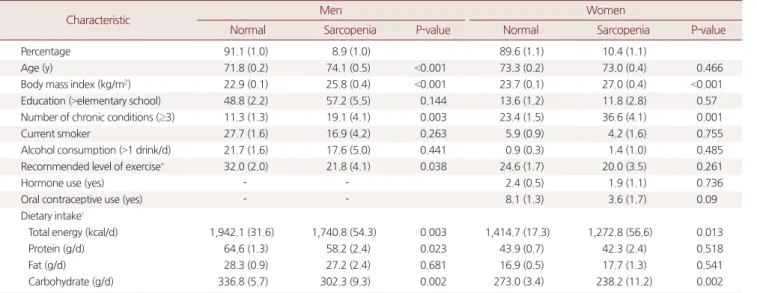
커피 섭취량 그룹에 따른 연구 대상자들의 임상적 특징을 Table 1 에 나타냈다. 남성에서는 체질량 지수, 지방 섭취량, 흡연자의 비율이 커피 섭취량에 따라 유의하게 증가하였으며 여성에서는 커피 섭취 량 증가에 따라 평균 연령이 유의하게 감소하였고 흡연자, 총 에너지 섭취량 , 탄수화물 섭취량은 유의하게 증가하였다. 또한 근감소증 여 부에 따른 따른 연구 대상자들의 특징을 Table 2에 나타냈다. 남성에 서는 근감소증이 있는 경우에 근감소증이 없는 경우와 비교하여 나 이 , 체질량 지수, 만성질환의 개수가 유의하게 더 많았으며 신체활동 량 , 총 에너지, 단백질, 탄수화물 섭취량은 유의하게 더 적었다. 여성 에서는 체질량 지수, 만성질환의 개수가 유의하게 더 많았고 총 에너 지, 탄수화물 섭취량은 유의하게 더 적었다.
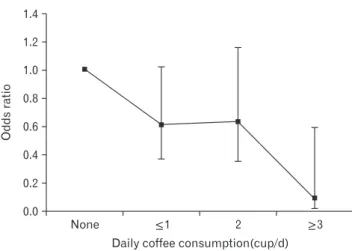
Table 3은 커피 섭취량 그룹에 따른 근감소증의 OR과 95% CI를 나 타낸 것으로 여성에서 커피를 마시지 않는 그룹에 대해 커피를 하루 에 1잔 이하, 하루에 2잔, 하루에 3잔 이상 마시는 그룹의 공변량을 보 정한 OR과 95% CI는 각각 0.612 (0.368−1.017), 0.637 (0.351−1.154), 0.090
Table 2. Characteristics of study participants by sarcopenia
Characteristic Men Women
Normal Sarcopenia P-value Normal Sarcopenia P-value
Percentage 91.1 (1.0) 8.9 (1.0) 89.6 (1.1) 10.4 (1.1)
Age (y) 71.8 (0.2) 74.1 (0.5) <0.001 73.3 (0.2) 73.0 (0.4) 0.466
Body mass index (kg/m2) 22.9 (0.1) 25.8 (0.4) <0.001 23.7 (0.1) 27.0 (0.4) <0.001
Education (>elementary school) 48.8 (2.2) 57.2 (5.5) 0.144 13.6 (1.2) 11.8 (2.8) 0.57
Number of chronic conditions (≥3) 11.3 (1.3) 19.1 (4.1) 0.003 23.4 (1.5) 36.6 (4.1) 0.001
Current smoker 27.7 (1.6) 16.9 (4.2) 0.263 5.9 (0.9) 4.2 (1.6) 0.755
Alcohol consumption (>1 drink/d) 21.7 (1.6) 17.6 (5.0) 0.441 0.9 (0.3) 1.4 (1.0) 0.485
Recommended level of exercise* 32.0 (2.0) 21.8 (4.1) 0.038 24.6 (1.7) 20.0 (3.5) 0.261
Hormone use (yes) - - 2.4 (0.5) 1.9 (1.1) 0.736
Oral contraceptive use (yes) - - 8.1 (1.3) 3.6 (1.7) 0.09
Dietary intake†
Total energy (kcal/d) 1,942.1 (31.6) 1,740.8 (54.3) 0.003 1,414.7 (17.3) 1,272.8 (56.6) 0.013
Protein (g/d) 64.6 (1.3) 58.2 (2.4) 0.023 43.9 (0.7) 42.3 (2.4) 0.518
Fat (g/d) 28.3 (0.9) 27.2 (2.4) 0.681 16.9 (0.5) 17.7 (1.3) 0.541
Carbohydrate (g/d) 336.8 (5.7) 302.3 (9.3) 0.002 273.0 (3.4) 238.2 (11.2) 0.002
Values are presented as mean (standard error) or percentage (standard error).
-, none
*≥150 min/wk of moderate-intensity and/or ≥75 min/wk of vigorous-intensity aerobic physical activity. †Daily energy and nutrient intakes were assessed using the 24-h recall method of the nutrition survey of Korea National Health and Nutrition Examination Survey IV.
오시내 외. 커피섭취와 근감소증의 역의 상관성 Korean Journal of Family Practice
KJFP
(0.014−0.589)으로 나타났으며 유의한 linear trend가 관찰되었다(P for trend=0.027) (Figure 1). 남성에서는 커피 섭취량과 근감소증 사이에 유 의한 관련이 관찰되지 않았다.
고 찰
본 단면연구는 커피 섭취가 근감소증 위험의 유의한 감소와 연관 이 있음을 보여주었다. 또한, 커피 섭취량에 따른 근감소증 위험의 감 소에 유의한 linear trend가 관찰되었다.
현재까지 사람에서는 커피 섭취와 근육과 관계된 지표들의 연관 성에 대해 연구된 바가 없으나 이전의 in vitro와 동물 모델 연구를 통 해 커피가 골격근에서 autophagy를 유도하고
12)glucose uptake를 증가
시키며
20-22)인슐린 민감성을 향상시키는
23,24)것으로 보고된 바 있다.
또한 Guo 등
11)의 연구 결과에 따르면 노화된 쥐에게 커피를 투여한 결과 대조군과 비교하여 근육량과 악력의 저하가 감소하였으며 손 상된 근육의 재생이 증가하였고 serum pro-inflammatory mediator (interleukin [IL]-1α, IL-6, and tumor necrosis factor [TNF]-α)의 레벨이 낮아져 있었다. 또한 골격근의 재생에는 satellite cell이 중요한 역할을 하는데
25)노화된 쥐에서 추출한 satellite cell에 커피를 투여한 결과 세 포 분열 속도와 세포주기가 증가하고 Akt intracellular signaling path- way의 활성이 증가하는 결과를 보였다. 혼합물 상태의 제품을 사용 한 연구이기 때문에 커피의 성분들 중 어떤 성분에 의해 이와 같은 효과가 있는 것인지는 평가할 수 없었다.
11)남성에서는 커피 섭취와 근감소증 사이에 유의한 연관이 발견되 지 않았다. 커피가 근육량에 미치는 영향이 남성에서는 여성에서보 다 적거나 혼란변수가 충분히 보정되지 않았을 가능성이 있다. 노년 남성에서 혈중 테스토스테론의 감소가 흔하게 나타나는데 이는 근
Table 3. Odds ratio (OR) (95% confidence intervals) for sarcopenia by categories of coffee consumption CharacteristicDaily coffee consumption (cup/d) MenWomen None≤12≥3P for trendNone≤12≥3P for trend Crude OR10.887 (0.415–1.896)0.908 (0.401–2.055)0.474 (0.172–1.302)0.43410.608 (0.378–0.979) 0.685 (0.377–1.246)0.115 (0.014–0.913)0.065 Model 1*10.912 (0.422–1.972)0.967 (0.419–2.230)0.514(0.183–1.438)0.51410.605 (0.377–0.970)0.678 (0.376–1.225)0.114 (0.014–0.906)0.059 Model 2†10.727 (0.289–1.824)0.774 (0.315–1.902)0.447 (0.148–1.345)0.51510.612 (0.368–1.017)0.637 (0.351–1.154)0.090 (0.014–0.589)0.027 *Adjusted for age. †Model 1 with additional adjustments for body mass index, education level (≤elementary school graduate, >elementary school, unknown), number of chronic conditions (0, 1, 2, ≥3, unknown), smoking (never, former, current, unknown), alcohol consumption (>1 drink/d, ≤1 drink/d, unknown), exercise (below than recommended, recommended, unknown), total energy intake (kcal/d), total protein, fat, carbohydrate intake (g/d), oral contraceptive (yes, no, unknown) and hormone use (yes, no, unknown) (women only).
None <1 2 >3
1.4 1.2 1.0 0.8 0.6 0.4 0.2
Oddsratio
Daily coffee consumption(cup/d) 0.0
Figure 1. Odds ratio for sarcopenia by categories of coffee consump- tion in women. Bars mean 95% confidence interval.
Sinae Oh, et al. Coffee Consumption Was Inversely Associated with Sarcopenia
Korean Journal of Family Practice
KJFP
육량의 감소와 연관되며 이러한 경우 테스토스테론을 보충함으로 써 근육량의 증가를 기대할 수 있다.
26-28)국민건강영양조사는 테스 토스테론의 레벨이나 보충 여부는 조사하지 않았기 때문에 본 연구 에서는 해당 정보를 파악할 수 없었다.
본 연구는 몇 가지 한계점을 갖고 있다. 첫째, 단면연구이기 때문 에 인과관계를 수립하는 데 있어 역의 인과관계일 가능성을 배제할 수 없으며 추가적인 혼란 변수가 존재할 수 있다. 둘째, European Working Group on Sarcopenia in Older People에서 새로 발표한 근감 소증의 진단 기준에서는 근육량과 근육 기능의 저하를 함께 고려하 도록 하고 있는데
1)본 연구에서는 근육량만을 기준으로 근감소증 을 정의하였다. 본 연구에 사용된 국민건강영양조사 자료에는 근육 기능에 대한 평가는 포함되어 있지 않기 때문에 근육 기능에 대해서 는 분석할 수 없었다. 마지막으로 국민건강영양조사에서는 커피를 카페인 커피와 디카페인 커피로 나누어 조사하지 않았기 때문에 본 연구에서도 카페인 함유 여부에 대한 구분 없이 분석을 시행하였다.
디카페인 커피는 현재 한국에서 소비량이 많지 않은 상태이다.
16)결론적으로 , 본 연구는 사람에서 커피 섭취가 근감소증과 연관이 있음을 나타낸 첫 번째 연구로 한국의 노인 여성에서 커피 섭취는 근감소증과 음의 상관관계가 있음을 확인하였다. 추후 근감소증의 예방에 커피가 갖는 영향에 대한 생물학전 기전 규명 및 전향적 연 구의 시도가 필요할 것으로 생각된다.
요 약
연구배경: 이전의 in vitro 모델과 동물 모델 연구에서 커피가 근육 에 유익한 효과가 있으며 근감소증의 진행을 늦춘다는 보고가 있었 으나 현재까지 사람에서 커피 섭취와 근감소증 간의 상관관계에 대 한 연구는 없는 상태이다. 본 연구는 국민건강영양조사 자료를 이용 하여 노인에서 커피 섭취량과 근감소증 간의 상관관계를 확인하고 자 하였다.
방법: 국민건강영양조사 제4–5기 2008–2011년도 자료로부터 65세 이상 2,578명(남자 1,105명, 여자 1,473명)을 대상으로 분석을 시행하 였다 . 커피 섭취빈도는 식품섭취빈도조사를 통해 조사하였으며 근 육량은 dual-energy X-ray absorptiometry를 통해 측정한 사지근육량 을 체중으로 보정한 값을 이용하였다. 근감소증은 젊고 건강한 성인 으로 이루어진 집단에서 근육량의 평균과 표준편차를 구하고 2 표 준편차 미만을 절단값으로 사용하여 정의하였다.
결과: 여성에서 커피를 마시지 않는 그룹에 대해 커피를 하루에 1잔 이하, 하루에 2잔, 하루에 3잔 이상 마시는 그룹의 교차비와 95% 신뢰 구간은 각각 0.612 (0.368–1.017), 0.637 (0.351–1.154), 0.090 (0.014–0.589)
으 로 나타났으며 유의한 linear trend가 관찰되었다(P for trend=0.027). 남성에서는 커피 섭취량과 근감소증 사이에 유의한 관 련이 관찰되지 않았다.
결론: 한국의 여성노인에서 커피 섭취는 근감소증과 음의 상관관계 가 있었다.
중심단어: 커피; 근감소증; 골격근; 노인
REFERENCES
1. Cruz-Jentoft AJ, Baeyens JP, Bauer JM, Boirie Y, Cederholm T, Landi F, et al.
Sarcopenia: European consensus on definition and diagnosis: report of the European Working Group on sarcopenia in older people. Age Ageing 2010;
39: 412-23.
2. Roubenoff R. Sarcopenia and its implications for the elderly. Eur J Clin Nutr 2000; 54 Suppl 3: S40-7.
3. Argilés JM, Busquets S, Stemmler B, López-Soriano FJ. Cachexia and sarco- penia: mechanisms and potential targets for intervention. Curr Opin Phar- macol 2015; 22: 100-6.
4. Dirks A, Leeuwenburgh C. Apoptosis in skeletal muscle with aging. Am J Physiol Regul Integr Comp Physiol 2002; 282: R519-27.
5. Marzetti E, Calvani R, Cesari M, Buford TW, Lorenzi M, Behnke BJ, et al.
Mitochondrial dysfunction and sarcopenia of aging: from signaling path- ways to clinical trials. Int J Biochem Cell Biol 2013; 45: 2288-301.
6. Chang WC, Chen CH, Lee MF, Chang T, Yu YM. Chlorogenic acid attenu- ates adhesion molecules upregulation in IL-1beta-treated endothelial cells.
Eur J Nutr 2010; 49: 267-75.
7. Shen T, Park YC, Kim SH, Lee J, Cho JY. Nuclear factor-kappaB/signal trans- ducers and activators of transcription-1-mediated inflammatory responses in lipopolysaccharide-activated macrophages are a major inhibitory target of kahweol, a coffee diterpene. Biol Pharm Bull 2010; 33: 1159-64.
8. Sato Y, Itagaki S, Kurokawa T, Ogura J, Kobayashi M, Hirano T, et al. In vitro and in vivo antioxidant properties of chlorogenic acid and caffeic acid. Int J Pharm 2011; 403: 136-8.
9. Higdon JV, Frei B. Coffee and health: a review of recent human research.
Crit Rev Food Sci Nutr 2006; 46: 101-23.
10. Loftfield E, Freedman ND, Graubard BI, Guertin KA, Black A, Huang WY, et al. Association of coffee consumption with overall and cause-specific mortality in a large us prospective cohort study. Am J Epidemiol 2015; 182:
1010-22.
11. Guo Y, Niu K, Okazaki T, Wu H, Yoshikawa T, Ohrui T, et al. Coffee treat- ment prevents the progression of sarcopenia in aged mice in vivo and in vi- tro. Exp Gerontol 2014; 50: 1-8.
12. Pietrocola F, Malik SA, Mariño G, Vacchelli E, Senovilla L, Chaba K, et al.
Coffee induces autophagy in vivo. Cell Cycle 2014; 13: 1987-94.
13. Dirks-Naylor AJ. The benefits of coffee on skeletal muscle. Life Sci 2015;
143: 182-6.
14. Ministry of Health and Welfare. Korea Health Statistics 2009: Korea Nation- al Health and Nutrition Examination Survey (KNAHNES IV). Seoul: Korea Centers for Disease Control and Prevention, Ministry of Health and Wel-
오시내 외. 커피섭취와 근감소증의 역의 상관성 Korean Journal of Family Practice
KJFP
fare; 2010.
15. Ministry of Health and Welfare. Korea Health Statistics 2011: Korea Nation- al Health and Nutrition Examination Survey (KNAHNES V-1,2). Osong:
Korea Centers for Disease Control and Prevention, Ministry of Health and Welfare; 2012.
16. USDA Foreign Agricultural Service. Coffee market brief update Korea-Re- public of. Seoul: The U.S. Agricultural Trade Office, U.S. Embassy; 2014.
17. Heymsfield SB, Smith R, Aulet M, Bensen B, Lichtman S, Wang J, et al. Ap- pendicular skeletal muscle mass: measurement by dual-photon absorpti- ometry. Am J Clin Nutr 1990; 52: 214-8.
18. Janssen I, Heymsfield SB, Ross R. Low relative skeletal muscle mass (sarco- penia) in older persons is associated with functional impairment and physi- cal disability. J Am Geriatr Soc 2002; 50: 889-96.
19. World Health Organization. Global recommendations on physical activity for health. Geneva: World Health Organization; 2010.
20. Tsuda S, Egawa T, Ma X, Oshima R, Kurogi E, Hayashi T. Coffee polyphenol caffeic acid but not chlorogenic acid increases 5’AMP-activated protein ki- nase and insulin-independent glucose transport in rat skeletal muscle. J Nutr Biochem 2012; 23: 1403-9.
21. Shearer J, Farah A, de Paulis T, Bracy DP, Pencek RR, Graham TE, et al.
Quinides of roasted coffee enhance insulin action in conscious rats. J Nutr 2003; 133: 3529-32.
22. Ong KW, Hsu A, Tan BK. Chlorogenic acid stimulates glucose transport in
skeletal muscle via AMPK activation: a contributor to the beneficial effects of coffee on diabetes. PLoS One 2012; 7: e32718.
23. Jia H, Aw W, Egashira K, Takahashi S, Aoyama S, Saito K, et al. Coffee intake mitigated inflammation and obesity-induced insulin resistance in skeletal muscle of high-fat diet-induced obese mice. Genes Nutr 2014; 9: 389.
24. Kobayashi M, Matsuda Y, Iwai H, Hiramitsu M, Inoue T, Katagiri T, et al.
Coffee improves insulin-stimulated Akt phosphorylation in liver and skele- tal muscle in diabetic KK-A(y) mice. J Nutr Sci Vitaminol (Tokyo) 2012; 58:
408-14.
25. Lepper C, Partridge TA, Fan CM. An absolute requirement for Pax7-posi- tive satellite cells in acute injury-induced skeletal muscle regeneration. De- velopment 2011; 138: 3639-46.
26. Sullivan DH, Roberson PK, Johnson LE, Bishara O, Evans WJ, Smith ES, et al. Effects of muscle strength training and testosterone in frail elderly males.
Med Sci Sports Exerc 2005; 37: 1664-72.
27. Kenny AM, Kleppinger A, Annis K, Rathier M, Browner B, Judge JO, et al.
Effects of transdermal testosterone on bone and muscle in older men with low bioavailable testosterone levels, low bone mass, and physical frailty. J Am Geriatr Soc 2010; 58: 1134-43.
28. Travison TG, Basaria S, Storer TW, Jette AM, Miciek R, Farwell WR, et al.
Clinical meaningfulness of the changes in muscle performance and physical function associated with testosterone administration in older men with mobility limitation. J Gerontol A Biol Sci Med Sci 2011; 66: 1090-9.