서 론
커피는 전세계적으로 인기 있는 기호식품 중 하나다.1) 커피섭취로 인해 발생하는 중추계 각성효과 외에도 최근 들어 항염증 효과와 항 산화 효과가 있다는 의견이 제기되고 이에 대한 각종 연구들이 지속 적으로 진행되고 있다.2-4) 커피에는 다당류, 지질, 유기아미노산, 무기 질, 카페인, 클로로겐산 등 다양한 물질들이 함유되어 있다.5) 커피 속
다양한 물질들 중에서도 메틸잔틴계 물질인 ‘카페인’이라는 성분이 커피의 항염증 효과 및 항산화 효과의 원인일 것이라 추정되고 있 다.5)
C-반응 단백질(C-reactive protein, CRP)은 염증 전구물질에 반응 하여 간세포에서 합성 및 분비되어 체내에 만성적인 염증 상태가 있 음을 시사하는 표지자 역할을 한다.3) 현대사회에 만연하고 있는 심 혈관질환, 뇌혈관질환, 각종 암, 제2당뇨병, 대사증후군, 비만 등의 발
Received May 29, 2018 Revised September 5, 2018 Accepted September 12, 2018
Corresponding author Seung-Pil Jung Tel: +82-53-620-3180, Fax: +82-53-654-2413 E-mail: [email protected]
ORCID: http://orcid.org/0000-0002-1215-3624
Copyright © 2019 The Korean Academy of Family Medicine
This is an open-access article distributed under the terms of the Creative Commons At- tribution Non-Commercial License (http://creativecommons.org/licenses/by-nc/4.0) which permits unrestricted noncommercial use, distribution, and reproduction in any medium, provided the original work is properly cited.
Original Article
https://doi.org/10.21215/kjfp.2019.9.1.64 eISSN 2233-9116
Korean J Fam Pract. 2019;9(1):64-70
Korean Journal of Family Practice
KJFP
한국 성인남녀에서 혈중 C-반응 단백질과 커피 섭취량의 상관관계
김연정, 이근미, 정승필*
영남대학교 의과대학 가정의학교실
The Relationship between Serum C-Reactive Protein and the Coffee Consumption in the Korean Adult Men and Women
Yeon-Jung Kim, Keun-Mi Lee, Seung-Pil Jung*
Department of Family Medicine, Yeungnam University College of Medicine, Daegu, Korea
Background: Coffee is a rich source of dietary antioxidants and is one of the most popular beverages worldwide. In recent times, substantial research has been published on its anti-oxidative and anti-inflammatory effect in addition to its effect as a stimulant. Chronic low-grade inflammation is known to affect the pathogenesis of diverse diseases such as cerebrovascular and cardiovascular disease, cancer, metabolic syndrome, type 2 diabetes mellitus, and obesity. Serum C-reactive protein (CRP) is a good marker of chronic inflammation in the body. Therefore, we examined the relationship between coffee consumption and serum CRP.
Methods: Participants were 759 men and 1,003 women, aged 20–64 years, who participated in the Korea National Health and Nutrition Examination Survey, 2015. We categorized coffee consumption as follows: less than one cup a day, two to four cups a day, and five or more cups a day.
Additionally, we classified women into pre- and post-menopausal women. Multiple linear regression analyses were conducted to evaluate the relationship between coffee consumption and serum CRP.
Results: Coffee consumption showed no measurable relationship with serum CRP in men and in pre- and post-menopausal women. However, serum CRP increased progressively with increase in coffee consumption in men reported high-risk alcohol use (P=0.005).
Conclusion: Except for high-risk male drinkers, there is no association between coffee consumption and serum CRP.
Keywords: Caffeine; Coffee; C-Reactive Protein; Alcohols
김연정 외. 한국 성인에서 혈중 C-반응단백과 커피섭취의 관련성 Korean Journal of Family Practice
KJFP
병기전에 체내 만성적인 염증상태가 영향을 주는 것으로 알려져 있
다.3,6,7) 선행연구에 따르면 혈중 CRP가 증가할수록 심혈관계 질환의
발병률과 사망률이 증가하고, 대사증후군 발병 위험도 역시 증가하 였다.8,9) 위에서 언급한 만성 염증상태와 관련 있는 질병들에서 커피 섭취로 인한 항염증 효과가 있음을 보여주는 연구도 있고10-12) 반대 의 결과를 보여주는 연구도 있다.13) 본 연구에서는 우리나라 건강한 성인 남녀에서 커피 섭취량과 혈중 CRP간의 상관관계를 조사하고 자 한다. 폐경 전 여자에 비해 폐경 후 여자에서 혈중 CRP가 증가한 다는 연구를 바탕으로 본 연구에서는 여자 집단을 세부적으로 폐경 전 여자와 폐경 후 여자로 나누어 분석하였다.14)
방 법
1. 연구대상
본 연구는 제6기 국민건강영양조사 자료 중 3차년도(2015년) 조사 자료를 토대로 분석하였다. 20세 이상에서 64세 미만 사이의 건강한 성인 남자와 여자를 대상으로 하였으며, 급성 혹은 만성 염증상태를 유발하여 혈중 CRP가 상승할 가능성이 있는 질병을 진단받은 자, 혹은 과거력, 약물 복용력이 있는 자는 제외하였다. 급성 상기도 감 염, 폐결핵, 천식, 만성 폐쇄성 질환, 심혈관 질환(동맥경화증, 심근경 색, 협심증), 뇌혈관 질환, 각종 암(위암, 간암, 대장암, 유방암, 자궁 부 암, 갑상선암, 폐암, 기타 암)을 진단받았거나, 고혈압, 당뇨, 만성 신질 환, 간질환(급성∙만성 B형간염 및 C형간염, 간경변), 류마티스 관절염, 퇴행성 관절염, 골다공증 환자 그리고 혈중 백혈구 >10,000 thou/µL, CRP >10 mg/dL 수치를 보이는 자, 임신 중인 여자, 현재 혹은 과거에 한 달 이상 여자 호르몬제 복용력이 있는 자는 분석 대상에서 제외 하였다. 연구대상자는 남자 759명, 여자 1,003명(폐경 전 745명, 폐경 후 258명)으로 총 1,762명이었다.
2. 연구방법
국민건강영양조사의 항목 중 건강 설문조사를 바탕으로 분석하 였다. 연구 대상자들의 특성인 성별, 결혼 유무, 연령, 소득 수준, 흡연 력, 음주력, 규칙적인 운동, 과거 및 현재 질병력을 참고하였다. 체질 량지수(body mass index, BMI), 혈압, 신장, 몸무게, 허리둘레 및 혈액 검사, 가족력은 검진 조사항목에서, 커피 섭취량은 영양 조사항목을 참고하였다.
수축기 혈압은 환자가 앉은 자세로 표준화된 측정 방법을 사용하 여 5분 간격을 두고 3회 측정하였으며, 2번째와 3번째 측정한 혈압의 평균값을 사용하였다. BMI는 체중(kg)을 신장의 제곱(m2)으로 나누 어 계산하였고 BMI가 18.5 미만인 군은 저체중, 25 이상인 군은 비만,
나머지는 정상으로 세 군으로 분류하였다. 비만의 정의는 아시아 태 평양지역 세계보건기구(World Health Organization, WHO)와 대한 비만학회에서 제시한 기준에 따라 BMI가 25 이상인 자로 정의하였 다.
WHO는 음주량을 중심으로 1일 남자 60 g, 여자 40 g을 초과한 순 수 알코올 섭취를 ‘고위험’ 수준으로 정의하고 있다. 국민건강영양조 사에서는 설문조사를 바탕으로 하여 1회 평균 음주량이 남자는 7 잔, 여자는 5잔 이상 혹은 평균 음주 빈도가 주 2회 이상 되는 사람을
‘고위험’ 음주군으로 정의하고 있다. 따라서 본 연구에서는 음주력을 비 음주군(non), 경-중등도 음주군(mild-moderate), 고위험 음주군 (high) 세 군으로 분류하였다. 흡연력은 비 흡연군(non), 과거 흡연군 (ex), 현재 흡연군(current)으로 분류하였다.
미국스포츠의학회(American College of Sports Medicine)와 미국심 장학회(American Heart Association)는 건강한 65세 미만 성인을 대상 으로 건강 증진을 위한 주간 권장 육체적 활동량을 제시하였다. 이 에 따르면, 중강도 운동은 1회 30분 이상, 주 5회 이상, 고강도 운동은 1회 20분 이상, 주 3회 이상 할 것을 권장하였다.15,16) 이를 바탕으로, 본 연구저자들은 규칙적인 운동과 혈중 CRP와의 상관관계를 파악 하기 위해 규칙적인 운동을 하지 않는 군(non), 중등도(moderate), 고 빈도(high) 운동군을 임의로 정의하였다. 1회 30분 이상, 주 5회 이상 의 중강도 운동을 하는 군, 그리고 1회 20분 이상, 주 3회 이상 고강도 운동을 시행하는 군 모두에 해당하는 경우를 ‘고빈도(high)’ 군으로 정의하였으며, 두 가지 모두 시행하지 않는 군을 규칙적인 운동을 하 지 않는군(non), 그리고 나머지를 ‘중등도(moderate)’ 운동군 으로 정 의하였다. 커피 섭취량은 설문지를 바탕으로 하루 1잔 이하 섭취군, 하루 2–4잔 섭취군, 그리고 하루 5잔 이상 섭취군으로 분류하였다.
가구 소득 수준은 국민건강영양조사의 분류에 따라 하, 중하, 중상, 상으로 분류하였다. 결혼 상태는 기혼(배우자 동거, 별거 포함), 미혼 (사별, 이혼 포함)으로 분류하였다.
연구 대상의 제외 및 혼란 변수의 선택 기준은 혈중 CRP를 이용 한 기존의 역학 연구들을 참고하였다.2,3,13,17-19) 또한, 혈중 CRP에 영향 을 주는 변수들인 연령, 소득 수준, 결혼 유무, BMI, 신장, 몸무게, 허 리둘레, 수축기 및 이완기 혈압, 총 콜레스테롤, 중성지방, 공복 혈당, 당화혈색소, 혈중 백혈구, 저밀도 지질 단백(low density lipoprotein, LDL), 고밀도 지질 단백(high density lipoprotein, HDL), 아스파르 테이 트 아미노 전달 효소(aspartate aminotransferase, AST), 알라닌 아미노 전달 효소(alanine aminotransferase, ALT), 규칙적인 운동 여부, 흡연 력, 음주력을 통계적으로 보정하였다.
Original Article
Korean Journal of Family Practice
Yeon-Jung Kim, et al. Coffee Consumption and CRP in the Korean Adults
Korean Journal of Family Practice
KJFP
3. 통계분석
연구 대상자들의 일반적인 특성을 알아보기 위해 커피 섭취량과 성별에 따라 ANOVA, Welch 검정을 시행하였다. 커피 섭취량과 혈중 CRP와의 연관성을 알아보기 위하여 혼란 변수들을 보정한 후 다중 회귀분석을 사용하였다. BMI, 규칙적인 운동, 음주력, 흡연력에 따른
커피 섭취량과 혈중 CRP와의 관계는 정규성을 만족하지 않아 비모 수검정인 Kruskal-Wallis test를 함께 시행하였다. 통계 분석은 IBM SPSS ver. 23.0 (IBM Co., Armonk, NY, USA)과 Microsoft Excel 2017 (Microsoft, Redmond, WA, USA)을 사용하였고 유의수준은 P값이 0.05 미만으로 하였다.
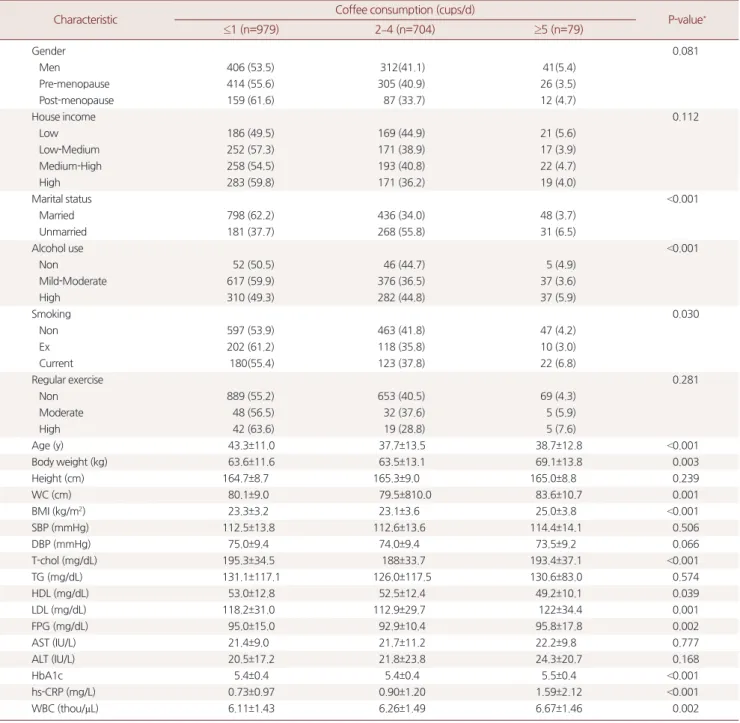
Table 1. General characteristics of study subjects according to category of the coffee consumption
Characteristic Coffee consumption (cups/d)
P-value*
≤1 (n=979) 2–4 (n=704) ≥5 (n=79)
Gender 0.081
Men 406 (53.5) 312(41.1) 41(5.4)
Pre-menopause 414 (55.6) 305 (40.9) 26 (3.5)
Post-menopause 159 (61.6) 87 (33.7) 12 (4.7)
House income 0.112
Low 186 (49.5) 169 (44.9) 21 (5.6)
Low-Medium 252 (57.3) 171 (38.9) 17 (3.9)
Medium-High 258 (54.5) 193 (40.8) 22 (4.7)
High 283 (59.8) 171 (36.2) 19 (4.0)
Marital status <0.001
Married 798 (62.2) 436 (34.0) 48 (3.7)
Unmarried 181 (37.7) 268 (55.8) 31 (6.5)
Alcohol use <0.001
Non 52 (50.5) 46 (44.7) 5 (4.9)
Mild-Moderate 617 (59.9) 376 (36.5) 37 (3.6)
High 310 (49.3) 282 (44.8) 37 (5.9)
Smoking 0.030
Non 597 (53.9) 463 (41.8) 47 (4.2)
Ex 202 (61.2) 118 (35.8) 10 (3.0)
Current 180(55.4) 123 (37.8) 22 (6.8)
Regular exercise 0.281
Non 889 (55.2) 653 (40.5) 69 (4.3)
Moderate 48 (56.5) 32 (37.6) 5 (5.9)
High 42 (63.6) 19 (28.8) 5 (7.6)
Age (y) 43.3±11.0 37.7±13.5 38.7±12.8 <0.001
Body weight (kg) 63.6±11.6 63.5±13.1 69.1±13.8 0.003
Height (cm) 164.7±8.7 165.3±9.0 165.0±8.8 0.239
WC (cm) 80.1±9.0 79.5±810.0 83.6±10.7 0.001
BMI (kg/m2) 23.3±3.2 23.1±3.6 25.0±3.8 <0.001
SBP (mmHg) 112.5±13.8 112.6±13.6 114.4±14.1 0.506
DBP (mmHg) 75.0±9.4 74.0±9.4 73.5±9.2 0.066
T-chol (mg/dL) 195.3±34.5 188±33.7 193.4±37.1 <0.001
TG (mg/dL) 131.1±117.1 126.0±117.5 130.6±83.0 0.574
HDL (mg/dL) 53.0±12.8 52.5±12.4 49.2±10.1 0.039
LDL (mg/dL) 118.2±31.0 112.9±29.7 122±34.4 0.001
FPG (mg/dL) 95.0±15.0 92.9±10.4 95.8±17.8 0.002
AST (IU/L) 21.4±9.0 21.7±11.2 22.2±9.8 0.777
ALT (IU/L) 20.5±17.2 21.8±23.8 24.3±20.7 0.168
HbA1c 5.4±0.4 5.4±0.4 5.5±0.4 <0.001
hs-CRP (mg/L) 0.73±0.97 0.90±1.20 1.59±2.12 <0.001
WBC (thou/µL) 6.11±1.43 6.26±1.49 6.67±1.46 0.002
Values are presented as mean±standard deviation or number (%) unless otherwise indicated.
WC, waist circumstance; BMI, body mass index; SBP, systolic blood pressure; DBP, diastolic blood pressure; T-chol, total cholesterol; TG, triglycerides; HDL, high-density lipid; LDL, low-density lipid; FPG, fasting plasma glucose; AST, aspartate amino transferase; ALT, alanine amino transferase; HbA1c, hemoglobin A1C; hs-CRP, high sen- sitive C-reactive protein; WBC, white blood cell.
*Calculated by ANOVA and Welch test.
김연정 외. 한국 성인에서 혈중 C-반응단백과 커피섭취의 관련성 Korean Journal of Family Practice
KJFP
결 과
1. 커피 섭취량에 따른 연구 대상자들의 일반적인 특성 평균 커피 섭취량에 따라 연구 대상 1,762명을 3개 군으로 나누었 다. 하루 평균 1잔 이하 섭취군 979명, 2–4잔 섭취군 704명, 5잔 이상 섭취군 79명이었고 각 군의 일반적인 특성은 Table 1과 같다. 세 군 간
의 차이가 있는 변수들은 결혼 상태, 음주력, 흡연력, 연령, 체중, 허리 둘레, 총 콜레스테롤, BMI, HDL, LDL, 공복 혈당, 당화혈색소, 혈중 백혈구 및 혈중 hs-CRP였다. 혈중 hs-CRP는 1잔 이하 섭취군, 2–4잔 섭취군, 5잔 이상 섭취군에서 각각 0.73, 0.90, 1.59로 나타났다 (P<0.001). 성별, 소득 수준, 규칙적인 운동 여부, 키, 수축기 혈압 및 이 완기 혈압, 중성지방, AST, ALT는 세 군 간에 차이가 없었다(Table 1).
Table 2. General characteristics of study subjects according to gender Characteristic
Gender
P-value* Men
(n=759)
Pre-menopause women (n=745)
Post-menopause women (n=258)
House income 0.525
Low 160 (21.1) 164 (22.0) 52 (20.2)
Low-medium 191 (25.2) 195 (26.2) 54 (20.9)
Medium-high 202 (26.6) 199 (26.7) 72 (27.9)
High 206 (27.1) 187 (25.1) 80 (31.0)
Marital status <0.001
Married 503 (66.3) 522 (70.1) 257 (99.6)
Unmarried 256 (33.7) 223 (29.9) 1 (0.4)
Alcohol use <0.001
Non 17 (2.2) 41 (5.5) 45 (17.4)
Mild-moderate 285 (37.5) 548 (73.6) 197 (76.4)
High 457 (60.2) 156 (20.9) 16 (6.2)
Smoking <0.001
Non 202 (26.6) 663 (89.0) 242 (93.8)
Ex 272 (35.8) 51 (6.8) 7 (2.7)
Current 285 (37.5) 31 (4.2) 9 (3.5)
Regular exercise 0.003
Non 676 (89.1) 699 (93.8) 236 (91.5)
Moderate 40 (5.3) 30 (4.0) 15 (5.8)
High 43 (5.7) 16 (2.1) 7 (2.7)
Age (y) 40.2±12.9 36.2±9.4 56.1±4.2 <0.001
Body weight (kg) 72.3±11.4 57.3±8.9 57.6±8.0 <0.001
Height (cm) 172.5±6.2 160.3±5.6 156.3±5.3 <0.001
WC (cm) 84.9±8.7 75.2±8.1 79.2±8.4 <0.001
BMI (kg/m2) 24.3±3.3 22.3±3.3 23.5±3.2 <0.001
Obese† 266 (35.0) 136 (18.3) 74 (28.7) <0.001
hs-CRP (mg/L ) 0.85±1.01 0.80±1.30 0.88±1.12 0.589
WBC (thou/uL) 6.6±1.4 6.0±1.4 5.5±1.4 <0.001
SBP (mmHg) 116.5±12.2 107.3±12.4 116.6±16.1 <0.001
DBP (mmHg) 77.6±8.8 71.1±9.0 75.2±9.1 <0.001
T-chol (mg/dL) 193.8±34.9 184.6±31.3 211.1±34.5 <0.001
TG (mg/dL) 164.8±151.9 92.8±60.3 128.6±76.6 <0.001
HDL (mg/dL) 48.0±10.9 56.7±12.2 54.0±13.8 <0.001
LDL (mg/dL) 118±31.0 109.2±28.5 130.1±31.2 <0.001
FPG (mg/dL) 96.4±16.6 91.1±10.0 96.4±10.4 <0.001
AST (IU/L) 24.1±10.8 18.6±9.8 22.7±7.0 <0.001
ALT (IU/L) 27.6±24.3 15.3±15.9 19.5±10.9 <0.001
Coffee consumption (cups/d) 1.6±1.8 1.4±1.4 1.4±1.6 0.100
Values are presented as mean±standard deviation or number (%) unless otherwise indicated.
WC, waist circumstance; BMI, body mass index; hs-CRP, high sensitive C-reactive protein; WBC, white blood cell; SBP, systolic blood pressure; DBP, diastolic blood pres- sure; T-chol, total cholesterol; TG, triglycerides; HDL, high-density lipid; LDL, low-density lipid; FPG, fasting plasma glucose; AST, aspartate amino transferase; ALT, ala- nine amino transferase.
*Calculated by ANOVA and Welch test. †Men and women whose BMI is 25 or more are considered as 'obese'.
Yeon-Jung Kim, et al. Coffee Consumption and CRP in the Korean Adults
Korean Journal of Family Practice
KJFP
2. 성별 및 폐경 여부에 따른 변수들의 특성
연구 대상자를 성별에 따라 남자, 폐경 전 여자, 폐경 후 여자 군으 로 나누었고 그에 따른 특성은 Table 2와 같다. 소득 수준과 혈중 hs- CRP 및 커피 섭취량은 세 군 간에 유의한 차이가 없었으며, 나머지 변수들은 세 군 간에 차이를 보였다. 키, 허리둘레, BMI, 비만도, 중성 지방, 현재 및 과거 흡연군 및 고위험 음주군은 남자 군에서 유의하 게 높았다. 혈중 hs-CRP는 폐경 후 여자, 남자, 폐경 전 여자 순으로 높았으나 통계적으로 유의하지 않았다(P=0.589) (Table 2).
3. 성별 및 폐경 여부에 따른 커피 섭취량와 혈중 CRP의 관계 성별 및 여자의 폐경 여부에 따라 커피 섭취량에 따른 혈중 CRP 의 연관성을 알아보기 위해, 그룹 간 차이를 보이는 변수들을 보정 한 후 관련성을 분석하였다. 커피 섭취량에 따른 혈중 CRP는 남자, 폐경 전 여자, 폐경 후 여자 군 모두에서 통계적으로 유의한 소견을 보이지 않았다(Table 3).
4. 음주력에 따른 커피 섭취량과 혈중 CRP의 관계
고위험 음주를 하는 남자 군에서 하루 평균 커피 섭취량이 1잔 이 하, 2–4잔, 5잔 이상으로 증가함에 따라 혈중 CRP가 점차적으로 상 승하였다(P=0.005) (Table 4).
고 찰
커피의 항염증 및 항산화 효과의 명확한 메커니즘은 밝혀지지 않 은 상태지만, 이에 대한 관심이 증가함에 따라 지속적으로 연구되고 있으며, 그 연구 결과 또한 다양하다. 커피 섭취량이 증가함에 따라 혈중 CRP가 감소하여 항염증 효과가 있음을 보이는 연구들도 있었
고,3,17) 커피 섭취로 인해 오히려 염증반응이 증가하는 결과를 보이는
연구도 있었다.13) 본 연구에서는 남자, 폐경 전 여자, 폐경 후 여자 세
군으로 분류하여 하루 평균 커피 섭취량에 따른 혈중 CRP의 관계를 분석해보았다. 그 결과, 세 군 모두에서 통계적으로 관련성이 없는 것 으로 나타났다. 이는 Rebello 등20)의 선행 연구에서 확인한 바와 같 다.
또한 본 연구 저자들은 커피섭취 와 혈중 CRP의 관계에 ‘음주력’
항목을 추가하여 분석해보았다. Maki 등3)의 연구에서는 ‘과다 음 주’(high consumption)를 하는 남자 군에서 커피 섭취량이 증가할수 록 혈중 CRP가 감소했고, 이 결과에 대한 해석으로 염증반응 중에 서도 알코올 섭취로 인해 간에서 발생한 염증반응에 대해 커피 속 카페인 성분이 항염증 효과를 보이는 것이라고 설명하고 있다. 또한 기존 연구들에 따르면, ‘중등도의 음주’는 CRP 생성에 관여하는 in-
Table 3. The association between the coffee consumption and C-reactive protein
Gender Coffee consumption (cups/d)
Adjusted R2 P-value*
≤1 2–4 ≥5
Men Reference 0.201 (0.135) 0.526 (0.344) 0.145 <0.001
P-value* 0.137 0.127
Pre-menopause women Reference -0.188 (0.184) 0.290 (0.468) 0.206 <0.001
P-value* 0.307 0.535
Post-menopause women Reference 0.018 (0.263) -0.052 (1.720) 0.230 0.003
P-value* 0.947 0.943
Values are presented as regression coefficient (standarded error) unless otherwise indicated.
*Calculated by multiple regression analysis.
Adjusted for age, household income, marital status, waist circumstance, body weight, height, body mass index, systolic blood pressure, diastolic blood pressure, total cholesterol, Triglycerides, high-density lipid, low-density lipid aspartate amino transferase, alanine amino transferase, fasting plasma glucose, blood white blood cells, al- cohol use, smoking, regular exercise.
Table 4. The association between the coffee consumption and CRP stratified to alcohol use in Men
Coffee consumption (cups/d)
Alcohol use
None Moderate High*
≤1
N 12 170 224
Average ranking† 8.67 139.79 213.84
2–4
N 4 104 204
Average ranking† 8.75 147.01 236.44
≥5
N 1 11 29
Average ranking† 14.00 154.59 293.81
P-value‡ 0.590 0.695 0.005
Adjusted for age, household income, marital status, waist circumstance, body weight, height, body mass index, systolic blood pressure, diastolic blood pres- sure, total cholesterol, Triglycerides, high-density lipid, low-density lipid aspartate amino transferase, alanine amino transferase, fasting plasma glucose, blood white blood cells , smoking, regular exercise.
CRP, C-reactive protein.
*Men whose daily alcohol intake is more than 7 cups a day and who drinks more than two times a week is defined as ‘the high-risk of alcohol use’ and lesser in- takes were defined as ‘moderate alcohol use’. †‘Average ranking’ means the aver- age of CRP values per each the coffee consumption group. ‡Calculated by Krus- kal-Wallis test.
김연정 외. 한국 성인에서 혈중 C-반응단백과 커피섭취의 관련성 Korean Journal of Family Practice
KJFP
terleukin-6의 합성을 억제시켜 CRP를 감소시키는 효과가 있다고 한
다.19,20-22) 여기서 말하는 ‘중등도 음주’의 기준은 5–7잔/주, 1–4잔/주,
1–49 g/일 등으로 선행 연구들에서 다양했다.3,6,19) 음주력 분류 외에 도 커피 섭취량의 분류 역시 다양했다. Maki 등3)은 하루 1잔 미만, 하루 1–3잔, 하루 4–6잔, 하루 7잔 이상으로 나누었고, Lopez-Garcia 등17)은 1잔/개월, 1잔 미만/개월–4잔/주, 5–7잔/주, 하루 2잔 이상, 그 리고 Choi 등2)은 하루 1잔 미만, 하루 1잔, 하루 2잔, 하루 3잔으로 나 누기도 했다. 이처럼 음주력과 커피 섭취량을 나누는 기준이 명확히 정해져 있지 않고, 기존 연구에서는 폐경 전 여성과 폐경 후 여성을 나누지 않았다는 점에서 본 연구결과가 기존 연구결과와 다른 결과 가 나온 것으로 그 원인으로 생각해 볼 수 있다. 본 연구에서는 Maki 등3)의 연구와는 다르게 고위험 음주를 하는 남자 군에서 커피 섭취 량이 증가함에 따라 혈중 CRP가 증가하는 소견을 보였고, 이는 고위 험 음주를 하는 남자 군에서 커피가 염증유발물질로 작용했다고 볼 수도 있다. 하지만, 본 연구 결과에 따르면, 고위험 음주를 하는 남자 군에서 커피 섭취량이 증가할수록 염증을 유발하는 요인들과 관련 된 BMI, 허리둘레, 몸무게, 비만율, 흡연률이 높은 것으로 나타났다.
이는 본 연구저자들이 커피에 의해 발생될 것이라 예상했던 항염증 효과보다는 음주, 흡연, 비만 등 생활 습관으로 인한 염증반응 유도 효과가 상대적으로 강하여 혈중 CRP가 상승한 것으로 볼 수도 있다.
de Sousa 등23), Lee 등24), 그리고 Visser 등25)의 연구가 이를 뒷받침한다.
본 연구는 몇 가지 제한점을 가지고 있다.
첫째, 본 연구는 단면조사를 시행한 연구로 커피 섭취량과 혈중 CRP와의 상관 관계는 설명할 수 있으나, 커피 섭취량에 따른 혈중 CRP 감소에 대한 선후 관계가 파악되지 않아 상호 인과관계에 관한 설명에 한계가 있다. 추후 연구를 설계할 때는 커피 섭취 전 CRP를 측정한 후 일정 기간 커피 섭취를 한 뒤 CRP를 재측정해서 기존 농 도와의 변화를 파악해 본다면 제한점을 보완할 수 있을 것이다.
둘째, 본 연구에서는 커피를 추출하는 방식(침지식 혹은 여과식),5) 커피의 종류(디카페인 혹은 카페인 커피, 믹스 커피, 더치 커피, 커피 전문점 커피 등),17) 커피 한잔에 함유된 카페인의 양, 한번 마실 때 커 피의 정확한 양, 그리고 녹차, 홍차, 자양강장제 와 같은 기타 식품 섭 취를 통한 카페인 섭취에 대한 정보는 고려하지 못했다.
셋째, 흡연력과 규칙적인 운동, 음주력, 질병 과거력 및 약물 복용 력 등에 대한 설문지가 자가 보고 방식으로 진행되어 정보의 정확성 에 문제가 있을 수 있다. 실제 음주량, 흡연량에 비해 줄이거나 늘려 서 작성했을 가능성이 있고, 질병력 또한 기억력에 의존해서 설문하 여 회상 비뚤림이 발생했을 가능성이 있다.
넷째, 본 연구 저자들은 단순히 커피 섭취량과 혈중 CRP의 관계 를 넘어서 비만의 척도인 BMI, 운동 유무, 흡연력 및 음주력이라는
항목을 접목시켜 더욱 심화된 연구를 진행하고자 했다. 그러나, 2015 년도 시행된 국민건강영양조사에서만 혈중 CRP를 다룬 관계로 분 석할 대상인구 수가 매우 적어 음주력 외에는 분석이 불가능했다.
이러한 제한점에도 불구하고, 본 연구는 국내에서 처음으로 커피 섭취량과 혈중 CRP와의 연관성을 확인했으며, 폐경 유무와 음주력 을 함께 분석한 연구로 그 의의를 찾을 수 있다.
요 약
연구배경:
커피는 각성효과 외에도 항염증 효과, 항산화 효과가 있 다는 연구가 지속적으로 발표되고 있다. 체내 만성적인 저농도 염증 상태는 심혈관 및 뇌혈관질환, 각종 암, 당뇨병, 대사증후군 및 비만 등 각종 질병의 발병기전에 영향을 주는 것으로 알려져 있다. 혈중 C-반응 단백질(C-reactive protein, CRP)은 체내 만성 염증상태를 알 려주는 생화학적 표지자로 위에 언급한 질병들의 유병률과 사망률 을 예측하는 인자로 유용하게 사용되고 있는 가운데 본 연구는 한 국 성인 남녀에서 커피 섭취량과 혈중 CRP간의 연관성을 분석하고 자 하였다.방법:
2015년 국민건강영양조사 제6기에 응답한 20세 이상, 64세 미 만 사이의 성인 남성 759명과 여성 1,003명을 대상으로 분석하였다.여성 집단은 폐경 전 및 폐경 후 여성으로 세분화하여 연구를 진행 하였다. 커피 섭취량은 하루 1잔 이하, 2–4잔, 5잔 이상 섭취군, 세 군 으로 분류하였다. 다중회귀분석을 시행하여 커피 섭취량과 혈중 CRP와의 관계를 알아보았다. 또한 음주력에 따른 커피 섭취량과 혈 중 CRP와의 관계는 비모수검정인 Kruskal-Wallis test를 시행하였다.
결과:
변수를 보정한 뒤 커피 섭취량과 혈중 CRP의 관계를 분석한 결과, 커피 섭취량에 따른 혈중 CRP는 남자, 폐경 전 및 폐경 후 여자 모두에서 통계적으로 유의한 소견을 보이지 않았다. 고위험 음주를 하는 남자 군에서 커피 섭취량이 1잔 이하, 2–4잔, 5잔 이상으로 증가 함에 따라 혈중 CRP가 점차적으로 상승하였다(P=0.005).결론:
커피 섭취량과 혈중 CRP는 유의한 연관성이 없었다. 반면, 고 위험 음주를 하는 남자 군에서 커피 섭취량과 혈중 CRP는 연관성이 있음을 확인하였다.중심단어:
카페인; 커피; C-반응 단백질; 알코올REFERENCES
1. Liang N, Kitts DD. Antioxidant property of coffee components: assessment of methods that define mechanisms of action. Molecules 2014; 19: 19180- 208.
Yeon-Jung Kim, et al. Coffee Consumption and CRP in the Korean Adults
Korean Journal of Family Practice
KJFP
2. Choi WJ, Park SA, Chung TH, Kwon YJ, Shim JY. Relationship between cof- fee intake and serum alkaline phosphatase in the Korean women: using the Korea National Health and Nutrition Examination Survey, 2011. Korean J Fam Pract 2016; 6: 421-5.
3. Maki T, Pham NM, Yoshida D, Yin G, Ohnaka K, Takayanagi R, et al. The re- lationship of coffee and green tea consumption with high-sensitivity C-re- active protein in Japanese men and women. Clin Chem Lab Med 2010; 48:
849-54.
4. Yukawa GS, Mune M, Otani H, Tone Y, Liang XM, Iwahashi H, et al. Effects of coffee consumption on oxidative susceptibility of low-density lipopro- teins and serum lipid levels in humans. Biochemistry (Mosc) 2004; 69: 70-4.
5. Eom S. Analysis of caffeine reduction effect depending on extraction condi- tion of Dutch coffee [dissertation]. Seoul: Sejong Univ.; 2016. Korean.
6. Piek JJ, van der Wal AC, Meuwissen M, Koch KT, Chamuleau SA, Teeling P, et al. Plaque inflammation in restenotic coronary lesions of patients with stable or unstable angina. J Am Coll Cardiol 2000; 35: 963-7.
7. Hwang JS, Lee SH, Park HS. The association between C-reactive protein and obesity among Korean men. J Korean Acad Fam Med 2003; 24: 58-63.
8. Koenig W, Sund M, Fröhlich M, Fischer HG, Löwel H, Döring A, et al. C- Reactive protein, a sensitive marker of inflammation, predicts future risk of coronary heart disease in initially healthy middle-aged men: results from the MONICA (Monitoring Trends and Determinants in Cardiovascular Disease) Augsburg Cohort Study, 1984 to 1992. Circulation 1999; 99: 237- 42.
9. Ridker PM, Buring JE, Shih J, Matias M, Hennekens CH. Prospective study of C-reactive protein and the risk of future cardiovascular events among ap- parently healthy women. Circulation 1998; 98: 731-3.
10. Giovannucci E. Meta-analysis of coffee consumption and risk of colorectal cancer. Am J Epidemiol 1998; 147: 1043-52.
11. van Dam RM, Hu FB. Coffee consumption and risk of type 2 diabetes: a systematic review. JAMA 2005; 294: 97-104.
12. Andersen LF, Jacobs DR Jr, Carlsen MH, Blomhoff R. Consumption of cof- fee is associated with reduced risk of death attributed to inflammatory and cardiovascular diseases in the Iowa Women’s Health Study. Am J Clin Nutr 2006; 83: 1039-46.
13. Zampelas A, Panagiotakos DB, Pitsavos C, Chrysohoou C, Stefanadis C. As- sociations between coffee consumption and inflammatory markers in healthy persons: the ATTICA study. Am J Clin Nutr 2004; 80: 862-7.
14. Davison S, Davis SR. New markers for cardiovascular disease risk in wom-
en: impact of endogenous estrogen status and exogenous postmenopausal hormone therapy. J Clin Endocrinol Metab 2003; 88: 2470-8.
15. Haskell WL, Lee IM, Pate RR, Powell KE, Blair SN, Franklin BA, et al. Physi- cal activity and public health: updated recommendation for adults from the American College of Sports Medicine and the American Heart Association.
Med Sci Sports Exerc 2007; 39: 1423-34.
16. Haskell WL, Lee IM, Pate RR, Powell KE, Blair SN, Franklin BA, et al. Physi- cal activity and public health: updated recommendation for adults from the American College of Sports Medicine and the American Heart Association.
Circulation 2007; 116: 1081-93.
17. Lopez-Garcia E, van Dam RM, Qi L, Hu FB. Coffee consumption and markers of inflammation and endothelial dysfunction in healthy and dia- betic women. Am J Clin Nutr 2006; 84: 888-93.
18. Joo NS, Kim HJ, Lee EJ, Park SB. The relationship between high-sensitive C- reactive protein and different obese types in middle-aged Koreans. J Korean Acad Fam Med 2008; 29: 484-91.
19. Jo YH, Choi EY, Cheong YS, Park EW, Kim JH. Association between alcohol consumption and hsCRP in Korean adults. J Korean Acad Fam Med 2007;
28: 768-73.
20. Rebello SA, Chen CH, Naidoo N, Xu W, Lee J, Chia KS, et al. Coffee and tea consumption in relation to inflammation and basal glucose metabolism in a multi-ethnic Asian population: a cross-sectional study. Nutr J 2011; 10: 61.
21. Imhof A, Froehlich M, Brenner H, Boeing H, Pepys MB, Koenig W. Effect of alcohol consumption on systemic markers of inflammation. Lancet 2001;
357: 763-7.
22. McCarty MF. Interleukin-6 as a central mediator of cardiovascular risk as- sociated with chronic inflammation, smoking, diabetes, and visceral obesity:
down-regulation with essential fatty acids, ethanol and pentoxifylline. Med Hypotheses 1999; 52: 465-77.
23. de Sousa CV, Sales MM, Rosa TS, Lewis JE, de Andrade RV, Simões HG. The antioxidant effect of exercise: a systematic review and meta-analysis. Sports Med 2017; 47: 277-93.
24. Lee K, Kye S, Lee J, Kim K, Kim Y, Cho M, et al. The effect of regular exercise on the increase of white blood cell count by smoking status in adult men.
Korean J Fam Pract 2018; 8: 32-8.
25. Visser M, Bouter LM, McQuillan GM, Wener MH, Harris TB. Elevated C- reactive protein levels in overweight and obese adults. JAMA 1999; 282:
2131-5.