Particle and Aerosol Research
Part. Aerosol Res. Vol.11, No. 3: September 2015 pp. 77-85 http://dx.doi.org/10.11629/jpaar.2015.11.3.077
Oscillatory Reaction in a Liquid-Liquid System with Nano-Particle Under Microwave Irradiation
Y. Asakuma1)*, S. Takahashi1), A. Saptoro2), Y. Maeda1) and N. Araki1)
1)Department of Mechanical and Systems Engineering, University of Hyogo, Himeji, Japan
2)Department of Chemical Engineering, Curtin University Sarawak, Miri, Malaysia (Received 11 August 2015; Revised 18 September 2015; Accepted 21 September 2015)
Abstract
A Belousov–Zhabotinsky reaction in a liquid-liquid system under microwave radiation was observed under non-stirring conditions. To control this non-equilibrium reaction, nano-particle, which is active under microwave irradiation, was added to the solution. Color changes of the solution during the oscillatory reaction were found to be influenced by the irradiation power although the droplet temperature was equal to the temperature of surrounding oil.
During the irradiation, the period of oscillation became shorter because the reaction rate was faster. It could also be observed that there is possibility to eliminate oscillatory behaviors of the reaction using higher power of microwave.
The possibility of controlling non-linear reaction using microwave was shown since microwave can easily travel through oil phase and reach water phase.
Keywords:Microwave; Non-equilibrium reaction; Oscillatory reaction
* Corresponding author.
Tel: E-mail:[email protected]
1. Introduction
Recently, non-equilibrium thermodynamics has been a subject of interest of research. For example, oscillatory reactions are non-linear chemical processes characterized by spontaneous periodic transitions between the oxidized and reduced forms of the intermediates. However, the unusual properties of non-equilibrium conditions indicate that even small changes in the initial conditions may lead to instability in the system. Therefore, non-linear proc- esses are often highly sensitive to various external fields, including magnetic [Okano H., Kitahata H., Akai D., Tomita N., 2008], ultrasonic [Salazar F.C., Barragán D., Suárez M.F., 2004] and electromagnetic [Zhadin MN., 2001] fields. Therefore, it may be hypothesized that non-linear reactions can be controlled by microwave irra- diation [Stanisavljev D.R., Djordjevic A.R., Likar- Smiljanic V.D., 2006]. By employing microwave charac- teristics, such as non-thermal effects due to molecular ro- tations of the polar molecules, microwave irradiation may induce steady and faster reactions. Belousov–
Zhabotinsky (BZ) reaction [Blagojević S.M., Anić S.R., Čupić Ž.D., Pejić N.D., Anić L.Z.K., 2009-Kitahata H., Yoshinaga N., Nagai K.H., Sumino Y., 2012] has been widely used to describe an oscillatory, non-linear reaction. In our previous work, BZ reaction for an air-liquid system under microwave irradiation was inves- tigated [Maeda Y., Asakuma Y., Araki N., (Krabi, Thailand, 2014)]. From the experimental results, the ef- fect of microwave on the reaction was confirmed to some extent. The possibility in controlling non-linear condition using microwave irradiation has been explored and data from the experiment showed that the oscillatory reaction disappeared at higher power and longer duration of the irradiation. Nevertheless, the mechanism under- lying this phenomenon is still not well-understood be- cause there are many different steps involved in the re- duction and oxidation of organic and inorganic catalytic components [Kitahata H., Yoshinaga N., Nagai K.H., Sumino Y., 2012]. Reaction of air-liquid system is un- common in process industries, thus, investigations on the use of microwave irradiation to control non-linear re-
action in a liquid-liquid system is necessary since to date limited studies can be found related to the aforemen- tioned. Exponential decay of microwave occurs in the oil rich phase before microwave reaches BZ droplet of wa- ter rich phase. Therefore, in this study, TiO2 particles were added to the water rich phase. UV illumination was also conducted to compensate the decay of microwave because microwave assisted photodegradation has been reported as a synergistic effect between microwave and photocatalyst [Horikoshi S., Serpone N., 2014-Horikoshi S., H.Hidaka, Serpone N., 2003].
2. Experimental
The BZ is an oscillatory reaction where of the ce- rium-catalyzed oxidation of malonic acid by bromate oc- curred in an acidic medium. Malonic acid is the sub- strate, and it reduces the metal ion catalyst (cerium) and removes bromine. The reaction alternatively changes from the reduction to oxidation reactions and vice versa, until the substrate completely reacts [Blagojević S.M., Anić S.R., Čupić Ž.D., Pejić N.D., Anić L.Z.K., 2009- Kitahata H., Yoshinaga N., Nagai K.H., Sumino Y., 2012]. If ferroin is added as a redox indicator, the color of the solution periodically changes from red due to fer- roin (Fe[II], reduced state) to blue due to ferriin (Fe[III], oxidized state). All chemicals were analytical grade re- agents and were used in this experiment without further purification. Four solutions (solution A (0.50 mL): so- dium bromate (0.23 mol/L); solution B (0.50 mL): ma- lonic acid (0.31 mol/L) and sodium bromide (0.059 mol/L); solution C (0.50 mL): ammonium hexanitrato- cerate (0.019 mol/L) and sulfuric acid (2.7 mol/L); sol- ution D (0.06 mL): ferroin (0.5%)), were prepared for the BZ reaction [Krüger F., Ungvárai Z.N., Müller S.C., 1995]. Solutions A–C were mixed using slow manual shaking (10 times). Here, predetermined amount of TiO2
particle (7 nm, ST-01, Ishihara Sangyo Kaisha LTD) was added. Solution D was injected at the top of the mixture and after 10 times of shaking, a drop of the solution with the diameter of 7 mm was placed into oleic acid at the
No Power [W] Irradiation time [s] Particle Concentration [g/L] UV 1
2 3
0, 60, 120
60, 120, 240, 300, 360, 420, 480 60, 120, 240, 300, 360, 420
0, 60 60 60
0, 0.05, 0.1. 0.2 0, 0.20
0.20
Off Off On Table 1. Experimental condition.
(a) Microwave reactor (b) Container
Fig.1. Experimental apparatus used for observations of the BZ reaction.
Visible light
Camera
Container UV light
center of the teflon container using a pipette. The di- mension of the container size is 26 mm in diameter and 10 mm in the height, and there is a circular groove of 0.5 mm depth at the bottom to prevent the self-propelled motion of droplet due to the Marangoni convection.
Finally, the container with the solution was positioned inside the tube-guide microwave reactor.
Normally, the oscillation period of the BZ reaction is calculated from the potential difference measured by an electrode [Blagojević S.M., Anić S.R., Čupić Ž.D., Pejić N.D., Anić L.Z.K., 2009–Nogueira P.A., Varela H., Faria R.B., 2012Nogueira P.A., Varela H., Faria R.B., 2012].
However, an electrode cannot be used in a microwave reactor because the metal parts may cause electric sparks. Therefore, a video of the drop was recorded to monitor color of the solution. Figure 1 shows the ex-
perimental apparatus with an in situ measuring device (designed and built by Micro Denshi Co., Inc.). The mi- crowave reactor has many holes (4 mm in diameter) at the top and bottom for the purposes of the light and cam- era installations (15 fps; Model SK-TC202USB-AT, Sigma Koki Co., Ltd.). Since the microwave reactor was designed to prevent microwave leakage, the reaction dy- namics can be monitored from the color of the BZ drop- let through non-contact measurements during the irradiation. The droplet was irradiated with microwaves 300 s after the oscillatory reaction began. During the ir- radiation, UV light (365 nm, 4 W) was turned on to illu- minate the solution. Experimental conditions are sum- marized and presented in Table 1. The recording time was 1200 s.
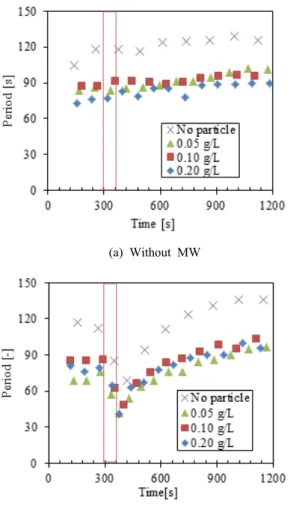
(a) Without microwave (b) With microwave (120 W) Fig. 4. Oscillatory behaviors of blue color of BZ solution at different particle concentrations.
Fig. 3. An example of RGB analysis from the captured movie
Fig. 2. An example of color changes of the BZ drop in a liquid-liquid system.
3. Results and discussion
Photographs of the color changes in the solution are shown in Fig. 2. Chemical wave, which is related to mo- lecular diffusion and reaction, progresses as gradations of red and blue [Kitahata H., Yoshinaga N., Nagai K.H., Sumino Y., 2012]. Three colors, (red (R), green (G), and blue (B)) were extracted from the digital movie data (Fig. 3). These data have similar profiles to the potential curve obtained from an electrode for the oscillation peri- od [Nogueira P.A., Varela H., Faria R.B., 2012]. In this analysis, since blue color gave the clearest colors, this color was used to obtain the period of each oscillating step from the maximum peaks. The red squares in Fig.
3 and following figures indicate the periods of con- tinuous irradiations.
Figure 4 shows the intensity of the blue color for the oscillatory reaction with and without microwave treat- ments at different particle concentrations. By shifting the values up and down, the intensities are compared with
the same graph. During irradiation, the profiles of color intensity were slightly more disordered and fluctuative.
Although a reaction was expected to cease similar like an air-liquid system, after the irradiation, the oscillatory reaction further continued for any concentration. In the case of air-liquid system, microwave was directly ab- sorbed at the interface and thus, molecules strongly
(a) Without MW (b) With microwave (60 W)
(c) With microwave (120 W)
Fig. 5. Oscillation period versus reaction time at different particle concentrations.
vibrate. On the other hand, since microwave was parti- ally absorbed in the oil phase, absorbance at the interface between liquid-liquid became weaker. Higher power is then required to end the reaction because microwave ef- fect toward water phase in liquid-liquid is limited. Figure 5 shows the relationship between the reaction time and the oscillation period for each concentration. The oscil- lation period, which is related to the diffusion and re- action rate, became shorter during the microwave irradi- ation due to the temperature rise caused by the irradiation. The oscillation period after the irradiation eventually returned to the initial value before the irradiation.
Figure 6 shows the intensities of blue color at various microwave powers. From this figure, it can be clearly observed that the intensities were more disordered. This behavior may be related to the temperature rise. Because microwave passed through the oil phase, temperature of the solution becomes higher. Higher temperature induced molecular diffusion and this may be the reason for more fluctuative intensity profiles [Asakuma Y., Miura M., 2014]. At higher power, characteristic behaviors for the suspensions were also observed after microwave was turned off. This indicated non-thermal effect of micro- wave on the oscillatory reaction.
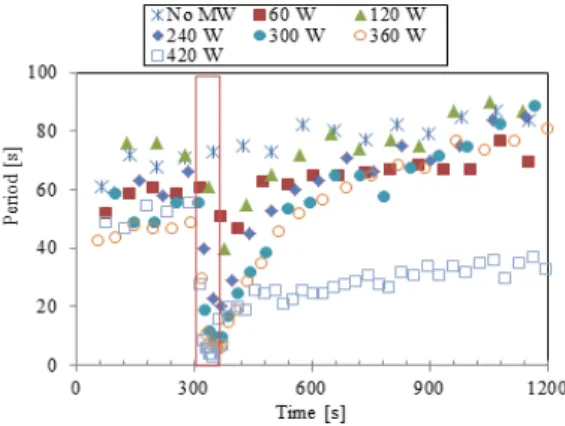
(a) No particles (b) 0.2 g/L Fig.7 Oscillation period versus reaction time for microwave power.
(a) No particles (b) 0.2 g/L
Fig.6 Oscillatory behaviors of blue color at various irradiation powers
Figure 7 describes the relationship between reaction time and the period of oscillation at different irradiation powers. The period became shorter during the micro- wave irradiation due to the temperature rise caused by the irradiation. Although the profiles of oscillation were seen to be slightly disordered during irradiation of lower power, the reaction continued or the intensity recovered after the irradiation under similar conditions at the initial stage of the reaction. This indicates that conditions of
the reaction before and after the irradiation were com- parable and the reagents were not substantially consumed during the irradiation. Consequently, the amount of the reagents was sufficient to maintain the reaction after mi- crowave was switched off. Figure 6 (a) shows that with- out addition of suspended particles, irradiation power of more than 480 W is required to eliminate the oscillation behavior of the solution. This means that concentration gradients of the chemical component, which is essential
Fig. 8. Oscillatory behavior of blue color under UV illumination.
Fig. 9. Oscillation period versus reaction time for UV illumination. (Table 3)
for non-linear behaviors such as oscillatory reactions [Nogueira P.A., Varela H., Faria R.B., 2012], remained at lower power (420 W) due to imperfect molecular diffusion. Nevertheless, despite the effectiveness of mi- crowave to promote reaction in liquid-liquid systems to some extent, non-thermal effect like molecular diffusion was insignificant. However, when the power is higher than 480 W, oscillation reaction seems to disappear. As a conclusion, to perfectly control the non-linear reaction for suspensions, higher power is required. This is differ- ent with air-liquid system [Maeda Y., Asakuma Y., Araki N., (Krabi, Thailand, 2014)], where irradiation power of 100 W is sufficient to stop the reaction.
On the other hand, chemical wave as shown in Fig.
2 was not observed for the droplet at shorter oscillation period. This may be caused by rapid reaction rate. As a result, amplitude of color change for oscillatory re- action became shorter for the cases of higher irradiation power and addition of particle as shown by Fig. 6 (b).
This amplitude is related to the mixing condition of the reagents of red and blue colors. From Fig. 7 (b), it is apparent that the period of oscillation of the solution with suspended particles after higher irradiation did not return to the initial conditions before the irradiation as shown. Although the color was almost unchanged by molecular diffusion, the period after higher power irradi- ation could still be estimated. Therefore, the period after the irradiation was fluctuative and became lower (around
30 s). Since TiO2 is active under microwave treatment and shows highly temperature dependency [Horikoshi S., Serpone N., 2014], the reactivity can be maintained for longer term. The effect of microwave irradiation was ob- served to be lasting even after the irradiation was turned off. Non-thermal effect obtained by a synergistic effect of photo-catalyst and microwave is also interesting.
Figures 8 and 9 show the effect of UV illumination starting from 300 s on the oscillatory behavior and the period of the reaction. A synergistic effect of microwave and photo catalytic reaction was expected. However, ad- ditional effect due to UV illumination was not clearly observed although UV stabilized the oscillatory reaction to some extent. To promote the reaction, it may be hy- pothesized that higher power of UV illumination is re- quired to produce active species such as OH radicals on the TiO2 particle [Horikoshi S., H.Hidaka, Serpone N., 2003]. Types of particle and solvent, which affect ab- sorbance of the heat generation and microwave pene- tration, respectively, should also be important factors for attaining more effective synergistic effect.
4. Conclusions
The BZ reaction in a liquid-liquid system was observed under microwave irradiation. The oscillation period be- fore, during, and after irradiation was examined. For
lower irradiation power, color intensity of the solution during the irradiation was slightly disordered by the ther- mal effects, and the reaction period after irradiation re- turned to its initial value. Although flat concentration distributions of the components were expected due to the microwave irradiation-induced molecular rotation, only higher power of microwave was able to end the oscil- latory reaction. Nevertheless, since microwave can travel through the oil phase, microwave treatment was useful for promoting the reaction of water rich droplet in oil phase. Addition of TiO2 particle was also observed to be effective for promoting microwave effect at higher power to eliminate the oscillatory behaviors of the reaction. Therefore, microwave irradiation may be an at- tractive tool to control non-equilibrium conditions when insufficient molecular diffusion is a limiting factor.
Nevertheless, further investigations are necessary to opti- mize a combined effect of non-thermal microwave, sus- pended nanoparticle and UV illumination since higher power is desirable for more significant effect.
References
Asakuma Y., Miura M., 2014. Effect of microwave radia- tion on diffusion behavior of anti-solvent during crystallization, Journal of Crystal growth 402, 32-36.
Blagojević S.M., Anić S.R., Čupić Ž.D., Pejić N.D., Anić L.Z.K., 2009. Temperature influence on the ma- lonic acid decomposition in the Belousov- Zhabotinsky reaction. Russian Journal of Physical Chemistry A 83, 1496-1501.
Horikoshi S., H.Hidaka, Serpone N., 2003. Hydroxyl radi- cals in microwave photocatalysis. Enhanced for- mation of OH radicals probed by ESR techniques in microwave-assisted photocatalysis in aqueous TiO2 dispersions, Chemical Physics Letters, 376, 475-480
Horikoshi S., Kajitani M., Hidaka H., Serpone N., 2008.
Investigation of factors that influence TiO2 pho- toassisted degradations under simultaneous illu-
mination by UV and microwave radiation fields, Journal of Photochemistry and Photobiology A:
Chemistry, 196, 159-164
Horikoshi S., Serpone N., 2014. On the influence of the microwaves’ thermal and non-thermal effects in titania photoassisted reactions, Catalysis Today, 224, 225-235
Hsu T.J., Mou C.Y., Lee D.J., 1994. Effects of Macromixing on the oregonator model of the belousov -zhabotinsky reaction in a stirred reactor. Chemical Engineering Science 49, 5291–
5305.
Kitahata H., Yoshinaga N., Nagai K.H., Sumino Y., 2012.
Spontaneous motion of a Belousov- Zhabotinsky reaction droplet coupled with a spiral wave.
Chem. Lett. 41, 1052-1054.
Krüger F., Ungvárai Z.N., Müller S.C., 1995. Influence of organic acids on oscillations and waves in the ferroin-catalyzed Belousov-Zhabotinsky reaction. Physica D: Nonlinear Phenomena 84, 95–102.
Maeda Y., Asakuma Y., Araki N., Diffusion behavior of oscillatory reaction under microwave radiation, 25th International Symposium on Transport Phenomena (Krabi, Thailand, 2014) No.25 Nogueira P.A., Varela H., Faria R.B., 2012. The role of
Ce(III) in BZ oscillating reactions. Chemical Physics Letters 530, 137-139.
Okano H., Kitahata H., Akai D., Tomita N., 2008. The Influence of a Gradient Static Magnetic Field on an Unstirred Belousov-Zhabotinsky Reaction.
Bioelectromagnetics 29, 598-604.
Rossi F., Budroni M.A., Marchettini N., Cutietta L., Rustici M., Liveri M.L.T., 2009. Chaotic dynamics in an unstirred ferroin catalyzed Belousov–
Zhabotinsky reaction. Chemical Physics Letters 480, 322–326.
Salazar F.C., Barragán D., Suárez M.F., 2004. In situ mon- itoring of the uncatalyzed oscillating reaction of phenol and bromate in an acidic medium by ultrasonically enhanced chronoampero- mmetry.
Electrochemistry Communications 6, 470-474.
Stanisavljev D.R., Djordjevic A.R., Likar-Smiljanic V.D., 2006. Microwaves and coherence in the Bray–
Liebhafsky oscillatory reaction. Chemical Physics Letters 42, 59–62.
Zhadin MN., 2001. Review of Russian literature on bio- logical action of DC and low-frequency AC mag- netic fields. Bioelectromagnetics 22, 27–45.