서 론
노인 천식은 최근 심각한 보건의학적 문제로 대두되고 있다. 미 국에서는 천식 유병률이 약 4%–10%이며, 주로 여성 인구에서 보 고되고 있다.1 우리나라에서는, 65세 이상 인구의 약 6.0%–7.65%가 천식 환자로 파악되고 있으며, 젊은층에 비하여(1%–3%) 높은 유병 률을 보인다.2
또한, 노인 천식 환자들은, 천식 조절률이 낮은 경향을 보이며,3-5 천식 이환률 및 사망률도 훨씬 높다.6,7 이는 노인 환자들이 젊은 환 자들보다 사회경제적 위치가 상대적으로 낮기 때문으로 생각한다.4
우리나라의 한 천식코호트 연구에 따르면, 노인 환자의 1/3 이상에 서 천식조절이 잘 되지 않고, 동반질환율이 매우 높다(≥80%).8
정상적인 노화 과정 중에 인지기능 및 육체활동의 저하가 흔하게 발생하며, 이로 인해 적절한 폐기능검사 및 설문지 결과를 얻기 어 려울 수 있다.9 노인 환자들은 앉아 지내는 경우가 많아, 호흡기계 자극에 민감도가 점차 떨어지는 경우가 많고, 활동 제한을 늦게 알 아차릴 수 있다. 또한, 여러가지 동반질환이 겹치는 경우가 많아, 이 로 인해 임상 증상의 발현이 혼동될 수도 있다. 따라서, 노인 천식 환자에서 인지기능 및 육체활동의 저하는 천식 조절에 영향을 미 칠 수 있을 것이다.10
Allergy Asthma Respir Dis 5(1):34-40, January 2017 https://doi.org/10.4168/aard.2017.5.1.34 ORIGINAL ARTICLE
Correspondence to: Hae-Sim Park http://orcid.org/0000-0003-2614-0303
Department of Allergy & Clinical Immunology, Ajou University School of Medicine, 206 World cup-ro, Yeongtong-gu, Suwon 16499, Korea
Tel: +82-31-219-5196, Fax: +82-31-219-4265, E-mail: [email protected]
*These authors contributed equally to this study and should be considered co-first authors.
• This study was supported by a grant from the Korean Health Technology R&D Project, Ministry of Health &
Welfare, Republic of Korea (HI14C1061).
Received: September 1, 2016 Revised: October 24, 2016 Accepted: October 25, 2016
© 2017 The Korean Academy of Pediatric Allergy and Respiratory Disease The Korean Academy of Asthma, Allergy and Clinical Immunology This is an Open Access article distributed under the terms of the Creative Commons Attribution Non-Commercial License
노인 천식에서 인지 기능 장애가 천식 조절에 미치는 영향
허규영,1,* 예영민,2,* 문소영,3 김주희,4 정기석,4 박해심2
1고려대학교 의과대학 내과학교실, 아주대학교 의과대학 2알레르기내과학교실·3신경과학교실, 4한림대학교 의과대학 호흡기-알레르기내과학교실
Impact of cognitive impairment on asthma control in older asthmatics
Gyu-Young Hur,1,* Young-Min Ye,2,* So Young Moon,3 Joo-Hee Kim,4 Ki-Suck Jung,4 Hae-Sim Park2
1Department of Internal Medicine, Korea University College of Medicine, Seoul; Departments of 2Allergy and Immunology and 3Neurology, Ajou University School of Medicine, Suwon; 4Department of Pulmonary & Allergy, Hallym University Sacred Heart Hospital, Hallym University School of Medicine, Anyang, Korea
Purpose: Assessment of the severity and clinical course of asthma is important for effective disease control. Cognitive and physical impairments occur due to the aging process, which may impact on asthma control. We aimed to evaluate the impact of cognitive function on the assessment of asthma control in older asthmatics as a prospective interventional trial.
Methods: A total of 50 mild to moderate asthmatics over 60 years of age were enrolled. Three questionnaires were used: the asthma control test (ACT), the asthma-specific quality of life, and the Korean version of the Short Form of the Geriatric Depression Scale. The Seoul neuropsychological screening battery-dementia version (SNSB-D), Korean version of the Mini-Mental Status Examination, and the Seoul instrumental activities of daily living scale were applied for neuropsychological assessment.
Results: The mean patient age was 67.0± 4.9 years, and 30 patients (60.0%) were female. The sensitivity and specificity of the ACT for determining well-controlled asthma were 91.7% and 39.5%, respectively. Regarding neuropsychological assessment, 22 patients (44%) had mild cognitive impairment, 4 (8.7%) had dementia, and 17 (34%) had depression. Total SNSB-D score was significantly higher in patients with an ACT score of ≥ 20 (P= 0.015). The ACT scores were significantly associated with SNSB-D results in analyses adjusted for age, sex, education duration, lung function, and depression (P= 0.004).
Conclusion: We found significant positive correlations between cognitive functions, as measured by SNSB-D, and asthma control status, as measured by ACT scores, in older patients with asthma. Therefore, cognitive impairment may be associated with poor asthma control in older asthmatics. (Allergy Asthma Respir Dis 2017:5:34-40)
Keywords: Asthma, Control, Older, Cognitive function
이번 연구는 노인 천식 환자에서, 신경정신학적 인지기능 측정도 구 및 천식조절검사(asthma control test, ACT)를 이용하여, 인지기 능과 천식 조절 여부의 연관성을 분석하고자 하였다.
대상 및 방법
1. 대상
노인 천식 환자를 대상으로 한 계획적 중재연구로서, 4주간 budesonide (400 μg/day) 치료 이후 천식 조절 여부를 측정하였다.
2개의 대학병원에서 60세 이상 천식 환자 50명을 모집하였다. 경 증에서 중증도 천식으로 진단받은 지 6개월 이상 경과한 환자를 대 상으로 하였다. 임상 증상(기침, 객담, 천명음, 호흡곤란, 가슴답답 함 등), 기도가역성 및 기도과민성으로 천식 여부를 진단하였다. 기 도가역성은 속효성 기관지확장제 사용 이후 forced expiratory vol- ume in 1 second (FEV1)≥12% (200 mL) 상승하는 경우 양성으로 판정하였고, 기도과민성은 메타콜린 유발검사 결과 PC20 (provoca- tive concentration of methacholine causing a 20% fall in FEV1)
<16 mg/mL인 경우로 정의하였다. 다른 급성기 질환이 있거나, 10 갑년 이상 흡연력, 천식 조절에 영향을 미치는 전신 스테로이드 및 면역억제제를 사용하는 질환이 있는 경우는 제외하였다. 이번 연 구는 2개의 대학병원의 연구윤리심의위원회(Institutional Review Boards)의 심의를 통과하였고, 각 대상자들로부터 서면동의서를 취득하였다.
모든 환자는 경증에서 중증도 천식 환자로서, 연구에 등록되기 이전에 Global Initiative for Asthma (GINA) 가이드라인에 따라, 저용량 inhaled corticosteroid (ICS) 단독, 저용량 ICS/leukotriene receptor antagonist (LTRA), 저용량 ICS/long-acting beta agonists 치료 등 을 사 용하였으며, 연구에 등 록되면서 동일 약제 (budesonide 400 μg/day)로 4주간 치료를 시행하였다.
2. 인지기능 및 우울감 평가
4주간 흡입 budesonide (400 μg/day) 치료 이후, 설문지를 이용하 여 대상 환자들의 신경정신학적 기능을 평가하였다. 서울 신경심리 검사(Seoul neuropsychological screening battery, SNSB)11를 축약 한, 단축형 서울 신경심리검사(SNSB-dementiaversion, SNSB-D)를 사용하였고, 이는 전반적인 인지기능 평가에 적합한 것으로 입증된 바 있다.12 SNSB-D는 주의력, 언어 및 관련기능, 시각공간기능, 기억, 전두엽/대표기능의 5개 도메인으로 구성되어있다. 전반적 인지기능 (global cognitive function)점수는 각 도메인의 합으로 산출된다(총 300점; 주의력 17점, 언어 및 관련기능 27점, 시각공간기능 36점, 기 억 150점, 전두엽/대표기능 70점; 점수가 낮을수록 인지기능 저하).
치매 및 경도 인지 장애(mild cognitive impairment, MCI)를 선 별하기 위해, 한국판 간이정신상태검사(Korean version of Mini-
Mental State Examination; 30점 만점, 점수가 낮을수록 치매가능 성 높음)13 및 복합일상활동평가(Seoul-instrumental activities of daily living, S-IADL; 15문항, 45점 만점, 점수가 높을수록 치매가 능성 높음)14를 시행하였다.
우울증 여부는 한국판 단축형 노인우울척도(Korean version of the Short Form of the Geriatric Depression Scale, SGDS-K)로 판 정하였다.15 이는 15개의 질문으로 구성되어 있고, 총 6점 이상인 경 우 우울증을 시사한다.
3. 폐기능 및 천식 조절 여부의 측정
4주간 budesonide 치료를 마친 이후, 폐기능을 측정하기 위해 폐 활량검사 및 6분보행검사를 시행하였다. ACT16 및 천식 삶의 질 설 문지(asthma-specific quality of life questionnaire)17를 작성하였다.
ACT는 지난 4주간의 천식 조절 여부를 반영하며, 총점 20점 이상 이면 조절(well-controlled), 15–19점은 부분조절(partly controlled), 15점 미만은 조절 안됨(uncontrolled)으로 분류한다.18 이번 연구에 서는 ACT 점수에 따라, 20점 이상이면 조절(well-controlled), 20점 미만은 조절 부족(poorly controlled)으로 정의하였다.
GINA 가이드라인에 따라,19 주간 및 야간 증상의 횟수, 구제약물 의 사용 여부, 활동의 제한 여부, 폐기능 등을 고려하여 천식 조절 여부를 3가지 카테고리로 다시 분류하였다(조절, 부분 조절 및 조 절 안됨).
GINA 분류에 따라, 조절(well-controlled) 상태는 (1) 주간 증상 이 1주에 2회 이하, (2) 야간 증상이 없을 것, (3) 활동제약이 없을 것, (4) 구제약물 사용이 1주에 2회 이하, (5) 정상 폐기능(FEV1≤정 상 참고치의 80%)으로 정의하였다. 조절 부족(poorly controlled) 군은 GINA 분류에 따라 부분 조절 혹은 조절 안됨군에 속한 환자 들로 분류하였다.
4. 통계 분석
통계 분석은 SPSS ver. 16.0 (SPSS Inc., Chicago, IL, USA)을 사용 하였다. 모든 결과치는 평균±표준편차, 혹은 빈도(%)로 표현하였 다. 두 군 간의 차이를 비교하기 위하여, Student t-test 및 chi-square test를 사용하였다. 비모수 검정을 위해 Fisher exact test를 이용하 였다. ACT와 연관성을 검정하기 위하여, univariate linear regres- sion을 사용하였다. 모든 값은 나이, 성별, forced expiratory flow 25%–75% (FEF25%–75%), 6분보행검사 결과, SGDS-K 점수로 보정하 였다.
결 과 1. 연구 대상자의 특성
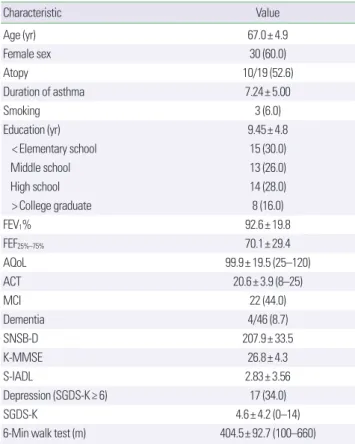
연구 대상자의 평균 연령은 67.0±4.9세였으며, 30명(60.0%)이
여성이었다. 평균 천식 유병 기간은 7.24±5.0년이었다. 단 1명 대상 자만이 문맹이었고, 평균 교육 연수는 9.45±4.8년이었다.
50명 중에서, 4명(8.7%)이 치매, 22명(44.0%)이 MCI로 진단되었 다. 17명(34.0%)이 SGDS-K 6점 이상으로, 우울증을 시사하였다 (Table 1).
2. 천식 조절 여부: ACT 및 GINA 분류
Fig. 1은 천식 조절 여부에 따른 ACT 점수와 GINA 분류의 분포 를 보여주고 있다. 환자들 중에서, 35명(70%)은 ACT≥20이었고, 15명(30.0%)은 ACT<20이었다. GINA 분류에 따랐을 경우, 12명 (24.0%)이 조절 상태였고, 31명(62.0%)이 부분 조절, 7명(14.0%)이 조절 안됨 상태였다. ACT≥20인 환자들 중에, 11명(32.4%)은 GINA 분류에 따른 조절 상태였으나, ACT<20인 환자들 중에서 15명(93.7%)은 조절 부족으로 분류되었다. ACT≥20으로 스스로 보고한 환자들 중에, 23명(67.6%)은 부분 조절 상태였다. 이는 노인 천식 환자 중 67.6%가 자신의 조절 여부를 과대평가하고 있음을 보
여준다. 조절 부족 상태를 파악하기 위한 ACT<20의 진단적 민감 도 및 특이도는 각각 39.5%와 91.7%였다. 반면 조절 상태(well-con- trolled)를 진단하기 위한 ACT≥20의 민감도 및 특이도는 각각 91.7% 및 39.5%였다.
3. 천식 조절 여부와 인지기능을 포함한 여러 임상 양상과의 연관 관계
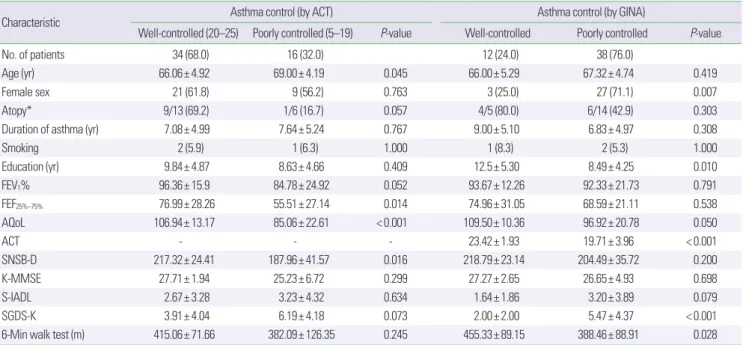
Table 2는 천식 조절 여부와 임상 소견과의 연관 관계를 보여준 다. ACT에 의한 조절 상태 천식은 나이, FEF25%–75%, AQoL 및 SNSB-D 값과 의미 있는 연관성이 있었다(P<0.05). 또한, GINA 분 류에 따른 조절 상태 천식은 여성, 교육 수준, AQoL, 우울증 여부, 6분보행검사 결과와 의미 있게 연관되어 있었다(all P<0.05).
인지기능 평가와 관련하여, 5개의 SNSB-D 도메인 중 3개에서 ACT로 정의된 천식 조절 여부와 의미 있는 연관성을 보였다 (P<0.05). ACT로 판정된 조절 상태 환자군에서 주의, 시각공간기 능, 기억 도메인에서 인지기능의 현저한 개선을 보였다(P = 0.024, P= 0.042, and P= 0.011, respectively). GINA 분류로 판정된 조절 상태 군은 SNSB-D 결과와 상관 관계가 없었다(Table 3).
4. ACT 점수와 관련된 인지기능 측정 인자
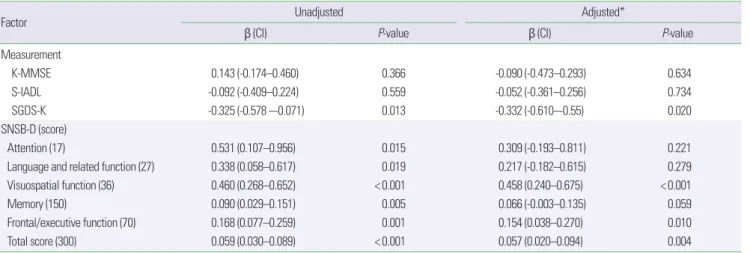
ACT 점수는 SNSB-D의 모든 도메인과 유의한 상관 관계를 보였 다(Table 4). SGDS-K 점수로 측정한 우울증 여부 또한 ACT 점수 와 상관 관계가 있었다(P= 0.013).
나이, 성별, 교육 기간, 폐기능, 우울증 여부로 보정한 이후에도 시각공간기능, 전두엽/대표기능 및 전반적 인지기능은 ACT 점수 와 강한 상관 관계를 보였다(Table 4). 따라서, ACT 점수로 측정한 천식 조절 여부는 SNSB-D로 평가한 인지기능 정도와 강한 상관 관 계가 있다(P= 0.004).
Fig. 1. Comparison of asthma control status as assessed by the asthma control test (ACT) score and Global Initiative for Asthma classification.
20
10
0
ACT < 20 Uncontrolled
7 (43.8%) 8 (50.0%)
1 (6.2%) 0
23 (67.6%)
11 (32.4%)
Uncontrolled Partly
controlled
Partly controlled Well-
controlled
Well- controlled ACT ≥ 20
Table 1. Clinical characteristics of the study subjects (n= 50)
Characteristic Value
Age (yr) 67.0± 4.9
Female sex 30 (60.0)
Atopy 10/19 (52.6)
Duration of asthma 7.24± 5.00
Smoking 3 (6.0)
Education (yr) 9.45± 4.8
< Elementary school 15 (30.0)
Middle school 13 (26.0)
High school 14 (28.0)
> College graduate 8 (16.0)
FEV1% 92.6± 19.8
FEF25%–75% 70.1± 29.4
AQoL 99.9± 19.5 (25–120)
ACT 20.6± 3.9 (8–25)
MCI 22 (44.0)
Dementia 4/46 (8.7)
SNSB-D 207.9± 33.5
K-MMSE 26.8± 4.3
S-IADL 2.83± 3.56
Depression (SGDS-K≥ 6) 17 (34.0)
SGDS-K 4.6± 4.2 (0–14)
6-Min walk test (m) 404.5± 92.7 (100–660)
Values are presented as mean± standard deviation or number (%).
FEV1, forced expiratory volume in 1 second; FEF25%–75%, forced expiratory flow at 25%–75% of lung volume; AQoL, asthma quality of life; ACT, asthma control test;
MCI, mild cognitive impairment; SNSB-D, dementia version of the Seoul neuropsy- chological screening battery; K-MMSE, Korean version of the Mini Mental Status Examination; S-IADL, Seoul-Instrumental Activities of Daily Living Scale; SGDS-K, Korean version of the Short Form of the Geriatric Depression Scale.
고 찰
ACT는 천식 조절 여부 평가를 위한, 간단한 환자기반의 도구이 다. 지난 4주간 천식 조절 여부를 반영하는 5개의 질문으로 구성되 어 있으며,16 환자 스스로 간단한 질문에 답하는 형식이다. 반면, GINA기준 천식 조절 여부는 의사에 의해 평가가 이루어진다. 그러 므로, ACT는 폐기능검사 없이 천식 조절 여부를 평가할 수 있는 유 용한 방법이다. 실제 임상 상황에서, ACT<20는 조절 부족 천식의 지표로 활용될 수 있다.18 Korn 등20의 연구에 따르면, GINA 기준 조절 안됨 천식을 식별하기 위해서, ACT≤16으로 cutoff 수정을 제 안하였으며, 이와 같이 ACT 기준 및 GINA 기준 조절 안됨 천식의
차이를 제시한 바 있다. 이번 연구에서, 노인 천식 환자의 천식 조절 여부는 ACT와 GINA기준 간에 현저한 차이를 보여주었다. ACT
<20은 GINA 기준 조절 안됨 천식을 파악하는 데 높은 민감도 (91.7%)를 보여주며, 반면 ACT≥20은 민감도가 낮았다(32.4%). 이 는 대부분 노인 천식 환자들이 자신들의 조절 여부를 과대평가하 고 있다는 점을 보여준다. 특히 노인 환자에서 환자주도 평가법인 ACT와 의사주도 평가법인 GINA 간의 불일치 소견을 해소할 수 있는, 적절한 천식 평가방법의 개발이 필요하겠다.
이러한 측면에서, 이번 연구자들은 노인 환자들의 육체작용을 평가하기 위한 측정도구인 physical functioning scale (PFS)를 제시 한 바 있으며, 이는 노인 천식 환자에서 천식 조절 여부 예측도구로 Table 2. Clinical findings according to asthma control status (measured by the ACT score and GINA classification)
Characteristic Asthma control (by ACT) Asthma control (by GINA)
Well-controlled (20–25) Poorly controlled (5–19) P-value Well-controlled Poorly controlled P-value
No. of patients 34 (68.0) 16 (32.0) 12 (24.0) 38 (76.0)
Age (yr) 66.06± 4.92 69.00± 4.19 0.045 66.00± 5.29 67.32± 4.74 0.419
Female sex 21 (61.8) 9 (56.2) 0.763 3 (25.0) 27 (71.1) 0.007
Atopy* 9/13 (69.2) 1/6 (16.7) 0.057 4/5 (80.0) 6/14 (42.9) 0.303
Duration of asthma (yr) 7.08± 4.99 7.64± 5.24 0.767 9.00± 5.10 6.83± 4.97 0.308
Smoking 2 (5.9) 1 (6.3) 1.000 1 (8.3) 2 (5.3) 1.000
Education (yr) 9.84± 4.87 8.63± 4.66 0.409 12.5± 5.30 8.49± 4.25 0.010
FEV1% 96.36± 15.9 84.78± 24.92 0.052 93.67± 12.26 92.33± 21.73 0.791
FEF25%–75% 76.99± 28.26 55.51± 27.14 0.014 74.96± 31.05 68.59± 21.11 0.538
AQoL 106.94± 13.17 85.06± 22.61 < 0.001 109.50± 10.36 96.92± 20.78 0.050
ACT - - - 23.42± 1.93 19.71± 3.96 < 0.001
SNSB-D 217.32± 24.41 187.96± 41.57 0.016 218.79± 23.14 204.49± 35.72 0.200
K-MMSE 27.71± 1.94 25.23± 6.72 0.299 27.27± 2.65 26.65± 4.93 0.698
S-IADL 2.67± 3.28 3.23± 4.32 0.634 1.64± 1.86 3.20± 3.89 0.079
SGDS-K 3.91± 4.04 6.19± 4.18 0.073 2.00± 2.00 5.47± 4.37 < 0.001
6-Min walk test (m) 415.06± 71.66 382.09± 126.35 0.245 455.33± 89.15 388.46± 88.91 0.028
Values are presented as number (%) or mean± standard deviation.
ACT, asthma control test; GINA, Global Initiative for Asthma; FEV1, forced expiratory volume in 1 second; FEF25%–75%, forced expiratory flow at 25%–75% of lung volume; AQoL, asthma quality of life; ACT, asthma control test; SNSB-D, dementia version of the Seoul neuropsychological screening battery; K-MMSE, Korean version of the Mini Mental Status Examination; S-IADL, Seoul-Instrumental Activities of Daily Living Scale; SGDS-K, Korean version of the Short Form of the Geriatric Depression Scale.
*Analyzed using Fisher exact test.
Table 3. Results of cognitive function test (SNSB-D) according to asthma control status measured by ACT and GINA
Domain (score) Asthma control (by ACT) Asthma control (by GINA)
Well-controlled (20–25) Poorly controlled (5–19) P-value Well-controlled Poorly controlled P-value
Attention (17) 10.82± 2.29 9.13± 2.63 0.024 11.25± 2.45 9.97± 2.48 0.125
Language and related function (27) 23.21± 3.24 21.13± 4.65 0.072 23.83± 2.12 22.13± 4.16 0.182
Visuospatial function (36) 34.65± 2.35 30.56± 7.23 0.042 34.54± 3.56 32.96± 5.16 0.329
Memory (150) 91.65± 14.47 78.59± 19.41 0.011 90.92± 10.41 86.38± 18.77 0.296
Frontal/executive function (70) 56.97± 8.39 49.19± 13.88 0.051 58.75± 9.55 53.13± 11.13 0.122
Total score (300) 217.32± 24.41 187.96± 41.57 0.016 218.79± 23.14 204.49± 35.72 0.200
Values are presented as mean± standard deviation.
SNSB-D, dementia version of the Seoul neuropsychological screening battery; ACT, asthma control test; GINA, Global Initiative for Asthma.
Table 4. Factors associated with the ACT score
Factor Unadjusted Adjusted*
β (CI) P-value β (CI) P-value
Measurement
K-MMSE 0.143 (-0.174–0.460) 0.366 -0.090 (-0.473–0.293) 0.634
S-IADL -0.092 (-0.409–0.224) 0.559 -0.052 (-0.361–0.256) 0.734
SGDS-K -0.325 (-0.578 –-0.071) 0.013 -0.332 (-0.610–-0.55) 0.020
SNSB-D (score)
Attention (17) 0.531 (0.107–0.956) 0.015 0.309 (-0.193–0.811) 0.221
Language and related function (27) 0.338 (0.058–0.617) 0.019 0.217 (-0.182–0.615) 0.279
Visuospatial function (36) 0.460 (0.268–0.652) < 0.001 0.458 (0.240–0.675) < 0.001
Memory (150) 0.090 (0.029–0.151) 0.005 0.066 (-0.003–0.135) 0.059
Frontal/executive function (70) 0.168 (0.077–0.259) 0.001 0.154 (0.038–0.270) 0.010
Total score (300) 0.059 (0.030–0.089) < 0.001 0.057 (0.020–0.094) 0.004
ACT, asthma control test; CI, confidence interval; K-MMSE, Korean version of the Mini Mental Status Examination; S-IADL, Seoul-Instrumental Activities of Daily Living Scale;
SGDS-K, Korean version of the Short Form of the Geriatric Depression Scale; SNSB-D, dementia version of the Seoul neuropsychological screening battery.
*Adjusted for age, gender, education, FEF25-75%, and SGDS-K.
서 의미 있는 결과를 보여주었다.21,22 노인 천식 환자에서 12주 동안 저용량 ICS 혹은 저용량 ICS/LTRA 치료 이후 GINA 기준 천식 조 절 여부를 비교하였고, PFS 및 ACT 변화와 의미 있는 상관 관계를 보여주었다.21 PFS는 이동성(mobility) 및 자립(self-care), 2개의 도 메인으로 구성되어 있으며, 각각 5개의 항목이 있다.23 이러한 연구 결과는, FEV1 (%)이나 객담세포분율, AQoL, ACT 등과 같은 천식- 특화 검사도구뿐만 아니라, 육체활동의 평가 또한 노인 환자의 치 료 예후에 중요한 영향을 미치는 것을 보여준다. 이번 연구에서도 PFS를 측정하였으나, SBSB-D 점수와는 의미 있는 연관 관계를 보 여주지 않았다. 이는 인지기능의 저하가 육체활동의 저하와 일치하 지는 않았던 것으로 추정한다.
노인 천식 환자가 인지기능이 저하되어 있을 경우, 기관지 수축 감지가 늦어질 수 있어, 천식 악화의 위험이 증가할 수 있다.24 따라 서, 스스로 보고하는 ACT로 천식 조절 여부를 평가했을 때, 정확 성이 떨어질 수 있다. 노인 환자에서 천식과 인지기능에 관련한 몇 몇 연구 결과가 있었다. Caldera-Alvarado 등25의 연구에 따르면, 55 세 이상 천식 환자에서 천식이 없는 사람보다 인지기능 장애의 위 험이 더 높았다. Bozek 등26은 359명의 노인 천식 환자에서, 1년간 적 절한 천식 치료 이후, MMSE 점수가 호전되는 것을 보고하여, 적절 한 천식 치료가 인지기능을 향상시킬 수 있다고 보고하였다. 그러 나, Ray 등27은 60세 이상 천식 환자 452명을 대상으로 한 대규모 코 호트연구에서, Asthma Control Questionnaire (ACQ)와 인지기능 상태를 비교하였고, ACQ 점수와 인지기능저하와 연관성을 찾지 못하였다.
이번 연구에서는 노인 천식 환자에서 치매와 MCI의 유병률이 각 각 8.7%와 44.0%로 나타났다. 이전 우리나라의 65세 이상 코호트 연구에서 각각 8.1%와 24.1%로 보고한 바 있다.4 따라서, 이번 연구
에서 MCI 유병률이 노인 천식 환자에서 일반 노인 인구보다 훨씬 높은 것을 알 수 있다. 2013년 Rusanen 등28은 2,000명의 중년 일반 인구를 25년 이상 추적 관찰한 결과, 중년에 만성폐쇄성폐질환 (chronic obstructive pulmonary disease, COPD)이나 천식이 있는 경우, 추후 인지기능 저하 발생 위험이 2배 이상 상승하였다(COPD hazard ratio [HR], 1.85; 천식 HR, 1.88). 이는 노인 환자의 천식이 인지기능 저하의 발생 위험을 증가시키는 것을 보여준다.
대부분의 이전 연구들이 코호트 관찰 연구임에 반하여, 이번 연 구는 4주간 ICS 치료 이후 천식 조절 여부와 인지기능평가를 실시 한, 전향적 중재연구이다. 연구 기간 동안 일정량의 같은 ICS (budesonide 400 μg/day)를 투여하여, 치료제에 의한 bias를 제거 하려 한 점이 이번 연구의 강점이라 할 수 있다.
덧붙여, 대부분 연구에서는 ACQ로 천식 조절 여부를 평가하였 는데, 이는 7개 항목으로 구성된, 설문지형태이다.29 환자들은 6개 질문(낮/밤 증상, 활동 제한, 호흡곤란, 천명음, 구제약물 사용)에 대한 답을 포함하여, FEV1% 점수가 7번째 항목으로 포함되어 있 다. ACT는 전적으로 자가설문지나, ACQ는 FEV1% 점수를 채우기 위해 임상직원의 참여가 필요하다. ACT는 지난 4주간의 천식 조절 여부를 반영하나, ACQ는 지난 1주간을 반영한다. 최근 ACT와 ACQ 간 천식 조절 여부의 차이를 비교한 메타분석 결과,30 ACT가 ACQ보다 실제 임상에서는 더욱 적합하다는 보고가 있었다. 그러 나, 이번 연구에서는 노인 천식 환자에서, ACT 결과가 천식 조절 여 부를 과대평가할 수 있음을 보여주었다. ACT는 폐기능 항목이 포 함되어 있지 않으나, 이번 연구에서 FEF25%–75%가 ACT>20인 노인 천식 환자에서 의미 있게 높은 수치를 보여, ACT 결과가 FEF25%–75%
가 나타내는 기도 폐쇄와 연관이 있음을 보여준다. 더욱이, 이번 연 구는 SNSB-D 점수와 ACT 간의 직접적인 상관 관계를 증명하였
고, SNSB-D의 각 도메인이 ACT와 상관 관계가 있음을 보였다. 이 중에서도 시각공간기능 및 전두엽/대표기능, 전반적 인지기능이 나 이, 성별, 교육 정도, 폐기능, 우울증 여부로 보정한 이후에도 ACT 점수와 의미 있는 상관 관계를 보였다. 따라서, 총 SNSB-D 점수 및 이로 측정한 전반적 인지기능 장애가 낮은 ACT 점수와 직접적 연 관 관계를 증명하였다.
노인들은 호흡곤란은 정상적인 노화 과정의 일환으로 흔히 생각 한다.31 더욱이 천식이 있는 경우, 증상 및 질병의 악화를 과소평가 할 수 있다.10,32 따라서, ACT와 같은 설문지 형식의 평가방법이 노인 환자의 천식 조절 여부를 평가하는 데 부적합할 수 있다. 그러나, 실 제 진료현장에서, 노인 천식 환자의 인지기능 장애를 알아내기는 매우 어렵다. 최근 GINA 지침서에서는, 천식 조절 평가를 위해 현 재의 증상 조절 상태뿐만 아니라, 미래의 위험 요소를 포함하여 평 가하도록 강조하였으며33, 노인 천식 환자에서는 인지기능 장애 또 한 미래의 천식 악화 위험 인자가 될 수 있겠다. 따라서, 노인 천식 환자에서, 인지기능의 평가 및 적극적 중재가 천식 조절 향상에 필 요하겠다.
결론적으로, 이번 연구에서 SNSB-D로 측정한 인지기능과 ACT 로 측정한 천식 조절 여부는 노인 천식 환자에서 유의한 연관성을 보인다. 따라서, 인지기능저하는 노인 천식 환자의 천식 조절 실패 와 연관될 수 있다.
REFERENCES
1. Kohansal R, Martinez-Camblor P, Agustí A, Buist AS, Mannino DM, So- riano JB. The natural history of chronic airflow obstruction revisited: an analysis of the Framingham offspring cohort. Am J Respir Crit Care Med 2009;180:3-10.
2. Kim CY, Park HW, Ko SK, Chang SI, Moon HB, Kim YY, et al. The finan- cial burden of asthma: a nationwide comprehensive survey conducted in the republic of Korea. Allergy Asthma Immunol Res 2011;3:34-8.
3. Smith AM, Villareal M, Bernstein DI, Swikert DJ. Asthma in the elderly:
risk factors and impact on physical function. Ann Allergy Asthma Im- munol 2012;108:305-10.
4. Talreja N, Baptist AP. Effect of age on asthma control: results from the National Asthma Survey. Ann Allergy Asthma Immunol 2011;106:24-9.
5. Song WJ, Jee YK. More effective strategies are needed for elderly asthmat- ics in real-world practice. Allergy Asthma Immunol Res 2015;7:419-20.
6. Tsai CL, Lee WY, Hanania NA, Camargo CA Jr. Age-related differences in clinical outcomes for acute asthma in the United States, 2006-2008. J Allergy Clin Immunol 2012;129:1252-8.e1.
7. Song WJ, Cho SH. Challenges in the management of asthma in the elder- ly. Allergy Asthma Immunol Res 2015;7:431-9.
8. Hwang EK, Jin HJ, Nam YH, Shin YS, Ye YM, Nahm DH, et al. The pre- dictors of poorly controlled asthma in elderly. Allergy Asthma Immunol Res 2012;4:270-6.
9. Hanania NA, King MJ, Braman SS, Saltoun C, Wise RA, Enright P, et al.
Asthma in the elderly: current understanding and future research needs:
a report of a National Institute on Aging (NIA) workshop. J Allergy Clin Immunol 2011;128(3 Suppl):S4-24.
10. Gibson PG, McDonald VM, Marks GB. Asthma in older adults. Lancet 2010;376:803-13.
11. Kang Y, Na DL. Seoul neuropsychological screening battery (SNSB).
Seoul: Human Brain Research & Consulting Co., 2003.
12. Ahn HJ, Chin J, Park A, Lee BH, Suh MK, Seo SW, et al. Seoul Neuropsy- chological Screening Battery-dementia version (SNSB-D): a useful tool for assessing and monitoring cognitive impairments in dementia pa- tients. J Korean Med Sci 2010;25:1071-6.
13. Jeong SK, Cho KH, Kim JM. The usefulness of the Korean version of modified Mini-Mental State Examination (K-mMMSE) for dementia screening in community dwelling elderly people. BMC Public Health 2004;4:31.
14. Ahn IS, Kim JH, Kim S, Chung JW, Kim H, Kang HS, et al. Impairment of instrumental activities of daily living in patients with mild cognitive impairment. Psychiatry Investig 2009;6:180-4.
15. Bae JN, Cho MJ. Development of the Korean version of the Geriatric De- pression Scale and its short form among elderly psychiatric patients. J Psychosom Res 2004;57:297-305.
16. Nathan RA, Sorkness CA, Kosinski M, Schatz M, Li JT, Marcus P, et al.
Development of the asthma control test: a survey for assessing asthma control. J Allergy Clin Immunol 2004;113:59-65.
17. Lee EH, Kim SH, Choi JH, Jee YK, Nahm DH, Park HS. Development and evaluation of an Asthma-Specific Quality of Life (A-QOL) question- naire. J Asthma 2009;46:716-21.
18. Schatz M, Sorkness CA, Li JT, Marcus P, Murray JJ, Nathan RA, et al.
Asthma Control Test: reliability, validity, and responsiveness in patients not previously followed by asthma specialists. J Allergy Clin Immunol 2006;117:549-56.
19. The Global Initiative for Asthma. GINA report, global strategy for asthma management and prevention - 2011 [Internet]. The Global Initiative for Asthma; [cited 2015 Apr 10]. Available from: http://ginasthma.org/gina- reports/.
20. Korn S, Both J, Jung M, Hübner M, Taube C, Buhl R. Prospective evalua- tion of current asthma control using ACQ and ACT compared with GINA criteria. Ann Allergy Asthma Immunol 2011;107:474-9.
21. Ye YM, Kim SH, Hur GY, Kim JH, Park JW, Shim JJ, et al. Addition of montelukast to low-dose inhaled corticosteroid leads to fewer exacerba- tions in older patients than medium-dose inhaled corticosteroid mono- therapy. Allergy Asthma Immunol Res 2015;7:440-8.
22. Ban GY, Ye YM, Lee Y, Kim JE, Nam YH, Lee SK, et al. Predictors of asth- ma control by stepwise treatment in elderly asthmatic patients. J Korean Med Sci 2015;30:1042-7.
23. Lee YH, Lee KJ, Han GS, Yoon SJ, Lee YK, Kim CH, et al. The develop- ment of physical functioning scale for community-dwelling older per- sons. Korean J Prev Med 2002;35:359-74.
24. Ekici M, Apan A, Ekici A, Erdemoğlu AK. Perception of bronchocon- striction in elderly asthmatics. J Asthma 2001;38:691-6.
25. Caldera-Alvarado G, Khan DA, Defina LF, Pieper A, Brown ES. Relation- ship between asthma and cognition: the Cooper Center Longitudinal Study. Allergy 2013;68:545-8.
26. Bozek A, Krajewska J, Jarzab J. The improvement of cognitive functions in patients with bronchial asthma after therapy. J Asthma 2010;47:1148- 27. Ray M, Sano M, Wisnivesky JP, Wolf MS, Federman AD. Asthma control 52.
and cognitive function in a cohort of elderly adults. J Am Geriatr Soc 2015;63:684-91.
28. Rusanen M, Ngandu T, Laatikainen T, Tuomilehto J, Soininen H, Kivipel- to M. Chronic obstructive pulmonary disease and asthma and the risk of mild cognitive impairment and dementia: a population based CAIDE
study. Curr Alzheimer Res 2013;10:549-55.
29. Juniper EF, O'Byrne PM, Guyatt GH, Ferrie PJ, King DR. Development and validation of a questionnaire to measure asthma control. Eur Respir J 1999;14:902-7.
30. Jia CE, Zhang HP, Lv Y, Liang R, Jiang YQ, Powell H, et al. The Asthma Control Test and Asthma Control Questionnaire for assessing asthma control: systematic review and meta-analysis. J Allergy Clin Immunol 2013;131:695-703.
31. Morgan R, Pendleton N, Clague JE, Horan MA. Older people's percep-
tions about symptoms. Br J Gen Pract 1997;47:427-30.
32. Hewitt J, Smeeth L, Bulpitt CJ, Tulloch AJ, Fletcher AE. Respiratory symptoms in older people and their association with mortality. Thorax 2005;60:331-4.
33. The Global Initiative for Asthma. GINA report, global strategy for asthma management and prevention - 2015 [Internet]. The Global Initiative for Asthma; [cited 2015 May 19]. Available from: http://ginasthma.org/gina- reports/.