The Association of Fever with Total Mechanical Ventilation Time in Critically Ill Patients
This research aims to investigate the impact of fever on total mechanical ventilation time (TVT) in critically ill patients. Subgroup analysis was conducted using a previous prospective, multicenter observational study. We included mechanically ventilated patients for more than 24 hours from 10 Korean and 15 Japanese intensive care units (ICU), and recorded maximal body temperature under the support of mechanical ventilation (MAXMV). To assess the independent association of MAXMV with TVT, we used propensity-matched analysis in a total of 769 survived patients with medical or surgical admission, separately. Together with multiple linear regression analysis to evaluate the association between the severity of fever and TVT, the effect of MAXMV on ventilator-free days was also observed by quantile regression analysis in all subjects including non-survivors. After propensity score matching, a MAXMV ≥ 37.5°C was significantly associated with longer mean TVT by 5.4 days in medical admission, and by 1.2 days in surgical admission, compared to those with MAXMV
of 36.5°C to 37.4°C. In multivariate linear regression analysis, patients with three categories of fever (MAXMV of 37.5°C to 38.4°C, 38.5°C to 39.4°C, and ≥ 39.5°C) sustained a significantly longer duration of TVT than those with normal range of MAXMV in both categories of ICU admission. A significant association between MAXMV and
mechanical ventilator-free days was also observed in all enrolled subjects. Fever may be a detrimental factor to prolong TVT in mechanically ventilated patients. These findings suggest that fever in mechanically ventilated patients might be associated with worse mechanical ventilation outcome.
Keywords: Body Temperature; Intensive Care Units; Mechanical Ventilation; Fever Dong Won Park,1 Moritoki Egi,2
Masaji Nishimura,3 Youjin Chang,4 Gee Young Suh,5 Chae-Man Lim,6 Jae Yeol Kim,7 Keiichi Tada,8 Koichi Matsuo,9 Shinhiro Takeda,10 Ryosuke Tsuruta,11 Takeshi Yokoyama,12 Seon-Ok Kim,13 Younsuck Koh,6 and Fever and Antipyretic in Critically ill patients Evaluation (FACE) Study Group in Japan-Korea Intensive Care Study (JAKOICS) Group
1Department of Internal Medicine, Hanyang University College of Medicine, Seoul, Korea;
2Department of Anesthesiology, Kobe University Hospital, Kobe, Japan; 3Department of Emergency and Critical Care Medicine, Tokushima University Hospital, Tokushima, Japan; 4Division of Pulmonary and Critical Care Medicine, Department of Internal Medicine, Chungbuk National University College of Medicine, Cheongju, Korea; 5Department of Critical Care Medicine, Samsung Medical Center, Sungkyunkwan University School of Medicine, Seoul, Korea; 6Department of Pulmonary and Critical Care Medicine, University of Ulsan College of Medicine, Asan Medical Center, Seoul, Korea;
7Department of Pulmonary and Critical Care Medicine, Chung-Ang University College of Medicine, Seoul, Korea; 8Department of Anesthesiology and Intensive Care Medicine, Hiroshima City Hospital, Hiroshima, Japan; 9Division of Intensive Care Unit, New Tokyo Hospital, Tokyo, Japan; 10Division of Intensive and Coronary Care Unit, Nippon Medical School Hospital, Tokyo, Japan;
11Advanced Medical Emergency and Critical Care Center, Yamaguchi University Hospital, Yamaguchi, Japan; 12Intensive Care Unit, Department of Anesthesiology, Teine Keijinkai Hospital, Sapporo, Japan; 13Department of Clinical Epidemiology and Biostatistics, University of Ulsan College of Medicine, Asan Medical Center, Seoul, Korea Received: 1 June 2016
Accepted: 6 September 2016 Address for Correspondence:
Younsuck Koh, MD
Department of Pulmonary and Critical Care Medicine, University of Ulsan College of Medicine, Asan Medical Center, 88, Olympic-ro 43-gil, Songpa-gu, Seoul 05505, Korea E-mail: [email protected]
https://doi.org/10.3346/jkms.2016.31.12.2033 • J Korean Med Sci 2016; 31: 2033-2041
INTRODUCTION
Fever occurs in approximately half of all patients admitted to the intensive care unit (ICU) (1). The significance of fever varies in different clinical settings. Fever may arise as an adaptive response to infectious causes (2) or as a nonspecific finding along with a critical illness or inflammatory condition (3). An elevated body temperature within physiologically febrile range in infectious conditions has been shown to enhance host immune cell activity against pathogen (4,5) and confer a survival benefit in a number of animal models and in human data (6,7). However, fever may be a mediator of wors- ened clinical outcome in critically ill patients, and high or persistent fever has been as- sociated with increased mortality (8-10).
Among mechanically ventilated patients, fever could have a detrimental effect on gas exchange, and increases in cardiac output and oxygen consumption driven by fe- ver tend to worsen hypoxemia (11,12). Moreover, increased production of carbon di- oxide may deteriorate minute ventilation requirements, resulting in failure to wean from mechanical ventilation (MV). Fever had been reported to worsen lung tissue in- jury by enhancing recruitment of neutrophils and oxygen toxicity in mechanically ven- tilated patients (13,14), and exacerbate ventilator-induced lung injury (15). Taken to- gether, cumulative data suggest that fever may have negative impacts on MV outcome, resulting in unfavorable consequences in critically ill patients. However, ventilator-as-
sociated infection complication (16,17) accompanied by fever could be associated with increased ICU length of stay and mor- tality (18,19). These findings urge us to investigate whether there is an independent association of fever and length of MV in me- chanically ventilated patients.
Recently, in a cohort study of mainly septic patients with acute lung injury, fever was found to be associated with a prolonged duration of MV (20). However, another study on patients with acute respiratory distress syndrome reported contradictory re- sults that fever in early phase may be an important factor in de- termining favorable outcome (21). Thus, the aim of our present study was to evaluate the association of body temperature with MV duration in a heterogenous cohort of mechanically venti- lated patients.
MATERIALS AND METHODS Study design and patients
The study population comprised consecutively enrolled patients in a previous prospective, multicenter observational study in Korea and Japan designed to evaluate the association of fever and the use of antipyretic therapy with mortality in critically ill patients with and without infection (22). That study included patients admitted to ICU for more than 48 hours from 1 Septem- ber 2009 to 30 November 2009, and excluded cases with post- cardiac arrest or acute brain injury.
This study was focused on the impact of body temperature on duration of MV in patients admitted to the ICU. The enrolled sub- jects were 882 critically ill patients who required MV for more than 24 hours from 10 Korean and 15 Japanese ICUs. To determine the degree of body temperature changes during MV, we defined maximum body temperature (MAXMV) as the highest body tem- perature measured at any time under the support of MV. We firstly enrolled survived patients within 28 days after ICU ad- mission and calculated total mechanical ventilation time (TVT) as the time from MV initiation up to 28 days after enrollment.
As the effect of fever on TVT could be skewed by early deaths within 28 days, we enrolled survived patients within 28 days af- ter ICU admission. We excluded those with MAXMV < 36.5°C, and those for whom data about MV were incomplete (Fig. 1). Me- chanical ventilator-free day (VFD) was also compared depend- ing on the presence of fever in all enrolled subjects including non-survivors.
Data collection
We recorded variables including age, gender, reason for ICU admission, duration of TVT, and the Acute Physiology and Chro- nic Health Evaluation II (APACHE II) scores. The category of ICU admission was classified as medical or surgical admission.
The major reason of admission was categorized as cardiac or vascular disease, thoracic or respiratory disease, renal or meta-
bolic disease, gastrointestinal tract disease, and other. We re- corded four-hourly body temperature readings until either ICU discharge or 28 days after ICU admission. The measurement of body temperature was performed as previously described (22).
Statistical analysis
Descriptive statistics included means ± standard deviations for continuous variables and frequencies and percentages for cate- gorical variables. Results were compared with t-test or Mann- Whitney U-test and the χ2 test or Fisher’s exact test as appropriate.
To evaluate whether high body temperature resulted in pro- longed TVT, we compared TVT between patients with a MAXMV
of 36.5°C to 37.4°C and those with a MAXMV ≥ 37.5°C in each of medical and surgical admission. Propensity scores for each sub- ject were generated using logistic regression analysis model to compute the probability of MAXMV ≥ 37.5°C, compared to MAXMV
of 36.5°C to 37.4°C, based on the following 10 clinically relevant covariates: gender, age, APACHE II score, height, weight, history of traumas, transplantation, readmission, sepsis within 24 hours of ICU admission, and reason for admission. Propensity score matching was performed by Greedy matching with using a cali- per of 0.2 standard deviations of the logit of the propensity score.
The selected patients formed well-matched 1:2 pairs in medical admission and 1:1 pair in surgical admission (patients with a MAXMV of 36.5°C to 37.4°C and those with a MAXMV ≥ 37.5°C).
In the propensity score matched cohort, TVT between patients with a MAXMV ≥ 37.5°C and those with a MAXMV of 36.5°C to 37.4°C was compared with Wilcoxon signed rank test or linear mixed model that accounted for the clustering of matching 1:2 pairs.
We hypothesized that high body temperature could be relat- ed to prolonged TVT. As the relationship between body tem- perature and TVT may not be linear, we treated body tempera- ture as a categorical variable, and MAXMV was analyzed in four Fig. 1. Study design in survived subjects.
MV = mechanical ventilation, MAXMV = maximum body temperature during MV.
882 critically ill patients
without any neurologic injury and derangement and required MV more than 24 hr
769 enrolled in the present study ∙ Medical admission (n = 341) ∙ Surgical admission (n = 428)
399 in propensity-matched analysis ∙ Medical admission (n = 165) ∙ Surgical admission (n = 234) 133 patients were excluded
- Data were not adequately collected (n = 8) - MAXMV < 36.5°C (n = 9)
- Non-survival (n = 96)
range categories of 36.5°C to 37.4°C, 37.5°C to 38.4°C, 38.5°C to 39.4°C, and ≥ 39.5°C. Univariate and multivariate linear regres- sion analyses were performed to examine how the severity of MAXMV affects TVT in each of medical and surgical admission.
We selected significant variables using a stepwise backward elim- ination procedure in multivariate models. The TVT was subject- ed to logarithmic transformation to achieve a normal distribu- tion before being entered into the linear regression model.
To verify the impact of fever on TVT, we additionally analyzed the association of MAXMV and VFD through multivariate analy- sis in all enrolled subjects including non-survivors. However, the distribution of VFD made it difficult to apply standard lin- ear regression model, showing the high frequency of extreme outcome ( Supplementary Fig. 1). Quantile regression approach was fitted to better explain the effect of MAXMV on VFD. We per- formed quantile regression analysis at 0.25 quantile and medi- an for medical admission and at 0.1 and 0.25 quantile for surgi- cal admission. The goodness-of-fit of the model was assessed as the pseudo R2. Variables were selected by backward elimina- tion and standard errors for regression coefficients were obtain- ed with the bootstrap method. All tests were two-sided, and a P value < 0.05 was considered significant. Data were analyzed using SPSS version 20.0 for Windows (SPSS Inc., Chicago, IL, USA) and SAS version 9.3 (SAS Institute, Cary, NC, USA).
Ethics statement
Data collection and data analysis for this study were approved by each of the local institutional ethics committees, and the in-
stitutional review board of Asan Medical Center approved this study (IRB No. 2009-0416). The requirement for informed con- sent was waived at each individual participating center.
RESULTS
Baseline characteristics of survived subjects with MV A total of 769 patients were firstly included in our present analy- sis (Fig. 1). The demographic and clinical characteristics of the unmatched survived patients in each of medical and surgical admission are listed in Table 1. A MAXMV ≥ 37.5°C was record- ed in 283 (83.0%) patients among the 341 with medical admis- sion, and in 301 (70.3%) among the 428 with surgical admission.
Among patients with both categories of ICU admission, men were less frequently observed and the mean APACHE II score was higher in those with a MAXMV ≥ 37.5°C than in those with a MAXMV of 36.5°C to 37.4°C. There were no significant differenc- es in other clinical variables between the patients with a MAXMV
≥ 37.5°C and a MAXMV of 36.5°C to 37.4°C in medical admission.
In surgical admission cases, patients with a MAXMV ≥ 37.5°C were older, tended to be from Japan, and were more likely to be associated with sepsis in the first day of ICU admission, com- pared to those with MAXMV of 36.5°C to 37.4°C.
Baseline characteristics after propensity matching
After propensity matching, 94.8% of patients with a MAXMV of 36.5°C to 37.4°C (n = 55) in medical admission were successful- ly matched 1:2 of patients with a MAXMV ≥ 37.5°C. In patients Table 1. Baseline characteristics in the unmatched, survived subjects
Variables
Medical admission (n = 341)
P value
Surgical admission (n = 428)
P value 36.5°C-37.4°C (n = 58) ≥ 37.5°C (n = 283) 36.5°C-37.4°C (n = 127) ≥ 37.5°C (n = 301)
No. % No. % No. % No. %
Country Japan Korea
13 45
22.4 77.6
105 178
37.1 62.9
0.032
31 96
24.4 75.6
207 94
68.8 31.2
< 0.001
Gender (male) 26 44.8 103 36.4 0.228 56 44.1 102 33.9 0.022
Age, yr 65.7 ± 15.1 63.3 ± 16.2 0.338 59.3 ± 14.9 63.9 ± 13.3 0.002
APACHE II 19.2 ± 6.7 21.0 ± 6.7 0.063 11.8 ± 5.7 14.0 ± 5.5 < 0.001
Height 162.4 ± 9.0 161.6 ± 9.3 0.586 161.4 ± 9.4 161.1 ± 9.2 0.768
Weight 56.4 ± 10.6 58.4 ± 13.4 0.243 60.1 ± 11.7 60.0 ± 12.5 0.964
Trauma 0 0.0 12 4.2 0.298 1 0.8 12 4.0 0.292
Transplantation 1 1.7 5 1.8 1.000 9 7.1 7 2.3 0.033
Readmission 3 5.2 13 4.6 0.741 6 4.7 5 1.7 0.459
Sepsis within 24 hr 38 65.5 217 76.7 0.075 3 2.4 42 14.0 0.001
Reason for admission Cardiac or vascular disease Thoracic or respiratory disease Renal or metabolic disease Gastrointestinal tract disease Other
9 41 5 1 2
15.5 70.7 8.6 1.7 3.5
45 175 18 18 27
15.9 61.8 6.4 6.4 9.5
0.314
100 16 3 8 0
78.7 12.6 2.4 6.3 0.0
180 55 10 55 1
59.8 18.3 3.3 18.3 0.3
0.005
Antipyretic therapy, any 4 6.9 189 66.8 < 0.001 21 16.5 208 69.1 < 0.001
RRT 12 20.7 57 20.1 0.524 6 4.7 52 17.3 < 0.001
ECMO 9 15.5 54 19.1 0.334 4 3.1 32 10.6 0.006
APACHE II = acute physiology and chronic health evaluation II, RRT = renal replacement therapy, ECMO = extracorporeal membrane oxygenation.
with surgical admission, suitable propensity 1:1 matching was found for 117 (92.1%) of the 127 patients with a MAXMV of 36.5°C to 37.4°C. Propensity matching successfully eliminated discor- dance that existed between the two temperature groups in this study (Table 2). As the only remaining unbalanced covariate was nationality, we performed additional propensity matching in survived subjects using all covariates including nationality (Supplementary Table 1).
Association of MAXMV with TVT
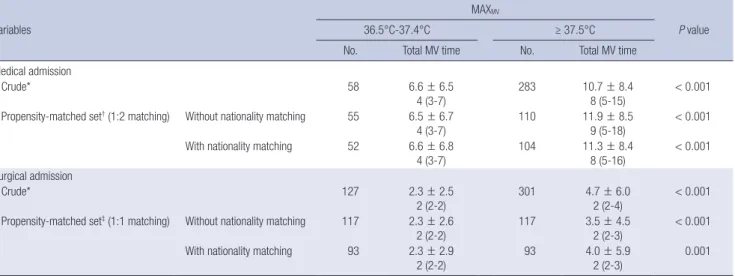
In Table 3, the TVT was separately assessed in medical and sur-
gical admission according to the MAXMV value. In crude analy- sis, patients with a MAXMV ≥ 37.5°C had a significantly longer TVT irrespective of the category of ICU admission, compared to those with a MAXMV of 36.5°C to 37.4°C. After propensity mat- ching, we found that the mean TVT of patients with a MAXMV
≥ 37.5°C was also significantly associated with a prolonged TVT by 5.4 days in medical admission and by 1.2 days in surgical ad- mission compared to those with a MAXMV of 36.5°C to 37.4°C.
We also performed propensity matching process using all co- variates including nationality and obtained similar results, and patients with MAXMV ≥ 37.5°C was proven again to be signifi-
Table 2. Baseline characteristics in the propensity-matched, survived subjects
Variables
Medical admission (1:2 matching)
P value
Surgical admission (1:1 matching)
P value 36.5°C-37.4°C (n = 55) ≥ 37.5°C (n = 110) 36.5°C-37.4°C (n = 117) ≥ 37.5°C (n = 117)
No. % No. % No. % No. %
Country Japan
Korea 12
43 21.82
78.18 43
67 39.09
60.91
0.027
30
87 25.64
74.36 65
52 55.56
44.44
< 0.001
Gender (male) 24 43.64 47 42.73 0.911 47 40.17 48 41.03 0.886
Age, yr 65.8 ± 15.1 64.6 ± 15.6 0.637 60.6 ± 14.4 60.7 ± 13.9 0.971
APACHE II 19.7 ± 6.4 19.9 ± 5.8 0.688 12.2 ± 5.6 12.0 ± 4.9 0.855
Height 161.8 ± 8.9 162.0 ± 9.9 0.999 161.6 ± 9.6 162.6 ± 9.5 0.394
Weight 56.3 ± 10.7 56.0 ± 13.1 0.875 60.6 ± 11.8 61.4 ± 10.7 0.591
Trauma 0 0.0 0 0.0 1.000 1 0.85 2 1.71 0.564
Transplantation 1 1.82 5 4.55 0.665 8 6.84 6 5.13 0.527
Readmission 3 5.45 3 2.73 0.401 4 3.42 4 3.42 1.000
Sepsis within 24 hr 38 69.09 76 69.09 1.000 3 2.56 4 3.42 0.705
Reason for admission Cardiac or vascular disease Thoracic or respiratory disease Renal or metabolic disease Gastrointestinal tract disease Other
9 39 4 1 2
16.36 70.91 7.27 1.82 3.64
11 82 8 3 6
10 74.55
7.27 2.73 5.45
0.824
91 15 3 8 0
77.78 12.82 2.56 6.84 0.0
93 16 2 6 0
79.49 13.68 1.71 5.13 0.0
0.909
APACHE II = acute physiology and chronic health evaluation II.
Table 3. Comparison of total mechanical ventilation time according to the MAXMV value in survived subjects
Variables
MAXMV
P value
36.5°C-37.4°C ≥ 37.5°C
No. Total MV time No. Total MV time
Medical admission
Crude* 58 6.6 ± 6.5
4 (3-7)
283 10.7 ± 8.4
8 (5-15)
< 0.001 Propensity-matched set† (1:2 matching) Without nationality matching 55 6.5 ± 6.7
4 (3-7) 110 11.9 ± 8.5
9 (5-18) < 0.001 With nationality matching 52 6.6 ± 6.8
4 (3-7) 104 11.3 ± 8.4
8 (5-16) < 0.001 Surgical admission
Crude* 127 2.3 ± 2.5
2 (2-2) 301 4.7 ± 6.0
2 (2-4) < 0.001 Propensity-matched set‡ (1:1 matching) Without nationality matching 117 2.3 ± 2.6
2 (2-2) 117 3.5 ± 4.5
2 (2-3) < 0.001 With nationality matching 93 2.3 ± 2.9
2 (2-2) 93 4.0 ± 5.9
2 (2-3) 0.001
Duration of mechanical ventilation are reported as means ± SD or as median (interquartile ranges).
MAXMV= maximum body temperature during mechanical ventilation, MV = mechanical ventilation.
*Mann-Whitney U-test; †Linear mixed model; ‡Wilcoxon signed rank test.
cantly related to prolonged TVT (Table 3).
Independent predictors of TVT
Univariate and multivariate predictors of prolonged TVT in the enrolled survived subjects are listed in Table 4. In univariate analysis, we obtained the mean estimated TVT by taking the antilog of the linear regression coefficient for the MAXMV. As body temperature was stratified by four categories according to the MAXMV values (36.5°C to 37.4°C, 37.5°C to 38.4°C, 38.5°C to 39.4°C, and ≥ 39.5°C), the mean estimated TVT in medical ad- mission was 4.8, 6.6, 9.6, and 10.7 days, respectively. For the pa- tients with surgical admission, we obtained values of 1.9, 2.7, 4.5, and 8.0 days, respectively, for the four categories of MAXMV. Multivariate analysis for predicting factors related to prolong- ed duration of TVT was performed, adjusting marginal and sig- nificant variables in univariate analysis. For the patients with medical admission, patients with fever within three categories of MAXMV of 37.5°C to 38.4°C, 38.5°C to 39.4°C, and ≥ 39.5°C sustained a significantly prolonged duration of TVT than those with MAXMV of 36.5°C to 37.4°C (β = 0.310, 0.704, 0.798, and P value = 0.009, < 0.001, < 0.001, respectively). Female gender (β = 0.259, P value = 0.003) and age (β = 0.006, P value = 0.024) were significantly associated with a longer TVT in medical ad- mission. For patients with surgical admission, all three catego- ries of fever (MAXMV of 37.5°C to 38.4°C, 38.5°C to 39.4°C, and
≥ 39.5°C) were also a significant predictor of increased TVT, compared to a normal MAXMV range (β = 0.229, 0.606, 0.986, and P value = 0.001, < 0.001, < 0.001, respectively). Older age
(β = 0.005, P value = 0.022), the presence of sepsis developed within the first day of ICU admission (β = 0.537, P value < 0.001) and renal/metabolic causes (β = 0.711, P value < 0.001) taking thoracic/respiratory causes as a reference were significantly as- sociated with longer TVT in surgical admission.
Association of MAXMV with VFD in all enrolled subjects To clarify the impact of fever on TVT, we observed the relation- ship between MAXMV and VFD in all enrolled subjects with non- survivors. Propensity score matching was performed in all sub- jects using all covariates including nationality (Supplementary Table 2). In propensity-matched analysis, we found that patients with a MAXMV ≥ 37.5°C had significant shorter duration of VFD in both category of ICU admission, compared to those with a normal range of MAXMV (Supplementary Table 3).
Table 5 shows the estimated coefficients of clinical variables from multivariate quantile regression analysis at percentiles of 0.1, 0.25, and 0.5 considering the distribution of VFD in all en- rolled subjects including non-survivors (Supplementary Fig. 1).
The effect of MAXMV on VFD was significant at the twenty-fifth and fiftieth percentile in patients with medical admission. When all other covariates were controlled at the fiftieth percentile, pa- tients with all three categories of fever (MAXMV of 37.5°C to 38.4°C, 38.5°C to 39.4°C, and ≥ 39.5°C) in medical admission had signif- icantly decreased VFD than those with normal range of MAXMV, by 2.7 days, 8.3 days and 14.0 days, respectively (The model fit statistics Pseudo R2 was 0.131). In patients with surgical admis- sion, higher range of MAXMV (38.5°C to 39.4°C, and ≥ 39.5°C) Table 4. Univariate and multivariate models for total mechanical ventilation time in survived subjects
Variables
Medical admission Surgical admission
Univariate analysis Multivariate analysis Univariate analysis Multivariate analysis
β (95% CI) P value β (95% CI) P value β (95% CI) P value β (95% CI) P value
MAXMV
36.5°C-37.4°C 0.0 (reference) 0.0 (reference) 0.0 (reference) 0.0 (reference)
37.5°C-38.4°C 0.323 (0.086, 0.560) 0.008 0.310 (0.077, 0.542) 0.009 0.313 (0.168, 0.458) < 0.001 0.229 (0.091, 0.367) 0.001 38.5°C-38.4°C 0.700 (0.443, 0.957) < 0.001 0.704 (0.451, 0.957) < 0.001 0.843 (0.642, 1.045) < 0.001 0.606 (0.408, 0.804) < 0.001 ≥ 39.5°C 0.811 (0.475, 1.146) < 0.001 0.798 (0.465, 1.132) < 0.001 1.418 (1.024, 1.812) < 0.001 0.986 (0.602, 1.369) < 0.001
Korea (vs. Japan) -0.040 (-0.225, 0.144) 0.669 - - -0.261 (-0.400, -0.122) < 0.001 - -
Female (vs. male) 0.315 (0.137, 0.493) 0.001 0.259 (0.089, 0.430) 0.003 0.171 (0.026, 0.315) 0.021 - - Age , yr 0.004 (-0.001, 0.010) 0.111 0.006 (0.001, 0.011) 0.024 0.010 (0.005, 0.015) < 0.001 0.005 (0.001, 0.010) 0.022
APACHE II 0.012 (-0.001, 0.025) 0.078 - - 0.036 (0.025, 0.048) < 0.001 - -
Height 0.007 (-0.003, 0.017) 0.175 - - -0.001 (-0.008, 0.007) 0.879 - -
Weight 0.003 (-0.004, 0.010) 0.384 - - 0.000 (-0.006, 0.006) 0.987 - -
Trauma -0.272 (-0.748, 0.204) 0.262 - - 0.338 (-0.069, 0.745) 0.103 - -
Transplantation 0.342 (-0.325, 1.010) 0.314 - - -0.029 (-0.398, 0.341) 0.879 - -
Readmission -0.014 (-0.430, 0.401) 0.946 - - -0.006 (-0.449, 0.437) 0.978 - -
Sepsis within 24 hr 0.301 (0.102, 0.501) 0.003 - - 0.834 (0.620, 1.049) < 0.001 0.537 (0.331, 0.743) < 0.001 Reason for admission
Cardiac or vascular -0.194 (-0.439, 0.051) 0.121 - - -0.129 (-0.310, 0.051) 0.159 -0.102 (-0.266, 0.061) 0.218
Thoracic/respiratory 0.0 (reference) 0.0 (reference) 0.0 (reference)
Renal/metabolic -0.389 (-0.743, -0.036) 0.031 - - 0.880 (0.471, 1.290) < 0.001 0.711 (0.338, 1.084) < 0.001 Gastrointestinal -0.076 (-0.461, 0.309) 0.698 - - 0.492 (0.257, 0.727) < 0.001 0.168 (-0.053, 0.390) 0.136
Other -0.301 (-0.620, 0.017) 0.064 - - -0.290 (-1.657, 1.077) 0.677 -0.805 (-2.047, 0.436) 0.203
CI = confidence interval, MAXMV= maximum body temperature during mechanical ventilation, APACHE II = acute physiology and chronic health evaluation II.
had a significant effect on decreased VFD at the twenty-fifth per- centile relative to the reference range of 36.5°C to 37.4°C. In con- trolled condition of other covariates, patients with fever (MAXMV
of 38.5°C to 39.4°C, and ≥ 39.5°C) in surgical admission had sig- nificantly decreased VFD than those with normal MAXMV range, by 4.0 days and 9.4 days at median quantile regression of VFD, respectively (Pseudo R2= 0.196).
DISCUSSION
This study showed that fever contributed to prolong TVT in our subjects regardless of ICU category. Fever was an independent predictor of prolonged duration of MV in two groups of survi- vors of both medical and surgical admission. In addition, fever was negatively associated with ventilator-free days in all enrolled subjects with non-survivors. These results suggest that fever should be considered a potential confounding factor on MV outcome to design future studies on the outcome of mechani- cally ventilated patients.
Similar to our present study, Netzer et al. (20) conducted a prospective cohort study on mechanically ventilated patients with acute lung injury. These authors demonstrated that an ad- ditional febrile day during the first week after acute lung injury was strongly related to delayed weaning from MV, but more
than two thirds of the enrolled cases were related to sepsis. The strength of our investigation is that we confirmed the signifi- cant association of fever with prolonged TVT in heterogenous ventilated patients with diverse underlying conditions, almost unrelated to sepsis. We used propensity score matching to as- sess this issue in each category of ICU admission, as the type of ICU admission could influence the outcome. In addition, we demonstrated that the degree of body temperature in mechani- cally ventilated patients was significantly associated with a pro- longed TVT. These are the main features of this study that de- serve to be highlighted as they differentiate it from the study by Netzer et al. (20).
Moreover, to verify these findings, fever during MV was found to be related to worse MV outcome by decreasing VFD in me- chanically ventilated patients even including non-survivors. In- terestingly, the association of reduced VFD with fever was slight- ly clearer for ICU patients with surgical admission, showing high- er pseudo R2, than those with medical admission. This finding might be related to the difference in the presence of sepsis in the first day of ICU stay between both categories of ICU admis- sion. About three quarters of medical admission had sepsis at admission to the ICU, but only 10% of those with surgical ad- mission were without sepsis. Recent studies have suggested fe- ver may have different clinical implications for ICU patients Table 5. Multivariate quantile regression analysis for patient variables at the quantiles of mechanical ventilator-free days in all enrolled subjects
Quantile Intercept
MAXMV (vs. 36.5°C-37.4°C)
Country Gender Age, yr APACHEII Trauma Sepsis within 24 hr
Reason for admission (vs. thoracic/respiratory) 37.5°C-
38.4°C 38.5°C-
38.4°C ≥ 39.5°C Cardiac/
vascular Renal/
metabolic Gastroin- testinal Other Medical admission
0.25
β 20.000 -13.000 -15.000 -15.000 16.000 -5.000 < 0.001 < 0.001 < 0.001 12.000
SE 2.754 3.579 2.267 2.300 6.755 1.137 1.861 3.172 3.819 3.444
P < 0.001 < 0.001 < 0.001 < 0.001 0.018 < 0.001 1.000 1.000 1.000 0.001
Pseudo R2= 0.096 0.5
β 29.333 -2.667 -8.333 -14.000 -3.000 -0.333 2.667 4.000 5.667 6.000
SE 1.639 1.224 1.495 3.095 1.005 0.075 1.108 2.395 3.501 1.320
P < 0.001 0.030 < 0.001 < 0.001 0.003 < 0.001 0.017 0.096 0.106 < 0.001
Pseudo R2= 0.131 Surgical admission 0.1
β 27.600 -0.400 -4.400 -16.000 -0.400 -14.000
SE 0.931 1.360 3.427 12.612 0.130 5.170
P < 0.001 0.769 0.200 0.205 0.002 0.007
Pseudo R2= 0.246 0.25
β 26.545 -0.455 -4.000 -9.364 -0.091 < 0.001 -14.545 -0.636 6.182
SE 0.730 0.350 1.124 4.042 0.031 0.693 5.568 1.249 43.966
P < 0.001 0.194 < 0.001 0.021 0.003 1.000 0.009 0.611 0.888
Pseudo R2= 0.196
The results shown are the obtained regression coefficients (β) with corresponding P values, which could be used to predict mechanical ventilator-free days at the distinct level of MAXMV. Variables including height, weight, post-transplantation and readmission that showed no statistically significance in the multivariate quantile regression analysis were not indicated.
MAXMV= maximum body temperature during mechanical ventilation, APACHE II = acute physiology and chronic health evaluation II, SE = bootstrapping standard error of re- gression coefficient in the multivariate quantile regression analysis.
with and without sepsis (22-24). Lee et al. (22) showed that fe- ver was associated with increased 28-day mortality in patients without sepsis but not in those with sepsis. Similar findings were observed in retrospective cohort study of Young et al. (23). High peak temperature in ICU patients without infection was associ- ated with an increased risk of in-hospital mortality. These find- ings raised possibility that the presence of sepsis or infection may be an important determinant of ICU outcome. Although further studies on the impact of fever on MV outcome should be needed, it is important that our results confirmed significant association between fever and worse MV outcome including VFD regardless of ICU category.
As prolonged MV can lead to various potentially serious com- plications (25), reducing the time that ICU patients receive MV is crucial. However, to the best of our knowledge, no previous clinical trial has shown whether fever control could shorten the TVT and improve MV outcome. In a randomized trial, Bernard et al. (26) evaluated the effect of intravenous ibuprofen in 455 patients with severe sepsis. Reducing temperature in patients receiving MV resulted in decreases in heart rate and minute ventilation, although no survival benefit was seen. Moreover, antipyretic therapy using propacetamol reduced the energy ex- penditure index and oxygen consumption in a small study of mechanically ventilated patients with infection (11). A previous randomized trial also showed that patients receiving external cooling were more likely to have shock reversal and achieve he- modynamic stability, reducing the vasopressor dose by 50% in mechanically ventilated patients with septic shock, compared to control group (12). These results suggest that fever control may have beneficial impacts on MV outcome. A recent study of Young et al. (27) demonstrated that early use of acetamino-phen in critically ill patients with known or suspected infection did not show a benefit in terms of primary outcome; however, the length of ICU stay was reduced among survivors, in line with our results. However, the impact of fever control on MV outcome should be further elucidated in randomized trials on mechani- cally ventilated ICU patients.
Several limitations should be considered, because our analy- sis was conducted using data from a previous observational study (22). Although we found a significant relationship between fever and prolonged duration of MV, casual link cannot be as- sumed. Moreover, there was no standardization for protocols of weaning from MV contributing data to our analysis. Other po- tential factors also could affect the MV outcomes. Sepsis in the ICU setting is commonly accompanied with fever (28), which might increase the risk of organ dysfunction and critical illness polyneuropathy resulting in delayed weaning from MV (29). This pathologic condition could be the underlying cause of both MV duration and fever. Moreover, characteristics of fever including timing and duration of fever may also affect TVT and MV out- come (30). Interestingly, prolonged duration of MV has been
also described for an independent risk factor for prolonged or long-lasting fever (10), which may explained in light of the high incidence of ventilator associated pneumonia (VAP). Previous literature reported that fever ( ≥ 38.0°C) in patients with VAP could persist for at least three days in more than one third of them (31), and the mean time to resolution of fever has been reported about 6 days (32). Thus, in evaluating the possible as- sociation of fever with MV outcome, the results should be inter- preted with caution regarding the presence of VAP, which in turn, might prolong the need for MV. Meanwhile, body temperature measured in the present study could be influenced by various factors. More than half of ICU patients were treated with anti- pyretic therapy without specific protocols for treatment of fever across the participating ICUs. Additionally, about ten percent of enrolled ICU patients received lifesaving therapeutic modality including extracorporeal membrane oxygenation and renal-re- placement therapy. These patients are more likely to experience heat loss through the extensive extracorporeal circuit, resulting in hypothermia (33,34). We only measured MAXMV defined as maximal body temperature during MV, and did not cover if fe- brile-range MAXMV was related to development of VAP in the current investigation. Thus, further research by using etiology and characteristics of fever needs to be conducted to elucidate the impact of fever on MV outcome.
Our current observations indicate that febrile patients with respiratory failure may have a significantly prolonged TVT com- pared to those with body temperatures within the normal range, regardless of ICU category. We also demonstrate that fever in mechanically ventilated patients is an independent risk factor for prolonged TVT, highlighting the importance of fever on MV outcome. Thus, fever in critically ill patients with MV appears to be significantly associated with worse MV outcome. Clinical implication of our results is that fever under the support of MV should be considered to design future researches on outcome of mechanically ventilated patients.
ACKNOWLEDGMENT
We acknowledge the assistance from The Korean Society of Crit- ical Care Medicine and the Japanese Society of Intensive Care Medicine supported the travel expense for the following research committee members to JAKOICS meetings.
Korea: Byung Ho Lee (Department of Anesthesiology, St. Paul’s Hospital, Catholic University of Korea, Seoul); Jae Young Kwon (Department of Anesthesiology and Pain Medicine, Pusan Na- tional University School of Medicine, Busan); Jisook Park (School of Media, Seoul Women’s University, Seoul); Kook Hyun Lee (Department of Anesthesiology and Pain Medicine, Seoul Na- tional University Hospital, Seoul); Kyoung Min Lee (Anesthesi- ology and Critical Cate Medicine, Konkuk University Hospital, Seoul); Seok-Hwa Yoon (Department of Anesthesiology and
Pain Medicine, Chungnam National University Hospital, Dae- jeon); Shin Ok Koh (Department of Anesthesiology and Pain Medicine, Chung-Ang University College of Medicine, Seoul);
Sung Jin Hong and Ji Young Lee (Department of Anesthesiology and Pain Medicine, College of Medicine, The Catholic Univer- sity of Korea, Seoul).
Japan: Daisuke Inui (Department of Emergency and Critical Care Medicine, Tokushima University Hospital, Tokushima);
Keiji Tanaka and Takeshi Yamamoto (Division of Intensive and Coronary Care Unit, Nippon Medical School Hospital, Tokyo);
Kenichi Ietsugu, Masanori Ito, and Shinsuke Saito (Tonami Gen- eral Hospital, Toyama); Kenji Uehara, Satoshi Nogami, and Ma- koto Takatori (Department of Anesthesiology and Intensive Care Medicine, Hiroshima City Hospital, Hiroshima); Kentaro Dote (Intensive Care Division, Ehime University Hospital, Ehime);
Kimitaka Tajimi and Toshiko Igarashi (Emergency & Critical Care Medicine, Akita University Graduate School of Medicine, Akita); Kiyoshi Morita (Department of Intensive Care, Okayama University Hospital, Okayama); Koji Hoshino and Naofumi Hon- da (Intensive Care Unit, Department of Anesthesiology, Teine Keijinkai Hospital, Sapporo); Koji Hosokawa and Nobuaki Shime (Department of Anesthesiology, Kyoto Prefectural University of Medicine, Kyoto); Masamitsu Sanui (Department of Anesthesi- ology and Critical Care Medicine, Saitama Medical Center, Jichi Medical University, Saitama); Naoko Okayama and Yasuyuki Kakihana (Division of Intensive Care Medicine, Kagoshima Uni- versity Hospital, Kagoshima); Shigeki Fujitani (Department of Emergency and Critical Care Medicine, St. Marianna Universi- ty, Kanagawa); Takuhiro Yamaguchi (Innovation of New Biome- dical Engineering Center, Tohoku University, Sendai); Tomoki Nishiyama (Department of Anesthesiology and Critical Care, Kamagaya General Hospital, Kamagaya).
DISCLOSURE
The authors have no potential conflicts of interest to disclose.
AUTHOR CONTRIBUTION
Study plan: Koh Y, Egi M, Nishimura M. Coordination of patient enrollment and data collection: Egi M, Nishimura M, Chang Y, Suh GY, Lim CM, Kim JY, Tada K, Matsuo K, Takeda S, Tsuruta R, Yokoyama T, Koh Y. Management of data collection: Park DW, Egi M, Chang Y, Kim S. Statistical analysis: Kim S. Data interpre- tation: Park DW, Egi M, Nishimura M, Chang Y. Drafting the man- uscript: Park DW, Egi M, Nishimura M, Koh Y. Review and ap- proval of final manuscript: all authors.
ORCID
Dong Won Park http://orcid.org/0000-0002-4538-6045
Moritoki Egi http://orcid.org/0000-0002-0099-3060 Masaji Nishimura http://orcid.org/0000-0002-8679-2672 Youjin Chang http://orcid.org/0000-0002-4838-466X Gee Young Suh http://orcid.org/0000-0001-5473-1712 Chae-Man Lim http://orcid.org/0000-0001-5400-6588 Jae Yeol Kim http://orcid.org/0000-0003-3631-4610 Keiichi Tada http://orcid.org/0000-0003-0736-2322 Koichi Matsuo http://orcid.org/0000-0002-0447-0742 Shinhiro Takeda http://orcid.org/0000-0001-6969-2189 Ryosuke Tsuruta http://orcid.org/0000-0002-7397-8507 Seon-Ok Kim http://orcid.org/0000-0001-9010-5460 Younsuck Koh http://orcid.org/0000-0001-5066-2027
REFERENCES
1. Laupland KB, Shahpori R, Kirkpatrick AW, Ross T, Gregson DB, Stelfox HT. Occurrence and outcome of fever in critically ill adults. Crit Care Med 2008; 36: 1531-5.
2. O’Grady NP, Barie PS, Bartlett JG, Bleck T, Carroll K, Kalil AC, Linden P, Maki DG, Nierman D, Pasculle W, et al. Guidelines for evaluation of new fever in critically ill adult patients: 2008 update from the American Col- lege of Critical Care Medicine and the Infectious Diseases Society of Amer- ica. Crit Care Med 2008; 36: 1330-49.
3. Marik PE. Fever in the ICU. Chest 2000; 117: 855-69.
4. Jiang Q, Cross AS, Singh IS, Chen TT, Viscardi RM, Hasday JD. Febrile core temperature is essential for optimal host defense in bacterial peritonitis.
Infect Immun 2000; 68: 1265-70.
5. Kluger MJ, Kozak W, Conn CA, Leon LR, Soszynski D. The adaptive value of fever. Infect Dis Clin North Am 1996; 10: 1-20.
6. Brandts CH, Ndjavé M, Graninger W, Kremsner PG. Effect of paracetamol on parasite clearance time in Plasmodium falciparum malaria. Lancet 1997; 350: 704-9.
7. Eyers S, Weatherall M, Shirtcliffe P, Perrin K, Beasley R. The effect on mor- tality of antipyretics in the treatment of influenza infection: systematic review and meta-analysis. J R Soc Med 2010; 103: 403-11.
8. Circiumaru B, Baldock G, Cohen J. A prospective study of fever in the in- tensive care unit. Intensive Care Med 1999; 25: 668-73.
9. Peres Bota D, Lopes Ferreira F, Mélot C, Vincent JL. Body temperature al- terations in the critically ill. Intensive Care Med 2004; 30: 811-6.
10. Seguin P, Roquilly A, Mimoz O, Le Maguet P, Asehnoune K, Biederman S, Carise E, Malledant Y; AtlanRea Group. Risk factors and outcomes for prolonged versus brief fever: a prospective cohort study. Crit Care 2012;
16: R150.
11. Gozzoli V, Treggiari MM, Kleger GR, Roux-Lombard P, Fathi M, Pichard C, Romand JA. Randomized trial of the effect of antipyresis by metamizol, propacetamol or external cooling on metabolism, hemodynamics and inflammatory response. Intensive Care Med 2004; 30: 401-7.
12. Schortgen F, Clabault K, Katsahian S, Devaquet J, Mercat A, Deye N, Del- lamonica J, Bouadma L, Cook F, Beji O, et al. Fever control using external cooling in septic shock: a randomized controlled trial. Am J Respir Crit Care Med 2012; 185: 1088-95.
13. Hasday JD, Garrison A, Singh IS, Standiford T, Ellis GS, Rao S, He JR, Rice P, Frank M, Goldblum SE, et al. Febrile-range hyperthermia augments pul- monary neutrophil recruitment and amplifies pulmonary oxygen toxici-
ty. Am J Pathol 2003; 162: 2005-17.
14. Rice P, Martin E, He JR, Frank M, DeTolla L, Hester L, O’Neill T, Manka C, Benjamin I, Nagarsekar A, et al. Febrile-range hyperthermia augments neutrophil accumulation and enhances lung injury in experimental gram- negative bacterial pneumonia. J Immunol 2005; 174: 3676-85.
15. Suzuki S, Hotchkiss JR, Takahashi T, Olson D, Adams AB, Marini JJ. Effect of core body temperature on ventilator-induced lung injury. Crit Care Med 2004; 32: 144-9.
16. Vincent JL, Bihari DJ, Suter PM, Bruining HA, White J, Nicolas-Chanoin MH, Wolff M, Spencer RC, Hemmer M. The prevalence of nosocomial infection in intensive care units in Europe. Results of the European prev- alence of infection in intensive care (EPIC) study. EPIC International Ad- visory Committee. JAMA 1995; 274: 639-44.
17. Kwak YG, Lee SO, Kim HY, Kim YK, Park ES, Jin HY, Choi HJ, Jeong SY, Kim ES, Ki HK, et al. Risk factors for device-associated infection related to or- ganisational characteristics of intensive care units: findings from the Ko- rean Nosocomial Infections Surveillance System. J Hosp Infect 2010; 75:
195-9.
18. Hayashi Y, Morisawa K, Klompas M, Jones M, Bandeshe H, Boots R, Lip- man J, Paterson DL. Toward improved surveillance: the impact of venti- lator-associated complications on length of stay and antibiotic use in pa- tients in intensive care units. Clin Infect Dis 2013; 56: 471-7.
19. Muscedere J, Sinuff T, Heyland DK, Dodek PM, Keenan SP, Wood G, Jiang X, Day AG, Laporta D, Klompas M ; Canadian Critical Care Trials Group.
The clinical impact and preventability of ventilator-associated conditions in critically ill patients who are mechanically ventilated. Chest 2013; 144:
1453-60.
20. Netzer G, Dowdy DW, Harrington T, Chandolu S, Dinglas VD, Shah NG, Colantuoni E, Mendez-Tellez PA, Shanholtz C, Hasday JD, et al. Fever is associated with delayed ventilator liberation in acute lung injury. Ann Am Thorac Soc 2013; 10: 608-15.
21. Schell-Chaple HM, Puntillo KA, Matthay MA, Liu KD; National Heart, Lung, and Blood Institute Acute Respiratory Distress Syndrome Network. Body temperature and mortality in patients with acute respiratory distress syn- drome. Am J Crit Care 2015; 24: 15-23.
22. Lee BH, Inui D, Suh GY, Kim JY, Kwon JY, Park J, Tada K, Tanaka K, Ietsugu K, Uehara K, et al. Association of body temperature and antipyretic treat- ments with mortality of critically ill patients with and without sepsis: multi- centered prospective observational study. Crit Care 2012; 16: R33.
23. Young PJ, Saxena M, Beasley R, Bellomo R, Bailey M, Pilcher D, Finfer S,
Harrison D, Myburgh J, Rowan K. Early peak temperature and mortality in critically ill patients with or without infection. Intensive Care Med 2012;
38: 437-44.
24. Young PJ, Saxena M. Fever management in intensive care patients with infections. Crit Care 2014; 18: 206.
25. Rello J, Quintana E, Ausina V, Castella J, Luquin M, Net A, Prats G. Incidence, etiology, and outcome of nosocomial pneumonia in mechanically venti- lated patients. Chest 1991; 100: 439-44.
26. Bernard GR, Wheeler AP, Russell JA, Schein R, Summer WR, Steinberg KP, Fulkerson WJ, Wright PE, Christman BW, Dupont WD, et al. The ef- fects of ibuprofen on the physiology and survival of patients with sepsis.
The Ibuprofen in Sepsis Study Group. N Engl J Med 1997; 336: 912-8.
27. Young P, Saxena M, Bellomo R, Freebairn R, Hammond N, van Haren F, Holliday M, Henderson S, Mackle D, McArthur C, et al. Acetaminophen for fever in critically ill patients with suspected infection. N Engl J Med 2015; 373: 2215-24.
28. Arons MM, Wheeler AP, Bernard GR, Christman BW, Russell JA, Schein R, Summer WR, Steinberg KP, Fulkerson W, Wright P, et al. Effects of ibupro- fen on the physiology and survival of hypothermic sepsis. Ibuprofen in Sepsis Study Group. Crit Care Med 1999; 27: 699-707.
29. Garnacho-Montero J, Amaya-Villar R, García-Garmendía JL, Madrazo- Osuna J, Ortiz-Leyba C. Effect of critical illness polyneuropathy on the withdrawal from mechanical ventilation and the length of stay in septic patients. Crit Care Med 2005; 33: 349-54.
30. Kiekkas P, Aretha D, Baltopoulos GI. The continuing question of how fe- ver duration is associated with patient outcome. Crit Care 2012; 16: 166.
31. Vidaur L, Gualis B, Rodriguez A, Ramírez R, Sandiumenge A, Sirgo G, Diaz E, Rello J. Clinical resolution in patients with suspicion of ventilator-asso- ciated pneumonia: a cohort study comparing patients with and without acute respiratory distress syndrome. Crit Care Med 2005; 33: 1248-53.
32. Dennesen PJ, van der Ven AJ, Kessels AG, Ramsay G, Bonten MJ. Resolu- tion of infectious parameters after antimicrobial therapy in patients with ventilator-associated pneumonia. Am J Respir Crit Care Med 2001; 163:
1371-5.
33. Yagi N, Leblanc M, Sakai K, Wright EJ, Paganini EP. Cooling effect of con- tinuous renal replacement therapy in critically ill patients. Am J Kidney Dis 1998; 32: 1023-30.
34. Fagnoul D, Taccone FS, Belhaj A, Rondelet B, Argacha JF, Vincent JL, Back- er DD. Extracorporeal life support associated with hypothermia and nor- moxemia in refractory cardiac arrest. Resuscitation 2013; 84: 1519-24.