TiO2 nanotube plate를 이용한 전기적광촉매시스템의 염료폐수 처리 가능성 연구
이용호
a․쑨밍하오
b․박대원
c,†서울과학기술대학교 에너지환경대학원 에너지환경공학과
A Study on the Possibility of Dye Wastewater Treatment of Electrical Photocatalytic System Using TiO2 nanotube plate
Yongho Lee
a․Minghao Sun
b․Daewon Pak
c,†Department of Environmental Energy Engineering, Graduate School of Energy and Environment, Seoul National University of Science & Technology
(Received 18 June 2019, Revised 2 September 2019, Accepted 9 September 2019)
Abstract
In this study, TiO2 nanotubes with different morphologies were prepared in the electrolyte consisting of ethylene glycol, ammonium fluoride(NH4F), and deionized water(H2O) by controlling the voltage and time in the anodization method. Thicknesses and pore sizes of these TiO2 nanotubes were measured to interpret the relationship between anodization conditions and TiO2 nanotube morphologies. Element contents in the TiO2 nanotubes were detected for further analysis of TiO2 nanotube characteristics. Photoelectrolyticdecolorization efficiencies of the TiO2 nanotube plates with various morphologies were tested to clarify the morphology that a highly active TiO2 nanotube plate should have. Influences of applied voltage in photoelectrolysis processes and sodium sulfate(Na2SO4) concentration in wastewater on the decolorization efficiency were also studied. To save the equipment investment cost in photoelectrolysis methods, a two-photoelectrode system that uses the TiO2 nanotube plates as photoanode and photocathode instead of adding other counter electrodes was studied. Compared with single-photoelectrode system that uses the TiO2 nanotube plate as photoanode and titanium plate as cathode on the view of the treatment of dye wastewater containing different amounts of salt. As a result, a considerably suitable voltage was strictly needed for enhancing the photoelectrolyticdecolorization effect of the two-photoelectrode system but if salts exist in wastewater, an excellent increase in the decolorization efficiency can be obtained.
Key words : Decolorization efficiency, Dye wastewater, Photoelectrolysis, TiO2nanotube plate
a 박사과정(Ph.D. Student), [email protected], https://orcid.org/0000-0001-5995-7884
b 석사과정(Master’s Student), [email protected], https://orcid.org/0000-0002-9336-0982
c Corresponding author, 교수(Professor),, [email protected], https://orcid.org/0000-0002-8664-1946
This is an Open-Access article distributed under the terms of the Creative Commons Attribution Non-Commercial License (http://creativecommons.org/
licenses/by-nc/3.0) which permits unrestricted non-commercial use, distribution, and reproduction in any medium, provided the original work is properly cited.
1. Introduction
방직과 섬유공업은 세계 경제성장에 중요한 역할을 하고 있지만 염료생산과 염색가공 시 발생된 염료폐수가 전체 공 업폐수의 20 %를 차지하고 있어 수계에 영향을 미치고 있다 (Kant, 2012). 염료폐수는 유기물 성분이 복잡하고 BOD/COD 값이 0.2보다 낮으며, 색도가 짙은 특징으로 인해 처리하기 어려운 공업폐수 중 하나이다(Gong, 2017). 염료폐수 처리기 술은 활성탄 필터 등 물리적인 방법과 응집⋅산화 등의 화학 적 방법, 혐기성 소화를 통한 생물학적 방법으로 처리하고 있 지만 단일방법으로 처리 시 방류수질기준에 부합하지 않아 두가지 이상의 기술을 조합해 처리하고 있다(An et al., 1996;
Khattri et al., 2009; Papic et al., 2004). 전형적인 처리 프로세 스는 3가지 방법을 결합 후 생물학적 처리단계를 반복적으로 사용하는데, 이는 슬러지 발생이 높고 효율이 낮은 문제가 발 생된다(Patel et al., 2016).
난분해성 유기물을 처리하는 방법으로 각광받는 고도산화 기술 중 하나인 광촉매 기술은 높은 산화력과 에너지절약 등 의 장점으로 인해 폐수처리 분야에 많은 연구가 진행되고 있 다. 광촉매 처리기술의 원리는 빛에너지를 사용하여 광촉매 를 여기(exciting) 시켜 전자-정공 쌍을 통해 산화력이 강한 OH radical(⋅OH)을 생성시켜 난분해성 물질을 산화시킨다 (Fujishima and Honda, 1972). 이 중 TiO
2는 광촉매로써 높 은 산화전위를 가지며, 광부식이 일어나지 않아 광촉매 사용 시 많은 이점을 가진다. 하지만 TiO
2를 단독으로 사용 시 전 자-정공 쌍의 재결합률이 높아져 사용 에너지 대비 효율이 떨어지는 단점을 가지게 된다. 이를 해결하기 위해 광촉매에 전압을 인가하여 전자나 정공을 대전극(counter electrode)으 로 이동시키는 전기적 광촉매 처리기술에 대한 연구도 활발 히 진행되어 왔다(Carneiro et al., 2004).
TiO
2를 사용하여 염료폐수 처리 연구 시 국내의 경우 methyl orange를 비롯해 acid red와 같이 분자 내 –N=N-의 아조기를 갖는 아조계 염료나 안트라퀴논을 사용하여 실험이 진행되었다. 연구에 사용된 TiO
2는 분말의 형태를 사용하였 는데, 분말 형태의 TiO
2를 사용하여 색도제거 시 슬러지 발생 과 더불어 반응 후 TiO
2회수의 어려움이 발생되며 처리하고
자 하는 염료폐수의 농도의 변화에 따라 투입되는 TiO
2의 투 입량이 변하게 되어 공정의 scale up 시 어려움이 발생된다 (Kim et al., 2009; Lee, 2000; Noh et al., 2012; Seo, 2012).
본 연구에서는 TiO
2를 분말이 아닌 plate 형태로 제조하여 광촉매로 사용하고자 하였고 분말 대비 plate의 표면적을 증 가시키기 위해 nanotube를 제조하고자 하였다. 제조 시 양극 산화 방법을 이용하였으며, 제작된 TiO
2nanotube plate를 대 전극으로 사용하여 전기적 광촉매 시스템을 통해 methyl orange의 색도제거 효율을 평가하여 전기적 광촉매 방법을 통해 염료폐수 처리 가능성을 평가하고자 하였다.
2. Materials and Methods
2.1 Preparation of TiO
2nanotube plate
TiO
2제조 시 sol-gel법, CVD 증착법 그리고 양극산화법을 사용한다. Sol-gel법의 경우 콜로이드(Colloid)나 알콕사이드 (Alkoxide)의 가수분해와 축합반응을 통해 TiO
2분말을 제작 하게 되는데 높은 제조 원가와 반응 공정의 변수가 많은 단점 을 가진다. CVD 증착법은 물리⋅화학적 방법으로 증기화를 통해 표면에 TiO
2를 증착시킨다. 제조 시 박막을 세밀하게 조 정하는 장점을 갖지만, 진공의 반응기가 필요하여 시편 제조 시 크기의 제약을 받으며 높은 반응기 비용의 단점을 갖는다.
따라서 본 연구에서는 충분한 전원공급을 통해 시편의 크기 제한 없이 저렴한 비용으로 TiO
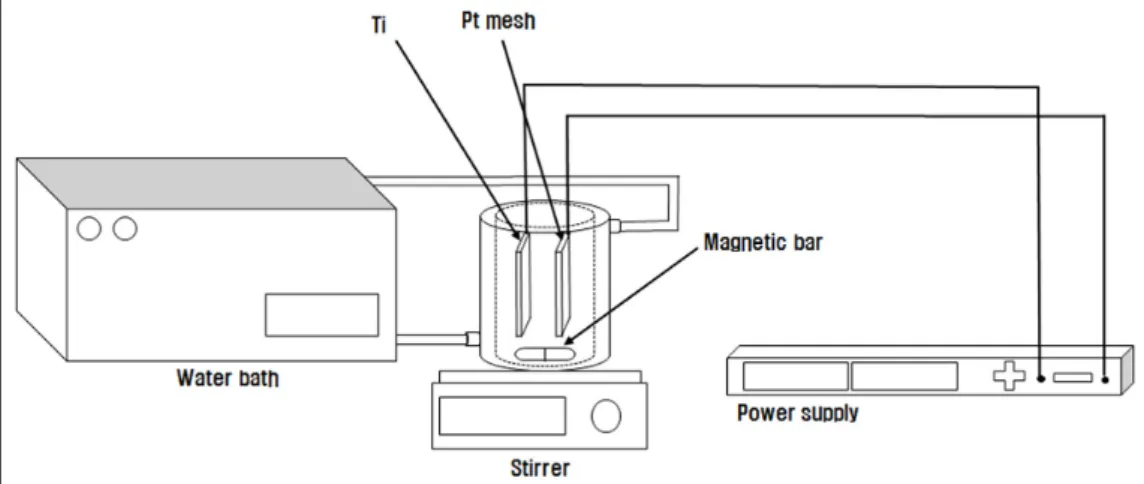
2의 박막을 ㎚로 제어할 수 있 는 특징을 가지는 양극산화법을 사용하였으며 Fig. 1과 같이 양극산화 장치를 제작하여 TiO
2nanotube plate를 제조하였 다. Titanium은 순도 99.8 % 이상의 두께 1 ㎜의 70 × 68 ㎜ 의 시편 중앙에 직경 21 ㎜ 정공이 있는 titanium을 사용하였 고 사용 전 표면의 유기물 및 불순물을 제거하기 위해 acetone, ethanol, deionized water 순으로 10분씩 sonication 후 사용하였다. 양극산화 시 사용된 음극은 50 × 80 ㎜ mesh 형태의 platinum을 사용하였으며, DC 정류기(AMETEK, XG150, U.S.A)를 통해 일정 전압을 인가하였다. 사용된 전해 질은 ethylene glycol을 base로 하였으며, nanotube 형태의 TiO
2를 얻기 위해 0.2 wt%의 NH
4F와 2 vol%의 H
2O를 첨가 하여 사용하였다(Lee and Pak, 2016). TiO
2nanotube의 형태
Fig. 1. Schematic diagram of anodization reactor.
에 따른 효용성 평가를 진행하기 위해 인가전압(40, 50, 60 V)과 반응 시간(5, 10, 15 hr)에 차이를 두어 실험을 진행하였 으며, 이중자켓을 이용하여 반응온도를 일정하게 유지하였고 agitator를 사용하여 150 rpm으로 전해질을 일정하게 교반하 였다. 양극산화로 제작된 TiO
2nanotube plate는 최종적으로 annealing 방법을 통해 500 ℃ 1시간 열처리 후 효용성 평가 를 진행하였다.
2.2 Morphology analysis of TiO
2nanotube plate
제작된 TiO
2nanotube plate의 물리⋅화학적 특성을 분석하 고자 하였으며, 물리적 분석 시 scanning electron microscope (SEM; TESCAN, VEGA3, Czech)를 통해 surface와 nanotube 의 길이를 측정하였고, energy dispersive spectroscopy(EDS;
Thermo scientific, Noran system7, U.S.A)을 통해 TiO
2nanotube plate의 함유 원소 조성을 분석하였다.
2.3 Evaluation of chromaticity removal efficiency of TiO
2nanotube plate
TiO
2nanotube plate의 색도제거 효율을 평가하기 위해 20
mg/L의 methyl orange 염료를 사용하여 150 mL 부피의 반응 기를 통해 실험을 진행하였다. 실험 진행 시 반응기 내 용액 의 농도구배를 없애기 위해 150 rpm으로 용액을 교반하였으 며, UV lamp(Sankyo, G8T5, Japan)를 사용해 photocatalysis 효용성을 평가하였다. 분광광도기(HACH, DR2700, U.S.A)를 이용하여 465 ㎚ 검출 파장에서 반응 후 용액의 흡광도 측정 을 통해 색도제거율을 도출하였다. Electrophotocatalysis 효율 성을 평가하기 위해 TiO
2nanotube plate를 anode로 사용하여 실험을 진행하였으며, 0.5 – 2 V까지 0.5 V씩 차이를 두어 전압을 인가하였다. 극간은 10 ㎜로 유지하였으며 cathode를 titanium과 TiO
2nanotube plate로 각각 사용하여 효율성 평가 를 진행하였다. 염을 함유하는 염료폐수의 처리 효율을 도출 하기 위해 0.025, 0.05, 0.1 M의 Na
2SO
4를 첨가하여 색도제거 효율을 평가하였다.
3. Results and Discussion
3.1 Morphology analysis of TiO
2nanotube plate
제조된 TiO
2nanotube의 길이와 공극 크기를 측정하고자
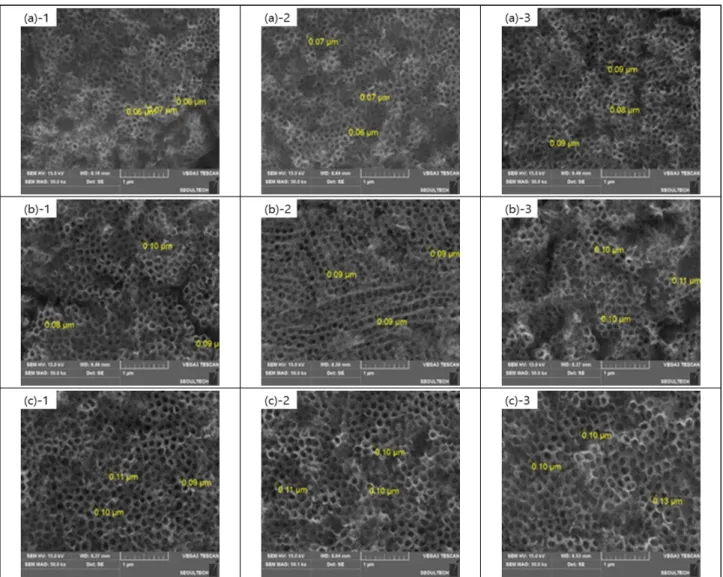
Fig. 2. Surface morphology analysis of the TiO2
nanotube plate (a) 40 V (b) 50 V (c) 60 V (Anodozation time -1: 5 hours, -2: 10
hours, -3: 15 hours).
SEM분석을 진행하였으며 결과는 Fig. 2-3과 같다. Fig. 2에 서와 같이 양극산화 시간이 길어져도 생성된 TiO
2nanotube 의 공극 크기 변화는 미비한 것을 알 수 있었다. 이는 양극 산화 시 사용되는 전해질과 관계되어 있는데 TiO
2nanotube 형성 시 식 1-2와 같이 F
-이온과 반응하여 생성된 [TiF
6]
2-착 화물로 인해 TiO
2layer에 porous nanotube가 생성되게 된다 (Bai et al., 2008; Grimes and Mor, 2009; Mohamed et al., 2010; Mor et al., 2006; Sul et al., 2001; Thompson, 1997).
본 연구에 사용된 전해질은 ethylene glycol base에 H
2O 2 vol%, NH
4F 0.2 wt%로 동일한 조건으로 사용하였으며, 이 로 인해 surface 분석 시 인가전압과 반응시간 차이에 의한 TiO
2nanotube 공극 크기의 차이는 나타나지 않은 것으로 판 단된다.
Ti
4++ 6F
-→ [TiF
6]
2-(1) TiO
2+ 6F
-→ [TiF
6]
2-(2)
TiO
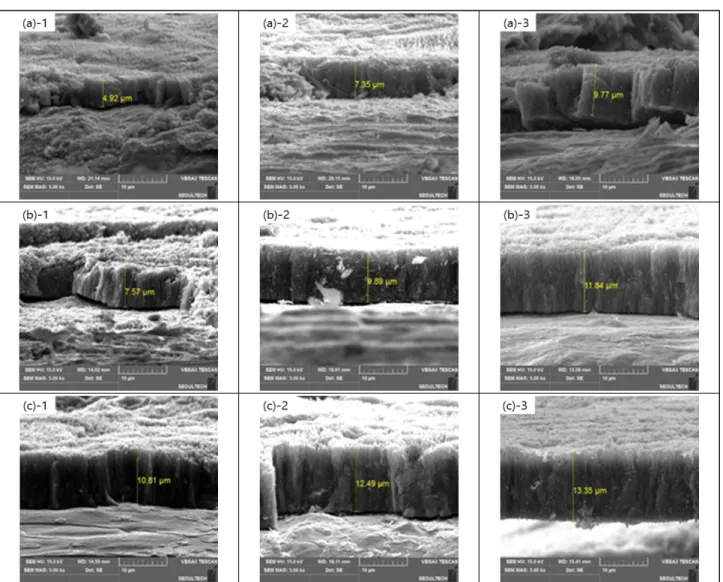
2nanotube 제조 시 nanotube의 길이는 전압과 반응시 간에 따라 Fig. 3과 같이 차이가 나타나는 것을 알 수 있었으
며, 이는 인가전압과 반응시간이 증가함에 따라 electric energy의 증대로 인해 전해질 내 ion 활동의 가증을 유발하 여 산화층 형성이 늘어난 것이라 판단된다. TiO
2layer의 nanotube는 oxide layer의 정상 시 F
-ion에 의한 식각작용을 통해 성장하게 된다(Grimes and Gopal, 2009; Lee and Pak, 2016). 본 연구의 TiO
2nantoube 제조 시 공극은 동일농도 (wt%)의 NH
4F 첨가로 인해 일정한 공극이 형성되었으며, 인 가전압과 반응시간 변경 시 공극의 차이를 나타내지 않음에 따라 TiO
2nanotube plate 제조 시 인가전압과 반응 시간이 공극에 미치는 영향은 미비하다 판단된다.
EDS 분석을 통해 TiO
2nanotube의 원소 조성분석을 실시 하였으며 분석결과는 Table 1과 같다.
완전한 산화상태를 이루는 TiO
2의 결정은 절연적인 특성을 띄지만 oxygen이 부족하거나 고온 조건에서 생성된 TiO
2의
Table 1. Element contents in the TiO2
nanotube plate
Element O Ti
Atom (%) 59.43 40.57
Fig. 3. Cross section morphology analysis of TiO2
nanotube plate (a) 40 V (b) 50 V (c) 60 V (Anodozation time -1: 5 hours,
-2: 10 hours, -3: 15 hours).
경우 oxygen vacancies가 생성되어 n-type 반도체의 성질을 띄 게 된다(Chen, 1997; Jiang et al., 2017; Yeo, 2012). 5 ㎚ 이하의 nanostructured-TiO
2는 n-type 또는 p-type 반도체의 성질을 띌 수 있다는 연구결과가 있지만(Coronado et al., 2013), 본 실험 결과 oxygen : titanium의 비율이 2:1보다 낮은 원소비율을 알 수 있었으며 이를 통해 n-type 성질을 띌 것이라 판단하였다.
3.2 Evaluation of chromaticity removal efficiency of TiO
2nanotube plate
TiO
2nanotube plate의 색도제거 효율을 평가하기 위해 photocatalysis, electrophotocatalysis 효용성 평가 실험을 진행 하였다. Photocatalysis 활성을 평가하기 위해 TiO
2nanotube plate 한 개를 사용하여 UV 조사 후 색도제거율을 측정하였 으며, electrophotocatalysis 효용성을 평가하기 위하여 0.5 – 2.0 V의 전압을 인가하였고, 전압 인가 시 TiO
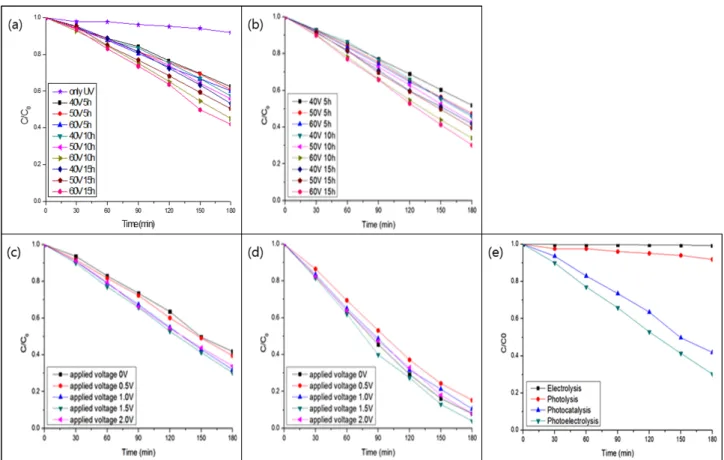
2nanotube plate의 anode 단독사용, anode⋅cathode 사용 실험을 통해 색 도제거율을 측정하였다(Fig. 4).
실험 결과 TiO
2nanotube plate를 photocatalysis로 사용 시 최대 약 60 %이상 색도제거율을 나타냈다. 색도제거율 감소 는 TiO
2nanotube의 표면적과 관련이 있는데 이는 식(3)과 같 다. 따라서 표면적과 색도제거 효율성은 정비례 하고 nanotube의 surface area 값이 클수록 효율이 높은 것을 알 수 있었다(Fig. 5).
Fig. 5. The connection between L/R and decolorization efficiency
of TiO
2nanotube plate.
∏× ∏×
∏ ∏
(3)
where,
S - Nanotube surface area R - Radius of nanotube pore
Fig. 4. Degradation of methyl orange by the TiO2
nanotube plate (a) The TiO
2nanotube plate + UV (b) The applied 1.5 V to
TiO
2nanotube plate + UV (c) The TiO
2nanotube plate(60 V/ 15 hours) as an anode with applied voltage type + UV (d)
TiO
2nanotube plate(60 V/ 15 hours) as an anode·cathode with applied voltage type + UV (e) The degradation of methyl
orange by different methods.
L - Thickness (nanotube length) π - Ratio of circumference to diameter
Electrophotocatalysis 효용성을 평가하기 위해 TiO
2nanotube plate를 anode로 사용하고 titanium을 cathode로 사용하여 색도 제거 실험을 진행하였다. 실험 진행 시 최대 70 % 이상 색도제 거가 이루어 진 것을 알 수 있었으며, photocatalysis 단독으로 사용 시 보다 더 높은 효율을 나타내는 것을 알 수 있었다.
이를 통해 photocatalysis 작용 시 conduction band의 electron이 balance band의 hole에 재결합으로 인한 ⋅OH 생성 저하의 문 제점을 전압 인가를 통해 해결할 수 있다 판단된다. 전압 인가 시 1.5 V에 비해 2.0 V의 경우 효율성이 떨어지는 결과를 얻었 다. 이는 수전해의 영향이라 판단되는데, 1.5 V의 전압 인가 시 methyl orange 용액과 전극의 저항으로 인해 1.23 eV의 energy가 전달되지 않아 water electrolysis 반응이 일어나지 않 지만, 2.0 V의 전압 인가 시 1.23 eV의 electron volt가 충족돼 water electrolysis 반응으로 인해 ⋅OH scavenger 작용으로 효 율성이 떨어진 것이라 판단된다(식 5).
Overall reaction:
→
(4)
Cathode:
→ (5)
Anode:
→
(6)
(7)
TiO
2nanotube plate를 anode와 cathode로 사용하여 전압을 인가 시 최대 95 % 이상 색도제거율을 보였다. 이는 cathode 로 추가된 TiO
2nanotube plate로 인해 photocatalysis 작용이 추가되어 더 큰 색도제거율을 보인 것으로 판단되며, 1.5 V 이상의 전압 인가 시 water electrolysis 반응이 증가하여 색 도제거율이 감소한 것이라 추측된다.
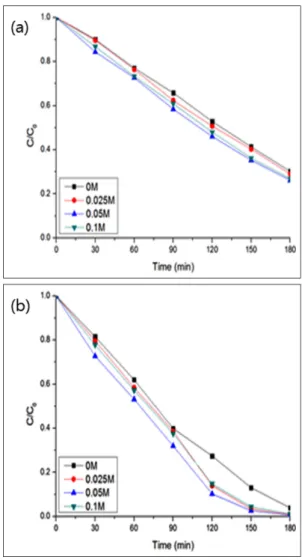
3.3 Evaluation of chromaticity removal efficiency of TiO
2nanotube plate
Methyl orange 용액에 0.025, 0.05, 0.1 M의 Na
2SO
4를 첨가 하여 함유된 염 농도에 따른 색도제거율의 변화를 알고자 하 였다. Fig. 6과 같이 색도제거율은 염의 농도가 증가할수록 높 아지는 것을 알 수 있었지만, 1 M의 염이 첨가될 시 낮아지는 결과를 나타냈는데, 이는 용액의 conductivity와 Na
+, OH
-의 결합에 의함 이라 판단된다. Na
2SO
4의 농도가 증가할수록 용 액 내 ion의 증가로 인해 conductivity가 증가하여 반응성이 커짐에 따라 색도제거율이 높아지지만, 일정 농도 이상의 Na
2SO
4가 첨가될 시 용해된 Na
+ion이 광촉매 반응과 전기분 해 반응으로 생성된 OH
-와 결합하여 NaOH(aq)로 변환되어
⋅OH의 생성을 저해하게 됨에 따라 처리효율이 떨어지는 것 이라 판단된다. 또한 TiO
2nanotube plate를 anode 단독으로 사용할 시 보다 anode⋅cathode로 사용할 시 UV+TiO
2광촉 매 작용 면적이 넓어지게 되고,⋅OH 생성이 증가되어 색도 제거율이 높아지는 것을 알 수 있었다.
Fig. 6. The degradation of methyl orange in the solution
with various salt concentrations (a) The TiO
2nanotube plate as an anode system (b) The TiO
2nanotube plate as an anode·cathode system.
4. Conclusion
본 연구를 통해 TiO
2nanotube plate를 사용하여 methyl orange 용액의 색도제거를 통해 염료폐수의 처리가능성을 알 아보고자 하였으며 다음과 같은 결론을 얻을 수 있었다.
1. TiO
2nanotube plate 제조 시 전압과 반응시간은 nanotube의 공극 크기에 미치는 영향은 미비하지만 인가전 압과 반응시간이 증가할수록 전해질 내 에너지증가로 인해 nanotube의 길이에 중요한 영향인자임을 알 수 있었다.
2. 전압인가는 TiO
2의 반응 기작 중 electron⋅hole 재결합 감소 등의 작용으로 인해 더 높은 색도제거율을 나타낸 것이 라 판단되지만 전압의 증가는 효용성 증가를 일으키나 수소 과전압 인가 시 ⋅OH scavenger 작용을 일으켜 효율이 감소 된다 사료되어 적정 전압인가가 electrophotocatalysis의 매우 중요한 인자임을 알 수 있었다.
3. TiO
2nanotube plate를 사용한 효용성 평가를 통해 색도
제거율은 TiO
2nanotube의 표면적 증가에 따라 높아지는 것
을 알 수 있으며, TiO
2nanotube plate를 anode⋅cathode로
사용 시 더욱 효과적인 수처리가 가능할 것이라 사료된다.
Acknowledgement
본 연구는 서울과학기술대학교의 지원을 받아 수행하였습 니다.
References
An, H. Y., Gu, X., and Tang, W. Z. (1996). Biological treatment of dye wastewaters using an anaerobic-oxic system,
Chemosphere, 33(12), 2533-2542.Bai, J., Zhou, B., Li, L., Liu, Y., Zheng, Q., Shao, J., and Zou, L. (2008). The formation mechanism of titania nanotube arrays in hydrofluoric acid electrolyte, Journal of materials science, 43(6), 1880-1884.
Carneiro, P. A., Osugi, M. E., Sene, J. J., Anderson, M. A., and Zanoni, M. V. B. (2004). Evaluation of color removal and degradation of a reactive textile azo dye on nanoporous TiO
2thin-film electrodes, Electrochimica Acta, 49(22), 3807-3820.
Chen, J. G. (1997). NEXAFS investigations of transition metal oxides, nitrides, carbides, sulfides and other interstitial compounds, Surface Science Reports, 30(1-3), 1-152.
Coronado, J. M., Fresno, F., Hernández-Alonso, M. D., and Portela, R. (2013). Design of advanced photocatalytic
materials for energy and environmental applications,Springer, London, 1-348.
Fujishima, A. and Honda, K. (1972). Electrochemical photolysis of water at a semiconductor electrode, Nature, 238, 37-38.
Gong, Z. Y. (2017). Characteristics and treatment technology of dye wastewater, Jiangxi Chemical Industry, 20(4), 24-27.
Grimes, C. A. and Mor, G. K. (2009). TiO
2 nanotube arrays:synthesis, properties, and applications, Springer Science &
Business Media, New York, 18-38.
Jiang, C., Moniz, S. J., Wang, A., Zhang, T., and Tang, J. (2017).
Photoelectrochemical devices for solar water splitting- materials and challenges, Chemical Society Reviews, 46(15), 4645-4660.
Kant, R. (2012). Textile dyeing industry an environmental hazard,
Natural science, 4(1), 22-26.Khattri, S. D. and Singh, M. K. (2009). Removal of malachite green from dye wastewater using neem sawdust by adsorption,
Journal of Hazardous Materials, 167(3), 1089-1094.Kim, Y. M,. Han, I. S., and Lee, Y. H. (2009). Decolorization of anthraquinone dye reacrive by UV/TiO
2system under carious operational conditions, Proceedings of the 2009 fall
Co-Conference of the Korean society on Water Environment and Korean Society of Water and Wastewater, Korean Societyon Water Environment and Korean Society of Water and
Wastewater, 395-396. [Korea Literature]
Lee, J. W. (2000). Photocatalytic degradation and adsorption
of C. I. Acid Red 377 in aqueous solution by using TiO2, Ph.D Dissertation, Kyunghee University, Seoul, Korea, 1-114.
[Korea Literature]
Lee, Y. H. and Pak, D. W. (2016). Evaluation of OH radical Generation to Nanotube Morphology of TiO
2Nanotube Plate,
Journal of Korean Society on Water Environment, 32(5),403-409. [Korean Literature]
Mohamed, A. E. R., Kasemphaibulsuk, N., Rohani, S., and Barghi, S. (2010). Fabrication of titania nanotube arrays in viscous electrolytes, Journal of nanoscience and nanotechnology, 10(3), 1998-2008.
Mor, G. K., Varghese, O. K., Paulose, M., Shankar, K., and Grimes, C. A. (2006). A review on highly ordered, vertically oriented TiO
2nanotube arrays: Fabrication, material properties, and solar energy applications, Solar Energy
Materials and Solar Cells, 90(14), 2011-2075.Noh, J. H., An, S. W., Kim, J. T,. Lee, S. J., and Chang, S.
W. (2012). Decolorization of acid orangeⅡ using UV by the fact of TiO
2and pH, Proceedings of the 2012 spring
Co-Conference of the Korean society on Water Environment and Korean Society of Water and Wastewater, Korean Societyon Water Environment and Korean Society of Water and Wastewater, 588-589. [Korea Literature]
Papic, S., Koprivanac, N., Bozic, A. L., and Metes, A. (2004).
Removal of some reactive dyes from synthetic wastewater by combined Al (III) coagulation/carbon adsorption process,
Dyes and Pigments, 62(3), 291-298.Patel, R., Bhingradiya, T., Deshmukh, A., and Gandhi, V. (2016).
Response surface methodology for optimization and modeling of photo-degradation of alizarin cyanine green and acid orange 7 dyes using UV/TiO
2process, Materials Science Forum, 855, 94-104.
Seo, K. A. (2012). A study on the color remocal and exotoxicity
reduction of reactive dye using by adcanced oxidation process,Master’s thesis, Chonnam National Univerisity, Korea, 1-75.
[Korea Literature]
Sul, Y. T., Johansson, C. B., Jeong, Y., and Albrektsson, T.
(2001). The electrochemical oxide growth behaviour on titanium in acid and alkaline electrolytes, Medical engineering
& physics, 23(5), 329-346.