Introduction
Chronic obstructive pulmonary disease (COPD) is now considered a systemic disease that affects organs beyond the lungs and airways. The disease is characterized by irreversible airflow obstruction and progressive weight loss, especially loss of lean body mass, which is associated with skeletal muscle dysfunction
1. Reduced testosterone levels and hypogonadism have been described in COPD
2. In adult men, this reduction is modest, but a progressive decline in testosterone produc- tion starts between the fourth and sixth decades of life
3,4. This decline is associated with a simultaneous increase of sex hormone-binding globulin (SHBG) levels, and thus, bioavail-
Larger Testicular Volume Is Independently Associated with Favorable Indices of Lung Function
Tae Beom Kim, M.D.
1and I-Nae Park, M.D.
21
Department of Urology, Gachon University Gil Medical Center, Incheon,
2Department of Pulmonology, Inje University Seoul Paik Hospital, Seoul, Korea
Background: Men with chronic obstructive pulmonary disease, have reduced endogenous testosterone levels, but the relationship between pulmonary function and endogenous testosterone levels, is inconsistent. Testicular volume is a known indicator of endogenous testosterone levels, male fertility, and male potency. In the present study, the authors investigated the relationship, between testicular volume and lung function.
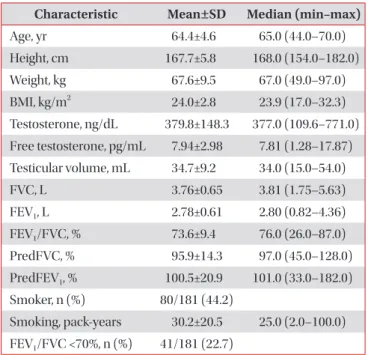
Methods: One hundred and eighty-one South Korean men age 40–70, hospitalized for urological surgery, were retro- spectively enrolled, irrespective of the presence of respiratory disease. Study subjects underwent pulmonary function testing, prior to procedures, and testicular volumes were measured by orchidometry. Testosterone levels of patients in blood samples collected between 7
AMand 11
AM, were measured by a direct chemiluminescent immunoassay.
Results: The 181 study subjects were divided into two groups, by testicular volume (≥35 mL vs. <35 mL), the larger testes group, had better lung functions (forced vital capacity [FVC]: 3.87±0.65 L vs. 3.66±0.65 L, p=0.037; forced expiratory volume in 1 second [FEV
1]: 2.92±0.57 L vs. 2.65±0.61 L, p=0.002; FVC % predicted: 98.2±15.2% vs. 93.8±13.1%, p=0.040;
FEV
1% predicted: 105.4±19.5% vs. 95.9±21.2%, p=0.002). In addition, the proportion of patients with a FEV
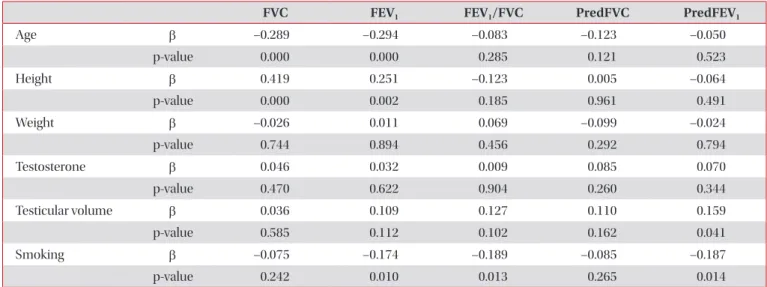
1/FVC of <70%, was lower in the larger testes group. Univariate analysis conducted using linear regression models, revealed that testicular volume was correlated with FVC (r=0.162, p=0.029), FEV
1(r=0.218, p=0.003), FEV
1/FVC (r=0.149, p=0.046), and FEV
1% predicted (r=0.178, p=0.017), and multivariate analysis using linear regression models, revealed that testicular volume was a significant predictive factor for FEV
1% predicted (β =0.159, p=0.041).
Conclusion: Larger testicular volume was independently associated, with favorable indices of lung function. These results suggest that androgens, may contribute to better lung function.
Keywords: Respiratory Physiological Phenomena; Pulmonary Disease, Chronic Obstructive; Respiratory Function Tests;
Testis; Testosterone
Address for correspondence: I-Nae Park, M.D.
Department of Pulmonology, Inje University Seoul Paik Hospital, 9 Mareunnae-ro, Jung-gu, Seoul 04551, Korea
Phone: 82-2-2270-0004, Fax: 82-2-2285-2286 E-mail: [email protected]
Received: Dec. 22, 2016 Revised: Mar. 13, 2017 Accepted: May. 8, 2017 Published online: Sep. 1, 2017
cc It is identical to the Creative Commons Attribution Non-Commercial License (http://creativecommons.org/licenses/by-nc/4.0/).