Introduction
World Health Organization (WHO) has reported that 65 million people have a moderate-to-severe chronic obstruc- tive pulmonary disease (COPD) and that COPD will become the third leading cause of death worldwide by 2030
1. COPD is reportedly characterized by both low lung function and ac- celerated decline in lung function
2. With aging, lung function and respiratory muscle strength decrease
3, and most patients with COPD are not diagnosed accurately
4. Although smoking is a well-known risk factor
5, environmental factors, such as air pollution and occupational exposure, are also crucial risk factors for COPD
6. Furthermore, exposure to cement dust is
Correlation between Physical Activity and Lung Function in Dusty Areas: Results from the Chronic Obstructive Pulmonary Disease in Dusty Areas (CODA) Cohort
Yuri Han, M.S.
1, Yeonjeong Heo, M.D.
1, Yoonki Hong, M.D.
1, Sung Ok Kwon, Ph.D.
2and Woo Jin Kim, M.D.
11
Department of Internal Medicine and Environmental Health Center, Kangwon National University, Chuncheon,
2Biomedical Research Institute, Kangwon National University Hospital, Chuncheon, Korea
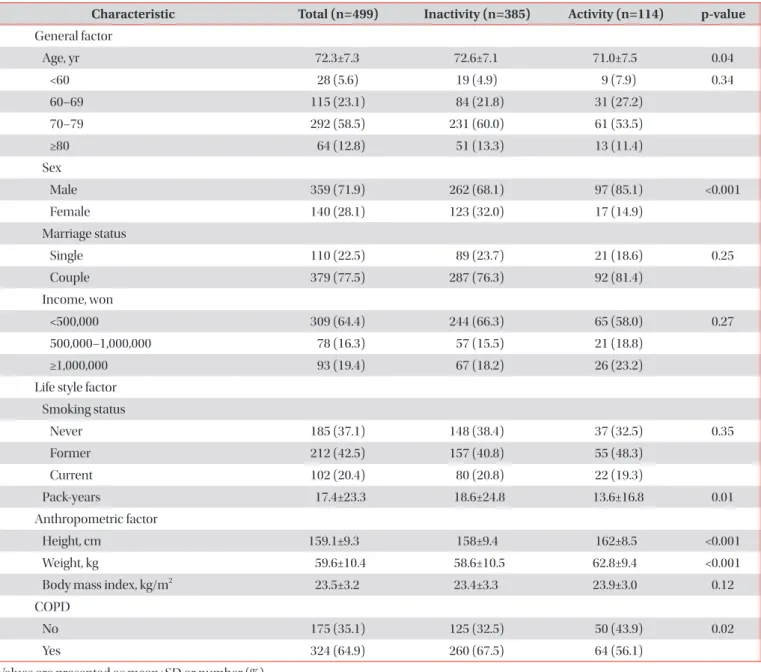
Background: Although physical activity is known to be beneficial to lung function, few studies have been conducted to investigate the correlation between physical activity and lung function in dusty areas. Therefore, the purpose of this study is to investigate the correlation between physical activity and lung function in a Korean cohort including normal and COPD-diagnosed participants.
Methods: Data obtained from the COPD in dusty areas (CODA) cohort was analyzed for the following factors: lung function, symptoms, and information about physical activity. Information on physical activity was valuated using questionnaires, and participants were categorized into two groups: active and inactive. The evaluation of the mean lung function, modified Medical Research Council dyspnea grade scores, and COPD assessment test scores was done based on the participant physical activity using a general linear model after adjusting for age, sex, smoking status, pack-years, height, and weight. In addition, a stratification analysis was performed based on the smoking status and COPD.
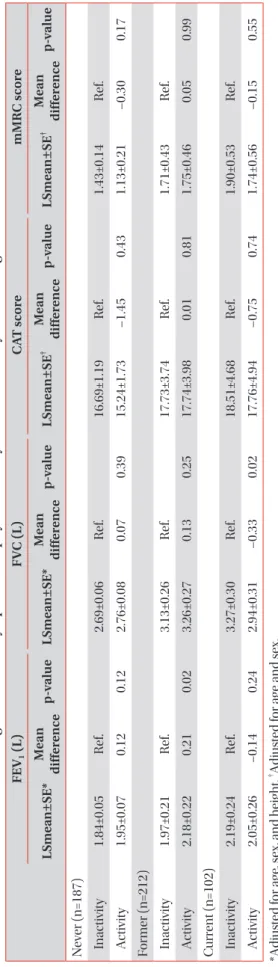
Results: Physical activity had a correlation with high forced expiratory volume in 1 second (FEV
1) among CODA cohort (p=0.03). While the active group exhibited significantly higher FEV
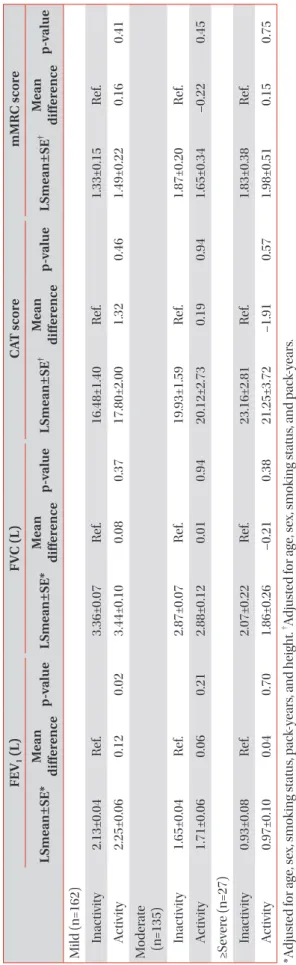
1compared to one exhibited by the inactive group among past smokers (p=0.02), no such correlation existed among current smokers. There was no significant difference observed in lung function after it was stratified by COPD.
Conclusion: This study established a positive correlation between regular physical activity in dusty areas and lung function in participants.
Keywords: Pulmonary Disease, Chronic Obstructive; Physical Activity; Lung Function Test; Smoking
Address for correspondence: Woo Jin Kim, M.D.
Department of Internal Medicine, Kangwon National University, 156 Baengnyeong-ro, Chuncheon 24289, Korea
Phone: 82-33-258-9364, Fax: 82-33-255-6567 E-mail: [email protected]
Received: Jan. 21, 2019 Revised: Apr. 2, 2019 Accepted: May. 9, 2019 Published online: May. 31, 2019
cc It is identical to the Creative Commons Attribution Non-Commercial License (http://creativecommons.org/licenses/by-nc/4.0/).