• 검색 결과가 없습니다.

Validity and Reliability of CAT and Dyspnea-12 in Bronchiectasis and Tuberculous Destroyed Lung

N/A
N/A
Protected

Academic year: 2021

Share "Validity and Reliability of CAT and Dyspnea-12 in Bronchiectasis and Tuberculous Destroyed Lung"

Copied!
8
0
0

로드 중.... (전체 텍스트 보기)

전체 글

(1)

Tuberc Respir Dis 2012;72:467-474

CopyrightⒸ2012. The Korean Academy of Tuberculosis and Respiratory Diseases. All rights reserved.

Validity and Reliability of CAT and Dyspnea-12 in Bronchiectasis and Tuberculous Destroyed Lung

Bo Young Lee, M.D.

1

, Seohyun Lee, M.D.

1

, Jae Seung Lee, M.D.

2

, Jin Woo Song, M.D.

2,3

, Sang-Do Lee, M.D.

2,3,4

, Seung Hun Jang, M.D.

5

, Ki-Suck Jung, M.D.

5

, Yong Il Hwang, M.D.

5

, Yeon-Mok Oh, M.D.

2,3,4

Departments of

1

Internal Medicine and

2

Pulmonary and Critical Care Medicine,

3

Asthma Center,

4

Clinical Reserch Center for Chronic Obstructive Airway Diseases, Asan Medical Center, University of Ulsan College of Medicine, Seoul,

5

Division of Pulmonary, Allergy and Critical Care Medicine, Department of Internal Medicine, Hallym University Sacred Heart Hospital, Hallym University College of Medicine, Anyang, Korea

Background: The objective of this study was to assess the validity and reliability of the Korean version of chronic obstructive pulmonary disease assessment test (CAT) and Dyspnea-12 Questionnaire for patients with bronchiectasis or tuberculous destroyed lung.

Methods: For 62 bronchiectasis patients and 37 tuberculous destroyed lung patients, 3 questionnaires including St. George's Respiratory Questionnaires (SGRQ), CAT, and Dyspnea-12 were obtained, in addition to spirometric measurements. To assess the validity of CAT and Dyspnea-12, correlation with SGRQ was evaluated. To assess the reliability of CAT and Dyspnea-12, Cronbach's α coefficient was calculated.

Results: The mean ages of the patients were 60.7±8.3 years in bronchiectasis and 64.4±9.3 years in tuberculous destroyed lung. 46.8% and 54.1% were male, respectively. The SGRQ score was correlated with the score of the Korean version of CAT (r=0.72, p<0.0001) and Dyspnea-12 (r=0.67, p<0.0001) in bronchiectasis patients. The SGRQ score was correlated with the score of CAT (r=0.86, p<0.0001) and Dyspnea-12 (r=0.80, p<0.0001) in tuberculous destroyed lung patients. The Cronbach's α coefficient for the CAT and Dyspnea-12 were 0.84 and 0.90 in bronchiectasis, and 0.88 and 0.94 in tuberculous destroyed lung, respectively.

Conclusion: We found that Korean version of CAT and Dyspnea-12 are valid and reliable in patients with tuberculous destroyed lung and bronchiectasis.

Key Words: Dyspnea; Severity of Illness Index; Questionnaires; Validation Studies; Bronchiectasis; Tuberculosis

Address for correspondence: Yeon-Mok Oh, M.D.

Department of Pulmonary and Critical Care Medicine, Asthma Center, Clinical Research Center for Chronic Obstructive Airway Disease, Asan Medical Center, University of Ulsan College of Medicine, 88, Olympic-ro 43-gil, Songpa-gu, Seoul 138-736, Korea

Phone: 82-2-3010-3136, Fax: 82-2-3010-6968 E-mail: [email protected]

Address for Co-correspondence: Yong Il Hwang, M.D.

Division of Pulmonary and Critical Care Medicine, Depart- ment of Internal Medicine, Hallym University Sacred Heart Hospital, 896, Pyeongchon-dong, Dongan-gu, Anyang 431-070, Korea

Phone: 82-31-380-3715, Fax: 82-31-380-3973 E-mail: [email protected]

Received: Feb. 9, 2012 Revised: Mar. 26, 2012 Accepted: Apr. 24, 2012

Introduction

Health-related quality of life (HRQL) is a concept

which involves all aspects of physical, mental and social life. Assessment and evaluation of HRQL is very im- portant in treating many diseases

1

. In chronic pulmo- nary diseases such as chronic obstructive pulmonary disease (COPD), asthma, and tuberculous destroyed lung, the natural course of diseases is usually pro- gressive, and the mainstay of treatment is to improve activity and quality of daily living. Therefore, develop- ing tools to assess these functions and quality of life is important

2

. In case of COPD, various tools have been developed to assess quality of life, and their validity and reliability have been well established

3

.

Currently, there is no disease-specific tool for assess-

ing HRQL in tuberculous destroyed lung and bron-

chiectasis yet. However, St. George's respiratory ques-

(2)

tionnaire (SGRQ), which has been widely used as a tool for assessing HRQL in chronic pulmonary disease cases, has been proven to be valid and reliable by several studies

4-8

. However, since SGRQ is complex and time consuming to complete, it is not readily applicable in routine practice. COPD assessment test (CAT) was de- veloped as a short, simple instrument for quantification of symptoms, and it was recently introduced after vali- dation

9,10

. Modified Medical Research Council dyspnea score (MMRC) is widely used to evaluate the severity of dyspnea, but quantification of the severity using MMRC is difficult

11

. Dyspnea-12 is composed of 12 questions designed to assess the severity of dyspnea

12

. Dyspnea-12 was validated in patients with COPD

10

. However, validity and reliability of Korean version CAT and Korean version Dyspnea-12 questionnaire for tuber- culous destroyed lung and bronchiectasis cases have not yet been confirmed. In the present study, the validity and reliability of Korean version CAT and Korean ver- sion Dyspnea-12 questionnaire are evaluated.

Materials and Methods 1. Study subjects

1) Inclusion criteria: Patients with either tuberculous destroyed lungs or bronchiectasis, who visited the out- patient clinic of Department of Pulmonology and Critical Care Medicine in Asan Medical Center and Hallym University Sacred Heart Pyeongchon Hospital between March 3, 2010 and May 3, 2011 were selected for the present study. These two institutions are university-af- filiated tertiary hospitals in South Korea. Definition on each disease was made by pulmonologists as follows:

(1) Tuberculous destroyed lung; All patients with a history of treating pulmonary tuberculosis at least 1 year ago were included if more than half of one lung is de- stroyed on chest radiography

13

.

(2) Bronchiectasis; Bronchiectasis was diagnosed based on computed tomography scan findings.

2) Exclusion criteria

(1) Cases with underlying diseases considered to sig- nificantly affect the quality of life were excluded.

- Heart failure

- Malignant neoplasm which is not in a disease free state

- History of myocardial infarction within 6 months - Severe liver diseases

- Severe psychiatric diseases - Hospitalized

(2) Patients who had difficulty in filling up the ques- tionnaire, or who did not agree to participate in the sur- vey were excluded from the present study.

2. Methods

As a prospective cross-sectional study, informed con- sents in written form were collected. Then, the patients were requested to complete Korean version SGRQ, Korean version CAT questionnaire and Korean version Dyspnea-12 questionnaire by themselves. Spirometry was also performed.

1) Questionnaires

(1) Korean version SGRQ; Korean version SGRQ is composed of 50 items divided into 3 categories: symp- tom, activity and impact. Scores calculated from each category and the total score from all categories were an- alyzed and recorded, respectively. Scores range from 0 to 100 where 0 is the best HRQL, and 100 the worst

4

. In the present study, Korean version SGRQ was used, which was previously validated

5

.

(2) Korean version CAT questionnaire; Korean ver- sion CAT questionnaire is composed of 8 items. Each item has a score ranging from 0 to 5, thereby making the total score range from 0 to 40. Score of 0 represents the best quality of life and 40 does the worst

9

. Korean version CAT questionnaire was used after obtaining per- mission from GSK (GlaxoSmithKline).

(3) Korean version Dyspnea-12 questionnaire; Korean version Dyspnea-12 questionnaire is composed of 12 items requiring either one of the 4 types of responses:

none, mild, moderate or severe. Each response receives

scores ranging from 0 to 3

12

. The original version of

Dyspnea-12 questionnaire was first translated into

Korean under permission of the original author of the

questionnaire. The quality of translation was again con-

(3)

Table 1. Characteristics of bronchiectasis patients

Characteristics Patients (n=62)

Age, yr 60.7±8.3

Male 29 (46.8)

Smoking history

Never-smoker 42 (67.7)

Ex-smoker 18 (29)

Current smoker 2 (3.2)

Pack year 6.5±13.0

PFT 39 (62.9)

FEV

1

, L 1.8±0.5

FEV

1

, % predicted 67.3±18.6

FVC, L 2.7±0.6

FVC, % predicted 76.5±14.8

FEV

1

/FVC 65.9±11.6

SGRQ (total) 31.5±14.9

Symptom 49.9±19.0

Activity 40.3±21.0

Impact 20.7±16.2

CAT score 15.4±7.3

Dyspnea-12 score 4.8±5.9

Values are presented as mean±SD or number (%).

PFT: pulmonary function test; FEV

1

: forced expiratory volume in 1 second; FVC: forced vital capacity; SGRQ: St. George Respiratory Questionnaire; CAT: chronic obstructive pulmonary disease assessment test; SD: standard deviation.

firmed by the original author after translation and thor- ough revision.

2) Spirometry tests: Using a spirometer (Vmax22 or 2130; Sensor Medics, Yorba Linda, CA, USA), forced ex- piratory volume in 1 second (FEV

1

) and forced vital ca- pacity (FVC) were measured. Spirometry was conducted following the method recommended by American Thoracic Society and European Respiratory Society.

With respect to normal predictive values of spirometry, the Korean reference equation reported by Choi et al.

14

was used.

3) Statistical analysis: In order to evaluate validity, correlation analysis was conducted using Pearson's correlation. The association between the scores of Korean version CAT questionnaire and the scores of the Korean version SGRQ, and that between the score of Korean version CAT questionnaire and the FEV

1

were evaluated. Similarly, for the scores of Korean version Dyspnea-12 questionnaire correlation analysis was un- derwent to evaluate its association with Korean version SGRQ and FEV

1

. To assess reliability, Cronbach's α co- efficient was calculated determining the internal con- sistency of Korean version CAT questionnaire and Korean version Dyspnea-12 questionnaire. Using SAS for Window version 18.0 (SPSS Inc., Chicago, IL, USA), statistical analysis was conducted. All data are ex- pressed means and standard deviations or frequencies.

Statistical significance was accepted for p-values less than 0.05.

4) Approval from Institutional Review Board (IRB):

Approval from IRB of Asan Medical Center and Hallym University Sacred Heart Pyeongchon Hospital was obtained. Written informed consents from all partic- ipants were collected.

Results 1. Bronchiectasis

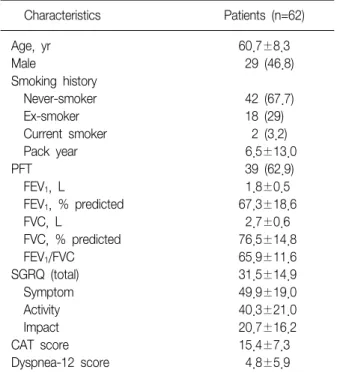
1) Patient characteristics: Sixty two patients were en- rolled to this study and their mean age was 60.7 years.

Most of patients in study cohort were female and non-smokers (Table 1). In average, spirometry showed

mild airflow obstruction.

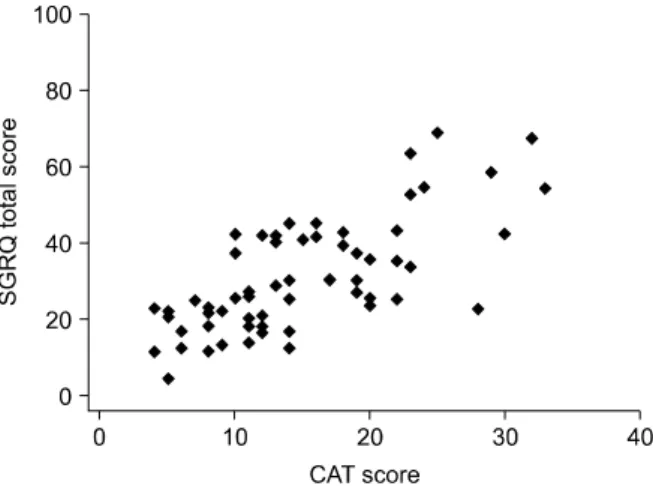
2) Correlation between Korean version CAT ques- tionnaire or Korean version Dyspnea-12 questionnaire, and Korean version SGRQ: The Korean version CAT questionnaire was strongly correlated with the Korean version SGRQ (Figure 1). Korean version Dyspnea-12 questionnaire also showed a significant correlation with Korean version SGRQ (Figure 2).

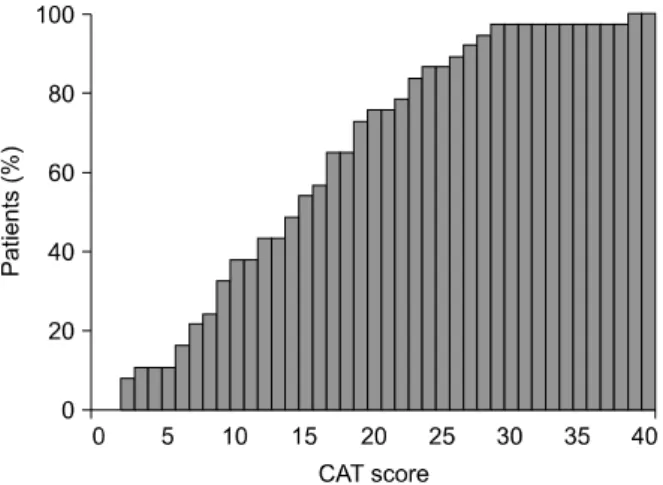
3) Distribution and internal consistency of Korean ver-

sion CAT questionnaire and Korean version Dyspnea-12

questionnaire: Most subjects scored 10 and 14 in Korean

version CAT questionnaire (n=5, 8.1%), and total score

was below 20 in 75% of the subjects (Figure 3). Most

of the subjects scored 0 in Korean version Dyspnea-12

questionnaire (n=15, 24.2%), and 36 (51.6%) of the sub-

jects scored from 0 to 3, implying that the scores of

Korean version CAT questionnaire and Korean version

Dyspnea-12 questionnaire were distributed mainly in

the low-score range (Figure 4). Cronbach's α coeffi-

(4)

Figure 1. Correlation between chronic obstructive pulmo- nary disease assessment test (CAT) score and St.

George's Respiratory Questionnaire (SGRQ) total score in bronchiectasis patients (r=0.72, p<0.0001; 62 patients).

Figure 2. Correlation between Dyspnea-12 score and St.

George's Respiratory Questionnaire (SGRQ) total score in bronchiectasis patients (r=0.67, p<0.0001; 62 patients).

Figure 3. Cumulative frequency distribution of chronic ob- structive pulmonary disease assessment test (CAT) score in 62 bronchiectasis patients.

Figure 4. Cumulative frequency distribution of Dyspnea- 12 score in 62 bronchiectasis patients.

cients representing internal consistency of Korean ver- sion CAT questionnaire and Korean version Dyspnea-12 questionnaire were 0.84 and 0.90, respectively.

4) Correlation between Korean version CAT ques- tionnaire or Korean version Dyspnea-12 questionnaire, and pulmonary function test: In patients with bron- chiectasis, no significant correlation was observed be- tween Korean version CAT questionnaire and pulmo- nary function test. With Korean version Dyspnea-12 questionnaire, both FEV

1

and FVC showed a significant negative correlation (Table 2).

2. Tuberculous destroyed lung

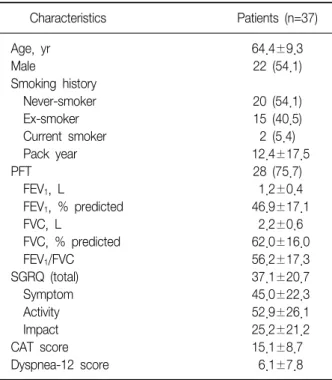
1) Characteristics of the subjects: Thirty seven pa- tients were enrolled to this study and their mean age was 64.4 years. Most of the subjects were male and non-smokers (Table 3).

In average, spirometry showed moderate airflow obstruction.

2) Correlation between Korean version CAT ques-

tionnaire or Korean version Dyspnea-12 questionnaire,

and Korean version SGRQ: The Korean version CAT

questionnaire was strongly correlated with the Korean

version SGRQ in patients with tuberculous destroyed

(5)

Table 2. Correlation between the questionnaires and pulmonary function test in 62 bronchiectasis patients

CAT score Dyspnea-12 score SGRQ total score

FEV

1

, % predicted −0.01 (0.96)* −0.37 (0.019) −0.29 (0.073)

FVC, % predicted −0.02 (0.91) −0.32 (0.045) −0.34 (0.037)

*Correlation coefficients with p-values in parentheses.

CAT: chronic obstructive pulmonary disease assessment test; SGRQ: St. George's Respiratory Questionnaire; FEV

1

: forced expiratory volume in 1 second; FVC: forced vital capacity.

Table 3. Characteristics of tuberculous destroyed lung pa- tients

Characteristics Patients (n=37)

Age, yr 64.4±9.3

Male 22 (54.1)

Smoking history

Never-smoker 20 (54.1)

Ex-smoker 15 (40.5)

Current smoker 2 (5.4)

Pack year 12.4±17.5

PFT 28 (75.7)

FEV

1

, L 1.2±0.4

FEV

1

, % predicted 46.9±17.1

FVC, L 2.2±0.6

FVC, % predicted 62.0±16.0

FEV

1

/FVC 56.2±17.3

SGRQ (total) 37.1±20.7

Symptom 45.0±22.3

Activity 52.9±26.1

Impact 25.2±21.2

CAT score 15.1±8.7

Dyspnea-12 score 6.1±7.8

Values are presented as mean±SD or number (%).

PFT: pulmonary function test; FEV

1

: forced expiratory volume in 1 second; FVC: forced vital capacity; SGRQ: St. George Respiratory Questionnaire; CAT: chronic obstructive pulmonary disease assessment test; SD: standard deviation.

Figure 5. Correlation between chronic obstructive pulmo- nary disease assessment test (CAT) score and St.

George's Respiratory Questionnaire (SGRQ) total score in tuberculous destroyed lung patients (r=0.86, p<0.0001;

37 patients).

Figure 6. Correlation between Dyspnea-12 score and St.

George's Respiratory Questionnaire (SGRQ) total score in tuberculous destroyed lung patients (r=0.80, p<0.0001;

37 patients).

lung (Figure 5). In addition, Korean version Dyspnea-12 questionnaire also showed a significant correlation with Korean version SGRQ (Figure 6).

3) Distribution and internal consistency of Korean ver-

sion CAT questionnaire and Korean version Dyspnea-12

questionnaire: According to the result of Korean version

CAT questionnaire, a 73% of the subjects scored less

than 20 (Figure 7). In Korean version Dyspnea-12 ques-

tionnaire, most of the subjects scored 0 (n=7, 18.9%),

and 22 (45.9%) of the subjects scored from 0 to 2, im-

(6)

Figure 7. Cumulative frequency distribution of chronic ob- structive pulmonary disease assessment test (CAT) score in 37 tuberculous destroyed lung patients.

Figure 8. Cumulative frequency distribution of dyspnea-12 score in 37 tuberculous destroyed lung patients.

Table 4. Correlation between questionnaires and pulmonary function test in 37 tuberculous destroyed lung patients

CAT score Dyspnea-12 score SGRQ total score

FEV

1

, % predicted −0.27 (0.16)* −0.29 (0.13) −0.30 (0.12)

FVC, % predicted −0.29 (0.13) −0.29 (0.13) −0.30 (0.12)

*Correlation coefficients with p-values in parentheses.

CAT: chronic obstructive pulmonary disease assessment test; SGRQ: St. George's Respiratory Questionnaire; FEV

1

: forced expiratory volume in 1 second; FVC: forced vital capacity.

plying that the scores of Korean version CAT and Korean version Dyspnea-12 questionnaire were dis- tributed mainly in the low-score range (Figure 8).

Cronbach's α coefficients representing internal con- sistency of Korean version CAT questionnaire and Korean version Dyspnea-12 questionnaire were 0.88 and 0.94, respectively.

4) Correlation between Korean version CAT ques- tionnaire or Korean version Dyspnea-12 questionnaire, and pulmonary function test: No significant correlation was observed between Korean version CAT ques- tionnaire and pulmonary function test in patients with tuberculous destroyed lung. Korean version Dyspnea-12 questionnaire did not show a significant correlation with pulmonary function test, either (Table 4).

Discussion

The results from this study demonstrated that the

Korean version CAT questionnaire and the Korean ver- sion Dyspnea-12 questionnaire are significantly corre- lated with the Korean version SGRQ in patients with bronchiectasis and also those with tuberculous de- stroyed lung. Also, its internal consistency appeared to be good. We used Pearson's correlation analysis for convergent validity and Cronbach's α coefficient was applied to confirm internal reliability.

The annual incidence of pulmonary tuberculosis is still globally high with approximately 8.8 million

15

. Although patients can be microbiologically cured with appropriate treatment, it can result in residual anatomi- cal and functional changes

16

. Moreover, the burden of diseases affecting HRQL is considered to be high, but only a few studies have been conducted regarding the HRQL of patients with tuberculous destroyed lung.

Bronchiectasis is a disease characterized by the irre-

versible bronchial dilation and deformity as a result of

the destruction of bronchial muscle and its elastic tissue.

(7)

Symptoms include cough, sputum and dyspnea, which are similar to those of COPD and tuberculous destroyed lung

17

. In present study, we evaluated the validity and reliability of Korean version CAT questionnaire, which was previously developed as a simple tool for assessing quality of life in patients with COPD, in patients with bronchiectasis and tuberculous destroyed lung. To our knowledge, there has not been a disease-specific tool to assess HRQL in these diseases, to date.

In our study, the correlation between the results of pulmonary function test and the scores of Korean ver- sion CAT questionnaire was found to be low and stat- istically insignificant. In previous studies, significant, but low correlation between pulmonary function test results and SGRQ in chronic pulmonary disease have been re- ported

5-7

. Similar result was reported by another study regarding the validity and reliability of Korean version CAT in COPD patients

10

. These results reflect that each individual's physiological profile such as FEV

1

does not necessarily determine one's quality of life by itself.

However, the significance of these correlation analyses might have been underestimated due to small sample size.

The study results showed that both Korean version CAT score and Korean version Dyspnea-12 Question- naire score were distributed at a relatively low-score range. This type of distribution might be due to the fact that most patients participated in this study visited out- patient clinics with moderate to mild symptoms. How- ever, despite this limitation, these assessment tools may be applicable to patients in routine practice as most pa- tients in routine practice are clinically stable.

Korean version CAT questionnaire does not have any item to assess hemoptysis and recurrent infection which are common symptoms of bronchiectasis, and accord- ingly, this might have limited reflecting disease-specific aspects. Since this was not evaluated in our study, fur- ther studies will be required to determine whether Korean version CAT questionnaire reflects the changes in disease-specific symptoms or symptoms accompanied by exacerbation.

In summary, we have confirmed the validity and the

reliability of Korean version CAT questionnaire and Korean version Dyspnea-12 questionnaire in patients with bronchiectasis and tuberculous destroyed lung.

Since these two questionnaires are composed of simple items, patients can easily complete in a short period of time, thereby making them more convenient tools for assessing quality of life in routine practice.

Acknowledgements

This study was supported by a grant of the Korea Healthcare Techonology R&D project, Ministry for Health and Welfare, Republic of Korea (A102065).

References

1. Guyatt GH, Feeny DH, Patrick DL. Measuring health- related quality of life. Ann Intern Med 1993;118:622-9.

2. Curtis JR, Martin DP, Martin TR. Patient-assessed health outcomes in chronic lung disease: what are they, how do they help us, and where do we go from here? Am J Respir Crit Care Med 1997;156(4 Pt 1):1032-9.

3. Jones PW, Bosh TK. Quality of life changes in COPD patients treated with salmeterol. Am J Respir Crit Care Med 1997;155:1283-9.

4. Jones PW, Quirk FH, Baveystock CM. The St George's Respiratory Questionnaire. Respir Med 1991;85 Suppl B:25-31.

5. Kim YS, Byun MK, Jung WY, Jeong JH, Choi SB, Kang SM, et al. Validation of the Korean version of the St.

George's respiratory questionnaire for patients with chronic respiratory disease. Tuberc Respir Dis 2006;61:

121-8.

6. Pasipanodya JG, Miller TL, Vecino M, Munguia G, Bae S, Drewyer G, et al. Using the St. George respiratory questionnaire to ascertain health quality in persons with treated pulmonary tuberculosis. Chest 2007;132:

1591-8.

7. Wilson CB, Jones PW, O'Leary CJ, Cole PJ, Wilson R.

Validation of the St. George's Respiratory Question- naire in bronchiectasis. Am J Respir Crit Care Med 1997;156(2 Pt 1):536-41.

8. Lee BH, Kim YS, Lee KD, Lee JH, Kim SH. Health-re- lated quality of life measurement with St. George's res- piratory questionnaire in post-tuberculous destroyed lung. Tuberc Respir Dis 2008;65:183-90.

9. Jones PW, Harding G, Berry P, Wiklund I, Chen WH,

(8)

Kline Leidy N. Development and first validation of the COPD Assessment Test. Eur Respir J 2009;34:648-54.

10. Lee S, Lee JS, Song JW, Choi CM, Shim TS, Kim TB, et al. Validation of the Korean version of chronic ob- structive pulmonary disease assessment test (CAT) and Dyspnea-12 questionnaire. Tuberc Respir Dis 2010;69:

171-6.

11. Stoller JK, Ferranti R, Feinstein AR. Further specification and evaluation of a new clinical index for dyspnea.

Am Rev Respir Dis 1986;134:1129-34.

12. Yorke J, Moosavi SH, Shuldham C, Jones PW. Quantifi- cation of dyspnoea using descriptors: development and initial testing of the Dyspnoea-12. Thorax 2010;65:21-6.

13. Lee JH, Chang JH. Lung function in patients with

chronic airflow obstruction due to tuberculous de- stroyed lung. Respir Med 2003;97:1237-42.

14. Choi JK, Paek D, Lee JO. Normal predictive values of spirometry in korean population. Tuberc Respir Dis 2005;58:230-42.

15. World Health Organization. Global tuberculosis con- trol: WHO report 2011. Geneva: World Health Organi- zation; 2011.

16. Pasipanodya JG, Miller TL, Vecino M, Munguia G, Garmon R, Bae S, et al. Pulmonary impairment after tuberculosis. Chest 2007;131:1817-24.

17. Barker AF. Bronchiectasis. N Engl J Med 2002;346:1383-

93.

수치

Table  1.  Characteristics  of  bronchiectasis  patients Characteristics Patients  (n=62) Age,  yr 60.7±8.3 Male   29  (46.8) Smoking  history      Never-smoker   42  (67.7)     Ex-smoker 18  (29)     Current  smoker   2  (3.2)     Pack  year     6.5±13.0
Figure 1. Correlation between chronic obstructive pulmo- pulmo-nary  disease  assessment  test  (CAT)  score  and  St
Figure 5. Correlation between chronic obstructive pulmo- pulmo-nary  disease  assessment  test  (CAT)  score  and  St
Figure 7. Cumulative frequency distribution of chronic ob- ob-structive pulmonary disease assessment test (CAT) score  in  37  tuberculous  destroyed  lung  patients

참조

관련 문서

Item Analysis using Classical Test Theory and Item Response Theory, Validity and Reliability of the Korean version of a Pressure Ulcer Prevention Knowledge.. Kang, Myung Ja 1

Objective: This study was conducted to identify the clinical usefulness, validity, and reliability of the Spirokit, a device that com- bines the pulmonary function test

Purpose: This research was carried out to evaluate the validity and reliability of the Korean version of the Summary of Diabetes Self-Care Activities Questionnaire (SDSCA)

Abstract The purpose of this study was to examine the validity and reliability of the Korean version of the nursing students' perception of instructor caring (NSPIC) scale

Reliability and Validity of the Korean Version of Presenteeism Scale for Students (K-PSS) in Nursing Students.. Kim, Jin Hee 1) ·

Validity and Reliability of the Korean Version Scale of the Clinical Learning Environment, Supervision and Nurse Teacher Evaluation Scale (CLES+T).. Kim, Sun-Hee 1 · Yoo, So Yeon 2

Validity and Reliability of Korean Version of the Family Management Measure (Korean FaMM) for Families with Children having Chronic Illness.. Kim, Dong Hee 1 · Im,

To assess criterion validity, the Korean version of the FACT-G (version 4) , developed by Cella et al. [15] and validated for Ko- rean patients with cancer by Kim et al. [16], was