• 검색 결과가 없습니다.

Relationship of Vitamin D Binding Protein Polymorphisms and Lung Function in Korean Chronic Obstructive Pulmonary Disease

N/A
N/A
Protected

Academic year: 2022

Share "Relationship of Vitamin D Binding Protein Polymorphisms and Lung Function in Korean Chronic Obstructive Pulmonary Disease"

Copied!
8
0
0

로드 중.... (전체 텍스트 보기)

전체 글

(1)

Relationship of Vitamin D Binding Protein

Polymorphisms and Lung Function in Korean Chronic Obstructive Pulmonary Disease

Ji Ye Jung,

1

* Dong Pil Choi,

2

* Sungho Won,

3

Young Lee,

4

Ju Hye Shin,

1

Young Sam Kim,

1

Se Kyu Kim,

1

Yeon Mok Oh,

5

Il Suh,

2

and Sang-Do Lee

5

1

Division of Pulmonology, Department of Internal Medicine, Institute of Chest Disease, Yonsei University College of Medicine, Seoul;

2

Department of Preventive Medicine, Yonsei University College of Medicine, Seoul;

3

Department of Epidemiology and Biostatistics, School of Public Health, Seoul National University, Seoul;

4

The Center for Genome Science, Korea National Institute of Health, KCDC, Osong;

5
Department of Pulmonary and Critical Care Medicine, Clinical Research Center for Chronic Obstructive Airway Diseases, Asan Medical Center, University of Ulsan College of Medicine, Seoul, Korea.

Received: September 13, 2013 Revised: January 11, 2014 Accepted: January 28, 2014 Co-corresponding authors: Dr. Il Suh, Department of Preventive Medicine, Yonsei University College of Medicine, 50-1 Yonsei-ro, Seodaemun-gu, Seoul 120-752, Korea.

Tel: 82-2-2228-1873, Fax: 82-2-392-8133 E-mail: [email protected] and

Dr. Sang-Do Lee,

Department of Pulmonary and Critical Care Medicine,

Clinical Research Center for Chronic Obstructive Airway Diseases, Asan Medical Center,

University of Ulsan College of Medicine, 88 Olympic-ro 43-gil, Songpa-gu, Seoul 138-736, Korea.

Tel: 82-2-3010-3140, Fax: 82-2-3010-6968 E-mail: [email protected]

*Ji Ye Jung and Dong Pil Choi contributed equally to this work.

∙ The authors have no financial conflicts of interest.

© Copyright:

Yonsei University College of Medicine 2014 This is an Open Access article distributed under the terms of the Creative Commons Attribution Non- Commercial License (http://creativecommons.org/

licenses/by-nc/3.0) which permits unrestricted non- commercial use, distribution, and reproduction in any medium, provided the original work is properly cited.

Purpose: Multiple genetic factors are associated with chronic obstructive pulmo- nary disease (COPD). The association of gene encoding vitamin D binding protein (VDBP, GC) with COPD has been controversial. We sought to investigate the types of GC variants in the Korean population and determine the association of GC variants with COPD and lung function in the Korean population. Materials and Methods: The study cohort consisted of 203 COPD patients and 157 control subjects. GC variants were genotyped by the restriction fragment-length polymor- phism method. Repeated measures of lung function data were analyzed using a linear mixed model including sex, age, height, and pack-years of smoking to in- vestigate the association of GC genetic factors and lung function. Results: GC1F variant was most frequently observed in COPD (46.1%) and controls (42.0%).

GC1S variant (29.0% vs. 21.4%; p=0.020) and genotype 1S-1S (8.3% vs. 3.4%;

p=0.047) were more commonly detected in control than COPD. According to lin- ear mixed model analysis including controls and COPD, subjects with genotype 1S-1S had 0.427 L higher forced expiratory volume in 1 second (FEV

1

) than those with other genotypes (p=0.029). However, interaction between the genotype and smoking pack-year was found to be particularly significant among subjects with genotype 1S-1S; FEV

1

decreased by 0.014 L per smoking pack-year (p=0.001).

Conclusion: This study suggested that GC polymorphism might be associated with lung function and risk of COPD in Korean population. GC1S variant and genotype 1S-1S were more frequently observed in control than in COPD. More- over, GC1S variant was more common in non-decliners than in rapid decliners among COPD.

Key Words: Vitamin D binding protein, polymorphism, lung function, chronic

obstructive pulmonary disease

(2)

examined the correlation between GC variants and lung function in COPD patients.

MATERIALS AND METHODS

Subjects

The COPD group consisting of 203 patients who were tak- en from the Korean Obstructive Lung Disease (KOLD) Cohort, in which patients with COPD or asthma have been enrolled from pulmonary clinics in 17 hospitals in South Korea from June 2005 to 2011, were selected for this study.

The subjects were culled from a KOLD Cohort that ful- filled the following criteria: post-bronchodilator ratio of forced expiratory volume in 1 second (FEV

1

) to forced vital capacity (FEV

1

/FVC) <0.7, over 40 years of age, smoking history of 10 or more pack-years, and no or minimal abnor- mality on chest radiography. The control group was select- ed from a community-based prospective cohort, South Ko- rea. Among 2534 people recruited in 2006, 157 participants had a normal pulmonary function test, 10 or more pack-years of smoking history, and were over the age of 40. The study protocol was approved by the Institutional Review Boards of the 17 hospitals included in the KOLD Cohort and the com- munity-based prospective cohort for control group, and in- formed written consent was obtained from all patients.

Pulmonary function testing

Spirometry was performed according to American Thoracic Society/European Respiratory Society guidelines. Airway obstruction is defined by Global Initiative for Chronic Ob- structive Lung Disease (GOLD) criteria as FEV

1

/FVC ratio of <0.7. The severity of the disease was based on the per- cent predicted FEV

1

in accordance with GOLD criteria.

28

For COPD patients, pulmonary function tests (PFTs) were performed at follow-up visits annually and PFT was per- formed at least two times in 178 (87.6%) with an average of 3.7 times during the study.

Genotyping

For genotyping GC, DNA was extracted from blood and polymerase chain reaction (PCR) was performed followed by restriction fragment-length polymorphism analysis. The region that includes the two point mutation sites in exon 11 (Glu/Asp 416 and Thr/Lys 420) was amplified.

27

We used upstream primer of 5ʼTAATGAGCAAATGAAAGAAG3ʼ and downstream primer of 5ʼTGAGTAGATTGGAG-

INTRODUCTION

The most critical risk factor for the development of chronic obstructive pulmonary disease (COPD) is cigarette smok- ing.

1

However, only 10--20% of heavy smokers develop air- way obstruction and --20--30% of COPD patients never smoke.

2-6

Moreover, previous reports of familial aggregation of COPD suggest that genetic components are likely associ- ated with susceptibility to the development of COPD.

7,8

Numerous candidate genes have been reported to be as- sociated with COPD. These genes are generally related to protease-antiprotease interaction, antioxidant effects, xeno- biotic metabolism, and inflammation and immune response pathways.

9

One of the candidates involved in inflammation and immune reaction is the gene encoding vitamin D bind- ing protein (VDBP, GC).

VDBP was first described by Hirschfeld in 1959 as a mark- er in gamma-globulin of human serum and characterized as a group-specific component.

10

In 1975, it was identified as the plasma protein that binds vitamin D.

11

The major role of VDBP is transporting 25-hydroxyvitamin D, the major cir- culating form of vitamin D, and 1,25-dihydroxyvitamin D, the most active vitamin D metabolite. However, when ex- pressed by neutrophils, VDBP activates macrophages and augments monocyte and neutrophil chemotaxis.

12-15

These roles of VDBP may contribute to the chronic inflammatory response in COPD.

GC, located on chromosome 4, is approximately 42 kb in size and has more than 120 reported variants.

16

Most of the variants are rare except three commonly recognized vari- ants according to single nucleotide polymorphisms at rs4588 and rs7041 in exon 11: GC1F (A/G), GC1S (A/T), and GC2 (C/G).

17

The association of these VDBP polymorphisms and the risk for COPD has been debated in the literature for some time.

9,18-26

GC2 tended to be protective variants for COPD in Caucasian populations and GC1F tended to be risk variants for COPD in Asian populations.

27

However, Asian studies were conducted in the limited ethnicities, and GC variants were not evaluated in South Korea. Moreover, the studies were conducted in a small number of patients and the relationship with lung function decline was rarely investigated.

20

The purpose of this study was to evaluate the frequencies

of GC variants in Koreans with COPD as well as healthy

subjects. We determined that certain GC variants are associ-

ated with a genetic susceptibility to COPD in Koreans and

(3)

at the 0.05 significance level was conducted with the linear mixed model to consider correlation between repeated mea- sures. COPD patients and control subjects were included for linear mixed model and COPD indicator was included as dummy variable to explain their mean differences. We also found the heteroscedasticity between COPD patients and control subjects, and a different variance-covariance ma- trix was applied. The optimal correlation structure between repeated observations was selected with the likelihood ratio test based on the restricted maximum likelihood method and the unstructured correlation format was chosen.

29,30

Age, sex, height, pack-year, and their interactions were included as co- variates and the significant interactions were selected with likelihood ratio test based on the maximum likelihood method. Marginal effects are all included in our final mod- el. In all analyses, a p-value <0.05 was deemed to be statis- tically significant.

RESULTS

Population characteristics

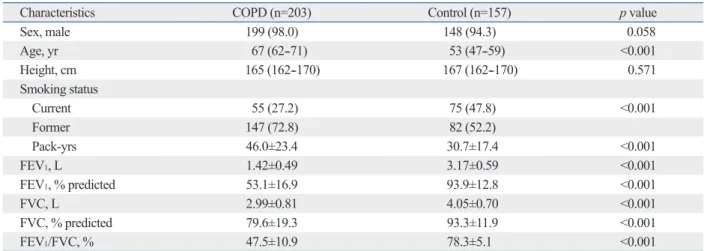
All baseline characteristics of the study population are sum- marized in Table 1. Both groups exhibited a similar gender distribution of significant male dominance. COPD patients were also of more advanced age than the control popula- tion. The number of current smokers was higher in controls compared to COPD group, whereas former smokers were more prevalent in the COPD group than controls. Among COPD patients, 17 (8.4%), 101 (49.8%), 73 (36.0%), and 12 (5.9%) patients were classified as GOLD class I, II, III and IV.

Genotyping

The frequency of each variant and genotype in COPD and control groups are compared in Table 2. Each of the investi- gated single nucleotide polymorphisms (rs4588 and rs7041) was in HWE in the controls (all p>0.05). Frequencies of GC1F, GC1S, and GC2 variants in COPD patients were 46.1%, 21.4%, and 32.5%, respectively, and 42.0%, 29.0%, and 29.0%, in controls, respectively. GC1S variant was more frequent in controls than COPD patients (29.0% vs.

21.4%; p=0.020). There were no significant differences in sex ratio, age, and smoking history between the different types of genotypes. Genotype 1F-2 was most common in both groups and genotype 1S-1S was significantly more frequent in control than COPD (8.3% vs. 3.4%; p=0.047).

TGCATAC3ʼ.

20,25

The final PCR product was a fragment of 462 base pairs (bp).

PCR was performed in a thermal cycler (DNA Thermal Cycler; Perkin Elmer Cetus; Norwalk, CT, USA). PCR re- actions were carried out in a volume of 40 μL containing 100 ng DNA, 1.5 mM MgCl

2

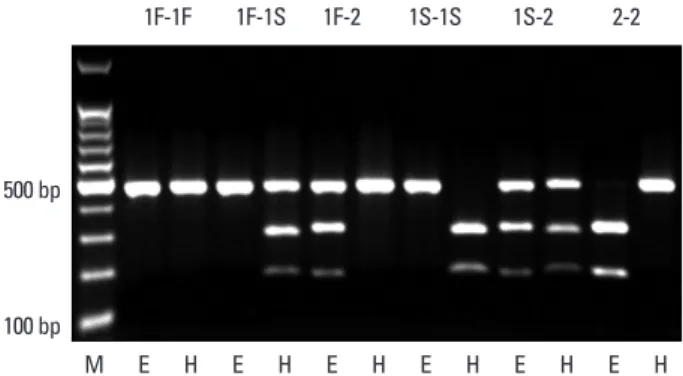
, 10 mM Tris Cl (pH 8.3), 40 mM KCl, 4% dimethyl sulphoxide, 0.2 mL of each dNTP (Amersham Biosciences KK; Tokyo, Japan), 0.5 μmol/L of each primers, and 3.75 units of Taq DNA polymerase (Bi- oneer, Daejeon, Korea). After amplification, PCR products were digested with Hae III (Toyobo; Osaka, Japan), or Eco T14 I (Takara Bio; Otsu, Japan) at 37°C overnight. Hae III cuts the GC1S product into two bands of 295 bp and 167 bp, whereas Eco T14 I cuts the GC2 product into two bands of 302 bp and 156 bp. GC1F PCR product remains uncut by either enzyme (Fig. 1).

Definitions

Rapid decliners were defined as those with a decrease in FEV

1

≥3.0% predicted/yr and non-decliners as those with an increase in FEV

1

≥0% predicted/yr.

24

Data analysis

Differences in distribution and frequency of variants and genotypes among the groups were examined by chi-squared test. Normally distributed variables are presented as means

±standard deviations, and non-normally distributed vari- ables are presented as medians (interquartile range). Geno- type frequencies and Hardy-Weinberg equilibrium (HWE) for the GC between COPD and control groups were deter- mined by chi-squared test. Statistical inference of the geno- type effect on FEV

1

was conducted with the linear mixed model to consider correlation between annually measured FEV

1

. Statistical inference of the genotype effect on FEV

1

Fig. 1. Restriction fragment-length polymorphism analysis of GC. Eco T14 I cuts GC2 into two bands of 302 base pairs (bp) and 156 bp, whereas Hae III cuts GC1S into two bands of 295 bp and 167 bp. GC1F remains uncut by ei- ther of the enzymes (E: digested by Eco T14 I, H: digested by Hae III).

100 bp 500 bp

M E H E H E H E H E H E H

1F-1F 1F-1S 1F-2 1S-1S 1S-2 2-2

(4)

FEV

1

=0.488-0.013×age (year)+0.027×height (cm)-0.012×

smoking pack-years-1.711 (for COPD group with genotype 1S-1S); FEV

1

=0.488-0.013×age (year)+0.027×height (cm) +0.002×smoking pack-years-2.649 (for COPD group with- out genotype 1S-1S).

DISCUSSION

The potential association of polymorphisms in GC with the risk of COPD and lung function was investigated for the first time in a Korean population. Subjects with GC1S vari- ant and genotype 1S-1S were more commonly observed in control than in COPD. Moreover, GC1S variant was more frequent in non-decliners than in rapid decliners among COPD. According to the linear mixed model analysis, gen- Comparison between rapid decliners and non-decliners

Table 3 shows the comparison of characteristics and geno- types between 62 rapid decliners and 74 non-decliners.

Baseline characteristics including sex ratio, age, and spirom- etry data were not different between the two groups. In com- paring the variants and genotypes, GC1S variant was more frequently observed in non-decliners (26.4% vs. 16.1%, p=0.042) and genotype 1F-2 was more frequently observed in rapid decliners (37.1% vs. 21.6%, p=0.047).

Parameters associated with FEV

1

according to linear mixed model analysis

The difference in FEV

1

between different genotypes was in- vestigated by linear mixed model analysis including sex, age, height, and pack-years of smoking as shown in Table 4.

FEV

1

was 2.649 L lower in COPD compared to controls (p<0.001), 0.345 L lower in females than in males (p=0.014), and 0.033 L lower per year of age (p<0.001). Moreover, as stature increased by 1 cm, FEV

1

also increased by 0.027 L (p<0.001). Among the different genotypes, subjects with genotype 1S-1S had 0.427 L higher FEV

1

than those with other genotypes (p=0.029). The genotype/smoking pack- year interaction was found to be particularly significant among subjects with genotype 1S-1S; FEV

1

decreased by 0.014 L per smoking pack-year (p=0.001).

According to the linear mixed model analysis, the final equations were obtained as follows: FEV

1

=0.488-0.033×

age (year)+0.027×height (cm)-0.012×smoking pack-years +0.427 (for control group with genotype 1S-1S); FEV

1

= 0.488-0.033×age (year)+0.027×height (cm)+0.002×smok- ing pack-years (for control group without genotype 1S-1S);

Table 1. Baseline Characteristics of the Study Population*

Characteristics COPD (n=203) Control (n=157) p value

Sex, male 199 (98.0) 148 (94.3) 0.058

Age, yr 67 (62--71) 53 (47--59) <0.001

Height, cm 165 (162--170) 167 (162--170) 0.571

Smoking status

Current 55 (27.2) 75 (47.8) <0.001

Former 147 (72.8) 82 (52.2)

Pack-yrs 46.0±23.4 30.7±17.4 <0.001

FEV

1

, L 1.42±0.49 3.17±0.59 <0.001

FEV

1

, % predicted 53.1±16.9 93.9±12.8 <0.001

FVC, L 2.99±0.81 4.05±0.70 <0.001

FVC, % predicted 79.6±19.3 93.3±11.9 <0.001

FEV

1

/FVC, % 47.5±10.9 78.3±5.1 <0.001

COPD, chronic obstructive pulmonary disease; FEV

1

, forced expiratory volume in 1 s; FVC, forced vital capacity.

*Data are presented as numbers (percentages) for categorical variables. Continuous variables are presented as means±standard deviations or median (interquartile range).

Table 2. Variant and Genotype Frequency of GC in COPD and Control Groups*

Variables COPD (n=203) Control (n=157) p value Variant

GC1F 187 (46.1) 132 (42.0) 0.281

GC1S 87 (21.4) 91 (29.0) 0.020

GC2 132 (32.5) 91 (29.0) 0.309

Genotype

1F-1F 45 (22.2) 34 (21.7) 0.907 1F-1S 41 (20.2) 31 (19.7) 0.915

1F-2 56 (27.6) 33 (21.0) 0.198

1S-1S 7 (3.4) 13 (8.3) 0.047

1S-2 32 (15.8) 34 (21.7) 0.199

2-2 22 (10.8) 12 (7.6) 0.304

COPD, chronic obstructive pulmonary disease.

*Data are presented as numbers (percentages).

(5)

nese population. In another Japanese study, Ito, et al.

20

re- ported a higher frequency of genotype 1F-1F in COPD pa- tients than in controls (32% vs. 17%, p=0.014). In a Chinese population, Lu, et al.

23

suggested that GC1F variant and genotype 1F-1F were risk factors for COPD (55.8% vs.

40.4%, p=0.018; 33.3% vs. 11.5%, p=0.005). In a Canadian Caucasian population, Horne, et al.

18

reported GC2 variant and genotype 2-2 were less frequently observed in a COPD group. Relative risks of genotype 2-2, 2-1S, 2-1F for COPD were 0.8, 0.7, and 0.5, respectively. Moreover, they stated that GC1F variant was a significant risk factor for COPD (relative risk=4.8). Schellenberg, et al.

25

were able to con- firm that genotype 2-2 was protective against COPD (odds ratio=0.17, 95% CI 0.03--0.83). In an American population, Kueppers, et al.

31

also showed genotype 2-2 as a protective factor for COPD (relative risk=0.2). Despite all these re- ports, several studies have failed to show association be- tween GC polymorphisms and COPD.

24,32

Most of these studies were conducted with a cross-sec- tional design, such that only the frequencies of certain GC polymorphisms were compared between COPD and con- otype 1S-1S showed higher initial FEV

1

than other geno-

types. However, FEV

1

decreased more in 1S-1S patients than in other genotypes as smoking pack-years increased.

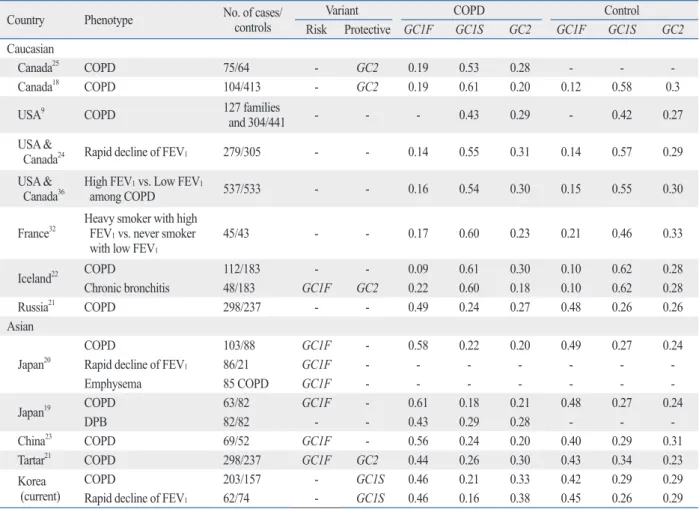
Frequencies of the different genotypes previously dis- cussed vary based on ethnicity (Table 4). In the Japanese population, GC1F variant is most commonly observed, comprising approximately half of the population (0.58-- 0.61 in COPD and 0.48--0.49 in control). In Caucasians, GC1S variant is most common with a frequency of 0.53-- 0.61 in COPD and 0.58 in controls.

19,20

The Korean popula- tion in this study showed a similar distribution to the Japa- nese population.

18,25

GC1F variant was most frequent in COPD (0.46) and control group (0.42), although its fre- quency was smaller than that in a Japanese population.

Prior investigations have demonstrated different results regarding the association between polymorphisms in GC and risk of COPD; however, studies focusing on Asian pop- ulations have only been in Chinese and Japanese cohorts.

Ishii, et al.

19

reported GC1F variant and genotype 1F-1F were significantly higher in COPD than in control (85.7%

vs. 75.6%, p=0.036; 36.5% vs. 20.7%, p=0.035) in a Japa-

Table 3. Characteristics of Subjects with COPD Classified by Annual Rates of Decline in FEV

1

*

Characteristics Rapid decliners (n=62) Non-decliners (n=74) p value

Sex, male 61 (98.4) 73 (98.6) -

Age, yr 65.5 (61--70) 67 (61--70) 0.896

Smoking status

Current 13 (21.3) 26 (35.1) 0.078

Former 48 (78.7) 48 (64.9)

Pack-yrs 44.7±18.1 49.9±28.5 0.197

FEV

1

, L 1.58±0.49 1.52±0.54 0.482

FEV

1

, % predicted 61.4±18.7 55.4±17.8 0.058

FVC, L 3.30±0.90 3.08±0.78 0.135

FVC, % predicted 88.2±23.3 80.4±19.3 0.036

FEV

1

/FVC, % 48.5±10.3 48.9±11.1 0.798

Variant

GC1F 57 (46.3) 67 (45.3) 0.860

GC1S 20 (16.1) 39 (26.4) 0.042

GC2 47 (37.9) 42 (28.4) 0.095

Genotype

1F-1F 12 (19.4) 16 (21.6) 0.745

1F-1S 10 (16.1) 19 (25.7) 0.176

1F-2 23 (37.1) 16 (21.6) 0.047

1S-1S 2 (3.2) 3 (4.1) -

1S-2 6 (9.7) 14 (18.9) 0.130

2-2 9 (14.5) 6 (8.1) 0.235

COPD, chronic obstructive pulmonary disease; FEV

1

, forced expiratory volume in 1 s; FVC, forced vital capacity.

*Data are presented as numbers (percentages) for categorical variables. Continuous variables are presented as means±standard deviations or median

(interquartile range).

(6)

strated vitamin D deficiency is associated with many types of chronic disease and these chronic diseases are all co- morbidities of COPD. Moreover, vitamin D deficiency is a risk factor of lung function decline in COPD through dys- regulation of adaptive and innate immunity. Janssens, et al.

33

reported that vitamin D deficiency correlates with the se- verity of COPD and certain types of GC polymorphisms are associated with reduced vitamin D levels.

34

Moreover, VDBP enhances the chemotactic activity of C5-derived peptides on human neutrophils and monocytes. Enzymatic processing of the carbohydrate side-chain of VDBP trans- forms the molecule into a potent macrophage-activating factor (MAF). In turn, VDBP-MAF stimulates macrophage activity. Recently, Wood, et al.

35

reported that the GC2 gen- otype is less efficient at converting VDBP to VDBP-MAF.

However, there are limitations to the present study. First, the sex and age between the two groups were not exactly matched. The COPD group was comprised of slightly more males and older subjects compared to the control group.

Though the effect of age was adjusted for by statistical trol groups. A few studies demonstrated the relationship of

GC polymorphisms with lung function decline through lon- gitudinal analysis.

20,24

Although Sandford, et al.

24

reported no difference between fast decliners and non-decliners, Ito, et al.

20

showed that GC1F variant still is a risk factor for rapid lung function decline even in a longitudinal analysis.

However, in the latter, the number of subjects with available follow-up lung function data was small and the follow-up duration of 1 year may not be long enough to accurately ana- lyze lung function decline. The size of the subjects in our study is too small to demonstrate the effect of GC polymor- phisms on COPD and lung function. However, we have an- alyzed all the follow-up lung function data of subjects with longer duration of follow-up using a linear mixed model.

There are several possible explanations for the associa- tion between GC polymorphisms and lung function de- cline. The major role of VDBP is to bind and transport vita- min D. Vitamin D is essential for maintaining normal bone growth and calcium homeostasis, but it also contributes to immune modulation. Epidemiologic research has demon-

Table 4. Frequency of GC Polymorphism and the Risk of Chronic Obstructive Pulmonary Disease in Other Countries

Country Phenotype No. of cases/

controls Variant COPD Control

Risk Protective GC1F GC1S GC2 GC1F GC1S GC2

Caucasian

Canada

25

COPD 75/64 - GC2 0.19 0.53 0.28 - - -

Canada

18

COPD 104/413 - GC2 0.19 0.61 0.20 0.12 0.58 0.3

USA

9

COPD 127 families

and 304/441 - - - 0.43 0.29 - 0.42 0.27

USA &

Canada

24

Rapid decline of FEV

1

279/305 - - 0.14 0.55 0.31 0.14 0.57 0.29

USA &

Canada

36

High FEV

1

vs. Low FEV

1

among COPD 537/533 - - 0.16 0.54 0.30 0.15 0.55 0.30

France

32

Heavy smoker with high FEV

1

vs. never smoker

with low FEV

1

45/43 - - 0.17 0.60 0.23 0.21 0.46 0.33

Iceland

22

COPD 112/183 - - 0.09 0.61 0.30 0.10 0.62 0.28

Chronic bronchitis 48/183 GC1F GC2 0.22 0.60 0.18 0.10 0.62 0.28

Russia

21

COPD 298/237 - - 0.49 0.24 0.27 0.48 0.26 0.26

Asian

Japan

20

COPD 103/88 GC1F - 0.58 0.22 0.20 0.49 0.27 0.24

Rapid decline of FEV

1

86/21 GC1F - - - - - - -

Emphysema 85 COPD GC1F - - - - - - -

Japan

19

COPD 63/82 GC1F - 0.61 0.18 0.21 0.48 0.27 0.24

DPB 82/82 - - 0.43 0.29 0.28 - - -

China

23

COPD 69/52 GC1F - 0.56 0.24 0.20 0.40 0.29 0.31

Tartar

21

COPD 298/237 GC1F GC2 0.44 0.26 0.30 0.43 0.34 0.23

Korea

(current) COPD 203/157 - GC1S 0.46 0.21 0.33 0.42 0.29 0.29

Rapid decline of FEV

1

62/74 - GC1S 0.46 0.16 0.38 0.45 0.26 0.29

COPD, chronic obstructive pulmonary disease; USA, United States of America; FEV

1

, forced expiratory volume in 1 s; DPB, diffuse panbronchiolitis.

(7)

REFERENCES

1. Snider GL. Chronic obstructive pulmonary disease: risk factors, pathophysiology and pathogenesis. Annu Rev Med 1989;40:411- 2. Behrendt CE. Mild and moderate-to-severe COPD in nonsmok- 29.

ers: distinct demographic profiles. Chest 2005;128:1239-44.

3. Bridevaux PO, Probst-Hensch NM, Schindler C, Curjuric I, Fel- ber Dietrich D, Braendli O, et al. Prevalence of airflow obstruction in smokers and never-smokers in Switzerland. Eur Respir J 2010;36:1259-69.

4. Fletcher C, Peto R. The natural history of chronic airflow obstruc- tion. Br Med J 1977;1:1645-8.

5. Kim DS, Kim YS, Jung KS, Chang JH, Lim CM, Lee JH, et al.

Prevalence of chronic obstructive pulmonary disease in Korea: a population-based spirometry survey. Am J Respir Crit Care Med 2005;172:842-7.

6. Lamprecht B, McBurnie MA, Vollmer WM, Gudmundsson G, Welte T, Nizankowska-Mogilnicka E, et al. COPD in never smok- ers: results from the population-based burden of obstructive lung disease study. Chest 2011;139:752-63.

7. Khoury MJ, Beaty TH, Newill CA, Bryant S, Cohen BH. Genetic- environmental interactions in chronic airways obstruction. Int J Epidemiol 1986;15:65-72.

8. Tager I, Tishler PV, Rosner B, Speizer FE, Litt M. Studies of the familial aggregation of chronic bronchitis and obstructive airways disease. Int J Epidemiol 1978;7:55-62.

9. Hersh CP, Demeo DL, Lange C, Litonjua AA, Reilly JJ, Kwiat- kowski D, et al. Attempted replication of reported chronic obstruc- tive pulmonary disease candidate gene associations. Am J Respir Cell Mol Biol 2005;33:71-8.

10. Hirschfeld J. Immune-electrophoretic demonstration of qualitative differences in human sera and their relation to the haptoglobins.

Acta Pathol Microbiol Scand 1959;47:160-8.

11. Daiger SP, Schanfield MS, Cavalli-Sforza LL. Group-specific component (Gc) proteins bind vitamin D and 25-hydroxyvitamin D. Proc Natl Acad Sci U S A 1975;72:2076-80.

12. Binder R, Kress A, Kan G, Herrmann K, Kirschfink M. Neutro- phil priming by cytokines and vitamin D binding protein (Gc- globulin): impact on C5a-mediated chemotaxis, degranulation and respiratory burst. Mol Immunol 1999;36:885-92.

13. Kew RR, Sibug MA, Liuzzo JP, Webster RO. Localization and quantitation of the vitamin D binding protein (Gc-globulin) in hu- man neutrophils. Blood 1993;82:274-83.

14. Piquette CA, Robinson-Hill R, Webster RO. Human monocyte chemotaxis to complement-derived chemotaxins is enhanced by Gc-globulin. J Leukoc Biol 1994;55:349-54.

15. Yamamoto N, Homma S. Vitamin D3 binding protein (group-spe- cific component) is a precursor for the macrophage-activating sig- nal factor from lysophosphatidylcholine-treated lymphocytes.

Proc Natl Acad Sci U S A 1991;88:8539-43.

16. Cooke NE, Willard HF, David EV, George DL. Direct regional as- signment of the gene for vitamin D binding protein (Gc-globulin) to human chromosome 4q11-q13 and identification of an associat- ed DNA polymorphism. Hum Genet 1986;73:225-9.

17. Cleve H, Constans J. The mutants of the vitamin-D-binding pro- tein: more than 120 variants of the GC/DBP system. Vox Sang 1988;54:215-25.

18. Horne SL, Cockcroft DW, Dosman JA. Possible protective effect

methods, some of the younger control subjects may yet de- velop COPD in the future. Moreover, cautious interpreta- tion of the results is needed because of the relatively small sample size, especially GC1S variant and genotype 1S-1S.

Analysis of lung function in control subjects was limited because follow-up lung function data were only available in five subjects of control group. Finally, vitamin D status is also an important factor in investigating the association of GC genotypes and lung function, but it was not included in this study.

In conclusion, this study suggested that GC polymor- phisms might be associated with COPD and lung function in Korean population. Subjects with GC1S variant and gen- otype 1S-1S were more common in control than in COPD.

GC1S variant was more frequent in non-decliners than in rapid decliners among COPD. The subjects with genotype 1S-1S showed higher initial FEV

1

than other genotypes.

However, genotype 1S-1S was associated with lower lung function in the context of cigarette smoking. As the amount of smoking in subjects with genotype 1S-1S increases, de- crease in lung function became more pronounced. To eluci- date the relationship of GC polymorphisms and lung func- tion in COPD, additional studies with larger number of subjects are required.

ACKNOWLEDGEMENTS

This study was supported by a grant of the Korea Healthcare technology R&D Project, Ministry of Health and Welfare (A102065), a grant of the Korea Centers for Disease Control and Prevention (2006-E71011-00), a faculty research grant of Yonsei University College of Medicine for 2011 (6-2011- 0192), and National Research Foundation of Korea Grant funded by the Korean Government (2013R1A1A 2010437).

All members of the Korean Obstructive Lung Disease

(KOLD) Study Group contributed to the recruitment of

COPD patients and also to the collection of data and sam-

ples: Ji-Hyun Lee, Eun Kyung Kim, Tae-Hyung Kim, Tae

Rim Shin, Kwang Ha Yoo, Seung Soo Sheen, Jin Hwa Lee,

Seong Yong Lim, Sang Yeub Lee, Ho Il Yoon, Yong Bum

Park, Yong Il Hwang, Young Sam Kim, Ji Ye Jung, Yoonki

Hong, Seung Won Ra, Joon Beom Seo, Sang Min Lee, Sei

Won Lee, Jae Seung Lee, Jin Won Huh, Ji Yong Moon,

Hye Kyeong Park, Hye Yun Park, Jin Woo Kim, Chin

Kook Rhee, Hyoung Kyu Yoon, Woo Jin Kim, Yeon-Mok

Oh, and Sang-Do Lee.

(8)

rax 2010;65:456-62.

28. Global Initiative for Chronic Obstructive Lung Disease. Global strategy for the diagnosis management, and prevention of chronic obstructive pulmonary disease (revised 2011). [accessed on 2012 March 9]. Available at: http://www.goldcopd.org/uploads/users/

files/GOLD_Report_2011_Feb21.pdf.

29. Neyman J, Pearson ES. On the problem of the most efficient tests of statistical hypotheses. Philos Trans R Soc Lond 1933;231:289- 30. Harville DA. Maximum likelihood approaches to variance com- 337.

ponent estimation and to related problems. J Am Stat Assoc 1977;72:320-38.

31. Kueppers F, Miller RD, Gordon H, Hepper NG, Offord K. Famil- ial prevalence of chronic obstructive pulmonary disease in a matched pair study. Am J Med 1977;63:336-42.

32. Kauffmann F, Kleisbauer JP, Cambon-De-Mouzon A, Mercier P, Constans J, Blanc M, et al. Genetic markers in chronic air-flow limitation. A genetic epidemiologic study. Am Rev Respir Dis 1983;127:263-9.

33. Janssens W, Bouillon R, Claes B, Carremans C, Lehouck A, Buysschaert I, et al. Vitamin D deficiency is highly prevalent in COPD and correlates with variants in the vitamin D-binding gene.

Thorax 2010;65:215-20.

34. Gomme PT, Bertolini J. Therapeutic potential of vitamin D-bind- ing protein. Trends Biotechnol 2004;22:340-5.

35. Wood AM, Bassford C, Webster D, Newby P, Rajesh P, Stockley RA, et al. Vitamin D-binding protein contributes to COPD by ac- tivation of alveolar macrophages. Thorax 2011;66:205-10.

36. Kasuga I, Paré PD, Ruan J, Connett JE, Anthonisen NR, Sandford AJ. Lack of association of group specific component haplotypes with lung function in smokers. Thorax 2003;58:790-3.

against chronic obstructive airways disease by the GC2 allele.

Hum Hered 1990;40:173-6.

19. Ishii T, Keicho N, Teramoto S, Azuma A, Kudoh S, Fukuchi Y, et al. Association of Gc-globulin variation with susceptibility to COPD and diffuse panbronchiolitis. Eur Respir J 2001;18:753-7.

20. Ito I, Nagai S, Hoshino Y, Muro S, Hirai T, Tsukino M, et al. Risk and severity of COPD is associated with the group-specific com- ponent of serum globulin 1F allele. Chest 2004;125:63-70.

21. Korytina GF, Akhmadishina LZ, Ianbaeva DG, Viktorova TV.

[Genotypes of vitamin-D-binding protein (DBP) in patients with chronic obstructive pulmonary disease and healthy population of Republic Bashkortostan]. Mol Biol (Mosk) 2006;40:231-8.

22. Laufs J, Andrason H, Sigvaldason A, Halapi E, Thorsteinsson L, Jónasson K, et al. Association of vitamin D binding protein vari- ants with chronic mucus hypersecretion in Iceland. Am J Pharma- cogenomics 2004;4:63-8.

23. Lu M, Yang B, Cai YY. [The relationship between vitamin D binding protein gene polymorphism and chronic obstructive pul- monary disease]. Zhonghua Nei Ke Za Zhi 2004;43:117-20.

24. Sandford AJ, Chagani T, Weir TD, Connett JE, Anthonisen NR, Paré PD. Susceptibility genes for rapid decline of lung function in the lung health study. Am J Respir Crit Care Med 2001;163:469- 25. Schellenberg D, Paré PD, Weir TD, Spinelli JJ, Walker BA, Sand- 73.

ford AJ. Vitamin D binding protein variants and the risk of COPD.

Am J Respir Crit Care Med 1998;157(3 Pt 1):957-61.

26. Bakke PS, Zhu G, Gulsvik A, Kong X, Agusti AG, Calverley PM, et al. Candidate genes for COPD in two large data sets. Eur Respir J 2011;37:255-63.

27. Chishimba L, Thickett DR, Stockley RA, Wood AM. The vitamin

D axis in the lung: a key role for vitamin D-binding protein. Tho-

수치

Fig. 1. Restriction fragment-length polymorphism analysis of GC. Eco T14 I  cuts GC2 into two bands of 302 base pairs (bp) and 156 bp, whereas Hae III  cuts GC1S into two bands of 295 bp and 167 bp
Table 3 shows the comparison of characteristics and geno- geno-types between 62 rapid decliners and 74 non-decliners
Table 3. Characteristics of Subjects with COPD Classified by Annual Rates of Decline in FEV 1 *
Table 4. Frequency of GC Polymorphism and the Risk of Chronic Obstructive Pulmonary Disease in Other Countries

참조

관련 문서

Correlation between Physical Activity and Lung Function in Dusty Areas: Results from the Chronic Obstructive Pulmonary Disease in Dusty Areas (CODA) Cohort..

Bone metabolism status and associated risk factors in elderly patients with chronic obstructive pulmonary disease (COPD).. Romme EA, Smeenk FW, Rutten EP,

Pharmacological treatment in chronic obstructive pulmonary disease (COPD) (From Korean Academy of Tuberculosis and Respiratory Diseases. COPD guideline revised 2012 [Internet].

Mechanisms of worsening gas exchange during acute exacerbations of chronic obstructive pulmonary disease. Seemungal TA, Donaldson GC, Bhowmik A, Jeffries DJ,

Coal workers’ pneumoconiosis (CWP) and chronic obstructive pulmonary disease (COPD) are characterized as chronic inflammation of the lung in miners exposed to coal

We aimed to explore the role of sex in relation to the prevalence of pulmonary em- bolism (PE) and deep vein thrombosis (DVT) in patients with chronic obstructive

AA: African American; ECLIPSE: Evaluation of COPD Longitudinally to Identify Predictive Surrogate Endpoints; GOLD: Global Initiative for chronic Obstructive Lung Disease;

A reduction in diaphragm mobility has been identified in patients with chronic obstructive pulmonary disease (COPD) and has been associated with a decline in pulmonary function