1분당서울대학교병원 폐센터, 서울대학교 의과대학 내과학교실 및 폐연구소, 2분당서울대학교병원 영양과, 3경희대학교 동서의학대 학원 의학영양학과
윤호일1, 박영미2, 조여원3, 강영애1, 권성연1, 이재호1, 이춘택1
Correlation between Caloric Intake and Lung Function Parameters in Patients with Chronic Obstructive Pulmonary Disease
Ho Il Yoon, M.D.
1, Young Mi Park
2, Ryowon Choue
3, Yeong Ae Kang, M.D.
1, Sung Youn Kwon, M.D., Ph.D.
1, Jae Ho Lee, M.D., Ph.D.
1, Choon-Taek Lee, M.D., Ph.D.
11
Medicine and Respiratory Center, Seoul National University Bundang Hospital, Department of Internal Medicine, Seoul National University College of Medicine, Lung Institute of Seoul National University Medical Research Center,
2Department of Nutrition, Seoul National University Bundang Hospital,
3Department of Medical Nutrition, Graduate School of East-West Medical Science, Research Institute of Clinical Nutrition, Kyung Hee University, Seoul, Korea
Background: There are reports that food deprivation causes emphysematous changes in the lungs of rats and humans.
However, the meaning of this phenomenon in patients with chronic obstructive pulmonary disease has not been evaluated. The aim of this study was to determine the correlations between the caloric intake and parameters of the lung function in patients with chronic obstructive pulmonary disease.
Methods: Patients with chronic obstructive pulmonary disease who had visited the respiratory clinic from March, 2006 for one year were enrolled in this study. The patients underwent pulmonary function tests, and a dietitian evaluated their nutritional intake using a food record method.
Results: There was no correlation between the total caloric intake and forced vital capacity (FVC, %predicted) or forced expiratory volume in one second (FEV1, %predicted). The total caloric intake showed a positive correlation with the diffusing capacity of carbon monoxide (DLCO %predicted, DLCO/VA %predicted), and a negative correlation with the total lung capacity (TLC, %predicted). Of the calories taken, only calories from protein intake correlated with the diffusing capacity of carbon monoxide (DLCO %predicted, DLCO/VA %predicted).
Conclusion: The total caloric intake of patients with chronic obstructive pulmonary disease showed a positive correlation with the diffusing capacity of the lung, and a negative correlation with the total lung capacity. Further study on the linkage between the caloric intake and severity of emphysema is needed. (Tuberc Respir Dis 2008;65:385-389)
Key Words: Chronic obstructive pulmonary disease, Nutrition, Emphysema, Energy intake, Lung function
This study was supported by a grant from the Korea Healthcare technology R&D Project, Ministry for Health, Welfare and Family Affairs, Republic of Korea. (A040153)
Address for correspondence: Ho Il Yoon, M.D.
Medicine and Respiratory Center, Seoul National University Bundang Hospital, 300, Gumi-dong, Bundang-gu, Seongnam 463-707, Korea
Phone: 82-31-787-7036, Fax: 82-31-787-7041 E-mail: [email protected]
Received: Aug. 8, 2008 Accepted: Oct. 6, 2008
서 론
만성폐쇄성폐질환은 흡연이나 대기오염 등의 외부인자 에 대한 비정상적인 기도의 염증반응으로 완전히 가역적 이지 않은 기도폐쇄를 특징으로 하는 질환이다. 흡연에 의한 산화손상과 기도염증이 중요한 기전으로 알려져 있 지만 아직도 병태생리가 명확하게 밝혀지지는 않았다. 과 거에는 기관지 및 폐에 국한된 단일장기의 질환으로 생각 되었으나 최근 관련지식의 증가로 전신적인 변화를 동반 하는 전신질환으로 이해되고 있다1-4. 이러한 전신적인 변 화들로는 심혈관계질환의 증가, 골다공증, 빈혈, 근육의
Table 2. Evaluated caloric intake
Total caloric intake 1,588.0±455.9 (Kcal/day) Intake of calories from protein
Intake of calories from carbohydrate Intake of calories from lipid
66.2±23.0 (Kcal/day) 237.5±64.8 (Kcal/day) 36.6±15.0 (Kcal/day) Values are mean±standard deviation.
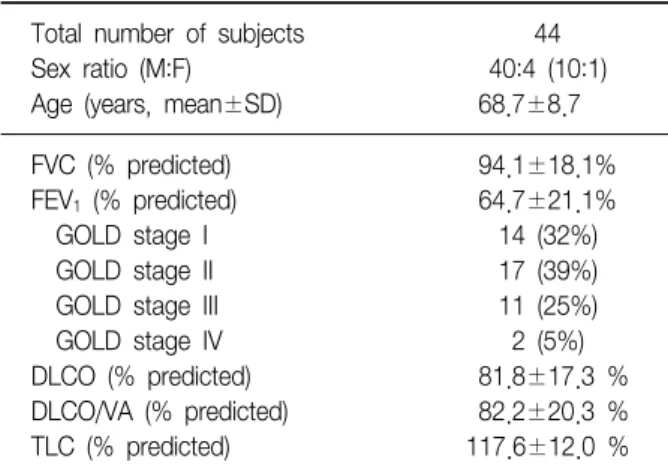
Table 1. Characteristics of subjects Total number of subjects
Sex ratio (M:F) Age (years, mean±SD)
44 40:4 (10:1) 68.7±8.7 FVC (% predicted)
FEV1 (% predicted) GOLD stage I GOLD stage II GOLD stage III GOLD stage IV DLCO (% predicted) DLCO/VA (% predicted) TLC (% predicted)
94.1±18.1%
64.7±21.1%
14 (32%) 17 (39%) 11 (25%) 2 (5%) 81.8±17.3 % 82.2±20.3 % 117.6±12.0 % Values are mean±standard deviation.
변화와 더불어 저체중 등의 영양학적 변화가 있으며 낮은 체질량지수는 만성폐쇄성폐질환의 불량한 예후와 관련되 어 있는 것으로 알려져 있다5-10.
세계 2차 대전 당시 포로수용소에서 아사한 시체들을 대상으로 한 부검연구에서 젊은 나이에도 불구하고 폐 기종성 변화가 관찰되었음이 보고된 이래로 영양섭취량 와 폐기종간의 관계가 관심의 대상이 되었다11. 생쥐를 대상으로 한 실험연구에서 음식공급을 줄이면 쥐들의 폐에 surfactant의 양이 감소하고 폐기종과 유사한 변화 가 유발되며 이러한 변화는 음식공급량을 늘이는 것에 의하여 회복됨이 증명된 바 있다12-17. 실제로 거식증 환 자들을 대상으로 흉부 전산화단층촬영을 시행하였을 때 역시 폐기종과 유사한 변화가 관찰됨이 여러 차례 보고 되었다18-20.
하지만 실제 만성폐쇄성폐질환 환자에서 영양분의 섭 취량이 질환에 미치는 영향은 연구된 바가 없다. 저자들 은 본 연구에서 영양의 섭취와 폐기능지표와의 상관관계 를 규명함으로써 영양의 섭취가 질환에 미치는 영향을 알 아보고자 하였다.
대상 및 방법
본 연구는 2006년 3월부터 2007년 2월까지 1년 동안 분당서울대학교병원에 내원한 만성폐쇄성폐질환 환자를 대상으로 하였다. 연구의 대상이 되는 모든 환자에서 폐 활량검사, 폐확산능 검사, 폐용적검사 및 식이섭취조사를 시행하였다.
만성폐쇄성폐질환의 진단은 GOLD지침을 따라 기관지 확장제 흡입 후 FEV1/FVC의 비가 0.7 미만인 환자로 하였 으며 이전에 천식으로 진단받았거나, 흉부단순방사선 소 견상 만성적인 기도폐쇄를 유발할만한 다른 폐질환이 있 는 경우는 배제하였다21. 최근 8주간 악화를 경험한 환자 도 배제 제외하였다.
폐기능검사는 폐활량측정기(Vmax22, SensorMedics, Yorba Linda, CA, USA)를 이용하였으며 방법은 미국흉부 학회의 지침을 준수하였다22. 예측치의 추정은 모리스의 예측식을 사용하였다23.
대상자들의 영양소 섭취상태평가는 한 명의 영양사에 의하여 이루어졌다. 식품기록법(food record)을 이용하였 으며 3일간의 식품섭취상태를 조사하였다. 식사일기 기록 에 앞서 식사일기 작성법을 교육하였고 일대일 면접으로 눈대중량과 실제 섭취량을 비교하였다. 조사한 자료를 기
초로 영양평가 프로그램 CAN Pro version 3.0 (Computer aided nutritional analysis program, 한국영양학회, 2005) 를 이용하여 1일 영양소 섭취량을 분석하였다.
통계분석은 SPSS 15.0을 이용하였으며 변수간의 상관 관계는 Pearson 상관계수를 구해 분석하였으며 p<0.05 를 기준으로 통계적 유의성을 판단하였다.
본 연구는 분당서울대학교병원 윤리위원회의 심의를 통과하였으며 모든 대상환자에게 충분한 설명 후 동의서 를 취득하였다.
결 과
분석의 대상이 된 환자들은 모두 44명이었다. 남자가 그 중 40명을 차지했으며, 평균 연령은 68.7±8.7세였다.
대상자들의 평균 1초간노력호기량(FEV1 %예측치)은 64.7
±21.1%로 GOLD병기를 적용하면 병기 I 혹은 II에 속하 는 환자들이 71%로 대부분을 차지하였다(Table 1). 일당 섭취열량의 평균은 1,588±455.9 Kcal였으며 열량의 성분 별 구성은 Table 2와 같았다.
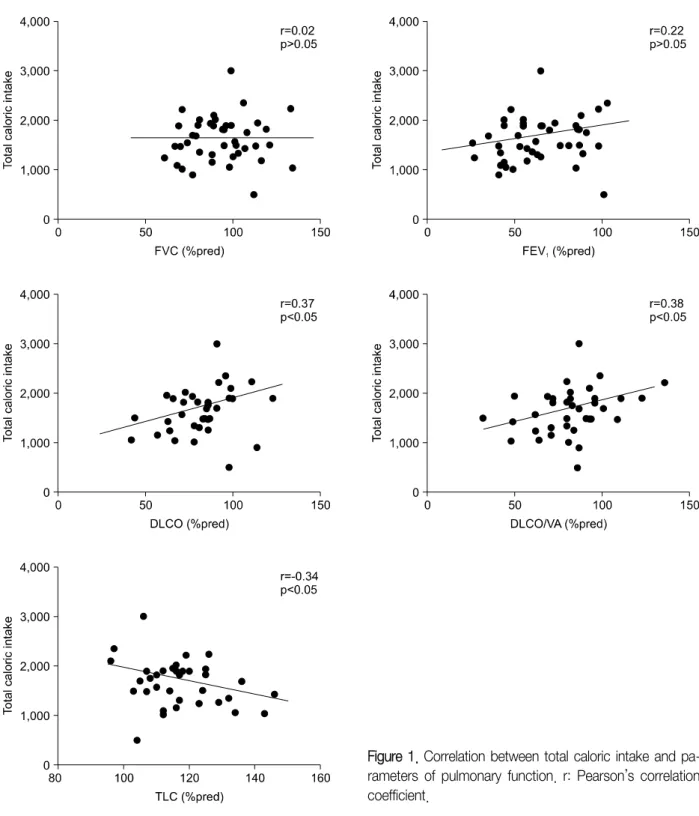
총섭취열량과 폐기능지표들 간의 상관관계를 살펴 보 았을 때 FEV1 (%예측치) (r=0.22, p=0.13), FVC (%예측
Figure 1. Correlation between total caloric intake and pa- rameters of pulmonary function. r: Pearson’s correlation coefficient.
치) (r=0.02, p=0.88)와는 아무런 상관관계를 찾을 수 없 었다. 반면 폐확산능의 지표인 DLCO (%예측치) (r=0.37, p=0.02), DLCO/VA (%예측치) (r=0.38, p=0.01)와는 양의 상관관계를, 총폐용적(total lung capacity, TLC %예측치) 과는 음의 상관관계(r=−0.34, p=0.04)를 보임을 관찰할 수 있었다(Figure 1).
총섭취열량과 통계적으로 의미 있는 상관관계를 보였 던 폐기능 지표들을 대상으로 성분별 열량섭취와의 상 관관계를 분석해 보았을 때 섭취한 열량 중 단백질섭취 열량과 DLCO (%예측치) (r=0.27, p=0.04), DLCO/VA
(%예측치) (r=0.38, p=0.01)은 통계적으로 의미 있는 상 관관계를 보였다. 그러나 탄수화물 및 지방섭취에 의한
열량은 어떤 폐기능지표와도 의미 있는 상관관계를 보 이지 않았다.
고 찰
본 연구에서 저자들은 총칼로리 섭취, 그 중에서도 단 백질섭취에 의한 칼로리의 섭취가 만성페쇄성폐질환 환 자들의 1초간 노력호기량과는 관계 없이 폐확산능이나 폐 용적과 관련되어 있음을 확인하였다. 이 같은 결과는 칼 로리의 섭취양이 폐기종의 변화와 관련되어 있을 가능성 을 제시한다.
만성폐쇄성폐질환 환자에서 여러 가지 영양학적인 문제가 동반되어 있고 그러한 영양학적 문제가 질환의 중등도나 예후와 관련되어 있다는 연구는 많이 발표된 바 있다. 그러나 대부분 영양분의 섭취 자체보다는 체 질량지표 등의 영양학적 지표들을 이용한 연구가 대부
분이다24,25. 하지만 식이섭취가 폐기능에 영향을 준다는
연구결과도 많은데 예를 들면 가공육을 즐겨 먹을수록 폐기능이 감소한다는 결과나 항산화 비타민이나 비타민 D의 혈중농도가 폐기능과 관련되어 있다는 연구 등이
있다26-31. 이 같은 연구에서 보듯이 만성폐쇄성폐질환
환자의 식이 섭취가 질병의 중등도나 유형과 관련되어 있을 가능성은 다분하다.
본 연구는 만성폐쇄성폐질환 환자의 기능적 지표인 폐 기능과 영양학적 지표가 아닌 섭취 자체-섭취된 칼로리- 와의 상관관계를 분석한 연구라는데 그 의의가 있다고 하 겠다.
본 연구의 제한점으로는 전산화단층촬영 등의 영상검 사를 분석하지 못해 과연 확산능이나 총폐용적이 폐기종 성변화와 관련되어 있는지를 규명하지 못하였다는 점과 상관관계만을 분석하였기 때문에 원인과 결과를 규명할 수 없다는 점, 대상자 수가 적어 개별영양소와 폐기능지표 와의 상관관계는 규명할 수 없다는 점 등이 있다.
본 연구에서 사용한 영양소의 섭취량 평가가 지난 3일 간(주중 2일, 주말 1일)의 섭취량에 대한 회상을 기반으로 하여 이루어졌으므로 과연 장기적인 섭취량을 반영할 것 인지의 문제가 있고 이는 이 연구의 또 다른 제한점으로 생각된다. 그러나 현실적으로 오래 전의 섭취량을 기억한 다는 것이 불가능하여 장기간의 섭취량 조사는 신뢰도가 떨어지는 문제가 존재한다.
그럼에도 불구하고 이전의 연구 결과에서 만성폐쇄성 폐질환이 없는 사람에서도 음식의 섭취량과 폐기종성 변 화가 관련되었을 가능성이 제시된 바 있으므로 본 연구의
상관관계가 실제로 섭취열량과 폐기능지표와 관련되어 있을 가능성이 있다.
앞으로 추가 연구를 통해 과연 만성폐쇄성폐질환환자 에서 섭취열량이 폐기종성 변화와 관련되어 있는지, 그렇 다면 어떤 기전에 의한 것인지가 밝혀져야 할 것으로 기대 된다.
요 약
연구배경: 이전의 연구에서 섭취의 제한은 폐기종과 유 사한 변화를 유발할 수 있음이 알려져 왔다. 그러나 이러 한 현상이 만성폐쇄성폐질환 환자에서 갖는 의미는 밝혀 진 적이 없다. 저자들은 만성폐쇄성폐질환 환자에서 영양 섭취량과 폐기능지표와의 상관관계를 알아보고자 본 연 구를 수행하였다.
방 법: 분당서울대학교병원에서 2006년 3월부터 1년 동안 진료받은 만성폐쇄성폐질환 환자들을 대상으로 하 였으며 폐활량검사, 확산능검사, 폐용적검사와 함께 영양 섭취상태평가를 시행한 후 분석하였다.
결 과: 총섭취열량과 1초간노력호기량이나 최대노력호 기량(%예측치)과는 아무런 상관관계를 찾을 수 없었다.
반면 폐확산능의 지표인 DLCO (%예측치), DLCO/VA (%
예측치)와는 양의 상관관계를, 총폐용량(%예측치)과는 음 의 상관관계를 보임을 관찰할 수 있었다. 섭취한 열량 중 단백질섭취열량과 폐확산능 DLCO (%예측치), DLCO/VA (%예측치)은 통계적으로 의미 있는 상관관계를 보였다.
그러나 탄수화물 및 지방섭취에 의한 열량과 폐기능지표 는 의미 있는 상관관계를 보이지 않았다.
결 론: 만성폐쇄성폐질환 환자의 하루 섭취 열량은 그 환자의 폐확산능과는 양의 상관관계, 총폐용량과는 음의 상관관계에 있어 섭취열량과 폐기종의 관련성에 대한 추 가 연구가 필요하다.
참 고 문 헌
1. Walter RE, Wilk JB, Larson MG, Vasan RS, Keaney JF Jr, Lipinska I, et al. Systemic inflammation and COPD:
the Framingham Heart Study. Chest 2008;133:19-25.
2. Agusti A. Systemic effects of COPD: just the tip of the Iceberg. COPD 2008;5:205-6.
3. Hoeper MM, Welte T. Systemic inflammation, COPD, and pulmonary hypertension. Chest 2007;131:634-5.
4. Fabbri LM, Rabe KF. From COPD to chronic systemic
inflammatory syndrome? Lancet 2007;370:797-9.
5. Ohara T, Hirai T, Muro S, Haruna A, Terada K, Kinose D, et al. Relationship between pulmonary emphysema and osteoporosis assessed by CT in patients with COPD. Chest 2008;0:chest.07-3054v1-0.
6. Cote CG, Pinto-Plata VM, Marin JM, Nekach H, Dordelly LJ, Celli BR. The modified BODE index: validation with mortality in COPD. Eur Respir J 2008;32:1269-74.
7. Sin DD, Man SF. Skeletal muscle weakness, reduced exercise tolerance, and COPD: is systemic inflammation the missing link? Thorax 2006;61:1-3.
8. Mascitelli L, Pezzetta F. Anemia and COPD. Chest 2005;128:3084.
9. John M, Hoernig S, Doehner W, Okonko DD, Witt C, Anker SD. Anemia and inflammation in COPD. Chest 2005;127:825-9.
10. Celli BR, Cote CG, Marin JM, Casanova C, Montes de Oca M, Mendez RA, et al. The body-mass index, air- flow obstruction, dyspnea, and exercise capacity index in chronic obstructive pulmonary disease. N Engl J Med 2004;350:1005-12.
11. Stein J, Fenigstein H. Pathological anatomy of hunger disease. In: Winick M, editor. Hunger disease: studies by the Jewish physicians in the Warsaw Ghetto: current concepts in nutrition. New York: Wiley & Sons; 1979.
12. Sahebjami H, MacGee J. Effects of starvation on lung mechanics and biochemistry in young and old rats. J Appl Physiol 1985;58:778-84.
13. Kerr JS, Riley DJ, Lanza-Jacoby S, Berg RA, Spilker HC, Yu SY, et al. Nutritional emphysema in the rat: influ- ence of protein depletion and impaired lung growth.
Am Rev Respir Dis 1985;131:644-50.
14. Dauber JH, Claypool WD. The role of nutrition in the pathogenesis of emphysema. Surv Synth Pathol Res 1984;3:83-92.
15. D'Amours R, Clerch L, Massaro D. Food deprivation and surfactant in adult rats. J Appl Physiol 1983;55:1413-7.
16. Sahebjami H, Vassallo CL. Influence of starvation on en- zyme-induced emphysema. J Appl Physiol 1980;48:284-8.
17. Gail DB, Massaro GD, Massaro D. Influence of fasting on the lung. J Appl Physiol 1977;42:88-92.
18. Stanescu D, Pieters T. Anorexia nervosa and emphysema.
Am J Respir Crit Care Med 2005;172:398.
19. Coxson HO, Chan IH, Mayo JR, Hlynsky J, Nakano Y, Birmingham CL. Early emphysema in patients with ano-
rexia nervosa. Am J Respir Crit Care Med 2004;170:
748-52.
20. Wilson NL, Wilson RH, Farber SM. Nutrition in pulmo- nary emphysema. J Am Diet Assoc 1964;45:530-6.
21. Rabe KF, Hurd S, Anzueto A, Barnes PJ, Buist SA, Calverley P, et al. Global strategy for the diagnosis, management, and prevention of chronic obstructive pulmonary disease: GOLD executive summary. Am J Respir Crit Care Med 2007;176:532-55.
22. Miller MR, Hankinson J, Brusasco V, Burgos F, Casaburi R, Coates A, et al. Standardisation of spirometry. Eur Respir J 2005;26:319-38.
23. Morris JF, Koski A, Johnson LC. Spirometric standards for healthy nonsmoking adults. Am Rev Respir Dis 1971;103:57-67.
24. Harik-Khan RI, Fleg JL, Wise RA. Body mass index and the risk of COPD. Chest 2002;121:370-6.
25. Wouters EF. Nutrition and metabolism in COPD. Chest 2000;117:274S-80S.
26. Siedlinski M, Postma DS, van Diemen CC, Blokstra A, Smit HA, Boezen HM. Lung function loss, smoking, vi- tamin C intake, and polymorphisms of the gluta- mate-cysteine ligase genes. Am J Respir Crit Care Med 2008;178:13-9.
27. Jiang R, Paik DC, Hankinson JL, Barr RG. Cured meat consumption, lung function, and chronic obstructive pulmonary disease among United States adults. Am J Respir Crit Care Med 2007;175:798-804.
28. Pearson P, Britton J, McKeever T, Lewis SA, Weiss S, Pavord I, et al. Lung function and blood levels of cop- per, selenium, vitamin C and vitamin E in the general population. Eur J Clin Nutr 2005;59:1043-8.
29. Mannino DM, Holguin F, Greves HM, Savage-Brown A, Stock AL, Jones RL. Urinary cadmium levels predict lower lung function in current and former smokers: da- ta from the Third National Health and Nutrition Examination Survey. Thorax 2004;59:194-8.
30. Gilliland FD, Berhane KT, Li YF, Gauderman WJ, McConnell R, Peters J. Children's lung function and an- tioxidant vitamin, fruit, juice, and vegetable intake. Am J Epidemiol 2003;158:576-84.
31. Britton JR, Pavord ID, Richards KA, Knox AJ, Wisniewski AF, Lewis SA, et al. Dietary antioxidant vi- tamin intake and lung function in the general population. Am J Respir Crit Care Med 1995;151:1383-7.