Implication of Sarcopenia and Sarcopenic Obesity on Lung Function in Healthy Elderly: Using Korean National Health and Nutrition Examination Survey
Previous studies have demonstrated a positive association between obesity and decreased lung function. However, the effect of muscle and fat has not been fully assessed, especially in a healthy elderly population. In this study, we evaluated the impact of low muscle mass (LMM) and LMM with obesity on pulmonary impairment in healthy elderly subjects. Our study used data from the Korea National Health and Nutrition Examination Survey from 2008 to 2011. Men and women aged 65 yr or older were included. Muscle mass was measured by dual-energy X-ray absorptiometry. LMM was defined as two standard deviations below the sex-specific mean for young healthy adults. Obesity was defined as body mass index ≥ 25 kg/m2. The prevalence of LMM in individuals aged over 65 was 11.9%. LMM and pulmonary function (forced vital capacity and forced expiratory volume in 1 second) were independently associated after adjusting for age, sex, body mass index, smoking status, alcohol consumption, and frequency of exercise. LMM with obesity was also related to a decrease in pulmonary function. This study revealed that LMM is an independent risk factor of decreased pulmonary function in healthy Korean men and women over 65 yr of age.
Keywords: Low Muscle Mass; Obesity; Respiratory Function Tests; Aged; Body Mass Index Ji Hyun Moon,1,2 Mi Hee Kong,1,3
and Hyeon Ju Kim1,3
1Department of Family Medicine, Jeju National University Hospital, 2Graduate School of Jeju National University and 3Department of Family Medicine, School of Medicine, Jeju National University, Jeju, Korea
Received: 25 February 2015 Accepted: 10 August 2015 Address for Correspondence:
Hyeon Ju Kim, MD
Department of Family Medicine, Jeju National University &
Hospital, 15 Aran 13-gil, Jeju 63241, Korea Tel: +82.64-717-8220, Fax: +82.64-757-8276 E-mail: [email protected]
http://dx.doi.org/10.3346/jkms.2015.30.11.1682 • J Korean Med Sci 2015; 30: 1682-1688
INTRODUCTION
As aging progresses, body composition also changes and is char- acterized by gain of fat mass and loss of skeletal muscle mass, a condition referred to as sarcopenia (1). Sarcopenia maintains a chronic inflammatory state, causes chronic disease, and ulti- mately increases mortality (2,3).
Previous studies have demonstrated that decreased pulmo- nary function leads to not only respiratory disease but also car- diovascular and cerebrovascular disease even in healthy elderly people (4,5). Many factors may contribute to pulmonary func- tion. Age, sex, smoking status, physical performance, and co- morbidities such as pulmonary disease are important factors affecting pulmonary function (6). Many studies have reported an association between obesity and lung function. However, the association of obesity and pulmonary function is controver- sial, and the mechanism by which obesity (increased fat mass and decreased muscle mass) impairs lung function is not clear- ly understood. Hence, age-related sarcopenia and lung func- tion impairment observed in old age could be related.
In men with chronic respiratory disorders such as chronic obstructive pulmonary disease (COPD), body weight, especial- ly lean body mass and obesity, are related to respiratory muscle strength and pulmonary function (7,8). Muscle strength, espe-
cially in quadriceps muscles, is an important factor of physical performance and quality of life in COPD patients (9). A study that investigated the relationship between peripheral muscle strength and pulmonary function in elderly men from a nurs- ing home found that handgrip strength is positively associated with maximal pulmonary pressure and maximal expiratory pressure (10).
A high proportion of patients admitted to a hospital for the first time with acute exacerbation have not been previously di- agnosed as having lung disease (11). Evaluation of lung func- tion and modifiable risk factors related to impaired lung func- tion are important in healthy elderly individuals who have not been previously diagnosed with lung disease. Sarcopenia may be associated with pulmonary function not only in COPD and elderly patients with major comorbidities but also in healthy el- derly men and women without lung disease diagnoses. The el- derly can easily acquire acute pulmonary infections, such as acute bronchiolitis or pneumonia. Additionally, these pulmo- nary infections lead to atelectasis and respiratory complications more easily in the elderly than in young adults even if the latter do not have a prior history of lung disease. The aim of this study was to evaluate the association between muscle mass and pul- monary function in healthy Korean men and women aged 65 yr or older.
MATERIALS AND METHODS Study population
The Korea National Health and Nutrition Examination Survey (KNHANES) is a nationally representative, population-based cross-sectional survey, which includes data since 1998 as re- ported by the Korea Centers for Disease Control and Preven- tion. A stratified, multistage probability sampling design was used to select the survey population. The survey consisted of a health interview, nutritional questionnaires, and health exami- nations. A pulmonary function test (PFT) was performed for adults aged more than 40 yr, and dual-energy x-ray absorpti- ometry (DXA) was performed to determine body composition in subjects aged more than 10 yr from 2008 to 2010. Our study was conducted using KNHANES data from 2008 to 2010.
Men and women older than 65 yr who underwent a health examination, PFT, and DXA were enrolled in our study. The sub- jects with pulmonary diseases such as COPD, bronchiectasis, asthma, and active tuberculosis were excluded. Participants with decreased lung function, defined as a forced expiratory volume in 1 second (FEV1)/forced vital capacity (FVC) ratio of
< 0.7, were also excluded to eliminate COPD interference. In addition, individuals with chronic diseases such as chronic kid- ney disease and liver cirrhosis and those with a history of stroke, myocardial infarction, or malignancy were also excluded. A to- tal of 1,583 subjects were finally enrolled.
Definitions of low muscle mass and low muscle mass with obesity
Whole-body muscle mass, fat, and bone mass were measured by DXA. Appendicular skeletal muscle mass (ASM) was calcu- lated as the sum of the muscle masses of the arms and legs. Low muscle mass (LMM) was defined as a value of ASM divided by weight (ASM/Wt, %) that was two standard deviations below the sex-specific mean of the young reference group (12,13). The reference group comprised healthy individuals aged 20-39 yr who were involved with KNHANES during the same period as the subjects were analyzed, excluding those with any malignan- cy, stroke, myocardial infarction, angina, chronic kidney disease, liver cirrhosis, hypertension, diabetes mellitus, asthma, or ac- tive tuberculosis. Finally, 2,292 men and 3,157 women were in- cluded in the reference group.
Obesity was defined as a body mass index (BMI) greater than 25 kg/m2 based on the World Health Organization recommen- dation for Asian population-based classification (14). Further- more, LMM with obesity was defined as the combination of LMM and obesity.
Pulmonary function test
A PFT was conducted by a trained technician using a dry roll- ing-seal spirometer, according to the American Thoracic Soci-
ety guidelines (15). Spirometry was repeated from a minimum of three times to a maximum of eight times in each subject to ensure acceptability and reproducibility, and the best FVC and FEV1 values were recorded. The predicted FVC and FEV1 values were determined by comparison with the Korean reference val- ues reported by Choi et al. (16).
Statistical analysis
All analyses were conducted using weighted values, which were calculated according to the number of subjects in each research year and the research category to represent a residential Korean population. Continuous variables were calculated by a complex samples general linear model and presented as the mean ± stan- dard error (SE). Categorical variables were analyzed by com- plex samples logistic regression analysis presented as the esti- mated proportion (SE). To assess the relationship between LMM and pulmonary function, complex samples logistic regression analyses were performed, using SPSS version 20.0 (IBM, New York, NY, USA). P values of < 0.05 were considered statistically significant.
Ethics statement
Written informed consent was given by all participants and the protocol for KNHANES IV and V were approved by the institu- tional review board of the KCDC (2008-04EXP-01-C, 2009-01CON- 03-2C, 2010-02CON-21-C, 2011-02CON-06-C). The present study did not require additional review and approval because the KN- HANES data set is publicly available.
RESULTS
General characteristics of the participants
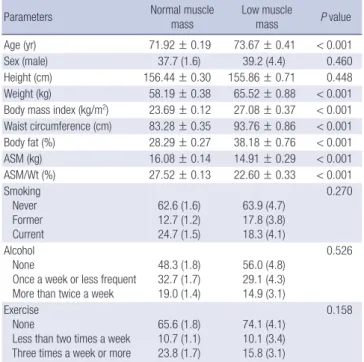
The study population comprised 635 men and 948 women. The cutoff points for LMM were 27.85% in men and 21.35% in wom- en according to the definition adopted. The estimated preva- lence of LMM in Koreans aged ≥ 65 yr was 11.9% (n = 167). The general characteristics of the subjects are shown in Table 1. The mean age in the LMM group (73.7 yr) was higher than that in the normal muscle mass group (71.9 yr, P < 0.001). Because of age differences between the two groups, other demographic data are adjusted for age. Sex distributions were similar in the normal muscle mass and LMM groups (P = 0.460). Current smo- kers comprised 24.7% and 18.3% of the normal muscle mass and LMM groups, respectively; this difference was not statisti- cally significant (P = 0.270).
Pulmonary function according to muscle mass status Compared with the normal muscle mass group, the LMM group had decreased lung function. Participants with LMM had lower mean FEV1, FVC, and FVC percentage values than the normal muscle mass group (all P < 0.001). However, the FEV1/FVC val-
Effect of LMM with obesity on lung function
Based on our definition of LMM with obesity, its estimated prev- alence rates in Koreans aged ≥ 65 yr were 7.8% and 9.6% in men and women, respectively. Furthermore, the estimated preva- lence of LMM with normal weight was 4.4% in men and 2.1% in women. The ages were different between the groups, especially in men. In men, the mean ages were 71.5 yr in the normal group, 70.4 yr in the normal muscle mass with obesity group, 75.1 yr in the LMM with normal weight group, and 73.4 yr in the LMM with obesity groups (P < 0.001). In women, the LMM groups were older than the normal muscle mass groups (P = 0.073).
Lifestyle parameters such as frequency of smoking, alcohol con- sumption, and exercise frequency were not different in both sexes.
Pulmonary function (FEV1 and FVC) differences between the four groups are presented in Fig. 2. After adjusting for age, the mean FEV1 and FVC values were lower in the LMM groups than in the normal muscle mass groups regardless of obesity status. Furthermore, the LMM with obesity group had more de- creased pulmonary function than the LMM with normal weight group in both sexes. In men, the mean FEV1 values were 2.63 ± 0.02 in the normal groups, 2.56 ± 0.07 in the LMM with normal weight group, and 2.45 ± 0.05 in the LMM with obesity group (P = 0.001). In women, the mean FEV1 values were 1.92 ± 0.02 and 1.85 ± 0.04 in the normal and LMM with obesity groups, respectively (P = 0.324). The mean FVC values in men were 3.70
± 0.04 in the normal group, 3.70 ± 0.05 in the normal muscle mass with obesity group, 3.53 ± 0.11 in the LMM with normal weight group, and 3.38 ± 0.08 in the LMM with obesity group (P = 0.001). The mean FVC values in women were 2.50 ± 0.02, 2.49 ± 0.02, 2.45 ± 0.15, and 2.38 ± 0.04 in the respective groups (P = 0.164).
DISCUSSION
This study revealed an association between LMM and pulmo- nary function in healthy Korean men and women aged ≥ 65 yr.
In addition, LMM with obesity was associated with lung func- tion in both sexes.
To our knowledge, this is the first study to evaluate the asso- ciation between LMM and pulmonary function in healthy el- derly men and women. Many studies have investigated the re- Table 1. Baseline characteristics of the study population
Parameters Normal muscle
mass Low muscle
mass P value
Age (yr) 71.92 ± 0.19 73.67 ± 0.41 < 0.001
Sex (male) 37.7 (1.6) 39.2 (4.4) 0.460
Height (cm) 156.44 ± 0.30 155.86 ± 0.71 0.448
Weight (kg) 58.19 ± 0.38 65.52 ± 0.88 < 0.001 Body mass index (kg/m2) 23.69 ± 0.12 27.08 ± 0.37 < 0.001 Waist circumference (cm) 83.28 ± 0.35 93.76 ± 0.86 < 0.001 Body fat (%) 28.29 ± 0.27 38.18 ± 0.76 < 0.001
ASM (kg) 16.08 ± 0.14 14.91 ± 0.29 < 0.001
ASM/Wt (%) 27.52 ± 0.13 22.60 ± 0.33 < 0.001 Smoking
Never Former Current
62.6 (1.6) 12.7 (1.2) 24.7 (1.5)
63.9 (4.7) 17.8 (3.8) 18.3 (4.1)
0.270
Alcohol None
Once a week or less frequent More than twice a week
48.3 (1.8) 32.7 (1.7) 19.0 (1.4)
56.0 (4.8) 29.1 (4.3) 14.9 (3.1)
0.526
Exercise None
Less than two times a week Three times a week or more
65.6 (1.8) 10.7 (1.1) 23.8 (1.7)
74.1 (4.1) 10.1 (3.4) 15.8 (3.1)
0.158
All data are weighted to the residential population of Korea and calculated by com- plex samples general linear model and complex samples logistic regression analysis.
Values are expressed as mean ± standard error or estimated percentage (standard error). ASM, appendicular skeletal muscle mass; Wt, weight.
Table 2. Pulmonary function parameters according to muscle mass status
Pulmonary parameters Normal muscle mass Low muscle mass P value P value* P value†
FEV1 (L) 2.21 ± 0.02 2.06 ± 0.04 < 0.001 0.010 0.009
FEV1 (% predicted) 96.65 ± 0.54 94.50 ± 1.62 0.218 0.172 0.169
FVC (L) 2.96 ± 0.03 2.74 ± 0.06 < 0.001 < 0.001 < 0.001
FVC (% predicted) 91.80 ± 0.48 86.06 ± 1.02 < 0.001 0.012 0.014
FEV1/FVC 0.75 ± 0.00 0.76 ± 0.01 0.813 0.591 0.624
All data are weighted to the residential population of Korea and calculated by complex samples general linear model and complex samples logistic regression analysis. *Adjust- ed for age, sex, and body mass index; †Adjusted for age, sex, body mass index, smoking status, alcohol consumption, and frequency of exercise. FVC, forced vital capacity; FEV1, forced expiratory volume in 1 second.
ues did not differ significantly between the two groups (P = 0.813). Complex sample logistic regression analysis was per- formed to determine whether LMM was independently associ- ated with pulmonary function. The results of the analyses are shown in Table 2. After adjusting for age, sex, and BMI, the LMM group showed significantly decreased FEV1 and FVC compared with the normal muscle mass group (P = 0.010 and P < 0.001, respectively). Similarly, after further adjusting for smoking sta- tus, alcohol consumption, and frequency of exercise, the asso- ciations of LMM with FVC and FEV1 were unchanged (P = 0.009 and P < 0.001, respectively).
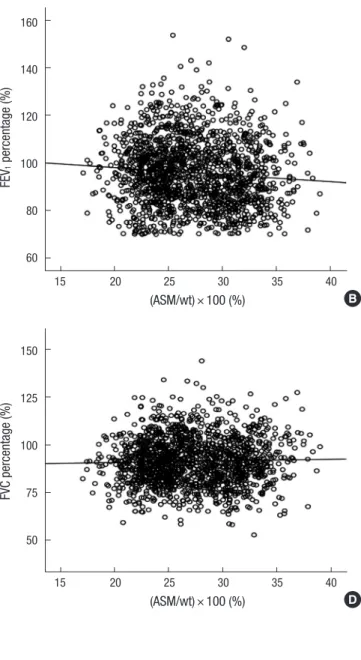
A scatter plot of ASM/Wt versus lung function parameters (FEV1, FVC, FEV1 percentage, FVC percentage, and FEV1/FVC) adjusted for age are presented in Fig. 1. ASM/Wt showed a sig- nificant positive correlation with FEV1 and FVC (all P < 0.001;
R2= 0.449 and R2= 0.487, respectively).
Fig. 1. Correlation between muscle mass and pulmonary function parameters.
(A) FEV1: R2 = 0.449, P < 0.001; (B) FEV1 (percent predicted): R2 = 0.028, P <
0.001; (C) FVC: R2 = 0.487, P < 0.001; (D) FVC (percent predicted): R2 = 0.005, P = 0.864; (E) FEV1/FVC: R2 = 0.102, P < 0.001. The data were adjusted for age and calculated by a complex samples general linear model. ASM, appen- dicular skeletal muscle mass; FEV1, forced expiratory volume in 1 second; FVC, forced vital capacity; WT, weight.
FEV1 (L)
(ASM/wt) × 100 (%)
15 20 25 30 35 40 4
3
2
1
FVC (L)
(ASM/wt) × 100 (%)
15 20 25 30 35 40 6
5 4
3
2
1
FEV1/FVC
(ASM/wt) × 100 (%)
15 20 25 30 35 40 1.0
0.9 0.8 0.7 0.6 0.5 0.4
FEV1 percentage (%)
(ASM/wt) × 100 (%)
15 20 25 30 35 40 160
140
120
100
80
60
FVC percentage (%)
(ASM/wt) × 100 (%)
15 20 25 30 35 40 150
125
100
75
50
A B
C D
E lationship between obesity and pulmonary function. Some in- dices of obesity, including the combination of height with body weight and other body measurements such as BMI, waist-to- hip ratio, percent body fat, and fat-free mass (FFM), have been
studied. The results differ according to the parameters and the definitions of obesity used.
Because of a partial negative association between BMI and mortality in many studies, overweight and obesity were con-
cluded to be associated with good pulmonary function (17).
However, other studies have reported a negative correlation be- tween whole-body fat mass and pulmonary function. Not only the amount of fat mass but also the distribution of fat has been considered an important factor in determining lung function.
In elderly men, central fat distribution was found to be nega- tively associated with lung function with statistical significance, and the amount of muscle mass was positively correlated with lung function (18). A cross-sectional study demonstrated that central fat distribution and lower FFM are related to poorer lung function in the elderly (19). In elderly Japanese-American men, FFM was found to be an independent risk factor of impaired lung function (20). An increased sagittal abdominal diameter and lower FFM were closely related to impaired lung function
in elderly men and women in a 7-yr longitudinal study (21).
Obesity causes body fat deposition in the thoracic and ab- dominal cavities and decreased pulmonary muscle mass, which may be related to changes in pulmonary function (22). In addi- tion, an obese person consumes more oxygen and energy than does a normal-weight individual during respiration. LMM causes a decline in physical performance and physical disability, which are related to decreased lung function. As aging progresses, skel- etal muscle mass decreases, and respiratory muscle mass may also decrease. A reduction in diaphragm muscle mass has been demonstrated in aging mice (23). A decrease in peripheral mus- cle mass may lead to respiratory muscle sarcopenia. However, respiratory muscle sarcopenia has not been well understood.
Interestingly, even after adjusting for smoking status in our Fig. 2. Comparisons of lung function parameters according to the LMM with obesity status. In men, FEV1 P < 0.001; for FVC P < 0.001, in women, FEV1 P = 0.324; for FVC P = 0.164. The data were adjusted for age and calculated by a complex samples general linear model. FVC, forced vital capacity; FEV1, forced expiratory volume in 1 second;
L−O−, nonsarcopenic nonobese; L−O+, nonsarcopenic obese; L+O−, sarcopenic nonobese; L+O+, sarcopenic obesity.
Men
FEV1 (L)
L−O− L−O+ L+O− L+O+
5
4
3
2
1
0
FVC (L)
L−O− L−O+ L+O− L+O+
6 5 4 3 2 1 0 Women
FEV1 (L)
L−O− L−O+ L+O− L+O+
4
3
2
1
0
FVC (L)
L−O− L−O+ L+O− L+O+
4
3
2
1
0
study subjects, LMM was closely related to respiratory function.
This finding is similar to that in the study by Santana et al. (18) who reported an association between body composition and lung function. After excluding the effect of smoking status, FFM was found to be positively correlated with FVC in the same study.
The investigation by Lazarus et al. (24) on the association be- tween muscle mass and pulmonary function included only non- smoking subjects, and the results seem to agree with our study results.
This study has some limitations. First, our study was perform- ed using data from KNHANES, making it a cross-sectional study.
As a result, we could not confirm a cause-and-effect relation- ship between muscle mass and pulmonary function. Second, although muscle mass is well known to be positively correlated with muscle power and function (25), the definition of sarcope- nia according to the Asian and European Working Group on Sarcopenia in Older People is the presence of both LMM and low muscle strength or impaired performance (26,27). Not only muscle mass but also muscle function is important for disease prevention and quality of life in the elderly. In this study, how- ever, we evaluated only muscle mass. Third, the amount of mus- cle and fat mass, as well as the distribution of muscle and fat, is important in determining lung function in the elderly. Our study was unable to evaluate the effects of muscle and fat distribution on lung function. Fourth, the present study was not able to pro- vide estimations on subject symptoms. Accordingly, further studies are needed to overcome these limitations, especially as- sessment of muscle function such as measuring handgrip or quadriceps power is required.
In conclusion, the present study suggests that in healthy el- derly people, muscle mass is positively correlated with pulmo- nary function. Specifically, LMM and LMM with obesity are strongly associated with impaired lung function. Regular exer- cise and diet modification to maintain muscle mass may be helpful in sustaining lung function in the elderly.
DISCLOSURE
All authors have no potential conflicts of interest to disclose.
AUTHOR CONTRIBUTION
Concept and coordination of the study: Moon JH, Kim HJ. De- sign of ethical issues: Moon JH, Kim HJ, Kong MH. Acquisition of data: Moon JH, Kong MH. Data review: Moon JH, Kim HJ.
Statistical analysis: Moon JH. Kim HJ, Manuscript preparation:
Moon JH, Kim HJ. Manuscript approval: all authors.
ORCID
Ji Hyun Moon http://orcid.org/0000-0001-6788-7521
Mi Hee Kong http://orcid.org/0000-0003-1464-8812 Hyeon Ju Kim http://orcid.org/0000-0002-9103-3275 REFERENCES
1. Gallagher D, Visser M, De Meersman RE, Sepúlveda D, Baumgartner RN, Pierson RN, Harris T, Heymsfield SB. Appendicular skeletal muscle mass: effects of age, gender, and ethnicity. J Appl Physiol 1997; 83: 229- 39.
2. Kim JH, Cho JJ, Park YS. Relationship between sarcopenic obesity and cardiovascular disease risk as estimated by the Framingham risk score. J Korean Med Sci 2015; 30: 264-71.
3. Kim S, Won CW, Kim BS, Choi HR, Moon MY. The association between the low muscle mass and osteoporosis in elderly Korean people. J Korean Med Sci 2014; 29: 995-1000.
4. Ebi-Kryston KL. Respiratory symptoms and pulmonary function as pre- dictors of 10-year mortality from respiratory disease, cardiovascular dis- ease, and all causes in the Whitehall Study. J Clin Epidemiol 1988; 41:
251-60.
5. Persson C, Bengtsson C, Lapidus L, Rybo E, Thiringer G, Wedel H. Peak expiratory flow and risk of cardiovascular disease and death. A 12-year follow-up of participants in the population study of women in Gothen- burg, Sweden. Am J Epidemiol 1986; 124: 942-8.
6. Hazzard WR, Brerman E, Blass J, Ettinger W, Halter J. Principles of geri- atric medicine and gerontology. 3rd ed. New York, NY: McGraw-Hill, 1994.
7. Nishimura Y, Tsutsumi M, Nakata H, Tsunenari T, Maeda H, Yokoyama M. Relationship between respiratory muscle strength and lean body mass in men with COPD. Chest 1995; 107: 1232-6.
8. Koo HK, Park JH, Park HK, Jung H, Lee SS. Conflicting role of sarcope- nia and obesity in male patients with chronic obstructive pulmonary disease: Korean National Health and Nutrition Examination Survey.
PLoS One 2014; 9: e110448.
9. Decramer M, Gosselink R, Troosters T, Verschueren M, Evers G. Muscle weakness is related to utilization of health care resources in COPD pa- tients. Eur Respir J 1997; 10: 417-23.
10. Bahat G, Tufan A, Ozkaya H, Tufan F, Akpinar TS, Akin S, Bahat Z, Kaya Z, Kiyan E, Erten N, et al. Relation between hand grip strength, respira- tory muscle strength and spirometric measures in male nursing home residents. Aging Male 2014; 17: 136-40.
11. Bastin AJ, Starling L, Ahmed R, Dinham A, Hill N, Stern M, Restrick LJ.
High prevalence of undiagnosed and severe chronic obstructive pulmo- nary disease at first hospital admission with acute exacerbation. Chron Respir Dis 2010; 7: 91-7.
12. Janssen I, Heymsfield SB, Ross R. Low relative skeletal muscle mass (sar- copenia) in older persons is associated with functional impairment and physical disability. J Am Geriatr Soc 2002; 50: 889-96.
13. Lim S, Kim JH, Yoon JW, Kang SM, Choi SH, Park YJ, Kim KW, Lim JY, Park KS, Jang HC. Sarcopenic obesity: prevalence and association with metabolic syndrome in the Korean Longitudinal Study on Health and Aging (KLoSHA). Diabetes Care 2010; 33: 1652-4.
14. WHO Expert Consultation. Appropriate body-mass index for Asian pop- ulations and its implications for policy and intervention strategies. Lan- cet 2004; 363: 157-63.
15. Standardization of Spirometry, 1994 Update. American Thoracic Soci-
ety. Am J Respir Crit Care Med 1995; 152: 1107-36.
16. Choi JK, Paek D, Lee JO. Normal predictive values of spirometry in Kore- an population. Tuberc Respir Dis 2005; 58: 230-42.
17. Vestbo J, Prescott E, Almdal T, Dahl M, Nordestgaard BG, Andersen T, Sørensen T, Lange P. Body mass, fat-free body mass, and prognosis in patients with chronic obstructive pulmonary disease from a random pop- ulation sample: findings from the Copenhagen City Heart Study. Am J Respir Crit Care Med 2006; 173: 79-83.
18. Santana H, Zoico E, Turcato E, Tosoni P, Bissoli L, Olivieri M, Bosello O, Zamboni M. Relation between body composition, fat distribution, and lung function in elderly men. Am J Clin Nutr 2001; 73: 827-31.
19. Cotes JE, Chinn DJ, Reed JW. Body mass, fat percentage, and fat free mass as reference variables for lung function: effects on terms for age and sex.
Thorax 2001; 56: 839-44.
20. Burchfiel CM, Enright PL, Sharp DS, Chyou PH, Rodriguez BL, Curb JD. Factors associated with variations in pulmonary function among el- derly Japanese-American men. Chest 1997; 112: 87-97.
21. Rossi A, Fantin F, Di Francesco V, Guariento S, Giuliano K, Fontana G, Micciolo R, Solerte SB, Bosello O, Zamboni M. Body composition and pulmonary function in the elderly: a 7-year longitudinal study. Int J Obes
(Lond) 2008; 32: 1423-30.
22. Lazarus R, Sparrow D, Weiss ST. Effects of obesity and fat distribution on ventilatory function: the normative aging study. Chest 1997; 111: 891-8.
23. Greising SM, Mantilla CB, Gorman BA, Ermilov LG, Sieck GC. Diaph- ragm muscle sarcopenia in aging mice. Exp Gerontol 2013; 48: 881-7.
24. Lazarus R, Gore CJ, Booth M, Owen N. Effects of body composition and fat distribution on ventilatory function in adults. Am J Clin Nutr 1998;
68: 35-41.
25. Reed RL, Pearlmutter L, Yochum K, Meredith KE, Mooradian AD. The relationship between muscle mass and muscle strength in the elderly. J Am Geriatr Soc 1991; 39: 555-61.
26. Chen LK, Liu LK, Woo J, Assantachai P, Auyeung TW, Bahyah KS, Chou MY, Chen LY, Hsu PS, Krairit O, et al. Sarcopenia in Asia: consensus re- port of the Asian Working Group for Sarcopenia. J Am Med Dir Assoc 2014; 15: 95-101.
27. Cruz-Jentoft AJ, Baeyens JP, Bauer JM, Boirie Y, Cederholm T, Landi F, Martin FC, Michel JP, Rolland Y, Schneider SM, et al. Sarcopenia: euro- pean consensus on definition and diagnosis: report of the European Work- ing Group on Sarcopenia in Older People. Age Ageing 2010; 39: 412-23.