• 검색 결과가 없습니다.

Antecedents of Corporate Adoption of Social Media and the Role of the Technology Acceptance Model in the Path

N/A
N/A
Protected

Academic year: 2021

Share "Antecedents of Corporate Adoption of Social Media and the Role of the Technology Acceptance Model in the Path"

Copied!
10
0
0

로드 중.... (전체 텍스트 보기)

전체 글

(1)

Abstract

The paper explores determinants of corporate adoption of social media and the role of technology acceptance model in the path. This paper assimilates some components of the technology acceptance dimension and social expectation theories to determine corporate intentions to use social media. Six hundred and forty-eight samples collected from hotel staff in Korea are analyzed using factor analysis, structural equation model techniques and one-way analysis of variance. The results show that corporate needs, social expectations, ease of use and usefulness should be viewed as important antecedents explaining the firm’s behavioral intention to use social media.

The study also finds that the ease of use and usefulness of the technology acceptance model have positive directional mediation effects in the path diagram.

Keywords: Social Media, Public Relations, Corporate Communication, Technology Acceptance, Social Orientation.

JEL Classification Codes: M14, M15, M31, M39.

* [This paper is a revised and expanded version of a paper entitled

"Antecedents of Corporate Adoption of Social Media and the Role of the Technology Acceptance Model in the Path" presented at the Twenty Fourth World Business Congress of The International Management Development Association, Famagusta, North Cyprus, May 27-31, 2015.]

** First Author. Administrative Sciences Department, Metropolitan College, Boston University[808 Commonwealth Avenue, Boston, MA 02125, USA] Email: [email protected]

*** Administrative Sciences Department, Metropolitan College, Boston University [808 Commonwealth Avenue, Boston, MA 02125, USA]

Email: [email protected]

**** Corresponding Author. Associate Professor, School of Business &

Entrepreneurship, American University of Nigeria [Lamido Zubairu Way, Yola Township By-Pass, PMB. 2250, Yola, Adamawa State, NIGERIA] Email: [email protected]; [email protected]

1. Introduction

With increasing trend of popularity of online social communities, it is quite evident that companies need to take cautionary measures in protecting reputation with respect to the company and its brands. In this process, every company should indulge in enhancing their company and brand’s image through social networking that fortifies the bonding nature among them.

The always-on nature of social networks has contributed to their phenomenal communication power and has altered the balance of power between consumers and firms. Social networks are used by hundreds of millions of people to communicate about a wide range of topics, including personal interests, activities, social events, and even public issues (Becker, Lee, & Nobre, 2010). Searching for any topic on Twitter leads to new contacts, networks and information. One resulting change is that consumers can communicate instantly and directly with companies, bypassing the traditional media filter (Becker et al., 2010; Lee, 2011).

Social media refers to the particular consumption of digital media or Internet that has little to do with traditional informational media use, in that provide a mechanism for the audience to connect, communicate, and interact with each other and their mutual friends through instant messaging or social networking sites. While Internet and social networks have become an important mean of interpersonal communication, they have developed into a major threat because of the ability to rapidly connect with consumers. This is highlighted by such recent events the Mc Donald’s Twitter ad campaign, Wall Street bank JP Morgan's "#Ask JPM" campaign, and UK’s leading supermarket Tesco’s "#Tesco Tweets" campaign, which backfired causing consumers to express anger through social media (Burn-Calander, 2013). The occurrence results in a significant impact on the company’s brand image and serves as a reminder of the nature of a consumer relationship, and how it is developed or maintained can directly affect whether it will withstand long or short-term disruptions.

One environmental threat to the equilibrium of image not being adequately addressed by firms relates to the new Internet social media, which includes such platforms as Facebook, Twitter, blogs as well as online reviews and rating sites. It is clear that in less than a decade advanced technologies have Print ISSN: 2288-4637 / Online ISSN 2288-4645

doi: 10.13106/jafeb.2016.vol3.no2.67.

Antecedents of Corporate Adoption of Social Media and the Role of the Technology Acceptance Model in the Path*

1)

Jung Wan Lee**, Kip Becker***, Rajasekhara Mouly Potluri****

[Received: December 23, 2015. Revised: March 28, 2016. Accepted: April 10, 2016.]

(2)

redefined social interaction. Previously, complaints spread by consumer’s word of mouth activities were conveniently isolated to a few close contacts making these lone singular voices ineffective. With the aid of social networks, however, these voices now have the ability to quickly garner the attention of millions. Social media has not only ended the age of one-way messaging but also put extreme pressure on businesses to engage constituents in unprecedented ways. One thing is clear that Internet and social media have changed the balance of power in the consumer’s favor, and this change has came about quickly. In the present situation, many firms in different sectors have failed to grab the opportunity that comes from the use of social networking sites. For this, aplenty of reasons like poor networking facilities, lack of awareness on usage of social networks, computers, tablets, Smart phones and its peripheral costs are not in a position to afford by many people in the country.

In this regard, the popularity of social media increases the need for companies to take ever increasing cautionary measures in protecting reputations and brands becomes essential. Jones, Temperley and Lima (2009) pointed to an expanding active online consumer defining new roles such as consumer watchdog, investigative journalist and opinion influencer. Through these new groups of consumers, an incidence of bad service can be echoed around social networks reaching thousands of other consumers within minutes. In summary, a better understanding of organization’s behavioral intention to use social media is an important and timely area of research. The success of using social media by companies would depend not only on corporate needs but also on their behavioral intention of using it. In contrast with the present research in the field of social media, this paper attempts to integrate the technology acceptance dimensions with social expectation theories by considering both social and corporate needs.

2. Literature Review

2.1. Public Relations Marketing and Use of Social Media

The addition of social media into the traditional perspective has significantly altered marketing’s focus and strategy. Deighton and Kornfeld (2009) noted that the flow of information about a brand has become multidirectional, interconnected and difficult to predict. They state that marketers have lost control over their brands and now participate in a conversation about the brand.

While social media facilitate companies to conversant with their customers, in a nontraditional sense, they enable customers to natter directly to one another. The control, timing and frequency of the social media-based conversations occurring between consumers and outside managers. Through those managers, they can influence the buying decisions of consumers.

Hennig-Thurau et al. (2010) provided a model of consumer interaction that depicts the relationship between company brand,

the consumer’s attitude towards the brand-company and the influence of consumer through social media. The model depicts many factors of the new media that serve to place many aspects of consumer company relationships beyond the – company’s control. How bonds are established and maintained can ultimately determine the degree of success that a firm will have when attempting to mitigate the potentially damaging effects of negative social media campaigns. Aaker, Fournier and Brasel (2004) suggested that brand personality significantly influences relationship’s strength and can help in predicting the strength of consumer-brand relationships. The importance in the social media context is that sincere brands tend to facilitate strong and stable relationships based on trust but are more susceptible to the transgression effects that may be irreversible.

Social networks obtain their power much in the same manner that interconnected networks do, through the value of each additional member to that network. Robert Metcalf’s law states that the value or power of a network increases in proportion to the square of the number of nodes on the network (Hendler &

Golbeck, 2007). This means that as the number of people in a network increases, the value of the content they share grows exponentially. Kozinets, Valck, Wojnicki & Wilner (2010) called attention to that conversations among buyers were more important than marketing communication in adoption. One might argue that in spite of this early observation, companies have done little to alter their communication patterns with consumers.

Companies traditionally have had a one-way communication monologue channel to their consumers. These one-way communications, however, directed toward consumers are becoming increasingly ineffective. Therefore, companies must move to establish an interactive dialogue communication with many social platforms that consumers use to exchange ideas, cooperate and seek advice from consumers in what is considered as social casting (Jones et al., 2009).

The use of social media with some types of businesses end portends several different objectives for corporate verses individual usage. Individuals use social media for networking opportunities, business research, business knowledge, contacts and product knowledge. Businesses are theorized to use social media for increasing exposure or awareness, client contacts, as a funnel to sales and revenues, access to a potential employee pool and public relations (Kaplan & Haenlien, 2010; Wander, 2007). In particular, using social media, as a part of an organization’s social media strategy is likewise foreseen to enhance these underpinning goals. Understanding the use of social media by different kinds of firms including non profits will facilitate in understanding the theoretical underpinnings of an organization’s social media strategy.

Given the aspirations and resources of different size

organizations, it seems likely that small firms and non profits

would find resources like social media financially appealing

(Hills, Hultman, & Miles, 2008). This is especially true since

small businesses are more apt to spend money on social media

type endeavors. The need for small firms and non profits to

have word of mouth referrals also bends these companies

toward social media use (Trusov, Bucklin, & Pauwels, 2009).

(3)

These marketing touch points help organizations integrate their messages into the rhythm of their customers’daily lives and enter a more personal dialogue with them (Martin & Todorov, 2010). They also provide a less expensive channel for reaching targeted customer segments, primarily those who choose to participate in organization’s online activities that could benefit organizations with limited resources, such as non profits and small businesses (Daniasa, Tomita, Stuparu, & Stanciu, 2010).

One would assume that large companies, by virtue of their resources, would be ahead of curve compared to smaller ones.

According to a recent study (Becker, Kanabar, & Nobre, 2011) reviewing small, medium and large firms on two world stock markets, it was determined that while many companies had social media sites, the number of firms actually monitoring activities on those social media remained mite. Becker and Lee (2012) reported that in the United States and Europe the average time to reply for the large firms was 7.14 hours while the small firms replied in 5.35 hours. It is interesting that when small firms responded, they did more quickly than large firms did. Without providing for consumer interaction, one could questionif most companies’ social media is not merely extensions of the firm’s static web pages. It seems that while many large firms have recognized the need to establish social media, they do not know what to do with them. Mangold and Faulds (2009) noted that social media communication paradigm now requires many important changes in a company’s attitudes and assumptions about how to manage communication strategy, as consumers are responding to social media in ways that directly influence all aspects of consumer behavior, from information acquisition to post-purchase expressions of satisfaction and dissatisfaction.

2.2. Corporate Communication Strategy and Use of Social Media

Over the past decade, the Internet and social media have become a prevalent source of information changing the way that businesses and consumers connect and communicate (Mangold

& Faulds, 2009). Businesses are beginning to realize that they need to engage in social media, where their consumers are interacting, and change their strategies of communication (Smith, 2009). As businesses recognize the advantages of using social media as a marketing tool, key benefits arise such as brand awareness, engagement, consumption and loyalty. Businesses can build a community around their brand through social media to engage in discussion on social media. According to Murugesan and Ebrary (2010), with social media services the web 2.0 has opened the digital realm to user-generated content, allowing everyday people to connect, express their identity, share opinions, and influence consumer behavior. This new form of social interaction is reshaping the way businesses and consumers communicate and access information.

Social media is becoming the alternative, preferred resource to seek information to make purchasing decisions, it is considered as a more trustworthy source than traditional corporate-sponsored advertising (Mangold & Faulds, 2009).

Businesses need to understand and respond to this shift in the way that audiences want to communicate with them. Consumers are now highly educated, historically affluent and increasingly skeptical (Mangold & Faulds, 2009). Learning to listen to the conversations that are taking place, responding to feedback and requests directly, and providing a venue for storytelling, as well as social interaction are just some ways that businesses have learnt to engage followers. Providing a dedicated networking space, such as social media for fans to interact and help each other to consume a brand, is another powerful mechanism to empower followers and turn fans into loyal advocates.

Consumer ability to communicate directly with one another limits the amount of control that companies have over the content and dissemination of information. Vollmer and Precourt (2008) underscored this in their book, Always On. They noted, in the era of social media "consumers are in control; they have greater access to information and greater command over media consumption than ever before" (p.5). Companies should consider online social media strategies that call for implicit collaboration between a company and the social media environment in order to shape and protect their image. Accordingly, it is clear that both small firms and large firms are increasingly aware of the power of social media with varying degrees of sophistication.

They are incorporating these tools in their communication portfolio.

One aspect of certainty would be the understanding of the most important constructs supporting a brand reputation, and how those constructs can be used to overcome threats coming from social media communication. Regarding this stage, Kozinets et al. (2010) recognized the attempts of one consumer to influence another’s attitude toward a product or service without direct prompt, influence, or measurement by marketers.

Fogel and Nehmad (2009) found that the continuous monitoring of today’s highly interactive social media environment now must be added to the list of threats to a firm’s image. Managing the social media environment is essential to stay relevant and build a loyal fan base. Those firms that have designed systems to react to social media threats have found that often their brand image and consumer relationships have strengthened (Becker et al., 2011; Becker & Lee, 2012).

2.3. Technology Acceptance Model and the Adoption of Social Media

The technology acceptance model assesses end-user acceptance of a technology for a professional communication purpose. The success of professional communication interventions via Internet based and other communication technologies is dependent on the use of technology by target audiences for intended purposes. The technology acceptance model provides a valid and reliable measure that predicts the acceptance or adoption of new technologies by end users (Davis, 1989; Davis, Bagozzi, & Warshaw, 1989). It is a commonly used model to measure technology acceptance (King

& He, 2006). The technology acceptance model predicts the

(4)

acceptance based on the end user’s perceived usefulness and perceived ease of use of the technology for a specific purpose.

Davis (1989) applied the model to work settings and defined perceived usefulness as the degree to which a person believed that using a particular system would enhance his or her job performance. For example, a perceived useful goal or job of a business information provider in posting and sharing business information hypothetically is to identify highly qualified information. In this circumstance, social media based information is useful to the extent of helping in achieving the latter goal.

Davis (1989) defined perceived ease of use as the degree to which a person believed that using a particular system would be free of effort.

The technology acceptance model has been integrated with motivational theory (Davis, Bagozzi, & Warshaw, 1992), and resulted in an extended model in which perceived usefulness is paired with external motivation (Venkatesh, Speier, & Morris, 2002). The model has been used extensively to measure:

tourism firms’ acceptance of social media (Sigala, 2011), firms’

use of social media for marketing communication (Kaplan &

Haenlein, 2012; Kirtiş & Karahan, 2011; Weinberg & Pehlivan, 2011), consumer acceptance of online travel information (Xiang

& Gretzel, 2010), consumer acceptance of blog usage (Hsu &

Lin, 2008), consumer acceptance of wireless mobile data services (Lu, Liu, Yu, & Wang, 2008), consumer acceptance of mobile commerce (Lee & Mendlinger, 2011), and consumer acceptance of online learning (Kim & Lee, 2011; Lee, 2010;

Lee, Becker, & Nobre, 2012). The model has been evaluated within broader behavioral theories such as the theory of reasoned action (Legris, Ingham, & Collerette, 2003). Some extensions of the model include the technology acceptance model version 2 (Legris et al., 2003) and the unified theory of acceptance and use of technology. These extended models include additional explanatory variables. Among the variables being added to these extended models, subjective norms are included in the technology acceptance model version 2 and social influence in the unified theory of acceptance and use of technology (Yi, Jackson, Park, & Probst, 2006).

In extending and integrating the previous studies on this topic, the current research aims to address the following hypotheses:

<Hypothesis 1> Social expectations have a positive effect on the ease of use of social media.

<Hypothesis 2> Social expectations have a positive effect on the usefulness of social media.

<Hypothesis 3> Corporate needs have a positive effect on the ease of use of social media.

<Hypothesis 4> Corporate needs have a positive effect on the usefulness of social media.

<Hypothesis 5> Social expectations have a positive effect on

corporate adoption of social media.

<Hypothesis 6> Corporate needs have a positive effect on corporate adoption of social media.

<Hypothesis 7> Perceived ease of use has a positive effect on corporate adoption of social media.

<Hypothesis 8> Perceived usefulness has a positive effect on corporate adoption of social media.

3. Research Methods

3.1. Survey and Sample Characteristics

A web-based survey was conducted with the Korea Hotel Association. The questionnaire was electronically mailed to 3,000 recipients from an email list of the Korea Hotel Association, (1253 member hotels are registered to the Association as of December 31, 2011). 984 recipients filled in questionnaires in the web-based survey, 336 cases were removed from the dataset because they have missing data or out liers. The final sample size was 648 cases that had no missing data and they were used for this study. The concern that the web-based survey might induce a self-selection bias would be less serious on this sample because in the web-based survey, in this kind of institutional email surveys participants would be more likely to respond.

Given that the model embeds complex relationships of corporate acceptance of social media, this study collected self-reported hotel staff’s perceptions using a questionnaire. An initial structured questionnaire was developed based on a study of existing literature (e.g., Davis, 1989; Davis et al., 1989; Lee, 2010) and the model’s hypotheses with 11participants of focus group interviews. The initial questionnaire included 23 items related to various constructs discussed in this study and 6 items that capture information pertaining to respondent gender, age, hotel location, and job position title, work experience in the hotel industry and experience of using social media.

The sensitivity of data in measuring employees’perceptions and their behavioral intention in many different cultural contexts poses a problem for the adoption of a single superior scale due to limited data comparability (Bartoshuk, Fast, & Snyder, 2005;

Dawes, 2008). For this reason, different researchers have

employed different scales in their measurement of

employees’perceptions and behavioral intention as one size does

not fit all. Therefore, a five-point Likert type scale is used in

this study to be consistent with research in different cultural

contexts. Hence, the response options in this research are

ranging from (1) strongly disagree, and (3) neutral, to (5)

strongly agree.

(5)

<Table 1> Survey and Sample Characteristics

Characteristics Classifications Frequency* Percent

Gender Male 345 53.2

Female 303 46.8

Hotel location

Metropolitan city (Seoul) 529 81.6

Metropolitan city (Busan) 50 7.7

Large city (Kwangju) 33 5.1

Large city (Daejeon) 3 0.5

Jeju island 33 5.1

Position title

Staff, low level 98 15.1

Associate, middle level 273 42.1

Manager 239 36.9

Director 38 5.9

Age group

Under 30 years old 206 31.8

31 - 40 years old 326 50.3

41 -50 years old 113 17.4

over 51 years old 3 0.5

Work experience in the hotel industry

Under 5 years 319 49.2

6 – 10 years 163 25.2

11 -15 years 120 18.5

More than 16 years 46 7.1

Experience using social media Yes 648 100.0

No 0 0.0

* Sample size = 648

3.2. Factor Analysis and Internal Consistency Reliability Test

Evidence of the effectiveness of a scale for its purpose is examined. Bartholomew (1996) and Basilevsky (1994) provided a comprehensive description of scale development and validation. Many methods of validation rely heavily on the analysis of inter-item or inter-scale correlations. Construct validity embraces a variety of techniques for assessing the degree to which an instrument measures the concept that it is designed to measure. This may include testing dimensionality and homogeneity. Construct validation is best seen as a process of learning more about the joint behavior of the items, and of making and testing new predictions about this behavior. Factor analysis is an often used key technique in this process. In order to ensure the construct validity of the measurement instrument, factor analysis was employed in a two-stage process. First, exploratory factor analysis with a varimax rotation procedure was employed to identify underlying predictors based on an eigenvalue cut-off of one. Second, confirmatory factor analysis using structural equation modeling techniques were employed to confirm that the identified predictors fitted the items correctly and reliably.

To identify underlying predictors of social media acceptance, a factor analysis with a varimax rotation procedure was employed. The component factor analysis was used to uncover the underlying structure of a large set of items and identified five components: component one with five items (eigenvalue = 4.083), component two with five items (eigenvalue = 4.005), component three with four items (eigenvalue = 3.230), component four with three items (eigenvalue = 2.602),and component five with three items (eigenvalue = 2.252). This resulted in the retention of 20items out of 23, which represented the five components. Afterward, the five components were used for the following analysis.

To test the appropriateness of the factor analysis, two

measures - the Kaiser-Meyer-Olkin and the Bartlett’s test - were

used. For the Kaiser-Meyer-Olkin, overall measure of sampling

adequacy of 0.913 falls within the acceptable significant level at

p < 0.01. For, the Bartlett’s test of sphericity of 10982.632 at

190 degree of freedom shows a highly significant correlation

among the survey items at p < 0.01. The sums of squared

loadings from the five components have the cumulative value of

80.875percent in explaining the total variance of the data. The

results of exploratory factor analysis using the principal

component analysis extraction method are reported in Table 2.

(6)

<Table 2> Results of Factor Analysis for Survey Items

Item Code Factor Loadings Eigenvalue Extracted Variance Construct Name Item-total Correlation Cronbach’s α

X101 0.822 4.005 20.026% Ease of Use 0.808 0.926

X102 0.808 0.765

X103 0.814 0.795

X104 0.852 0.819

X105 0.834 0.848

X106 0.758 4.083 20.415% Usefulness 0.793 0.931

X107 0.824 0.835

X108 0.848 0.845

X109 0.864 0.844

X110 0.765 0.803

X111 0.802 3.230 16.151% Corporate Needs 0.805 0.919

X112 0.846 0.852

X113 0.813 0.786

X114 0.844 0.826

X115 0.892 2.602 13.024% Social Expectations 0.789 0.906

X116 0.919 0.848

X117 0.876 0.801

Y201 0.825 2.252 11.258% Social Media Acceptance 0.821 0.899

Y202 0.688 0.755

Y203 0.811 0.830

Internal consistency reliability is a measure of how well a test addresses different constructs and delivers reliable scores. A more comprehensive description of scale development and reliability is given in Dunn (1989). Three main reliability tests are split in halves, Kudar Richardson and Cronbach’s alpha tests. These tests check that the results and constructs measured by a test are correct, and subject, size of the data set, as well as responses dictate the exact type used. However, the most common method for assessing internal consistency is Cronbach’s alpha. This form of intra-class correlation is closely related to convergent validity, i.e. the extent to which the items in a scale are all highly inter-correlated. For example, in a series of questions that ask the subjects to rate their response between one and seven, Cronbach’s alpha gives a score between zero and one, with 0.7 and above being reliable. The test also takes both the size of the sample and the number of potential responses into account.

The Cronbach’s alpha test is preferred in this study due to the benefit of averaging the correlation between every possible combination of split halves and allowing multi-level responses.

For example, the survey items are divided into the five constructs. The internal consistency reliability test provides a measure so that each of these particular constructs is measured correctly and reliably. The results of internal consistency reliability tests of the five constructs of social media

communications acceptance are reported as follow: ease of use (5 items, α = 0.926), usefulness (5 items, α = 0.931), corporate needs (4 items, α = 0.919), social expectations (3 items, α = 0.906), and social media acceptance (3 items, α = 0.899). The detailed results of internal consistency reliability tests include item-total correlation coefficient values which are reported in Table 2.

The confirmatory factor analyses using structural equation modeling techniques were employed to confirm that the identified predictors fit the items correctly and reliably. The results of confirmatory factor analyses indicate that a single factor solution fit the items acceptably, and the corrected item-total correlation value of each item to the construct is presented in Table 2.

4. Results

4.1. Structural Equation Model Estimates and Path Diagram

The analysis of moment structures was used for an empirical

test of the structural model. The maximum likelihood estimation

was applied to estimate numerical values for the components in

(7)

the model. In the process of identifying the best fit model, multiple models were analyzed because the researchers were testing competing theoretical models. From a predictive perspective, we determine which model fits the data best, but sometimes the differences between the models appear small on the basis of the fit indexes. When comparing non-nested models, the Akaike information criterion fit index is used as our first choice because the difference in the Chi-square values among the models cannot be interpreted as a test statistic (Kline, 2005).Our second choice is the root mean square of approximation fit index, and then the goodness of fit index as our third choice.

The results of the analysis of moment structures generally achieve acceptable goodness-of-fit measures, see Table 3. For example, the index of the goodness of fit index (= 0.936) indicates that the fit of the proposed model is about 94% of the saturated model (the perfectly fitting model). The index of the normed fit index (= 0.916) indicates that the fit of the proposed model is about 92%. Table 3 displays the estimates of social media acceptance using the structural equation model. The details of model fit index and the goodness of fit index are as follow:

Model fit summary: The minimum value of the sample discrepancy, CMIN (= 930.962), degree of freedom, DF (= 163), CMIN/DF (= 5.711).

Model fit measures: The goodness of fit index, GFI (= 0.936), the adjusted goodness of fit index, AGFI (= 0.913), the parsimony goodness of fit index, PGFI (= 0.895), the root mean square residual, RMR (= 0.043), the root mean square of approximation, RMSEA (= 0.036).

Baseline comparisons measures: The Bentler-Bonett normed fit index, NFI (= 0.916), the Bollen’s relative fit index, RFI (= 0.902), the Tucker-Lewis coefficient index, TLI (= 0.918), the comparative fit index, CFI (= 0.930).

Parsimony-adjusted measures: The parsimony ratio, PRATIO (= 0.905), the parsimony normed fit index, PNFI

(= 0.872),the parsimony comparative fit index, PCFI (= 0.895).

The estimate of the non-centrality parameter, NCP (=767.962), the Akaike information criterion, AIC (=1024.962), the Browne-Cudeck criterion, BCC (=1028.115) and the Bayes information criterion, BIC (=1235.235).

In testing hypotheses 1 and 2, there are relationships between social expectations and ease of use, and between social expectations and usefulness, Table 3 shows that there are positive relationships between the latent variables and statistically significant at a 95% confidence level (p < 0.01). This suggests that social expectations have a positive and direct effect on both ease of use and usefulness.

The hypotheses 3 and 4 test relationships between corporate needs and ease of use, and between corporate needs and usefulness. Table 3 shows that there are positive relationships between the two latent variable sand statistically significant at a 95% confidence level (p < 0.01). This suggests that corporate needs have a positive and direct effect on both ease of use and usefulness.

In testing hypotheses 5, 6, 7 and 8 that there are relationships between social expectations, corporate needs, ease of use, usefulness, and social media acceptance, each pair in Table 3 shows that there is a positive relationship between the latent variables and statistically significant at a 95% confidence level ( p < 0.05 or p < 0.01). This means that all of social expectations, corporate needs, ease of use and usefulness directly influence corporate acceptance of social media.

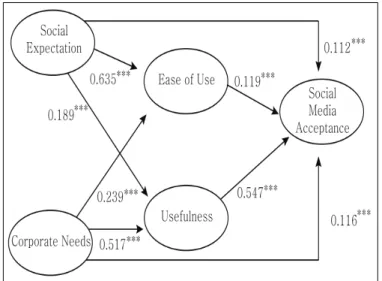
Figure 1 displays a path diagram of corporate acceptance of social media. Overall of social expectations, corporate needs, ease of use and usefulness serves as important antecedents of corporate acceptance of social media. In the path diagram, the two latent variables of ease of use and usefulness playa mediating role of corporate acceptance of social media in governing the path relationship.

<Table 3> Structural Equation Model Estimates

Independent Variable Dependent Variable Regression Estimates Standardized Effects Total Direct Indirect

H1: Social Expectations ➜ Ease of Use 0.635*** 0.857 0.635 0.222

H2: Social Expectations ➜ Usefulness 0.189*** 0.296 0.189 0.107

H3: Corporate Needs ➜ Ease of Use 0.239*** 0.239 0.239

H4: Corporate Needs ➜ Usefulness 0.517*** 0.517 0.517

H5: Social Expectations ➜ Social Media Acceptance 0.112** 0.250 0.112 0.138

H6: Corporate Needs ➜ Social Media Acceptance 0.116** 0.519 0.116 0.403

H7: Ease of Use ➜ Social Media Acceptance 0.119*** 0.119 0.119

H8: Usefulness ➜ Social Media Acceptance 0.547*** 0.547 0.547

Note: Numbers in the cells are standardized coefficient values.

Probability values for rejection of the null hypothesis of zero coefficient are employed at the 0.05 level (** p < 0.05 and *** p < 0.001).

(8)

In testing hypotheses 1 and 2, there are relationships between social expectations and ease of use, and between social expectations and usefulness, Table 3 shows that there are positive relationships between the latent variables and statistically significant at a 95% confidence level (p < 0.01). This suggests that social expectations have a positive and direct effect on both ease of use and usefulness.

The hypotheses 3 and 4 test relationships between corporate needs and ease of use, and between corporate needs and usefulness. Table 3 shows that there are positive relationships between the two latent variables and statistically significant at a 95% confidence level (p < 0.01). This suggests that corporate needs have a positive and direct effect on both ease of use and usefulness.

In testing hypotheses 5, 6, 7 and 8 that there are relationships between social expectations, corporate needs, ease of use, usefulness, and social media acceptance, each pair in Table 3 shows that there is a positive relationship between the latent variables and statistically significant at a 95% confidence level ( p < 0.05 or p < 0.01). This means that all of social expectations, corporate needs, ease of use and usefulness directly influence corporate acceptance of social media.

Figure 1 displays a path diagram of corporate acceptance of social media. Overall of social expectations, corporate needs, ease of use and usefulness serves as important antecedents of corporate acceptance of social media. In the path diagram, the two latent variables of ease of use and usefulness playa mediating role of corporate acceptance of social media in governing the path relationship.

Coefficient is statistically significant at a 95% confidence level (** p < 0.05 and *** p < 0.01)

<Figure 1> Path Diagram of Corporate Acceptance of Social Media

4.2. Demographic Differences in Acceptance of Social Media

One-way analysis of variance was conducted to compare means of the five constructs by job position titles of hotel staff.

Table 4 reveals statistically significant mean differences between job position titles in the perceived corporate needs (p < 0.01) and social media acceptance (p < 0.05) whereas it shows insignificant mean differences (p > 0.05) in terms of perceived social expectations, perceived ease of use, and usefulness.

Further more, the result shows that hotel employees with higher position titles have a negative propensity in perceiving highly corporate needs and their acceptance of social media.

<Table 4> One-way Analysis of Variance by Job Position Titles Variables Staff Associate Manager Director F-statistic Ease of Use -0.024 -0.055 0.014 0.375 2.192

Usefulness -0.049 0.055 -0.091 0.302 2.113 Corporate Needs 0.365 0.037 -0.131 -0.149 6.280***

Social

Expectations 0.135 0.032 0.028 -0.294 1.865 Social Media

Acceptance 0.103 0.080 -0.064 -0.435 3.723**

Probability values for rejection of the null hypothesis of no mean difference are employed at the 0.05 level(** p < 0.05 and *** p < 0.01).

Note: Numbers in the cells are standardized mean values.

5. Discussion and Managerial Implications

The results from an empirical analysis support all of the hypotheses. This study reveals that social expectations and corporate needs exert an imperative influence on their behavioral intention to use social media. The positive impact of social expectations and corporate needs on organizations’behavioral intention of using social media is a unique interest. The results indicate that social expectations and corporate needs should be viewed as important antecedents besides job position title differences in terms of perceived corporate needs and behavioral intention to use social media for business communication. The result expounds that hotel staff with higher position title has a negative propensity in perceiving the needs and benefits of using social media in their work and their behavioral intention to use social media for their business communication.

Although the number of companies using social media is

increasing, they often refuse to use social media for their

business communication with their customers and sharing

business information because of the tendency that social media

might not provide confidence and trust toward their business

communication. In addition, social expectations toward

organizations’use of social media affect its service evaluation by

customers and their future behavior of using the service. Because

of the direct and significant impact of the two, social and

corporate needs, organization’s using social media for their

business communication should develop a lucrative and congenial

environment for better delivering the service and for better

communicating with their customers.

(9)

The result of this study also shows that the perceived ease of use and usefulness of social media directly influence organizations’behavioral intention to use social media. The perceived reliability, capability and customization ability of staff clearly determines service provider’s levels and skills, in order to provide trusted communication and promised service delivery.

Therefore, staffing of suitably qualified and experienced personnel should remain stable to meet consumer needs in an efficient and timely manner. In addition, consumers should be rest-assured that they would receive business information in a timely manner from a candid source.

6. Conclusion and Future Research

Social media is rapidly emerging as a popular source of business information, especially for teens and young adults.

Social media marketing carries the advantages of low cost, rapid transmission through a wide range of communities, increasing opportunities of customer involving marketing communication and customer interaction. Businesses should recognize the importance of social media and their potential efficacy for communicating with their customers. The best way of using social media should be found in order to achieve marketing promotion outcomes. In this regard, a better understanding of organizations’ behavioral intention to use social media as a business communication channel is an important and timely area of research.

The findings of this research pave the way for the success of organizations using social media for their business communication, which depends on not only corporate needs but also their behavioral intention of using it. This paper integrate some components of the technology acceptance dimensions and social expectation theories couple with the recently developed construct of social expectations and corporate needs to determine organizations’behavioral intention to use social media. This research article is the initial research that has unique benefit which contributes to both the world of academia and most significantly to corporate world.

Future research should generalize these findings and may examine additional business sectors from different countries as potential sources of variation in the determinants of behavioral intention to use social media as a business communication channel. Therefore, further research is required to determine whether there is a consistent pattern or not. For example, extensions of this research may employ a more fine-grained approach to exam how business sectors in different business environments, industry characteristics, and organizational environments accept new information technology and intend to use social media or engage in a range of activities with the new technology. In addition, further studies should validate selected survey items elucidating social expectations and corporate needs of using social media.

References

Aaker, J. L., Fournier, S., & Brasel, S. A. (2004). When good brands do bad. Journal of Consumer Research, 31(June), 1-16.

Bartholomew, D. J. (1996). The Statistical Approach to Social Measurement. San Diego, Calif: Academic Press.

Bartoshuk, L. M., Fast, K., & Snyder, D. J. (2005). Differences in our sensory worlds: Invalid comparisons with labeled scales. Current Directions in Psychological Science, 14(3), 122-125.

Basilevsky, A. (1994). Statistical Factor Analysis and Related Methods: Theory and applications. New York: John Wiley and Sons.

Becker, K., & Lee, J. W. (2012). Social network reputation man- agement: An investigation of the actions of firms on the New York and London stock exchanges. In E. Kaynak and T.D. Harcar (Eds.), Proceedings of the Twenty First Annual World Business Congress of International Management Development Association, 21 (pp. 356-362), Hummelstown, PA: International Management Development Association.

Becker, K., Kanabar, V. K., & Nobre, H. M. (2011). Company in- tegrity management in the new social network environ- ment: A comparison of large and small firms on Facebook.

Advances in Global Management Development, 20, 268-272.

Becker, K., Lee, J. W., & Nobre, H. M. (2010). The new ecom- merce freeloaders: Effects on consumer behavior and decision making. International Journal of Technology Marketing, 5(4), 291-302.

Burn-Calander, R. (2013). The top 10 corporate social media disasters, Business Insider, Retrieved November 15, 2014, from http://www.businessinsider.com/the-top-10-cor- porate-s ocial-media-disasters-2013-11

Daniasa, C., Tomita, V., Stuparu, D., & Stanciu, M. (2010). The mechanisms of the influence of viral marketing in social media. Economics, Management, and Financial Markets, 5(3), 278-282.

Davis, F. D. (1989). Perceived usefulness, perceived ease of use, and user acceptance of information technology. MIS Quarterly, 13(3), 319-340.

Davis, F. D., Bagozzi, R. P., & Warshaw, P. R. (1989). User acceptance of computer technology: A comparison of two theoretical models. Management Science, 35(8), 982-1003.

Davis, F. D., Bagozzi, R. P., & Warshaw, P. R. (1992). Extrinsic and intrinsic motivation to use computers in the work- place1. Journal of Applied Social Psychology, 22(14), 1111-1132.

Dawes, J. (2008). Do data characteristics change according to the number of scale points used? An experiment using 5-point, 7-point and 10-point scales. International Journal of Market Research, 50(1), 61-77.

Deighton, J., & Kornfeld, L. (2009). Interactivity's unanticipated

(10)

consequences for marketers and marketing. Journal of International Marketing, 23(1), 4-10.

Dunn, G. (1989). Design and Analysis of Reliability Studies.

London, UK: Edward Arnold.

Fogel, J., & Nehmad, E. (2009). Internet social network com- munities: Risk taking, trust, and privacy concerns.

Computers in Human Behaviour, 25, 153-160.

Hendler, J., & Golbeck, J. (2007). Metcalfe's law, web 2.0, and the semantic web. Journal of Web Semantics, 6(1), 14-20.

Hennig-Thurau, T., Malthouse, E. C., Friege, C., Gensler, S., Lobschat, L., Rangaswamy, A., & Skiera, B. (2010). The impact of new media on customer relationships. Journal of Service Research, 13(3), 311-330.

Hills, G. E., Hultman, C. M., & Miles, M. P. (2008). The evolu- tion and development of entrepreneurial marketing.

Journal of Small Business Management, 46(1), 99-112.

Hsu, C., & Lin, J. C. (2008). Acceptance of blog usage: The roles of technology acceptance, social influence and knowledge sharing motivation. Information & Management, 45, 65 74. – Jones, B., Temperley, J., & Lima, A. (2009). Corporate reputa-

tion in the era of web 2.0: The case of Primark. Journal of Marketing Management, 25(9-10), 927-939.

Kaplan, A. M., & Haenlein, M. (2010). Users of the world unite!

The challenges and opportunities of social media.

Business Horizons, 53, 59-68.

Kaplan, A. M., & Haenlein, M. (2012). The Britney Spears uni- verse: Social media and viral marketing at its best.

Business Horizons, 55, 27-31.

Kim, Y. E., & Lee, J. W. (2011). Critical factors in promoting customer acceptance of and loyalty to online business management degree programs. African Journal of Business Management, 5(1), 203-211.

King, W. R., & He, J. (2006). A meta-analysis of the technology acceptance model. Information & Management, 43(6), 740-755.

Kirtiş, A. K., & Karahan, F. (2011). To be or not to be in social media arena as the most cost-efficient marketing strat- egy after the global recession. Procedia Social and Behavioral Sciences, 24, 260 268. –

Kline, R. B. (2005). Principles and Practice of Structural Equation Modeling (2nd ed.). New York: The Guilford Press.

Kozinets, R. V., Valck, K. D., Wojnicki, A. C., & Wilner, S. J. S.

(2010). Networked narratives: Understanding word-of- mouth marketing in online communities. Journal of Marketing, 74, 71-89.

Lee, J. W. (2010). Online support service quality, online learning acceptance, and student satisfaction. Internet and Higher Education, 13(4), 277-283.

Lee, J. W. (2011). Critical factors promoting customer loyalty to smartphone and mobile communications service providers.

Academy of Marketing Studies Journal, 15(1), 59-69.

Lee, J. W., & Mendlinger, S. (2011). Empirical investigation of the relationship between the operational competence of

service providers and the use and adoption of mobile commerce. Journal of Distribution Science, 9(2), 5-12.

Lee, J. W., Becker, K., & Nobre, H. (2012). Impact of culture on online management education. Cross Cultural Management - An International Journal, 19(3), 399-420.

Legris, P., Ingham, J., & Collerette, P. (2003). Why do people use information technology? a critical review of the tech- nology acceptance model. Information & Management, 40, 191-204.

Lu, J., Liu, C., Yu, C. S., & Wang, K. (2008). Determinants of accepting wireless mobile data services in China.

Information & Management, 45(1), 52-64.

Mangold, W. G., & Faulds, D. J. (2009). Social media: the new hybrid element of the promotion mix. Business Horizons, 52, 357-365.

Martin, K., & Todorov, I. (2010). How will digital platforms be harnessed in 2010, and how will they change the way people interact with brands. Journal of Interactive Marketing, 10(2), 61-66.

Murugesan, S., & Ebrary, I. (2010). Handbook of Research on Web 2.0, 3.0, and X.0: Technologies, Business, and Social Applications. New York: Information Science Reference.

Sigala, M. (2011). eCRM 2.0 applications and trends: The use and perceptions of Greek tourism firms of social net- works and intelligence. Computers in Human Behavior, 27, 655 661. –

Smith, T. (2009). The social media revolution. International Journal of Market Research, 51(4), 559-561.

Trusov, M., Bucklin, R., & Pauwels, K. (2009). Effects of word-of-mouth versus traditional marketing: Findings from an Internet social networking site. Journal of Marketing, 73(5), 90-102.

Venkatesh, V., Speier, C., & Morris, M. G. (2002). User accept- ance enablers in individual decision making about tech- nology: toward an integrated model. Decision Sciences, 33(2), 297-316.

Vollmer, C., & Precourt, G. (2008). Always On: Advertising, Marketing, and Media in an Era of Consumer Control.

New York: McGraw-Hill.

Wander, J. (2007). The four P’s in social simulation, a per- spective on how marketing could benefit from the use of social simulation. Journal of Business Research, 60, 868-875.

Weinberg, B. D., & Pehlivan, E. (2011). Social spending:

Managing the social media mix. Business Horizons, 54(3), 275 282. —

Xiang, Z., & Gretzel, U. (2010). Role of social media in online travel information search. Tourism Management, 31(2), 179 188. –

Yi, M. Y., Jackson, J. D., Park, J. S., & Probst, J. C. (2006).

Understanding information technology acceptance by in- dividual professionals: Toward an integrative view.

Information & Management, 43(3), 350-363.

수치

Figure 1 displays a path diagram of corporate acceptance of social media. Overall of social expectations, corporate needs, ease of use and usefulness serves as important antecedents of corporate acceptance of social media
Table 4 reveals statistically significant mean differences between job position titles in the perceived corporate needs (p &lt; 0.01) and social media acceptance (p &lt; 0.05) whereas it shows insignificant mean differences (p &gt; 0.05) in terms of percei

참조

관련 문서

• 이명의 치료에 대한 매커니즘과 디지털 음향 기술에 대한 상업적으로의 급속한 발전으로 인해 치료 옵션은 증가했 지만, 선택 가이드 라인은 거의 없음.. •

After choosing the type of bike, the next step is the right bike size. the right size for you from

44 글의 첫 번째 문장인 The most important thing in the Boat Race is harmony and teamwork.을 통해 Boat Race에서 가장 중요한 것은 조 화와 팀워크임을

Now that you have the right bike for you, it is important to learn the right riding position.. A poor riding position can lead to injuries

44 글의 첫 번째 문장인 The most important thing in the Boat Race is harmony and teamwork.을 통해 Boat Race에서 가장 중요한 것은 조 화와 팀워크임을

12 that절 내의 주어를 문장의 주어로 쓰고 that절 내의 동사를 to부정사로 써 서 수동태 문장을 만들 수 있다... 13 반복되는 the reason을 관계대명사 which로 바꿔주고

③ A student who attended Korean course at KNU Korean Language Program and holds TOPIK Level 3 or a student who completed Korean course Level 4 at the KNU Korean Language

· 50% exemption from tuition fee Ⅱ for the student with a TOPIK score of level 3 or higher or completion of level 4 or higher class of the Korean language program at the