약학희지 제
42
권제2
호165*-169(1998) Yakhak Hoeji Vol. 42. No. 2
환쥐 다형핵백혈구의 fMLP로 유도한 유주현상에 대한 신나믹산 유사체의 억제효과
민경락 • 김진준* • 박선규* ■이정래 • 강세훈* • 김영수* 충복대학교약학대학
, •(
주)LG
화학화장품연구소(Received December 20, 1997)
Inhibitory Effects of Cinnamic Acid Analogs on fMLP-Induced Chemotaxis of Rat Polymorphonuclear Leukocytes
Kyung Rak Min*, Jin-Jun Kim**, Sun-Gyoo Park**, Jeongrai Lee*, Seh-Hoon Kang**, and Youngsoo Kirr/*
*College o f Pharmacy, Chungbuk N ational University, Cheongju 361-763, Korea and
**Cosmetic R & D Center, LG Chemical Ltd., Taejon 305-343, Korea
Abstract— Inhibitory effects of 16 cinnamic acid analogs on formyl-Met-Leu-Phe(fMLP)-induced chemo
taxis of rat polymorphonuclear leukocytes were determined by using a microchemotaxis apparatus. 3.
4-Dihydroxycinnamic acid called as caffeic acid exhibited the highest inhibitory effect on the chemo
taxis among cinnamic acid analogs tested in this study. Hydroxycinnamic acids exhibited stronger in hibitory effects on the chemotaxis than cinnamic acid. Hydroxycinnamic acids w ith one hydroxy group at ortho, meta or para position exhibited similar inhibitory effects on the chemotaxis with cor
responding methoxycinnamic acids, but 3.4-dihydroxycinnarnic acid did stronger inhibitory effects than 3.4-cfaiethoxycinnamic acid. 3.4~Dimethoxycinnamic acid exhibited weaker inhibitory effects on the chemotaxis than 1.2-dimethoxy-4-prof)enyIbenzene and 3,4-dimethoxy cinnam onitiile with -CH=
CHCN or -CH^CHCHs group instead of -CH=CHCOOH group. 4-Hydroxy cinnamic acid and 3.4-dihy- droxycinnamic acid exhibited stronger inhibitory effects on the chemotaxis than ^(4-hydroxyphenyl) propionic acid and 3.4-dihydroxyhydrocirmamic acid with -CH^H2C00H group instead of -CH=
CHCOOH group.
Keywords □ Cinnam ic acid analogs, polymorphonuclear leukocytes, chemotaxis. fMLP.
국소적생체방어작용인염중반응에서혈액내백혈구 가염중국소로 이동하는 것을유주현상(chemotaxis) 이라 청하며 이 현상은 주화성 인자(chemoattrac*
tant)에 의해 유도된다."'® 백혈구외 유주현상은 se- lectin에외해 백혈구가혈관부위에 구르는단계를 시 작으로백혈구에주화성인자가결합하고이어세포표 면에부착물질인 integrin 수가중가한다.^"* 백혈구표 면외 integrin은 혈관 내피세포의 ICAM, ELAM,
VCAM 등과상호작용하여 백혈구가혈관내피세포에
*
본 논문에 관한 문의는 이저자에게로(
전화) 0431-61-2823 (
팩스) 0431-68-2732
부착하는단계에 도달하고이어서 혈관내피세포의 간 극을통헤 백혈구가혈관을 탈출하여 이물질이 침입한 국소로이동한다.*
주화성 인자로는 지질대사체인 platelet activating factor와 leukotriene B
4
, 보체절편 C5a, chemokine, 박테리아 웹타이드인 fMLP 등이 알려져 있다.**"® 주 화성인자는백혈구를포함한염증세포의표면에노출된 수용체에 특이적으로 결합하고 G 단백질을 경유한 phospholipase의활성화에의해 second messenger인 diacylglycer이과 inositol triphosphate를 생성한다.®주화성인자는이물질이침입한국소의세포에서분비되 며저농도의주화성인자는유주현상을일으키지만고농
민경락
■
김진준■
박선규■
이정래■
강세훈■김영수도의주화성 인자는염증세포외활성화및탈과럽을일 으킬수있다. 따라서유주현상에 외해혈관을탈출하여 이물질이침입한국소에도달하면고농도외주화성인자 에의해 백혈구가활성화되어 활성산소등을방출하고 탈과럽에의해각종가수분해성효소를유리시켜이물질 을분해시키는 염중반옹이 일 어 난 다 / 그 러 나 과대 염중반응은이물질의분해와제거외에도주변에있는정 상세포를 손상시킨다. 따라서 항염증 약물을복용함에 의해과대 염중반응에 의한정상세포외 손상을최소화 할수있다®
본논문은 fMLP로유도한흰쥐 다형핵백혈구의 유 주현상에대한 16종 cinnamic acid 유사체둘의억제효 과롤 1 uM 농도에서 평가한연구로시료중 3,4-dihy- droxycinnamic add(caffeic acid)가가장우수한억 제효과를나타냈으며 cinnamic acid 유사체외구조와 다형핵백혈구의유주현상에대한억제효과간의상관성 을고찰하였다.
실험방법
시약 및 기기 - RPM I 1640와 H anks' balanced salts는 GIBCO 사(Grand Island, N Y)에서 구입하 였고 f-MLP, arachidonic acid, heparin, histo- paque 1077, histopaque 1119, dextran은 Sigma 사 (St. Louis, M O )에서 구입하였다. 본연구에 사용된 cinnamic ad d와그유사체는 Aldrich 사에서구입하 여 사용하였다. Neuro Probe 사의 microchemo- taxis chamber와 Cambridge 사의 영상분석기를사 용하였다.
환쥐 다형핵백혈구 분리 - Sprague-Dawley계 흰 쥐를 에텔로 마취시킨 후 심장으로부터 Im /의 he- parin(75 units/m O을넣은주사기로 약
10
m /의혈 액을 채취한다옴동량의 H anks' 용액으로희석하였 다. 희석한혈액에 5 m /의 histopaque 1077과 5 m /의 histopaque 1119를가한다옴상온에서 10분간방처 하고 1600 rpm에서20
분간원심분리하였다. 다형핵백 혈구분획을채취한다옴 H anks' 용액으로 1회세척하 고 dextran 침전및증류수로적혈구를제거한다옴 5 ml RPM I 1640 배지에 현탁시켰다. Trypan blue로 염색한후현미경하에서살아있는다형핵백혈구수(생 존율은 95% 이상)를산정한 다음1
x10
® cells/m/이 되도록 RPM I 1640 배지로희석하였다,유주현상 측정 - Microchemotaxis chamber의 lower chamber에 RPM I 1640 배지로 희석한 0.1 uM외 fMLP를 well당 25 u i씩주입하고그위에 low- er filter와 upper filter를순차적으로올려놓은다옴 upper chamber를 고정하였다. Upper filter(poly- carbonate, 3um ) 와 lower filter (nitrocellulos e, 0.02 um )는 0.03% BSA를함유한 RPM I 1640 배지에
2
시간 이상 방치한 다옴 사용하였다. 시료인 dn-namic add 유사체는 에탄을로 용해한 다옴 RPM I 1640 배지로희석하여사용하였다. 180 u/외다형핵백 혈구현탁액(1X 10« cells/mu/)에 20 u/의시료를가하 고 37°C, 5% CO
2
에서 30분간 방치한 다옴 upper chamber의 well당 45 ui씩 주입하였다. 37°C, 5%CO
2
에서1
시간방치한다옴 upper chamber의세포 현탁액을제거하고 filter에부착된 다형핵백혈구틀고 정하기 위해 well당 50 u/외 formaldehyde를가하고 30초간상온에서방처하였다. Lower filter에고정된다 형핵백혈구수를영상분석기를사용하여산정하였다.유주현상억제율산출 - RPM I 1640 배지만처처된 대조군에 대한시료군의유주현상 정도틀비교하여 억 제율(%)로 산출하였으며 동일시료를 15개(n = 15)처 치하여 얻은 결과를 통계처리하였고 유의성은 Stu- dent's t-test로검정하였다.
실험결과 및 고찰
주화성인자인 fM LP의농도에따른다형핵백혈구의 유주현상을평가한 결과 0.1 uM의 fMLP틀처치했을 때 가장 높은 효과를 나타냈다. 0.001 uM 이하의
fMLP 농도에서는유의성있는유주효과를나타내지않
았으며, lu M 이상의 fMLP를 처치했을때는 0.1 uM 외 fMLP를처처했을때나타나는유주효과보다감소 하는경향이있었다. 따라서시료의다형핵백혈구유주 현상에 대한억제효과를평가할때 0.1 uM외 fM LP를 사용하였다. 방치시간에 따른 다형핵백혈구외 유주현 상을평가한결과방처시간에 비례하여유주효과가증 가하였으나, 90분이상방치하였을때는 lower filter로 이동한다형핵백혈구의 수가너무 많아산정하기가어 려웠다. 따라서시료에의한유주현상억제효과틀평가 할때방치시간을 60분으로정하였다.
시료로 cinnamic acid와 benzene 환에수산기또는 메톡시기가치환된유도체와 -CH=CH COOH기가다
J. Pharm. Soc. Korea
Chinamic aad H H H 2-Hydroxycinnamic acid OH H H 3-Hydroxycinnamic acid H OH H 4-Hydroxydnnainic acid H H OH 3,4-Dihydroxycinnamic acid H OH OH
Fig. 1 — Inhibitory effects on chemotaxis by hydroxy- dnnamic adds.
Inhibitory effects of hydroxydrmamic acids at the concentration of 1 uM are represented as % of inhibition compared with the control, mean±
standard error (n=15), and significant diff
erences of them from the control are *p<0.05 and *
*p<0.01.
른 기눙기로 치환된 유사체. 총 16중을 선별하여 fMLP로유도한다형핵백혈구의유주현상에대한억제 효과를 평가하였다. 농도 lu M에서 본 연구외 시료 16종은 14%에서 63%의 억제효과를 나타냈고 3,4- dihydroxycinnamic acid (caffeic acid) 가가장높은 억제효과를나타냈다.
Cinnamic acid의 benzene 환에 수산기가 처환된 유도체돌외다형핵백혈구유주현상에 대한억제효과는 Fig. 1과같다. Cinnamic acid의억제효과는 1 uM에 서 26%이었으나
ortho, meta
또는para
위치에 수산기 한개가치환된 hydroxycinnamic acid들은동일농도 에서 44%에서 53%의 억제효과를 나타냈고 meto와para
위치에 두 개의 수산기가 치환된 3.4-dihy-droxycinnamic acid는 63%의억제효과률나타냈다. 따라서 cinnamic acid 보다 benzene 환에수산기 한 개가치환된유도체들이다형핵백혈구유주현상에 대한 억제효과에 있어유의성있게 강한것을알수었었고. 또한두개외수산기가치환된유도체는한개의수산기 가치환된유도체보다더강한억제효과를나타내는것 을알수있었다.
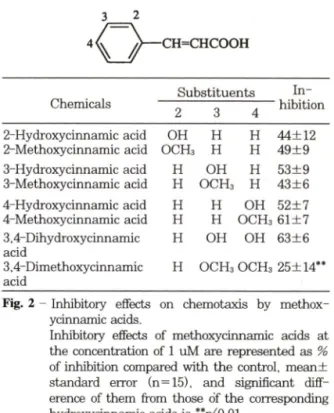
Hydroxycinnamic acid들의수산기가메털화된화합 물둘의다형핵백혈구유주현상에대한억제효과는 Fig.
2와 같다. 2-Methoxycinnamic acid, 3-methoxy- cinnamic acid. 4-methoxycinnaimc acid의다형핵백 혈구유주현상에 대한억제효과는 1 uM 농도에서각각 49%, 43%, 61%이었다. 그리고 3,4-4imethoxycin-
2-Hydroxycinnamic acid 2-Methoxycinnamic acid 3-Hydroxycinnamic acid 3-Methoxycinnamic acid 4-Hydroxycinnamic acid 4-Methoxycinnamic acid 3.4-Dihydroxycinnamic acid
3.4-Dimethoxycinnamic acid
OH H H 44±12
OC H
3H H 49±9
H O H H 53±9
H O C H
3H 43±6
H H O H 52±7
H H O C H
361±7
H O H O H 63±6
H O C H
3O C H
325+14
천Fig. 2 - Inhibitoiy effects on chemotaxis by methox- ycinnamic acids.
Inhibitory effects of methoxycinnamic acids at the concentration of 1 uM are represented as % of inhibition compared w ith the control. mean±
standard error (n=15), and significant diff
erence of them from those of the corresponding hydroxycinnamic acids is **p<0.01.
namic acid는 lu M 농도에서 다형핵백혈구 유주현상 울 25% 억제하였다. 한 개의 수산기가 치환된 hy- droxycinnamic acid돌과수산기가메털화된 대응하는 methoxycinnamic acid둘간은다형핵백혈구유주현상 에대한억제효과에 있어서로차이가 없는것을알수 있었다. 그러나 3,4-dihydroxycinnamic acid와비교하 여두 개의 수산기가모두 메틸화된 3,4-dimethoxy- cinnamic acid는다형핵백혈구 유주현상에 대해 현저 히약한억제효과를나타냈고수산기가없는 cinnamic acid와유사한수준의억제효과를나타냈다.
Cinnamic acid 유도체의 -CH = CH C O O H기가다 른기능기로치환된화합물둘의다형핵백혈구유주현상 에대한억제효과는 Fig. 3과같다. 2-Methoxycinna- m aldehyde 와 4-hydroxy-3-methoxycinnamal-
dehyde의다형핵백혈구유주현상에대한억제효과는
1
uM 농도에서 38%와 14%이었고. l,2-dimethoxy-4- propenylbenzene 과 3,4-dimethoxycinnamonitrile 외 억제효과는 40%와 51%이었다. 3-(4-Hydroxy- phenyl)propionic acid와 3.4-dihydroxy hydrocin- namic acid의다형핵백혈구유주현상에 대한억제효과 는 1 uM 농도에서 29%이었고 3-(4-Tnethoxyphenyl) propionic acid외억제효과는 46%이었다. Cinnamic
3 2 3 2
CH=CHCOOH CH=CHCOOH
흰쥐 다형핵백혈구의
M L P
로유도한유주현상에 대한신나믹산유사체의 억제효과________________m
Chemicals
브뼈요는^
2 3 4 i% )
Substituents
Chemicals ~ ~ ~ ~ ~ hibition
3
2*
*
* 1 1 9
76
±
±
±
±
± 6
^ 3
2
3 2
5
56
민 경 락• 김 진 준 • 박선규 • 이정래 • 강세훈• 김영수
4<
3 2
Q
—RChemicals Substituents
Inhibition(%)
2 3 4 R
2-Methoxycinnamic acid 2-Methoxycinnamaldehyde
OCH3
OCH3
H
H H
H CH=CHCOOH
CH=CHCHO 49+9 38+10 4-Hydroxy-3-methoxycinnamic acid
4-Hydroxy-3-methoxycinnamaldehyde H
H OCH3 OCH3
OHOH CH=CHCOOH
CH-CHCHO 23±9 14+13
3.4-Dihydroxy cinnamic acid 1.2-Dimethoxy-4-propenylbenzene
3.4-Dimethoxycinnamonitrile
HH H
OCH3 OCH3 OCH3
OCH3 OCH3 OCH3
CH=CHCOOH CH=CHCH3 CH=CHCN
25±14 40±12*
51+7**
4-Hydroxycinnamic acid
3-(4~Hydroxyphenyl) propionic acid
H
H H
H OH
OH CH=CHCOOH
CH2CH2COOH 52±7 29±11*
3.4-Dihydroxy cinnamic acid
3.4-Dihydroxyhydrocinnamic acid H
H OH
OH OH
OH CH=CHCOOH
CH2CH2COOH 63±6 29+13**
4-Methoxycinnamic acid
3-(4-Methoxyphenyl)-propionic acid
H
H H
H OCH3 OCH3
CH=CHCOOH
CH2CH2COOH 61+7 46+12 Fig. 3 - Inhibitory effects on chemotaxis by cinnamic add analogs.
Inhibitory effects of samples at the concentration of 1 uM are represented as % of inhibition compared with the control, mean±standard error (n=15), and significant differences of them from those of the cor
responding cinnamic acids are *p<0.05 and **p<0.01.
acid 유도체와 -CH=CHCHO기를 가지고 있는 cin- namaldehyde 유도체간에는 다형핵백혈구 유주현상에 대한 억제효과에 있어 서로 차이가 없는 것을 알 수 있 었다. 3.4-Dimethoxycinnamic acid와 비교하여 -CH = C H C H
3
기를 가지고 있는 1.2-dimethoxy-4- propenylbenzene과 -CH = C H C N기를 가지고 있 는 3.4-dimethoxycinnam onitrile은 다형핵백혈구 유주현상에 대한 억제효과에 있어 현저히 강한 것을 알 수 있었다. Hydroxycinnamic acid 유도체와 비 교하여 -CH = C H C O O H기 가 -CH2
C H2
C O O H기로 치환된 화합물들온 다형핵백혈구 유주현상에 대한 억 제효과에 있어 현저히 약하였고, 4-methoxycin- nam ic acid와 비교하여 -CH2
C H2
C O O H기를 가지 고 있는 3-(4-methoxyphenyl) propionic acid는 유 주현상 억제효과에 있어 서로 차이가 없는 것을 알 수 있었다.Cinnamic acid 유사체들의 구조와 다형핵백혈구 유 주현상에 대한 억제효과간의 상관성을 종합하면 다옴 과 같다. Cinnamic acid 보다 benzene 환에 수산기 한 개가 치환된 hydroxycinnamic acid들과 ben- zene 환의 mete와 para 위치에 수산기가 치환된 3.4- dihydroxycinnamic acid가 다형 핵 백혈구 유주현상에
대한 억제효과에 있어 유의성 있게 강하였다. Ben
zene 환에 수산기 한 개가 치환된 hydroxycinnamic acid들과 수산기가 메틸화된 대응하는 methox- ycinnamic acid둘은 유주현상 억제효과에 있어 차이 가 없었으나, 3,4-dihydroxycinnamic acid와 비교하 여 수산기가 모두 메틸화된 3.4-dimethoxycinnamic acid는 다형핵백혈구 유주현상에 대한 억제효과가 현 저히 약하였다. 3.4-Dimethoxycinnamic acid와 비교 하여 -CH =CH COOH기가 -C H ^C H C N기 또는 -CH=CHCH3기로 치환된 l,2-dimethoxy-4-prope- nylbenzene과 3,4-dimethoxycinnaiTionitrile은 다 형핵백혈구 유주현상에 대한 억제효과에 있어 유의성 있게 강하였다. 따라서 cinnamic acid의 meto와 para 위치에 수산기가 치환되고 H3H=CHCN기 또는 -CH = CHCH3기로 치환된 화합물돌이 다형핵백혈구 유주현상에 대해 강한 억제효과를 나타낼 것으로 기대 된다.
감사의 글
본 연구의 일부분은 과학기슬처 연구비 (95~*O04- 03-A-31)에 의해 수행되었으며 이에 감사드린다.
J. Pharm. Soc. Korea
흰쥐 다형핵백혈구의
fMLP
로유도한유주현상에 대한신나믹산 유사체의 억제효과문 헌
1) Weissmann, G. : Inflammation historical per
spective.
In Inflam m ation: Basic Principles and Clinical CorrelatesiGaBin,
J. L, Goldstein, I. M..Snyderman. R. eds.), pp. 5-10, Raven Press.
New York (1992).
2) Snyderman, R. and Uhing, R. J. : Chemoat- tractant stimulus-response coupling
in In flammation
:Basic Principles and Clinical Correlates
(Gallin, J. I., Goldstein, I. M.. Snyderman. R.
eds.), pp. 421-440, Raven Press, New York (1992).
3) Carlos, T. M. and Harlan. J. M. ; Membrane proteins involved in phagocyte adherance to en
dothelium.
Im m unol Rev. 114.
5 (1990).4) Osborn, L. : Leukocyte adhesion to endothe
lium in inflammation.
Cell 62,
3 (1990).5) Springer, L. M. : Adhesion receptors of the im
mune system.
Nature
346. 425 (1990).6) Amaout, M. A. ; Structure and fiinction of the leukocyte adhesion molecules CD11/CD18.
Blood 75.
1037 (1990).7) Perretti, M ■ Endogenous mediators that in
hibit the leukocyte-endothelium interaction.
TIPS 18,
418 (1997).8) Kishimoto, T. K. and Anderson. D. C. : The role of integrin in inflammation.
In Inflammation
:Basic Principles and Clinical Correlates
(Gallin, J. L.Goldstein. I. M., Snyderman. R. eds.), pp. 353- 406. Raven Press, New York (1992).
9) Butcher, E. C. : Cellular and moleculer mechan
isms that direct leukocyte traffic.
Cell 63.
861 (1990).10) Heimer, M. E. : VLA proteins in the integrin family: structures, functions, and their roles on leukocytes.
Annu. Rev. Immunol. 8.
365 (1990).11) Prescott. S. M., Zimmerman, G. A. and McIn
tyre, T. M. - Platelet-activating factor.
J. Biol.
Chem. 265,
17381 (1990).12) Samuelsson, B. : Leukotrienes: mediators of immediate hypersensitivity reactions and in
flammation.
Science 220,
568 (1983).13) Goldstein. I. M. ■ Complement: biologically ac
tive products.
In Inflammation: Basic Principles and Clinical
Correktes(Gallin, J. L. Goldstein. I. M..Snyderman, R. eds.), pp. 63-80. Raven Press, New York (1992).
14) Schall, T.
J . ■
The chemokines.In The Cytokine Handbook
(Thomson, A. ed.)pp. 419-460, A- cademic Press, New York (1994).15) Boulay. F.. Tardif, M.. Brouchon, L. and Vignais, P. : The N-fomiyl-peptide receptor.
Biochem, 29,
11123 (1990).16) Tamura, M., Tamura, T., Tyagi, S. R. and Lam
beth, J. D. : The superoxide-generating respira
tory burst oxidase of human neutrophil plasma membrane. }.
Biol Chem. 263,
17621 (1988).17) Rotrosen, D. ; The respiratory burst oxidase.
In Infkmrmtion: Basic Principles and Clinical Correlates
(Gallin, J. I., Goldstein, I. M.. Snyderman, R.eds.), pp. 589-601, Raven Press, New York (1992).
18) Bentwood, B. J. and Henson. P. M. '■ The sequential release of granule constituents from human neutrophils.
J. Im m unol. 124.
855 (1980).19) Henson, P. M.. Henson, J. E., Fittschen, C., Bratton. D. L. and Riches, D. W. H. ; De
granulation and secretion by phagocytic cells.
In Inflammation: Basic Principles and Clinical Correlates
(Gallin, J. L, Goldstein, I. M., Snyderman, R.eds.). pp. 511-539, Raven Press. New York (1992).
20)Prous, J. R. :
The Year's D rug News,
Prous Science. Barcelona (1995).