Vol. 43, No. 3, September 2017, 195-200 http://dx.doi.org/10.15230/SCSK.2017.43.3.195
1)
1. Introduction
Machilus thunbergii Sieb. et Zucc. (M. thunbergii) is a deciduous tree grown in the southern areas of Korea and its bark is commonly used as a folk medicine for the
† 주 저자 (e-mail: [email protected]) call: 031)220-2360
treatment of leg edema, abdominal pain and abdominal distension[1,2]. Meso-dihydroguaretic acid (MDGA)[3,4], which is a lignan component in the bark of M. thunbergii, has been shown to have broad biological activities such as neuroprotective activity[5], osteoblast differentiation in- ducing activity[6], inhibitory activity against the ex- pression of MMP-2 and 9[7], antioxidative activity[8] and depigmenting activity[9]. However, no studies of MDGA
메조-디하이드로구아레틱산 메틸, 아세틸 치환체의 합성 및 이들 화합물들의 LPS에 의해서 유도된 일산화질소(NO)의 억제 효능에 대한 연구
최 경 오⋅노 호 식†
수원대학교 화공신소재공학부, 뷰티사이언스연구센터
(2017년 7월 10일 접수, 2017년 9월 19일 수정, 2017년 9월 22일 채택)
Synthesis of Methylated and Acetylated Derivatives of Meso-dihydroguaretic Acid and Study of Their Inhibitory Activities on LPS Derived Nitric Oxide (NO) Production
Kyungoh Choi and Ho Sik Rho†
Department of Chemical and Material Engineering, Beauty Science Research Center, The University of Suwon, 17 Wauan-gil, Bongdam-eup, Hwaseong-si, Gyeonggi-do 18323, Korea
(Received July 10, 2017; Revised September 19, 2017; Accepted September 22, 2017)
요 약: 본 연구는 메조-디하이드로구아레틱산(MDGA, 1)과 합성 유도체(2와 3)의 일산화질소(NO)억제 효능 에 대한 내용이다. MDGA는 토후박(Machilus thunbergii Sieb. et Zucc.)껍질에서 분리된 리그난 화합물이다.
본 연구자들은 디메틸로 치환된 화합물(2)과 디아세틸로 치환된 화합물(3)을 합성하였고, 이 두 화합물의 일산 화질소 억제 효능을 MDGA (1)와 비교하여 측정하였다. MDGA (1)와 화합물(3)은 LPS에 의해서 유도된 일산 화질소 억제 효능을 나타내었다. RT-PCR 분석을 통해 MDGA (1)와 화합물(3)의 일산화질소 억제 효능은 iNOS의 mRNA 발현의 감소에 기인함을 확인하였다. 이러한 실험 결과로부터 디아세틸로 치환된 화합물(3)은 MDGA의 프로드럭으로 사용될 수 있음을 확인하였다.
Abstract: This study was conducted to examine the inhibitory effects of meso-dihydroguaretic acid (MDGA, 1) and its synthetic derivatives (compound 2 and 3) against NO production. MDGA is a lignan component isolated from the bark of Machilus thunbergii Sieb. et Zucc. We synthesized dimethylated MDGA (2), diacetylated MDGA (3) and compared NO inhibition of two derivatives with that of MDGA (1). MDGA (1) and compound 3 showed suppressive effects against the generation of NO in LPS-activated macrophages. RT-PCR analysis suggested that MDGA (1) and compound 3 inhibited NO production through the suppression of iNOS mRNA expression. From these results, diacetylated MDGA (3) can be used as a pro-drug for MDGA.
Keywords: meso-dihydroguaretic acid, methylated derivatives, acetylated derivative, nitric oxide, LPS
as a nitric oxide (NO) inhibitor have been reported to date. The MeOH extract[10] of this plant exhibited in- hibitory activity against NO production in LPS-activated macrophages, but the compounds responsible for this ac- tivity have not been identified.
NO[11] is a free radical generated by constitutive and inducible nitric oxide synthase in numerous mammalian cells and tissues. NO constitutively expressed by neuronal NOS (nNOS) and endothelial NOS (eNOS) is a key regu- lator of homeostasis[12]. However, the synthesis of NO by iNOS is induced by a variety of stimuli, including LPS, bacteria, viruses and postinflammatory cyto- kines[13]. Excess production of NO can damage DNA, lipids and proteins.
MDGA (1) has two aromatic hydroxyl groups which can be considered as a pharmacophore. Although naturally occurring phenols show various biological activities, their uses in cosmetics are limited because of their unfavorable stabilities[14]. Thus, there are strong needs to enhancing chemical stability and biological activities of phenols by minimal modification of aroatic hydroxyl groups[15].
Recently, several aromatic compounds, protected by methyl and acetylgroups, showed potent biological activities. In particular, O-methylated flavonoids exhibited a superior activity than the corresponding hydroxylated derivatives[16,17]. In acetyl derivatives, 3,5,4’-tri-acetyl resveratrol has been studied as a pro-drug for resvera- trol[18,19]. In this study, we synthesized di-O-methyl MDGA (2) and di-O-acetyl MDGA (3) and evaluated their inhibitory effects on NO production.
2. Experimental
2.1. General Methods
All the chemicals were from Sigma. Mass spectra were acquired in the range of (full) m/z 125-1,200 (MS-MS ion isolation width, 5 Da; MS-MS collision energy, 45%; and MS-MS scan range, m/z of parent ion to ca.
1/3 m/z parent ion).
1H,
13C-NMR spectra were re- corded on a Varian GEMINI-500BB (500 MHz) spectrometer.
2.2. Synthesis
2.2.1. Synthesis of Compound 2
To a stirred solution of MDGA (1, 4.8 g, 30 mmol) and K
2CO
3(4.0 g, 40 mmol) in acetone (100 mL) under N
2was added dimethylsulfate (3.6 g, 33 mmol). The reaction mixture was stirred for 2 h at reflux and then the solid was filtered off. The filtrate was evaporated in vacuo. The residue was extracted with ethyl acetate (50 mL), washed with water. The solvent was dried over MgSO
4and evaporated to dryness. The crude product was purified by silica gel column chromatography to give desired product 2 in 81% yields.
1
H-NMR (500 MHz, CDCl
3): d 6.78 (d, 1H, J = 8.1 Hz), 6.70 (d, 1H, J = 8.1 Hz), 6.65 (s, 1H), 3.85 (s, 6H), 2.78 (m, 1H), 2.37 (m, 1H), 1.79 (m, 1H), 0.86 (d, 3H, J = 6.6 Hz).
13C-NMR (125 MHz, CDCl
3): d 148.9, 147.3, 134.6, 121.1, 112.5, 111.3, 56.09, 55.98, 39.3, 39.0, 16.3. FAB MS: (m/e) 359 [M+H]
+.
2.2.2. Synthesis of Compound 3
To a stirred solution of MDGA (1, 4.8 g, 30 mmol) and triethylamine (4.0 g, 40 mmol) in CH
2Cl
2(100 mL) under N
2was added acetic anhydride (3.6 g, 33 mmol).
The reaction mixture was stirred for 2 h at room temper- ature and then CH
2Cl
2was evaporated in vacuo. The resi- due was extracted with ethyl acetate (300 mL), washed with water. The solvent was dried over MgSO
4and evaporated to dryness. The crude product was purified by silica gel column chromatography to give desired product
3 in 78% yields.1
H-NMR (500MHz, CDCl
3): d 6.94 (d, 1H, J = 8.1 Hz), 6.73 (d, 1H, J = 8.1 Hz), 6.71 (s, 1H), 3.79 (s, 3H), 2.80 (m, 1H), 2.36 (m, 1H), 2.30 (s, 3H), 1.80 (m, 1H), 0.87 (d, 3H, J = 6.6 Hz).
13C-NMR (125 MHz, CDCl
3) d 169.3, 150.9, 140.8, 137.9, 122.4, 121.3, 113.3, 56.0, 39.40, 39.24, 20.8, 16.4. FAB MS: (m/e) 415 [M+H]
+. 2.3. Biological Activities
2.3.1 Cell Culture
RAW264.7 cell line was obtained from the Korean Cell
Line Bank (Korea). The cells were cultured in Dulbecco’s modified Eagle’s medium (DMEM) containing 10% fetal bovine serum (FBS), 100 U/mL penicillin, 0.1 mg/mL streptomycin at 37 ℃ in a humidified 95% air and 5%
CO
2atmosphere.
2.3.2 Measurements of NO Production
RAW264.7 cells (1 × 10
6cells/mL) were preincubated with MDGA and its derivatives for 30 min and con- tinuously activated with LPS (1 µg/mL) for 24 h. Nitrite concentration was measured by adding 100 µL of Griess reagent (1% sulfanilamide and 0.1% N-[1-naphthyl]- ethylenediamine dihydrochloride in 5% phosphoric acid) to 100 µL of culture supernatants for 10 min at room temperature. OD at 570 nm (OD
570) was measured using a Spectramax 250 microplate reader (Molecular Devices, Sunnyvale, USA). A standard curve of NO was made with sodium nitrite.
2.3.3 Measurements of Cytotoxicity
After the preincubation of RAW264.7 cells (1 × 10
6cells/mL) for 18 h, MDGA and its derivatives (0-100 µM) were added to the cells and incubated for 24 h. The cyto- toxic effect of MDGA and its derivatives was then eval- uated by a conventional MTT assay. At 3 h prior to cul- ture termination, 10 mL of the MTT solution (5 µg/mL in a phosphate buffered-saline, pH 7.4) were added and the cells were continuously cultured until termination. The incubation was halted by the addition of 15% sodium do- decyl sulfate into each well, solubilizing formazan. The absorbance at 570 nm (OD
570-630) was measured by a Spectramax 250 microplate reader.
2.3.4 mRNA Detection
Total RNA from LPS-treated-RAW264.7 cells (5 × 10
6cells/mL) was prepared by adding TRIzol Reagent (Gibco BRL) according to the manufacturer’s protocol. The total RNA solution was stored at –70 ℃ until used.
Semi-quantitative RT reactions were conducted using MuLV reverse transcriptase. Total RNA (1 µg) was in- cubated with oligo-dT15 for 5 min at –70 ℃ and mixed
with a 5 × first-strand buffer, 10 mM dNTPs and 0.1 M DTT. The reaction mixture was further incubated for 5 min at 37 ℃ and for 60 min after the addition of MuLV reverse transcriptase (2 U). Reactions were terminated after 10 min at 70 ℃, and total RNA was depleted by adding RNase H. The PCR reaction was conducted with the incubation mixture (2 mL cDNA, 4 µM 5’ and 3’ pri- mers, a 10 × buffer [10 µM Tris-HCl, pH 8.3, 50 µM KCl, 0.1% Triton X-100], 250 µM of dNTP, 25 µM of MgCl
2, and 1 unit of Taq polymerase [Promega, USA]).
The following incubation conditions were used: a 30 s denaturation time at 94 ℃, an annealing time of 30 s between 55 and 60 ℃, an extension time of 45 s at 72
℃, and a final extension of 5 min at 72 ℃. For real-time PCR analysis, 1 µg of RNA was submitted to reverse transcription with the Molony murine leukemia virus re- verse transcriptase (Invitrogen). Two microliters of cDNA obtained for each sample were submitted to a qPCR using the SYBR green Master mix method (Applied Biosystems, USA) in the ABO sequence detection system.
The results were normalized with the 18S transcript. The primers (Bioneer, Korea) used in this experiment are in- dicated as follows: iNOS F-5’-GGAGCCTTTAGAC CTCAACAGA-3’ and R-5’-TGAACGAGGAGGGTGGT G-3’; GAPDH F-5’-CAATGAATACGGCTACAGCAAC-3’
and 5’-AGGGAGATGCTCAGTGTTGG-3’.
3. Results and Discussion
3.1. Sythesis of MDGA Derivatives
MDGA (1) was prepared from M. thunbergii as pre- viously described[5]. MDGA was reacted with dime- thylsulfate in refluxing acetone to give dimethyl protected MDGA (2). Alternatively, MDGA was reacted with acetic anhydride and triethylamine in methylene chloride to af- ford diacetyl protected MDGA (3). The synthetic path- ways are shown in Scheme 1.
3.2. Inhibition of Nitric Oxide
The inhibitory activities of MDGA and its synthetic de-
rivatives against nitric oxide induced by LPS were
investigated. The cytotoxicity of these compounds was checked using a MTT assay.
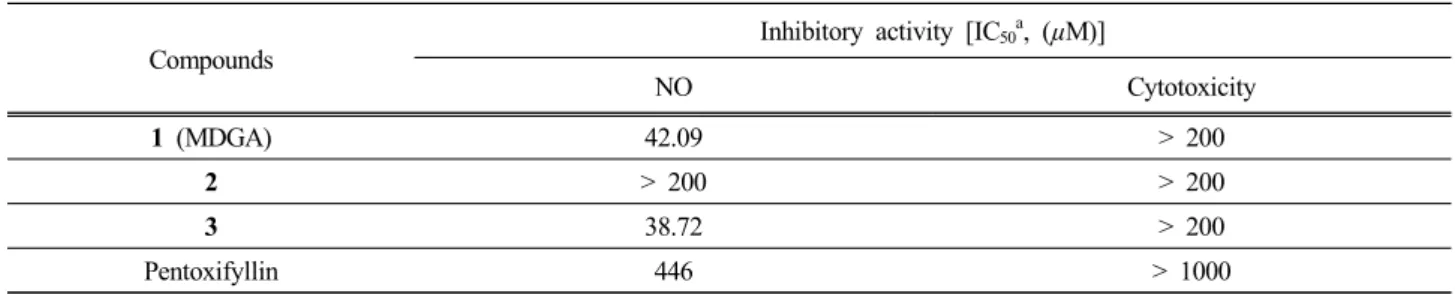
After confirming cell viability, we evaluated NO in- hibitory activities at various concentrations. Pentoxifyllin was used as a positive control. The results are shown in Figure 1.
Compound 1 and compound 3 significantly inhibited NO production in a dose dependent manners. The struc- ture of compound 1 (MDGA) comprises two main parts:
the C
6alkyl chain, and two aromatic hydroxyl groups.
These two aromatic hydroxyl groups can be considered as a pharmacophore for various biological activities includ- ing antioxidative activity. MDGA exhibited potent in-
hibitory activity against NO production (IC
50= 42.09 µM). When two hydroxyl groups of MDGA were methy- lated, its activity was completely lost (Entry 2 in Table 1). However, diacetylated MDGA (3) showed potent in- hibitory activity against NO productions. Specifically, the activity of compound 3 (IC
50= 38.72 µM) was similar to that of MDGA, even though its two hydroxyl groups are protected by acetyl groups. These results indicated that compound 3 can be used as an alternative of MDGA.
3.3. Expression of iNOS mRNA
To compare the mechanism for the inhibition of NO production by MDGA and compound 3, we examined the
Compounds Inhibitory activity [IC50a, (µM)]NO Cytotoxicity
1 (MDGA) 42.09 > 200
2 > 200 > 200
3 38.72 > 200
Pentoxifyllin 446 > 1000
aValues were determined from logarithmic concentration-inhibition curves and are given as the means of three experiments.
Table 1. NO Inhibitory Activities of Meso-dihydroguaretic Acid and Its Derivatives
a
1, MDGA
MeO HO
b
2
MeO AcO
3
MeO MeO
OH
OMe
OAc OMe
OMe OMe
Scheme 1. Reaction conditions: (a) dimethylsulfate, acetone, K2CO3, reflux; (b) acetic anhydride, triethylamine, methylene chloride, room temperature.
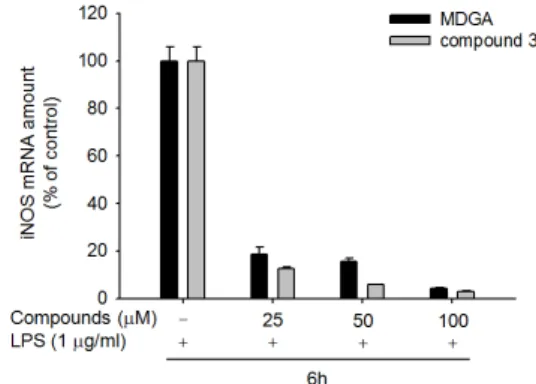
expression of iNOS mRNA in LPS-activated RAW264.7 cells. For RT-PCR analysis, the mRNA of iNOS was in- duced by treatment of the cells with 1 µg/mL LPS for 6 h (Figure 2). Treatment with MDGA and compound 3 at concentrations of 25, 50 and 100 µM suppressed the ex- pression of iNOS mRNA significantly. In addition, the in- hibitory activities of both compounds were found to occur in a dose-dependent manner. These results suggested that the inhibition of NO production by MDGA and com- pound 3 was due to the decrease of iNOS mRNA. The result in which iNOS mRNA assay showed the similar ef- fect with MDGA corroborates a potential use of com- pound 3 as an alternative of MDGA.
4. Conclusion
We synthesized MDGA derivatives (2 and 3) and com- pared their inhibitory activities against NO production in LPS-activated macrophages to that of MDGA (1). MDGA and diacetylated MDGA (3) showed potent inhibitory ac- tivities and their activities appeared to be correlated with the suppression of iNOS mRNA. However, dimethylated MDGA (2) showed no activity. This study showed that aromatic hydroxyl group can be used as pharmacophore for the inhibition of NO production. Although compound
3 has no aromatic hydroxyl groups, its inhibitory activitywas similar to that of MDGA. The activity of diacetylated MDGA (3) may be originated from the rapid generation of MDGA by hydrolysis. From these results, we can de-
velop diacetylated MDGA (3) as a pro-drug for MDGA.
Further studies on the relationship between iNOS mRNA and expression of protein iNOS are underway in our laboratory.
Acknowledgement
이 연구는 2017년 수원대학교 교내연구비의 지원으
로 수행되었습니다 .
Reference
1. B. S. Chung and M, G, Shin, Dictionary of Korean Folk Medicine, Yong Lim Sa, p. 458 (1990).
2. U. Y. Yu, S. Y. Kang, H. Y. Park, S. H. Sung, E.
J. Lee, S. Y. Kim, and Y. C. Kim, Antioxidant li- gnans from Machilus thunbergii protect CCl4-injured primary cultures of rat hepatocytes, J. Pharm.
Pharmacol., 52, 1163 (2000).
3. H. Shimomura, Y. Sashida, and M. Oohara, Lignans from Machilus thunbergii, Phytochemistry, 26, 1513 (1987).
4. H. Karikome, Y. Mimaki, and Y. Sashida, A butano- lide and phenolics from Machilus thunbergii, Phytochemistry, 30, 315 (1991).
5. C. J. Ma, S. H. Sung, and Y. C. Kim, Neuroprotective lignans from the bark of Machilus thunbergii, Planta Med., 70, 79 (2004).
6. M. K. Lee, H. Yang, C. J. Ma, and Y. C. Kim,
Figure 2. Effects of MDGA (1) and compound 3 on the expression of iNOS mRNA in LPS-activated macrophages.Figure 1. Effects of compound 1, compound 2 and compound 3 against nitric oxide induced by LPS.