• 검색 결과가 없습니다.

Protective Effects of Cinnamic Acid Derivatives on Gastric LesionSun Yi Lee, In Young Hwang, and Choon Sik Jeong

N/A
N/A
Protected

Academic year: 2022

Share "Protective Effects of Cinnamic Acid Derivatives on Gastric LesionSun Yi Lee, In Young Hwang, and Choon Sik Jeong"

Copied!
7
0
0

로드 중.... (전체 텍스트 보기)

전체 글

(1)

https://doi.org/10.20307/nps.2017.23.4.299

299

Protective Effects of Cinnamic Acid Derivatives on Gastric Lesion

Sun Yi Lee, In Young Hwang, and Choon Sik Jeong*

College of Pharmacy, Duksung Women's University, Seoul 01369, Republic of Korea

Abstract − P-methoxycinnamic acid and 3,4,5-trimethoxycinnamic acid are the compounds found in Polygalae Radix, the root of Polygala tenuifolia Willdenow, and have been reported to have hepatoprotective and anti- neurodegenerative effects. On the other hand, there are no reports of their effects on gastric lesions. This study examined the inhibitory effects of cinnamic acids, including p-methoxycinnamic acid, 3,4,5-trimethoxycinnamic acid, and 8 compounds (cinnamic acid, 2-(trifluoromethyl) cinnamic acid, 3-(trifluoromethyl) cinnamic acid, trans-4-(trifluoromethyl) cinnamic acid, 4-(dimethylamino) cinnamic acid, 3,4-(methylenedioxy) cinnamic acid and 3,4-dihydroxycinnamic acid), which were selected based on their presence in medicinal herbs and molecular weight, against gastric lesions. Animal models were used to confirm the protective effects on acute gastritis caused by the administration of HCl/EtOH. Gastric acid inhibition was examined by an acid-neutralizing test and the proton pump (H

+

/K

+

-ATPase) inhibiting activity. In addition, antioxidant tests were performed and the gastric emptying rate was determined. The results showed that cinnamic acid, p-methoxycinnamic acid, and 3,4,5- trimethoxycinnamic acid had an inhibitory effect on gastric lesions.

Keywords − Cinnamic acid, Gastritis, Gastric acid, H

+

/K

+

-ATPase

Introduction

Gastritis can be classified into acute and chronic gastritis. Acute gastritis is a sudden inflammation or swelling in the lining of the stomach. Acute gastritis is caused by inflammation, injury, bacteria, viruses, severe psychological and physical stress and drugs (NSAIDs inhibit cyclooxygenase-1(COX-1); nonsteroidal anti-infla- mmatory drugs, antibiotics, steroids, anti-cancer drugs and etc.). In the case of NASIDs, short term use is not dangerous but long term use may cause gastritis. For some other reason is ingesting irritants as alcohol or spicy food.

1

Acute gastritis can be classified into acute hemorrhagic gastritis, acute erosive gastritis, which are caused by acute chemical or irritative damage,

2

and acute Helicobacter pylori (H. pylori) gastritis.

3

Proton pump inhibitors (PPIs) reduce gastric acid by irreversibly inhibited the secretion of H

+

/K

+

-ATPase. PPIs are mainly used to treat reflux esophagitis, gastritis, and ulcers caused by drugs. Drugs for H. pylori-induced ulcers are combinations of PPIs and antibiotics. Long-term use of PPIs may cause hypogonadism and increase risks of colds, pneumonia, anemia, and osteoporosis.

4,5

Oxidative

stress is defined as an imbalance between the production of reactive oxygen species (ROS) and the ability of cells to induce an effective antioxidant response.

6

Free radicals chemically modify lipids, proteins, and DNA, and lead to aging and predispose various diseases.

7

Furthermore, overeating and gastric stasis cause gastric damage. Cinnamic acid is a compound produced by Cinnamomum cassia (family, Lauraceae). The cinnamic acid-related compounds were chosen for the present study.

8

P-methoxycinnamic acid and 3,4,5-trimethoxycinnamic acid structure possess a 1 or 3 methoxy group, respectively. 2-(trifluoromethyl) cinnamic acid, 3-(trifluoromethyl) cinnamic acid, and trans-4-(trifluoromethyl) cinnamic acid structure have one CF

3

group on positions 2, 3, 4. 4-(dimethylamino) cinnamic acid, 3,4-(methylenedioxy) cinnamic acid and 3,4-dihy- droxycinnamic acid structure includes dimethylamino, methylenedioxy and dihydroxy group, respectively. The aim of this study was to examine the effects of these cinnamic acid derivatives on gastric lesions. This study was investigated to compare activity against gastrointestinal disease by structure of p-methoxycinnamic acid, 3,4,5- trimethoxycinnamic acid, and 7 kind’s compounds of cinnamic acid as basic moiety which were selected based on the ingredient of medicinal herbs and molecular weight, and to confirm the factor affecting the gastric lesion inhibitory effects.

*Author for correspondence

Choon Sik Jeong, College of Pharmacy, Duksung Women's Univer- sity, Seoul 01369, Republic of Korea.

Tel: +82-2-901-8382; E-mail: [email protected]

(2)

purchased from JUNSEI Chemical Co., Ltd (Nihonbashi- honcho, Chuo-ku, Tokyo); ATP, cimetidine, Bradford reagent, L-ascorbic acid, pyrogallol, phenol red, and tris- HCl were from Sigma-Aldrich (MO, USA); Magnesium chloride, p-methoxycinnamic acid, 3,4,5-trimethoxycinnamic acid and 3,4-dihydroxycinnamic acid were obtained from Wako; 2-(trifluoromethyl)cinnamic acid, 3-(trifluoromethyl) cinnamic acid, trans-4-(trifluoromethyl)cinnamic acid, and 4-(dimethylamino)cinnamic acid from Alfa Aesar (MA, U.S.A); 3,4-(methylenedioxy)cinnamic acid from ACROS; and albumin standard from Pierce. Potassium chloride, ether, EtOH, and trichloroacetic acid were from Samchun Chemical Co., Ltd (Kyunggi-do, Korea), reba- mipide was purchased from DAEHE Chemical (Kyunggi- do, Korea), and activated charcoal, iron(III)chloride and potassium ferricyanide were from Duksan Chemical (Kyunggi-do, Korea). All other reagents and solvents were of analytical grade. Micropipettes were from Sorenson

TM

BioScience, Inc. (Murray, UT, USA), the 5810R centrifuge was purchased from Eppendorf (Hamburg, Germany); the microcentrifuge from Vision (Daejeon, Korea); the optical microscope from Kyowa (Model No. No.870518; Chofu, Tokyo); the high speed centrifuge from Sorvall RT-6000 (MA, USA); the UV spectrophotometer from (ASIS UVM340; Cambridge, U.K.).

Experimental animals − Male Sprague–Dawley rats, weighing 170 – 190 g and white male ICR mice, weighing 28 - 32 g were purchased from Samtako Inc. (Kyunggido, Korea). All animal experiments were conducted in accordance with guideline issued by the National Research Council (Institutional Animal Care and Use Committee;

IACUC) for the Care and Use of Laboratory Animals (Ministry of Food and Drug Safety). The experimental protocol was approved beforehand by the Animal Experi- ment Committee at Duksung Women’s University (permit number: 2015-017-008).

HCl/EtOH-induced gastritis in rats − After a 24-hour fast with free access to water prior to the experiment, samples (200 mg/kg) were administered orally to rats.

Thirty minutes later, 1 ml of a HCl/EtOH solution (150 mM HCl in 60% EtOH) was administered orally. One hour later animals were sacrificed by ether inhalation and stomachs were excised, inflated by injecting 2 ml of normal saline, and then fixed for 30 min in a 2% formalin solution. Stomachs were then incised along the greater curvature and the glandular portion was examined for hemorrhage. The length (mm) of each lesion was measured

length (drug)] / [lesion length (control)] × 100.

Acid-neutralizing capacity − 1 mg of each of the compounds was added to 100 µl of 0.1 N HCl and incubated for 1 hr at 37

o

C with shaking. Acid-neutralizing capacity was determined by titration versus 0.1 N NaOH using methyl orange as indicator.

H

+

/K

+

-ATPase activities − When it comes to the method, the rat gastric membrane protein determined by the bradford’s law was tested, and pre-incubated at 37

o

C for 1 hr with 300 µL of reaction mixture containing 20 mM MgCl

2

, 20 mM ATP and 20 mM KCl, and 20 mM Tris- HCl (pH 7.4) were added and incubated at 37

o

C for 30 min, and then, another 300 µL of the assay mixture containing 4.5% ammonium molybdate and 30% TCA 300 µL, added and centrifuged at 3,000 rpm for 10 min and the supernatant was taken. Absorbance was measured at 400 nm.

10

DPPH radical scavenging assay − Abilities to scavenge the DPPH (1,1-diphenyl-2-picrylhydrazyl) radical were determined as described by Lee et al. (2005).

11

0.4 mL of methanol solution was added to 0.1 mL of 1.5 × 10

−4

M DPPH /methanol, vortexed for 15 seconds, left at room temperature for 30 min, and then absorbance was read at 520 nm by UV-spectrophotometry. Antioxidant effect was defined as the absorbance of test compound required to reduce the DPPH radical concentration to 50% (IC

50

), and L-ascorbic acid was used as a positive control drug.

Inhibition rate (%) was calculated using [1 − (A

Experimental

– A

Blank

) / A

Control

] × 100.

Reducing power assay − This assay was conducted as described by Oyaizu (1986),

12

50 µL of samples was mixed with 225 µL of phosphate buffer (pH 6.6) and 225 µL of 1% K

3

Fe(CN)

6

(potassium ferricyanide) and incubated at 50

o

C for 20 min. 225 µL of 10% TCA (trichloroacetic acid) was then added and the mixture was centrifuged at 3,000 rpm for 10 min. 225 µL of the supernatant was added to 225 µL of deionized water and 50 µL of 0.1% FeCl

3

, and absorbance was measured at 700 nm by UV-spec- trophotometry.

Evaluation of gastric emptying − The mice were fasted for 24 hrs, and were administered samples orally with the 0.5% CMC solution (1 mL/100 g). After 30 min, 0.5 mL solution of 0.05% phenol red (w/v) with the 0.5%

CMC administered. Right after this administration of the

phenol red and in 20 min respectively and the stomach

was immediately removed. The stomachs were then

immediately removed and cut into several pieces which

(3)

were homogenized in 5 mL of 0.01 N NaOH. 0.2 mL of 20% TCA (w/v) was then added to 1 mL of homogenates.

These mixtures were then centrifuged for 15 min at 3,000 rpm, and supernatants (0.6 mL) were added to 5 mL of 0.01 N NaOH. The absorbances of these solutions were measured using a spectrometer at 560 nm.

13

Gastric emptying rate (%) was calculated using 100 – (A / B) × 100, where A is the amount of phenol red remaining in the stomach 20 min after administration of phenol red solution, and B is the amount of phenol red in the stomach immediately after administering phenol red solution.

Result and Discussion

HCl/EtOH-induced acute gastritis − The effects of pretreatment with cinnamic acid derivatives on HCl/

EtOH-induced gastritis were investigated (Fig. 1). In the non-treated control group, the index of gastric lesions was 74.2 ± 15.7 mm. In the treatment groups; in cinnamic acid (200 mg/kg) 26.0 ± 18.7 mm (inhibition, 65.0%), p-methoxy- cinnamic acid (200 mg/kg) 33.5 ± 18.7 mm (inhibition, 54.9%), and 3,4,5-trimethoxycinnamic acid (200 mg/kg) 10.2 ± 5.0 mm (inhibition, 86.3%). Cimetidine (200 mg/

kg) the positive control had a index of 35.0 ± 8.5 mm (inhibition, 52.8%).

Acid-neutralizing capacity − On the experiments of acid-neutralizing capacity, when titrated 0.1 NaOH, 94.3

± 0.6 µL of control was consumed, while 89.3 ± 0.8 µL (inhibition, 5.3%) of p-methoxycinnamic acid, and 90.4 ± 0.8 µL (inhibition, 4.1%) of 3,4,5-trimethoxycinnamic acid were consumed, which showed the increase of acid- neutralization inhibition compared to the control. Especially, 62.2 ± 0.6 µL (inhibition, 34.0%) of 4-(dimethylamino) cinnamic acid was consumed, which showed the highest antacid activity (Fig. 2).

Proton pump (H

+

/K

+

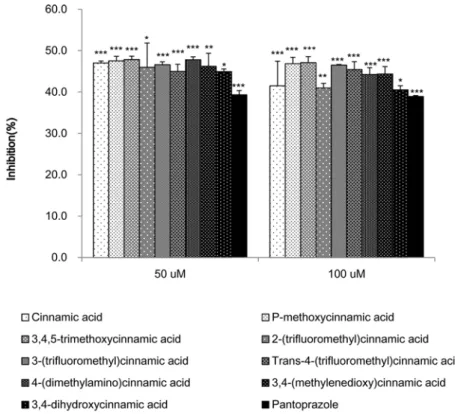
-ATPase) inhibition − Cinnamic acid and the cinnamic acid derivatives, p-methoxycin- namic acid, 3,4,5-trimethoxycinnamic acid, 2-(trifluoromethyl) cinnamic acid, 3-(trifluoromethyl)cinnamic acid, trans-4- (trifluoromethyl)cinnamic acid, 4-(dimethylamino) cinnamic acid, 3,4-(methylenedioxy) cinnamic acid, and 3,4- dihydroxycinnamic acid inhibited acid secretion by inhibiting proton pump (H

+

/K

+

-ATPase) that is the gastric acid secretion enzyme in gastric mucosa parietal cells (Fig. 3).

DPPH radical scavenging assay − DPPH is a soluble

Fig. 1. Effect of cinnamic acid derivatives on HCl/EtOH-induced gastritis in rats.

(4)

substance that readily forms radicals in solution. DPPH radical scavenging activity was measured using a color change from purple to yellow when DPPH reacts with

antioxidant.

14

Of the 9 cinnamic acid derivatives examined, 3,4-dihydroxycinnamic acid showed free radical sca- venging activity with an IC

50

of 24.5 µg/mL (Table 1).

Fig. 2. Acid-neutralizing capacity of cinnamic acid derivatives.

Fig. 3. H

+

/K

+

-ATPase inhibiting activity of cinnamic acid derivatives in rat stomach.

(5)

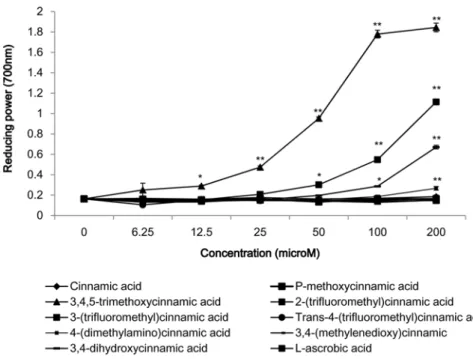
Reducing power assay − The experiment principle is that the reducing power is measured by the absorbance which is increased by Fe

3+

reduction. Pyrogallol (200 µg/

mL) the positive control had high reducing power absorbance of 1.844 ± 0.042 at 700 nm. Although 3,4- dihydroxycinnamic acid at 200 µg/mL showed less reducing power than the positive control at 0.671 ± 0.018 it had greater reducing power than the other 8 cinnamic acid

derivatives. Furthermore, it was found to behave in a concentration-dependent manner (Fig. 4).

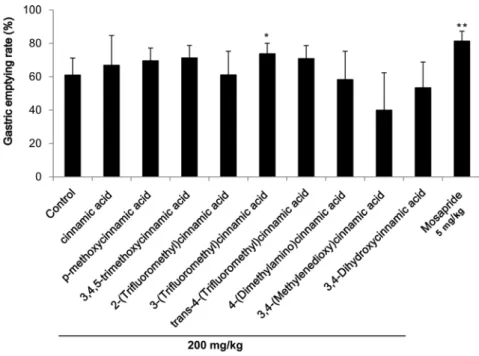
Gastric emptying − The gastric emptying experiment was conducted to confirm improved gastric emptying delayed. Gastric emptying percentages were as follows;

control 61.0 ± 10.2%, cinnamic acid (66.9 ± 17.8%), p- methoxycinnamic acid (69.6 ± 7.6%), 3,4,5-trimethoxy- cinnamic acid (71.3 ± 7.5%), 2-(trifluoromethyl)cinnamic acid (61.1 ± 14.2%), 3-(trifluoromethyl)cinnamic acid (73.8 ± 6.3%), and trans-4-(trifluoromethyl) cinnamic acid 70.9 ± 7.8% at a dosage of 200 mg/kg. Mosapride (5 mg/

kg), a positive control had a gastric emptying percentage of 81.4 ± 5.9% (Fig. 5). Therefore, 6 of the cinnamic derivative tested, that is, ‘cinnamic acid, p-methoxycinnamic acid, 3,4,5-trimethoxycinnamic acid, 2-(trifluoromethyl) cinnamic acid, 3-(trifluoromethyl)cinnamic acid, and trans- 4-(trifluoromethyl) cinnamic acid’ improved gastric emptying delay as compared with the control.

Gastritis has various causes, which include excessive gastric acid production. Thus, the acid-neutralizing activity of PPI or the inhibition of acid secretion by PPI inhibits gastric lesion development. Defective radical scavenging activity is another factor associated with attacking the stomach.

15

Free radicals may attack gastric cell by inducing lipid peroxidation, protein denaturation or DNA

Fig. 4. Reducing power of cinnamic acid group derivatives.

Table 1. Free radical scavenging activities of cinnamic acid derivatives

Material IC

50

( µM)

cinnamic acid >160

P-methoxycinnamic acid >160

3,4,5-trimethoxycinnamic acid >160 2-(trifluoromethyl)cinnamic acid >160 3-(trifluoromethyl)cinnamic acid >160 Trans-4-(trifluoromethyl)cinnamic acid >160 4-(dimethylamino)cinnamic acid >160 3,4-(methylenedioxy)cinnamic acid >160

3,4-dihydroxycinnamic acid 24.5

L-ascrobic acid <5

0.4 mL of methanol solution containing sample was added with

0.1 mL of 1.5 × 10

−4

M DPPH/methanol and mixed. And the

absorbance was read at 520 nm by using UV-spectrophotometry.

(6)

cross-linking. Thus, free radical scavenging activity and reducing power are also importantly inhibit gastric lesion development.

16,17

In addition, over eating and gastric stasis are aggressive factors, and thus, increasing the gastric emptying rate helps keep stomachs healthy. Cinnamic acid, p-methoxycinnamic acid, and 3,4,5-trimethoxy- cinnamic acid were found to have inhibitory effects on gastric lesion development in vivo. Although 4-(dimethy- lamino)cinnamic acid had less acid neutralizing capacity (inhibition, 34.0%) than non-treated control group, it is expected it might be helped for the gastroprotective effect as a natural product. Of the 9 cinnamic acid derivatives, examined cinnamic acid, p-methoxycinnamic acid, 3,4,5- trimethoxycinnamic acid, 2-(trifluoromethyl)cinnamic acid, 3-(trifluoromethyl)cinnamic acid, trans-4-(trifluoromethyl) cinnamic acid, 4-(dimethylamino)cinnamic acid, 3,4- (methylenedioxy) cinnamic acid, and 3,4-dihydroxy- cinnamic acid were found to inhibit acid secretion by inhibiting proton pump (H

+

/K

+

-ATPase). In antioxidant experiments, 3,4-dihydroxycinnamic acid showed free radical scavenging activity (IC

50

of 24.5 µg/mL) and had the greatest reducing power among the cinnamic acid derivatives. Six cinnamic acid derivatives ‘cinnamic acid, p-methoxycinnamic acid, 3,4,5-trimethoxycinnamic acid, 2-(trifluoromethyl)cinnamic acid, 3-(trifluoromethyl)cinnamic acid, and trans-4-(trifluoromethyl) cinnamic acid’ improved

gastric emptying delay compared to the control. Delayed gastric emptying rate causes gastric lesions. In addition, P-methoxycinnamic acid and 3,4,5-trimethoxycinnamic acid inhibited excessive gastric acid secretions, presumably by inhibiting the proton pump and neutralizing the gastric acid secreted. Furthermore, the 3,4-dihydroxycinnamic acid exhibited DPPH radical scavenging activity and reducing power, and 3-(trifluoromethyl)cinnamic acid promoted gastric emptying. These results support the conclusion that materials with different structures should be used depending on how they inhibit gastric damage.

Acknowledgments

This work was supported by Priority Research Centers Program through the National Research Foundation of Korea (NRF) funded by the Ministry of Education, Science and Technology (project number 2016R1A6A1A 03007648).

References

(1) Yakabi, K.; Nakamura T. Nihon Rinsho. 1998, 56, 2336-2342.

(2) Laine, L.; Weinstein, W. M. Dig. Dis. Sci. 1988, 33, 490-503.

(3) Rocha, G. A.; Queiroz, D. M.; Mendes, E. N.; Barbosa, A. J.; Lima Júnior, G. F.; Oliveira, C. A. Am. J. Gastroenterol. 1991, 86, 1592-1595.

(4) Sachs, G.; Shin, J. M.; Howden, C. W. Aliment. Pharmacol. Ther.

Fig. 5. Gastric emptying of cinnamic acid derivatives in mice.

(7)

2006, 23, 2-8.

(5) Sohn, Y. A.; Hwang, I. Y.; Lee, S. Y.; Cho, H. S.; Jeong, C. S. Biol.

Pharm. Bull. 2017, 40, 151-154.

(6) Morry, J.; Ngamcherdtrakul, W.; Yantasee, W. Redox Biol. 2017, 11, 240-253.

(7) Devasagayam, T. P.; Tilak, J. C.; Boloor, K. K.; Sane, K. S., Ghaskadbi, S. S.; Lele, R. D. J. Assoc. Physicians India. 2004, 52, 794- 804.

(8) Jung, J.; Lee, J. H.; Bae, K. H.; Jeong, C. S. Yakugaku Zasshi 2011, 131, 1103-1110.

(9) Mizui, T.; Doteuchi, M. Jpn. J. Pharmacol. 1983, 33, 939-945.

(10) Naik, Y.; Jayaram, S.; Harish Nayaka, M. A.; Lakshman.;

Dharmesh, S. M. J. Ethnopharmacol. 2007,112, 173-179.

(11) Lee, E. J.; Kim, K. S.; Jung, H. Y.; Kim, D. H.; Jang, H. D. Food Sci. Biotechnol. 2005, 14, 123 -130.

(12) Oyaizu, M. Jpn. J. Nutr. 1986, 44, 307-315.

(13) Coruzzi, G.; Scarpignato, C.; Zappia, L.; Bertaccini, G. Farmaco Prat. 1980, 35, 466-472.

(14) Yen, G. C.; Chen, H. Y. J. Agric. Food Chem. 1995, 43, 27-32.

(15) Kim, M. J.; Hwang, I. Y.; Lee, J. H.; Son, K. H.; Jeong, C. S.;

Jung, J. H. J. Health Science 2011, 57, 289-292.

(16) Koenig, M. L.; Meyerhoff, J. L. Neurotox. Res. 2003, 5, 265-272.

(17) Hahm, K. B.; Park, I. S.; Kim, Y. S.; Kim, J. H.; Cho, S. W.; Lee, S. I.; Youn, J. K. Free Radic. Biol. Med. 1997, 22, 711-716.

Received August 21, 2017

Revised October 28, 2017

Accepted October 29, 2017

수치

Fig. 3. H + /K + -ATPase inhibiting activity of cinnamic acid derivatives in rat stomach.
Table 1. Free radical scavenging activities of cinnamic acid derivatives Material IC 50  ( µM) cinnamic acid &gt;160 P-methoxycinnamic acid &gt;160 3,4,5-trimethoxycinnamic acid &gt;160 2-(trifluoromethyl)cinnamic acid &gt;160 3-(trifluoromethyl)cinnamic a
Fig. 5. Gastric emptying of cinnamic acid derivatives in mice.

참조

관련 문서