• 검색 결과가 없습니다.

Alterations of Amino Acid Level in Depressed Rat Brain

N/A
N/A
Protected

Academic year: 2022

Share "Alterations of Amino Acid Level in Depressed Rat Brain"

Copied!
6
0
0

로드 중.... (전체 텍스트 보기)

전체 글

(1)

371 http://dx.doi.org/10.4196/kjpp.2014.18.5.371

ABBREVIATIONS: AA, amino acid; CUMS, chronic unpredictable mild stress; TRP, tryptophan; LNAA, large neutral amino acids;

OCD, obsessive compulsive disorder; OFT, open field test; VIP, variable importance in projection; EAA, excitatory amino acids; IAA, inhibitory amino acids; MDD, major depressive disorder.

Received February 25, 2014, Revised August 18, 2014, Accepted August 25, 2014

Corresponding to: Jian Ni, School of Chinese Materia Medica, Beijing University of Chinese Medicine, No.11 East Road North 3rd Ring Road, Chao Yang District, Beijing, P.R. China 100029. (Tel) 86-10- 84738607, (Fax) 86-10-84738607, (E-mail) [email protected]

*These authors contributed equally to this study.

This is an Open Access article distributed under the terms of the Creative Commons Attribution Non-Commercial License (http://

creativecommons.org/licenses/by-nc/3.0) which permits unrestricted non-commercial use, distribution, and reproduction in any medium, provided the original work is properly cited.

Alterations of Amino Acid Level in Depressed Rat Brain

Pei Yang*, Xuechun Li*, Jian Ni, Jingchen Tian, Fu Jing, Changhai Qu, Longfei Lin, and Hui Zhang School of Chinese Materia Medica, Beijing University of Chinese Medicine, Beijing, P.R. China 100029

Amino-acid neurotransmitter system dysfunction plays a major role in the pathophysiology of depression. Several studies have demonstrated the potential of amino acids as a source of neuro-specific biomarkers could be used in future diagnosis of depression. Only partial amino acids such as glycine and asparagine were determined from certain parts of rats’ brain included hippocampi and cerebral cortex in previous studies. However, according to systematic biology, amino acids in different area of brain are interacted and interrelated. Hence, the determination of 34 amino acids through entire rats’ brain was conducted in this study in order to demonstrate more possibilities for biomarkers of depression by discovering other potential amino acids in more areas of rats’ brain. As a result, 4 amino acids (L-aspartic acid, L-glutamine, taurine and γ -amino-n-butyric acid) among 34 were typically identified as potentially primary biomarkers of depression by data statistics. Meanwhile, an antidepressant called Fluoxetine was employed to verify other potential amino acids which were not identified by data statistics. Eventually, we found L-α -amino-adipic acid could also become a new potentially secondary biomarker of depression after drug validation. In conclusion, we suggested that L-aspartic acid, L-glutamine, taurine, γ-amino-n-butyric acid and L-α -amino-adipic acid might become potential biomarkers for future diagnosis of depression and development of antidepressant.

Key Words: Amino acids, Behavior, Chronic Unpredictable Mild Stress, Depression, LC-MS/MS

INTRODUCTION

Depression is one of the most prevalent and costly brain diseases with up to 20% of the worldwide population suffer- ing from moderate to severe forms of the disease [1]. Many models of depressive disorder were developed and its proce- dures have been crucial in discovery and development of clinically-effective drugs. Frazer and his colleagues have ex- plored what kinds of animal models should be adopted in the study of depression. They assumed that the attempt to recreate or mimic the entire spectrum of symptoms com- prised by the syndrome of depression may be more in- formative to develop animal models for these behavioral dimensions. Such models may then provide access not only to the neural regulatory mechanisms underlying effective antidepressant treatment, but may also provide clues to the processes underlying the development and manifestation of depression [2]. A model of depression was initially proposed and developed by Katz and his colleagues who subjected

rats to various stressors, such as electrical shock, im- mersion in cold water, reversal of light/dark cycle, fast, iso- lation, tail pinch, being shaken, moved from cage to cage over a period of 3 weeks [3-5]. A new study suggested that chronic unpredictable stress affects depressive behaviors [6]. In comparison with gene-knockout or other equivalent methods in modeling of depressed mice, we suggested to the employment of Chronic Unpredictable Mild Stress (CUMS) as a major method in this study is more practical and closer to the mechanism of depression.

AA, the basic units of proteins, plays an important role

in the metabolic processes of living organism. The history

of depression and amino acids can be dated back to 1900s

[7-9]. Earliest case reported a decreased tryptophan ratio

was known to result in decreased brain tryptophan and

may contributed to depression through a deficiency of brain

serotonin [10]. Another study provides significant insight

into the roles of 5-HT on the development of visual cortical

circuits and on the age-dependent decline of long-term syn-

aptic plasticity [11]. A major depressive syndrome could be

a state variable affecting the changes in plasma TRP and

TRP/LNAA ratio in OCD patients [12]. Although it is get-

ting more and more attention to develop new biomarkers

of depression, only few researches have been conducted to

explore the impact of amino acids levels for laboratory diag-

nostics of depression.

(2)

Table 1. Chronic unpredictable mild stress procedure

Day Method

1 Change to single cage; Clamping tail (1 min) 2 Remove food; Swimming in hot water for 5 min (45

o

C) 3 Restore food; 24 hours wet cage (200 ml water/cage) 4 Change dry cage, close light, flash light for 12 hours 5 Stop flash light, tilt cage (45

o

)

6 Remove water, 2 hours white noise (85 dB)

7 Restore water, swimming in cold water for 5 min (4

o

C) 8 Continuous light for 24 hours, binding for 4 hours Abbreviations: The rats were exposed to these stressors accord- ing to this schedule and repeated for 4 cycles.

Table 2. Gradient program of liquid chromatography

Step Time (min) Flow rate A (%) B (%)

0 0 800 98 2

1 10 800 72 28

2 10.1 800 0 100

3 16 800 0 100

4 16.1 800 98 2

5 25 800 98 2

In this study, we attempted to discover new biomarkers for laboratory diagnostics of depression through determin- ing and analyzing the levels of amino acids in rats’ brain as well as providing potentially appropriate amino acids in plasma for future clinical diagnosis of depression and im- provement of antidepressants.

METHODS Chemicals and reagents

HPLC-grade organic solvents such as acetonitrile, formic acid were obtained from Fisher Scientific (Fair Lawn, NJ, USA). Ultra-pure water (18.2 mΩcm) from a Cascada IX water purification system (Pall Corporation, USA) was used to prepare all aqueous solutions. Fluoxetine was obtained from China-Japan Friendship Hospital (Patheon, FRANCE).

Animals

Male Sprague-Dawley rats (230+10 g) were obtained from Vital River Laboratories (Beijing, P.R. China). Rats were housed in a temperature and humidity controlled en- vironment and maintained in a 12-hour light/dark cycle for three days with free access to food and water, except when the CUMS procedure was required.

All experimental procedures followed by the National Institutes of Health Guide for the Care and Use of Labor- atory Animals were approved by the Committee of Animal Care and Utilities were provided by Beijing University of Chinese Medicine.

CUMS procedure and sucrose intake test

CUMS procedure and sucrose intake test were performed using procedures as stated by Pan and his colleagues [13].

Chronic Unpredictable Mild Stress procedure is shown in Table 1. On a body weight basis, 36 rats were individually trained to consume 1% sucrose solution before CUMS procedure. Training consisted of initial 72 hours sucrose solution exposure without water. Baseline test of sucrose intake was conducted 3 times over 7 days for all rats.

Sucrose intake test involved 24 hours water deprivation fol- lowed by offering sucrose/water for 1 hour with food and water available. The placement (left and right) of su- crose/water bottle on the cage was randomly changed over times. At the end of test, sucrose intake was measured by weighting pre-weighted bottle containing sucrose solution

and expressed as sucrose preference (%). On the basis of sucrose intake in the final baseline test, 5 out of 36 rats were discarded due to high variations in baseline.

Sequently, 7 out of the rest 31 rats were selected as Non-CUMS group which were housed in a separate room.

The other 24 rats were adopted by CUMS procedure. After 32 days, 10 more rats out of these 24 were discarded due to the resistance to the development of anhedonia (sucrose intake reduction).As a result, the final 14 rats modeled by CUMS procedure were divided into two groups evenly. The first group was defined as depressed rats. On the other hand, the second group with 7 rats was fed with Fluoxetine (0.3 mg/day/rat) for another 30 days. Finally, Non-CUMS and CUMS group were ready for LC-MS/MS analysis.

Open field test

Open field test was performed on the 4th day after arrival of animals. Motor activity in a novel environment was eval- uated by OFT. The open field was a square arena (length 90 cm, width 90 cm and height 45 cm), which is made of wood and painted in black. Each rat was transferred from their home cage to the open field area. The measurement of the motor activity was started as soon as the rats were placed in the center of the arena with observation of 5 mi- nutes for each. The open field area was cleaned with etha- nol-water (4:1, v/v) solution after each test to unify the con- dition of experiment. The parameters for motor activity were measured by total travel distance, velocity and fre- quency of central zone. The data was analyzed afterwards with a computerized tracking system and image analyzer EthoVision (Noldus, Holland).

Chromatographic separation

All samples were analyzed by an Ultimate3000 HPLC (DIONEX, USA) linked with QTRAP LC-MS/MS 3200 (AB SCIEX, USA). The LC system was on-line couplet to an Agilent 6460 Triple Quad LC/MS equipped with the electro- spray ionization (ESI) source. Curtain Gas was set at 20 Psi and Collision Gas was performed in medium mode. 5500 V was chosen for IonSprayVoltag. The Ion Source Gas1 and Gas2 were set at 55 Psi and 60 Psi respectively. Temper- ature was set at the high level of 580

o

C.

Liquid chromatography analysis were performed in a gra-

dient elution mode using AAA C

18

(150×4.6 mm,5μm) at

50

o

C. The mobile phase was consisted of water (containing

0.1% formic acid) and acetonitrile (containing 0.1% formic

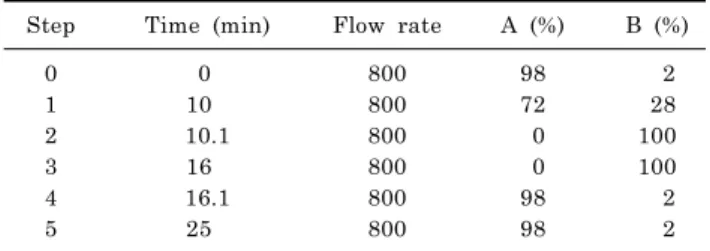
acid). The gradient program is depicted in Table 2. The

samples were kept at 4

o

C in the auto-sampler and a volume

of 3μl was injected into the HPLC system. The mobile

phase was conducted on a daily basis and was sonicated

before use, it then purged with nitrogen gas throughout the

(3)

Table 3. The changes of healthy rats and depressed rats

Test items N D F

Body weight (g) 520±7 414±9* 422±7*

Sucrose preference (%) 34±5 16±3* 18±3*

Open-field test Crossing numbers(Center zone) 5 1* 1*

Mean Velocity (cm/s) 12.50±3.22 6.77±2.10* 8.34±1.09*

Distance moved (cm) 4696±55 2385±84* 2809±60*

Abbreviations: Healthy control group (N), CUMS model group (D) and Fluoxetine group (F) were expressed as mean±SD (n=7).

*p<0.05 (D and F compared with N respectively).

Table 4. Key differentiating of AA between N and D in the OPLS-DA

AA P (2-tailed) N (μg/g) D (μg/g) VIP

L-aspartic acid 0.002 233.100±28.246 289.664±27.054 2.405**

Taurine 0.006 164.352±17.762 189.846±9.592 1.563**

γ -amino-n-butyric acid 0.024 139.986±19.766 161.592±10.098 1.334**

L-glutamine 0.046 179.692±21.394 200.766±13.012 1.254**

O-phospho-ethanolamine 0.007 37.766±3.918 43.512±2.582 0.736

L-α-amino-n-butyric acid 0.007 1.540±0.274 1.952±0.196 0.736

L-tryptophan* 0.001 13.342±1.688 16.558±0.714 0.597

D,L-β-amino-isobutyric acid 0 1.550±0.452 3.372±0.388 0.481

L-asparagine 0.004 9.370±1.260 11.432±0.886 0.451

Ethanolamine 0.004 11.254±1.364 13.274±0.662 0.445

β-alanine 0 2.340±0.318 3.266±0.250 0.333

L-methionine 0.029 9.156±1.226 10.488±0.720 0.327

L-proline 0.001 3.546±0.398 4.440±0.258 0.318

L-Ornithine 0.025 1.562±0.342 1.934±0.176 0.174

Healthy control group (N) and CUMS model group (D) were expressed as mean±SD (n=7).

*The data was analyzed by Wilcoxon test. **VIP value>1.

experiment. AA45 (PHYS SULFOSALICYLIC ACID) was chosen as isotope label ingredient. The LLOQ of each AA was 1 pg/ml.

Preparation of samples

Firstly, brain samples were quickly removed and frozen in liquid nitrogen, it then stored at −80

o

C until analysis.

After that, the brain samples were homogenized in ice-cold normal saline with equivalent volume of brain samples for 45 seconds. Firstly, Homogenates (40μl) were spiked with sulfosalicylic acid (10μl) by vortex mixing for 30s. Secondly, the mixture was then centrifuged at 7378*g for 2 min for deproteinization. Moreover, an aliquot of 10μl supernatant was transferred into a fresh tube and 40μl labeling buffer was spiked with it. The mixture was then centrifuged at 7378*g for 2 min. After that, 10μl supernatant from the sec- ond step was transferred to another fresh tube and 5μl iTRAQ were spiked with it. Meanwhile, the mixture was also centrifuged at 7378*g for 2 min and incubated for 30min at room temperature. After incubating, 5μl hydroxylamine were added into the tube and centrifuged with the same pro- cedure as above. Finally, 32μl isotopelabelingredientwas added and spiked, in the meantime, 3μl supernatant was injected into HPLC after centrifugation.

Statistical analysis

All Data was analyzed with independent-sample T test

and significance was set at α=0.05. All analysis was per- formed with SPSS (version 17.0, SPSS Inc., USA) and SIMCA-P (version 11.0, Umetrics AB, Sweden).

RESULTS AND DISCUSSION

Depressive symptoms were described in terms of weight, sucrose preference, crossing numbers of center zone, mean velocity and total distance. The variation of healthy control group (N), CUMS model group (D) and fluoxetine group (F) are shown in Table 3. In the comparison of these results, there is a notable difference in parameters when comparing either group D with group N or group D with group F (p

<0.05, two-tailed). The results proved the modeling in this study was validated and fluoxetine was effective.

Derivatization changes the structure of chemicals and al- so changes their physical and chemical properties, resulting in high ionization efficiency, low matrix effect and low dis- turbance by inorganic salts and endogenous compounds in LC-MS [14]. In the meantime, stable isotope labeling is probably considered as one of the most accurate ways to determinate AA level and also could be performed in con- junction with LC MS/MS approaches. In this study, we ob- tained the data of 42 different amino acids by utilizing the combination of derivatization and isotope labeling method.

34 AA among them were determinated in the brain tissue of CUMS rats for further analysis.

Firstly, the amino acids concentrations were analyzed

(4)

Fig. 1. Total Ion Chromatography of amino acids.

Table 5. The concentration of 20 AA between N and D in the T test &Wilcoxon test

AA P (2-tailed) N (μg/g) D (μg/g)

L-alanine 0.083 62.780±8.308 69.518±4.058

L-leucine 0.094 20.018±2.814 22.164±1.362

glycine 0.101 54.588±7.812 60.458±3.960

L-glutamic acid 0.105 223.436±18.520 240.954±18.864

hydroxy-L-proline 0.117 0.408±0.082 0.476±0.066

L-isoleucine 0.129 8.024±1.162 9.014±0.616

L-threonine 0.132 30.604±3.462 33.428±3.048

cystathionine 0.156 6.096±1.336 7.956±2.958

L-cystine 0.192 12.272±3.714 14.370±1.532

L-valine 0.193 14.106±1.810 15.276±1.322

L-arginine 0.247 26.956±3.770 28.808±1.410

L-phenylalanine 0.316 13.998±1.936 14.092±0.722

L-serine 0.323 49.362±7.46 52.598±3.630

L-lysine 0.360 24.954±3.426 26.366±1.840

L-tyrosine 0.458 11.268±1.778** 10.712±0.692

L-carnosine 0.606 0.474±0.122 0.514±0.136

1-methyl-L-histidine 0.659 7.708±1.436** 7.422±0.826

L-α-amino-adipic acid 0.719 0.356±0.074** 0.344±0.092

L-citrulline* 0.457 3.520±0.566 2.724±0.414

L-histidine* 0.438 16.048±2.760 16.988±1.174

Abbreviations: Healthy control group (N) and CUMS model group (D) are expressed as mean SD (n=7).

*The data was analyzed by Wilcoxon test. **The concentration of AA in control group was higher than which in CUMS model group.

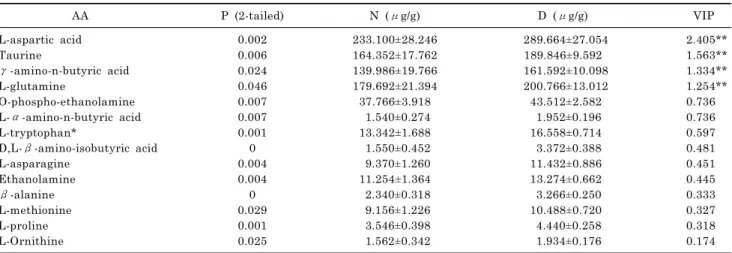
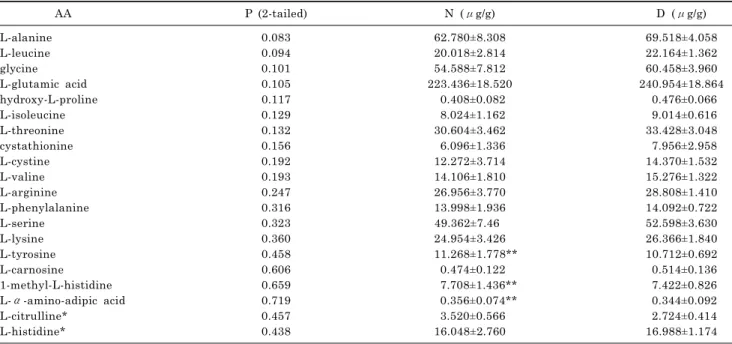
here by using SPSS technique. We employed normality ex- amination for each amino acid in order to select appropriate methods for varianceanalysis. The results classified the da- ta into two groups (normal distribution and abnormal dis- tribution). After that, AA was analyzed either by T test for the group of normal distribution or by Wilcoxon test for the group of abnormal distribution. As we can see in Table 4, it indicates p-values of 14 AA generated by both test were less than 0.05, which means they were capable to be se- lected for analysis by SIMACA-P according to the data sta- tistics which states p-values less than 0.05 are considered to be statistically significance. On the other hand, p-values of 20 AA were identified more than 0.05 in Table 5 and 3 AA among them were noticed and selected for further drug validation as its inverse data in group D.

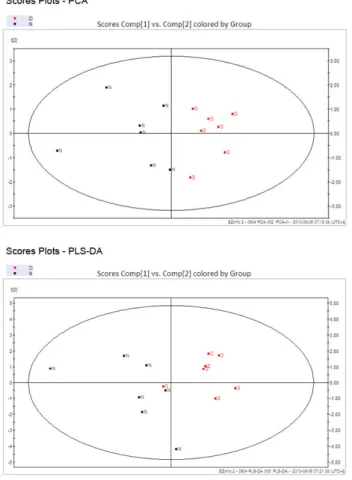
Secondly, the analysis conducted by SIMACA-P for the ex- perimental results was presented in Fig. 2. The score plots displaying discrimination between group N (black) and group D (red). A good quality and predictability (R

2

X= 91.9%, Q

2

=0.716) of the PCA model was obtained by establishing PCA model with first two components (PC1 and PC2) at 84.83%. Meanwhile, PLS-DA score plots also revealed that depressed rats were statistically distinguishable from healthy group (R

2

X=88.4%, Q

2

=0.391). Of the above PCA and PLS-DA score plots suggested the original model is valid.

The VIP values of four amino acids (L-aspartic acid, L-glutamine, taurine and γ-amino-n-butyric acid) were represented more than 1 in Table 4. Comparing EAA group (L-aspartic acid and L-glutamine) with IAA group (taurine and γ-amino-n-butyric acid), the average levels of L-as- partic acid and glutamine in EAA group were increased ap- proximately by 15% after CUMS procedure. Meanwhile, the mean levels of taurine and γ-amino-n-butyric acid in IAA group were raised around 13% since CUMS procedure.

Additionally, the experimental results of SIMACA-P in-

dicated that L-aspartic acid had a significant impact among 14 AA with VIP value of 2.405. Hence, we suggested EAA group has greater impact for depression.

Four amino acids, L-aspartic acid, L-glutamine, taurine and γ-amino-n-butyric acid have a tight connection to depression.

L-aspartic acid with the most VIP value of 2.405 plays an important role either in cellular energy production which is gaining popularity in the management of chronic fatigue or in citric acid cycle and Krebs cycle where other amino acids and the biochemicals are synthesized. The change on level of L-aspartic acid is critical to variation on energy which is directly connected to depression accord- ing to the statistics from Human Metabolome Database. In Table 4, the level of L-aspartic acid had a significant change with increase of 20% in group Dafter CUMS procedure from 116.550μg/mL in group N. We suggested L-aspartic acid could have potentially relationship with depression.

The brain glutaminergic system has been implicated in

(5)

Table 6. The concentration of 3AA among N, D and F in Wilcoxon test

AA N (μg/g) D (μg/g) F (ìg/g)

1-methyl-L-histidine 7.708±1.436 7.422±0.826 7.504±0.558

L-α-amino-adipic acid 0.356±0.074 0.344±0.092 0.380±0.068*

L-tyrosine 11.268±1.778 10.712±0.692 10.228±1.172

Abbreviations: Healthy control group (N), CUMS model group (D) and Fluoxetine group (F) were expressed as mean SD (n=7).

*Denotes that the concentrations of AA in group F were similar to group N with p<0.05 (F compared with D).

Fig. 2. Scores and loadings from PCA and PLS-DA.

the etiology of depression and glutamate has been proposed as the neurotransmitter projecting to this system. In pre- vious study, increased glutamine in plasma had been re- ported to play a role in depression [15] and glutamate was increased in the medial prefrontal cortex in patients with postpartum depression [16]. In this study, L-glutamine was determined in depressed rats’ brain with increase from 179.692μg/g to 200.766μg/g between group N and D as shown in Table 4. As a result, we believe L-glutamine could play a role in depression.

γ-amino-n-butyric acid is an important neurotrans- mitter involved in regulating mood and mental clarity.

Studies on the connection between γ-amino-n-butyric acid and depression were reported from 1970 [8]. It is speculated that the consequence of increasing level of γ-amino-n-buty- ric acid is a result of the change of glutamine which is a major source for γ-amino-n-butyric acid synthesis. As we

can see in Table 4, the level of γ-amino-n-butyric acid in rats’ brain modeled by CUMS procedure was increased by 22.006μg/g to161.592μg/g from group N to D. The result verified γ-amino-n-butyric acid in central systems could have a link to depression.

Moreover, taurine, as a secondary important VIP amino acid, its concentration was increased nearly by 13% after CUMS procedure from164.352μg/g in group N. It is de- picted in Table 4.Previous biochemical studies suggested a transmitter role for taurine in the central nervous system.

When taurine was administered microelectrophoretically to neurons of the spinal cord and cerebral cortex, it caused a depression of firing [17]. Taurine supplementation has an antidepressant-like effect and an ability to change de- pression-related signaling cascades in the hippocampus ac- cording to a new study [18]. With integration of previous study, we deemed taurine could be related to depression.

In this study, we noticed that the concentrations of three amino acids (L-tyrosine, 1-methyl-L-histidine and L-α- amino-adipic acid) in Table 5 were decreased in group D comparing with other increased levels of amino acids. In previous study, α-Kato acid, decomposed from amino acids, is able to release energy according TCA cycle. The de- creased level of amino acid might cause low energy release by limited α-Kato acid. Meanwhile, the energy deficiency is connected with reduced activity and curiosity, which is considered as one of the most represented depressive symptoms. Hence, we have a hypothesis that whether any other new amino acids among L-tyrosine, 1-methyl-L-his- tidine and L-α-amino-adipic acid may become secondary potential biomarkers of depression even though the p val- ues of them were more than 0.05. In this case, Fluoxetine was employed as a treatment drug to verify the validation of the hypothesis.

As we can see in Table 6, after treating with Fluoxetine, L-α-amino-adipic acid was the only one among these three amino acids recovering back to normal values. The level of L-α-amino-adipic acid was 0.356μg/g in healthy group, and then decreased to 0.344μg/g after adoption of CUMS procedure. However, it recovered to 0.380μg/mL after adoption of Fluoxetine. Assuming there is a potential link between L-α-amino-adipic acid and depression. Moreover, Bellance and associates recently has identified L-α-amino- adipic acid and γ-amino-n-butyric acid as related bio- markers of cancer [19]. A hypothetical explanation for the relationship between L-α-amino-adipic acid and depres- sion is that L-α-amino-adipic acid and γ-amino-n-butyric acid may have the same metabolic footprint and gene locus.

Hence, we suggested that L-α-amino-adipic acid could also become a new potentially secondary biomarker of depres- sion.

Apart from our main focus, other relative amino acids

were analyzed in this study such as tyrosine. In Table 6,

the level of tyrosine was 11.268μg/g in healthy group and

(6)

then was reduced to 10.712μg/g in CUMS group. Although tyrosine was not validated by Fluoxetine, as a precursor for norepinephrine and dopamine synthesis, it stimulates the central nervous system and acts as an antidepressant which was used in the clinical treatment for depression from 1980 [20-23]. Meanwhile, due to complexity of disease mechanism and variation in pathway of disease, Fluoxetine might not directly affect tyrosine with increasing its level for treatment of depression. Nevertheless, we still sug- gested considering tyrosine as a potential biomarker for fu- ture study in depression.

In this study, a new method was developed for quantita- tive analysis of amino acids. Most AA shows neither natural UV absorption nor fluorescence. In this case, it is very diffi- cult to detect AA at trace levels by using HPLC. Therefore, a new method for AA determination in rats’ brain was de- veloped by adopting LC-MS/MS with AA45 as isotope label ingredient in this study in order to provide more in- formation of AA and accurate data of quantitative analysis.

Finally, there are some limitations in this study. For in- stance, small sample size might result in deviation in data statistics and lack of female rats could cause difficulty of elimination in gender difference. Furthermore, a new re- search indicated that different kind of rats will have differ- ent performances in the metabolism of amino acids [24].

Hence, the findings in this study need to be considered as preliminary warrant. We suggested replication in more samples including both male and female rats shall be con- sidered in future study. Meanwhile, we suggested to de- termine amino acids in plasma sample which were marked in brain sample and analyze the relationship between brain and plasma sample. It will be significative for potential clinical markers of depression.

This study has focused on the determination of amino acids which plays a significant role for depression. As a re- sult of this study, we suggested that L-aspartic acid, Taurine, γ-amino-n-butyric acid, L-glutamine and L-α- amino-adipic acid could be potential biomarkers of depres- sion. This could lead to some interesting attempt to deter- minate level of amino acids and observe effect of them by different antidepressant in the future study. We believe that the analysis of amino acids level in brain will improve diagnostic capabilities for depression and also will contrib- ute to future discovery of antidepressant.

ACKNOWLEDGEMENTS

We express our gratitude to all participants of the study.

We thank the Ministry of National Science and Technique (China, no. 2012ZX09103201-026) and Innovation Team of Beijing University of Chinese Medicine (no. 2011-CXTD-13).

REFERENCES

1. Keck ME. Corticotropin-releasing factor, vasopressin and receptor systems in depression and anxiety. Amino Acids. 2006;

31:241-250.

2. Frazer A, Morilak DA. What should animal models of depre- ssion model? Neurosci Biobehav Rev. 2005;29:515-523.

3. Katz RJ. Animal model of depression: effects of electrocon- vulsive shock therapy. Neurosci Biobehav Rev. 1981;5:273-277.

4. Katz RJ. Animal model of depression: pharmacological sensi-

tivity of a hedonic deficit. Pharmacol Biochem Behav.

1982;16:965-968.

5. Katz RJ, Baldrighi G. A further parametric study of imipra- mine in an animal model of depression. Pharmacol Biochem Behav. 1982;16:969-972.

6. Yoon SH, Kim BH, Ye SK, Kim MH. Chronic non-social stress affects depressive behaviors but not anxiety in mice. Korean J Physiol Pharmacol. 2014;18:263-268.

7. Bennett GS, Edelman GM. Amino acid incorporation into rat brain proteins during spreading cortical depression. Science.

1969;163:393-395.

8. Johnson ES, Roberts MH, Straughan DW. Amino-acid induced depression of cortical neurones. Br J Pharmacol. 1970;38:659- 9. Farkas T, Dunner DL, Fieve RR. L-tryptophan in depression. 666.

Biol Psychiatry. 1976;11:295-302.

10. Branchey L, Branchey M, Shaw S, Lieber CS. Relationship between changes in plasma amino acids and depression in alcoholic patients. Am J Psychiatry. 1984;141:1212-1215.

11. Jang HJ, Cho KH, Park SW, Kim MJ, Yoon SH, Rhie DJ.

Effects of serotonin on the induction of long-term depression in the rat visual cortex. Korean J Physiol Pharmacol. 2010;14:

337-343.

12. Bellodi L, Erzegovesi S, Bianchi L, Lucini V, Conca R, Lucca A. Plasma tryptophan levels and tryptophan/neutral amino acid ratios in obsessive-compulsive patients with and without depression. Psychiatry Res. 1997;69:9-15.

13. Pan Y, Hong Y, Zhang QY, Kong LD. Impaired hypothalamic insulin signaling in CUMS rats: restored by icariin and fluoxetine through inhibiting CRF system. Psychoneuroendo- crinology. 2013;38:122-134.

14. Li Y, Xu LL, Ruan JX, Zhang ZQ. Research progress of enhancing quantitative sensitivity by using LC-MS(n) with derivatization method in bio-matrices. Yao Xue Xue Bao.

2011;46:637-641.

15. Küçükibrahimoğlu E, Saygin MZ, Calişkan M, Kaplan OK, Unsal C, Gören MZ. The change in plasma GABA, glutamine and glutamate levels in fluoxetine- or S-citalopram-treated female patients with major depression. Eur J Clin Pharmacol.

2009;65:571-577.

16. McEwen AM, Burgess DT, Hanstock CC, Seres P, Khalili P, Newman SC, Baker GB, Mitchell ND, Khudabux-Der J, Allen PS, LeMelledo JM. Increased glutamate levels in the medial prefrontal cortex in patients with postpartum depression.

Neuropsychopharmacology. 2012;37:2428-2435.

17. Haas HL, Hösli L. The depression of brain stem neurones by taurine and its interaction with strychnine and bicuculline.

Brain Res. 1973;52:399-402.

18. Toyoda A, Iio W. Antidepressant-like effect of chronic taurine administration and its hippocampal signal transduction in rats.

Adv Exp Med Biol. 2013;775:29-43.

19. Bellance N, Pabst L, Allen G, Rossignol R, Nagrath D. On- cosecretomics coupled to bioenergetics identifies alpha-amino adipic acid, isoleucine and GABA as potential biomarkers of cancer: Differential expression of c-Myc, Oct1 and KLF4 coordinates metabolic changes. Biochim Biophys Acta. 2012;

1817:2060-2071.

20. Gelenberg AJ, Wurtman RJ. L-tyrosine in depression. Lancet.

1980;2:863-864.

21. Goldberg IK. L-tyrosine in depression. Lancet. 1980;2:364-365.

22. Hoskins JA. L-tyrosine in depression. Lancet. 1980;2:597.

23. Mouret J, Lemoine P, Minuit MP, Robelin N. L-tyrosine cures, immediate and long term, dopamine-dependent depressions.

Clinical and polygraphic studies. C R Acad Sci III. 1988;306:

93-98.

24. Nagasawa M, Ogino Y, Kurata K, Otsuka T, Yoshida J,

Tomonaga S, Furuse M. Hypothesis with abnormal amino acid

metabolism in depression and stress vulnerability in Wistar

Kyoto rats. Amino Acids. 2012;43:2101-2111.

수치

Table 2. Gradient program of liquid chromatography
Table 4. Key differentiating of AA between N and D in the OPLS-DA
Fig. 1. Total Ion Chromatography of amino acids.
Table 6. The concentration of 3AA among N, D and F in Wilcoxon test

참조

관련 문서

Hwa Jung Kim, Bon-Cheol Ku, Jae Kwan Lee “Use of Pyrolyzed Amino Acids as Versatile Dopants for Synthesis of Heteroatoms-doped

따라서 본 연구에서는 미역과 다시마 열수추출물을 이용하여 항암 , 혈당강하 , 항산화 및 간 기능보호와 숙취해소 등이 용이한 기능성 식품 제조 기술을 개발하기 위해

Dombret H, Sutton L, Duarte M, Daniel MT, Leblond V, Castaigne S, Degos L: Combined therapy with all-trans retinoic acid and high-dose chemotherapy in

The stereoscopic microscope image of gold particles in the leaching residue from Geumsan sample as a function of nitric acid concentration on the filter papers by lead

 Manipulation of protein’s amino acid sequence to change its function or properties.

phenylalanine, carnosine, ornitine contents were significantly higher in carrot than in parsnip, while α-aminoadipic acid, leucine, tyrosine, γ-amino-n-butyric

이 스케일억 제제들로는 Acrylic acid-hydroxypropyl acrylate copolymer, Styrene sulfonic acid-maleic acid copolymer, Acrylic acid-sulfonic acid copolymer

학순도 측정을 위해서 키랄 컬럼을 이용한 액체 크로마토그래피 방법이 가장 정확하고 편리한 분석법으로 알려져 있다 [2]. 그 중에서 α-amino acid ester 의 아미노