
Inhibitory Effects of a Combination of Grapefruit and Rosemary Extracts for Alleviating UV-Induced Skin Ageing
13
0
0
전체 글
(2) Korean J. Plant Res. 32(3) : 207~219 (2019). ROS production activates the mitogen-activated protein kinase. grapefruit and rosemary extracts on UV-induced damage in. (MAPK) signaling pathway (Son et al., 2013). Cumulative. skin cell models and humans. They revealed that oral. evidence indicates that mitogen-activated protein kinases. administration of grapefruit and rosemary extracts (250 ㎎) in. (MAPKs), such as extracellular-regulated protein kinase. humans resulted in a significant minimal erythema dose. (ERK), Jun N-terminal kinase (JNK), and p-38, are closely. (MED) increase after 8 weeks (34%, p < 0.05), although the. associated with skin aging (Sun et al., 2015). Stimulation of. precise molecular mechanisms underlying the effect of these. MAPKs by UV irradiation may modulate cell proliferation,. extracts were not elucidated.. differentiation, inflammation, and apoptosis (Sun et al., 2015).. The protective effects of orally as well as topically. Furthermore, MAPK activation also regulates the activator. administered grapefruit and rosemary extract combination on. protein 1 (AP-1), which stimulates matrix metalloproteinase. UVB-induced skin aging and mechanisms underlying such. (MMP) expression in various cultured cells and animal. effects have not been extensively studied. In the current. tissues (Liu et al., 2018). Among MMPs, MMP-1 is a major. study, we explored the anti-skin aging effects of a com-. collagenase which degrades type 1 collagen contained in skin. bination of grapefruit and rosemary extracts (cGℜ 1:1. connective tissues (Rittie and Fisher, 2002). Thus, activation. ratio) on UVB-stimulated models and the molecular mecha-. of MMP-1 by UV-irradiation and subsequent degradation of. nisms underlying these effects.. collagen are viewed as hallmarks of skin inflammation as. Materials and Methods. well as photo-damage (Inomata et al., 2003). Recently, there have been many reports on the functional effects of plant extracts (Koo et al., 2018; Sekhon-Loodu et al., 2019). Natural. Sample Preparation and HPLC Analysis. plant substances including polyphenols and flavonoids with. The herbal extract was a combination of grapefruit and. anti-oxidant effects are being discovered and studied to. rosemary extracts supplied by Monteloeder S.L. (Miguel. alleviate these symptoms of aging (Kaurinovic and Vastag,. Servet 16, Elche, Alicante, Spain), obtained from dried. 2019). Grapefruit trees, similar to other citrus trees, are. rosemary (Rosmarinus officinalis) leaves and grapefruits. perenifolium trees. Grapefruit contains an abundance of. (Citrus paradisi) at a 1:1 ratio. The extract was standardized. ascorbic acid and polyphenolics and exerts diversified. with naringin and carnosic acid as reference compounds for. pharmacological effects including those which are anti-. grapefruit and rosemary, respectively. The naringin content. genotoxic and chemopreventive (Cristobal-Luna et al., 2018;. was 18.0±1.0 g/100 g on a dry weight basis, while the. Garcia-Martinez et al., 2018). Rosemary (Rosmariunus. carnosic acid content was 2.0±0.2 g/100 g on a dry weight. officinalis L.), found mainly in the Mediterranean region, is a. basis.. fragrant plant from the Lamiaceae family. Mounting evidence. For HPLC analysis, a combination of grapefruit and. indicates that rosemary exhibits pharmacological potential by. rosemary (2 g; 1:1 ratio) was extracted using 50 ml of. exerting antioxidant, anticancer and anti-diabetic effects. dimethyl sulfoxide (DMSO). The sample was filtered into. which are mainly associated with the presence of a high. HPLC via a 0.45-㎛ syringe filter. HPLC was performed. degree of phenolic constituents (Cheung and Tai, 2007;. using an Agilent 1,200 system equipped with a model. Cuvelier et al., 1996; Erenmemisoglu et al., 1997; Xie et al.,. G1312A binary LC pump, an auto sampler, and a diode-array. 2006). Therefore, it is assumed that the mixture of both plant. detector. A C-18 (LiChrospher 100 RP-18) column (250 ㎜ x. extracts could exposed synergic effect for improving anti-. 4.0 ㎜ id and 5 ㎛ particle size) was used to separate all. aging symptoms in skin. Numerous studies have suggested. polyphenols and flavanones from the extract. The standards. that a combination of natural plant extract has been shown to. were purchased from Sigma Chemicals (St. Louis., MO,. more improve the beneficial effects than individual single. USA). Peaks were detected at 235 ㎚. Chromatographic. extract or compound (Zhou et al., 2016; Chanda and Rakhollya,. separations were performed via a gradient mobile phase. 2011). Perez-Sanchez et al. reported the protective effects of. consisting of 2.5% acetic acid prepared in nanopure water (a). - 208 -.
(3) Inhibitory Effects of a Combination of Grapefruit and Rosemary Extracts for Alleviating UV-Induced Skin Ageing. and 100% acetonitrile (b) with the following solvent gradient:. UVB-Irradiated Cell Viability Assay. 0 min, 95% A; 15 min, 80% A; 25 min, 75% A; 40 min, 50%. HaCaT cells were seeded on 96-well plates (1 x 10⁵ cells/. A; 70 min, 20% A; 80 min, 95% A. The injection volume was. mL), and treated with different doses of cG&Re for 24 h. The. 20 μL, mobile phase flow rate was 1 mL/min, oven temper-. media was changed to 1X PBS (100 μL) and the plates were. ature was 30℃ and the detection wavelength was 235 ㎚.. exposed to 30 mJ/㎠ of UVB using a UV lamp (Bio-Link crosslinker). Next, media were removed and predetermined. Elastase Inhibition Assay. concentrations of cG&Re were applied in fresh media. After. Elastase inhibition activity of cG&Re was analyzed. 24 h exposure to UVB, 100 μL of MTT solution was added to. according to a previously reported method with a slight modi-. the cells following 1 h incubation. The media was removed. fication (Kraunsoe et al., 1996). In brief, 0.1 M Tris-HCl (pH. and insoluble formazan crystals formed in intact cells were. 8.0) containing 0.78 mM N-succinyl-Ala-Ala-Ala-p-nitroanilide. solubilized in 100 μL of DMSO. Absorbance was measured. (S4760, Sigma-Aldrich, St. Louis, MO, USA) was added. using a microplate reader (Victor3, Perkin Elmer, MA, USA).. together with 0.04 unit/mL elastase (45124, Sigma-Aldrich). Two microliters each of various concentrations of cG&Re. Mice UVB-Induced Models. and 100 μL of substrate solution were mixed following the. Male BALB/c mice, aged 7 weeks and weighting 18-22 g. addition of elastase enzyme (100 μL) in a 96-well plate (SPL. were obtained from Samtako, Korea. The mice were main-. Life Science Co., Ltd., Pocheon, Korea). Enzyme and substrate reaction was monitored 25 times at 1-min intervals,. tained at 22 ± 1℃ and a humidity of 55 ± 1% under 12 h dark/light cycles. They were fed a commercial diet and had. using a UV spectrophotometer (VICTOR3, Perkin Elmer,. ad libitum access to water. The study was approved by the. Wellesley, MA) at 405 ㎚ and 37℃. Epigallocatechin gallate. Laboratory Animal Ethics Committee (KNU 2018-0073),. (EGCG) served as a positive control.. Kyungpook National University (Daegu, Korea). For topical application of a cG&Re studies as follows, the mice were. Cell Culture and Cell Viability Assay. divided into 5 groups, each group consisting of 5 mice. HaCaT immortalized human keratinocytes were obtained. intended for topical application; group I: Vehicle treated,. from AddexBio Technologies (T002001, San Diego, CA,. group II: UVB-irradiated only; group III: UVB-irradiation. USA). The cells were cultivated in DMEM, supplemented. with epigallocatechin gallate (EGCG) (10 ㎎/mL), group IV:. with 10% fetal bovine serum (FBS) and 1% penicillin-. UVB-irradiation with cG&Re (10 ㎎/mL), group V: UVB-. streptomycin (P/S) at 37℃ in a 5% CO2 atmosphere. MTT. irradiation with cG&Re (50 ㎎/mL). A 150 μL sample was. assay was conducted using 3-(4,5-dimethyl-2-thiazolyl)-2,5-. applied to the dorsal skin of each mouse followed by. diphenyl-2H-tetrazolium bromide (MTT) in order to evaluate. exposure to UVB, which was gradually increased from 1. 5. cell viability. Briefly, HaCaT cells (1 x 10 cells/mL) were. MED to 4 MED. 1, 3-butylene glycol with saline (3:7, v/v). placed in 96-well plates. Subsequent to HaCaT cell growth. was used as the vehicle, and EGCG was used as the positive. reaching 80-90 % confluency, the cells were treated with 1, 3,. control. For purposes of oral administration, mice were treated. 10, 30, and 100 ㎍/mL of cG&Re for 24 h in a CO2incubator. with cG&Re dissolved in deionized water at a concentration. at 37℃. The media was changed to MTT (5 ㎎/mL in PBS). of 50 ㎎/day/kg (p.o.) followed by UVB exposure according. solution following incubation for an additional 1 h. Next,. to the above protocol.. MTT solution was removed and 100 μL of DMSO was added to dissolve formazan in each well. The formation of insoluble. Measurement of Skin Thickness, Erythema Level, and. formazan was measured using a microplate reader at 595 ㎚. Transepidermal Water Loss (TEWL). (Victor3, Perkin Elmer, MA, USA).. Skin thickness was measured using a digimatic thickness gauge (Code No. 547-315, Mitutoyo, Kanagawa, Japan). A colorimeter (CR-400, Minolta, Tokyo, Japan) and a vapometer. - 209 -.
(4) Korean J. Plant Res. 32(3) : 207~219 (2019). (Delfin Technologies, Stamford, Connecticut) were used to. Western Blot Analysis. assess the level of erythema and transepidermal water loss. Homogenized skin tissues were lysed in lysis buffer using. (TEWL) in dorsal skin, respectively, based on the manu-. protease and phosphatase inhibitor. The proteins were. facturers’ instructions as described elsewhere.. quantified using Bradford protein method (Kruger., 2009). Fifty ㎍ of proteins were separated via 10% sodium dodecyl. Histochemical Analysis. sulfate-polyacrylamide gel electrophoresis (SDS-PAGE) and. After the mice were sacrificed, dorsal skin tissue samples. transferred to nitrocellulose membranes (Whatman, Dassel,. were obtained. Dorsal skin tissues were immobilized in 10%. Germany). The membranes were blocked with 5% skim milk. formaldehyde solution in phosphate buffered saline (PBS) for. or BSA for 1 h and washed with Tris-buffered saline in-. 24 h and embedded in paraffin. The slices were cut into 5-㎛. cluding Tween-20 (TBST) for 1 h at 15 min intervals. Next,. thick sections, which were deparaffinized prior to being. the membranes were incubated with primary antibodies against. soaked in acetone and washed in PBS. Slides were treated. MMP-1, SIRT1, ERK 1/2, phospho-ERK 1/2, phospho-JNK,. with 3 % hydrogen peroxide in methanol due to peroxidase. p38, and phospho-p38 at 4℃ overnight. After rinsing, the. activity and epitope retrieval was conducted. Subsequently,. membranes were incubated with anti-rabbit IgG-horseradish. samples were treated with 10 % normal goat serum for 1 h.. peroxidase (HRP) (BETHYL, USA), anti-mouse IgG-horseradish. SIRT1 (ab166821, Abcam), MMP-1 (ab137332, Abcam), and. peroxidase (HRP) (BETHYL, USA) and anti-goat IgG-horseradish. IL-1β (ab9722, Abcam) primary antibodies were incubated. peroxidase (HRP) (BETHYL, USA) secondary antibodies for. with the sections overnight. Hematoxylin and eosin (H&E). 2 h. Proteins were detected using an ECL solution system. staining and Masson’s trichrome staining was conducted to. (ChemiDoc™ XRS+, BIO-RAD).. evaluate skin thickness and collagen content in the dermis, respectively. Stained slides were imaged using an ECLIPSE. Statistical Analysis. TE2000-U microscope (Nikon, Japan).. All data are expressed as mean ± standard deviation (SD). Statistical values were analyzed via a Student’s t-test and. RNA Isolation and Reverse Transcription-Polymerase. one-way analysis of variance (ANOVA) with Fisher’s Least. Chain Reaction (RT-PCR). Significant Difference (LSD) test using the statistical package. Total RNA from mice dorsal skin samples was isolated using. for the social sciences (SPSS) software (SPSS Inc., Chicago,. TRIzol reagent (Life Technology, CA, USA) in accordance. IL). Statistical significance was set at p < 0.05 and p < 0.01.. with the manufacturer’s protocol. Equal amounts of RNA (2. Results. ㎍) was used as a template for cDNA synthesis using RT-&GO Master Mix (MP Biomedicals, CA, USA). The amplified products were electrophoresed on 1% agarose gel,. HPLC Profile of cG&Re. visualized with ethidium bromide and detected using Image. The cG&Re was standardized with naringin and carnosic acid. Lab software (ChemiDoc). GAPDH was used for normali-. as reference compounds for grapefruit and rosemary,. zation. The primer sets for RT-PCR were as follows: MMP-1,. respectively. The naringin and carnosic acid contents on a dry. forward (F): 5’-GGC TCA TGA ACT GGG TCA CT-3’ and. weight basis were 18.0±2.0 g/100 g and 2.0±0.2 g/100 g,. reverse (R): 5’-ATG TGG TGT TGT TGC ACC TG-3’;. respectively. Five peaks were identified on the HPLC chromato-. MMP-13, F: 5’-AGG CCT TCA GAA AAG CCT TC-3’ and. gram as follows: naringin (21.7 min); rosmarinic acid (23.8. R: 5’-CCC ACC ATA GTT TGG TCC AG-3’; SIRT1, F: 5’-. min); poncirin (32.6 min); carnosol (51.5 min), and carnosic. GGT AGA GCC TGC ATA GAT CTT CA-3’ and R: 5’-TGG. acid (58.3 min); (Fig. 1A). The above 5 polyphenol compounds. CAG TAA TGG TCC TAA CTG GG-3’.. were identified by comparing each peak (peak 1-5) with a standard mixture using HPLC. These results were further utilized to elucidate the mechanism underlying cG&Re effects.. - 210 -.
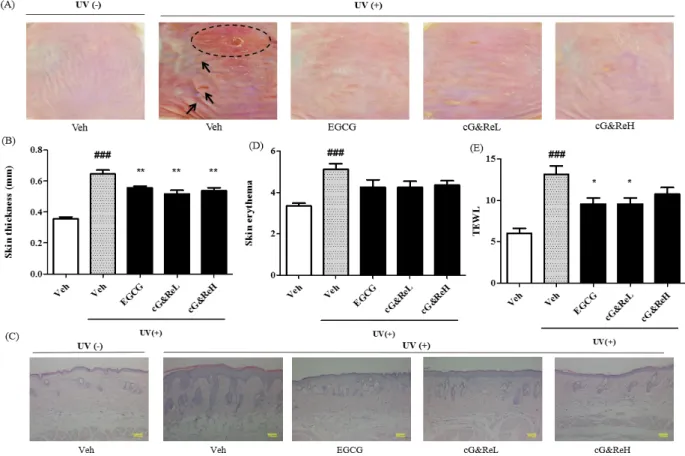
(5) Inhibitory Effects of a Combination of Grapefruit and Rosemary Extracts for Alleviating UV-Induced Skin Ageing. Fig. 1. HPLC chromatogram, elastase inhibitory activity and cell vitality of cG&Re. (A) A classical feature of 5 standard compounds (4th lane), grapefruit extract (2nd lane), rosemary extract (3rd lane), and a combination of grapefruit and rosemary extract (1st lane, cG&Re). Peak 1, naringin; peak 2, rosmarinic acid; peak 3, poncirin; peak 4, carnosol; peak 5, carnosic acid. (B), Elastase inhibitory activity by cG&Re. Activity was assayed according to procedures described in the Materials and Methods section. EGCG was used as a positive control. (C-D), MTT assay was carried out to evaluate cell viability using HaCaT cells with (D) or without (C) exposure to UVB, with cG&Re treatment. ###= P < 0.001 and * = P < 0.05, ** = P < 0.01, *** = P < 0.001 compared with non-treated. Effect of cG&Re on Elastase Inhibitios. was an approximately 20% decrease in cell viability. Interes-. Elastase is an enzyme which breaks down elastin and elastic. tingly, treatment with cG&Re extract at concentrations of 1,. fibers. Our result revealed that the cG&Re extract showed. 3, and 10 ㎍/mL significantly protected cell viability by. potential for significantly inhibiting elastase (Fig. 1B).. suppressing UVB-induced cell death. These results suggested. Results indicated that cG&Re at 30 ㎍/mL exhibited higher. that cG&Re treatment may protect cell viability from UV. elastase inhibition activity compared with the same. irradiation (Fig. 1D).. concentration of EGCG, used as the positive control.. Effects of cG&Re on UVB-induced Mice Skin Effect of cG&Re on Cell Viability. UV treatment triggered wrinkles, roughness, dryness, flakes. Before initiating the cell experiment, a MTT assay was. and redness of skin (2nd image; Fig. 2A) compared to that in. implemented to test the cytotoxicity of 1, 3, 10, 30, and 100. the untreated group (1st image; Fig. 2A). Interestingly, topical. ㎍/mL of cG&Re. Up to 30 ㎍/mL of the cG&Re extract. application of cG&Re prevented UV-induced skin aging. displayed no cytotoxicity in HaCaT cells (Fig. 1C). Based on. lesions (4th-5th images vs 3rd image of a positive control; Fig.. these results, concentrations of 1, 3, 10 and 30 ㎍/mL of. 2A). The UVB-irradiated group dramatically increased skin. cG&Re were selected for use in further studies. UVB-induced. thickness (2nd column; Fig. 2B) compared with the untreated. cell toxicity was analyzed following exposure to UV. group (1st column; Fig. 2B). In addition, cG&Re treatment. irradiation (30 mJ/㎠) which causes cell death in HaCaT. significantly inhibited UVB-induced epidermal thickening.. cells. Following 24 h of exposure to 30 mJ/㎠ of UVB, there. Moreover, UVB irradiation substantially induced skin. - 211 -.
(6) Korean J. Plant Res. 32(3) : 207~219 (2019). Fig. 2. Preventive effects of cG&Re. (A), A classical feature of protective effects by CG&Re treatment was shown on the UVB-induced skin aging mouse model. Dotted circle denotes inflammatory erythema on the skin, while arrows indicate wrinkles. Veh, vehicle; UV(-), non UVB-irradiated; UV(+), UVB-irradiated. cG&ReL and cG&ReH mean the low (10 ㎎ /mL) and high (50 ㎎/mL) doses of the applied extract on the skin. (B, D~E), Skin thickness, skin erythema and TEWL were calculated by digimatic thickness gauge (Code No. 547-315, Mitutoyo, Kanagawa, Japan), colorimeter (CR-400, Minolta, Tokyo, Japan), and vapometer (Delfin Technologies, Stamford, Connecticut) were used to assess erythema level and transepidermal water loss (TEWL) in dorsal skin, respectively, as shown in (E). (E), From the skin tissues of (A), all samples were sectioned at a 5-㎛ thickness and the sections were deparaffinized prior to being soaked in acetone and washed in PBS, as described in Materials and Methods section. Hematoxylin and eosin (H&E) staining was conducted and stained slides were photographed using a microscope (ECLIPSE TE2000-U, Nikon, Japan). ###= P < 0.001 and * = P < 0.05, ** = P < 0.01 compared with non-treated. Scale bar: 100 ㎜. erythema in mouse dorsal skin, wherein cG&Re treatment. image; Fig. 3A), cG&Re treatment restored UVB-induced. alleviated this (Fig. 2D). However, treatment with cG&Re. decrease in collagen contents in the dermis (4th-5th images vs. strongly suppressed transepidermal water loss (TEWL). 2nd -3rd images; Fig. 3A). An immunohistological analysis. compared to that in the UVB-irradiated group (Fig. 2E). ###=. was performed to estimate the expression of specific proteins. P < 0.001 and * = P < 0.05, ** = P < 0.01, ***= P < 0.001. and cytokines in the skin tissues. Our results demonstrated. compared with non-treated.. that cG&Re treatment stimulated SIRT1 secretion (Fig. 3B) which was stained brown in the dermis. On the other hand,. Effect of cG&Re on Histochemical Changes. expression of MMP-1 and IL-1β (Figs. C and D), which was. Next, we evaluated collagenase inhibitory activity via. stained brown stains in the epidermis, decreased in the. Masson’s trichrome staining of dorsal skin tissues. Although. cG&Re-treated group (4th-5th images; Figs. 3C and D). the UVB-irradiated group showed low collagen density (2nd. compared to that in the UVB-irradiated group (2nd images;. - 212 -.
(7) Inhibitory Effects of a Combination of Grapefruit and Rosemary Extracts for Alleviating UV-Induced Skin Ageing. Fig. 3. Effects of cG&Re on histochemical changes and skin aging-related biomarkers. (A), A characteristic image depicting protective effects of CG&Re treatment in the UVB-irradiated mouse skin aging model. Masson’s trichrome staining was conducted to inspect collagen content in dermis. Stained slides were illustrated using a microscope (ECLIPSE TE2000-U, Nikon, Japan). (B-D), SIRT1, MMP-1, and IL-1β were examined to assess the anti-skin aging activity in the animal model using hematoxylin and eosin (H&E) staining. Veh, vehicle; UV(-), non UVB-irradiated; UV(+), UVB-irradiated. cG&ReL and cG&ReH indicate low (10 ㎎/mL) and high (50 ㎎/mL) doses of the applied extract on the skin. Scale bar: 100 ㎜.. Figs. 3B-D). These data indicated that cG&Re treatment. high concentration (50 ㎎/mL) of cG&Re compared to that in. protected protein expression of skin ageing-related bio-. the UVB-irradiated group (2nd band vs 3rd-5th bands).. markers by inhibiting MMP-1 and IL-1β and activating. However, cG&Re did not affect SIRT 1 mRNA expression. SIRT-1.. (1st-5th bands of 3rd image). Next, western blot analysis was conducted to investigate protein expression of MMP-1 and. Effects of cG&Re on mRNA and Protein Expression of. SIRT1. The data showed increased MMP-1 and SIRT 1. Skin Aging-Related Biomarkers. expression in the UVB-treated group (2nd band; Fig. 4B). Expression of MMP-1, MMP-13, and SIRT 1 mRNA was. compared to that in the non-treated group (1st band), but. examined using RT-PCR in the animal tissues (Fig. 4A).. cG&Re treatment inhibited protein expression of MMP-1. MMP-1 and MMP-13 mRNA was overexpressed due to. (4th-5th bands). Similar to the pattern of RT-PCR results,. UV-irradiation (2nd bands of 1st and 2nd images; Fig. 4A),. cG&Re had no effect on SIRT 1 expression (2nd image; Fig.. whereas cG&Re treatment suppressed expression of MMP-1. 4B). To elucidate the precise mechanism underlying the. and MMP-13 mRNA in a dose-dependent manner. Notably,. anti-skin aging effect of cG&Re, phosphorylation of. expression of MMP-1 mRNA was significantly reduced by a. mitogen-activated protein kinases (ERKs, JNK, and p38) was. - 213 -.
(8) Korean J. Plant Res. 32(3) : 207~219 (2019). Fig. 4. mRNA and protein expression of aging-related biomarkers and signaling molecules induced by cG&Re. (A), Samples of dorsal skin tissue were obtained from sacrificed mice. Total RNA of mice dorsal skin samples was isolated using TRIzol reagent (Life Technology, CA, USA) in accordance with the manufacturer’s protocol, followed by RT-PCR which was performed as described earlier. (A), Homogenized skin tissues were lysed in lysis buffer using protease and a phosphatase inhibitor. Separated proteins were transferred to nitrocellulose membranes (Whatman, Dassel, Germany) for the purpose of analyzing the expression of MMP-1 (B), SIRT1 (B), and MAPK cascades (p38, ERK and JNK) (C). Veh, vehicle; UV(-), non UVB-irradiated; UV(+), UVB-irradiated; cG&ReL and cG&ReH represent low (10 ㎎/mL) and high (50 ㎎/mL) dose of the extract, respectively. assessed. UVB upregulated phosphorylation of p38, but. vs 2nd image; Fig. 5B) than that of UV-treated tissues, whereas. cG&Re inhibited UVB-mediated phosphorylation of p38 at. cG&Re treatment effectively reduced its inflammatory res-. high concentrations (1.7-fold) (Fig. 4C). In addition, pho-. ponse in the tissues. In the same manner, there was no striking. sphorylation of ERKs and JNK affect cG&Re treatment,. inflammatory response in the cG&Re-treated tissues (Fig.. suggesting that MAPK signaling was directly associated with. 5C). Immunohistochemical data clearly showed an increased. the protection afforded by cG&Re activation.. level of SIRT-1, as well as decreased levels of MMP-1, and IL-1β (2nd image vs 3rd image for each protein; Fig. 5C).. Protective Effects of Orally Administered cG&Re on Skin. These data suggested that orally administered cG&Re affected. Tissues. expression of anti-inflammatory and skin ageing-related. To further scrutinize the protective effect of orally admini-. biomarkers in the skin tissues.. stered cG&Re, we administered cG&Re at a concentration of. Discussion. 50 ㎎/kg and conducted an immunohistochemical analysis of SIRT-1, MMP-1 and IL-1β expression in UV-treated mouse tissues. Interestingly, image data indicated that the dermis of. There is an increasing demand for biomaterials derived from. UV-untreated tissues had a thicker epidermal layer (1st image. natural sources in the food and cosmetic industries (Khan and. vs 2nd mage; Fig. 5A) and a thinner collagen layer (1st image. Abourashed., 2011). This demand originates from the need. - 214 -.
(9) Inhibitory Effects of a Combination of Grapefruit and Rosemary Extracts for Alleviating UV-Induced Skin Ageing. Fig. 5. Histochemical changes and protein expression of aging-related biomarkers induced by oral administration of cG&Re. (A~B), Following oral administration of 250 ㎎/mL of cG&Re, mice dorsal skin tissues were sectioned to assess the histochemical changes related to skin thickness (A) and collagen content (B) by hematoxylin & eosin (H&E) staining and Masson’s trichrome staining, respectively. Arrows indicate the thickness of inflammatory epidermis. An asterisk depicts protected dermis. A box depicts morphology of degraded collagen. (C), SIRT1, MMP-1, and IL-1β were examined to assess anti-skin aging activity in the animal model using hematoxylin & eosin (H&E) staining. Veh, vehicle; UV (-), non UVB-irradiated; and UV(+), UVB-irradiated. Scale bar: 100 ㎜. for better health and beauty care, with particular reference to. ageing, via downregulation of MMP and IL-1β and upre-. balanced extrinsic and intrinsic beauty resulting in. gulation of SIRT-1, using mouse models.. homeostasis (whitening, anti-inflammation, anti-skin ageing,. The study indicated that cG&Re may inhibit elastase. etc.). As a result of this trend, the emergence of food. activity in a concentration-dependent manner (Fig. 1B). This. ingredients based on various natural substances aimed at. activity was more compatible than that of EGCG. Therefore,. optimizing intrinsic beauty, has begun to attract the attention. we analyzed the active ingredients of cG&Re with HPLC.. of both industry and customers. Currently, critical ageing-. Because the extract did not display toxicity towards cells, we. associated biomarkers capable of assessing specific skin-. examined cell viability following UV exposure, which is a. associated benefits of a food ingredient are unavailable.. trigger of skin ageing. The findings revealed that cG&Re. Therefore, many scientists have been seeking novel agents. could protect against UV-induced cell damage in a dose-. for the development of functional food biomaterials. Towards. dependent manner, indicating that polyphenols, flavonoids. this end, the current study was intended to demonstrate the. and other small molecules may play a key role in maintaining. scope of cG&Re extract in alleviating UV-induced skin. cell viability, although the 2 major peaks at 35.5 min and 41.5. - 215 -.
(10) Korean J. Plant Res. 32(3) : 207~219 (2019). min of retention time, respectively, were not recognized as. responses following UV irradiation in HaCaT cells (Wang. polyphenol compounds (Fig. 1A).. and Bi, 2006). IL-1β may also induce other pro-inflammatory. Mounting evidence suggests that chronic exposure to UVB. cytokines, such as IL-6 and IL-8 (Orjalo et al., 2009). These. can damage skin cells, enhancing skin aging (Bissett et al.,. inflammatory cytokines secreted from epidermal keratinocytes. 1990). Apparently, UVB (290-320 ㎚) is mostly absorbed by. stimulate dermal fibroblasts and keratinocytes, and then. keratinocytes in the epidermis. It not only repeatedly induces. upregulate mRNA and protein expressions, and enzymatic. melanin biosynthesis, but finally executes the ageing process. activity levels of MMPs. MMPs consequently act on collagen. when the skin is unable to recover from repeated exposure. and elastic fibers, leading to the formation of wrinkles (Fisher. and/or stress responses. Up to 10 ㎍/mL cG&Re did not exert. et al., 2000). The mice skin tissues, stimulated with UV,. any toxic effects on human keratinocyte HaCaT cells, and. showed a significant expression of low density of collagen. restored cell viability which was reduced due to UVB-. contents in comparison with control. However, cG&Re. irradiation, suggesting that cG&Re is involved in inhibiting. extract exhibited a broad spectrum of inhibitory effects on the. cell damage in UVB-irradiated skin cells. Photoaging is. expression of IL-1β by immunohistological analysis. Therefore,. characterized by thickening, wrinkling, erythema like mottled. in an in vivo experiment, markedly reduced IL-1β deposition. pigmentation, skin dehydration and transepidermal water loss. were observed in cG&Re -treated UVB-induced mice,. (TEWL) (D’orazio et al., 2013; Xu et al., 2009; Kang et al.,. suggesting potential anti-inflammatory effects of cG&Re.. 2018). Our studies of HaCaT cells indicated that cG&Re. Similarly, oral administration of cG&Re also showed a strong. ultimately prevented wrinkle formation induced by UV. potential for ameliorating skin aging in UVB-irradiated. exposure. We clearly demonstrated that MMP-1 and -13. mouse tissues (Fig. 5A~C).. expression was decreased by cG&Re treatment at both low. MMPs, known as zinc-containing proteinases, are involved. and high concentrations (Fig. 4A). Because RT-PCR analysis. in the degradation of ECM components, such as collagen,. did not indicate downregulation of any other MMPs, we. elastin and fibrillin-1 (Quan et al., 2009). Reportedly, inhi-. surmised that the 2 MMPs, MMP-1 and MMP-13, played a. bition of MMP production is an effective strategy for the. key role in ameliorating the skin aging process by inhibiting. prevention and treatment of photoaging-associated epidermal. the aging parameters previously described by other researchers. thickening and wrinkle formation induced by UV (Park et al.,. (Vincenti and Brinckerhoff, 2002).. 2014). UVB-induced expression of MMP-1 and MMP-13. A new concept of the anti-aging strategy is to protect the. was significantly suppressed by topical application of cG&. skin after the damage has caused morphological changes in. Re (Fig. 4A). MMP-1 is considered to be a major collagenase. cells. Therefore, we attempted to evaluate the anti-skin aging. causing collagen breakdown in photoaged skin (Fisher et al.,. activity of cG&Re in mouse UVB-induced models with 2. 2009). In the present study, we confirmed that cG&Re effec-. types of treatment; 1) topical application, and 2) oral admini-. tively inhibited not only protein expression of MMP-1/13 but. stration. Topical application of cG&Re alleviated symptoms. also expression of MMP-1/13 mRNA, implying that MMP-. of photoaging which was confirmed numerically (Fig. 2). Our. 13 may be a potential indicator of the anti-skin ageing. histochemical analysis demonstrated that topical application. process. Human sirtuins (SIRT1-7) are known as a family of. of cG&Re resulted in moderate collagen accumulation and. anti-skin ageing proteins, associated with cancer, Alzheimer’s. suitable organization as loose and wavy fibers, more com-. disease and diabetes (Cao et al., 2009). Similar to SIRT6 and. parable to normal skin tissues (Fig. 3A). UV-induced damage. SIRT7, SIRT1 is basically localized to the nucleus, and is. which drives the degradation of ROS with the inflammatory. involved in mediating extensive activities including DNA. response. In this study, we evaluated the role of cG&Re. apoptosis, mitochondrial biogenesis, hypoxia, cellular stress. extracts in inflammatory responses in mice skin. Pro-. and inflammation, as well as homeostasis of glucogenesis and. inflammatory cytokine IL-1β was reported to be released and. lipogenesis (Haigis and Sinclair, 2011). Absence of SIRT1. responsible for initiation of a cascade of pro-inflammatory. expression in cells may trigger aging-related machinery to. - 216 -.
(11) Inhibitory Effects of a Combination of Grapefruit and Rosemary Extracts for Alleviating UV-Induced Skin Ageing. properties of rosemary Rosmarinus officinalis. Oncol Rep.. initiate the skin aging process. Sinclare et al. reported that. 17(6):1525-1531.. resveratrol in grapes overexpressed SIRT1 proteins in a rodent model, although this finding is subject to some. Choi, S., J. Youn, K. Kim, D.H. Joo, S. Shin, J. Lee, H.K. Lee,. controversy (Hubbard and Sinclair, 2014). However, there. I.-S. An, S. Kwon and H.J. Youn. 2016. Apigenin inhibits. was no difference in mRNA and protein expression of SIRT-. UVA-induced cytotoxicity in vitro and prevents signs of. 1 between cG&Re treatment groups (Fig. 4B). In order to. skin aging in vivo. Int J Mol Med 38(2):627-634.. further investigate the molecular signaling pathway using. Cristóbal-Luna, J.M., I. Álvarez-González, E. Madrigal-Bujaidar and G. Chamorro-Cevallos. 2018. Grapefruit and its bio-. mice tissue, we performed western blot analysis for MAPK. medical, antigenotoxic and chemopreventive properties.. signaling biomarkers (Fig. 4C). As predicted, phosphorylation of MAPK was dramatically reduced by the cG&Re treatment. Food Chem Toxicol 112:224-234. Cuvelier, M.E., H. Richard and C. Berset. 1996. Antioxidative. indicating that MAPKinase was associated with skin aging.. activity and phenolic composition of pilot‐plant and commercial. Collectively, these results suggested that cG&Re triggered. extracts of sage and rosemary. J Am Oil Chem Soc 73(5):. inhibition of MAPK signaling by inhibiting MMP-1/13 and IL-1β and activating SIRT-1.. 645-652. D'Orazio, J., S. Jarrett, A. Amaro-Ortiz and T. Scott. 2013. UV. In order to develop a functional food ingredient for anti-skin aging purposes, it is necessary to test various. radiation and the skin. Int J Mol Sci 14(6):12222-12248. Erenmemisoglu, A., R. Saraymen and S. Ustun. 1997. Effect of. administration methods using animal models prior to. a Rosmarinus officinalis leave extract on plasma glucose. initiating a clinical trial. This is due to the availability of many application techniques for assessing the functionality. levels in normoglycaemic and diabetic mice. Die Pharmazie 52(8): 645.. of food ingredients. Overall, this study indicated that both. Fisher, G.J., S. Datta, Z. Wang, X.-Y. Li, T. Quan, J.H. Chung,. topical and oral application of cG&Re, protected the skin. S. Kang and J.J. Voorhees. 2000. c-Jun–dependent inhibition of cutaneous procollagen transcription following ultraviolet. from UV-induced photo-aging in mouse models. The current study was initiated due to the need to develop functional foods from natural and nontoxic food ingredients. In addition, the findings suggest that a combination of active ingredients. irradiation is reversed by all-trans retinoic acid. J Clin Invest 106(5):663-670. Fisher, G.J., T. Quan, T. Purohit, Y. Shao, M.K. Cho, T. He, J. Varani, S. Kang and J.J. Voorhees. 2009. Collagen fragmen-. leading to a synergistic effect may yield better skin care while. tation promotes oxidative stress and elevates matrix metalloproteinase-1 in fibroblasts in aged human skin. Am J. enhancing inner beauty care.. Pathol 174(1):101-114.. References. Fisher, G.J., Z. Wang, S.C. Datta, J. Varani, S. Kang and J.J. Voorhees. 1997. Pathophysiology of premature skin aging. Bissett, D., R. Chatterjee and D. Hannon. 1990. Photopro-. induced by ultraviolet light. New Engl J Med 337(20):. tective effect of superoxide-scavenging antioxidants against ultraviolet radiation-induced chronic skin damage in the. 1419-1429. García‐Martínez, E., I. Andújar, A. Yuste del Carmen, J. Prohens and N. Martínez‐Navarrete. 2018. Antioxidant and. hairless mouse. Photodermatol Photo. 7(2):56-62. Cao, C., S. Lu, R. Kivlin, B. Wallin, E. Card, A. Bagdasarian, T. Tamakloe, W.J. Wang, X. Song and W.M. Chu. 2009.. anti‐inflammatory activities of freeze‐dried grapefruit phenolics as affected by gum arabic and bamboo fibre. SIRT1 confers protection against UVB‐and H2O2‐induced. addition and microwave pretreatment. J Sci Food Agr 98(8):. cell death via modulation of p53 and JNK in cultured skin keratinocytes. J Cell Mol Med. 13(9b):3632-3643.. 3076-3083. Haigis, M.C. and D.A. Sinclair. 2011. Sirtuins in aging and. Chanda, S. and K. Rakholiya. 2011. Combination therapy:. age-related diseases. Handbook of the biology of aging,. Synergism between natural plant extracts and antibiotics against infectious diseases. Microbiol Book Series:520-529.. Elsevier:243-274. Hubbard, B.P. and D.A. Sinclair. 2014 Small molecule SIRT1. Cheung, S. and J. Tai. 2007. Anti-proliferative and antioxidant. activators for the treatment of aging and age-related. - 217 -.
(12) Korean J. Plant Res. 32(3) : 207~219 (2019). on UVB‐induced skin photoaging in hairless mice. Photo-. diseases. Trends Pharmacol Sci 35(3):146-154.. dermatol Photo 30(5):237-245.. Inomata, S., K. Takada, M. Tsunenaga, M. Fukuda, Y. Matsunaga, S. Amano, K. Kobayashi, T. Nishiyama and Y.. Pérez-Sánchez, A., E. Barrajón-Catalán, N. Caturla, J. Castillo,. Kohno. 2003. Possible involvement of gelatinases in base-. O. Benavente-García, M. Alcaraz and V. Micol. 2014. Pro-. ment membrane damage and wrinkle formation in chro-. tective effects of citrus and rosemary extracts on UV-. nically ultraviolet B-exposed hairless mouse. J Invest Dermatol. induced damage in skin cell model and human volunteers. J Photochem Photobiol B 136:12-18.. 120(1):128-134. Kang, M., S. Yumnam and S. Kim. 2018. Oral intake of. Quan, T., Z. Qin, W. Xia, Y. Shao, J.J. Voorhees and G.J.. collagen peptide attenuates ultraviolet B irradiation-induced. Fisher. 2009. Matrix-degrading metalloproteinases in photo-. skin dehydration in vivo by regulating hyaluronic acid syn-. aging. J Invest Derm Symp. Elsevier. 14(1):20-24. Rittié, L. and G. J. Fisher. 2002a. UV-light-induced signal cas-. thesis. Int J Mol Sci 19(11):3551.. cades and skin aging. Ageing Res Rev 1(4):705-720.. Kaurinovic, B. and D. Vastag. 2019. Flavonoids and Phenolic Acids as Potential Natural Antioxidants. Antioxidants, IntechOpen.. . 2015. Natural and sun-induced aging of human skin. Csh Perspect Med 5(1): a015370.. Khan, I. A. and E.A. Abourashed. 2011. Leung's Encyclopedia. Rosenthal, F.S., A.E. Bakalian and H.R. Taylor. 1986. The. of Common Natural Ingredients: used in food, drugs and cosmetics, John Wiley & Sons. Emeraldinsight, Hoboken,. effect of prescription eyewear on ocular exposure to ultraviolet radiation. Am J Public Health 76(10):1216-1220.. New Jersy.. Sekhon-Loodu, S. and H.P. Rupasinghe. 2019. Evaluation of. Kim, J.-K., Y. Kim, K.-M. Na, Y.-J. Surh and T.-Y. Kim. 2007. Gingerol prevents UVB-induced ROS production and. antioxidant, antidiabetic and antiobesity potential of selected traditional medicinal plants. Frontiers in Nutrition 6:53.. COX-2 expression in vitro and in vivo. Free Radical. Son, Y., S. Kim, H.-T. Chung and H.-O. Pae. 2013. Reactive. Research 41(5):603-614. Koo, H. J., S.R. Lee, Y. Park, J.W. Lee, G. So, S.H. Kim and H.. oxygen species in the activation of MAP kinases. Method Enzymol. Elsevier. 528:27-48.. Lim. 2018. Inhibitory effects of ethanol extract from. Sun, Y., W.-Z. Liu, T. Liu, X. Feng, N. Yang and H.-F. Zhou.. Angelica tenuissima root on oxidative stress and melanogenesis. Korean J. Plant Res. 31(4):312-321 (in Korean).. 2015a. Signaling pathway of MAPK/ERK in cell proliferation, differentiation, migration, senescence and apoptosis. J Recept. Kraunsoe, J.A., T.D. Claridge and G. Lowe. 1996. Inhibition of human leukocyte and porcine pancreatic elastase by homologues of bovine pancreatic trypsin inhibitor. Biochemistry. Sig Transd 35(6):600-604. Varani, J., R. L. Warner, M. Gharaee-Kermani, S.H. Phan, S. Kang, J. Chung, Z. Wang, S.C. Datta, G.J. Fisher and J.J.. 35(28):9090-9096.. Voorhees. 2000. Vitamin a antagonizes decreased cell growth. Kruger, N.J. 2009. The Bradford Method for Protein Quantitation. The Protein Protocols Handbook, Springer, Totowa,. and elevated collagen-degrading matrix metalloproteinases and stimulates collagen accumulation in naturally aged. New Jersy (USA), pp. 17-24.. human skin1. J Invest Dermatol 114(3):480-486.. Liu, Y., E. Hwang, H. Ngo, H. Perumalsamy, Y. Kim, L. Li and T.-H. Yi. 2018a. Protective effects of Euphrasia officinalis. Vincenti, M.P. and C.E. Brinckerhoff. 2002. Transcriptional regulation of collagenase (MMP-1, MMP-13) genes in. extract against ultraviolet B-induced photoaging in normal. arthritis: integration of complex signaling pathways for the. human dermal fibroblasts. Int J Mol Sci 19(11):3327. McCullough, J. L. and K. M. Kelly. 2006. Prevention and. recruitment of gene-specific transcription factors. Arthritis Res Ther 4(3):157.. treatment of skin aging. Ann Ny Acad Sci 1067(1):323-331.. Vogt, T.M., J. Welsh, W. Stolz, F. Kullmann, B. Jung, M.. Orjalo, A.V., D. Bhaumik, B.K. Gengler, G.K. Scott and J. Campisi. 2009. Cell surface-bound IL-1α is an upstream. Landthaler and M. McClelland. 1997. RNA fingerprinting displays UVB-specific disruption of transcriptional control. regulator of the senescence-associated IL-6/IL-8 cytokine. in human melanocytes. Cancer Res 57(16):3554-3561.. network. Pnatla Sci India A 106(40):17031-17036. Park, J.E., H.B. Pyun, S.W. Woo, J.H. Jeong and J.K. Hwang.. Wang, X.-y. and Z.-g. Bl. 2006. UVB-irradiated human keratinocytes and interleukin-1α indirectly increase MAP kinase/. 2014. The protective effect of K aempferia parviflora extract. AP-1 activation and MMP-1 production in UVA-irradiated. - 218 -.
(13) Inhibitory Effects of a Combination of Grapefruit and Rosemary Extracts for Alleviating UV-Induced Skin Ageing. pathway. P Natl A Sci 103(46):17378-17383.. dermal fibroblasts. Chinese Medical Journal. 119(10):827-831. Wen, W., J. Chen, L. Ding, X. Luo, X. Zheng, Q. Dai, Q. Gu, C.. Xu, G.-H., I.-J. Ryoo, Y.-H. Kim, S.-J. Choo and I.-D. Yoo.. Liu, M. Liang and X. Guo. 2018. Astragaloside exerts. 2009. Free radical scavenging and antielastase activities of. anti-photoaging effects in UVB-induced premature sene-. flavonoids from the fruits of Thuja orientalis. Arch Pharm Res 32(2): 275-282.. scence of rat dermal fibroblasts through enhanced autophagy.. Zhou, X., S.W. Seto, D. Chang, H. Kiat, V. Razmovski-. Arch Biochem Biophys 657:31-40. Xie, M., D. Zhang, J. R. Dyck, Y. Li, H. Zhang, M. Morishima,. Naumovski, K. Chan and A. Bensoussan . 2016. Synergistic. D.L. Mann, G.E. Taffet, A. Baldini and D.S. Khoury. 2006.. effects of Chinese herbal medicine: a comprehensive review. A pivotal role for endogenous TGF-β-activated kinase-1 in. of methodology and current research. Front Pharmacol. the LKB1/AMP-activated protein kinase energy-sensor. 7:201.. (Received 28 February 2019 ; Revised 20 March 2019 ; Accepted 5 April 2019). - 219 -.
(14)
수치
관련 문서
