약학회지 제 45 권 제 4 호 387~396 (2001) Yakhak Hoeji Vol. 45, No. 4
아스코르빈산과 티올류 및 유기산이 폴리페놀 산화효소 활성에 미치는 영향
김안근
•김유경
*#숙명 여 자대 학교 약학대 학,*서 울시 보건환경 연구원 (Received June 14,2001; Revised July 5, 2001)
Effects of Ascorbic Acid, Thiols and Organic Acid on Polyphenol Oxidase Activity
An Keun Kim and Yoo Kyung K im *#
Collage of Pharmacy, Sookmyung Women's University, Seoul, 140-742,
*Seoul Metropolitan Government Research Institute of Public Health and Environment, Seoul, 137-130, Korea
Abstract —— The effects of ascorbic acid, thiols such as cysteine,
n
-acetyl-/-cyteine, glutathione, thiourea, 2-mercaptoethanol and dithiotreithol and organic acids such as malic acid, citric acid, glycolic acid, taurineand kojic acid on polyphenol oxidase (PPO) activity were studied in order to establish if it reacts with oxi
dized product and/or directly inhibits the enzyme. To investigate the mechanism, the quantification of
t-butylcatechol and 4-methylcatechol (phenolic compounds) as substrates, their oxidized product and sul- phydryl colorless additional compounds were determined by high performance liquid chromatograph (HPLC) method. Chromatographic results indicate that ascorbic acid, organic acids and lower level of cys
teine reduced oxidized product of substrates back to their respective positions ofo-diphenols. On the other
hand, other thiols and high level of cysteine reacted with oxidative product of o-diphenols and then pro
duced sulphydryl colorless compounds. Cysteine apperars to have two types of mechanism of actions in the formation of oxidative products of substrates depending on its concentration; ascorbic acid-type and other thiols-types. The effect of ascorbic acid with thiols on polyphenol oxidase was determined by same method. Chromatographic results indicate that ascorbic acid was more reactive with oxidized product of substrates than thiols.
Keywords □ Polyphenol oxidase, ascorbic acid, thiols
Polyphenol oxidase(PPO)
는 구리를 함유하는
me- talloenzyme 0-로
■서
1-3)동물에서는
melanization에 관여 하며 식물에서는 효소적 갈변에 관여하는 것으로 알려 져 있다
.많은 식물종에서
PPO는 잠복적 형태로 존재 하며 활성화되기 위해서는 단백질 가수분해나 계면활
성제
,산 또는 염기 처리등이 필요하다
.4) PPO는 그
생리학적인 작용은 아직 자세히 규명되어 있지 않으나
잠복적 형태로 존재하는
PPO가 병변에 의해 활성화
# 본 논문에 관한 문의는 이 저자에게로 (전화) 02-710-9561 (팩스) 02-715-9498
되므로서 숙주방어기전에 관여하기도 하고
,5^ photosystem II particle
에서
PPO가 발견되는 것으로 보 아 광합성 전자전달의 매개체로서 작용한다고 추정된
다
.7>이 효소는 과일이나 야채에 존재하여 갈변을 일
■5^1
는데
1-cysteine과
glutathione, sodium bisulfite등은 효소의 빈응생성물에 •하여 무색의 안정한 중
합체
(quinone coupler)을 형성하므로서 갈변방지 효과
를 나타낸다고 알려져 있다
. Ascorbic acid와
glutathione, cysteine
이
tyrosinase활성에 미치는 영향에 관 한 연구로 고속액체크로마토그래프
(ECD; electrochemical detector)
로 검출하는 방법이 보고되어 있다
.8"9)387
388 김안근 • 김^경
Ascorbic acid
와
glutathione은 반응산소와의 상호작용
으로
redox buffer의 역할을 하는 주요한 세포내 수용
성 항산화물질로서
phenoxy radical의
oxidativestress
에 방어작용을 하는 것으로 알려져 있다
.10)또한
organic acid
중
kojic acid는 포유류의
tyrosinase의
melanogenesis
에 대한 강한 저해작용을 갖고 있다고
한다
.11-12)이에 본 실험에서는
ascorbic acid와
thiol류 및
organic acid
이 어떤 방법으로
PPO의 활성에 영향
을 미치는지 알아보기 위하여 들깨잎에서 추출된
PPO
를 이용하여
HPLC법으로 분석한 결과를 보고
하고자 한다
.실험방법
실험재료
-PPO를 얻기 위한 재료는 서울 근교에서
재배된 들깨잎을 채취하여 실험에 시용하였다
.시약 및 기기 一 시약은
sodium phosphate dibasic, sodium phosphate monobasic, sodium chloride, thiourea, 2-2-mercaptoethanol Wako사
(Japan)제품 을
, glutathione, ascorbic acid, 1-cyteine, n-acetyl-1- cysteine, dithiothreithol, sodium octanesulfonate, phosphoric acid, citric add, malic acid, glycolic acid, kojic acid, taurine, tartaric acid는
Sigma사《
U.S.A)에서 구입하였다
. Triton x-114는
Fluka사
(German)제품를 시용하였다
. High performance liquid chroma- tograph(Waters; U6k injector, 510 pump, 486 tunable absorbance detector), pH meter(Metrohm 654),
Centrifuge(Hanil Supra 28K), spectrophotometer (Hewlett packard 8452A), water bath(S Lauda)
를
^1
용하였다
.효소의 추출 및 정제
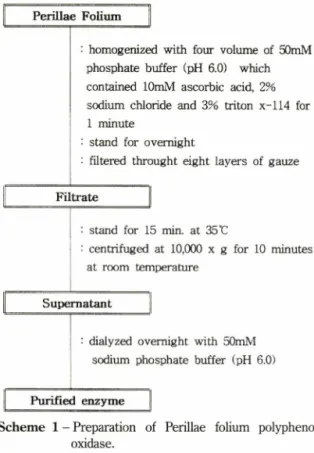
-Scheme 1에 따라 추출 및
정제를 한 효소
(2589 unit/m/)를 실험에 사용하였으며
기질은
o-diphenol류 중
PPO에 대해 활성이 높게 나
Perillae Folium
: homogenized with four volume of 50mM phosphate buffer (pH 6.0) which contained lOmM ascorbic acid, 2%
sodium chloride and 3% triton x-114 for 1 minute
• stand for overnight
: filtered throught eight layers of gauze
Filtrate
• stand for 15 min. at 35*C
: centrifuged at 10,000 x g for 10 minutes at room temperature
: dialyzed overnight with 50mM sodium phosphate buffer (pH 6.0)
Purified enzyme
Scheme 1 - Preparation of Perillae folium polyphenol oxidase.
타나는
fbutylcatech이과
4-methylcatech이를 사용하
였다
. 5mM기질(혹은 저해제를 첨가한 기질)에 정제
한 효소를
10\ \ 1 가하여 혼화한 후
30oC circulating water bath에서
10&간 반응시켜서 효소반응액으로 사
였다
.HPLC
분석조건
-Table I의 조건으로 분석하였다
.저해제의 영향
- Ascorbic acid와
thi이류
6종
(cysteine, n-acetyl-l-cysteine, glutathione, thiourea, 2- mercaptoethanol, dithiotreithol)및
organic acid^- 6 ^ (malic acid, citric acid, glycolic acid, taurine, kojicacid
)을 다양한 농도로 기질
5mM에 첨가하여 효소와
빈웅시킨 후 효소반응액을
Table I조건으로 분석하여
Table I - Analytical condition of High liquid chromatograph
t-butylcatechol as substrate 4-methylcatechol as substrate column
flow rate detector mobile phase
|i-Bondapak C18 0.7 m//min.
UV 214 nm
50% methanol with 50 mM sodium octanesulfonate (pH 2.0)
|j,-Bondapak C18 0.7 m//min.
UV 214 nm
40%(or *25%) methanol with 50 mM sodium octanesulfonate (pH 2.0)
*25% was used for analysis of product of n-acetyl-l-cysteine with 4-methylcatechol
J. Pharm. Soc. Korea
아스코르빈산파 티올류 및 유가산이 폴리페놀 산화효소 활성에 미치는 영향 389
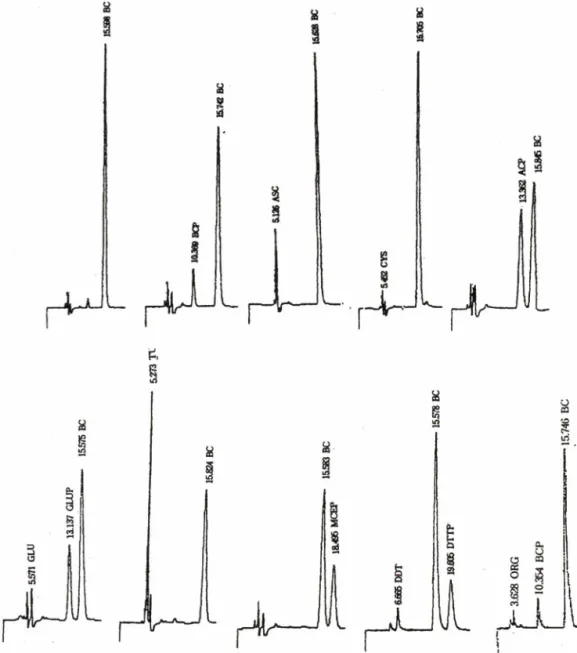
Fig. 1 - Chromatogram of 궁-butyulcatechol(BC) and either ascorbic acid (ASC), cysteine (CYS), n-acetyl-l-cysteine (AC), thiourea (TU), glutation (Glu), 2-mercapto-ethanol (MCE), dithiotheithol (DTT) or organic acid (ORG) and their products (-P) on PPO-catalyzed oxidation of t-butylcatechol.
저해제의 농도에 따른 기질과 효소와의 반응산물의 양 과 저해제에 의해 형성되는 생성물의 양의 변화를 측정
였다
.Ascorbic acid
첨가에 따른
thiol류의 저해율 비교
-기질
5mM에
thiol류
3mM과
0.5,1,3 mM세가지 농
도의
ascorbic acid를 첨가한 후 효소와 반응시킨 후 그
효소반응액을
Table I조건으로 분석하여 기질과
thiol류 의 생성물의 변화를 관찰하므로서
ascorbic acid첨가에
따른
thiol류의 저해율을 비교하였다
.실험결과 및 고찰
PPO
활성에 저해작용을 한다고 알려진
ascorbic add와
thiol류 및
organic acid의
PPO활성에 대한 영향을
조사하기 위하여 들깨잎
PPO에 높은 활성을 나타내는
diphenol
물질인
t-butylcatechol및
4_methylcatechol을
님
%
I§
9 U)
osvael
ut
O CQ9
? l r
; l-
-- hs l
cu: m s o
§
ill
dLia
90 따 61
mu SSI.
님
offl
dmo
3
a I
r 니
Vol. 45, No. 4, 2001
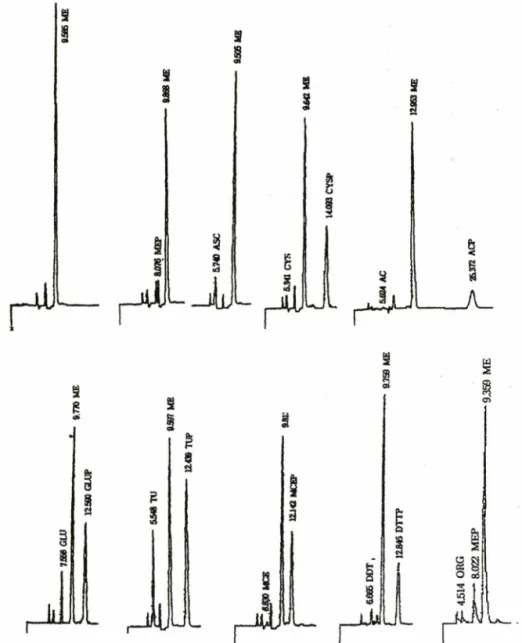
Fig. 2 - Chromatogram of 4-methylcatechol (ME) and either ascorbic acid (ASC), cysteine (CYS), n-acetyl-l-cysteine (AC), thiourea (TU), glutation (Glu), 2-mercaptoethanol (MCE), dithiotheithol (DTT) or organic acid (ORG) and their products (-P) on PPO-catalyzed oxidation of 4-methylca- techol.
기질로
A]용하여 그 기질 및 기질과 효소와의 반응산
물
,반
g산물과
thiol류에 의한 반응에서 얻어진 무색의
생성물에 대한 크로마토그램을
HPLC로 분석하여 다음 과 같은 결과를 얻었다
(Rg. 1, 2).Ascorbic acid
와
thi이류 및
organic acid의 영 향
- 5m M f-Butylcatech이을 기질로 사용한 경우
ascorbic acid와
0.5및
1 mM cysteine은 기질과 효 소와의 빈응산물인
0-quinone을 다시 환원하여 기질이 재생성된다
.특히
cysteine의 경우에는
0.5 mM이하
에서는
o-quinone이 첨가된
cysteine농도에 반비례하
여 감소하고 다른 화합물을 생성하지 않으며
, Im M이상에서
o-quinone과의 무색의 반응산물
(quinonecoupler)
인
SH-product가 생성된다
.반면
,다른
thiol류는 첨가된
thiol류 농도와 반비례하여
0-quinone이
감소하는 동시에
SH-product의 양이 비례적으로 중가
한다
.다만
2-mercaptoethanol의 경우에는 농도가
3mM
로 높아지면
SH-product의 양이 도리어 감소하는
양상을 보아 생성된
o-quinone을 모두 소비한 후 그
/. Pharm. Soc. Korea
아스코르빈산과 티올류 및 유7)산이 폴리페놀 산화효소 활성에 미치는 영향 391
이상 농도의
2-mercaptoethan이에 의해서는 이 방법
으로 검출되지 않는 다른 성분으로 전환되는 것으로 추정된다
.그리고
thiourea의 경우에는
420nm에서 흡 광도를 측정하여 갈변정도에 따른 저해율을 측정하는 실험에서와 일치하예
3〉10 mM농도로 증가하여도 o-
quinone이 계속 검출이 된다
. Triton x-114로 처리하 지 않은 이전의 들깨잎 효소에서는 기질로서
catechol과
4_methylcatechd를 사용하여
cysteine과
glutathione의 저해율을 측정한 결과
100%저해를 나타내는 농
도가 같다고 보고되어 있는데
,본 실험에서는 저해율 이 크게 나타나는
cysteine과
glutathione에서는 첨가 량에 따른 기질량의 변화가 유의성있게 나타났으며
cysteine
이
0.5 mM농도에서 기질과 효소와의 반응산
물이 검출되는 반면
glutathione의 경우에는
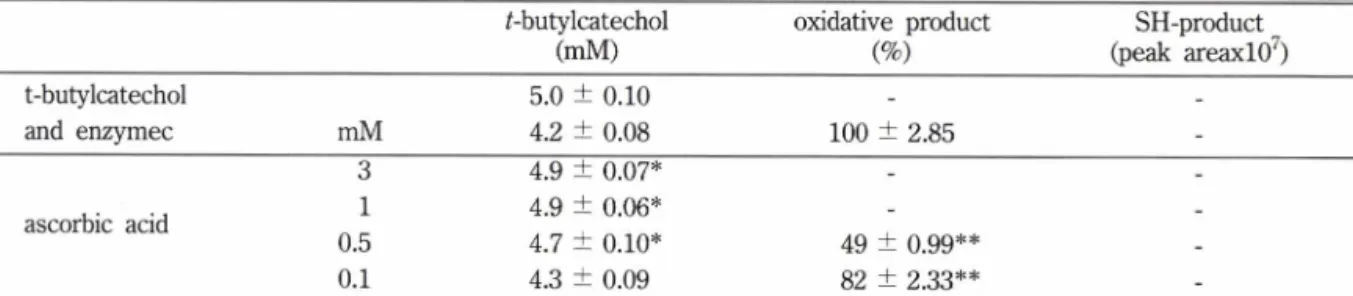
0.2 mMTable II - The effect of ascorbic acid on PPO-catalyzed oxidation of hbutylcatechol
호
-butylcatechol
(mM)
oxidative product (%)
SH-product
(peak areaxlO7)
t-butylcatechol
5.0 ± 0.10
- -and enzymec mM 4.2 ± 0.08 100 ± 2.85
-3
4.9 ± 0.07*
- -ascorbic acid 1 4.9 ± 0.06* -
-0.5
4.7 ± 0.10* 49 ± 0.99**
-0.1 4.3 ± 0.09 82 ± 2.33** -
control groupc (*p<0.05 and **p<0.01)
Table III - The effect of thiols on PPO-catalyzed oxidation of f butylcatechol
^-butylcatechol (mM)
oxidative product (%)
SH-product (peak areaxlO7)
^-butylcatechol 5.0 ± 0.10 - -
and enzymec mM 4.2 ± 0.08 100 ± 2.85 -
3 4.2 ± 0.05 - 8.05 ± 0.22
1 4.8 ± 0.07* - 1.24 ± 0.05
cysteine 0.5 4.9 ± 0.08** 41 ± 1.27** -
0.3 4.2 ± 0.10 56 ± 1.31** -
0.1 3.8 ± 0.09* 82 ± 1.59** -
4.3 ± 0.15 - 6.56 ± 0.15
n-acetyl-l-cysteine 1 4.1 ± 0.09 - 4.39 ± 0.12
0.5 4.0 ± 0.13 56 ± 1.00** 2.08 ± 0.07
1 3.7 ± 0.07* - 3.55 ± 0.10
0.5 3.8 ± 0.09 _ 3.36 ± 0.08
glutathione
0.3 3.8 ± 0.08* - 0.66 ± 0.02
0.1 3.7 ± 0.11* 47 ± 1.33** 0.45 ± 0.02
10 4.4 ± 0.09 25 ± 0.91** 0.07 ± 0.003
thiourea 4.2 ± 0.09 50 土 1.47** 0.06 ± 0.003
1 4.2 ± 0.10 95 ± 2.25 0.04 ± 0.002
4.2 ± 0.07 - 3.22 ± 0.09
2-mercapto-ethanol 1 4.2 ± 0.04 - 4.09 ± 0.05
0.5 4.3 ± 0.08 94 ± 1.72* 1.07 ± 0.04
4.4 ± 0.10 - 4.96 ± 0.15
dithiotreithol 1 4.3 ± 0.14 - 3.34 ± 0.10
0.5 4.3 ± 0.08 9 ± 0.26** -
The data were expressed as means 士 S.D. for 3 experiments. Asterisks denote a significant difference compared with the control group0 (*p<0.05 and **p<0.01)
Vol. 45,No. 4’ 2001
392 김안근 • 김유경
농도에서도 효소반응생성물이 불검출되 어
glutathione이
cysteine에 비해 저해율이 더 큼을 알 수 있었다
(Table II
,
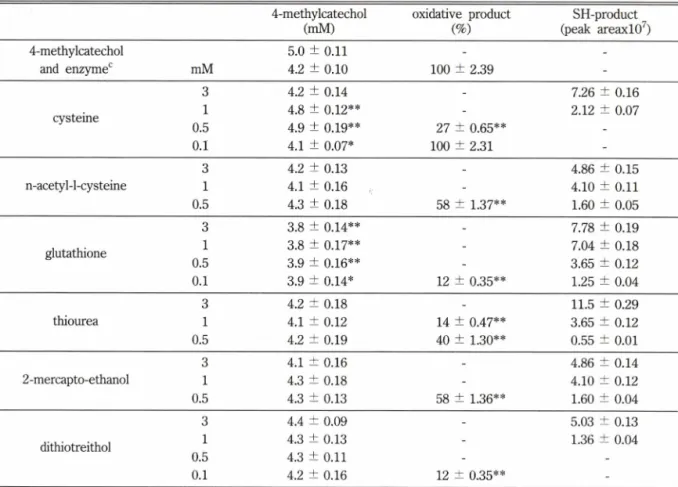
HI).5 mM 4-Methylcatech
이을 기질로 사용한 경우에는
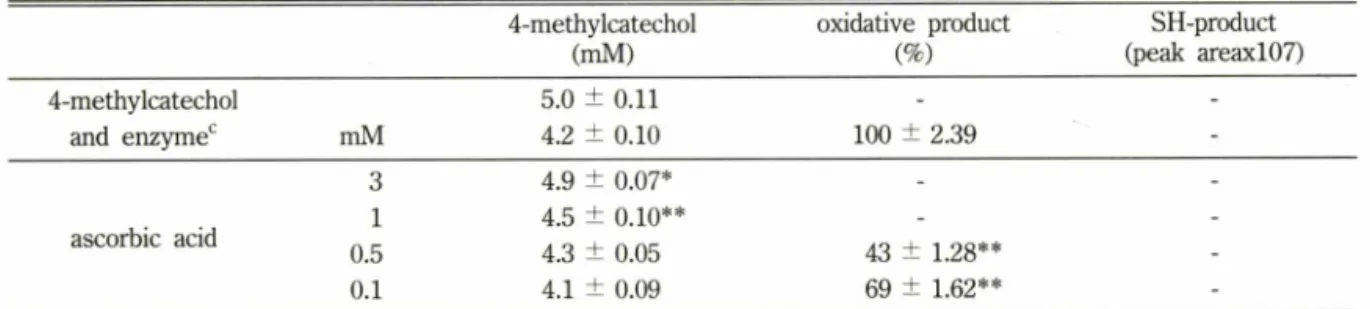
ascorbic acid
와
cysteine의 경우
fbutylcatechol을 기
질로 한 경우와 비슷한 결과를 보이며
, 2-mercaptoe-thanol
의 경우 다른
thiol류와 동일한 결과를 보여서
SH-product
의 양이 비례적으로 중가하며,
thiourea의
경우에
1 mM이하에서 효소와 기질과의 반응산물이
검출되어
t-butylcatech이에 비해 저해율이 큼을 알 수
있었다
(Table Y VI).Mushroom tyrosinase
에서는
thiol류와
o-diphenol의 효소반응생성물과의
sulfhydryl conjugate를 형성한
다고 하고
ascorbic acid의 경우에는 기질과 효소의 반
응생성물을 다시 환원시킨다고 하였는데严 들깨잎의
PPO에서는
ascorbic acid의 경우에는
mushroomTable IV - The effect of organic acid on PPO-catalyzed oxidation of f butylcatechol
/-butylcatechol
(mM)
oxidative product (%)
SH-product (peak areaxl07)
t-butylcatechol 5.0 ± 0.07 - -
and enzyme0 mM 4.2 ± 0.08 100 ± 2.85 -
25 5.0 ± 0.12** 5 ± 0.13** -
malic acid 10 4.6 ± 0.16** 79 ± 2.17** -
5 4.3 ± 0.12 91 ± 2.06** -
25 5.0 ± 0.19** 2 ± 0.05** -
citric acid 10 4.5 ± 0.16** 18 ± 0.51** -
5 4.4 ± 0.08* 70 ± 1.63** -
25 5.0 ± 0.16** 34 ± 1.18** -
glycolic acid 10 4.8 ± 0.14** 79
土2.36** -
5
4.4 ± 0.17* 90 ± 2.57**-
25
4.9 ± 0.13**
14 ± 0.47**-
tartaric acid
10 4.4 ± 0.16**
21 ± 0.67**-
5 4.2 ± 0.11
74 ± 2.22**-
50
4.5 ± 0.17*
63 ± 1.59**-
25 4.4
±
0.14* 82±
1.78**10
4.4±
0.16*85
土2.00** -
5 4.3 ± 0.16 88
±
1.89**-
5 5.0 ± 0.12**
4 ± 0.11**
-kojic acid
1 5.0
±0.10** 14 ± 0.64** -
0.5 4.5 ± 0.19* 58 ± 1.46** -
The data were expressed as means 土 S.D. for 3 experiments. Asterisks denote a significant difference compared with the control groupc (*p<0.05 and **p<0.01)
Table V - The effect of ascorbic acid on PPO-catalyzed oxidation of 4-methylcatechol
4-methylcatechol(mM)
oxidative product (%)
SH-product (peak areaxl07)
4-methylcatechol 5.0 ± 0.11 - -
and enzymec mM 4.2 ± 0.10 100 ± 2.39 -
3 4.9 ± 0.07* - -
1 4.5 ± 0.10** _ _
ascorbic acid
0.5 4.3 ± 0.05 43 ± 1.28** -
0.1 4.1 ± 0.09 69 ± 1.62** -
The data were expressed as means 土 S.D. for 3 experiments. Asterisks denote a significant difference compared with the control group0 (*p<0.05 and **p<0.01)
J. Pharm. Soc. Korea
아스코르빈산과 티올류 및 유가산이 폴리페놀 산화효소 활성에 미치는 영향 393
Table VI
- The effect of thiols on PPO-catalyzed oxidation of 4-methylcatechol 4-methylcatechol(mM)
oxidative product (%)
SH-product (peak areaxlO7)
4-methylcatechol 5.0 ± 0.11 - -
and enzymec mM 4.2 ± 0.10 100 ± 2.39 -
3 4.2 ± 0.14 - 7.26 ± 0.16
1 4.8 ± 0.12** - 2.12 ± 0.07
0.5 4.9 ± 0.19** 27 ± 0.65** -
0.1 4.1 ± 0.07* 100 ± 2.31 -
3 4.2 ± 0.13 - 4.86 ± 0.15
n-acetyl-l-cysteine 1 4.1 ± 0.16 - 4.10 ± 0.11
0.5 4.3 ± 0.18 58 ± 1.37** 1.60 ± 0.05
3 3.8 ± 0.14** - 7.78 ± 0.19
1 3.8 ± 0.17** - 7.04 ± 0.18
0.5 3.9 ± 0.16** - 3.65 ± 0.12
0.1 3.9 ± 0.14* 12 ± 0.35** 1.25 ± 0.04
3 4.2 ± 0.18 - 11.5 ± 0.29
thiourea 1 4.1 ± 0.12 14 ± 0.47** 3.65 ± 0.12
0.5 4.2 ± 0.19 40 ± 1.30** 0.55 ± 0.01
3 4.1 ± 0.16 - 4.86 ± 0.14
2-mercapto-ethanol 1 4.3 ± 0.18 - 4.10 ± 0.12
0.5 4.3 ± 0.13 58 ± 1.36** 1.60 ± 0.04
3 4.4 ± 0.09 - 5.03 ± 0.13
dithiotreithol 1 4.3 ± 0.13 - 1.36 ± 0.04
0.5 4.3 ± 0.11 - -
0.1 4.2 ± 0.16 12 ± 0.35** -
The data were expressed as means 土 S.D. for 3 experiments. Asterisks denote a significant difference compared with the control groupc (*p<0.05 and **p<0.01)
tyrosinase
와 동일한 기전으로 저해작용을 하며
cysteine
을 제외한 다른
thiol류는
sulfhydryl conjugate를 형성하여 저해효과가 나타남을 확신 할 수 있었다
.9)기질로서
4-methylcatech이를 사용한
PalmitoPPO
의
1-cysteine에 의한 저해작용의 연구에서 반응
액에
quinone이 존재하지 않는
lag period가 보여지 며
300nm에서 측정한 결과 무색의
thiol-quione복 합체를 형성함이 관찰되었다
.14)들깨잎
PPO의 경우
에는
cysteine의 저해작용은 저농도에서는
ascorbicacid
와 유사한 작용과
Im M이상 고농도에서
sulfhydryl conjugate
를 형성하는 두가지 반응이 나타
^
다
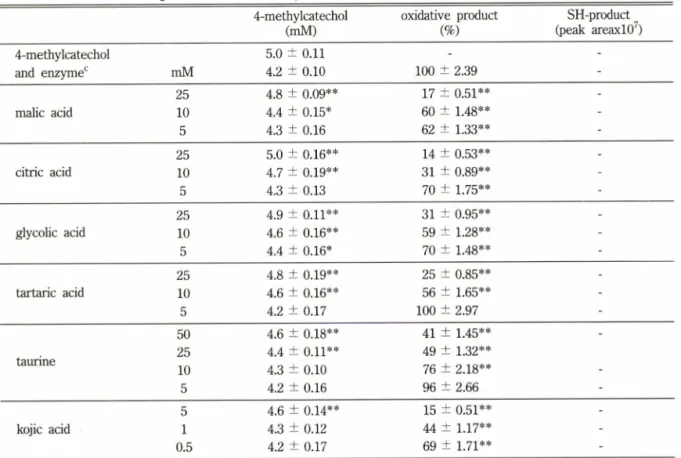
.Organic acid
을 두가지 기질 모두에서
ascorbicacid
에서와 유사한 방법으로 저해를 하는 것으로 보여
지나
, PPO의 저해제로 알려진
kojic acid를 제외하고
는
ascorbic acid에 비해 매우 높은 농도에서 저해작
용을 볼 수 있었으며
(25 mM에서도 완전 저해되지 않
음
),특히
taurine의 경우에는
50 mM이상에서도 효 소활성이 완전히 저해되지 않아서 저해작용이 대부분 약하게 나타났다
(Table iy VII).Ascorbic acid
첨가에 따른
thi이류의 저해율
- thiol류의 농도를
3 mM로 하고
ascorbic acid를
3,1,0.5 mM
로 첨가한 경우 두가지 기질에서 유시•한 결과
를 나타내었는데
ascorbic acid농도가
thiol류와 동일 한 농도일 때
ascorbic acid가 우선적으로 소비되고
1 mM, 0.5 mM에서는
thiol류의 소비가 다시 증가하였다
.특히 저해정도가 약하다고 알려진
thiourea는
0.5 mM ascorbic acid에서
t-butylcatech이의 반응산물과
의 무색의 생성물이 검줄되고
4-methylcatech이에서는
전혀 검출되지 않았다
(Table Vffl, IX).Rat tyrosinase
를 항암제로 이용되는
etoposide를 기질로 하여
glutathione, ascorbic acid를 혼합하여
Vol. 45,No. 4,2001
394 김안근 • 김유경
Table V II - The effect of organic acid on PPO-catalyzed oxidation of 4-methylcatechol 4-methylcatechol
(mM)
oxidative product (%)
SH-product (peak areaxlO7)
4-methylcatechol 5.0 ± 0.11 - -
and enzyme0 mM 4.2 ± 0.10 100 ± 2.39 -
25 4.8 ± 0.09** 17 ± 0.51** -
malic acid 10 4.4 ± 0.15* 60 ± 1.48** -
5 4.3 ± 0.16 62 ± 1.33** -
25 5.0 ± 0.16** 14 ± 0.53** -
citric acid 10 4.7 ± 0.19** 31 ± 0.89** -
5 4.3 ± 0.13 70 ± 1.75** -
25 4.9 ± 0.11** 31 ± 0.95** -
glycolic acid 10 4.6 ± 0.16** 59 ± 1.28** -
5 4.4 ± 0.16* 70 ± 1.48** -
25 4.8 ± 0.19** 25
土
0.85** -tartaric acid 10 4.6 ± 0.16** 56 ± 1.65** -
5 4.2 ± 0.17 100 ± 2.97 -
50 4.6 ± 0.18** 41 ± 1.45** -
taurine 25 4.4 ± 0.11** 49 ± 1.32**
10 4.3 ± 0.10 76 ± 2.18** -
5 4.2 ± 0.16 96 ± 2.66 -
5 4.6 ± 0.14** 15 ± 0.51** -
kojic acid 1 4.3 ± 0.12 44 ± 1.17** -
0.5 4.2 ± 0.17 69 ± 1.71** -
The data were expressed as means
土S.D. for 3 experiments. Asterisks denote a significant difference compared with the control group0 (*p<0.05 and **p<0.01)
반응시킬 때
ascorbic acid가 우선 소비된 이후
glutatione
이 소비되고
, glutathione이 거의 소비된 이
후에 기질인
etoposide가 소비되는 것으로 나타났다
.1®이러한 결과와 일치하여 들깨잎
PPO에
ascorbicacid
와
thiol류를 혼합하여 반응한 결과
, ascorbic acid는 동일한 농도에서는
thiol류에 비해 우선적으로 효소 반응산물을 환원하여 기질이 재생성되도록 한다
.반면
thiol
류는 효소와 기질과의 반응산물과
2차로 반응하며
무색의 반응산물을 생성한다
. ascorbic acid와
thiol화 합물 둘 다 효소와 기질의 빈응신물에 대해
2차로 반 응하므로 빈응시간동안에는 무색을 유지하는 경우도 시간이 경과함에 따라 다시 갈색 혹은 적색
(4- methylcatech이의 경우
)I:띄게 된다
.그러므로 저해제
로 알려진 이들 물질은 직접
PPO의 활성을 억제하는
것이 아니라 그 반§산물에 작용하여 저해작용을 나타 냄을 알 수 있었다
. organic acid의 경우에는
PPᄋ에 저해작용이 있다고 알려진
kojic acid를 제외하고는 저 해작용이 약하게 나타내었으며 반응기전은
ascorbicacid
와 유사한 것으로 생각된다
.결 론
1.
갈변효소인
PPO에 대한 저해물질로 알려진
ascorbic acid과
thiol류
6종
,organic acid 6종을
PPO의 두가지 기질
(t-butylcatechol, 4~methylcatechol)에 각각 첨가하며 기질
,저해제
,각각의 빈음생성물의 양
을
HPLC법으로 측정하므로서 다음과 같은 결과를 얻
었다
.-
두가지 기질 모두에서
ascorbic acid과
0.5및
1mM
의
cysteine에서는 기질과 효소의 반응산물의 환원
에 의해 저해작용을 나타냈으며
,다른
thiol화합물과
3m M
이상의
cysteine에서는 기질의 양이 효소와 기
질만 반응했을 때의 기질의 양과 일치하여 이는 반응 산물이 기질로 재생성되지 않고 무색의 생성물로 전환 되었다
.-유기산 첨가시에는
kojic acid를 제외하고는 저해
J. Pharm. Soc. Korea
TableVIII - Theeffect of ascorbic acid on thiolsasinhibitorsinPPO-catalyzedoxidation of ^-butylcatechol
th io ls ( 3 m M ) t- bu ty lc at ec ho l (m M ) SH -p ro du ct ( % ) 0 ad de d as co rb ic a ci d (m M ) 0. 5 1 3 0C ad de d as co rb ic a ci d (m M ) 0. 5 1 3 ^- bu ty lc at ec ho l 5. 0 ± 0. 10 an d en zy m e0 4. 2 ± 0. 08 cy st ei ne 4. 1 + 0. 11 4. 4 ± 0 .0 8* 4. 6 ± 0. 12 ** 5. 0 ± 0. 16 ** 10 0 ± 2 .6 3 76 ± 1. 97 ** 45 ± 1 .2 7* * Q **
n-acetyl-/-cysteine4. 2 ±
0.094. 4 ± 0 .1 1* 4. 8 ±
0.14**4. 8 ± 0. 14 ** 10 0 ± 3 .4 2 48 ± 1. 46 ** 25 ± 0 .9 3* * 5 ± 0 .1 5* * gl ut at hi on e 3. 9 ± 0. 12 4. 6 ± 0 .0 9* * 4. 8 ± 0. 09 ** 5. 0 ± 0. 17 ** 10 0 ± 2 .0 1 83 ± 2 .2 5* *
56±
1.32**7 ±
0.23**th io ur ea 4. 1 ±
0.094. 9 ± 0 .1 0* *
5.0—10.13**4.9±0.13**10 0
± 2.3310土 0 .3 5* *
0**Q** 2-mercaptoethanol4.2士
0.074.7 ± 0.07**5. 0 ± 0. 11 ** 5. 0 ± 0. 16 ** 10 0 ± 3 .2 7 49 ±
1.16**37±
0.98**19
±0 .6 5* *
dithiotreithol4. 2 ± 0. 09 4. 8 ± 0 .1 3* * 5. 0 ± 0. 12 ** 5. 0
土0. 13 ** 10 0 ± 1 .7 1 73 ±
1.94**63±
1.21**30 ± 0 .8 1* *
The data were expressed asmeans土S.D. for 3 experiments. Asterisks denotea si gn ifi ca nt d iff er en ce c om pa re d w ith t he c on tr ol g ro up 0 (* p< 0 .0 5 a nd * *p < 0 .0 1 )
TableIX - Theeffect of ascorbic acid onthiolsasinhibitorsinPPO-catalyzed oxidation of 4-methylcatechol thiols(3mM)t-butylcatechol(mM)SH-product (%) 0addedascorbic acid (mM) 0.5 130cadded ascorbic acid (mM) 0.5 13 4-methylcatechol5.0±0.11 and enzymec4.2±0.10 cysteine4.2±0.134.7 ± 0.11**4.8±0.14**5.0±0.13**100±2.4544 ± 1.27**29 ± 0.87**15 ± 0.51** n-acetyl-/-cysteine4.0±0.124.6 ± 0.14**4.9±0.12**5.0±0.14**100±2.8231 ± 0.75**21 ± 0.90**0** glutathione3.8+0.12*4.7 ± 0.08**4.8±0.11**4.8±0.14**100±2.4832 ± 1.15**26 ± 0.75**80 ± .23** thiourea4.2±0.114.6 ± 0.12**4.8±0.13**4.9±0.16**100±3.03Q**Q**Q** 2-mercaptoethanol4.2±0.094.4 ± 0.10*4.7土0.16*4.9±0.10**100±2.9949 ± 1.42**37 ± 0.81**19 ± 0.55** dithiotreithol4.2±0.134.3 ± 0.164.8:上0.12**4.8土0.13**100±1.9373 士 1.80**63 ± 1.73**30 ± 0.75** Thedata were expressed asmeans
土
S.D. for 3 experiments. Asterisks denote a significant difference compared with the controlgroupc (*p<0.05 and **p<0.01)^ -8-\l vaol 출 오 一 ds rlr ol os l CO 95
vᄋ/. 45, Isrp 4, 2001
396 김안근 • 김유경
작용이 약하게 나타내었고 작용기전은
ascorbic acid와 유사하였다
.2. 3mM
일정 농도의
thiol류와
0.5,1,3 mM ascorbic acid을 첨가하여 두가지 기질에서 기질과 무색생성물 의 양을 측정한 결과는 다음과 같다
.Thiol
류의 농도와 동일한
3m M ascorbic acid에서
는
ascorbic acid의 소비가 우세한 반면무색생성물이
적게 검출되었고,
Im M , 0.5mM에서는 무색생성물의
양이 현저히 증가하는 경향을 보인다
.다만
thiourea의
경우에는
0.5 mM ascorbic acid농도에서도 무색생성 물이 검출되지 않았다
.감사의 말씀
본 연구의 일부는 숙명여자대학교
1999년도 교내연 구비 지원에 의해 수행되었으며 이에 깊이 감사드립 니다
.문 헌
1) Hunt, M. D.
,Eannetta, N. T, Yu, H.
,Newman, S. M.
and John C. S .: cDNA cloning and expression of potato polyphenol oxidase
P la n t M o le cu lar B iology21,59 (1993).
2) Newman, S. M., Eannetta, N. T, Yu, H., Prince, J. R,
Vicente, M. C., Tanksley, S. D. and John C. S .:Organisation of the tomato polyphenoloxidase gene family.
Plant Morecular Biology
21, 1035 (1993).3) Sherman, T. D.,Vaughn K. C. and Duke S. 0.: A
limited survey of the phytogenetic distribution ofpolyphenol oxidase.
P hytochem istry30,2499 (1991).
4) Asaka, M., Aoyama, Y., Nakanishi, R. and Hayashi, R.
: Purification of a latent from of polyphenoloxidase
La France pear fruit and its pressure-activation.B io sc i. B iotech, B iochem .
58(8), 1486 (1994).
5) Mayer A. M .: Polyphenol oxidase in plants - recent progress.
P hytochem istry26, 11(1987).
6) Vaughn K. C., Lax A. R. and Duke S. 0.: Polyphenol oxidase - the chloroplast enzyme with no established
function.
P la n t P h y sio l72
,659(1988).
7) Lax, A. R. and Vaughn, K. C .: Colocalization of
polyphenol oxidase and photosystem II proteins.Plant Physiol.
96, 26 (1991).8) Robinson, S. R and Dry, I. B .: Broad bean leaf
polyphenol oxidase is a 60-kilodalton protein susceptibleto proteolytic cleavage.
P la n t P h y sio l99
,317(1992).
9) Nappi, A. J. and Vass, E .: Chromatographic analyses
of the effects of glutathione, cysteine and ascorbic acid on the monophenol and diphenol oxidase activitiesof tyrosinase.
J . L iq u id C hrom at.17(4), 793(1994).
10) Kagan, V E.
,Talowich, J. C.
,Day, B. W., Goldman, R
.,Gantchev, T. G. and Stoyanovsky, D. A .: ascorbate in
the primary reductant of the phenoxyl radical of etoposide in the presence of thils bothe in cellhomogenates and model systems,
biochem istry33
,9651 (1994).
11) Victoria M. V, Nobuhiko, K.
,Jun, M. and Mincent, J.
H .: A standardized protocil for assessing regulators of pigmentation.
A n a ly tic a l B iochem istry270,207
(1999).12) Ernest, V C., Cecil, K., Heino, H., Hansrue, G .:
Inhibitors of mammalian melanocyte tyrosinase: In
vitro comparisons
o falkyl ester of gentisic acid with other putative inhibitors.
B io ch em ical P harm acology57,663(1999).
13) 노진희 :Perilla frutescens britton 엽 중의 Phenolic acid
의 산화 효소에 관한 연구
.숙명여대 석사학위논문
.p . 22 (1987).
14) Robert, C.
,Richardforget, E, Pabion, M. and cadet, E : A kinetic study of the inhibition of palmito polyphenol oxidase by 1-cysteine.
In t. J . B iochem .Cell Biol
28(4),
1357(1996).15) Kagan, V E., Talowich, J. C.
,Day, B. W., Goldman, R
.,Gantchev, T. G. and Stoyanovsky, D. A .: Ascorbate
is the primary reductant of the phenoxyl radical of etoposide in the presence of thiols both in cellhomogenates and in model systems.
B iochem istry33, 9651(1994).
J. Pharm. Soc. Korea