pISSN 2466-1384 eISSN 2466-1392 Korean J Vet Res (2019) 59(3):157~160 https://doi.org/10.14405/kjvr.2019.59.3.157
157 Short Communication
Prevalence and molecular characteristics of 16s rRNA methylase gene rmtB in amikacin resistant Escherichia coli isolated from South Korea
Kuastros Mekonnen Belaynehe1,4, Ho Geun Won1,2, In Joong Yoon2, Han Sang Yoo1,3,*
1Department of Infectious Diseases, College of Veterinary Medicine, Seoul National University, Seoul 08826, Korea
2Chung Ang Vaccine Laboratory, Daejeon 34055, Korea
3Bio-MAX/N-Bio, Seoul National University, Seoul 08826, Korea
4National Animal Health Diagnostic and Investigation Center, Sebeta 04, Ethiopia
Abstract: The production of rmtB-encoded 16S rRNA methylases has emerged as a novel mechanism promoting high-level resistance toward aminoglycosides in Gram-negative bacteria. Between 2015 and 2017, 636 distinct commensal Escherichia (E.) coli isolates were collected from different farms in South Korea to determine the prevalence and molecular characteristics of rmtB. The positive rates of rmtB between all the isolates and amikacin-resistant isolates were 1.1 and 100%, respectively. High-level aminoglycoside resistance could be transferred by conjugation from rmtB-positive donors to higher amikacin-resistance efficacies.
This is the first report of 16S rRNA methylase-encoding genes in E. coli isolated from food-producing animals in Korea.
Keywords: Escherichia coli, 16S RMTase gene, amikacin resistance, transferability
The mechanism of the clinically significant aminoglycosides has long been known to be associated with their ability to bind to the bacterial 30S ribo- somal subunit and interfere with bacterial protein translation [1]. Serious infections caused by Gram-negative bacteria can often be effectively treated with a combination of aminoglycoside-β-lactam agents [2]. However, the clin- ical significance and effectiveness of aminoglycosides have been challenged by different bacterial resistance mechanisms. Among the globally dissemi- nated aminoglycoside resistance mechanisms, acquired 16S ribosomal RNA methyltransferases (16S RMTases) in Gram-negative bacteria are the most worrisome due to their ability to compromise the activity of all aminoglyco- sides [3]. 16S RMTases confer resistance to aminoglycosides by methylating a nucleotide in the aminoglycoside attachment region located in the A-site of the 16S rRNA using S-adenyosyl-L-methionine [2].
The aminoglycoside binding site of the specific nucleotide residues, either the N-7 position of nucleotide G1405 or the N-1 position of nucleotide A1408, in 16S rRNA can be enzymatically modified by various 16S rRNA methyltransferases [4,5]. There are ten acquired N7-G1405 16S RMTase- encoding genes (armA, rmtA, rmtB, rmtC, rmtD, rmtD2, rmtE, rmtF, rmtG, and rmtH), although only one acquired N1-A1408 16S RMTase gene (npmA) exclusively confers resistance to aminoglycosides. The first encoded 16S RMTase was discovered in Japan in 1997 on a plasmid harboring rmtA in an AGA-resistant Pseudomonas aeruginosa strain [6]. Later, in the early 2000s, significant progress in the field of genetic analytical techniques led to discov- ery of another member of the 16S rRNA methylase gene family, armA, in Klebsiella pneumoniae isolated from a hospitalized patient in France [7].
Recently, O'Hara et al. [8] identified rmtH from a clinical K. pneumoniae strain in a wounded male USA solder returning from the Iraq war.
Despite exhibiting a low clinical prevalence, the clinical significance of 16S RMTases is increasing globally, posing considerable potential health risks due to 16S RMTases being able to confer resistance to many clinically important aminoglycosides, including amikacin. The predominant 16S RMTases are cur- rently encoded by rmtB and armA, which have spread worldwide to resistant
*Corresponding author Han Sang Yoo
Department of Infectious Diseases, College of Veterinary Medicine, Seoul National University, Seoul 08826, Korea.
Tel: +82-2-880-1263 Fax: +82-2-874-2738 E-mail: [email protected] ORCID:
Kuastros Mekonnen Belaynehe https://orcid.org/0000-0002-8508-0809 Ho Geun Won
https://orcid.org/0000-0003-4568-4429 In Joong Yoon
https://orcid.org/0000-0002-8761-4296 Han Sang Yoo
https://orcid.org/0000-0003-0548-0835 Conflict of Interest
The authors declare no conflicts of interest.
Received: August 19, 2019 Accepted: September 11, 2019
158 Kuastros Mekonnen Belaynehe, Ho Geun Won, In Joong Yoon, Han Sang Yoo
bacterial strains isolated from humans and livestock [9,10].
In South Korea, 16S RMTase genes has been reported from human clinical E. coli isolates, with the most commonly encountered 16S RMTase genes responsible for aminoglyco- side-resistance being armA and rmtB [11].
However, the prevalence of high-level aminoglycoside resistance mediated by 16S rRNA methylases among E. coli strains isolated from food-producing animals has not been investigated. In this study, we describe the identification of rmtB in a commensal E. coli strain recovered from healthy animals. Thus, the aim of this study was to investigate the prevalence of rmtB among E. coli isolates collected in South Korea and to gain insights into the molecular characteriza- tion of these rmtB-positive strains.
We screened 636 commensal E. coli isolates recovered from fecal samples obtained from clinically healthy animals (341 from cattle, 265 from swine, and 30 from chickens) during a nationwide surveillance study on antimicrobial sus- ceptibility conducted between 2014 and 2017. Fecal samples were freshly collected from cattle, swine, and chickens, and E. coli isolates were obtained by culturing on MacConkey and Eosin methylene blue agar.
MIC testing was conducted according to the recommenda- tions of the Clinical Laboratory Standards Institute (CLSI) (2015), and the resulting MIC values were interpreted using CLSI standards. An inoculum of 105 CFU/mL was incubated in Mueller-Hinton broth (MHB) in the presence of two-fold serial dilutions of antimicrobials, with the MIC defined as the lowest concentration of antibiotic that completely inhibited visible growth. The following antimicrobial agents were tested in the described range of concentrations (mg/L): amikacin (0.25-512), streptomycin (0.125-128), gentamicin (0.125-128), kanamycin(0.25-256), neomycin (0.125-256), tobramycin (0.125-256), tetracycline (0.25-512), ampicillin (0.125-256), minocycline (0.25-512), and cephalothin (0.125-128).
PCR amplification to investigate the 16S RMTase-encod- ing genes (rmtA, rmtB, rmtC, rmtD, rmtE, armA,and npmA) along with other resistance mechanisms was carried on
strains displaying phenotypic resistance for amikacin by employing primer pairs reported in previous studies [4,12,13].
Conjugation experiments were performed to determine the transferability of 16S rRNA methylase genes between the donor and recipient strains using the broth mating technique.
The transconjugants were selected for and confirmed by PCR. The MICs for recipient, transconjugant, and donor strains were determined using the broth microdilution method with procedures and interpretation guidelines of the CLSI [14].
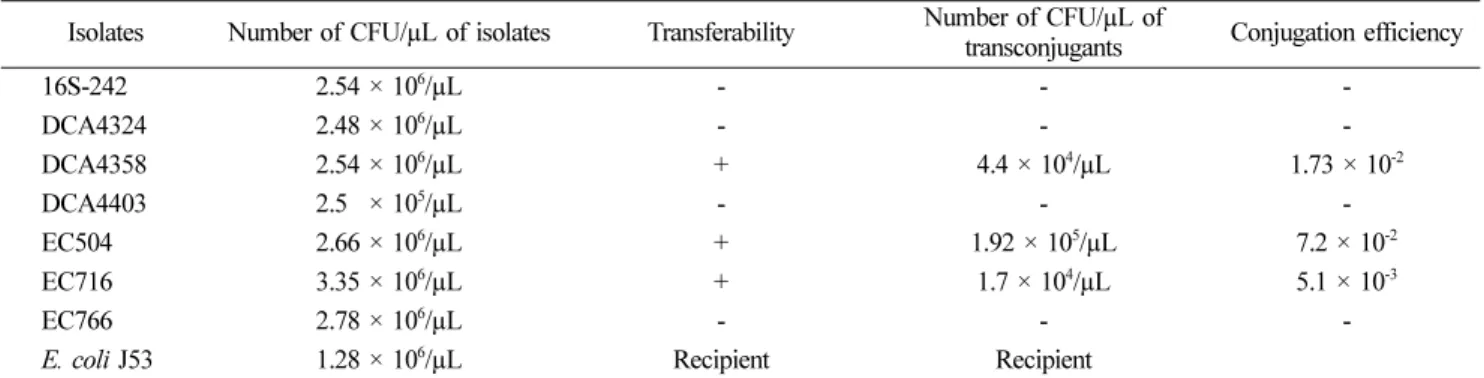
High-level amikacin resistance (MIC ≥ 512 µg/mL) was observed in 7 (1.1%) of the 636 assayed E. coli isolates. Of the investigated 16S rRNA methylase genes, only rmtB was detected in all 7 isolates, whereas all the isolates tested nega- tive for the armA, rmtA, rmtC, rmtD, rmtE, and npmA genes (Table 1). The conjugation assay results confirmed the suc- cessful transfer of amikacin resistance to 3 of the 7 rmtB-pos- itive isolates by conjugation to the azide-resistant E. coli strain J53. The presence of the rmtB gene was confirmed by PCR in 3 of the transconjugants, which showed the same resistance profiles for amikacin (MIC ≥ 512 µg/mL) as the donor isolates (Table 2). The three transconjugants were selected with amikacin at a conjugation frequency of 1.73
× 10−2 to 5.1 × 10⁻³ (number of transconjugants divided by the number of donor cells) (Table 3).
In addition to impermeability and multidrug-active efflux systems, the primary mechanism of aminoglycoside resis- tance involves modification of the target region by enzymes that are collectively known as aminoglycoside modifying enzymes (AMEs) [3]. We previously reported that commen- sal E. coli isolates from food-producing animals in Korea have a tremendous ability to harbor and transfer AME genes [15]. More recently, 16S rRNA methylases have become an important public health threat due to their ability to confer high-level and broad-spectrum resistance to most clinically relevant aminoglycosides [9]. To the best of our knowledge, we here report for the first time a molecular epidemiological based investigation of 16S rRNAmethylase gene, rmtB, car- rying E. coli strains in Korea. All 7 rmtB-carrying isolates
Table 1. MICs, phylogroups and antimicrobial resistance gene profiles for amikacin-resistant Escherichia coli isolates of animal origin from South Korea collected between 2015 and 2017
Isolates Year of isolation
Phylogenetic
group Origin Amikacin MIC 16S rRNA
methyltransferase gene Other resistance genes
16S-242 2016 D Pig ≥ 512 µg/mL rmtB TEM, aph3’-1a
DCA4324 2017 D Pig ≥ 512 µg/mL rmtB tetA, sul1, sul2, TEM, floR,
StrAB
DCA4358 2017 A Pig ≥ 512 µg/mL rmtB tetA, tetB, sul1, sul2, TEM,
cat, StrAB, aadB, aph3’-1a
DCA4403 2017 A Pig ≥ 512 µg/mL rmtB tetA, sul2, TEM, aph3’-1a
EC504 2015 A Pig ≥ 512 µg/mL rmtB tetB, sul1, sul2, sul3, TEM,
cat, StrAB, aph3’-1a
EC716 2015 A Pig ≥ 512 µg/mL rmtB tetA, sul1, sul2, sul3, TEM,
floR, StrAB, aph3’-1a
EC766 2015 A Pig ≥ 512 µg/mL rmtB tetB, sul1, sul2, TEM, cat,
StrAB, aadB, aph3’-1a
Prevalence and molecular characteristics of 16S rRNA Methylase gene 159
were highly resistant to amikacin (MIC value of ≥ 512 μg/
mL), a resistance phenotype consistent with production of a 16S RMTase.
In this study, the overall prevalence (1.1%) of 16S rRNA methylase genes in E. coli isolates was similar to that previ- ously reported in a Taiwanese study (0.4%) [16], but lower than was observed in a study from China (5.4%) [17]. Gen- erally, a low relatively low prevalence of acquired 16S RMTases has been reported, with lower prevalence rates of 1% or less having been reported in different regions of the world [18].
Although we investigated all the known 16S RMTase genes, we only detected the rmtB gene, which is the most prevalent 16S RMTase gene among Enterobacteriaceae iso- lates [4]. 16S rRNA methylase genes have been linked to other resistance determinants, such as AME genes, tet genes, blaTEM, cat, sul genes, and floR (Table 1). Our data are con- sistent with those of other studies, indicating that these resis- tance determinants are co-harbored on a similar plasmid [17].
Amikacin resistance was transferrable from three of seven rmtB-positive strains by conjugation. The MICs of amikacin against transconjugants were uniform (≥ 512 µg/mL), sug- gesting a similar expression of the rmtB gene in the transcon- jugants. PCR analyses also confirmed the presence of rmtB in three transconjugants. Similarly, a previous study showed that the rmtB gene was readily transferable to a recipient strain since the gene can be both plasmid and chromosom- ally encoded [19].
In conclusion, the prevalence of 16S rRNA methylases, while still low, is increasing and will continue to be reported
globally. Plasmid-mediated 16S rRNAmethylase rmtB gene was detected among commensal E. coli isolates from food- producing animals in South Korea. These results have a strong impact on the treatment options used in both veteri- nary and human medicine since 16S rRNA methylases can hamper the effectiveness of most clinically relevant amino- glycoside antibiotics.
Acknowledgments
This study was supported by the “the Strategic Initiative for Microbiomes in Agriculture and Food, MAFRA (No.
iPET918020-4), the Research Institute of Veterinary Science and the BK21 PLUS program, Seoul National University, Republic of Korea.
References
1. Fosso MY, Li Y, Garneau-Tsodikova S. New trends in aminoglycosides use. MedChemComm 2014;5:1075-1091.
2. Garneau-Tsodikova S, Labby KJ. Mechanisms of resistance to aminoglycoside antibiotics: overview and perspectives. Med ChemComm 2016;7:11-27.
3. Becker B, Cooper MA. Aminoglycoside antibiotics in the 21st century. ACS Chem Biol 2013;8:105-115.
4. Doi Y, Arakawa Y. 16S ribosomal RNA methylation: emerging resistance mechanism against aminoglycosides. Clin Infect Dis 2007;45:88-94.
5. Morić I, Savić M, Ilić-Tomić T, Vojnović S, Bajkić S, Vasiljević B. rRNA Methyltransferases and their role in resistance to antibiotics. J Med Biochem 2010;29:165-174.
Table 2. Antimicrobial resistance profile of rmtB-harboring Escherichia coli transconjugants Transconjugants 16S rRNA
methylase gene
MIC value (µg/mL)
AMK CAZ/CLA CAZ CTX CTX/CLA MEM
TC504 rmtB ≥ 512 0.5 0.5 0.5 0.25 0.06
TC716 rmtB ≥ 512 0.5 0.25 1 1 0.06
TC358 rmtB ≥ 512 0.25 0.5 1 1 0.06
ATCC29212# - 2 0.25 0.25 1 0.5 0.03
AMK, amikacin; CAZ/CLA, ceftazidime-clavulanic acid; CTX/CLA, cefotaxime-clavulanic acid; MEM, meropenem; ATCC, American Type Culture Collection.
Table 3. Transferability and conjugation frequencies of rmtB-harboring Escherichia coli isolates from food-producing animals in South Korea
Isolates Number of CFU/µL of isolates Transferability Number of CFU/µL of
transconjugants Conjugation efficiency
16S-242 2.54 × 10⁶/µL - - -
DCA4324 2.48 × 10⁶/µL - - -
DCA4358 2.54 × 10⁶/µL + 4.4 × 10⁴/µL 1.73 × 10⁻²
DCA4403 2.54 × 10⁵/µL - - -
EC504 2.66 × 10⁶/µL + 1.92 × 10⁵/µL 7.2 × 10⁻²
EC716 3.35 × 10⁶/µL + 1.7 × 10⁴/µL 5.1 × 10⁻³
EC766 2.78 × 10⁶/µL - - -
E. coli J53 1.28 × 10⁶/µL Recipient Recipient
160 Kuastros Mekonnen Belaynehe, Ho Geun Won, In Joong Yoon, Han Sang Yoo
6. Yokoyama K, Doi Y, Yamane K, Kurokawa H, Shibata N, Shibayama K, Yagi T, Kato H, Arakawa Y. Acquisition of 16S rRNA methylase gene in Pseudomonas aeruginosa. Lancet 2003;362:1888-1893.
7. Galimand M, Courvalin P, Lambert T. Plasmid-mediated high- level resistance to aminoglycosides in Enterobacteriaceae due to 16S rRNA methylation. Antimicrob Agents Chemother 2003;47:2565-2571.
8. O’Hara JA, McGann P, Snesrud EC, Clifford RJ, Waterman PE, Lesho EP, Doi Y. Novel 16S rRNA methyltransferase RmtH produced by Klebsiella pneumoniae associated with war-related trauma. Antimicrob Agents Chemother 2013;57:
2413-2416.
9. Wachino J, Arakawa Y. Exogenously acquired 16S rRNA methyltransferases found in aminoglycoside-resistant pathogenic Gram-negative bacteria: an update. Drug Resist Updat 2012;
15:133-148.
10. Deng YT, Zeng ZL, Tian W, Yang T, Liu JH. Prevalence and characteristics of rmtB and qepA in Escherichia coli isolated from diseased animals in China. Front Microbiol 2013;4:198.
11. Lee TH, Hwang JH, Lee WK, Shin MK, Woo HR, Chung KM, Lee CS. ArmA and RmtB were the predominant 16S RMTase genes responsible for aminoglycoside-resistant isolates in Korea. J Korean Med Sci 2018;33:e262.
12. Davis MA, Baker KN, Orfe LH, Shah DH, Besser TE, Call DR. Discovery of a gene conferring multiple-aminoglycoside resistance in Escherichia coli. Antimicrob Agents Chemother 2010;54:2666-2669.
13. Zhou Y, Yu H, Guo Q, Xu X, Ye X, Wu S, Guo Y, Wang M. Distribution of 16S rRNA methylases among different
species of Gram-negative bacilli with high-level resistance to aminoglycosides. Eur J Clin Microbiol Infect Dis 2010;29:
1349-1353.
14. Clinical Laboratory and Standards Institute (CLSI). Performance standards for antimicrobial susceptibility testing; 25th infor- mational supplement. CLSI M100-S25. Clinical and Laboratory Standards Institute, Wayne, PA: Clinical and Laboratory Standards Institute; 2015.
15. Belaynehe KM, Shin SW, Park HT, Yoo HS. Occurrence of aminoglycoside-modifying enzymes among isolates of Escherichia coli exhibiting high levels of aminoglycoside resistance isolated from Korean cattle farms. FEMS Microbiol Lett 2017;364:
fnx129.
16. Yan JJ, Wu JJ, Ko WC, Tsai SH, Chuang CL, Wu HM, Lu YJ, Li JD. Plasmid-mediated 16S rRNA methylases conferring high-level aminoglycoside resistance in Escherichia coli and Klebsiella pneumoniae isolates from two Taiwanese hospitals.
J Antimicrob Chemother 2004;54:1007-1012.
17. Yu FY, Yao D, Pan JY, Chen C, Qin ZQ, Parsons C, Yang LH, Li QQ, Zhang XQ, Qu D, Wang LX. High prevalence of plasmid-mediated 16S rRNA methylase gene rmtB among Escherichia coli clinical isolates from a Chinese teaching hospital. BMC Infect Dis 2010;10:184.
18. Doi Y, Wachino JI, Arakawa Y. Aminoglycoside resistance:
the emergence of acquired 16S ribosomal RNA methyltrans- ferases. Infect Dis Clin North Am 2016;30:523-537.
19. Yu T, He T, Yao H, Zhang JB, Li XN, Zhang RM, Wang GQ. Prevalence of 16S rRNA methylase gene rmtB among Escherichia coli isolated from bovine mastitis in Ningxia, China. Foodborne Pathog Dis 2015;12:770-777.